
Way Cool Global View of My Blog!

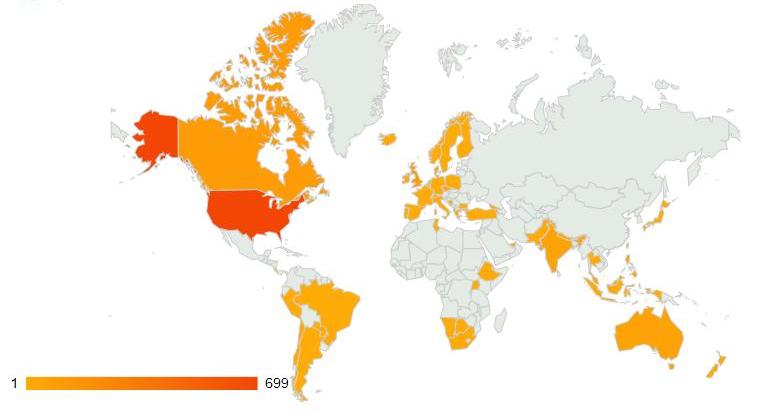
Here is a global view of the views of my blog for the last week:

As you can see, the vast majority of my blog views come from the United States, but here are the number of views I’ve had from other countries during the past week:

United Kingdom FlagUnited Kingdom 111
Canada FlagCanada 106
India FlagIndia 59
Australia FlagAustralia 55
Philippines FlagPhilippines 19
Singapore FlagSingapore 18
New Zealand FlagNew Zealand 11
Malaysia FlagMalaysia 10
Viet Nam FlagViet Nam 8
Germany FlagGermany 6
Pakistan FlagPakistan 6
Botswana FlagBotswana 6
Denmark FlagDenmark 5
Nepal FlagNepal 5
South Africa FlagSouth Africa 5
Switzerland FlagSwitzerland 5
Turkey FlagTurkey 4
Taiwan, Province of China FlagTaiwan 4
Japan FlagJapan 4
Greece FlagGreece 3
United Arab Emirates FlagUnited Arab Emirates 3
France FlagFrance 3
Lebanon FlagLebanon 3
Thailand FlagThailand 3
Finland FlagFinland 3
Norway FlagNorway 3
Georgia FlagGeorgia 2
Czech Republic FlagCzech Republic 2
Belgium FlagBelgium 2
Qatar FlagQatar 2
Iceland FlagIceland 2
Bulgaria FlagBulgaria 2
Bosnia and Herzegovina FlagBosnia and Herzegovina 2
Sweden FlagSweden 2
Hong Kong FlagHong Kong 2
Ethiopia FlagEthiopia 2
Portugal FlagPortugal 2
Russian Federation FlagRussian Federation 2
Netherlands FlagNetherlands 2
Korea, Republic of FlagRepublic of Korea 2
Jamaica FlagJamaica 2
Trinidad and Tobago FlagTrinidad and Tobago 2
Poland FlagPoland 2
Brunei Darussalam FlagBrunei Darussalam 1
Uganda FlagUganda 1
Ireland FlagIreland 1
Spain FlagSpain 1
Bahamas FlagBahamas 1
Indonesia FlagIndonesia 1
Albania FlagAlbania 1
Brazil FlagBrazil 1
Armenia FlagArmenia 1
Tunisia FlagTunisia 1
Cyprus FlagCyprus 1
Paraguay FlagParaguay 1
Argentina FlagArgentina 1
Namibia FlagNamibia 1
Peru FlagPeru 1
Chile FlagChile 1
Costa Rica FlagCosta Rica 1

There was also one view from Italy, which didn’t show up on the table for some reason.

If you have a WordPress blog, you too can see these amazing statistics for your blog. Just go to http://wordpress.com, log in, then click on the My Stats tab on the WordPress home page, then scroll down a bit to find the global stats. If you’d like to see your views by country for a week, click on summaries. Isn’t that cool?

So, where do your viewers come from?

What is the easiest part of the writing process? What is the most difficult?

The easiest aspect of writing for me is editing. The words are all there, it’s just a matter of making sure they are the right ones and that they say what I want them to say. The most rewarding is knowing I wrote a book worth reading. People tell me they really enjoy Daughter Am I, that they “hate saying goodbye to these wonderful characters.”

The most difficult part of writing for me right now is just sitting down and writing. I have no real inclination to write fiction, and I find it hard to focus on a long project. I’m sure the desire will come back, probably when I stop spending so much time on the Internet.

Here are some responses from other authors about the easiest and hardest parts of the writing process. The comments are taken from interviews posted at Pat Bertram Introduces . . .

From an interview with J J Dare, Author of False Positive and False World

The easiest part of the writing process is inspiration. When it’s there, the words flow like a raging river. If the story is in my head and I’ve been tapped by my muse (and she stays with me), I can write a novel in a week.

The hardest part of the writing process is inspiration. When it’s not there, it can’t be faked. Constipated writing can be unbearable.

From an interview with Dale Cozort, Author of “Exchange

For me, the easiest part is writing the rough draft. Once I have characters and a plot outline I can write the rough draft of a novel in four to six weeks and I enjoy doing it. What happens before and after writing the rough draft is far more difficult and time-consuming.

The most difficult part is the last five percent of the editing process, the part that gets you from almost the right words to exactly the right words. For me that takes more time than writing the rough draft.

From an interview with A. F. Stewart, Author of Once Upon a Dark and Eerie

For me, the easiest element of writing is the dialogue. I rarely have a problem with the flow of dialogue. Possibly because I can hear all those character voices whispering in my head.

The most difficult part is writing the middle section of the plot. I’m great at churning out beginnings and endings, but I always have to work at writing the stuff in between.

So, for you, What is the easiest part of the writing process? What is the most difficult?

(If you’d like me to interview you, please check out my author questionnaire http://patbertram.wordpress.com/author-questionnaire/ and follow the instruction.)

Excerpt From “Grief: The Great Yearning” — Day 3

So many people have told me lately that I should write a book about grief, that I realized somehow I’m not getting the point across — I did write a book about grief, and it is now published.

I never actually set out to write a book, never planned to make any of my writing public (except for the blog posts, of course), but I was so lost, so lonely, so sick with grief and bewildered by all I was experiencing, that the only way I could try to make sense of it all was to put my feelings into words. Whether I was writing letters to my deceased life mate/soul mate or simply pouring out my feelings in a journal, it helped me feel close to him, as if, once again, I was talking things over with him. The only problem was, I only heard my side of the story.  He never told me how he felt about his dying and our separation. Did he feel as broken as I did? Did he feel amputated? Or was he simply glad to be shucked of his body, and perhaps even of me?

People always mention how my pain shines through my words, yet at the beginning, I was in such shock, I didn’t feel much. Two years later, I still miss him, still hate that he’s dead, though I don’t have the physical trauma that I did, and I have regained some of my energy. It truly shocked me how exhausting grief is, but then, most of what I experienced shocked me. I never expected to feel this sort of grief. Never knew it was possible.

Excerpt from Grief: The Great Yearning

Day 3, Grief Journal

This was a hard day, though I don’t suppose any of them will be easy for a while. It’s amazing how little energy I have. I can’t do much at all. Today I rewound some of Jeff’s video tapes, the ones we watched toward the end. Perhaps tomorrow I will find the strength to put them away.

The hospice nurse came and got rid of the drugs. (Dumped them in a plastic bag of kitty litter, which turned them into a solidified mess, and took them with her.) The medical supply people are supposed to come tomorrow to pick up the oxygen tank. It’s like I’m rewinding his life. I wish I could rewind it back to the good times. We did have good times. I know we did. But everything got so muddled at the end. All we were doing was struggling to survive.

I can’t believe there was ever a time I wished the struggle were over so I could start my new life. How could I not have known I’d feel such pain? I heard today that losing a long-time mate was like an amputation, and that’s exactly what this feels like.

Good, bad, indifferent—it was all the same. We were together. We took care of each other. And now he’s been amputated from me and my life.

I got furious on his account today. It’s so unfair that he had such ill health, that his life ended too soon and too terribly. It seems unreal, now, that we took for granted he would die young. Shouldn’t we have railed against it more? But he was so disciplined, focusing his energies on trying to prolong his life and be productive.

I don’t know which is worse, the times I miss him dreadfully or the times I concentrate on doing something and he drifts from my thoughts. It seems such a betrayal. If he only exists in my memory and I don’t think about him, it’s as if he’s dying again. And once was hard enough. It takes my breath away when I realize I will never talk to him again. Well, I will talk to him, and I do, but we will never converse. I will never hear his voice.

I thought I was through telling people our sad little tale, but I’ve remembered a few others I have to notify about his being dead. I hope I don’t start crying when I talk to them. I’m tired of crying, tired of feeling sick to my stomach, tired of the hole in my chest. How do people endure such grief for months on end? I truly hate that he’s gone. Hate it!!

***

Click here to find out more about Grief: The Great Yearning

Two Years and One Day of Grief

Today I embark on my third year of grief since the death of my life mate/soul mate, and I am now in uncharted territory.

The first year of grief passes in a blur of angst, emotional shock, myriad physical reactions, painful surprises about the nature of loss and grief, and the almost impossible effort of going through the chores of living.

The second year of grief is one of learning to deal with the truth that he is dead, and that there is nothing you can do about it. No matter how well you deal with your grief, no matter how you rise to the challenge of life without him, he is not coming back. You knew this, of course, but now it has seeped deeper into your consciousness, and you feel it with every breath you take. Because of this, the second year (or at least parts of it) can be worse than the first. What makes the second year even harder to face is that you’ve used your grief card. Everyone thinks you should be over your grief, and they have little patience for your continued tears. They urge you to get on with your life, but they don’t understand that this is how you are getting on with your life.

The third year of grief is . . . I don’t yet know since this is only the first day of this new year. Today feels no different from yesterday or the day before, and I don’t imagine tomorrow will feel any different.

During the past two years, I’ve been looking for the bedrock of my new life — the thing, the idea, the place, whatever that bedrock might be — that gives me a foundation on which to build a future. Mostly, I’ve been waiting for my grief to dissipate so I can find my way, but the truth is, I will always grieve for him, though perhaps not as actively as I have been, because he will always be dead.

Acceptance is supposed to be one of the stages of grief, but I’ve never actually reached that stage (nor did I experience most of the supposed stages of grief). I cannot accept that he is dead for the simple reason that it’s not my place to accept it. Acceptance to me suggests that it is okay, and I will never believe that it is okay for him to be dead (even though I do understand the necessity of it). Perhaps acceptance only means that I accept the reality of my continued sorrow and loneliness.

People tell me that you never do get over such a grievous loss, but that after three to five years you rediscover the importance of living. It might be easier to meet the future head-on if I’m not expecting my sadness to dissipate. Maybe this is my bedrock — the missing, the yearning, the sadness, the loneliness. If so, I just need to accept that they are part of my life, and build from there.

Two Years of Grief

A year ago today, my life mate/soul mate died of inoperable kidney cancer. Wait . . .  what am I saying? One year? No. It’s been two years since he died. What a strange error to have made, yet perhaps it’s understandable. The night he died is still so very clear, as if he’s been gone only months, not years.

On the recommendation of his hospice nurse, I’d taken him to the hospice care center in the hopes that they could figure out how to regulate his drugs to give him the most lucidity and the least pain. It crushed my heart to take him there. I never got to talk with him again — he was in a drug-induced coma for those last five days of his life. I think he was at peace the final two days, though. All the time he was there, his breathing sounded like moaning, and I worried that he was in pain, but during his next-to-last day he exhaled a few melodious-sounding breaths, as if he wanted to reassure me he was okay.

He once told me that if it ever came to his being in a facility, he didn’t want me to visit, but how could I not? Even though the care center was sixty-five miles away, I went there every day, but I left early enough so I could get home before dark. The irony is he agreed to go so I could get some rest, but I never did sleep those nights. I was too worried about him.

His last night, Friday night, I didn’t go home. A few snowflakes fell and I used that as an excuse to stay. Also, I was restless, sensing the end was near. So I waited.

Around 1:30 in the morning, his breathing changed. Became harsher. I went to his side, said it was okay for him to leave, that I would be all right. At 1:40, he took a breath. His Adam’s apple bobbed once. Twice. And then he was dead. I kissed him by the side of his mouth. Waited a few minutes before I went to get the nurse.

I like that I got to tell them he was gone rather than have them tell me.

The nurse confirmed that he was gone. She called the funeral home, and I sat there in the room with him for two hours, just waiting. I might have cried. I might have been numb. I don’t really remember. I couldn’t even see his face — they had cleaned him and wrapped him in a blanket — so I just sat there, thinking nothing until almost dawn, when they came for him. (They came in an SUV, not a hearse. And they used a red plush coverlet, not a body bag.)

I followed them outside, watched them put him in the SUV and drive away, then I left. The highway was dry, but about halfway home, I skid. (I must have hit a patch of black ice, because there was no indication that patch of road was any different from what I’d already traveled.) I went careening, around and around, back and forth, my car totally out of control. I thought I was going to die, but oddly, I never left the road. The car finally came to a halt facing the wrong way on the highway. I was fine. So was the car. I remember wondering if he had stopped by on his way out of this world to leave me a final reminder to be careful, or maybe he was shaking his ghostly head, thinking that after his being gone only two hours, I was already getting careless.

He always worried that I wasn’t careful enough. I’m trying to be careful. Trying to take care of myself. I hope he’s taking care of himself.

The past two years have been agony for me. I know there was no way he could have continued to live considering the vast extent of the tumors. I know death was the only way to set him free from his excruciating pain. When he died, I truly was relieved. And yet . . . he was my best friend, my playmate, my business partner, my life companion. He was the one person who listened to me, who was always there for me. (As I was for him.) Even though I can see the necesssity of his death, I hate that he’s gone from this earth.

Not one of the previous 731 days have passed without my missing him. Even as I go on with my life, even as he and my grief recede further from me, I will continue to miss him. He was a good man. The earth is poorer for his death.
Grief — Two Years Minus Five Hours

In five hours, it will be exactly two years since my life mate/soul mate died of inoperable kidney cancer. He and I shared so much that even as I am getting to where I can accept the situation, even accept that I might find peace or possibly happiness, I can’t forget that it’s at his expense. I wonder what this feels like from his perspective. I know he wants me to go on, to get what I can from life — he told me that — but still, where is he in all this? At some point, our separation has to be complete, doesn’t it? I have to realize that whatever I say or think or do has no affect on him — it can’t change anything that happened. It can’t bring him back. And I don’t want him back — his death was too hard-won.

Iron Sam, the dying hit man in my novel Daughter Am I, told my hero Mary that a person experiences death only once. Well, my mate’s dying was my experience of death. The utter undoableness of it — the finality — shocked me to my core (and still gives me that falling-elevator feeling of panic when I think of his being dead). That shock must be what can only be experienced once. A prognosis of my own death probably won’t have the same impact on me as his diagnosis. Will I have his strength, his courage? I won’t have him, and that might not be a bad thing. Maybe my death will be easier to handle if I know I’m not going to devastate anyone when I go. (I think about that, how hard it must have been on him to know he wouldn’t be here to comfort me after he was gone.)

People always talk about finding someone to grow old with (and oh! I so do not want to grow old alone), but I’m not sure growing old with someone is a blessing. Lately, I’ve been seeing a lot of very old couples (this area is filled with hospitals, doctors offices, oncology clinics, pain treatment centers, nursing homes) and I try to imagine what it would be like for the two of us to deal with each other’s old age infirmities. I’m glad he’ll be spared that. It was hard enough for him to die without having to worry about my dying, too.

I wish he were waiting for me on the other side of grief so we could start a new life together, and in a way he will be there — he is still so much a part of me. Maybe literally a part of me. If we’re all made of stardust, if everything is commingled, how much more commingled are we who spent so many decades in each other’s company! The biorhythms of people who live together ebb and flow in sync. Benign and not so benign viruses carry cell information from one to the other, intermingling physical bodies on a cellular level. As one of my fellow bereft reminded me yesterday, “The heart puts out an electrical field which is measurable and it intertwines with the electrical field of the other loved one and when that is gone, the body knows it and feels the loss.”

I’ve heard that every seven years a person’s cells completely turn over, so that in seven years you become a different person. In seven years, then, maybe I won’t feel such yearning for him since he will no longer be written into the fabric of new cells. But beyond the physical commingling, there are all the movies we watched together, the books we shared, the thousands upon thousands of hours of electric conversation, the ideas we developed, the businesses we created — all those are part of me.

But  there is so much that will never be part of my life again. His smile nourished my soul, his laughter warmed my heart, his voice soothed my ears, his wise counsel eased my mind.

How have I survived such enormous losses? One day a time, that’s how. Sometimes one tear at a time. And so two years (minus five hours) have passed.

Still Confounded by Grief

For two years, my reaction to the death of my life mate/soul mate has bewildered me. I knew he was dying and I’d spent over a decade preparing myself for that eventuality. I thought I’d accepted the inevitable, but now I see I was merely resigned (and perhaps exhausted). Still, I am independent-minded, always have been. I know how to do things on my own, know how to entertain myself, know how to take care of myself. I’ve never been afraid of being alone, never been one to hide behind pretty lies or protective fantasies. And yet his death devastated me as much as it confounded me. In fact, after almost two years (two years minus two days, to be exact; 729 days) I still feel lost, still feel broken.

Not all deaths affect people the same. My mother died three years before my mate, and my brother died a year before that. My grief for them was what I used to consider “normal.” I missed them and felt bad that they were gone, but my life went on without any major upheavals. But when my mate died, it was a cataclysm, affecting every part of my life. And the strong connection we always had, a cosmic-twin sort of connection, was broken.

The day before my mother’s funeral, I broke my ankle, so I spent her viewing at the emergency room and I spent her funeral at the bone specialist. It turns out that what I had was a very bad sprain, so bad that when the ligaments tore away, they cracked the bone.

I realize now this same sort of thing happened when my mate died. Whatever connection we had was so strong that when he was torn away from me and our life, it fractured me. This fracture had nothing to do with my being weak or too dependent on him or unwilling to face the truth or any of the other snide rationalities people have made about my sorrow. However deep and prolonged, my grief for him is normal and understandable. It takes a long time for a broken bone to heal and regain its former strength. How much longer must it take when one’s psyche has been broken.

And so, I still deal with the fracture his death caused in me, and I still deal with the bewilderment of his death. Perhaps when he died, he took a chunk of me with him, the same way bone still adheres to torn ligaments, and so part of me would be wherever he is, if he is. His death felt like an amputation, and I can no longer feel that part of me where we were attached. Some people still feel connected to those who are gone, but I never do. I merely feel his goneness, his absence, which seems as strong as his presence once did. And I still feel fractured. Still feel lost. Perhaps to a certain extent I will always feel this way, because the cause of this loss, his being dead, will always be a part of me. And that is one truth I wish I didn’t have to face.

Anniversaries of Grief

I don’t know why certain anniversaries loom so large in our lives, but for whatever reason, the anniversaries of grief are immense. At the beginning of my grief over the death of my life mate/soul mate, a minister friend told me that always on the anniversary, even if I’m not consciously aware of the date, I will feel an upsurge of grief. This is only my second anniversary, with perhaps dozens still to come, but I can already see the truth of his words. Grief comes from somewhere deep within, somewhere deeper than thought, somewhere deeper than volition. And it keeps track of time.

People who have not experienced a grievous loss often think that grief is a choice. Sometimes, especially when young children are involved, the remaining parent can put off grief to focus on the childrens’ needs, but still, grief will surface at the anniversary. Later in life, this grief will surface again, perhaps when the last child leaves home, or when a beloved pet dies. I know a woman who went from taking care of a dying husband to taking care of her aged mother. She didn’t grieve after the death of her husband because of this new focus, but the death of her mother about destroyed her. For most of us, though, grief cannot be denied. We embrace it or it embraces us, and we reap the whirlwind.

This anniversary phenomena does mystify me, though. I’ve been experiencing a devastating grief upsurge, and yet nothing significant happens on the anniversary to count for all the sorrow. In fact, if last year is anything to go by, the day itself will be peaceful, bringing with it a quiet gladness that he was in my life. But the anniversary is not the end of anything. In fact, it is the beginning of something even worse — the beginning of another year without him. Another year where he is dead. Another year of trying to build a future on the ashes of our shared past.

The worst thing, of course, is that I’ve had two years of living in a world where he does not exist. The sheer goneness of him builds rather than dissipates. He is more gone now than he was two years ago, and next year he will be even more gone. Apparently, one can get used to anything, so eventually I’ll simply get used to the feeling of emptiness he left in the world, perhaps even learn to look beyond the blank space on Earth he once inhabited.

I hope, of course, I will be able to find a new life. Or do I mean a new focus? Because, of course, this is my life and always has been. It was my life before I met him, it was my life while we were together, and it is still my life, as alien as it feels. And as much as I hate that he is dead, as much as I fight the idea that I am still alive, the truth is that he is, and that I am.

Counting Down to the Second Anniversary of Grief

I’ve been on a grief hiatus for a few months — no major upsurges of grief — but yesterday, for no apparent reason, I started crying, and I’ve been crying on and off ever since. I’ve been trying not to think of the upcoming two-year anniversary of my life mate/soul mate’s death, trying to look ahead to the future, trying to find something to be passionate about (or at least something to hang my life on). Despite the exhaustion of attempting to put a good face on the seemingly bleak future, I thought I’d been doing well.

And then came the tears.

It still surprises me that the body remembers even when the conscious mind doesn’t. I’d forgotten that yesterday was the two-year anniversary of the last time we talked, the last time we were together in our home, the last time we touched. But something deep inside, something beneath thought, remembered. And grieved.

Two years ago yesterday, the hospice nurse expressed concern for us. I hadn’t slept in I don’t how many days, and neither had he. Some people, as they near death, suffer from what is called terminal restlessness. In his case, the rapidly growing tumors, his impossibly fast heart rate, the morphine, and various other factors made it impossible for him to be still. He wanted/needed to be on his feet, moving, always moving. And since he was too weak to be left alone, I would pace with him.

That last morning at home, the nurse suggested that he go to the hospice care center for a five-day respite, and he and I agreed. He knew I needed sleep (though ironically, I got very little sleep those days) and I thought they would adjust his dosages to give him the most alertness and the least pain. But they never tried. They dosed him with tranquilizers to keep him in bed, and he never had another moment of consciousness.

Those days were exactly two years ago. And I remember them as clearly as if they were happening now. I watched him die. I was there at the end. As agonizing as that was, I know there are worse things. I might not have been there when he took his last breath. I might not have witnessed the very moment he left my life. I might not have been able to say good-bye. Unlike many bereft, I don’t have to deal with those regrets.

For a long time I regretted taking him to the hospice care center — I felt as if I’d deprived him of one more day at home, one more day of lucidity, but in the end, I suppose there was no other choice. He’d stopped being able to swallow, the morphine made him disoriented, and the tranquilizers they prescribed to stop the terminal restlessness made him delusional. I’m glad he doesn’t have to deal with his body any more, but oh, I so wish I could see him once more, or talk to him on the phone, or go back to his store where we spent so much time when we were young and new.

I hope death feels better from the other side than it does from this side, because the only thing that brings me peace is the belief that he is no longer suffering. It’s strange to think that the very moment his suffering ended, mine began. I never expected to grieve. He’d been sick for so very long that his death came as a relief, but when the truth hit me, it hit with the force of a cyclone. And two years later, I am still whirling from the pain.

Choosing Book Titles

The title of a book is important. It’s the first thing a prospective reader sees . . . or at least it used to be. Now the author’s name generally comes first and apparently is a much better selling tool than the title ever was. A title is still important, however. It often sets the mood for the book, it lays out the theme, and it tantalizes readers into opening the book. Think of Gone With the Wind. With such a title, you expect a wide sweep of a story. The title speaks of loss and perhaps survival in the face of broad changes. Even before you open the book, you are primed to find out what is lost and why it disappeared into the wind. Imagine then, how different your feeling would be if the book had been published under its working title. Pansy. Would the book, the movie, the character have ever had such an impact if that had been the name? Of course not.

Another major work with last minute name changes was Catch 22 by Joseph Heller. Originally Catch 18, it was changed because of another book that was coming out at the same time: Leon Uris’s Mila 18. And 1984 was originally 1948. So not the same feeling!

Choosing a title is not an easy task. My novels all had simple working titles: The Red Death, The Chameleon, The Gangster Book, The Alien Book, but except for The Red Death, none of those titles were ever possible for the real title.

For A Spark of Heavenly Fire, I considered using the title The Red Death since my quarantine mirrored the middle ages, though in a hi-tech way, but the name had already been used several times. And anyway, from the very first, I’d planned on using A Spark of Heavenly Fire. That was my inspiration for the book, the Washington Irving quote: “There is in every true woman’s heart a spark of heavenly fire, which lies dormant in the broad daylight of prosperity; but which kindles up, and beams and blazes in the dark hour of adversity.” I wanted to tell the story of ordinary women, women who seemed colorless in ordinary times, but who blazed brightly in dark times. When I found no takers for the book, I thought perhaps the title didn’t reflect the story, so I changed it to In the Dark Hour. And I got an agent. She couldn’t sell the book, so when my contract was up, I changed the title back to A Spark of Heavenly Fire. And that’s the title Second Wind Publishing released it under.
I had to try several times before I got the title of More Deaths Than One right. The working title was The Chameleon but that was never a real contender since I didn’t want to give the story away. So first I used the Law of the Jungle, which amused me since the jungle was so much a part of the story. Also, at one point I had my hero say that the villain might be above the law, but he wasn’t above the law of the jungle. Both the line in the book and the title ended up being deleted because they were too trite, so next I went with Nature of the Beast. It was adequate, and I would have stuck with it despite its triteness, but then I came across a couplet from Oscar Wilde’s “Ballad of Reading Gaol”: He who lives more lives than one/More deaths than one must die. Since my hero appeared to have more lives (and deaths) than one, More Deaths Than One struck me as the perfect title.
Daughter Am I, my gangster book, only had one previous title: Sins of the Fathers, though really it should have been Sins of the Grandfathers. Then I found the Rudyard Kipling quote: “Daughter am I in my mother’s house but mistress in my own.” The quote would have more accurately described the theme of the book if it were “daughter am I in my father’s house,” but I was taken with the title Daughter Am I and decided it was close enough.

Which brings me to my most recent novel, Light Bringer. Sad to say, I haven’t a single story to tell about the title. Even though the working title was The Alien Book, I always knew the title was Light Bringer. Light is the theme of the book, and the Light Bringer (planet X) was the reason for the story.

So, as a reader, what are your favorite titles? As an author, how did you come up with the names of your books?