The Perfect Road Trip

Daily writing prompt
How do you plan the perfect road trip?

The perfect road trip, obviously, is the one that’s perfect for you, so my experience might not be applicable. For one thing, I had years to plan since I was taking care of my aged father at the time and couldn’t take off even if I had wanted to. For another thing, grief still lay heavily on me, so I wouldn’t have enjoyed the trip even if I could have taken off. For yet another thing, it was great having such a long time to plan because a big part of a road trip is in the planning.

And the not planning.

I had originally wanted to do an epic hiking trip, such as one of the long trails or a walk across the country or anything that would take me out of myself and perhaps change both me and the trajectory of my life. When it turned out that I couldn’t do an epic hike (too much water to carry and not enough stamina), I decided to walk across the country my own way by driving from campsite to campsite and from hiking trail to hiking trail. That way, I got the feel of a lot of different places as well as the feel of a doing a long hike without actually hiking the whole way.

Once I’d decided on the project, then it was time to decide what gear I needed for where I wanted to go. Since I left in February, my itinerary was obvious — along the southern edge of the country. Then, since I had no camping supplies, the next step was to research what I needed. I had a lot of backpacking equipment in preparation for the backpacking hike that never happened (except for one overnight hike and hundreds of day trips), but no car camping gear, such as a livable tent and heavier clothes. I of course posted all this preparation online, and some people found it amusing to watch what I was doing. I suppose it was amusing, my buying for a camping trip when I’d never camped before, especially since I might not even have been able to go on the long trip. But the preparation was important to me regardless of what might have happened in what at the time was an unforeseeable future.

I knew a lot of the spots where I wanted to stop — mostly national parks and national monuments, but also people I wanted to visit. (Many of my online friends volunteered to host me. Offline people warned me about going to stay with people I’d never met face to face, but in every case, the person I met in real life was exactly what they were like online, so it felt like what it was — a continuation of an established friendship.) I also left a lot unplanned because I didn’t want to keep to a strict schedule and I knew there would always be tantalizing vistas and advertisements along the road to drag me off course.

I was lucky; since I had no home at the time (my father had died, the house sold, and I had yet to decide where I was going to live), the trip didn’t have to be a quickie affair. In fact, I was gone almost six months. I might never have returned, but I had promised to do a dance performance, which put me on the clock, but it was still a lengthy trip. All the preparation helped make the whole adventure easier, including the “not planning” I mentioned above. As I travelled, people I didn’t know but who knew me through my grief blogs, invited me to stop by, which added surprising twists to my journey. In one case, a woman I met at a campground invited me to visit, and I decided what the heck, and that had surprising twists in a different way since I felt as I’d stumbled into a Southern Gothic story. Whew! I was never so glad to set on down the road.

I also didn’t camp as often as I’d planned because some of the campgrounds were closed or they didn’t feel right, or they were too full or too empty, but that’s where the money I’d set aside for a motel fund came in handy. As I’d learned, always plan for a change of plans.

If you can’t take a road trip and wish to do one vicariously, you can follow my trip here: Road Trip 2016 | Bertram’s Blog. It truly was a remarkable experience, both the road trip itself and the fun of planning it.

You can also plan a road trip without ever intending to go anywhere. Pick a route, follow along the road with Google maps or — heaven forbid! — a paper map, then see what photos and information you can find. With all the online resources available, there is a lot you can see in the palm of your hand.

Oh, I almost forgot — the most important thing when planning the perfect road trip? Having fun!

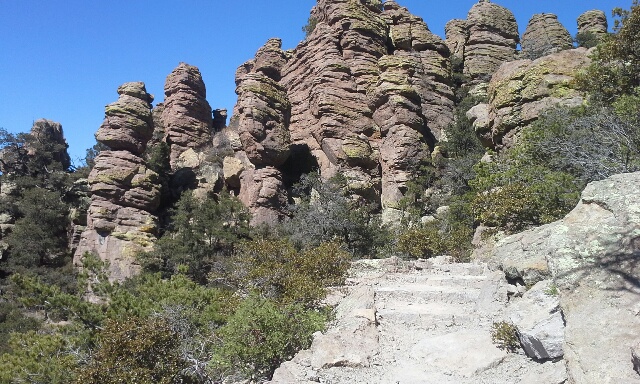
Chiricahua National Monument

***

Pat Bertram is the author of Grief: The Inside Story – A Guide to Surviving the Loss of a Loved One
The Camping Life

Daily writing prompt
Have you ever been camping?

The summer before my epic cross-country trip, I lived in a friend’s camper in Northern California where I could tramp along the coast and hike the redwood forests. Although most people call this camping, to me I was simply living in a tiny house and enjoying the environment that was so different from anything I’d experienced before. (And enjoying the friendship, of course.)

The other end of the camping spectrum is “cowboy camping” — out in the wilderness with no roof over your head except the Milky Way and so many stars you wouldn’t believe. Although the romanticism of that appealed to me, the physical sensation of being out alone and vulnerable in that vastness seemed too intimidating, so I never did it.

I did camp in a tent, though, which seemed, Goldilocks-like, to be perfect, falling as it does somewhere between a tiny house on wheels and an infinite roof overhead.

I loved tent camping. Like most of my adventures, people kept telling me I couldn’t do it — I was too old, it was too dangerous, too many things could go wrong — but that didn’t deter me.

The first night I camped out was the first night of my cross-country trip. I’d practiced setting up the tent, so that wasn’t a problem, though it was a bit awkward since the tent was a six-footer. (I got a big one because I wanted to be able to stand up. And it was on sale.) I had a folding lounge chair big enough to sleep in since I wasn’t sure I could sleep on the ground, and all sorts of other comforts, including the main one — a restroom within walking distance.

I woke in the middle of the night to use that rest room. By the time I got back I was wide awake, so I lay on the top of the picnic table and drank in the stars. Eventually, I went back into the tent and finished the night in my cozy pallet on the ground.

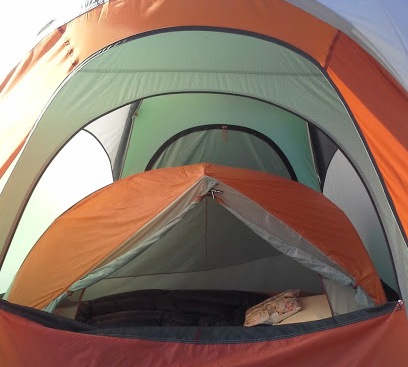
I learned a lot about how to be comfortable in that tiny space. I spent most of my time outside, of course, so it was only at night and in the heat of the day that I sought shelter. A few nights were frigid, and I couldn’t get warm, so I opened my backpacking tent inside the larger tent, and soon became warm enough to sleep comfortably.

During that trip, I camped in deserts, mountains, forests, near swamps and lakes and on a beach. Each campsite was special. Each experience was exquisite. Each person I met was an instant friend. One slightly older woman had gone to the same high school I did, which made us even instanter friends. She was a retired teacher whose retirement funds didn’t stretch enough for a conventional life, so she spent most of her time on the road, living in her tent. Although campers were only allowed a two-week stay, she’d been there almost a month. There were few campers during that February, and so they let her stay.

I considered doing what she was doing, and if I hadn’t lucked out on buying a house, I might have lived the camping life, though to be honest, as much as I loved camping, I’m so much more comfortable living in a stationary house with a roof and heat and running water and my own bathroom.

I didn’t camp every night during that trip. Most often I was with friends, who treated me royally. Occasionally I spent nights in motels, especially if the weather was bad or I was tired or there weren’t any nearby national parks. (I did stay in a couple of state parks, but so many were almost as expensive as a motel that it didn’t seem worth it.)

I still have that oversize lounger. Maybe this summer I’ll drag it out and sleep under the stars. Or not. Although it’s a nice thought, second thoughts remind me that mosquitos, skunks, and other denizens of the night aren’t so nice.

It’s funny — sitting here writing this, I know I had all those adventures, but they seem as if they happened to someone else, as if I’d just read myself into some fictional character’s life — a character who is spontaneous and adventuresome and courageous, all things I’m not.

Except, apparently, I am those things. Or at least I was.

***

Pat Bertram is the author of Grief: The Inside Story – A Guide to Surviving the Loss of a Loved One

Risky Behavior

Daily writing prompt
When is the last time you took a risk? How did it work out?

The risks I take nowadays are nothing I would have considered risky in my younger days. The most dangerous risk I took recently occurred a few months ago when I climbed a ladder to replace my smoke alarm batteries. The risks of such a venture for older folk are real. If you fall when you’re young, you get up, brush yourself off, and continue as if nothing happened. If you fall when you’re old, it could change your life since breaking a hip or some other body part makes living alone problematic.

Luckily, I managed to change the batteries without mishap. Will I try to change the batteries again? I don’t know. Most people I know who would help are as old as I am or even older, and those I know who can still climb ladders are people I’m uneasy about having in my house. I’m not scheduled to change the batteries again for a few months, so maybe I’ll meet someone young enough or tall enough who will do it for me.

Other risky behavior is not something I can avoid by having someone else do it. Getting out of bed in the morning, for example. Sounds silly, doesn’t it? But the truth is, many older people stand up too quickly, get dizzy, and end up falling. Or they are awakened by their alarm clock, get disoriented, and get up without pausing to orient themselves. Such silly things to be so dangerous! I’ve gotten in the habit of sitting on the side of the bed for a minute before rising, which does mitigate the danger, but still, it’s a very real risk.

Even sillier, though perhaps not as dangerous, is staying in bed. Gravity works to pull joints out of whack, loosens ligaments, and does other nefarious things. I never had problems with my knees until I got up one day a few years ago and could barely walk. It took months of rest, ice, heat, and the proper exercises to get me walking again. I’m still not back to where I was. Even though I’m careful when I’m awake and careful about how I position myself in bed, I can’t control what happens when I am asleep.

I’m not even going to get into the whole shower thing, which is perhaps the most dangerous activity people can do. I’ve minimized the risk with a step-in shower and railings, which help. And so will the bath chair I can see in my future.

I suppose working in my garden could be classified as a risk because the last couple of times I’ve fallen have been when I was outside working. Somehow, garden work doesn’t seem to be as dangerous as the risky behavior listed above, but being outside, especially when I’m concentrating on something other than where I place my feet, has its perils.

Life sure does narrow when one gets older! Still, we all take risks anyway because there’s no other choice. The best we can do is to be careful and to pay attention to what we are doing.

***

Pat Bertram is the author of Grief: The Inside Story – A Guide to Surviving the Loss of a Loved One.

Cross Country Risks

Yesterday I wrote about my cross-country trip. As important as that journey was to me, I’ll ever do anything like that again, not just because my car and I are ten years older, but because risks I took back then could now land me in jail. Well, one particular risk could.

When Jeff and I traveled together and stopped at a truck stop to fill the car and unfill us, we found the difference in the use of male and female restrooms to be staggering. In a lot of cases, both had a single stall, which didn’t take in the reality that women needed longer in the little room. Or perhaps there were more women needing them. Whatever the reason, there were always long lines of women waiting their turn and generally no men. So one day, Jeff suggested I use the men’s room while he stood guard. I was in and out quickly, and despite my nervousness at having done something wrong, it all worked out. The women I passed on my way out, looked at me, looked at each other, looked at the men’s restroom, and suddenly there were two lines of women waiting for both restrooms.

When I traveled alone after he was gone, I continued to sail past long lines of women if there were no men waiting, and head directly to the men’s room. I figured that even if someone noticed, they would prefer my misuse of the restrooms to a puddle on the floor for them to clean up.

There was only one time that I met a man as I was coming out of the room, so I looked back at the designation on the door, shrugged sheepishly, and said, “Sorry.” (Occasionally, it truly was a mistake. When people got too cute about the male and female signs, sometimes it was hard to figure out which was which.)

What once could have gotten me a nasty look now could get me arrested.

When the debate about who can use what restroom started, I thought about those single side-by-side rooms and wondered why men would want to use the women’s restroom. Obviously, they never traveled much because who would want to wait in a long line of jittering women desperate to go when there was a perfectly usable room right next door. (Besides, the solution in those cases was easy — change the signs so that anyone could use either.) Admittedly, there were often several stalls in some restrooms, but there weren’t long lines at those stops, so it wasn’t an issue for me, though I can see where it would be an issue for others. New laws in some states now demand you use the restroom that matches your biological gender, and of all the risks I imagined while traveling, I’d never once considered having to stand before a judge and admit guilty to an overfull bladder.

Hmmm. Do I really want to post this? It’s not something I’ve ever talked about with anyone, and in fact, it’s a bit embarrassing, but what the heck. It’s not the most embarrassing thing I’ve ever posted, or the worst thing I’ve ever admitted, but at least the picture of my garden is pretty.

***

Pat Bertram is the author of Grief: The Inside Story – A Guide to Surviving the Loss of a Loved One.

No Regrets

Daily writing prompt
Describe a risk you took that you do not regret.

I don’t like taking risks. Too often I’ve seen people taking risks, such as with their investments, because as “everyone” knows, the bigger the risk, the greater the rewards. Except, of course, when those risks don’t deliver the sure thing people are expecting. Quite frankly, I’m not sure “everyone” knows what a risk is — if they don’t get the outcome their bravery at taking the risk seems to call for, then they’re shocked and they get upset. But that’s what a risk is — you take a chance, and it might work out or it might not.

In my case, I never take a risk if I can’t handle the negative outcome. Which means, I don’t take risks.

And yet . . .

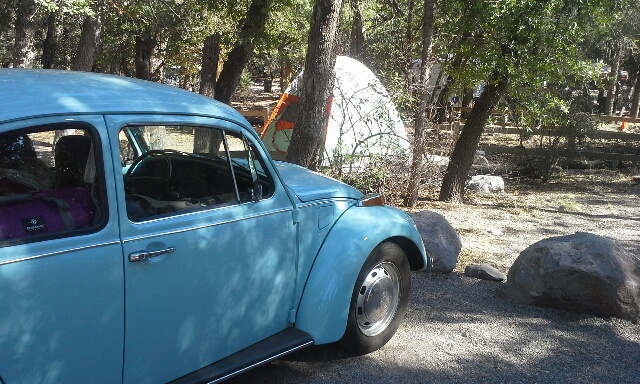
I’ve done a few things that other people considered extremely risky, though I didn’t. Ten years ago, when I planned a cross-country trip in my vintage VW bug, people were horrified and kept telling me I couldn’t do it, that it was too dangerous for me to go alone. Of course, none of those people offered to go with me to mitigate the danger, but it wouldn’t have mattered. The point was for me to do it by myself.

I wasn’t foolish about the trip. I had my car restored, a new engine put in, bought reliable camping equipment, and stocked up on emergency supplies for when unexpected and perhaps dangerous things might happen. And dangerous things did happen, but I handled whatever came along. To me, it was all part of the adventure, that willingness to go wherever the road took me and to live with the uncertainty (and consequences) of each day. Even more than that, it was a way of reclaiming my life after the death of both Jeff and my father. (After Jeff died, I was left homeless, so I went to take care of my father, and after he died, I was left homeless again.)

Perhaps the trip was a risk, but I didn’t see it as such. I wouldn’t do a long trip again, though just writing this I think maybe . . . someday . . . Still, the car is ten years older, as am I, and I’m not willing to put myself in the danger a trip could bring, not just the driving danger, but the uncertainty of the situations I might encounter — the USA isn’t the same as it was ten years ago, and even back then there were times I wasn’t sure what country I was in.

Besides, I’m homeful now, not homeless, so there is a lot more at risk than there was a decade ago.

Another risk I took was when I bought this house sight unseen. I’d seen photos, of course, and had an inspector check out the house, but I never saw it as a risk. The way I figured, it was my house, and I’d do whatever needed to be done. Other people were appalled at what they thought was my lackadaisical outlook, and the realtor made me sign a document absolving her of any responsibility if things didn’t work out.

I don’t regret either of these risks. Both worked out, but however they would have worked out, they would have worked out. I’m just glad, and so very thankful, to have had both these experiences.

Nope, no regrets at all!

***

Pat Bertram is the author of Grief: The Inside Story – A Guide to Surviving the Loss of a Loved One.

Being Silly

Daily writing prompt
Describe something you learned in high school.

In high school, specifically the first couple of years, I learned to be silly. I’d always been serious, spending whatever time I could manage with a book, but then things changed. I changed.

I went to a high school where I knew only a couple of people, and we were in different classes, so I no longer carried the burden of eight years of being a social outcast. It was freeing, to say the least.

One friend I made seemed to bring out the silly in me. Our high school had a long, straight hand rail on the steps leading to the building, and one day we decided to slide down the banister. Unfortunately, it wasn’t slick enough. So the next day we brought some wax paper, which brings me to another thing I learned in high school — wax paper is a good polisher. After we polished that railing, we went sailing! I don’t remember if we got in trouble or not, but I vaguely remember a disapproving frown or two.

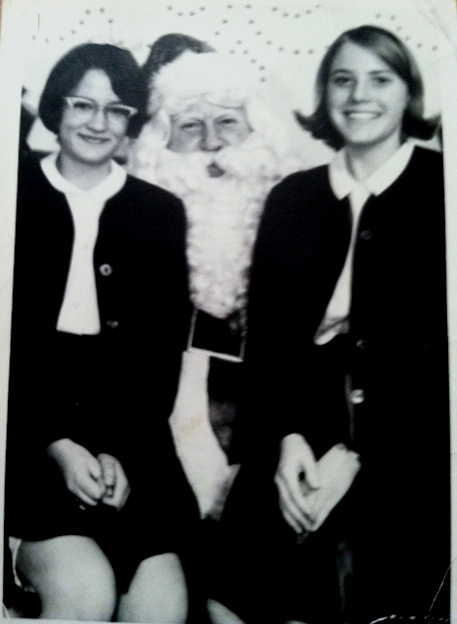
When Christmas came around, we got our photos taken with a department store Santa. I remember giggling about that, and even today, it brings a smile to my face.

She and I often talked about what we would do when we were grown up, and we thought that it would be fun to open a restaurant in Georgetown and sell things like Alferd Packer pancakes and Democratic sausages. That, too, makes me smile.

I managed to be silly on my own for a while after high school. One of my first jobs was at a fabric store. We got in a collection of appliques, and one of a smiling frog tickled me, so I bought it and pinned it on my dress. I wore that frog every day until I stuck myself with the pin. When people asked why I stopped wearing it, I told them that it bit me. I thought it was funny, but my boss didn’t. She thought I was crazy as in certifiably insane, but luckily, I managed to keep my job when I finally convinced her I was just playing and that I didn’t think the silly frog was real.

Like most lessons I learned in high school, I eventually forgot what I learned. Or maybe too many people like that boss helped quash the impulse, and I again became the serious person I was as a child. Occasionally I consider doing something silly, but it just seems too . . . silly. And anyway, being silly by oneself is no fun, to say nothing of the energy it takes.

***

Pat Bertram is the author of Grief: The Inside Story – A Guide to Surviving the Loss of a Loved One.

Life, Fate, and Conundrums

On Chinese New Year, a friend of Chinese descent who was born and raised in Malaysia, and I, a German/Polish hybrid, who was born in raised in Colorado, had lunch at a Chinese restaurant owned by a man originally from Vietnam, who chatted with us while we waited for our food. Mind boggling, right? I can’t even imagine how many tens of thousands of decisions we each made, how many unexpected changes in our lives, and how much time had to pass for all of us to end up in that exact place at that exact moment.

It almost makes me believe in fate, but perhaps that’s what fate is: everything that has to occur so that a certain event can happen. In some cases, those events and decisions are simply living and going where the day takes you. Other times, it’s a significant event, such as the death of a loved one. In my case, Jeff’s death untethered me so that I ended up in California taking care of my father. My father’s death broke whatever strings I had left, which sent me all over the country in an effort to run away from my life as well as run towards it. It’s mere happenstance — an unasked-for email from a real estate site — that I ended up here.

I’ve been thinking about this definition of fate as it applies to the Walk for Peace. On October 26, 2025, the monks set out from Fort Worth with barely a wave good-bye. Almost no one noticed them as they walked, though they did get some heckling and a few people who stopped to talk. Truckers and Texas residents shared sightings on Tik Tok, which got them some online followers, but mostly, they walked alone along empty roads.

Then, on November 19, a pick-up struck the escort vehicle so hard that it pushed the escort vehicle into the walking monks. Several were injured. One seriously. (He lost a leg but was doing well enough to attend the ending ceremonies in Washington.) After seeing that their fellow monk was taken care of, they continued their walk with the Harris County sheriff’s department riding alongside to keep them safe. The sheriff notified the sheriff’s department in the next county, and those law enforcement officers continued the protection, and so it went, all across the country.

That accident and the law enforcement notifications catapulted the walk into the public’s eye. No longer just a few bystanders on the open road — suddenly there were miles and miles of people lining their pathway. Thousands of people — hundreds of thousands — endured the cold and wind and rain and snow to wait to see the monks walk by. Millions followed the monks online. Lives were changed. People vowed to find peace within. And the effects of that walk are still rippling.

So, what would have happened without that accident? Was it a necessary part of their journey? Was it fate that it happened? Did the monk who lost his leg think it was a fair payment for the good the walk did? Was it a further example of their belief in breathing, in peace, in accepting the physical aspect of suffering while letting go of the resulting mental suffering? (One of the lessons they taught was that 10% of suffering was physical, the other 90% mental.)

Conundrums like this keep me wondering about life, about all the dots that need to be connected for anything to happen. Depending on what source you check out, there is between a one in seventy trillion chance and a one in four hundred trillion chance of any one of us being born.

So many changes and connections. Events and decisions. And time, lots of time. And all to get us here, to this very moment.

A moment that was eons in the making, a moment that will never be repeated.

During this rare and precious moment, may you be well, happy, and at peace.

***

Pat Bertram is the author of Grief: The Inside Story – A Guide to Surviving the Loss of a Loved One.

Peace Pilgrims

Several years ago, I seriously considered doing an epic walk — hike one of the long trails like the Pacific Crest Trail, trek along the Pacific coast, or walk across the United States. I was just starting to come out of my deep grief after Jeff died, and I wanted to find a deeper connection to both myself and the world, maybe even go through some sort of spiritual transformation. When I mentioned this desire to a friend, she suggested that I walk for a cause like the Peace Pilgrim did because if I had a cause, people would be more willing to help supply food, water, a shower or even transportation if I need it, and they might even get others to help. I never did find a cause, nor, despite training for it, was I ever able to do that epic walk. Instead, I took hundreds of day hikes, an overnight hike, and finally a 12,000, 21-week cross-country road trip, camping and hiking when I could, staying with friends or even treating myself to a motel when I wanted to or needed to.

As epic as that trip was, it was not what I’d originally envisioned, which was something akin to what the Peace Pilgrim did. The Peace Pilgrim was a woman who, in response to a spiritual awakening, had taken a vow to “remain a wanderer until mankind has learned the way of peace, walking until given shelter and fasting until given food.” Her pilgrimage began in 1953 when she was 44 and ended with her death in 1981. She carried only a pen, a comb, a toothbrush, and a map, trusting to those she met to supply what she needed, though she never asked for anything.

I admired her zeal and wished I could do the same, but I didn’t have that sort of trust. Still don’t. Nor do I have the physical ability for such an endeavor. I am on a different mission now, if such a solemn word can describe what I am living for — a peaceful life, taking care of myself, maybe even that deeper connection to myself and the world I once envisioned. Still, that old dream of a life-changing walk haunts me, which is one reason I was so fascinated by the monks and their walk for peace.

As with so many of my posts, the first few paragraphs usually serve only as background to a point I’d like to make, which is the uncanny connections between the Peace Pilgrim and the leader of the Walk for Peace.

She died in 1981. He supposedly was born in 1981. She started her walking mission when she was 44. He is said to be 44. They both experienced a spiritual awakening that took them from their mundane lives to one of spirituality, service, and inner peace. During both of their walks, they depended on others for food and shelter, accepting what is offered, asking for nothing. I’m not suggesting anything here, just making the observation that the second walk seems to be a continuation of the first. “Seems to be” being the operative words, since there really is no connection except for a few interesting coincidences.

Is there something bizarre about my sitting home, in my comfortable life, admiring (and I admit, envying at least a tad) those who willingly suffer the indignities of the road in the name of peace? If so, I am okay with that. I’m just glad someone is doing what I never could. And glad I got to participate in the Walk for Peace, if only vicariously.

***

Pat Bertram is the author of Grief: The Inside Story – A Guide to Surviving the Loss of a Loved One.

Ten-Year Anniversary of My Road Trip

Daily writing prompt
Think back on your most memorable road trip.

It’s odd to think that my cross-country road trip was ten years ago! It doesn’t seem that so much time has passed, and yet, I’ve lived what seems a lifetime since then — moving (both into a new location and out of grief), becoming a first-time homeowner, landscaping the yard, meeting new people and making new friends.

Despite the vast change in my life during the past years, I never had any problems adjusting to anything that happened to me probably because of all the traveling that had gone before — the twenty-one week cross-country trip, the longitudinal trips, the half-cross-country trips (from California to Colorado). I really enjoyed all those trips, but now, I’m just as glad to stay home. (Though I tend to think part of that is not wanting to drive my geriatric car too much anymore. I shudder at times to think of my traveling solo all over the country in my ancient VW bug. I made it safely, but I’m not sure I want to test my luck.)

There was so much to see and do on all of my trips, but the most memorable one has to be that cross-country trip. I was out there by myself, doing what I wanted, going where I wanted, camping when I could, staying in motels when I needed to, visiting friends. Most of those friends were people I’d met online, and I was amazed and honored by how well they treated me, taking me to see the special sights and sites in their area. I experienced more of the continental USA during that time than I had in all my previous years.

Lucky for me, even though I do remember the trip, I don’t have to. I documented my travels, from the first hesitant raising of my first tent to the final feeling of loss at finding myself the same at the end as I was at the beginning.

And lucky for you, you can experience my trip for yourself by clicking on this link: Road Trip 2016.

Safe travels wherever you go!

***

Pat Bertram is the author of Grief: The Inside Story – A Guide to Surviving the Loss of a Loved One.

More Things In Heaven and Earth

Daily writing prompt
What are your thoughts on the concept of living a very long life?

What a person thinks about the concept of a long life is rather meaningless since one lives the years one is given, and thinking beyond that is rather pointless. But so are most hypothetical musings. I have no thoughts whatsoever on the long lives of other people (or other creatures — the prompt did not specify long life for humans). There have been accounts of alchemists who have cracked the code of life and managed to evade death, though I have never found the truth of that rumor. It’s possible, I suppose. As Hamlet said, “There are more things in heaven and earth, Horatio, than are dreamt of in your philosophy.”

As for a long life for myself, um . . . no. Most people nowadays who live many years beyond what the actuarial tables say they could live, end up frail, sometimes helpless, feeling useless, and occasionally beset by dementia and other bewildering complications. I so do not want that for myself. Until, of course, I get to that point, then I’m sure, like everyone else in that situation, I will do everything I can to keep on living another day.

What is a long life, anyway — outliving your usefulness? Living to one hundred or beyond? Living biblical years of nine hundred or a thousand? It seems that long life to one creature is but a blink to another. To Methuselah, the bristlecone pine in the Inyo National Forest that is almost 5,000 years old, our puny ages would be as nothing.

But speaking of me (which is what this blog always comes down to), if I could have remained young, strong, healthy, vibrant, active, full of youthful energy, and joints that would never give out, living to be as old as Methuselah (either the biblical person or the tree person) would be great. I’d walk the world — literally walk. Just start out on foot, and keep going, looking at everything I pass, musing on everything I see, talking to people I meet, learning what languages I can, watching the years go by as I tramp forever.

It seems that a major problem of a great age, even when one maintains one’s vigor, is boredom. Walking the world, would be a great way to stave off boredom and keep oneself young in spirit to match that ever young body.

Despite Hamlet’s words to Horatio, I tend to think such a dream truly is impossible since I am way past the youthful body stage of my life. I am grateful for the years I’ve had, look forward to more years, and hope that however long my life turns out to be, that I will find a way to enjoy each day.

Wishing the same for you, too.

***

Pat Bertram is the author of Grief: The Inside Story – A Guide to Surviving the Loss of a Loved One.