Happy Turkey Day!

Thanksgiving is becoming like all other holidays, a time for people to trot out their favorite “racisms.” I understand their point, but the myth of the origins of the holiday in no way takes away from the benefits of having one day set aside to be grateful. Of course, that doesn’t mean we can’t be grateful at other times, but Thanksgiving is a group effort, not just a personal one.

Adding to the claims of racism against indigenous people are now claims of African racism, focused on the name of a traditional Thanksgiving food. Yams, that is. Apparently, a real “yam” is an African staple, a fibrous starchy root that can grow up to 45 feet. What we call yams aren’t yams, but sweet potatoes, even though those “orange sweet potatoes” have as much in common with a classic potato as the so-called yam has with a . . . well, with a yam. In fact, those orange “sweet potatoes” have more in common with a morning glory than with a classic potato. Yams, potatoes, and sweet potatoes all belong to different classifications; real yams are related to lilies, potatoes are part of the nightshade family, and sweet potatoes are part of the morning glory family.

Originally, there was a hard tuber that stayed firm even when cooked that was called a sweet potato. It vaguely resembled the yams of Africa, so the slaves called it a yam, and it became one of the “transfer” foods that helped captive Africans keep some of their own traditions. A staple of the southern diet for generations, it was considered an inferior food by rich whites. Later, when a new, softer, sweet potato was cultivated (the orange tuber we are familiar with), marketers needed a different name for the sweet potato, so they called it a yam. (A sort of racial theft.)

But it’s not a yam. Not a potato. Not even a traditional sweet potato. So who knows what it is. All I know is I cooked up a couple. (Unlike most people, I find the tubers sweet enough without the addition of sugar or marshmallows or whatever, and nibble on them without adornment as a treat.)

What does all this have to do with Turkey Day? Not much, really. These are just things I’m thinking and reading about as my turkey cooks. Yep. You heard it right. I’m cooking a turkey today. I was in the grocery store recently and having a hard time deciding what I’d like to eat. When I saw the turkey on sale, I thought, “Why not?”

Who says a turkey has to be cooked on Thanksgiving? Why can’t it be just . . . food?

So, that’s what I’m doing, cooking a turkey right now, which makes today a happy turkey day.
***

Pat Bertram is the author of Grief: The Inside Story – A Guide to Surviving the Loss of a Loved One. “Grief: The Inside Story is perfect and that is not hyperbole! It is exactly what folk who are grieving need to read.” –Leesa Healy, RN, GDAS GDAT, Emotional/Mental Health Therapist & Educator.
Dona Nobis Pacem

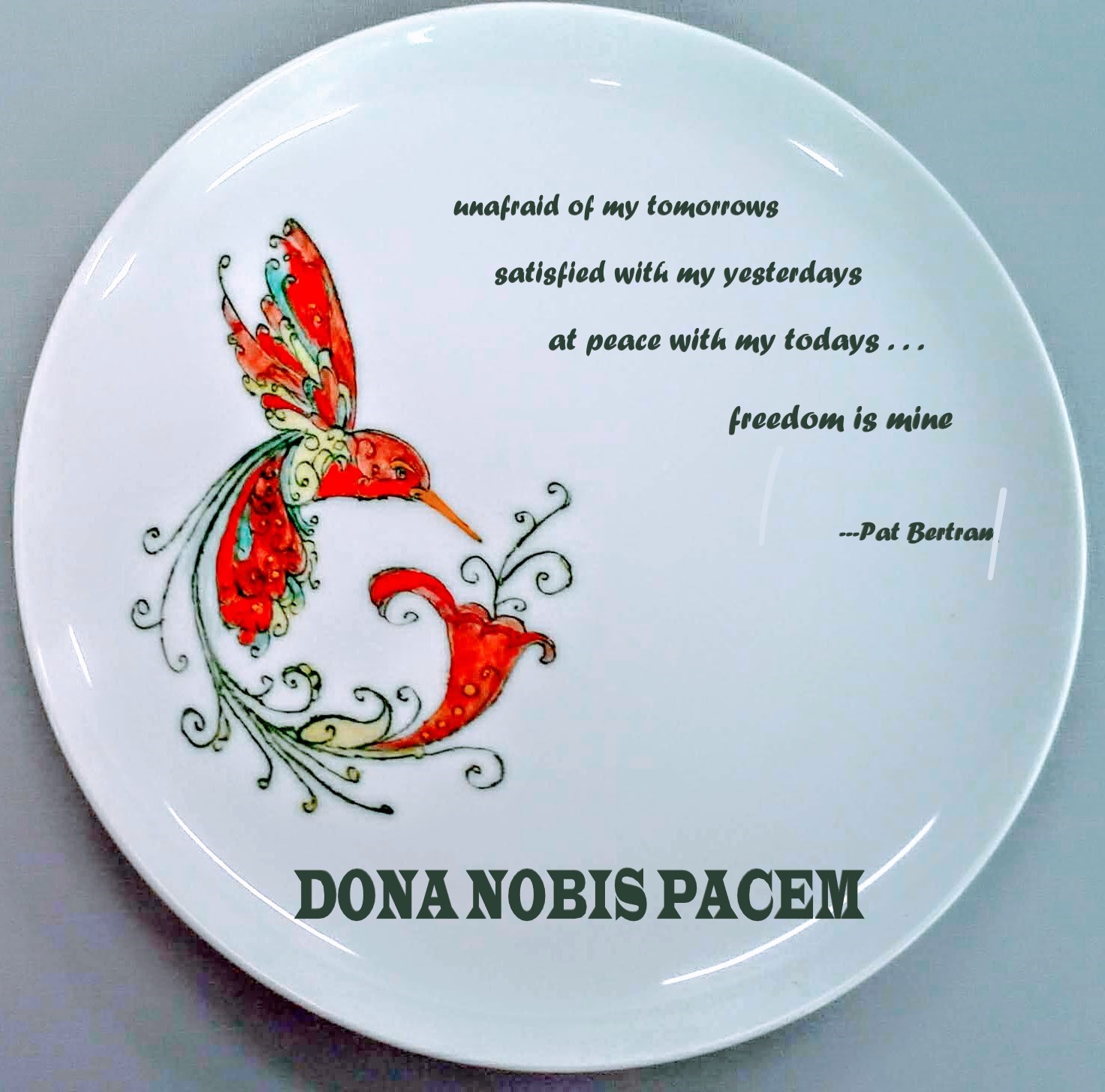
Every November fourth for the past dozen or so years, I’ve been blogging for peace, though I’m not sure why I decided to participate in the first place. I don’t believe in “world peace” as a cause, and this year I’ve been particularly demoralized by all the wars going on in the world. Is this really who are? After all these eons of human life, is war still the only way we have of resolving international conflicts? Of defending freedom?

People always talk about the human race as if we are warmongers, and yes, some people are, most notably those who make money and take power from wars, but think about it. How many wars have you personally started? For the most part, we (you and me, anyway) are peace lovers. We shy away from violence, even in the name of freedom. Most of us don’t even start personal conflicts, though sometimes we do unwillingly get involved in contretemps we don’t quite know how to end.

When people accept that humanity will probably never be able to eradicate aggression and violence, they look to nature for peace, thinking of warm bucolic days when the only sound is a distant a bird or a nearby insect. But even that isn’t “peace.”

Think about it — there you are, having a pleasant walk through the woods, having a picnic in a meadow, or perhaps standing on top of a mountain. All is peaceful. Or is it? If your ears were hypersensitive, as is the hero from my novel Bob, The Right Hand of God:

All seemed silent, still.

His ears became attuned to the quiet, and he heard insects cricking and chirring and buzzing.

Then other sounds registered, sounds so faint several seconds passed before he comprehended what he was hearing: the relentless hunger of nature. The larger prairie creatures and the most minute devoured each other in a cacophony of crunching, tearing, ripping, gnashing, grinding.

At the realization he was sharing space with things that must be fed, he took a step backward and bumped into a tree, a gnarled oak that hadn’t been there a moment ago. Leaning against the ancient tree, he heard the roots reaching out, creeping, grasping, wanting, needing. He jerked away from the tree and fell to hands and knees. Blades of grass moaned under his weight, and the screams of wildflowers being murdered by more aggressive vegetation almost deafened him.

He opened his mouth to add his own shrieks to the clamor but closed it again and cupped his ears when he became aware of a long sonorous undulation deep beneath the ground. The heartbeat of the earth.

Yeah, right. Peace.

If we expand peace to a microscopic or even a cosmic plane, we see a stasis created by opposite but equal forces in conflict.

And yet . . . and yet . . .

Today hundreds, maybe thousands of people are peacefully blogging about peace, creating peaceful images, sharing peaceful words, contemplating peace, visiting each other’s peace blogs. A lovely day. A peaceful day.

We may not be stopping wars or violence. We may or may not be attaining peace within ourselves, may or may not be at peace with our world.

But despite all that, today seems less about peace and freedom (today’s theme is No Freedom, No Peace) and more about believing we matter. And we do matter.

At least I hope so.

***

Pat Bertram is the author of Grief: The Inside Story – A Guide to Surviving the Loss of a Loved One. “Grief: The Inside Story is perfect and that is not hyperbole! It is exactly what folk who are grieving need to read.” –Leesa Healy, RN, GDAS GDAT, Emotional/Mental Health Therapist & Educator.
I’m going to Blog for Peace. Will You?

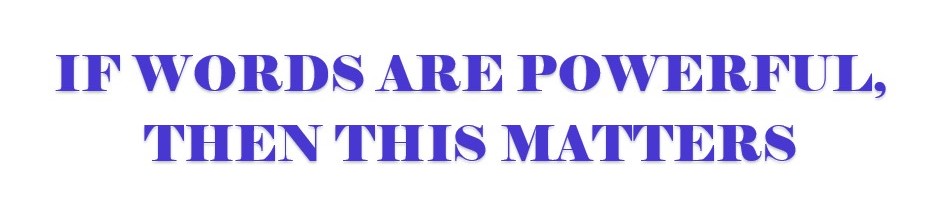
Tomorrow, November 4th, people all over the world will blog for peace. Blog4Peace was created and founded by Mimi Lenox, who believes that because words are powerful, blogging for peace is important.

Mimi began blogging for peace in November 2006. Fourteen years and thousands of peace bloggers later she — and all those she inspired — are still blogging for peace. On every continent. In 214 countries and territories. In war-torn countries and peaceful villages. Whole families. Babies in utero (yes, really!) Teenagers. Senior citizens. Veterans of war. Poets and singers. Teachers. Classrooms. Authors and artists. Doctors. Lawyers. Cats (many, many cat bloggers). Dogs. Gerbils. Birds. Goats and Bunnies. Scientists. Designers. Researchers. Stay-at-home-parents. Kids. Baby Boomers. From the Netherlands to Kansas. And everywhere in between.

I joined the peace bloggers in 2012. And I still blog for peace. 

This year’s theme is No Freedom, No Peace. As Mimi says, “Can we bring about a liberated world inside of ourselves and let it spill out onto the planet? Yes, we can.” This is a theme I can adopt; in fact, my novel Bob, The Right Hand of God was written with the themes of freedom and peace in mind. Although I do not believe in the possibility of world peace (because war and stressful times are never our personal choice but are fostered by others or foisted on us by circumstances) and freedom is not always a choice, (anyone who flies can attest to that) I do believe in finding peace and what freedom we can within ourselves no matter what happens to provoke us into chaos.

And yes, words are powerful. And yes, this matters.

How To Blog For Peace:

  1. Choose a graphic from the peace globe gallery http://peaceglobegallery.blogspot.com/p/get-your-own-peace-globe.htmlor from the photos on Facebook https://www.facebook.com/BlogBlastForPeace#!/BlogBlastForPeace/app_153284594738391 Right click and Save. Decorate it and sign it, or leave as is.
  2. Send the finished globe to blog4peace@yahoo.com
  3. Post it anywhere online November 4 and title your post Dona Nobis Pacem (Latin for Grant us Peace)

Sounds cool, doesn’t it? See you on November 4!

***

Pat Bertram is the author of Grief: The Inside Story – A Guide to Surviving the Loss of a Loved One. “Grief: The Inside Story is perfect and that is not hyperbole! It is exactly what folk who are grieving need to read.” –Leesa Healy, RN, GDAS GDAT, Emotional/Mental Health Therapist & Educator.
Terrestrial Triumphs

A little more than two years ago, I started to do a daily tarot reading. I wanted to learn the cards effortlessly (that is, without having to actively memorize each of the 78 cards), and though I’m still at it, I have very little retention of what the cards mean, so after all this time, I still have to look up the meaning of each card. Adding to the confusion, each guide included in most decks offers a different interpretation of the cards, though there is a vague thread of similarity between each of those interpretations. Some of the major arcana seem obvious, such as the Wheel of Fortune or Judgment, but the minor arcana all runs together, especially the court cards (the people cards). These generally refer to the people in our lives, but I have very few people and none of court cards ever seem to have anything to do with them or me.

Actually, the readings themselves never seem to have anything to me except shallowly, the way newspaper horoscopes offer shallow advice or ambiguous prophesy. It’s possible that I am not doing the readings correctly, not opening myself to possible meanings, not meditating on the cards or whatever it is I am supposed to be doing since I am not gleaning anything about myself or my life that I don’t already know. It’s also possible that at this stage of my life there isn’t anything more I can know. That’s not to say I know everything about myself, just that I know what I know and can’t intuit what I don’t know, with or without the help of the tarot.

Still, I continue to do a daily reading, choosing a different deck each month. In the hope that by limiting the number of cards I use, I will be able to better learn the meanings, this month I am using the Glass Tarot, a gorgeous deck reminiscent of stained glass, that’s comprised of only the major arcana. (The title of this blog, terrestrial triumphs, is how the major arcana was once known; hence, the term “trumps” as another name for those cards.)

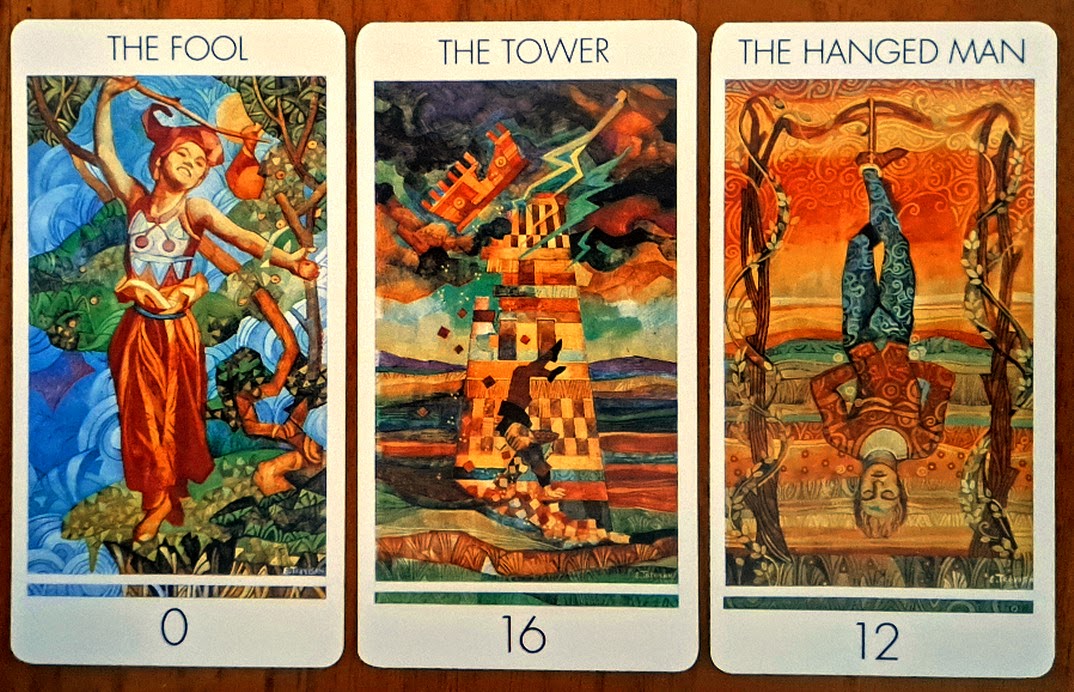
Today’s three-card reading included all cards that I am familiar with, and so my interpretation before looking at what the guide says, is that once I was naïve about certain matters, such as what grief can do to a person (The Fool), but then Jeff died and the world I knew came tumbling down (The Tower), and now I see things from a different perspective (The Hanged Man).

All true, of course, but it doesn’t tell me anything I don’t already know. (My question for the reading was “What do I need to know today?) Going by the definitions in this particular guide, the cards mean something else and deviate a bit from how others interpret the cards.

The Fool: Freedom from concern over material matters, extravagances, follies, light-heartedness, incomprehensible or inexplicable actions.

The Tower: Arrogance, pride, presumptuousness, upset equilibrium, danger, exile, collapse of mistaken convictions.

The Hanged Man: Disinterestedness, altruism, repentance, detachment from matter, moment of transition, utopia, art, punishment.

Even reading my cards from a different angle, perhaps that my follies let to arrogance and now I have to repent, doesn’t tell me much, though it is interesting to see how the same cards are subject to two completely different interpretations.

It does show me, too, that a few cards are sticking in memory, so my daily readings are helping me learn the cards, for whatever that’s worth.

***

Pat Bertram is the author of Grief: The Inside Story – A Guide to Surviving the Loss of a Loved One. “Grief: The Inside Story is perfect and that is not hyperbole! It is exactly what folk who are grieving need to read.” –Leesa Healy, RN, GDAS GDAT, Emotional/Mental Health Therapist & Educator.
Charming Weather

It’s an interesting new experience not spending two to four hours working outside every day. It got to be so much of a habit that I just automatically went out in the morning and stayed until whatever tasks I’d set myself were finished. This autumn, I’d been spending closer to four hours since the weather was so charming. “Charming” is not a word I would have ever thought to use for weather; it just showed up. And no wonder: the weather has been so pleasant and likeable that these days have charmed me. I was glad to have excuses to spend so much time outside — cleaning up gardens in preparation for planting wildflowers this winter, dividing and transplanting the prolific New England asters, and planting a few indulgences such as lily bulbs and a couple of plants.

I tried once before to plant Russian sage, a plant that bees seem to love, but that one died, and it looks as if the one I just planted wants to go the same way. Oh, well, what will be will be. I certainly learned that with my lawn — no matter what I did, the Bermuda grass encroached, and now I have large brown swaths of dormant Bermuda grass edging the bright green. Even worse, no matter what I did, some of my lawn desiccated in the summer. I’ll be interested to see what happens next spring with the grass areas that became heat stressed. Some patches seem to be dead, but in other places, a few green blades are laboriously making their way back.

I blamed myself for the demise of the grass, though I don’t see what I could have done differently. Extensive research finally gave me the answer — when temperatures exceed 95 degrees, cool season grasses go dormant. Over 100 degrees, the grasses die. To keep the grass alive, I should have misted the lawn a couple of hours every afternoon. I’m not sure I’d have done that, but perhaps if the grass comes back, I’ll think of something. The greenest area in my yard gets a lot of shade during the day, so perhaps I’d find a way to shade the areas that are in full sun from morning to night. Maybe umbrellas to shade those areas. Or maybe I’ll just wait to see what happens. It does look as if some wildflower seeds took root, so that might be a solution — just let them take over. As long as the area is mowable and not overrun by the so very aggressive Bermuda grass, I’m not sure I care.

As you can see, even without a lot of outside work to do, I still spend time thinking about my yard and planning for next year.

This “charming” weather will be coming to an end soon, but after the coming cold spell, I’m sure there will be plenty of work to do, such as cleaning up all the leaves that have yet to fall from my neighbors’ trees and clearing out the final garden. That garden still has a few struggling flowers that I am loath to dig up, but I am sure the coming freeze (maybe even snow!) will put an end to any blooms.

Meantime, I’m avoiding garden withdrawal by taking small walks. It’s funny to me that I spent years taking long aimless walks, but now I have a hard time walking just to walk. It seems as if I need a reason, so I’ve been going to the library more often. (Have to fill all those empty hours somehow!)

I hope you’re having lovely weather, too, and that the cold front we’re expecting doesn’t adversely affect you.

***

Pat Bertram is the author of Grief: The Inside Story – A Guide to Surviving the Loss of a Loved One. “Grief: The Inside Story is perfect and that is not hyperbole! It is exactly what folk who are grieving need to read.” –Leesa Healy, RN, GDAS GDAT, Emotional/Mental Health Therapist & Educator.




