A common “exchange” at Christmas is a cookie exchange, where everyone involved makes a big batch of cookies. The exchangers then get together to trade cookies, so at the end, each person comes away with an assortment of cookies they didn’t have to take the time to bake.
There are two problems with this — too often the various bakers have different skill levels, so the person who spends a lot of time and effort on their cookies can come home with cookies they couldn’t eat themselves and certainly wouldn’t serve to guests. The second problem is that many people are on prescribed diets to limit sugar intake, which takes away the fun of such an exchange.
A different sort exchange I recently heard of is a book exchange, where each person buys their favorite book and includes a note as to why they liked it so much. This would actually work better as a group gift idea for one person, so that person would end up with a whole slew of books as well as a great insight into each of her friends, but it still works nicely for an exchange with a group of book lovers, where each person gets one new book. As nice as that sounds, though, it’s not all that special. I frequently do book exhanges — it’s called “going to the library.”
Another idea is a plant exchange. The woman I work with and her daughters exchanged plants for Christmas — each of the women set up plants for all the others. After the exchange, each ended up with four new house plants. So very clever!
In an oblique way, I am a participant in this exchange. I didn’t end up with any plants (whew!) but I get to enjoy seeing the plants grow up.
I’ve never had any luck with house plants so I shied away from them. Oddly, I have done well with a couple of plants I’ve been gifted with since I moved to this house, and as long as the plants stay small enough to sit in front of my south-facing kitchen window, they do fine. Elsewhere in my house, it’s too dark or too cold or no space for them. But at that window? Perfect! In fact, one plant grew so large I had my own private plant exchange, the big plant for a little one.
But that’s just to explain the “whew” a couple of paragraphs ago and is not really part of today’s story.
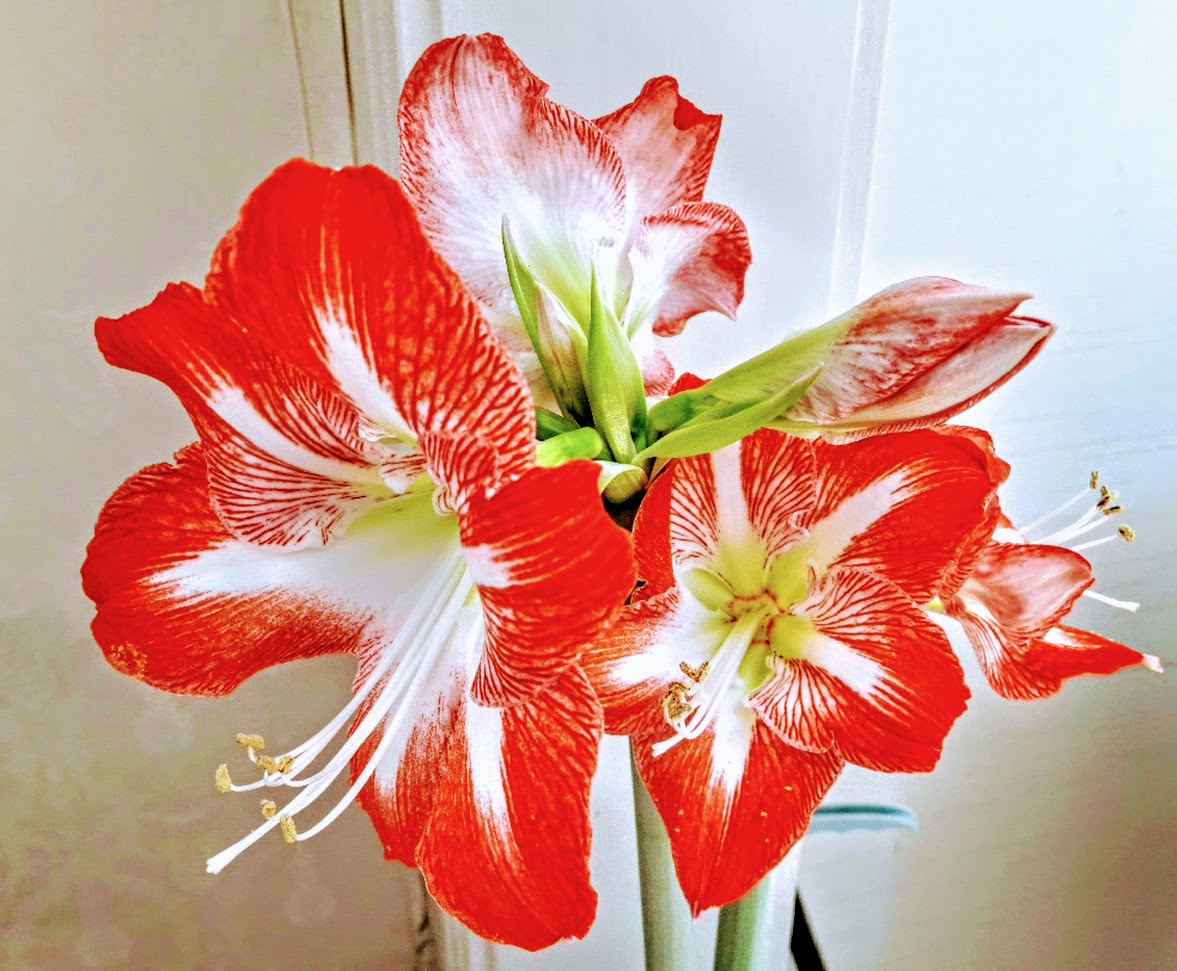
One of the plants that was gifted in the group plant exchange was an amaryllis. I don’t think I’ve ever seen one in real life, so I have enjoyed seeing the flowers bloom. Not only are they spectacularly pretty, but they brightened the dreary winter days we’d been having. Too bad they don’t grow outside in Colorado. I’d certainly love to see a whole garden filled with such gems! Still, being able to see even one amaryllis plant in bloom is a joy.
***
Pat Bertram is the author of intriguing fiction and insightful works of grief.















 Bertram's Blog
Stitches of Togetherness
January 30, 2022 — Pat BertramSmall talk — conversation about unimportant or uncontroversial matters — is a staple of my life now. When I visit with friends, we talk about small town life, ourselves, their pets and children and grandchildren, people we know. The only time I have a conversation about something more vital is if I know they more or less feel the same as I do because I simply have no energy to discuss anything anyone feels passionate about. Their passion for their beliefs about the “issues” of the day exhausts me.
For many years, I didn’t engage in small talk. At least not that sort of small talk. Jeff and I talked about everything that was important, both in our lives, in history, in health, in myth, in the world. We generally agreed, and if we didn’t, we’d discuss things, listening to each other without interruption, until we came to a middle ground. Mostly, though, through the decades, we formed our ideas in tandem. These ideas weren’t based on feelings but on in-depth reading (thousands upon thousands of books) on a multitude of subjects, including many things we didn’t necessarily agree with but wanted to know more about.
Then there was the other sort of talking we did. Small talk so small it wasn’t really small talk, more like the stitching that holds two lives together. You know the sort of thing I mean. Things said more or less in passing: “We didn’t get any mail today.” Or “I saw so-and-so today.” Or “They were out of something at the store today.” Or “I’m home!” Nothing of importance beyond the moment.
Several years ago, I wrote that one of the collateral aspects of losing a life mate was having no one to do nothing with. Although Jeff and I worked and played and talked for more than three decades, we often did nothing together. We were just there, a presence in each other’s lives. I’ve found other people to fulfill some of the roles he played in my life, such as someone to do something with, but I have no one to do nothing with.
I’m now realizing it’s the same with talking, and why I so often talk to his photo. I have people to talk with, both small talk and sometimes larger talk, but there’s no one around for the smaller than small talk. If I am sad or lonely, I can call someone, or I can go to the library and chat with the librarians while they check out my books, or I can do any number of things. But there’s no one around for the sub-small talk. I can’t call someone to say, “I didn’t get any mail today.” Just the effort to call would turn the idle comment into something it wasn’t meant to be and would give my not getting mail an importance it didn’t deserve. And yet, a shared life is made up of these passing comments, these “stitches” of togetherness.
Those stitches are another of the many things no one really notices until they are gone. In my case, other things were so much more overwhelming — not just the pain and angst of his being dead, but the silence of my life, the yearning for one more word or smile from him, the lack of someone to do nothing with, the stark aloneness of being alone (it’s completely different having alone times in a shared life than being alone in an unshared life).
When grief started leaving me, I became engrossed in other activities, such as dancing and traveling, moving from place to place and trying to figure out what to do with my life. So many of those activities are no longer a factor. I’ve bought a house and moved to my perhaps final home, so now the subtler and more permanent aspects of living alone after the death of a life mate are making themselves felt.
And apparently, this lack of “stitching” is one of those aspects.
***
Pat Bertram is the author of Grief: The Inside Story – A Guide to Surviving the Loss of a Loved One. “Grief: The Inside Story is perfect and that is not hyperbole! It is exactly what folk who are grieving need to read.” –Leesa Healy, RN, GDAS GDAT, Emotional/Mental Health Therapist & Educator.