Word Play

I have gotten into the habit of using a walking stick around town, partly because of the rough terrain (the sidewalks here are worse than a lot of the trails I used to hike) and partly because of my iffy knees. The other day I wondered if I should stop using the stick because it’s become more of a crutch than a necessity, and it occurred to me how strange it was that the word “crutch” has come to mean the opposite of what it used to mean as well as keeping the original meaning of being a device to help when one is injured. In both cases, a crutch is something we rely on, but in the first case, there is a hint that the reliance is unnecessary, and in the second case, the physical reliance is a necessity.

This led me to think of other words that have come to mean something different while also keeping their original meanings, such as “moot.” Originally, something moot was a point to be debated. Now in general usage it means a point that is so obvious or so irrelevant that it needs no debate.

Smart is the same. Originally smart something sharp. Then people began calling those with a sharp tongue “smart.” And now, smart is largely associated with intelligence, though it still retains its original connotation when we refer to a sharp pain as smarting.

Other common words have taken on the opposite meaning of the original intent, and the origins have been lost somewhere along the way.

Two that interest me because they show more of a centuries-old prejudice against the poor than because of the words themselves. A villein used to be a bonded servant, a poor person, one who had nothing but was tied to land owned by someone else and could not leave it without permission. Now, of course, a villain is someone bad. Same with naughty. A naughty person used to be a person with naught, a poor person. So, the general idea, which holds today, is that people without anything are somehow bad.

I tried to find other fun words online, but most of them seemed silly to me. At least by today’s definition of silly. “Silly” used to mean blessed or fortunate. “Nice,” on the other hand, used to mean silly.

One word I did find interesting that I wasn’t aware of was “hussy.” A “hussy” was originally a housewife. Wow, what a turnaround to today’s meaning! “Radical” also has undergone a radical change — it originally meant something rooted, basic, fundamental, not, as it has come to mean, something or someone who advocates upheaval of fundamental ideas and complete social or political reform.

And all this because of a walking stick that may or may not be a crutch.

***

What if God decided S/He didn’t like how the world turned out, and turned it over to a development company from the planet Xerxes for re-creation? Would you survive? Could you survive?

A fun book for not-so-fun times.

Click here to buy Bob, The Right Hand of God.
Banking Online

I’m surprised it took me so long to sign up for banking via the internet, and more surprised at how convenient it is.

Come to think of it, it’s not surprising that it took me so long to sign up after all. I wasn’t sure I trusted the safety of such transactions, with the way passwords are occasionally compromised, and I didn’t like it that I had to ask my bank “permission.” It wasn’t really permission, but it seemed that way since I had to ask them to set it up.

When I opened my accounts here, it was mostly automatic. They told me what to do, I did it, and that was that. Now, I can’t imagine going back to the old way where a person had no idea what was happening in their accounts until they got a monthly bank statement. And even then, a person never really knew what was going on, because there was approximately a two-week lag time between when the statement was prepared and when it was received. And then there was all the adding and subtracting to reconcile the account, because there were always checks that had been written and sometimes even deposits made during that lag time.

I don’t really have a lot of banking tasks, but I do have a separate account to use for PayPal and online purchases, which I keep mostly empty. So that means I have to transfer money from one account to another to pay for online purchases and bill paying. Banking online makes all that so easy! Less than a minute, and the money is transferred. And even though I do keep a separate written tally because just like in the old paper banking days, it takes a few days before checks and transfers show up in the account, and I like knowing where I stand.

In retrospect, it would have been a good idea to have used internet banking during those years I was living in a different state than my bank, but I managed to survive it, as well as survive someone fraudulently using my debit card.

The theft of my card number was probably why, when I moved here, I was so willing to make the change to a paperless account. Back then, I had to call the hospital and give them my debit card number to pay the monthly bills for my arm surgeries, and it was one of those employees who stole my card number. It would have been so much better doing it online.

Not that any of this has anything to do with anything except that I paid bills today, transferring money from one account to another to do so, and it dawned on me how convenient it all is. It makes it convenient to spend money, too, but that’s a different issue.

***

Pat Bertram is the author of Grief: The Inside Story – A Guide to Surviving the Loss of a Loved One. “Grief: The Inside Story is perfect and that is not hyperbole! It is exactly what folk who are grieving need to read.” –Leesa Healy, RN, GDAS GDAT, Emotional/Mental Health Therapist & Educator

A Hopping Good Time

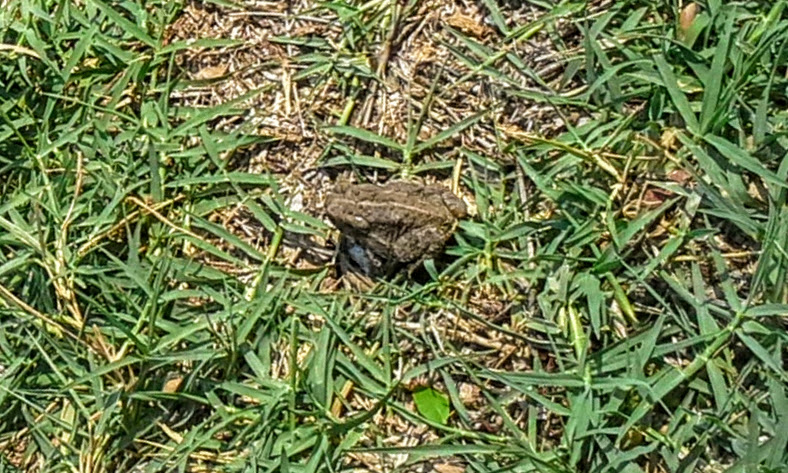
When I went out my back gate this morning to pull weeds out in front of my driveway again — all this rain we’re having is making it impossible to keep ahead of the growth, especially since I’m used to a drier and sunnier climate — I got a glimpse of movement. It took me a while to see the culprit because it looked like nothing more than a clod of dirt, but then I looked closer and realized what it was.

Seeing a toad is good luck, not just because it’s a rare occurrence for me, but because toads prey on various insects, and all this moisture is bringing the insects out in force. I was bedeviled by gnats when I was out, and I’ve already been bitten by mosquitoes a couple of times. Despite the toad being a good omen, I have a hunch the mosquitoes will make this a miserable summer, though I do have insect repellent for my face and hands and I will spray my clothes to add a different layer of protection.

But that’s a problem for another day.

Today I just want to enjoy knowing that a toad visited my yard.

***

What if God decided S/He didn’t like how the world turned out, and turned it over to a development company from the planet Xerxes for re-creation? Would you survive? Could you survive?

A fun book for not-so-fun times.

Click here to buy Bob, The Right Hand of God.

Remembering

During the past couple of years, I have tried to concentrate more on what I have gained rather than all that I have lost. The tally is still vastly weighted on the loss side, but good things have happened, such as finding a house and creating a home for myself.

The past few days, however, melancholy has gotten hold of me, and I remember the losses. I don’t know whether the plethora of dark clouds and rainy days are responsible or if it’s merely one of “those” times. That this is Memorial Day is entirely coincidental. In fact, I didn’t even remember it was Memorial Day until I went to the library and found it closed. Besides, although Memorial Day has become a day to remember all our dead, its original intent was a day for remembering those who died for their country in any of its various wars.

It’s true that most of my “losses” are loved ones who have died in the past decade or so — my parents, my brothers closest to me in age, and Jeff, of course — but there are other profound losses during those same years that still shape my life, such as the destruction of my arm (though I have become used to the deformity and the remnants of pain), the lack of dance classes, the inability to hike long distances, and losing my home not once but twice (once when Jeff died and once when my dad died). The home loss is especially poignant in an area where families have remained for generations. They might not have lived their whole lives in this very town; they might have come from a nearby town, but to someone who is new to the area, this seems inconsequential. It’s not as if they moved hundreds of miles. They are still within reach of where they grew up, within reach of family and memories.

But this isn’t about them. It’s about me feeling the losses and me feeling lost. Although I didn’t list it with my losses above, I think one of the greatest losses is of myself. Grief changes a person. Being semi-nomadic changes a person. Being isolated changes a person. Owning a home changes a person. I am getting used to who I have become and am still becoming, but it’s not the me I remember being all those years with Jeff. Somehow, our being together allowed me to be a truer version of me than I’d ever been before. I tend to think I am again living a true version of myself, but it’s a different version, one that sometimes strikes me as being . . . not me.

It might be that I spend too much time alone. Although I am comfortable living alone, I must admit I still miss having someone to do nothing with. Sometimes I have someone to something with, but those days of doing nothing in particular with someone are long gone. There are so many little nothings in a day — miniscule victories or insignificant happenings that aren’t worth talking about, but that we want to mention anyway. And there are times when we’re sad or lonely or restless, and just want a moment’s connection — perhaps nothing more than a shared look — before continuing our daily tasks. I can call people or text them, but it’s not the same thing. By the time I make the connection, the moment of nothing has become something.

I don’t mean to sound as if I feel sorry for myself. I don’t really, at least, not much. I just think it’s important to occasionally stop and remember what once was and is no longer.

***

Pat Bertram is the author of Grief: The Inside Story – A Guide to Surviving the Loss of a Loved One. “Grief: The Inside Story is perfect and that is not hyperbole! It is exactly what folk who are grieving need to read.” –Leesa Healy, RN, GDAS GDAT, Emotional/Mental Health Therapist & Educator

My Formative Years

I did not grow up watching television. My father refused to have a set in the house until we all left home because he did not want us to have that sort of influence in our lives. Some of my siblings went to a friend’s house after school to watch, but I didn’t. Any free time I had — then and now — I spent reading. Consequently, it’s given me a different worldview from most people my age (and younger) because we had completely different influences in our formative years. Well, our early formative years. As far as I can see, I am still in my formative years, though I can’t really say what I’m being formed into. I just know that I am not yet a finished product.

Despite my disclaimer of not watching television, over the years I have managed to get a sampling of the programming I missed. One such program was “All in the Family.” I think about this particular show whenever I put on my socks and shoes. (It seems odd to say socks and shoes rather than shoes and socks, but since socks go on first, it seems as if “socks” should be listed first.) The episode I saw was Archie Bunker berating his son-in-law (at least, that’s who I think the younger man was) about the way he put on his socks and shoes. Like me, the young fellow put a sock and shoe on one foot, and then put a sock and shoe on the other foot. I’m not sure why the character put his shoes on that way, but for me, now that I’m getting older, it’s simply easier to do one foot at a time.

It’s weird to think that putting a foot on a knee, pulling on a sock, then putting the foot down, putting the other foot on a knee, pulling on that sock, then putting that foot down, and then repeating all that motion to put on shoes has become so arduous that it’s simply easier to do one foot at a time. Yet, for me, it is so.

Still, Archie Bunker wouldn’t approve; he claimed it was a stupid way to put on socks and shoes. “What if the second sock has a hole in it?” he asked his son-in-law to the accompaniment of a raucous laugh track. “Then you’d have to take off the first shoe and sock and do it all over again.”

Even though he does have a point, I continue do it the “wrong” way, at least according to Archie. There have been times the second sock did have a hole in it, so I’d limp to my dresser — one shoe on and one shoe off — and drag out another sock. Luckily, I buy socks in batches, so chances are there will be another matching sock in the sock drawer, but if there isn’t, I’ll wear an unmatched sock of the same color because really, if anyone is close enough to my feet to notice that two white or two black socks don’t exactly match, then I have a greater problem than unpaired socks. On occasion, though, I do take off the shoe to go get another sock, but that’s because I don’t like tracking dirt around the house, and has nothing to do with the right sequence of putting on shoes and socks.

Come to think of it, perhaps my father had the right idea about no television. If a single episode of a single show has this sort of influence, I can’t imagine what a steady diet of television programming would have done to me in my formative years.

***

What if God decided S/He didn’t like how the world turned out, and turned it over to a development company from the planet Xerxes for re-creation? Would you survive? Could you survive?

A fun book for not-so-fun times.

Click here to buy Bob, The Right Hand of God.
Browsing for Browsers

I waste a lot of time trying to undo things computers do to me, such as change settings that aren’t supposed to change. For example, I prefer browsers to open with Google or even a blank page, but suddenly, for some unfathomable reason, Edge decided to forget my preference and instead open with the Microsoft page. I don’t mind Edge, but I do not like Bing, and even though I use Microsoft products, I don’t like the name jammed down my throat to gag me. Which is why I want Google as the opening page.

I spent what seemed like hours searching for the instructions on resetting Google as my homepage (though it probably wasn’t more than half an hour). As it turns out, the setting is still the same, with Google set as the default opening page. Edge has simply decided to ignore it.

You’d think, then, that I would switch to Chrome to get the opening page I want, but I always seemed to have problems with Chrome, though it could have been my old computer that had problems with it and this one would like it okay.

Although many people over the years have recommended Firefox, I never was that fond of it. I do use it as an alternative browser, though, so I can keep two different sets of sites going at once. For example, on one browser, this blog is kept logged in, and on another browser, a different blog is kept logged in. (That’s the blog I have to use to reblog this blog so I can post a link on Facebook so my friends there can keep current with me. Confusing, right?)

With previous browsers, a new tab would open to my default opening page, but Microsoft removed that option, so now it takes me an extra step to get to the Google page on subsequent tabs. I imagine I’ll get used to doing the same thing when I open the browser. It’s not as if an extra click is that onerous, it’s that computers are supposed to be increasingly easy to use without having to make those extra clicks.

I could go with a completely different browser — I’ve heard that Opera is good — but like Edge, it uses the Chromium page-rendering engine. (From what I can gather, the only holdout is Firefox.) So why bother with any browser other than Chrome?

In my case, it’s laziness. Edge came with my computer, and so that’s what I’ve been using, though, as you can see, I’m rethinking that particular option and browsing for browsers.

***

Pat Bertram is the author of Grief: The Inside Story – A Guide to Surviving the Loss of a Loved One. “Grief: The Inside Story is perfect and that is not hyperbole! It is exactly what folk who are grieving need to read.” –Leesa Healy, RN, GDAS GDAT, Emotional/Mental Health Therapist & Educator

Unlearning

When I left school and started reading books not in any curriculum, I discovered that some things I had learned as fact simply were not so. George Washington did not cut down a cherry tree, the little Dutch boy did not stick his finger in a dike, the graphic showing the gradual but steady rise of human evolution — though logical — did not happen in that way.

Consequently, I spent most of my adult life laboriously unlearning what I had so laboriously learned as a child. As far as I know, 2+2 still equals four, at least in base ten, which meant there were some things I didn’t have to relearn, though when it comes to English as a subject, many of the words I learned how to spell are now spelled a different way due to the debasement of the language. (Some people think the language is evolving to suit the needs of today’s younger generations, which might be true, but it seems like a devolution to me, and I don’t feel any need to learn their way of reading and writing and speaking.)

Because of this concerted effort to find out the truth, it came as a shock to learn that there is at least one “fact” I still “know” that may or may not be true. And if there is one such untrue fact, there has to be others, right? Luckily, I am no longer as interested in unlearning as I once was, so I am willing to forego the search unless a possible untruth falls in my lap as did this one.

So what’s this fact that may or may not be a fact? That crude oil is a fossil fuel formed by the decay of plant and animal material, and that it is finite. As it turns out, there are two different theories about crude oil. The fossil idea is considered a biotic theory because of its relation to erstwhile living things. It was first postulated by a Russian in 1757.The other theory is an abiotic one, and was also postulated by a Russian, albeit two centuries later. The senior geologist at the time said, “The overwhelming preponderance of geological evidence compels the conclusion that crude oil and natural petroleum gas have no intrinsic connection with biological matter originating near the surface of the earth. They are primordial materials which have erupted from great depths.” Other geologists think it is a renewable resource, that the earth keeps creating the oil, which is why some wells in the Gulf of Mexico are being depleted at an astonishingly slow rate.

Does it really matter io me what this particular truth is? Of course not, though I did find it interesting that there was such a gap in my knowledge base. Not that I know everything, of course, but I do know bits and pieces of a lot of things — the result of a lifetime of study and research.

And now I know this. I know that there are two explanations for the creation of oil, as well as a possible third or even fourth explanation — that both theories are correct, or that neither theory is correct.

And so, surprisingly, the unlearning continues.

***

What if God decided S/He didn’t like how the world turned out, and turned it over to a development company from the planet Xerxes for re-creation? Would you survive? Could you survive?

A fun book for not-so-fun times.

Click here to buy Bob, The Right Hand of God.
The Sounds of Unsilence

I’ve never understood windchimes. As mobile art, they are rather intriguing, but when you add in the wind part, they are aggravating as all heck. But that must just be me. Obviously, other people find them pleasing otherwise there wouldn’t be so ubiquitous.

Still, there aren’t many people whose sound of choice is silence. There are a lot of noises I can’t tolerate, such as outdoor machinery, but at least there seem to be a purpose to those noises, and once the job is done, the noises cease. (And now that I have the semblance of a yard, I too am making noise with a yard machine.) With windchimes, though, the noise is arbitrary, based on whatever the wind is doing, and in a windy climate? Ouch. Those things are almost constant.

Luckily, the windchime currently aggravating me doesn’t disturb my sleep. In other places I’ve lived, the windchimes were so constant, they invaded my dreams, so I could never get away from them until I finally was able to move. Even more luckily,, come summer, the air conditioner will be on at least part of the time. The air conditioner has always been a rather hard choice for me to make — silence and sweat, or noise and coolness — but this year, having it on will help drown out the windchimes.

I wish it was just a matter of getting used to the chimes, but it’s not a so much that I prefer silence, but that windchimes, even the so-called tuned ones, grate on my nerves like fingernails on a blackboard. (Do young people today even know what that sound is, or have whiteboards replaced the old-fashioned blackboards?)

From what I remember of last summer, the early morning hours are fairly still, with the winds picking up later in the afternoon. Or perhaps I’m remembering the desert where I was living before I moved here. In that area, I know, the winds picked up as the day went on. Either way, I’ll find quiet times to go outside and sit. Or not. It could be that I’ll just go out to do whatever work I need to do, then come and hide inside where it is relatively quiet.

The windchime problem has given me an idea for a book, though. The poor protagonist is at wits end because of the noise, and she talks of shooting them. People misunderstand and think she’s talking of shooting her neighbors, and then they end up dead. But I wouldn’t want to harm my neighbors even in literary fun because that would seem to bring bad Karma, especially since we’re all planning on hanging around here until the end, whatever that end might be.

***

Pat Bertram is the author of Grief: The Inside Story – A Guide to Surviving the Loss of a Loved One. “Grief: The Inside Story is perfect and that is not hyperbole! It is exactly what folk who are grieving need to read.” –Leesa Healy, RN, GDAS GDAT, Emotional/Mental Health Therapist & Educator

Thought-Provoking

This is a hurry-up-and-write-something-post-so-I-can-say-I-wrote-something post. I don’t normally have a busy day, but this is one of those rare occasions. I had to water my garden, go check on a friend’s house and water her houseplants, check with my car mechanic about the brake part he ordered, and stop at the store to pick up a few groceries. As if that isn’t enough, I have to go to work early today. Which means there’s no time to write a thought-provoking post, or rather try to think of something thought-provoking to post (though I often fail in the thought-provoking part, I do try).

Hence, this bit of silliness.

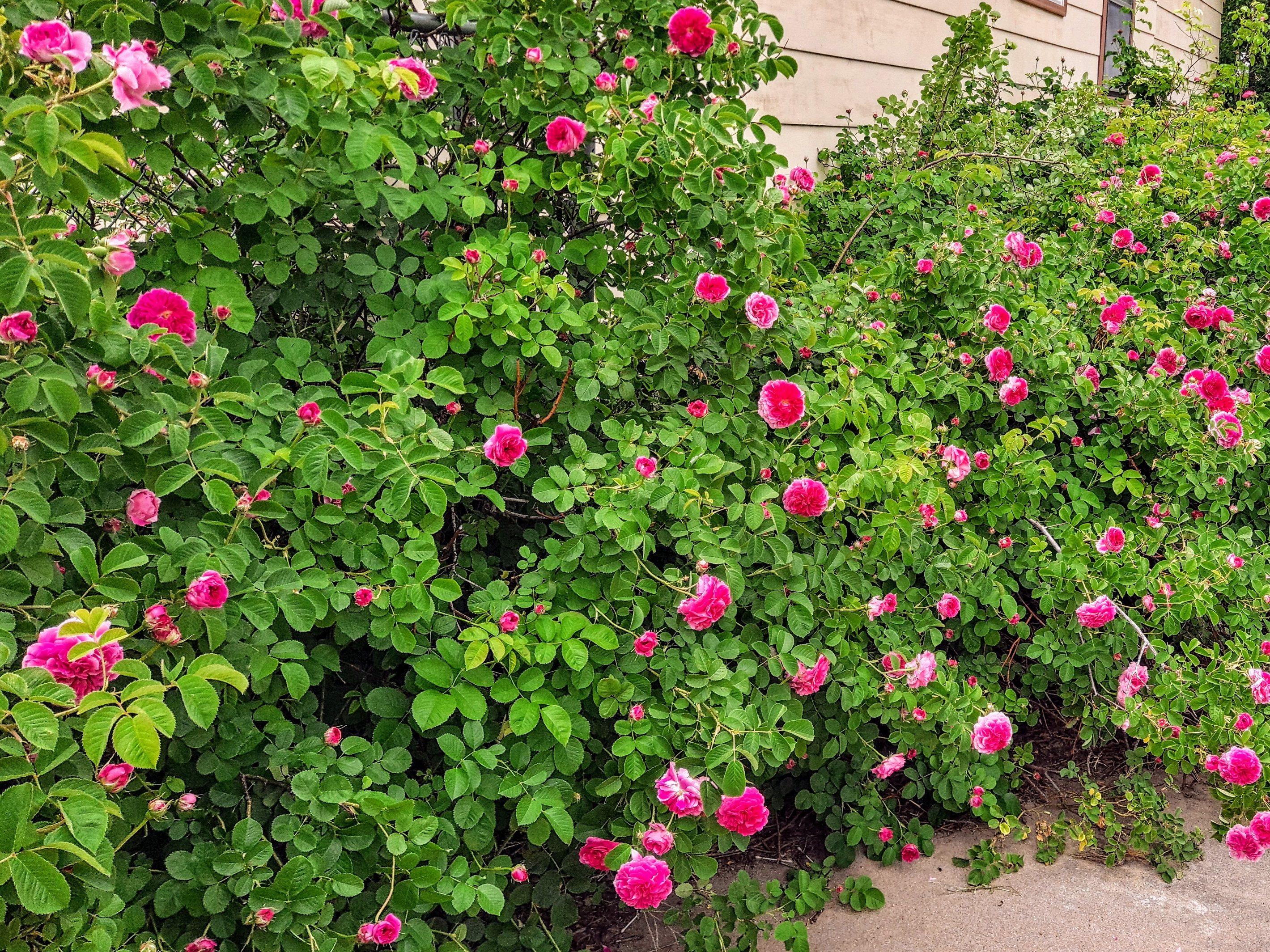
I did get a chance to check out a neighbor’s roses as he suggested. He’s rightly proud of them, and I’m glad I got a chance to see them at their peak

And, since I was wandering around with my phone in hand, I stopped to take a photo of my larkspur. (Which, incidentally, originally came from the rose neighbor’s yard.)

Now that I think about it, I’d take flowers over a thought-provoking post any day.

***

What if God decided S/He didn’t like how the world turned out, and turned it over to a development company from the planet Xerxes for re-creation? Would you survive? Could you survive?

A fun book for not-so-fun times.

Click here to buy Bob, The Right Hand of God.
Wild Raft Ride of Thoughts

In the book I am currently reading, a couple was chosen by the birth mother to adopt her soon-to-be born baby. All goes well until the child is nine-months old. Then the birth father decides he wants the baby he has never even seen.

This scenario has me whitewater rafting on a wild stream of thoughts, starting with the oft-quoted presumption that a woman’s body is her right. She gets to choose to have an abortion or bring the baby to term. But when does her right end? When the baby is born? If so, why would that be? The child is still part of her, and if you doubt that, ask any bereaved woman who has lost her child — at whatever age — how she feels, and she will tell you she feels as if part of her has died too, as if a limb has been amputated, as if her heart has been scooped out of her body and stomped on.

In other words, whether inside or outside a mother’s body, the baby is still a part of her. So what about father’s rights? In this scenario, it seems as if the only rights he has are those the mother confers on him. Why else would he have any rights? Adding to the whole weird situation, if a woman had a child by another man, then that man’s DNA can migrate to her body from the fetus, so any subsequent baby could have the first man’s DNA, too.

Even if the baby only had the father’s DNA, being a sperm donor or a DNA imparter doesn’t really change anything because our DNA doesn’t necessarily belong to us. It belongs to whoever mines it from our bodies.

That sounds dramatic I know, but the truth is, every time you have blood drawn or any other invasive test, the doctors are mining your body for information. They send it to various labs to be processed. And that part of your body no longer belongs to you. There have been scenarios where a person’s blood was so valuable that the lab company laid claim to it legally. And if the person ever finds out how valuable their blood is (for example, if the person’s blood produces antibodies against The Bob that would protect people forever and against all variants) the person can’t sell it to the highest bidder or even give it away because someone else owns their blood.

In addition, it seems as if aborted babies belong to the abortionist or whoever the person works for because so much medical research, including stem cell research, is done with fetal cells, and where else would the researches get all those fetal cells, unless they are growing them in incubators, which adds a whole other level of insanity to the equation.

Then who does the baby belong to? The midwife or doctor who delivers it? Of course not. It’s the mother’s. She “baked” it. It came from her body. In that case, how could anyone but the mother have any rights? (Though it was not my intention, this would seem to negate the whole child-support question.)

And if we do have rights to our bodies, how can any government mandate any sort of medical procedure, even those they consider as innocuous as inoculations?

I told you this was a wild raft ride of thoughts. As with any wild ride, I’m not sure where I’m going with all these hypothetical questions (meaning I’m not sure what I think and I’m not looking for answers). Mostly I’m taking certain political and scientific presumptions to a logical conclusion, or what seems logical to me. It for sure has nothing to do with my thoughts on abortion, which basically are nonexistent since the issue has nothing to do with me. I have no right to decide what anyone does with any part of their body, though I do give serious thought before I let anything be taken out of — or put into — my body.

***

Pat Bertram is the author of Grief: The Inside Story – A Guide to Surviving the Loss of a Loved One. “Grief: The Inside Story is perfect and that is not hyperbole! It is exactly what folk who are grieving need to read.” –Leesa Healy, RN, GDAS GDAT, Emotional/Mental Health Therapist & Educator