Finding a New Life that Fits Properly and Looks Good

dancingIn a conversation with a friend about my father, who is still going strong at 96, I said, “I take after my mother, which is good because there is no way I want to live to such an advanced age, particularly since I won’t have a widowed daughter to come stay with me. It’s kind of spooky thinking of having to grow old alone.”

She said, “You never know what will happen. Maybe a new love will drop into your life. I can imagine you at some writer’s festival and a distinguished stud with salt and pepper hair and a sweet smile flirts with you. He asks for your number and the next thing the rest of us know, Pat’s out dancing and dining every Saturday night and she’s suddenly submitting romance novels for publication…”

I laughed. “I love the ‘sweet smile’ part. Who knows, with or without a stud, I might go out dancing every Saturday night. I desperately need a new life.”

She responded, “I think you need a new life too. I’m afraid you’re just wilting away. So — how do you get a new life? What do you want your new life to be?”

And that’s where the conversation stalled. How do you get a new life? It’s not as if you can go to the mall and search the aisles at Lifes ‘R’ Us until you find a new life that fits properly and looks good. (Though that does sound like an interesting concept.)

What-we-can-become is dependent on whether what-we-are is an integral part of our genetics, keeping us always “us,” or if we are infinitely mutable and can become whatever we wish to be despite our inborn proclivities. In other words, can we really get a new life or are we always “us”?

For me to go out dancing every Saturday night, I’d need a personality transplant. I’ve always been drawn to quiet activities, such as dinner and conversation that dances from one topic to another. If somehow I did overcome my natural inclination for such sedentary pursuits, where would I go dancing? I’m too old for nightclubs and too young for senior citizens groups.

Still, I will need a new life of some sort. My father will not live forever, and I will need to decide where to go and what to do. And the truth is, I haven’t a clue.

Current research by Harvard psychologist Daniel Gilbert shows that while we can see how much we have changed in the past, we never think we will change in future. (Hence that ill-advised tattoo you got when you were young and now wonder what you were thinking.) But this isn’t always true. I know how much I have changed in the past. I have a photo of me as a baby, and I can see the vast changes between me and that poor befuddled creature. I can also see how different I am today from what I was four years ago when I watched my life mate/soul mate’s slow descent into death, and I can see how different I am from what I was almost three years ago when grief catapulted me out of that shared life into a new one. I can extrapolate from those experiences of change that I will also drastically change in the future.

I always feel the same, of course. — just me. (There must be some sort of mechanism, like an internal gyroscope, that keeps us “us” no matter how we change.)

The point is that I cannot figure out now what I want my life to be when I am free to pursue that life because I don’t know who or what I will be at the time. Maybe by then, I’ll miraculously have developed grace and style, and will have become a dancing queen. Or not.

***

Pat Bertram is the author of the suspense novels Light Bringer, More Deaths Than One, A Spark of Heavenly Fire, and Daughter Am I. Bertram is also the author of Grief: The Great Yearning, “an exquisite book, wrenching to read, and at the same time full of profound truths.” Connect with Pat on Google+


Thirty-Four Months of Grief

desert roadThirty-four months ago today, my life mate/soul mate died of inoperable kidney cancer. For thirty-four months now, I have been posting updates on my progress through grief, and that astounds me. Thirty-four months? How is that possible? Written out, it seems such a short time for him to have been gone, and yet it feels immeasurably vast — so many minutes, hours, days, weeks, months, and now years, spent trying to come to grips with what happened to us. For most of our lives we were connected by some mystical bond, a cosmic twinning, that kept us together even when times were rough. And then suddenly, in a single breath, that connection was broken. I am here, alone, and he is . . . well, I don’t know where he is or even if he is.

I never had survivor’s guilt for the simple reason that I wasn’t sure which of us got the worst end of the deal, but I have felt uncomfortable going on without him, as if somehow I were being disloyal. We helped fight each other’s battles, sticking up for each other, caring for each other, waiting for whichever of us happened to be lagging behind, always taking the other into consideration, and it feels as if I should still be doing so. But he is beyond my reach, beyond my care, beyond my consideration.

I have come to see that continuing the disconnect that began with his descent into death is one of the tasks of my grief. (Grief seems to be not so much about passing through stages, but more about completing tasks, such as processing the loss and learning to live again.) Until I understand within my depths that for all practical (earthly) purposes we are not one, I will never be able to embrace fully what life has in store for me. We are separate persons, each with our own experiences, our own journey, and our own destination. For a while, our paths crossed, but now, I have to continue as me, alone. No matter what I do, or think or feel, it cannot change the past. No matter how much I hate that he is dead, no matter how much I rail against the unfairness, no matter how much I miss him or wish desperately for one more word or smile, he is no longer in my life.

For most of those thirty-four months, this disconnect has seemed an impossible task, but there is a bit of light illuminating my path. Last week, when I went to my Yoga class, they asked how I was, and I said, without thinking, “I’m doing great.” It stunned me to hear those words come out of my mouth, because for more than five years, during the last of his dying and these many months of grief, I have had times of feeling okay, and I thought that was the best I could do. But at that moment, I did feel great. It didn’t last long, only about an hour before I began sliding into sadness again, but that hour stands as a beacon for what might be.

Up until that class, this year has been one of increased sorrow and tears, and such grief upsurges often precede or follow a deeper level of acceptance. It’s not so much that I am learning to accept his death — I accepted the truth of it from the beginning, though I hate it and will never be able to comprehend it — but I am learning to accept that I am alive, and that is a much harder thing to accept.

***

Pat Bertram is the author of the suspense novels Light Bringer, More Deaths Than One, A Spark of Heavenly Fire, and Daughter Am I. Bertram is also the author of Grief: The Great Yearning, “an exquisite book, wrenching to read, and at the same time full of profound truths.” All Bertram’s books are published by Second Wind Publishing. Connect with Pat on Google+

Being Real Online: The Truth of Me

shadowIn a recent blog interview, someone asked me what I would do differently if I were invisible for a day, and I responded that for all practical purposes I am invisible. “Practical purposes” meaning “offline.” Some people responded that I was very visible, and they are right. I am visible online, but they (and you) don’t know if I’m visible offline, so basically, nothing would change if I were. I’d still be the same person — whoever that is.

I started out online with a certain persona — not fake exactly, but not entirely me. More of a slightly idealized version of me. The odd thing is that over the years, I have grown into that persona, so I don’t know which is the real me any more, but I think the fake one is the real one.

There’s been a lot of talk online lately about the truth of what we hear and see on the Internet, mostly because of Manti Te’o’s story. To be honest, I haven’t a clue he is or what is story is, but it did make me wonder if the people I meet are real.

I tend to take people at face value online, even though I suspect some of them are not who they say they are. For example, there are a few authors portraying themselves as hulking men with biceps and tattoos that I suspect are really women who are using not only pseudonymous names but also pseudonymous personas, but it doesn’t matter as long as they add a bit of color to otherwise staid discussions. And if they really are those men, that doesn’t that matter, either.

If the people who comment frequently on this blog — the ones I have come to think of as online friends — turn out to be not who they say they are, it wouldn’t change anything. Their insights add depth to the conversation and make me think. That is real even if they are not. But I would be willing to bet they are exactly as they seem.

I have met several people offline that I first became friends with online, and they were who and what I expected. In most cases, there wasn’t even a moment of uncomfortableness — we just continued our online relationship offline.

Of course, online we talked about books and writing, ideas and dreams, and that is hard to fake. I mean, if you don’t have ideas it’s hard to pretend that you do, or if you haven’t read books, it’s hard to make an intelligent remark about literary matters.

Maybe the point is that online we are who we say we are. Offline, we get so used to being what we’re not so that we don’t get in fights or so people don’t get angry with us or to get our way or so we can get a promotion or for any number of reasons, but online, what we are really doing is stream-of-consciousness writing, and that taps into the inner us.

If we are creatures made of stardust and electrons, if all our thoughts are particle waves or energy or whatever, maybe it’s easier to plug in to the essential spirit of people online since the Internet is an electronic medium. Online, you get a feel for people, for who they really are, not how they look or what they do for a living. Online, you’re not obese or crippled or ugly. Online, you don’t repel people with your awful smell or your terrible disease. Online, you’re just you.

Sometimes people take the freedom of the internet too far and, hiding behind fake personas, spew invective at the world. But that is true, too. It’s who they are. It’s the real people who are bogus, pretending to be affable when in fact, they are filled with anger and hate.

Are you wondering if I am real? You already know the answer. Whether I’m visible or invisible, fake or real, it’s my words that matter. My words tell you the truth of me.

***

Pat Bertram is the author of the suspense novels Light Bringer, More Deaths Than One, A Spark of Heavenly Fire, and Daughter Am I. Bertram is also the author of Grief: The Great Yearning, “an exquisite book, wrenching to read, and at the same time full of profound truths.” All Bertram’s books are published by Second Wind Publishing. Connect with Pat on Google+

Believing Impossible Things

In an effort to see life in a new light, I’m going try to believe impossible things. I’ve always wanted to know the truth, but grief has thrown so many of my perceptions out of whack that I don’t know the truth of anything any more, so I’ve decided to believe things that are untrue. For example, I’m going to believe I am at the perfect weight. And maybe that’s the truth. Who’s to say? Only me, and I’m not talking.

And hey. Why stop at weight? Maybe I’ll believe that I myself am perfect. Now that I think about it, that is the truth. Since I am the only me in the world, whatever I am is perfectly me.

I’ve always been very self-aware — knowing both my good points and my bad points, my successes and failures — but if the universe is unfolding as it should be and I am where I am supposed to be, then there can be no good points and bad points. There can be no successes and failures. There is just me, a creature born of stardust, the culmination of billions of years of creativity and change. Odd to think that I (well, all of us) are a part of this process.

Maybe we are the process.

This thing called grief has given me an interesting perspective on life. A day or two after my life mate died, I couldn’t visualize him, so I looked at the only photo I have of us, and I wept because I did not recognize him. When that photo was taken, it was an exact likeness of him, but during the subsequent years of illness, he lost the fullness in his face, first becoming distinguished looking, then gaunt. When he died, I an idea/image of him in my mind, perhaps a composite of him through the years, perhaps what he actually looked like near the end, and that single photo I have of him does not resemble the person I knew. Now, however, the photo is how I remember him since it’s the only image of him I have. (Occasionally I can remember his smile or the way he looked when he died, but mostly he has faded from memory.) The way he looked in the photo and the way he looked at the end are both parts of his process, so I’m content remembering him when he was still relatively young and healthy.

It’s not just our internal images of a person that changes to accommodate the vagaries of age; our internal image of the relationship itself changes to accommodate the vagaries of life. Most of the transformation of a relationship from youthful and passionate to aged and (perhaps) wise and companionable goes unnoticed. We are always who we are. We are always in the present.

In other words, we are a process. Do we have an existence beyond the process? Someone told me recently that we can’t prove we exist. Maybe this is why we can’t prove it — whatever we try to pin down is already gone, lost in the past.

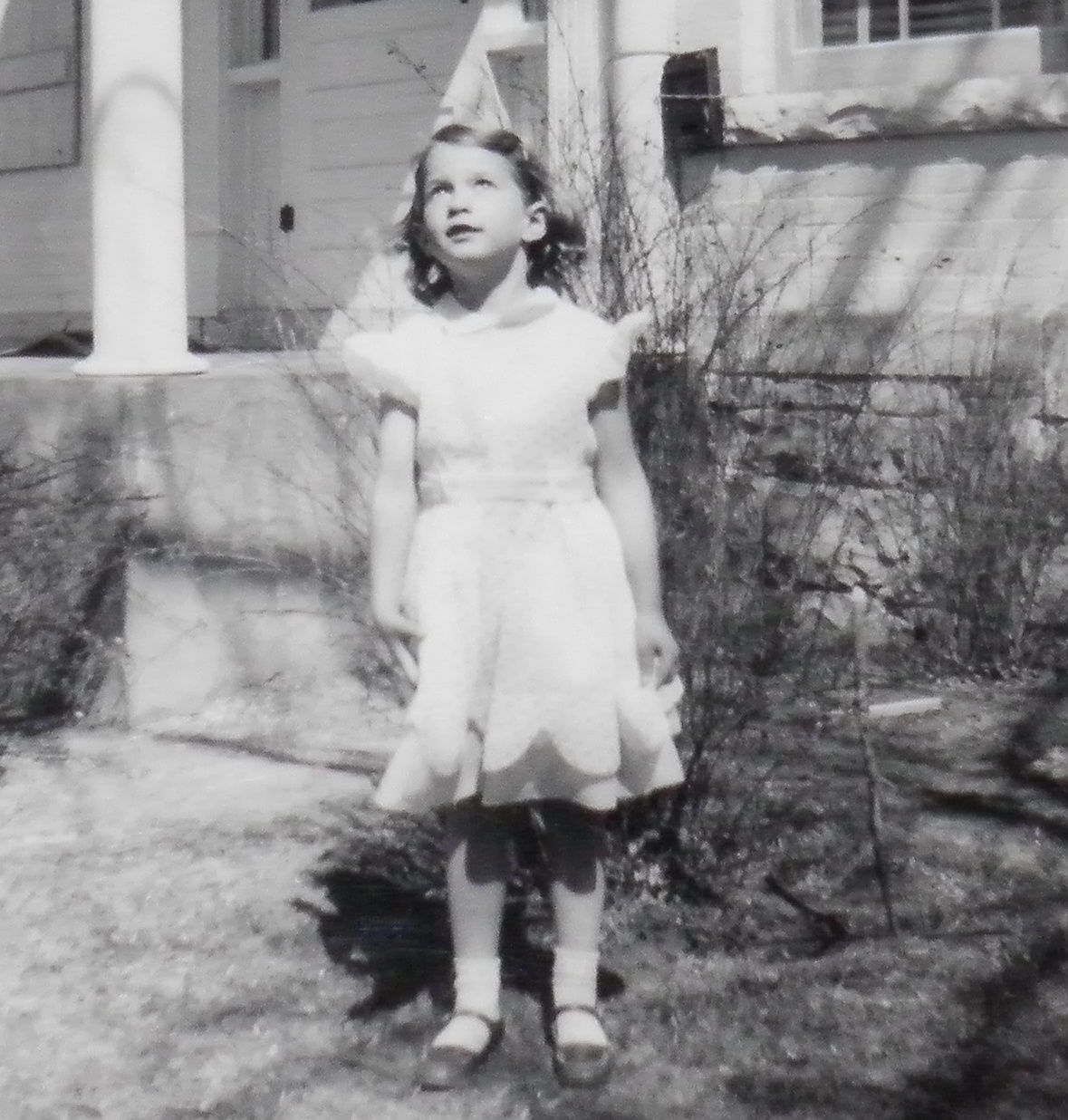
I never had much use for photographs of myself, but after my mother died, I inherited a bunch of photos taken of me when I was young. I put them in an album and I leaf through it occasionally, seeing the progression of myself from a baby to a young woman, trying to figure out what those girls have to do with the me of today. I’ve always felt like just me, and yet, (for example) I cannot remember this little girl in the photo, cannot remember being her. She has receded far into my past. Or perhaps she’s become subsumed into my current persona. Either way, she no longer exists even in memory.

But she is part of the process of me.

(Hmmm. Maybe there is something to this idea of believing impossible things. I’ve already found one new way of looking at life.)

***

Pat Bertram is the author of the suspense novels Light Bringer, More Deaths Than One, A Spark of Heavenly Fire, and Daughter Am I. Bertram is also the author of Grief: The Great Yearning, “an exquisite book, wrenching to read, and at the same time full of profound truths.” Connect with Pat on Google+

Close Encounters of the Coyote Kind

SANYO DIGITAL CAMERAIn A Spark of Heavenly Fire, I had a character meeting up with a coyote as a way of showing that the character was becoming “untamed,” that she was finding her inner savage.  She went from searching for self-affirmation from the men in her life to finding affirmation in herself. But more than that, she overcame her squeamish nature to do whatever she needed to do to survive.

Although her communion with the coyote seemed a bit trite or maybe just too pointedly mystical, I couldn’t think of a better way to show the change in her. And perhaps it only seemed trite because such things do happen. Yesterday, while walking in the desert, I came across not one but three coyotes. They were far enough away that I was never in danger, but they all stopped and stared at me. I stared back. We stood there for a minute or two, then I got distracted by a noise, and when I looked for them a second later, they were gone.

Perhaps this encounter was symoblic, a way of showing me that like my character, I am becoming untamed, embracing my inner savage, willing to do whatever I need to do to survive. More probably, the coyotes had come close to civilization in an attempt to find food. Either way, it was an interesting synchronicity of life imitating art.

***

Here is the coyote excerpt from A Spark of Heavenly Fire:

She had traveled only a mile or two when she felt a presence. Someone. Something. The awareness vibrated in her body, jangled her nerve endings. She stopped. Looked around. Although she didn’t see anyone, she knew she was no longer alone.

On full alert, she walked farther, and suddenly, there he stood, silhouetted on a hill.

A coyote.

Pippi froze, afraid that if she made a single move, he would spring on her. She thought of the knife, but it didn’t give her any comfort; the knife was so small and the coyote so large.

She tried to remember what you were supposed to do in a situation like this. Look the animal in the eyes? Look past it? Look at the ground?

Too late. Her eyes locked onto the coyote’s.

As she looked into him and he looked into her, she could feel her fear draining away.

They stood motionless, staring at each other for a long time — eons. Then the coyote’s ears pricked up. He cocked his head as if listening to something in the distance.

Pippi cocked her head, too, but all she heard was a quickening breeze.

Casually, as if he had more important things to do than to stare at this insignificant human, the coyote trotted off.

He turned to give her one last look, then he was gone.

***

Pat Bertram is the author of the suspense novels Light Bringer, More Deaths Than One, A Spark of Heavenly Fire, and Daughter Am I. Bertram is also the author of Grief: The Great Yearning, “an exquisite book, wrenching to read, and at the same time full of profound truths.” Connect with Pat on Google+

A Child of Grief

My life mate/soul mate died thirty-three months ago today, and I found myself hesitating before writing this post. I worried it might seem as if I am trying to keep myself in the center of a drama, a drama that has long since lost its power and poignancy. But the truth is, even though I am not actively mourning — at least not often, and not much — grief still shades every moment of my life.

untitledvWhen people fall in love, when they are giddy with hormones, when they get caught up in the emotion of their love and the dream of a wonderful new life together, their friends and family never tell them,  “Okay. Enough. It’s time to get over your love and move on.” The whole world celebrates their love (or so it seems to the new couple), and everything they say and do for the rest of their lives is shaded by this focus on each other.

Grief reflects this process, though through a dark mirror. The newly bereft are buffeted by hormones, caught up in the emotion and pain of their loss, tormented by a future that no longer has any meaning, focused on someone who is no longer there. The loved one might be dead, but the love doesn’t die. (What do you do with love when it is no longer needed? I never have figured that one out.) And the bereft are told, “Okay. Enough. It’s time to get over your grief and move on.”

Other people get tired of our drama, but for us, it is always there — a blankness in our lives. An absence.

I am doing well, trying new things, preparing myself for a future alone. I have hermit tendencies, so to make sure that I don’t stagnate, I am planning adventures — simple excursions and experiences for today and complicated journeys for another time. From the beginning, I embraced my grief, wanting to process the guilts and regrets, the anger and fears as quickly as possible so I could charge into whatever the future held for me. I am now more determined than ever to celebrate life, and yet . . .and yet . . .

I am aware that if it weren’t for his death, I wouldn’t need to worry about my hermit tendencies. We were hermits together, friends in our solitude. Until those last years when he could barely drag himself out of bed, we did everything together, so there was no reason to plan solitary experiences or excursions. Every day with him brought the possibility of something exciting, even if only a long rambling conversation through history, science, philosophy and back to history, so there was no need to find a way to keep from stagnating. But now there is.

Grief has shaped my life in other ways. I am here in the desert because he is dead. I am taking care of my father because I am not needed elsewhere now that my life mate/soul mate is gone. I made new friends through my attendance at a grief support group, and those friendships have long outlasted the group. I am taking yoga classes, learning to find a new way to open to the universe because he is no longer here keeping me connected to the world.

His absence is still a very real presence in my life. I don’t feel his total goneness as much as I did at the beginning, but I am aware of his absence. My yearning to see him once more doesn’t claw at me the way it once did, but I am aware that I will never again hear his voice or be warmed by his smile. I am far beyond the days where I curled up, cradling my new pain and sorrow as if it were some sort of new born creature, but what those days did to me — stealing away the last of my naiveté, lightheartedness, and innocence — will remain with me forever.

I am a child of grief. No matter how adventurous or fulfilling my life might end up being, no matter who or what I grow to be, something deep inside of me will always be aware of the death that made these changes necessary, the absence that made them possible.

***

Pat Bertram is the author of the suspense novels Light Bringer, More Deaths Than One, A Spark of Heavenly Fire, and Daughter Am I. Bertram is also the author of Grief: The Great Yearning, “an exquisite book, wrenching to read, and at the same time full of profound truths.” Connect with Pat on Google+

One Thousand and One Days of Grief

clockAlthough yesterday’s post 1000 Days of Grief — and this one — might make it seem as if I am still counting the days of grief, I actually stopped counting after the first year. Once when I could not imagine ever being able to get through another hour, I counted to the 1000th day and marked it on the calendar. It seemed like a significant number — a guidepost — and I thought I should know the date. It is astonishing to me that I have managed to survive so many days since the death of my life mate/soul mate, but in truth, I am doing more than simply surviving. I am living.

Of the articles I have recently written, posts about celebrating various aspects of life outnumber my posts about grief, which puzzles me since I am not feeling at all festive. When you lose the person who connects you to the world, you have to find new ways of reconnecting to life, and apparently those celebratory posts are indicative of the changes in me, of how on a visceral level, my focus is turning away from death to life.

For so long, I didn’t feel right about embracing life when he was dead. I knew he wouldn’t want me to be sad, but frankly, he had no say in the matter, and for the most part, neither did I. Grief is a force, like a whirlwind, and all I could do was endure as best as I could until it lost its power. Even when the power of grief began waning, I still didn’t feel right about embracing life. It’s not so much that I had survivor’s guilt (especially since I wasn’t sure I still wanted to be here), but that it didn’t seem fair. If life is a gift, why was it taken from him?

Maybe he got the worst end of the deal by having to die so young. Maybe I got the worst end of the deal by having to live. This conundrum of who got the worst of the deal tormented me for a long time, but now I see that it doesn’t matter. It can’t matter. He died. I didn’t. That’s the way things are.

I’m starting to see myself as just me now, not as a shattered, left-behind half of a couple; starting to feel that whatever our life together meant, whatever our connection, this is my life. Not his. Not ours. Mine.

On a larger scale, perhaps, there is no such thing as “my life” and “his life” and “your life.” Maybe we are all somehow connected, like books on a library shelf, our stories interlocking and making a whole. But I cannot think of that larger scale right now. I need to be me, or rather, to find a new way of being, and oddly, this seems to be a typical leg in grief’s journey. I am taking a yoga class (therapy yoga, a gentler form of yoga that allows for one’s imitations) as part of my effort to open myself to new possibilities, and I recently discovered that, coincidentally, all the women in the class have lost their husbands. Our losses vary from one to ten years, but we are all striving for a new way of being, a new focus. We are also all trying to learn how to take care of ourselves in our old age since we won’t be growing old with anyone.

Whether I count the days or not, time is still passing, and at an increasingly rapid rate. On September 16, 2015, it will be 2000 days since his death. (No, I didn’t count those days, I used a decimal birthday counter.) What will I be like in another 1000 days? What will my life be like? If the changes come as rapidly as in the previous 1000 days, I doubt I will recognize me. Whatever happens, though, the number of days since I was born into this new life that his death forced on me, has little significance except as another guidepost. Each day stands alone. Each day finds its own meaning. Each day is mine to survive, or to celebrate, as best as I can.

***

Pat Bertram is the author of the suspense novels Light Bringer, More Deaths Than One, A Spark of Heavenly Fire, and Daughter Am I. Bertram is also the author of Grief: The Great Yearning, “an exquisite book, wrenching to read, and at the same time full of profound truths.” Connect with Pat on Google+

1000 Days of Grief

S1000 days have passed since the death of my life mate/soul mate.

1000 days. An incomprehensible number. At the beginning, I could not imagine living one more hour let alone one more day in such pain. And yet now 1000 of those days have passed and I don’t know where they went or how I survived them.

Even more incomprehensible, while I remember being in absolute agony those early months, beset by panic attacks, gut spasms, loss of breath, inability to grip things and hundreds of other physical and emotional affects, there is an element of blank to the memories, as if it were someone else in such distress. I remember screaming to the winds, though I can’t exactly recall what it felt like to be so stressed that only screaming could relieve the pain. I remember feeling as if I would die if I did not hear his voice, see his smile, feel his arms around me one more time. I remember the horrible feeling of goneness I was left with, as if half my soul had been wrenched from my body leaving an immeasurable void, but now I am bewildered by it all. Was that really me — staid, stoic me — lost in such an emotional maelstrom?

Most incomprehensible of all, as recently as a month or two ago, I was still subject to occasional flashes of raw agony, but even those seem far removed now. I still have times of tears, and probably always will have. How could I not? Someone whose very breath meant more to me than my own is gone — gone where, I do not know. But I no longer feel as if half of me has been amputated. I am just me now, not a shattered, left-behind half of a couple. Or maybe I have simply become used to this new state, as if this is the way my life has always been.

I still hate that he’s dead, but I’m also aware that his death has set me free. I spent many years watching him waste away, numbing myself to his pain, waking every morning to the possibility that he hadn’t lasted the night, dreading the end, worrying if I were up to the task of fulfilling his final wishes. All that is gone now, though the feelings of dread and worry and doubt inexplicably lasted way into this third year of grief. I used to think that grief was his final gift to me — despite the angst and agony, I embraced grief like a friend. I knew instinctively it would take me where I needed to go.

But now I know freedom was his final gift, though it was as unwanted and as unasked for as the grief. I haven’t learned yet what to do with this freedom. Perhaps if I embrace it as I did my grief, it will also take me where I need to go.

I’m still so very sad, though I am more at peace than I have been for a long time. In fact, the same photo of him that was too painful for me even to peek at for more than eighteen months after his death, now sometimes makes me smile. It might take me the rest of my life to puzzle out the meaning of our shared life, our incredibly bond, his death — if in fact there is a meaning — but what I’m left with right now is the knowledge that for whatever reason, he shared his life with me. He shared his dying. And then he set me free.

***

Pat Bertram is the author of the suspense novels Light Bringer, More Deaths Than One, A Spark of Heavenly Fire, and Daughter Am I. Bertram is also the author of Grief: The Great Yearning, “an exquisite book, wrenching to read, and at the same time full of profound truths.” Connect with Pat on Google+

After Grief: Crashing the Party of Life

witchOnce a long time ago, I crashed a Halloween party. It sounds as if I am very bold, doesn’t it? But truly, it was out of character for me, and besides, I was in costume. I remember that the party was given by a friend of a friend, but I have no idea how or why I decided to go — perhaps as a joke to see how long it would take for people to realize they didn’t know me.

I dressed as a comic-book witch — the whole bit: long black scraggly hair, puttied nose and chin almost meeting, heavy black brows, green-tinged skin, cackling voice. I walked into the party as if I belonged there, and for a while I was the belle of the ball as people tried to guess who I was. It finally occurred to one guy that I was a total stranger. So I left. Rather hurriedly.

That’s how I feel now as I am reawakening to the world after the numbness that gripped me during the long dying of my life mate/soul mate and the grief I experienced after his death — as if I have crashed a party, and I don’t know myself or any of the guests. Everyone seems costumed in happiness and success, though I know those facades are as misleading as mine. Our smiles and even our laughter hide old sorrows and new insecurities.

I couldn’t follow my mate to wherever he went, so I this is what is left to me — trying to find my way alone, wondering why I am at the party. I don’t belong, but where else would I be?

I remember the quiet excitement I felt at that Halloween party, the adrenaline rush of stepping out of my normal life, and occasionally I feel that now, as if the world is opening to me, if I only knew what to do with it. I left that Halloween party when the situation became too uncomfortable, but I don’t have that option now. Even though I am not comfortable with life’s party I have inadvertantly ended up attending, I have to stick it out, waiting for . . . what? I do not know.

And so here I am, boldly acting as if I belong, but secretly wondering if anyone will guess that I am a stranger in a strange land.

***

Pat Bertram is the author of the suspense novels Light Bringer, More Deaths Than One, A Spark of Heavenly Fire, and Daughter Am I. Bertram is also the author of Grief: The Great Yearning, “an exquisite book, wrenching to read, and at the same time full of profound truths.” Connect with Pat on Google+

Celebrating Life and Offbeat Occasions

photobI like to celebrate offbeat occasions, or at least acknowledge them. For example, I celebrate the anniversary of my connection to the internet with a sacrifice to the online gods to ensure the safety of my travels in cyberspace. In other words, that’s the day I renew my virus protection. It’s also the day I celebrate the birthday of my online persona, “Pat Bertram.” (The persona I established then has now become the real me. Odd that. The name, of course, has always mine, or at least a version of it.)

And just few days ago I celebrated my father’s 35,000th day.

Years before these celebrations were other offbeat parties. One of the most fun was the long ago day my best friend and I had a birthday party for a tree. There is (or was, anyway. I don’t know if it is still there) a stunning elm in the corner of Denver’s City Park at Colorado Boulevard and Seventeenth Street. A plaque beneath the tree said “Shakespeare Elm: The scion from which this tree was grown was taken from the tree at Shakespeare’s grave at Stratford-on-Avon.” The plaque also noted that the tree was planted on April 23, 1916, which is exactly 300 years after Shakespeare’s birthday. (April 23, 1616).

How could such a momentous occasion not be celebrated? So my friend and I baked elm tree cookies, made a “pin the leaf on the tree” game, stirred up gallons of green punch, even baked a tree shaped cake with candles. We sent hundreds of invitations to friends, family, Denver notables, the media, but on April 23, only family and friends showed up. And two cops.

The cops stood apart from all of us, though they did nibble on cookies and take tentative sips of punch. At one point, one of the cops turned to the other and said in amazement, “They really are having a birthday party for this tree.” Apparently they had been dispatched to the site in case we were staging a drug rendezvous or some such. As it turns out, it was lucky that no one showed up. Since it ended up being simply a family picnic, we weren’t fined for putting on a public event without a license. Whew!

Another idea my friend and I had was for a restaurant in the mountains. I don’t remember much of those elaborate plans, but I do remember that the menu was going to feature Alferd Packer pancakes and democratic sausages. That still cracks me up.

Well, life had its own plans, and when we grew up, it flung us separate ways. Over the years I looked for her, but it wasn’t until recently, thanks to the internet, that we reconnected. (See why I celebrate my connection day? What a wondrous thing the internet is!) And now we are planning to meet in person next year.

I wonder if she still has that creative mind and wacky sense of fun? I wonder if I do?

At the very least, it should be a great celebration.

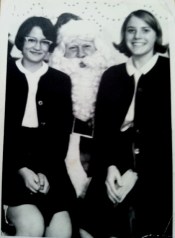
(BTW, I am on the left in the photo. My friend is on the right.)

***

Pat Bertram is the author of the suspense novels Light Bringer, More Deaths Than One, A Spark of Heavenly Fire, and Daughter Am I. Bertram is also the author of Grief: The Great Yearning, “an exquisite book, wrenching to read, and at the same time full of profound truths.” Connect with Pat on Google+



