Rubicon Ranch: Secrets — My Newest Chapter

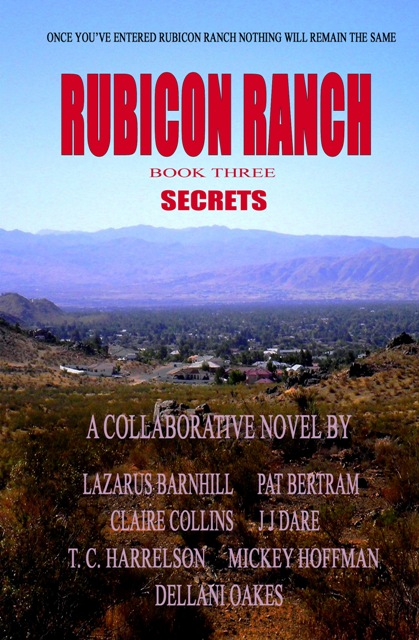
RRBookThreemidsizeRubicon Ranch is a collaborative and innovative crime series set in the fictional desert community of Rubicon Ranch and is being written online by the authors of Second Wind Publishing.

In the current story, the  body of a local realtor is found beneath the wheels of an inflatable figure of a Santa on a motorcycle. The realtor took great delight in ferreting out secrets, and everyone in this upscale housing development is hiding something. Could she have discovered a secret someone would kill to protect? There will be suspects galore, including a psychic, a con man, a woman trying to set up an online call-girl service, and the philandering sheriff himself. Not only is the victim someone he had an affair with, but he will also have to contend with an ex-wife who has moved back in with him and a jilted lover, both with their own reasons for wanting the realtor dead.

We hope you will enjoy seeing the story develop as we write it. Let the mystery begin! Whodunit? No one knows, not even the writers, and we won’t know until the very end! If you don’t want to miss further chapters, please go to the blog and click on “sign me up” on the right sidebar to get notifications of new chapters.

(If the Christmas theme seems unseasonal, well . . . considering how long it takes to write a book at the rate of a chapter a week, in a few months, the season will catch up to us!)

Chapter 15: Lydia Gavin
by Pat Bertram

Sunday, December 23, 2:20pm

Lydia sat by Zazzi’s pool, soaking up what rays she could. She had helped Zazzi open the umbrella over the patio table, but since it was too cold to sit in the shade, she’d moved a chair out into the sunlight.

Sun.

Fire.

Lydia stared up at the pale blue winter sky and shivered with delight at the thought of that burning ball overhead. Did the Goddess love fire as much as she did? Is that why she had created so many suns?

Lydia smiled, remembering the flames curling around the hideous living room furniture. She had lied to Zazzi about not being in the house when the fire had started, but she saw no reason to tell the truth. Zazzi sure as hell wasn’t being honest with her. Lydia might not be a cop any more, but she still had her cop’s nose, and that nose told her whatever business Zazzi operated didn’t bear scrutiny. Still, the woman had made her welcome and offered her a room for the night, which made Lydia think kindly of her. And anyway, Lydia had to admit her own life no longer could hold up under a close examination.

With Nancy and her prying eyes and magpie mentality out of the way, though, she was safe, at least for a while.

How much had Nancy known? In her mind, Lydia went over every detail of her husband’s death, and couldn’t see where she had slipped up. No one knew of her husband’s abuse, not even Seth. When she and Seth were naked together, she’d kept the lights dimmed so any welts and bruises wouldn’t show, and if he’d inadvertently aggravated the injuries, he’d mistaken her groans of pain as moans of pleasure.

She’d vowed that the beating her husband gave her for having the affair would be the last time he’d ever hurt her. Things were okay at first after she got kicked off the job—he’d liked the idea of a slave wife—but then came the day he’d lost a big case. He’d blamed her, of course, saying that she’d never be a proper lawyer’s wife. He’d raised a hand to her. She dashed away. He caught her at the top of the stairs. She pushed. He fell down the marble steps. Cracked his head. She stared at him for a moment, wondering if she should call an ambulance—he’d probably be okay with immediate care. Instead, she sneaked out the back door, went for a run, and left him to die.

Dozens of people had seen her jogging in her fuchsia shorts and lime green top, and though she’d been questioned, the cops never suspected her. Why should they? She had an alibi and she’d always played the loving wife in public.

But Nancy had found out. Or had she? When the realtor said in that oh, so ominous voice, “I know you killed your husband,” could she have been merely fishing?

It didn’t matter now. Nothing mattered but those lovely dancing flames. Even Seth’s love had never ignited her the way the heat of the fire had.

As she’d watched the flames devour the furniture, the stone Lydia had seemed to melt and flow like lava, and suddenly she’d been awash in a volcano of molten tears. She’d never known such life. Love. Ecstasy.

She’d managed to wrest herself away from the flames and rush outside before her new love could hurt her as much as her past loves, and although she wanted to continue her enthrallment with the blaze, she couldn’t bear to be around the gawkers. What could they know of the love that now burned in her heart? Only the paltry excitement of destruction kept them riveted to the scene.

Lydia had wandered off in a daze, and hadn’t come back to herself until Zazzi had confronted her. She’d managed to hide her rapture behind cop’s eye—that cold calculating look was not something you ever forgot how to give—keeping her secret safe in her heart.

Lydia stared up at the sun, and took a deep breath. The air smelled deliciously of smoke and ashes and charcoal and burnt offerings. Is this what the Goddess smelled every day of creation? Lydia stretched, like a cat on a warm hearth, and wondered where to go from here.

Home, probably. She could no longer remember why she’d come to Rubicon Ranch. Had she come just to be near Seth? To try to get back together with him? To get even? To remove her competition? To warn his new love of his philandering ways?

It hadn’t been hard to find out about his affair with Nancy. She’d simply followed him one day when he left the sheriff’s department and seen him meet with the realtor. She’d only made an appointment with Nancy to see what Seth preferred over her, but had stayed to watch the fun when she realized Seth had met his match.

Were all men so blind they couldn’t see what was in front of their very eyes? She had deeply loved Seth, wanting only the best for him, and he had thrown her away, calling her a vituperative bitch. Yet Nancy, who didn’t love him, and who truly was a vituperative bitch, he had kept.

But now she was through with men and their incomprehensible needs. She had found something better. Something that would never let her down. Something that would forever burn in her heart.

Fire!

***

Pat Bertram is the author of the suspense novels Light Bringer, More Deaths Than One, A Spark of Heavenly Fire, and Daughter Am I. Bertram is also the author of Grief: The Great Yearning, “an exquisite book, wrenching to read, and at the same time full of profound truths.” All Bertram’s books are published by Second Wind Publishing. Connect with Pat on Google+

Whose Story are You Writing?

Every story is someone’s story. Whether we are writing about war, child abuse, romance, murder, or any other topic, we must make readers care about a character. Readers want someone to root for, to bond with, to love. Once they have found that, they will be eager to read further.

Sometimes it’s hard for us writers to decide whose story we are writing. We create a lot of characters while writing our novels, and we fall in love with all of them, even the villains. We feel disloyal to our creations if we give one character more consideration than others, and we believe the story needs all those points of view. But the reader knows only what is on the page, not what is in our minds, and all those equally significant characters become confusing. Readers need to know whose story it is. Or whose story it mostly is.

One way for us to decide this is to figure out which character has the most at stake and which one will change the most. If we are lucky, the two will be the same, and we will know whose story it is. If not, we have to make the character who will change the most into the main story character while upping that character’s stakes.

A character with nothing to lose is not one people will care about. If someone in the story parachutes out of a plane for fun, readers might find it entertaining, but they won’t be concerned. But if someone wearing a faulty parachute jumps out of a plane into flames to save a child lost in the middle of a forest fire, everyone except the most curmudgeonly will care.

The same is true of character growth. A character who remains static, who learns nothing from experience, is not someone readers can love. A story is always about change, and since a story is also about a character, that character must grow, or should at least change in some small way. A timid character might learn to stand up for himself. An arrogant character might learn a touch of humility. The essence of the character does not need to change. A timid reporter who turns into superman is the stuff of comic books, not a realistic novel. But a character who grows, who learns, who comes back from his or her experiences with something to share, that is a character readers care about.

And that’s whose story it is.

***

Pat Bertram is the author of the suspense novels Light Bringer, More Deaths Than One, A Spark of Heavenly Fire, and Daughter Am I. Bertram is also the author of Grief: The Great Yearning, “an exquisite book, wrenching to read, and at the same time full of profound truths.” Follow Pat on Google+. Like Pat on Facebook.

How to Hook a Reader

The age of writing long descriptive passages (or even short ones) at the beginning of a novel has passed. Today people want to be drawn immediately into the story without wading through such excess. An editor might look at the first five pages before tossing aside your manuscript, but potential customers will give you a mere twenty seconds to draw them in. Once you have caught their attention, they might read a little further, and perhaps they will even buy the book. They certainly will not wade through five, ten, fifty pages until they get to “the good part.”

That “good part” must be right up front, especially if you’re a first-time writer. That’s all you have going for you — the ability to get off to a fast start and capture the reader’s attention. Your name certainly won’t do it; no one knows who you are yet. Your credentials might help, but only to establish your credibility after a potential reader has been hooked. And they will never be hooked by your ability to turn a clever phrase.

So what will hook the reader?  A character. Always a character. No one reads a book for a description of the weather, a place, or an issue. They don’t even want a description of the character. They want to meet him, to see life through his eyes, to bond with him. They want to know what he wants, what his driving force is. And they want to know who or what he’s in conflict with.

Without conflict, there is no story, but without a character for the reader to care about, there is no story either. Character and conflict are inextricably combined, and together they create the tension necessary to sustain a story. I know you think it’s okay to let the tension rise slowly, which it is, but the tension level at the beginning must be high enough to let the reader know something is going on.

I rewrote More Deaths Than One four times, and each time, the story fell flat. It wasn’t until I realized I’d spent too much time describing things or had Bob alone meandering through much of the story that the book took on life. I gave Bob a love interest, a server he met at a coffee shop.

More Deaths Than One begins:

“What do you think of a guy who embezzles from his own business?”

Bob Stark recognized the voice of the graveyard shift waitress, the attractive one with the black hair. He glanced up from his contemplation of the scars on the laminated plastic table and saw her standing by his booth, gazing at him, her eyebrows quirked. She seemed to expect a response, but he had no idea what to say. 

This isn’t the real hook, it’s just enough to capture your attention so I can reel you in for the punchline.

Reviewer Sheila Deeth said, The first three pages of “More Deaths than One” have to constitute a serious contender for the best opening scene of a novel. Two main characters are introduced, a garrulous waitress and a taciturn hot-chocolate customer. They meet. She talks, a lot. He reads the paper. “And Lydia Loretta Stark was dead. Again.” With two such immediately real and appealing characters, and a line like that, I’d challenge anyone not to want to keep turning the pages.

***

Pat Bertram is the author of the suspense novels Light Bringer, More Deaths Than One, A Spark of Heavenly Fire, and Daughter Am I. Bertram is also the author of Grief: The Great Yearning, “an exquisite book, wrenching to read, and at the same time full of profound truths.” Follow Pat on Google+. Like Pat on Facebook.

Authors Connecting With Readers

I read an article the other day telling writers they should be connecting with readers online instead of other writers. He gave a few suggestions like going on Goodreads, following people who read the same sort of book you wrote, leaving comments on their reviews or joining the same groups and responding to the same discussions they do.

Is this what online promotion has come to? Authors stalking readers like prey? Many readers do like to interact with authors, and perhaps they would be flattered if it were an author they knew, but an unknown author trying to connect with an unknown Readingreader seems tacky at best. I know I would hate it if I found myself in some author’s sights, and I can’t imagine I’m the only one who would.

I am not a reader who likes to connect with authors. (Though I love when readers connect with me!) To me, a book exists separate from its creator, a thing in and of itself. In fact, once I started coming in contact with writers, especially writers whose book I have read, I lost all interest in reading. It made me more cognizant of the person behind the story, and made the book much less personal.

I do have a group for connecting with readers on Facebook, the Genre Book Club, but most of the people who participate are authors in search of readers. The main problem is that I don’t seem to be able to get people to discuss the books they read. Everyone has different tastes, and few of the participants read the same books.

It is a conundrum, this online promotion. I do realize that connecting with other writers is not the way to sell a ton of books, but writers send me a lot more invitations to connect than readers do, and after all, many of us writers started out as readers.

The article also suggested attracting readers by blogging about the subject matter of your books. I do this, of course, when it comes to grief, but I said all I want to say about conspiracy theories, government intervention in our lives, and the scary possibility of an unstoppable epidemic in my novels. I don’t want to spend the rest of my life talking about such matters. The books were a way of my putting an end to those topics of research, and to keep them in the forefront of my mind and this blog would be appallingly boring. (For me, anyway.)

Still, this blog is a way of connecting with people, not as stalker and prey, but simply as two individuals who happen to be in the same place at the same time and like what each other has to say. And that’s more important than running after readers in the hopes they will buy my books.

***

Pat Bertram is the author of the suspense novels Light Bringer, More Deaths Than One, A Spark of Heavenly Fire, and Daughter Am I. Bertram is also the author of Grief: The Great Yearning, “an exquisite book, wrenching to read, and at the same time full of profound truths.” Follow Pat on Google+. Like Pat on Facebook.

Keeping Track of Characters

LBI don’t often do character profiles before writing a novel except to decide on basic information — gender, a couple of physical traits and maybe general idea of personality type. I prefer to let the needs of the story dictate who the character is. I mean, if I have created a caring, nurturing character, and the story demands a wisecracking sharpshooter, then the story starts out with problems from the beginning. (Unless, of course, the wisecracking hides a caring, nurturing side of the character, which could make for an interesting character, though I’m sure it’s been done thousands of times before.)

Each book, of course, has its own demands, and Light Bringer had more demands than most. It was the only book I did a storyboard for. Halfway through, I got lost in all the points of view, the various stories that needed to be intertwined, the special needs of the novel, so I wrote a brief description of each scene on a card and played with them, dealing them out in various arrangements until I found the best way to fit all the pieces together.

Light Bringer was also the only book I did a character chart for. The story was based on both modern and ancient conspiracy theories (though ancient conspiracy theories fall under the category of “myth”). Instead of having one erudite character lecture a clueless character on the theories, I created a discussion group where each character believed and vociferously defended his or her pet theory. One unexpected benefit of the group was that I had ready-made pool of characters to draw from for bit parts.

Group dialogue causes problems for readers in that it’s hard sometimes to keep track of who is talking and what their purpose is in the story. It’s also hard for writers to keep track, so I made a chart of all the characters, their beliefs, style, food needs, and various other aspects to make sure that each was different.

For example, Scott Newman, a retired banker, believed that the international bankers were controlling the world to gain total wealth and power. He was lean, sharp-featured, contemptuous, didn’t eat “corporate foods” (things like chips and frozen dinners that were created by corporations) because as a loan officer, he’d already done enough to further the aims of the international bankers.

Faye Pozinski was almost his direct opposite. She believed that the British oligarchy (London bankers, the London School of Economics, the Fabian Society, the Rhodes Round Table) were controlling the world to create a neoBritish empire ruled by a theocratic world king. An ample woman in her fifties still working as a grocery clerk, Faye was hearty with a braying voice, a vegetarian, and delighted in wearing wildly colored clothes.

And then there was Chester, a wizened, jeans-wearing diabetic fruit grower who overdramatized everything. He’d once seen a UFO over his orchard, and he believes we are ripe for an alien takeover because he’s convinced these otherworldly creatures want to keep us from blowing up the earth.

These are only three of my discussion group characters but you can see why I needed a chart. So much to keep track of!

***

Pat Bertram is the author of the suspense novels Light Bringer, More Deaths Than One, A Spark of Heavenly Fire, and Daughter Am I. Bertram is also the author of Grief: The Great Yearning, “an exquisite book, wrenching to read, and at the same time full of profound truths.” Follow Pat on Google+. Like Pat on Facebook.

How do you give readers the background information they need?

All my books seem to have a character like Teach, my learned con man from Daughter Am I, who tends to be a lecturer. The hardest part of editing that particular book was to take out everything that wasn’t essential to understanding the story. I worry that Teach’s talk about the history of gold is a bit much, but there is no way to understand why the gold was buried without understanding the history of the era. I did try to space the information to add a bit of suspense at times or to offer a respite from the action at other times.

For Light Bringer, I had to present various conspiracy theories, and instead of having a character like Teach to “teach” the theories, I created a discussion group, each member of which believed a different theory and vociferously defended it while denigrating what the others believed. It was a fun way to present the information without an extended information dump.

Here are some responses from other authors about giving readers the background information they need. The comments are taken from interviews posted at Pat Bertram Introduces . . .

From an interview with Donna Galanti, Author of “A Human Element”

I try to tease them with only a few descriptive details of backstory and setting as I go along. Give them only what they need at the time. Readers want to feel smart. They like to fill in the blanks, as long as there aren’t too many blanks. I try and look at all backstory and gauge if it serves the story. If it doesn’t out it goes. By introducing questions early on with giving just enough information to keep the story going, we involve the reader, take them along for the ride, and…build suspense. Hopefully!

From an interview with Sam Lopez, author of “Dead Sea”

Disputes between characters can provide helpful information but if there is no conflict, then sometimes you just have to spell out what needs saying.

What about you? How do you deal with exposition and give readers the background information they need?

(If you’d like me to interview you, please check out my author questionnaire http://patbertram.wordpress.com/author-questionnaire/ and follow the instruction.)

***

Pat Bertram is the author of the suspense novels Light Bringer, More Deaths Than One, A Spark of Heavenly Fire, and Daughter Am I. Bertram is also the author of Grief: The Great Yearning, “an exquisite book, wrenching to read, and at the same time full of profound truths.” Follow Pat on Google+. Like Pat on Facebook.

Sample Sunday

If you’ve been wanting to check out my books, now is your chance to read the first chapter of each novel online. Who knows, you might get so intrigued you will want to buy one of the  book to take with you to the beach this summer or read on an airplane. (Or, for my friends in the southern hemisphere, you might decide one is the perfect companion to read by the fire on a chilly winter’s eve.) I hope you will enjoy sampling a “Pat Bertram” book.

More Deaths Than OneBob Stark returns to Denver after 18 years in SE Asia to discover that the mother he buried before he left is dead again. At her new funeral, he sees . . . himself. Is his other self a hoaxer, or is something more sinister going on?

Click here to read the first chapter: More Deaths Than One

***

A Spark of Heavenly FireIn quarantined Colorado, where hundreds of thousands of people are dying from an unstoppable, bio-engineered disease, investigative reporter Greg Pullman risks everything to discover the truth: Who unleashed the deadly organism? And why?

Click here to read the first chapter of: A Spark of Heavenly Fire

***

DAIWhen twenty-five-year-old Mary Stuart learns she inherited a farm from her recently murdered grandparents — grandparents her father claimed had died before she was born — she becomes obsessed with finding out who they were and why someone wanted them dead.

Click here to read the first chapter of: Daughter Am I

***

Thirty-seven years after being abandoned on the doorstep of a remote cabin in Colorado, Becka Johnson  returns to try to discover her identity, but she only finds more questions. Who has been looking for her all those years? And why are those same people interested in fellow newcomer Philip Hansen? And what do they have to do with a secret underground laboratory?

Click here to read the first chapter of: Light Bringer

***

Pat Bertram is the author of Light Bringer, More Deaths Than One, A Spark of Heavenly Fire, and Daughter Am I.All Bertram’s books are available both in print and in ebook format. You can get them online at Second Wind Publishing, Amazon, B&N and Smashwords.  At Smashwords, the books are available in all ebook formats including palm reading devices, and you can download the first 20-30% free!

Serial Killers and Sociopaths

Despite fads and new genres, serial killers endure as a favorite villain for writers and readers alike, though I lost my taste for such books years ago. For one thing, too many writers use killing as a cheap way of escalating tension, with each murder upping the ante. For another thing, too many writers perpetuate the serial killer myth of the white, middle-class, intelligent, charming male about thirty-five years old.

Dr. Katherine Ramsland, a forensic psychologist, debunks this stereotype in a guest post she did for this blog: Serial Killers and the Writers Who Love Them: Facts about Popular Myths. As Ramsland points out, “Serial killers are not all alike. They’re not all male. Some have been as young as eight or older than fifty. They’re not all driven by sexual compulsion. They’re not all intelligent, nor even clever – often, they’re just lucky. They’re not all charming. A single killer may choose different weapons or methods of operation, although they will tend to stay with whatever works best. Even with rituals, the basis of a ‘signature,’ they often experiment and change things. They might be profit-driven, in search of thrill or self-gratification, or compelled by some other deep-seated desire, fear or need. Occasionally, serial murder is about revenge or it’s inspired by a delusion. In most cases, the killer does not wish to be stopped or caught. Yet a few do intentionally undermine themselves or stop of their own accord. Some rare killers have even professed remorse or killed themselves.”

Far more fascinating to me are the sociopaths who don’t kill. Some psychologists estimate that there are thirty thousand mindpsychopaths who are not serial killers for every one who is. (Some professionals use “sociopath” and “psychopath” interchangably as I am doing and some argue there is a difference, but oddly, no one seems to agree on what those differences are.)

So who are these non-killing psychopaths? Your neighbor, perhaps, or your mother-in-law. Probably many politicians and scientists. Possibly even you.

(In A Spark of Heavenly Fire, Peter Jensen says: “I have a theory, entirely unproven, that a lot of psychopaths gravitate to the sciences, biology especially, where they can hide behind that famed scientific detachment. They can also torture animals in the name of science, and no one calls them insane.”)

Even if you don’t write crime fiction, familiarity with the sociopathic personality can help you create dynamic characters and even interesting dialogue. For example, sociopaths frequently use contradictory and illogical statements such as “I never touched her, and anyway, she wanted it.”

A sociopath has difficulty connecting to others, though people often like them. They can be charming, glib, witty, and use captivating body language. (Sounds like a politician, doesn’t it?) Because of their impulsiveness, need for excitement, no need to conform to societal standards, poor behavior controls, and lack of responsibility, they can be fun companions, but because they lack empathy, conscience, and remorse, they can never truly connect with anyone.

One characteristic that keeps a sociopath from being a good fiction hero is that in fiction heroes need to change during the course of the novel, and sociopaths have solid personalities that are extremely resistant to outside influences. But, being the manipulative creatures that they are, they can make us believe they have changed.

In a relationship, such manipulation might be intolerable, but in fiction, it makes for a interesting character, even if the character isn’t a killer.

***

Pat Bertram is the author of the suspense novels Light Bringer, More Deaths Than One, A Spark of Heavenly Fire, and Daughter Am I. Bertram is also the author of Grief: The Great Yearning, “an exquisite book, wrenching to read, and at the same time full of profound truths.” Follow Pat on Google+. Like Pat on Facebook.

Does your understanding of the story you are writing change during the course of the book?

Before I wrote A Spark of Heavenly Fire, I did extensive research into pandemics and into the government’s response to such emergencies (I based my fictional response on actual executive orders that Clinton signed), so there wasn’t much change in my understanding of these matters during the course of the book, but there was a big difference in my thoughts about what “they” want us to know and what they don’t. When I learned about Pingfan, the Japanese biological warfare installation where they did horrendous experiments on POW’s and nearby villagers, I thought I’d stumbled onto something really explosive. Yet, as happened to a character in A Spark of Heavenly Fire, the very next novel I picked up used Pingfan as a setting. It got me to thinking about the nature of cover-ups, and many of the discussions in the last half of the book were actual discussions I had with a friend while I was writing the book.

Here are some responses from other authors about how their understanding of the story changes during the course of the book. The comments are taken from interviews posted at Pat Bertram Introduces . . .

From an interview with Sherrie Hansen, Author of “Love Notes”

I start the story, my characters finish it. Themes come to me as the book goes on, and often, when it’s totally finished. Sometimes I have to rewrite the beginning of the book, because by the time I’m done, I know the characters so well that I think they would never say or do the things they did at the beginning of the book.

From an interview with Cynthia Vespia, Author of “Sins And Virtues”

Sometimes. That makes it fun though. You expect it to go one way and instead it veers off course and takes you to an entirely new level. For me, when that happens, it feels like I’m reading it myself.

From an interview with Alan Place, Author of “Pat Canella: The Dockland Murders”

My understanding is constantly changing as the character evolve their own lives, I never try to force them to do things that I feel don’t fit.

What about you? Does your understanding of the story you are writing change during the course of the book?

(If you’d like me to interview you, please check out my author questionnaire http://patbertram.wordpress.com/author-questionnaire/ and follow the instruction.)

***

Pat Bertram is the author of the suspense novels Light Bringer, More Deaths Than One, A Spark of Heavenly Fire, and Daughter Am I. Bertram is also the author of Grief: The Great Yearning, “an exquisite book, wrenching to read, and at the same time full of profound truths.” Follow Pat on Google+. Like Pat on Facebook.

Describe your writing in three words

Three words to describe my fiction writing:

colorful, character-driven, conspiratorial

Here are some responses from other authors about three words they would use to describe their writing. The comments are taken from interviews posted at Pat Bertram Introduces . . .

From an interview with Donna Galanti, Author of “A Human Element”

Haunting. Dark. Hopeful.

From an interview with Siobhán Nolan, Author of “Old Man Harry”

Silly, relatable, fanciful.

From an interview with Andrew Scorah, Author of “Homecoming Blues”

Dark, gritty, cool

What about you? How would you describe your writing in three words?

(If you’d like me to interview you, please check out my author questionnaire http://patbertram.wordpress.com/author-questionnaire/ and follow the instruction.)

***

Pat Bertram is the author of the suspense novels Light Bringer, More Deaths Than One, A Spark of Heavenly Fire, and Daughter Am I. Bertram is also the author of Grief: The Great Yearning, “an exquisite book, wrenching to read, and at the same time full of profound truths.” Follow Pat on Google+. Like Pat on Facebook.