Building a Story from the Inside Out

Jordan Dane, national bestselling and award-winning thriller writer, is guesting my blog today. I know guesting isn’t a word, but I’m still pleased that she consented to be my guest blogger. She is also hosting a discussion on my Suspense/Thriller Writers  group on Facebook, so stop by and add your bit to the onion, or leave a comment for her here. Jordan writes:

Ever thought about building an onion from the inside out? (Come on. Humor me!!)

This little exercise of writing the dialogue first came from having to split my time between my day job and writing. On my special writing days, I’d grab lunch by myself and take a notepad with me. (I wasn’t really alone. Like Sybil, writers never are. Oh, I just scared myself.)

People would always comment that my scenes jumped right into the action with pace, sharp concise narratives and to-the-point dialogue. In trying to explain to another writer how I do this, I had to understand it myself. That’s when I realized how much my little lunchtime exercise had trained my brain to think this way-in terms of breaking down elements to any scene.

I had broken apart the dialogue from the rest of the narrative as a more efficient use of my time before I got home that night to finish the scene. Consequently, the dialogue got my full attention. And I usually tend to visualize the scene in my head as a TV program or movie. Visualizing it like a movie stirred my thoughts on the scene and helped orient me into the characters’ motivation too.

I later learned aspects of this method are called LAYERING. You can use it to build that onion as I describe below or use it to add more emotion or tension or atmosphere to your scenes-whatever you want more of-even after you think that scene or book is finished. Layering is one of the last steps I use when I’m doing my final edits on a novel. I read through the book and punch up the various scenes until I’ve come to the last page.

1. FIRST-Use dialogue as the framework for the scene (like a screen writer)

Consider writing the dialogue first so you can concentrate on it (Use this as an exercise only. Once you get this down, you won’t need to do this time and time again.)

Make the dialogue important-There’s nothing like witty banter or a clever verbal skirmish between two adversaries

If your character confronts someone at a high school reunion that they haven’t seen in twenty years when they buried a body after Prom, you better have them say more than, “Gee, nice sweater.” Chitchat would never happen in real life, given this situation, unless these two people are guiltless serial killers. Too much introspection can kill the impact of their first meeting. Personally, I like a challenge like this. And don’t get me started on the whimsical world of the serial killer. But think about it-what WOULD they say to each other?

2. SECOND-Body Language/Action

Body language can be fun, especially if it contradicts what the character is saying in dialogue-Use it! Manipulate it!

Be concise and not too wordy with action, but keep it REAL. If guns are blasting, remember your characters are dodging bullets, not witty banter. Bullets stop for no man…or woman!!!

3. THIRD-Mood & Setting-Use it to accentuate what’s happening.

I LOVE LOVE LOVE the mood created with a great setting. It can embellish the emotion in a scene or add an underlying tension (ie an escalating storm or a well-placed gust of wind against a silk blouse or skirt). The beauty is in the details.

4. LAST-Emotional layering-Introspection

Give your character a journey through the scene. Don’t just repeat the same old thoughts over and over in different ways no matter how clever you are. Have their introspection grow or change.

Too much introspection, for me as a reader, slows the pace. But if an editor wants it, read my first point over again and build upon the emotional layers with new material. Insights into a character can be a wonderful gift to your reader.

5. THEN STAND BACK AND TAKE A LOOK-What’s there? Do you have a whole ONION or a lemon?

Make every scene into a tight mini-story with a hook beginning and a memorable page-turning end. Or end it with a beautiful image a reader will remember and feel long after they’ve put the book down.

Or stop in the middle of the action and continue it on the top of the next chapter.

You are in control of your story’s layout. Make it interesting.

NOTE: For more writer resources, please check out my website FOR WRITERS page for craft tips, promotion ideas, and other articles like my “First Sale” story or “How to Make a Book Trailer FOR FREE”.
Meaningful Names

I just finished reading a book where the men’s first names were North, West, and Laine, and the women’s first names were Whitney and Blaire. Forgetting for the moment the silliness of naming two unrelated males in a book after directions, whatever happened to simple names? Names with meaning? Like Andrew (which means manly) and Louis (which means famous warrior) or Bonnie (which means pretty) and Mildred (which means gentle hope). I suppose Mildred is too old-fashioned for a child of today, but I do like what it means. Maybe someday I will name a character Mildred — I can see her now, a quiet little girl with long dark hair, who resembles the great-grandmother she was named after.

Whether it’s for a character in a book or for a baby, a name can become destiny, so it needs to mean more than a direction.

Other meaningful names:

Alden: Old friend
Alfred: Good counsel
Arnold: Power of an eagle
Basil: Kingly, royal
Bernard: Bold as a bear
Carmen: Song
Clement: Merciful
Curtis: Courteous
Cyril: Lordly
David: Beloved
Dennis: God of wine
Derek: Ruler of the people
Dexter: Fortunate
Donald: World leader
Earl: Warrior
Edgar: Spear of wealth
Edward: Guardian of wealth
Felix: Happy, prosperous
Gregory: Vigilant
Hector: Holding fast
Hubert: Bright in spirit
Ira: Watchful
Jason: Healer
Leonard: Strong, brave
Leroy: Royal
Lionel: Young lion
Maynard: Bold in strength
Merle: Blackbird
Morgan: Dweller on the sea
Nathan: Gift
Raymond: Wise protection
Richard: Strong in rule
Robert: Strong in fame
Solomon: Peaceful
Winfred: Joyous peace
Wolfgang: Path of the wolf

Abigail: Source of joy
Adelaide: Of noble rank
Alma: Cherishing
Amy: Beloved
Audrey: Noble strength
Beatrice: She that makes happy
Bernice: Bringing victory
Bertha: Bright
Bonita: Pretty
Celeste: Heavenly
Cherie: Dear
Clara: Bright
Dorcas: Gazelle
Esther: Star
Ethel: Noble
Eunice: Happy Victory
Evangeline: Bringing good news
Felice: Happiness
Florence: Bloom, prosperity
Hilda: Battle
Irene: Peace
Iris: Rainbow
Leila: Dark as night
Letitia: Gladness
Mabel: Lovable
Melanie: Blackness
Nadine: Hope
Naomi: Pleasant
Phoebe: Shining
Regina: Queen
Sylvia: She of the forest
Vera: Faith

***

Pat Bertram is the author of the suspense novels Light Bringer, More Deaths Than One, A Spark of Heavenly Fire, and Daughter Am I. Bertram is also the author of Grief: The Great Yearning, “an exquisite book, wrenching to read, and at the same time full of profound truths.” Follow Pat on Google+. Like Pat on Facebook.

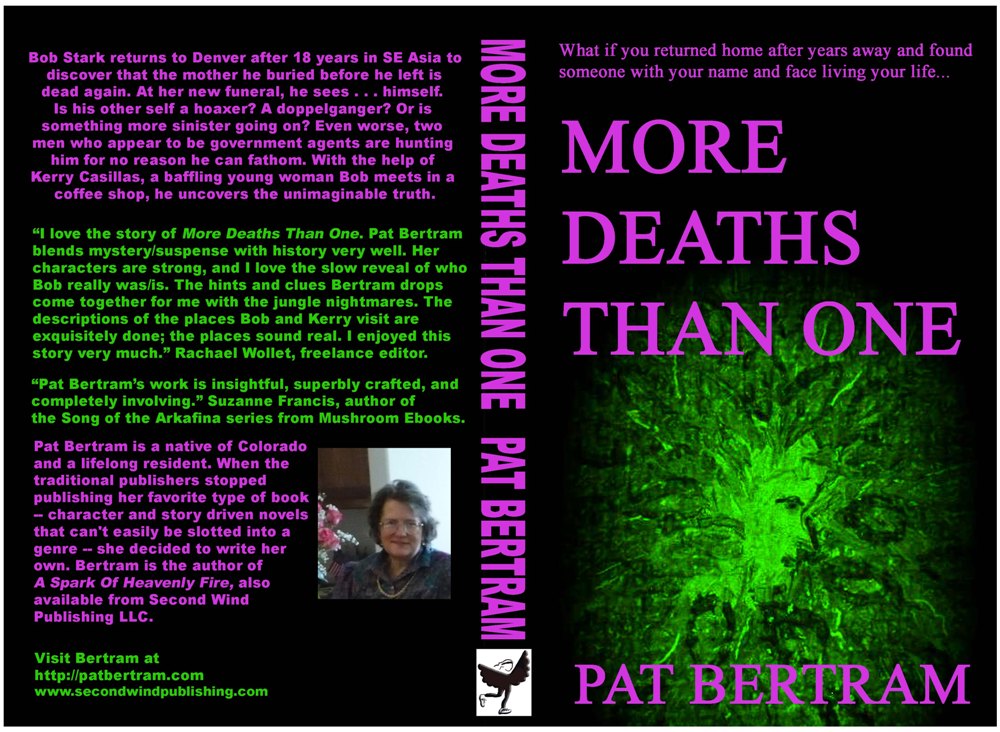
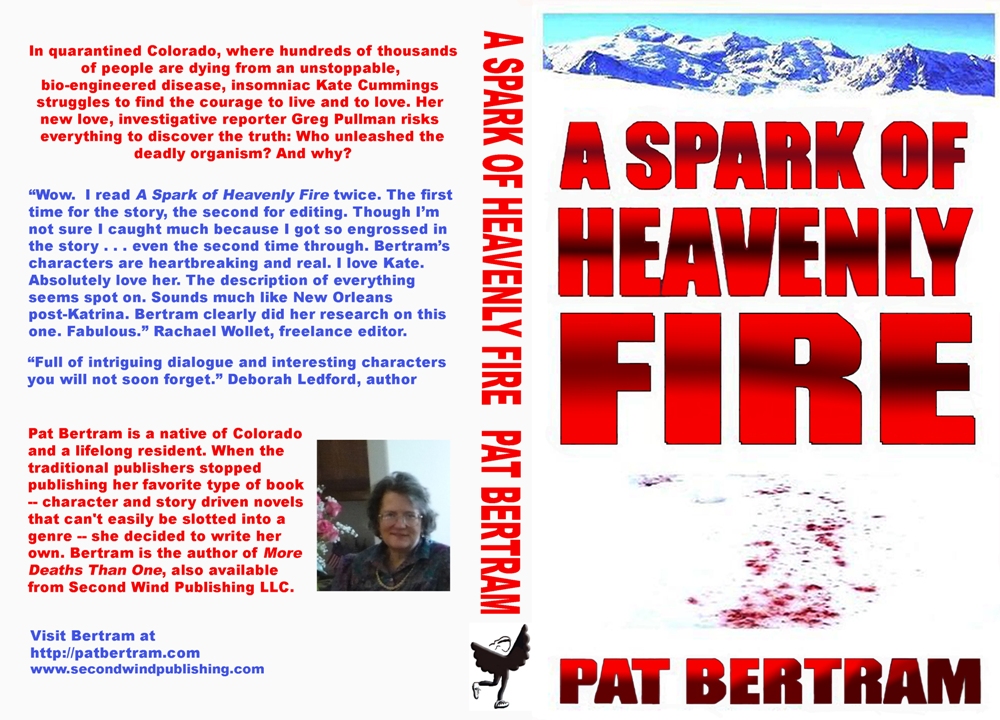
Sneak Preview of My Book Covers.

Front and Back Covers of More Deaths Than One

Front and Back Covers of More Deaths Than One

Front and Back Covers of A Spark of Heavenly Fire

Front and Back Covers of A Spark of Heavenly Fire

Heart of Diamonds

My guest blogger today is Dave Donelson, author of Heart of Diamonds, a romantic thriller with roots in reality. Donelson says: 

There has been a great deal of discussion about reality versus imagination in memoir, but something that’s often overlooked is the role real events and people can play in fiction. 

That is especially true in a novel like Heart of Diamonds, my high-concept romantic thriller about blood diamonds in the Congo. The plot concerns the White House, the President of the Democratic Republic of Congo, and an American televangelist in a diamond smuggling scheme that is uncovered by an enterprising TV reporter, Valerie Grey.

One of the main characters in Heart of Diamonds is Gary Peterson, the American televangelist who owns the diamond mine. He’s a fabulously successful man of God, a close pal of the President of the United States, and utterly devoted to making a quick buck or two if the opportunity presents itself. He also has a right hand man, missionary Thomas Alben, who runs the diamond mine for him and does most of the dirty work in the operation.

All of these characters are fictional, of course, but they had their genesis in the real world. The whole concept for Heart of Diamonds sprang from an article I read in Time Magazine about the cozy relationship between Pat Robertson, the famous American televangelist, and Mobutu Sese-Seko, the dictator who raped the Congo for thirty years. When I found out Robertson owned diamond mines and timber concessions in the Congo-making profits from slave labor, no less –I  simply had to write a book about it.

The Robertson-Mobutu connection is fascinating. Mobutu was essentially put in office by the CIA. He ran the country for three decades and stole literally billions of dollars. During that time, he had one of the worst human rights records in Africa.

The other member of the tag team is Pat Robertson, one of the most successful evangelical preachers of all time. He founded the 700 Club, ran for President of the United States, and has millions of followers around the world who subscribe to his version of Christianity. You wouldn’t think these two men would be buddies, but they were.

Robertson had many business interests in the Congo-and it just wasn’t possible to operate there at the time without the direct approval of Mobutu. It was also well-known that you didn’t get that approval for free. Apparently, Robertson and Mobutu got along famously. The Time article reported that one time, Robertson and his wife and their entourage were flown from Paris to Kinshasa on one of Mobutu’s personal Boeing 707s. In Zaire, Mobutu himself took them on the presidential yacht on a ride up the Congo River to visit one of his estates.

Robertson had a relief program in the Congo that is still functioning, Operation Blessing, as well as a private concern called the African Development Company, which made investments in mining, lumber, agriculture, transportation and power generation, supposedly with an eye to plowing the profits back into humanitarian efforts. One of those investments was a diamond mine in a small town south of Tshikapa near the Congo’s border with Angola. That’s the site of the diamond mine in Heart of Diamonds.

One of the men who ran ADC for Robertson was Bill Lovick, a former minister of the Assemblies of God who was dismissed by the church in 1985 for questionable fund-raising practices. Readers of Heart of Diamonds may find some interesting similarities between these men and some of the characters in the novel, notably televangelist Gary Peterson, the missionary Thomas Alben who runs the diamond mine, and Moise Messime, the President of the Congo.

The more I learned about these guys and the things they were doing in the Congo in the name of Jesus Christ, the more intrigued I became. Heart of Diamonds isn’t their story-the smuggling scheme, the connection to the White House, the U.S. military involvement, and many other elements are completely fictional. The characters are figments of my imagination, too, although they certainly have personality traits similar to some real individuals.

What is very real in Heart of Diamonds is my portrayal of the terrible plight of the people of the Democratic Republic of Congo, which is the direct result of the unadulterated greed of people trying to control the vast natural resources of the country. Mobutu may be long gone and Pat Robertson’s business interests gone with him, but the brutality continues.

Interview with C.A. Milson, author of The Chosen

Interview with C.A Milson, author of The Chosen, available from Amira Press:

Bertram: What inspired you to write The Chosen?

CM:  The first inspiration for writing this particular story came to me in 1989, when I was living in Melbourne, Australia. The original story was titled “Shack of Evil”, a 9-page story based on the character of Jamiesonn. The story idea came from a Hobbytex picture my mother had on the wall of her apartment. After writing “Shack of Evil”, I went on to write an additional 25 short stories, all of different genres, including a children’s story. “Shack of Evil” would later become the base for what is now the trilogy of The Chosen, Bloodline of Darkness, and Prophecy’s End.

Bertram: What was the hardest part of writing your novel?

CM: The hardest part is the re-writing of chapters and scenarios. No part of writing is perfect from the first sentence, as I will have an idea for a chapter, then when I have reviewed it I am likely to scratch that whole scene and go in a completely different direction. The other hard part is coming up with new ideas and concepts. There are times when I can sit in front of the computer for hours with no inspiration at all.

Bertram: What is your favorite scene?

CM: One of my favorite scenes in The Chosen is when Alex faces his nemesis for the last time. Alex has been anointed with supernatural power that even the forces of darkness sit back in awe. There is a scene where he is thrown into the sea of fire, and . . . well, I won’t say too much as that will give the plot away.

Bertram: What do you hope readers will say about your book?

CM: I hope my readers will say that they loved my novel and await the second one to come out!

Bertram: What’s next for you?

CM: Next for me is writing Bloodline of Darkness, which is the second in the trilogy in the life of Alex Manning — a man who is put in the middle of a spiritual conflict he otherwise wants no part of. Bloodline of Darkness is set seven years after The Chosen. Alex has forsaken his powers to live a “normal” life, and the forces of Tartarus have arisen to harvest the souls of humans and plunge the world into darkness. Alex once again must stand and save humanity but can he overcome the ever-present darkness that also reigns in his own heart?

The Story Behind “Stalking Susan” by Julie Kramer

Julie Kramer, author of Stalking Susan is here as my guest to to tell us the story behind the Susans:

Because the plot in my debut thriller involves a serial killer targeting women named Susan, people want to know if I have a special enemy by that name. I don’t. STALKING SUSAN is not a personal tale of revenge.

But some stories stay with journalists long after the newscast wraps. A decade ago, as a television news producer, I covered two cold case homicides that inspired me to write STALKING SUSAN. The cases involved two women, both named Susan, murdered exactly two years apart in St. Paul, MN.

My debut story is not their story. That’s why I use the word ‘inspired,’ rather than ‘based on.’ Their cases remain unsolved. But in the world of fiction I was free to ask myself, what if?

Being a career journalist it’s no surprise I’m a rip-it-from-the-headlines writer. But transitioning from writing news to writing fiction did come naturally. It felt like cheating. And it was work to overcome that feeling. Apparently though, I do have an imagination – a vivid one – and it kicks in for the conclusion, if not the set up.

When I wrote STALKING SUSAN, I changed the victims’ appearances, occupations, and the times and locations of their deaths. I also added more victims. I changed their last names and almost changed their first name. But I decided to keep Susan because I never forgot them and I wanted others to remember them, too.

I don’t recommend other authors give their characters the same name — I ended up with five Susans — it complicates storytelling and character development. But if I’d changed their names to Mary, I’d have ended up with a completely different plot. Because the twists in STALKING SUSAN come from using name origination and famous Susans in history as clues. Because of this, readers named Susan tell me they love the story because it makes them feel special.

When it comes to the world of news, It’s the stories without resolution that tend to stick in reporters’ minds. Besides the parallels of name and date of death – which could end up being completely coincidental – what attracted me to these cases was that they were unimportant murders, buried deep inside the daily newspapers with no real follow-up. Fifteen years later a reporter colleague and I made a run for tips and answers and came up empty. That’s how it usually ends in newsrooms, no matter what you see about reporters in the movies or read in books.

In real life, journalists don’t often catch the killer, so writing this book was a little like living a news fantasy.

But it really was just a fantasy, because bottom line, someone, maybe more than one someone, got away with murder. So any opportunity to keep the names of the true victims out there, is a good thing. So here goes:

Susan Ginger Petersen, age 28, was strangled May 17, 1983.
Susan Jean Rheineck, age 16, was asphyxiated May 17, 1985.

Their murders have never officially been connected. Not by DNA, witnesses or any other evidence. But some similarities in the crime scenes are suggestive.

Now the St. Paul Police Cold Case Unit is taking a fresh look at these murders, and privately investigators are saying wouldn’t it be funny if fiction brought attention to bring tips to solve the crimes after all this time.

To learn more about the author visit http://www.juliekramerbooks.com

Julie Kramer: Stalking Susan

Book Blogs, a Bibliophile’s Dream

I’ve been orbiting the blogosphere, looking for bloggers who will host my blog tour (if you’re interested, let me know!) for when and if my books are published. (The date has been pushed back another month, so I’m looking at sometime in December.) Most of the sites I found want a review copy, but they do not guarantee they will do a review, nor do they guarantee that it will be a complimentary one.

Sounds great — for the reviewer. If I still retained the thrill I used to get from reading (I lost it about 10,000 books ago) I would set myself up as a book blogger. Just think — I’d never have to buy another book; I’d have a steady stream of reading material; and I wouldn’t have to do anything in return unless I wanted to. And I’d get a gazillion blog readers. Well, maybe not a gazillion, but more than I get now. And, of course, it would be a great way to promote my own books.

Too bad I don’t have the spirit for it. But maybe you do. If you want to become a  book blogger/reviewer, you can find an article about how to write reviews here.

Ranting And Writing

We are always told to show not tell, yet new writers often have a hard time understanding the difference. And apparently, so do professional writers.

I found this example of tell in a book by a bestselling author. She was enraged, and this was very visible. You and I certainly could never get away with such a ridiculous sentence. How was her rage visible? Did she turn red? Did flames shoot out of the top of her head? Describing how she looked when angry, though not ideal, is better than simply saying her anger was visible, but an accomplished writer shows the anger, shows what the character did.

Perhaps she was angry at her fiancé and so she slapped him. (As an aside, why is this still acceptable behavior for women? If men aren’t allowed to hit women, then women shouldn’t be allowed to hit men.) Or perhaps she tore off her engagement ring and tossed it in the river. Even better if she surreptitiously picked up a pebble, then palmed her engagement ring, and threw the pebble in the river. That way she could show many things besides her anger: she can show that she is smart, controlled, even manipulative. Maybe she isn’t even angry; could be she just wants the guy to think she was angry.

Any way you look at it, the sentence as it stands is weak. So is this one by the same author: He remained perfectly still, not moving a muscle. At least she showed him doing something, but remaining perfectly still and not moving a muscle mean the same thing. Redunancy, anyone?

While I’m on my rant here, I have something else I’ve been meaning to say. The preferred usage now is to use a instead of his or her when referring to a limb. For example: He put a hand in his pocket. The reasoning is that if you say he put his hand in his pocket, it presupposes that he has a single hand. But I always wonder: if he puts a hand in his pocket, whose hand is it? His? A disembodied hand he just happened to have lying around? Okay, I’m getting ridiculous here, but it shows the ambiguity of words.

Sometimes ambiguity is acceptable, but more often it’s the lazy way of writing. Makes me wonder why readers shell out hard-earned money when authors are so willing to repay them with sentences such as She was enraged, and this was very visible.

Is Writing Worth the Effort?

A friend asked me if trying to become a successful author is worth the investment of time and money. Not only do writers have to hone the craft, they need to attend conferences, workshops, hire editors and publicists, build websites and promote.

I wish I knew the answer to my friend’s question. Now that my books are nearing their release date, I’ve been spending most of my time on the internet researching how to promote. And I still don’t know how to do it. Blogging, of course. Publishing articles. Making connections on Facebook and Gather. But to become successful, writers need to go beyond the obvious. Nor do I have the money necessary to do all that is required, including attending conferences, joining national writing groups, traveling to booksignings. So I have to do it on the cheap.

Is it worth it? I won’t know for a year or two or ten if I’m going to be a successful author, so right now,  I’ll leave you with the daunting facts: one and a half to two million books are written every year. 150,000 are published (about half of those are self-published), and since many carry over from year-to-year, I figure that at least a million are being peddled as we speak. 75% of published books (including some with big advances) sell less than 500 copies. 85% of published book sell less than 1000 copies. 84% of books in a bookstore sell less than 2 copies. A book is considered successful if it sells a total of 5000 copies. Considering the time it takes to write, edit, and promote, that comes to about $1.00 an hour for the author. Woohoo. (And that doesn’t take into consideration the sometimes hefty amounts people shell out for conferences, editing, classes, etc.)

Because time as well as money is at a premium, we feel guilty when we promote and let the writing lie fallow. And we feel guilty when we write and don’t promote. Juggling with fire would be easier, and less complicated, especially when the fireballs being juggled include jobs and family.

On the other hand, what choice do we have? We are writers. We need to write, and we need readers.

As a Writer, Where and How Are You Dropping Your Pebbles?

My guest blogger today is marketing consultant Sia McKye. McKye writes:

I’m a reflective person by nature.  I think about many things in life.  Look for lessons and ways to make things better for me and mine.  To me, life is like a giant puzzle made of pebbles.  Sometimes it’s comprised of hard labor.  Other times, the fun is in seeing how to work all the pieces tossed at us, and make a picture of it.  Don’t like those particular pieces? Rearrange them.   I’m also an optimist but with my feet firmly planted in reality.  I know if I work at it hard enough, think it through, I’ll find a way.  And so it is with my writing.

To be a writer is rather solitary.  We pour our hearts and souls into our writing–our characters, our created world.  They’re part of us, aren’t they?  When someone rejects that, of course we feel it AND feel they’re rejecting us. On one level that’s true, but we have to learn to compartmentalize, or we’re dead in the water.  We have to have tough Rhino skin or we’re not going to survive.  And yah, it sucks.

As with most of the entertainment/arts groups, publishing is a tough playing field to break into.  A key element to be a success in any field is to be focused, working at perfecting your skills, and believing in yourself and your abilities.

I think about authors like Nora Roberts, Jayne Ann Krentz, and Catherine Coulter.  They all started out with Harlequin and or Silhouette.  Many curled their lips at books from Harlequin.   Whether it’s a lightweight romance publisher, or POD and E-book publishers-who cares where you start, so long as you start? I believe these authors honed their story telling skills and learned what readers like and didn’t like, and built a readership base in these forums. And who are we to curl our lips, or diminish the worth of an author that makes those choices? Now, these authors are now regularly on the Best Sellers lists.

Singers start out playing local, market themselves aggressively, and get their names out there.  How?  Singers play for anyone that lets them sing.  Bars, lounges, you name it.  Actors do the same with local theatre, and work their way up. They network like crazy.  Are you doing that as a writer? 

Pebble in the pool effect.   Think about American idol.  These singers are looking for shortcuts and there isn’t anything wrong with that, but even the shortcuts come with fierce competition.  As authors, we do contests too, so we can relate.

What’s important here is: if the pebble isn’t first dropped into a pool of water, no ripples happen.  The pebble has to be dropped more than once. It’s the same with writing.  Every time you write a story, you drop a pebble and every time you query, or enter a contest, you drop another one.  Every blog, writer’s conference, and joining a writing group is another pebble.

 Maybe only a few of us will make it big.  The truth of the matter is; it’s not solely dependent upon talent.   There are lots of talented people.  Sometimes chance or fate or whatever you want to call it, steps in.  But, if we’re not putting forth the effort, and getting our writing, our name out there, it can’t be offered.

There’s a quote I like and I’ll share it with you.  Opportunity dances with those already on the dance floor.”

 …or dropping the pebbles.

It’s something I think about frequently-what am I doing with my pebbles?

Stacking them in a pile with no work or thought given them?

Am I hoarding them in a drawer where no one can see them?   

Am I allowing fear of success or failure, hold me back?  


By putting our work out there, we’re on the dance floor or to continue the metaphor, dropping our pebbles.

 As a writer, where and how are you dropping your pebbles? Are your pebbles used to the best effect?




