“Golly gee what have you done to me?”

As part of my quest to refigure the pathways in my mind and open myself up to more light, I’ve been doing my version of dance therapy — dancing to a peppy song or two every day. I hop a bit, wave my arms around, and surrender to the rhythm. It generally works to lighten my mood, but today, Saturday, my sadder day, the song had the opposite effect and I ended up pummeling the air instead of bopping to the beat.

The song? Buddy Holly’s “It Doesn’t Matter Any More.

Cripes. As if I really needed to hear Buddy singing, “There you go and baby here am I / Well you left me here so I could sit and cry / Golly gee what have you done to me?”

Someone told me that grief over the death of a mate is like a relationship gone bad, and sometimes it does feel that way. I talk to him, and he says nothing in return. I beg for a hug, and he ignores me. I yearn for him, and he remains remote. I ask what happened to us, what did I do that was so terrible he had to leave me, and he doesn’t answer.

And then I remember — he didn’t leave me, he died. Now he is there and I am here with no way to bridge the gap. We don’t even have the opportunity to get together to fight about who gets what — I ended up with everything by default. If he were here, he could have everything. I’d even let him have the silly dishes we argued about that last year. (I received a set of Melmac dishes for Christmas when I was young. It was some sort of giveaway, and my mother got the whole set and saved them for my hope chest — though it wasn’t a chest, just a shelf in the kitchen cabinet. I still use those dishes occasionally — they are a wonderful size, and so very light.)

He and I shared everything during our years together, but for some reason I got very protective of those vintage dishes the last year of his dying. We’d started cutting up beets and other colorful vegetables for salads and I asked him not to use those plates — they were white and the beet juice stained them — but he kept using them anyway. (I should have known something was dreadfully wrong with him — he was the most considerate person I’d ever met.) I don’t know why my frustration over his continued decline focused on those dishes, but it did. I don’t even know why it  mattered. It sure doesn’t matter any more.

The song (“It Doesn’t Matter Anymore” written by Paul Anka) continues, “Now you go your way baby and I’ll go mine / Now and forever till the end of time.” Yeah. A real spirit lightener.

The song ends with the words, “baby / We’ll say we’re through / And you won’t matter any more.”

We might be through — my life mate and I — and I wish I could say he doesn’t matter any more, but he does. And he always will.

Facebook Makes Us … (Fill In the Blank)

Facebook has become an icon, a symbol for our times. We are lonelier than ever — disconnected from family and friends in offline life — yet at the same time we are more connected online. Various recent articles have suggested that Facebook makes us sick, narcissistic, depressed, lonely, and anxious, partly because of the shallowness of Facebook relationships. But honestly, does anyone consider “liking” a comment an actual relationship? I doubt it.

Facebook is good or bad depending on how you use it. An article in The Atlantic that suggested Facebook makes us lonely used Yvette Vickers, a former Playboy playmate and B-movie star (best known for her role in Attack of the 50 Foot Woman) as an example. Apparently, the actress had been dead for almost a year before anyone realized she was gone. (This is hard for me to believe. Perhaps all her bills were automatically paid out of her bank account every month, but what about taxes? Wouldn’t someone from any of the various tax collecting bureaucracies have noticed her delinquency?)

Still, the story goes that a neighbor found her and was so concerned about Yvette’s ignominious end that she scanned Yvette’s phone records and discovered that the former actress’s last calls were to old fans who found her via Facebook. Ignoring the neighbor’s decided lack of concern for the actress while the woman was alive, what business was it of hers how Yvette spent her last days? What business is it of ours? There is no way of knowing how Yvette felt. Perhaps it made her happy to connect with her past, to remember that she once had a life, to know that she once touched people. Perhaps everyone she knew and loved had died, and she needed to reach out and connect somehow. We don’t know the truth. We can never know another’s truth. The story is only pathetic because of our own fears of ending up alone.

Facebook doesn’t create loneliness. It might exacerbate a loneliness that already exists, (and face it, if we really had full offline lives, would we be spending so much time online?), but it also gives us the opportunity to connect with our past and maybe our future. I know several people who fell in love online, and the connection continues offline even now.

Facebook makes us informed. If it weren’t for Facebook, I would never have seen the above-mentioned articles, hence I would never have known about the deleterious effects of Facebook. Nor would I have seen these incredible before and after photos of Nagasaki.

Facebook makes us humble. You’re feeling thrilled that you sold ten books that day and then someone boasts they sold 10,000. Brings you down a peg, that’s for sure. Is humility such a bad thing? In a world that seems to revere aggrandizement, a bit of modesty is good for one’s soul.

Facebook makes us grateful. Mixed in with all the brags and too-cute animal photos are the heartbreaking posts. People talking about how their chemo is going, sharing their angst at the death of a loved one, giving updates on their hospital stays, telling us about the traumas their children and aged parents are facing. Such posts make us realize that no matter how bad things are for us, someone has it worse.

Facebook makes us aware of community. Or at least that’s the goal of my various groups. In the Suspense/Thriller Writers Group, I’m trying to keep writers focused on the craft of writing, on helping each other attain our writing goals. Perhaps together we can do what each of us can’t do alone.

In other words, Facebook doesn’t make us do anything. We make of it whatever we can.

Review of Grief: The Great Yearning

What a wonderful author Pat is. I found Grief: The Great Yearning so well written and it shows you, as the reader, the full extent of grief at losing a loved one.

I totally recommend you read this author’s books. She has a way with words and knows how to capture her reader right from the start.

Grief: The Great Yearning is an emotional ride and I promise you, you will need a hankie when reading, but I am so glad I have read it and I wish Pat every success with this book.
— review written by Sylvia Kerslake

***

Excerpt from Grief: The Great Yearning

Day 39, Grief Journal

I detest this roller coaster of emotions, though it’s not a roller coaster since there are no ups, only downs. It’s more of a side-to-side shimmy.

I woke this morning in tears. I am still depressed. Still feel way too much mental and physical pain. Still scream for him.

Someone suggested that I concentrate on the enrichment he brought to my life and less on my loss. It’s too soon for that, though — even good memories bring about a spate of grief. I hate feeling so maimed. I hate feeling that there is no one just for me any more. I hate feeling so damn alone.

At the grief group yesterday a woman said she wished her divorced daughter would find someone to grow old with. As if that’s all that was necessary — to find someone. I did have someone to grow old with, and now I don’t. Even if I come out of this okay, he will still be dead, so how is that okay? Damn it! This is not the way our lives were supposed to be!

I’ve been reading old Reader’s Digests, and boy, are those enough to scare a person half to death — stories of awful diseases, dreadful problems of aging, terrible accidents, all the horrors the world has to offer. And from now on, whatever happens to me, I’ll have to deal with it alone.

We always tried to be safe, to be healthy, and still, he got sick. A mutual acquaintance said to me, “How could he have let himself get sick like that?” What??!! As if he chose to get cancer. Sheesh. A woman at the grief group mentioned that this county has a higher than normal rate of cancer. Could that have been a factor? Even if it is, it doesn’t change anything.

I hope he didn’t suffer too much at the very end.

I miss him. I miss working with him, talking with him, watching movies with him, laughing with him. I miss our shared hopes for a better future. It’s a good thing I have so much to do — getting my car ready for the trip, getting ready for the yard sale—otherwise I’d just sit around feeling even sorrier for myself.

I have to steel myself to go on. I will not molder for the rest of my life. If I’m going to be here on Earth, I want to live, laugh, love. But not yet. I’m not ready to let go of my grief. It’s all I have left of him.

***

Grief: The Great Yearning is available from Amazon (both print and kindle), Second Wind Publishing (at a $2.00 discount!), and Smashwords (download the first 20% free in any ebook format).

The Necessity For Grief

People keep telling me I’m courageous to write about my grief, and perhaps it does take courage to let people see me at my most vulnerable, especially when I remember that the grieving me will be living forever in cyberspace. Even if I find peace or new meaning or happiness, that vulnerable part will still be accessible to anyone with a connection to the internet. But that is a small price to pay to be able to get my message across.

I never had a message to impart, but after the death of my life mate/soul mate, I found I did have something to say, and it is this: it’s okay to grief. Such a simple message, really, and not just meant for the bereft, but also those connected to the bereft. Too often family and friends urge their bereft loved one to “move on,” “get over it,” “stop thinking about it.” And they need to know that it’s okay for the bereft to grieve. If they can’t handle their loved one’s grief, imagine how much harder it is for the bereft to handle the pain.

We live in a society that values cheerfulness at all costs, and sometimes, when it comes to grief, the cost of putting on a cheery mien to make others feel better is simply too high. Despite what people seem to think, happiness and joy are not the only allowable emotions. Grief is important, too. If the bereft shows no danger signs, such as drinking too much, blocking out family and friends for many months, suicidal impulses such as stockpiling pills, then it’s better to let grief take its course.

Grief is how we learn how to adapt to a world without — without our loved ones’ presence, without their friendship, without their support, without their love —and it is possible to learn how adapt well enough so that we can live, laugh, love again. Grief digs deep into our psyche, allowing us to ask the important questions that get lost in the activity of daily life: who am I, why am I here, and what’s it all about? Even more important, perhaps, grief helps us to grow in courage, strength, wisdom. It would be nice if happiness and easy living gave us such attributes, and sometimes they do, but more often growth comes with adversity.

Although we bereft often wish to be done with our grief, we would resist anyone who tried to take it away from us. It is ours. Its lessons are ours to learn. Its power to reshape us into people who can deal with anything is ours to grasp.

Apparently, as I’ve been writing this bloggerie, I’ve amended my message. Not only is it important to grieve, it is necessary.

A Different Level of Sadness

I reached a different level of sadness today, both better and worse. For twenty-five months now, I’ve grieved the loss of my life mate/soul mate. As much as I hate the word “loss” when it refers to death, it was an unbearable loss to me when he died. All my hopes were lost along with our shared life and too many collateral losses to enumerate here. At times I could barely breathe for the pain. But somehow, I have managed to survive.

I truly never expected to grieve — he’d been sick so long and had suffered so much, that I was relieved when he died. In fact, I wished that he would. I’ve had a hard time these past months remembering that his death was actually a good thing — all I could think was that he should never have suffered in the first place. And he shouldn’t have. No one should have to deal with such pain for so many years. He stayed away from drugs as long as he could, suffering unbearably, because he knew the truth: the same drugs that would relieve his pain would addle his mind and disorient him. He wanted to be himself as long as he could (though he already was drifting from himself — the cancer had invaded his brain, and the poor man could barely hold two thoughts in his head.)

I wrote once about grief and our lizard brain. That feral part of us eventually adapts to the different reality, and the effects of new grief pass — the nausea, dizziness, inability to sleep or the inability to stay awake, the inability to eat or the inability to stop eating, the loss of one’s grip, the loss of balance and equilibrium, the hormonal storms. And finally, even some of the emotional storms pass, and there are times when we can see a bit clearer.

As I’m learning to face my new truth — that I’m going to have to find a new way of life, a new focus and new meaning — I’m recalling how relieved I was that he died. I feel selfish and self-indulgent for wanting him back, for yearning for him, for begging one more word or smile from him. Even the thought that he might have stayed a while longer if he could to satisfy my selfish longings makes me weep for him and for me. He was terrified of lingering as a helpless invalid, and if he hadn’t died, if he had remained here with me, he would have been helpless. I’m glad he didn’t have to deal with that, glad he’s safe from further indignities, glad he’s spared pain and a reliance on drugs. (He was taking so many drugs that he feared becoming a drug addict but, knowing how little time he had left, I could tearfully promise him he would never become a drug addict.)

Can you tell that I’m crying as I write this? As I said, this is a new level of sadness — better because I am learning to be at peace with his death and the need for it, worse because I feel as if I’ve lost him yet again. Every step away from grief seems to bring with it a new and different grief. Not as breathtaking, perhaps, but still sorrowful.

I will continue to yearn for him, of course — that is the nature of grief — but perhaps (at least some of the time) I will remember that he deserves to be at peace, even if it’s the serenity that only death will bring.

Grief Update — Two Years and One Month

Grief continues to confound me. It is now two years and one month after the death of my life mate/soul mate. I would have thought I’d have moved beyond grief’s ability to disquiet me, but I still have times where tears rush in to fill the void he left behind.

Some of my grief now is the poking-at-a-sore-tooth-to-see-the-extent-of-the-pain kind rather than the overwhelming agony and angst of the first year. There are still sore spots, most notably the obvious one — that he is dead. I cannot fathom death. My mind just cannot work itself around the conundrum of a once living person being so very gone from this earth. And there is the corollary murmuring deep in my psyche, “and someday you will be gone, too.” But . . . gone where?

When my grief was new, I often wandered in the desert crying out in desperation, “Where are you? Can you hear me?” I don’t call out any more, though I still wonder where he is, if he is, what he is. I envy those who believe without a doubt that their deceased loved ones still exist and that they will see them again because I have no such constant belief, though I do have flickers.

One of the many paradoxes of my grief is that I hope he still exists somewhere, but for myself, I’d be okay with oblivion. Is his death worse for me if he still exists somewhere beyond my ability to connect with him? Or is it worse if he is completely deleted except for a spark of indestructible non-conscious energy? Either way, he is gone out of my life. Either way, I have to deal with the mysteries of death, love, grief, and what the heck am I going to do with the rest of my life?

I met my life mate when I was young and believed in fate and destiny and a mystical connection with the universe. I subscribed to the belief that when the student is ready, the master will appear. And he appeared. He was so radiant, it seemed to me he was a higher being come to earth to help me on my life’s quest. In the few ups and many downs of our shared life, I forgot that feeling. And no wonder — as he got sicker and sicker, his radiance dimmed and all but went out.

During that last year, when he could no longer carry on a two-sided conversation, he would lecture me on what I should do after he was gone. He kept saying, “Listen to me. I won’t always be here to teach you.” I didn’t accept that his dying was imminent, so these lectures aggravated me, as if he thought I was so stupid I couldn’t live on my own. (I’d give anything to hear one of those “lectures” again. How could I not have treasured every word?) But the point is, apparently, deep in his subconscious, he believed what I had once believed, that he came here to be my teacher.

There is not a single question (except the unanswerable ones such where he is and if he is) that has arisen in the past twenty-five months that I didn’t know the answer to. We had discussed everything, sometimes all day, day after day, year after year. He took me as far as he could, imparted his wisdom, and left.

If there is any truth to this scenario, rather than being the rather romantic idea created by a bereft woman grasping hold of life any way she can, then the question of what I am going to do with the rest of my life takes on even greater significance. What is so important about me and my life that this radiant creature would share half his lifetime and all of his long and painful dying with me? I suppose that is what I am left to find out.

Being Open to the Possibility of Joy

Helen Howell does one-card Joie de Vivre tarot readings on Facebook, and just out of curiosity I asked her, “Does the card promise me joy?” I have never been a joyful person, have never really thought happiness was that important —other things have always mattered more: contentment, truth, friendship. Still, it seemed the logical question to ask of a Joy of Living card. And this was Helen’s response:

To answer your question of does the card promise you joy?

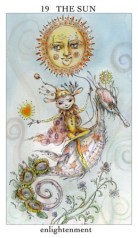
The Joie de Vivre has given me the Sun reversed.

Had this card been up the upright I would have said a definite yes, but the card is telling me there has been some disappointments from the past that still are with you. It says there can be happiness and joy, but for now it’s you that seems to be clouding it for yourself.

I wonder if the disappointment angle comes from maybe not totally getting the acknowledgement or success you hoped for in some part of your life? I think too this card is telling me that there has been a loss of something or someone that has taken the light out of your life a little. Did that loss provide the joy for you?

In this card the figure wears a suit of yellow, that’s the colour of mental activity. It seems to indicate that you have been thinking about things, giving a great deal of mental energy to this, but also note he wears a cloak of soft purple and that shows me that you have an awareness of this.

I like how the seahorse has green leaves around the sun flowers on its tail and also how a plant is growing in the foreground. Green symbolizes for us balance, adaptability, growth and potential. It seems to suggest that there is the potential here to adapt to circumstances better and bring things back into balance that will bring you the joy you hope for.

This is a number 19 card and it breaks down to 1+9 = 10 – this is the number of endings and beginnings all in one. It shows us that something has to be released before a new start can be made.

It appears to me that the Joie de Vivre is telling me that you need to stop blocking the joy from your own life. Be aware of how you think about certain things and this in turn will allow you the potential to adapt better to certain circumstances, which will result in a happier you.

I hope this has helped in some small way. I ask that you give me feedback and if you liked the reading.

I attach a link to the card, but remember this shows the card in an upright position and I drew it in reversed.

Thanks for allowing me to read for you.

Helen @ https://www.facebook.com/profile.php?id=1270902251

And here is my response:

Very interesting, Helen. I lost my life mate two years ago, and I am still struggling with grief. It’s not that the joy has gone out of my life, because I have never been a joyful person, but that the meaning has gone out of my life. I’m trying to find meaning in my life, in his death, in my writing, in the future. And yes, I think about it. And yes I am aware of how much mental energy I am giving to such thoughts.

Actually, I need balance more than joy. His death threw me and the world off balance, and my grief caught me by surprise since I knew he was dying. But I never understood what his goneness from my life would mean, never understood that it would bring me such an awareness of death, that it would shatter me.

This has been a time of great growth for me, and yet this is only the first part of my journey back to life. I’m taking care of my 95-year-old father, and when he is gone, I will have to find a place to live, a reason to live, something to care about. I’ll have to completely start over. I’m trying to see the good in that, but since I haven’t a clue what to do or where to go, mostly I’m just waiting.

I don’t know how to let go of my grief. Supposedly it takes three to five years, so perhaps it’s too soon.

***

What particularly interested me was Helen’s comment that I seem to be clouding my own happiness since other people have suggested the same thing, but to be honest, I don’t know how to dispel the clouds. Perhaps time and a willingness to face whatever life brings will take care of the matter. Or, as Helen points out, maybe I just need to be aware of how I think about certain things.

Throughout this grief journey of mine, the only future I’ve been able to envision is one of continued sadness and loneliness, and I’ve tried to prepare myself for such a life. But just because all I can see are sadness and loneliness, it doesn’t mean that’s all there will be. There could be joy. Maybe that’s all the Joie de Vivre card is telling me — be open to the possibility of joy.

Untaming Me and Embracing My Inner Savage

I watched The Sleeping Dictionary the other night, or at least as much of it as I have on tape. My life mate/soul mate recorded movies that he liked and often ended them before things got ugly, turning a painful movie into a touching one, so in my version, the story ends when John and Selima profess their love. (I had become so tuned to death and disappointment during his last years that I could not bear stories with unhappy endings or characters who fought instead of appreciating what they had. Watching his movies, I now understand he’d developed that same sensitivity. His version of Braveheart, for example, ends before William Wallace is tortured and killed.)

But I digress.

When the young headhunter first appeared on the scene in The Sleeping Dictionary, I was struck by his savagery. I don’t mean his cruelty — though today “savage” is synonymous with brutality, it originally came from a word that means “woods.” I’m referring to his elemental nature, his primal being, his untameness.

I am a highly civilized person. For the most part, I am considerate of others. I am never intentionally rude or bad mannered or insulting. I am not uncouth. I don’t make scenes in public (or private, for that matter). I seldom raise my voice. I listen more than I talk. I dress modestly. I use correct English and am not given to crudeties or foul language. If it’s in my power and nature, I almost always do what others ask. I try to be helpful. In other words, I am tame.

As I watched the movie, I wondered if the time had come to untame me, to embrace my inner primitive. I don’t know what or how to do that, but it’s something worth thinking about. I know your first thought — tattoos. Nope. Today tattoos are not a matter of primalness but of fad, and fad is the epitome of civilization.

It would be interesting to have totems, rituals, amulets that meant something to me and my life, that would help me connect to life or at least remind me of that connection. To find or develop such primal symbols, however, I would first need to know who I am, to know what meaning life has for me, but the death of my life mate/soul mate so devastated me that I no longer know who I am or how I connect to anything.

Now, as I write this, I realize that I don’t need to start a search for my inner primitive. I am already on that quest.

I walk in the desert (as primeval a place as there is around here) and pay attention to how my body and mind join to the earth. I feel how my feet connect with the ground (well, how my shoes connect. I am not so savage as to be willing to walk in rattlesnake country unshod). I feel the air coursing through my lungs, and the breezes touching my skin. I feel the heat of the sun and the coolness of my evaporating perspiration. I open my mind and feel new ideas flowing in and old ideas flowing out.

Maybe someday I will untame me — find out who I am at rock bottom and live according to my truth. And maybe I am living that way now.

How Many Books Are Going to be Published in 2012? (Prepare for a Shock)

I hadn’t planned to write any more about the book world. For one, it’s too depressing, and for another, I’m getting to where I’m okay with it. I’ve never had much use for 99.99% of books published anyway, so it doesn’t really matter if the world is being overrun with terrible books. It always has been. And, truth be told, I don’t enjoy reading much any more. After having read more than 20,000 books, I’m way past the first flush of enthusiasm when it comes to new books. (Okay, I admit it, I’m jaded.) When people start writing before they have read thousands of books, they don’t know that the story they are telling has been written a zillion times before. Nor do their equally unread readers know or care. It’s new and fresh to them. So, perhaps I should leave the book world to those who still embrace it.

So why am I writing about the book world again? I came across a statistic tonight that totally staggered me (All information comes from Bowkers, the company in the U.S. who issues ISBN numbers).

300,000 books were published in the U.S. 2003.

411,422 books were published in the U.S. in 2007.

1,052,803 books were published in the U.S. 2009.

Approximately 3,000,000 books were published in the U.S. in 2011.

And . . . drum roll, please . . . in an online interview, Seth Godin suggests that 15,000, 000 books will be published in 2012.

15,000,000. Yikes.

Google estimates that as of August 2010, there were 129,864,880 books in existence. Which means that the total number of books that could be published in 2012 is more than 1/10 of all the books in existence. That is an unfathomable jump, a 500% increase in a single year. (That is correct, right? 3,000,000 times 500% = 15,000,000.) Unbelievable.

I got an email from a book marketer today, wanting me to write an article about what the publishing landscape will look like in 2016. I cannot imagine what it will look like. Even if the number of books published returns to the more typical 200% increase per year, by the year 2016, we will have doubled all the books that were in existence in 2011.

Who is going to read all those books? Who is going to buy them?

What To Do (And What Not to Do) When Someone is Grieving

Every few weeks I decide to stop posting articles about grief and my grieving process. When one talks, the words dissipate into the atmosphere and are soon forgotten. When one writes, the words last until the paper is lost or destroyed. But when one posts to a blog on the internet, the words are eternal. And I’m not sure showing such vulnerability forever is healthy. As I gather strength and courage to face the challenges of my new life as a woman alone, as I change and grow into the person I will need to become, the vulnerable me of these grieving years will still exist in cyberspace. I don’t know how much this ever-living past will shadow my future; at the very least, it will be a perpetual reminder of a very dark time.

But life doesn’t seem to want me to give up these posts quite yet. Today’s decision to stop posting was forestalled by an email from a grieving friend who thanked me for voicing what she could no longer say. Any mention of her grief worried her family, and they suggested therapy so often, she now hides her grief from them. And if she writes about grief, relatives call up with advice about moving on or looking for someone new.

People often worry about what to say to someone who is grieving, but they should be more worried about what not to say. Saying almost any heartfelt words will do. We bereft see beyond the sometimes bumbling, often touching attempts to breach the grief gap, and we appreciate the effort.

What we don’t appreciate and have no use for is advice. Generally, the people who offer advice have not a clue what we are going through, so it seems to them a simple matter of just moving on, and they are quite free with suggestions of how to accomplish this. (I cannot think of a single instance where someone who suffered a grievous loss offered me advice, probably because they know how unwelcome and unproductive it would be.)

When I started writing about grief, the whole point was just to say how I felt so others would know that what they are feeling isn’t abnormal even though it feels dreadfully abnormal. I never asked for advice. I never wanted advice. I simply laid out my feelings. And yet I got advice. I tried to be kind and understanding, realizing that the advice-givers felt helpless and wanted to do something to ease my pain, but the truth is, advice does more damage than good. As with my grieving friend, so often the only way we bereft have of staving off advice is to hide our grief, and that is not healthy for anyone.

So, what can you do to help when someone you knows loses a spouse or a child to death?

1. Do something tangible. Offer to clean the house, take care of the kids, take the bereft to lunch, go grocery shopping. Almost as useless as advice is the typical, “Call me if you need help.” How is a person who is totally devastated by grief supposed to find the energy to call? You call. Don’t leave it up to them. And don’t leave it open ended with a “Let me know what I can do.” Be specific. “I’m going to the grocery store. Do you need anything? Milk? Coffee?” or “You’ve had a lot of people tramping through your house. Can I help clean up?” The best thing anyone did for me was clean the house before I moved. I will never forget that, will appreciate it as long as I live.

2. Let the person talk. Don’t try to make it better. Don’t offer advice. Simply listen. A woman I knew casually invited me to lunch, and she asked questions about him, let me talk, listened. It made me feel less alone, less of a pariah.

3. After the first month, the thing that helped me most was sharing stories with other bereft. (In the beginning, the whole thing was so overwhelming, I couldn’t deal with anyone else’s pain; I couldn’t even deal with my own.) As depressing as it was to find out that people still had occasional grief upsurges after ten years or that they never stopped missing their loved one, it helped knowing that others had gone through the same thing I was experiencing, and it helped knowing what I was up against. But if you haven’t suffered a similar loss, please do not talk about the death of your 100-year-old grandmother, or your dog, or your cousin. Even though these losses are important to you, they don’t offer any comfort to someone who has just lost the love of her life, especially if he died at a relatively young age.

4. Always, a shoulder to cry on and a comforting hug are welcome, and are worth a million times more than advice. Even better, cry with us. A few days after my life mate/soul mate died, I stopped by the grocery store where he and I shopped. The clerk asked where he was, and when I told her, she hugged me and cried with me. Not enough tears had been shed for him — no amount of tears will ever be enough—so those tears gave me comfort. His life — and death — shouldn’t pass lightly. No one’s should.