Dreaming of Life on Foot

Once upon a time when I was going through a rough patch in my life, I considered just taking off and walking the length of the Pacific Crest Trail. I figured by the end of the hike, things would be different, or I would.

The rough patch passed, as bad times often do, but I have retained that image of hiking the length of the trail. I don’t remember why I chose the Pacific Crest Trail since I was also enamored with the idea of the Appalachian Trail. Perhaps I was confusing the Pacific Crest Trail with the Pacific Coast Highway, and envisioned a walk along the trailscoastline. Surprising to me now is that although I lived in Colorado, I wasn’t aware of the Continental Divide Trail, or if I was aware of it, perhaps it was too close to home to seem romantic.

And that’s what the idea was — romantic. I know this now. Recently I’ve been on a couple of short hikes on the Pacific Crest Trail (a thrilling taste of that old dream), and I’ve been hearing all sorts of stories, suggestions, cautions from my fellow hikers. For example, my idea of hiking without any sort of preparation, just finding the start of the trail and heading out, is not practical. Through hikers, those who hike the entire trail from top to bottom (or rather, bottom to top — they generally start out at the Mexican border and walk up to the Canadian border) often spend months in preparation, drying foods, mapping water holes, sending ahead care packages to themselves at various places along the trail. They need to be prepared for emergencies, all weather conditions, and whatever might overtake them on the trail. (Apparently, most through hikers make the trek alone, so my idea of walking solo was not too farfetched.)

Someday my current responsibilities — looking after my 97-year-old father and dealing with my perhaps bipolar brother — will end, and then what? What will I do? Who will I become? I’ve been checking out various trails in the US, and if I were so inclined, I could spend the rest of my life on foot. Thirty different trails comprise the National Trails system, and many states seem to have additional trails, such as the Oregon Coast Trail that extends for 400 miles from the Columbia River to the California Border, and the Colorado Trail that runs 486 miles from Waterton Canyon southwest of Denver to Durango.

A friend of mine recently bought a motor home, and she plans to live on the road until she finds a place to settle down. That, too, is a romantic idea (also practical), but not for me. I prefer to be less cumbered, to go lightly through life. But so lightly as to live with only that which I can carry or send on ahead? I don’t know. Still, I can’t help wondering. And dreaming . . .

***

Pat Bertram is the author of the suspense novels Light Bringer, More Deaths Than One, A Spark of Heavenly Fire, and Daughter Am I. Bertram is also the author of Grief: The Great Yearning, “an exquisite book, wrenching to read, and at the same time full of profound truths.” Follow Pat on Google+. Like Pat on Facebook.

Doorways and Exploding Eggs

So often, it seems, we get up from our chairs in front of the computer to do something or get something in the next room that seems relevant at the time (yes, there is life away from the computer!!), but when we get where we are going, we have forgotten why it was so important to go there in the first place. Sometimes, if we go back to where we were when we got the inclination to do or get that something, we can remember, but other times the memory has completely disappeared.

Gabriel Radvansky, Sabine Krawietz. and Andrea Tamplin, a team of researchers at the University of Notre Dame, have shown that walking through a doorway makes us forget. They postulate that our brains are wired to keep the most relevant information handy until the need for it expires, and then oudoorr brains purge those details in preparation for new “need-to-know” information. (Please excuse this tangent, but I am laughing and had to share the joke. I just checked synonyms for “information” on MSWord, which I am using to write this post, and the only synonyms MS gives are: “in order,” “in sequence,” “in turn,” “in rank,” and “in a row.” Apparently, MS thinks “in formation” is a single word. Or maybe they think information is in such scant supply that we don’t need a synonym.)

According to the Notre Dame researchers, going through a doorway signifies that whatever information being held at the ready in our brains is no longer vitally important, and so our brains purge that information. In other words, we forget. Makes sense — we can’t keep every thought at the forefront of our brains, especially since a lot of what we learned in the past is no longer relevant. For example, we no longer have to remember how to crawl or how to let our mothers know our diapers need to be changed. Nor, in this digital age, do we need to remember where to put decimal points when multiplying percentages. For that matter, we don’t even need to remember how to add and subtract.

I have a hunch hallways are much like doors. Cross a threshold, walk down a hall and through a doorway into another room, and we are lucky to remember who we are, let alone what we were doing.

In the past couple of weeks, I have managed to blow up two pans of eggs I was hardboiling. Yep. Blew them up. Loud cracks of explosions. Bits of egg all over the kitchen. I do know how to make perfect hardboiled eggs, of course. The problem is that I do not have the patience to stand around waiting for the water to boil (I know for a fact watched pots do boil, it just seems like they don’t). I planned to set the timer, but the timer was next to my computer where I left it the last time I used it (because that’s where I was when the timer was set to go off, of course. What I said above about there being life away from the computer? Ignore that. I spend so much time online, I’m not sure it’s true.)

To set the timer, all I had to do was walk from one room, down a hall, and into another, and in those few seconds, I completely forgot about the eggs. Forgot to set the timer. It wasn’t until I heard the loud cracks of the explosion and went to investigate that I remembered. (I’m not sure why the eggs exploded. The water had long boiled off, so perhaps the heat conducted by the stainless steel pan was so great the moisture inside had turned to steam, and since the shell couldn’t expand with the steam, the egg exploded.)

The explosion wasn’t my fault, of course. It was the fault of a faulty memory system that doesn’t allow us to retain a thought from one room to the next. Yeah, that’s it. Not my fault at all.

***

Pat Bertram is the author of the suspense novels Light Bringer, More Deaths Than One, A Spark of Heavenly Fire, and Daughter Am I. Bertram is also the author of Grief: The Great Yearning, “an exquisite book, wrenching to read, and at the same time full of profound truths.” Follow Pat on Google+. Like Pat on Facebook.

One More Post About Philip Seymour Hoffman (Or Rather, Philip Hoffman)

I hadn’t intended to write about Philip Hoffman — there have been more than enough blog posts written about him — but I’ve been thinking of the first time I saw him in a movie, so here is one more post about the deceased actor.

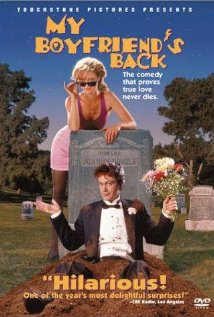
One of my favorite movies is the 1993 film My Boyfriend’s Back. The first time I ever saw Philip Seymour Hoffman was in that black comedy, though back then, he only called himself Philip Hoffman. Of course, that was long before he got his reputation for being such a great actor, so perhaps two names were all he needed. Still, his small role made MyBoyfriendsBack_a big impression on me. Made a big impression on his head, too. In the film, the hero, Andrew Lowry, comes back from the dead because the prettiest girl in school had agreed to go to the prom with him. (He’d saved her life, so what else could she do? Besides, he was dying . . .)

There is considerable prejudice in the high school against “dead kids,” and Philip Hoffman tried to kill Lowry — Chuck, Philip’s character, wasn’t exactly the brightest kid in school, so it never occurred to him he couldn’t kill someone who was already dead. Still, he took the axe from the emergency box on the wall (um . . . please tell me no one actually puts axes in schools anymore!). He swung the axe back to get momentum for a good swing, and because he was holding the axe backwards, he axed himself in the head. It doesn’t sound funny as I write this, but then, so often that is the nature of black comedy — the humor is in the moment.

The writer, Dean Lorey, penned some great lines.

For example, Dr. Bronson, who examines Chuck tells Big Chuck, Hoffman’s father, “I’m afraid I have some bad news. Your boy is very sick. He’s lost a massive amount of blood, and his pulse and retinal response are poor, and as you can see there’s an axe sticking out of his head.

Big Chuck: He’s not sick, you idiot, he’s dead!

Dr. Bronson: Oh, everybody’s a doctor. You think maybe I could make the diagnosis?”

Missy (the prettiest girl in school) tries to renege on her promise to go to the prom with the dead kid, and Lowry responds. “You may not know this, Missy, but I ate Chuck for YOU!” Missy’s friend tells her how lucky she is: “God, my boyfriend won’t even pump gas for me.”

I’m not sure why I’m telling you this, except that all the talk about Philip Seymour Hoffman reminded me of this movie, and it makes me smile. As great an actor as Hoffman is purported to be, he still had to start somewhere, and his “somewhere” was in a little known, badly acclaimed, poor money maker that is one of filmdom’s hidden gems.

It reminds me that no matter how serious we are about our writing, there is always room for a bit of humor, even black humor. It’s what makes our writing — and characters — memorable.

(An odd little mystery — Traci Lind, who played Missy, seems to have disappeared, at least disappeared from movies and the internet. Wherever she is, I hope she is happy. I always enjoyed seeing her.)

***

Pat Bertram is the author of the suspense novels Light Bringer, More Deaths Than One, A Spark of Heavenly Fire, and Daughter Am I. Bertram is also the author of Grief: The Great Yearning, “an exquisite book, wrenching to read, and at the same time full of profound truths.” Follow Pat on Google+. Like Pat on Facebook.

Wishing You Life and Love

Mahatma Ghandi said, “Where there is love, there is life.” On this day set aside for celebrating love, I wish you a life filled with love.

I love you

***

Pat Bertram is the author of the suspense novels Light Bringer, More Deaths Than One, A Spark of Heavenly Fire, and Daughter Am I. Bertram is also the author of Grief: The Great Yearning, “an exquisite book, wrenching to read, and at the same time full of profound truths.” Follow Pat on Google+. Like Pat on Facebook.

Lies, Damned Lies, and Statistics

“There are three kinds of lies: lies, damned lies, and statistics.”

This quote is usually attributed to Mark Twain, and in fact, he did use it in his biography, but he himself quoted it. Twain’s actual words were: ‘The remark attributed to Disraeli would often apply with justice and force: “There are three kinds of lies: lies, damned lies, and statistics”.’ But Disraeli’s biographer claims that the renowned statesman never used that particular phrase.

Some people postulate that Twain heard the phrase from Leonard Henry Courtney, a British economist and politician who said, in an August 1895 speech in New York, ‘After all, facts are facts, and although we may quote one to another with a chuckle the words of the Wise Statesman, “Lies – damn lies – and statistics,” still there are some easy figures the simplest must understand, and the astutest cannot wriggle out of.’ Courtney didn’t attribute the saying to Disraeli, and in fact, “wise statesman” might not even refer to a specific person, but a way of attributing the phrase to . . . whoever.

The earliest instance of the phrase found in print is from a letter that seems to indicate the saying was in common usage before Courtney’s speech, and was so old no one knew anymore who said it.  The letter dated June 8, 1891 and published June 13, 1891 states: “Sir,–It has been wittily remarked that there are three kinds of falsehood: the first is a ‘fib,’ the second is a downright lie, and the third and most aggravated is statistics. It is on statistics and on the absence of statistics that the advocate of national pensions relies…..”

I don’t suppose it matters who said “There are three kinds of lies: lies, damned lies, and statistics.” I don’t suppose it matters if there are, in fact, three kinds of lies, though I do know statistics can’t truly be a kind of lie. They are simply bits of data that have been compiled from a large sampling. People, of course, use these bits of data to bolster whatever truth or falsehood they happen to be peddling, and they are able to do this because of the very nature of statistics. For example, although everyone in the United States knows how abnormal this winter is, statistics show that on average, this is simply a normal winter — the warmth and dryness of the west balances the cold and snow of the east, giving us the lie of a normal winter.

Lucky for me, I happen to be on the warm, dry end of the “lie.” For all of you who are living on the opposite side of the land, be safe and try to stay warm.

***

Pat Bertram is the author of the suspense novels Light Bringer, More Deaths Than One, A Spark of Heavenly Fire, and Daughter Am I. Bertram is also the author of Grief: The Great Yearning, “an exquisite book, wrenching to read, and at the same time full of profound truths.” Follow Pat on Google+. Like Pat on Facebook.

Another Blessing For You

Concerned about my struggles with my rage-ful brother, yesterday a friend sent me a blessing by John O’Donohue, an Irish poet, author, priest, and philosopher.  Today she sent another one that really speaks to my longing for freedom. May you, too, find harmony between your soul and your life.

Blessing by John O’Donohue

May you listen to your longing to be free.
May the frames of your belonging be generous enough for your dreams.
May you arise each day with a voice of blessing whispering in your heart.
May you find harmony between your soul and your life.
May the sanctuary of your soul never become haunted.
May you know the eternal longing that lives at the heart of time.
May there be kindness in your gaze when you look within.
May you never place walls between the light and yourself.
May you allow the wild beauty of the invisible world to gather you, mind you and embrace you in belonging.

***

Pat Bertram is the author of the suspense novels Light Bringer, More Deaths Than One, A Spark of Heavenly Fire, and Daughter Am I. Bertram is also the author of Grief: The Great Yearning, “an exquisite book, wrenching to read, and at the same time full of profound truths.” Follow Pat on Google+. Like Pat on Facebook.

A Blessing for You

Concerned about my struggles with my rage-ful brother, a friend sent me the following blessing by John O’Donohue, an Irish poet, author, priest, and philosopher.  And now I am passing it on to you in the hopes that it will make your day a bit brighter.

moonOn the day when the weight deadens on your shoulders and you stumble, may the clay dance to balance you.
 
And when your eyes freeze behind the grey window and the ghost of loss gets into you, may a flock of colors, indigo, red, green, and azure blue come to awaken in you a meadow of delight.
 
When the canvas frays in the currach of thought and a stain of ocean blackens beneath you, may there come across the waters a path of yellow moonlight to bring you safely home.
 
May the nourishment of the earth be yours.
May the clarity of light be yours.
May the fluency of the ocean be yours.
May the protection of the ancestors be yours.
 
And so may a slow wind work these words of love around you, an invisible cloak to mind your life.
_

***

Pat Bertram is the author of the suspense novels Light Bringer, More Deaths Than One, A Spark of Heavenly Fire, and Daughter Am I. Bertram is also the author of Grief: The Great Yearning, “an exquisite book, wrenching to read, and at the same time full of profound truths.” Follow Pat on Google+. Like Pat on Facebook.
Upgrading to a Smartphone

My poor old dumb phone finally decided it had enough of being at my peck and call, and it quit working. Although I have never wanted a smartphone, that’s what I ended up with, and oh, my. I thought the internet consumed time, but that phone could pretty much eat up my days if I wanted it to.

For starters, it took a long time to find my way around and get it the way I wanted. It’s not that the actions were complicated, but in many cases, it was hard to find the instructions.

One of the things I didn’t like was that all texts ended up in the inbox of one of my online email accounts. Yikes. It wasn’t bad yesterday when I had only a couple of texts, but some family members cphoneorrespond with me strictly via text, and I had visions of spending hours deleting such items from my inbox. Also, all contacts from certain email accounts ended up as contacts on my phone, and most of those people I’m not close to. I certainly don’t want to be carrying them with me wherever I go.

And then there was Facebook. I downloaded the app, got it all set up, even downloaded the app for Facebook pages, then went to add something on the calendar on my phone and found it flooded with events and birthdays from people on FB I don’t even know. I found a way to empty the calendar, but it immediately filled up again. It wouldn’t be a problem since I have never used ecalendars (I’m not always on the computer when I need to check my schedule), but I thought I’d try the one on the phone. I found no way to unsync all the FB info, so when it turned out to be a choice between FB or the calendar, I chose the calendar. So I uninstalled the FB app. If you’re one of my FB contacts, you won’t be inundated with silly status updates. Aren’t you glad?

I found a cool calculator that works like its unvirtual counterpart, and a colorful game — Blendoku. I have always loved the way colors shade and fade into each other, so the game is a natural for me.

I’m sure there are hundreds of other apps that I would find fascinating — for example, I saw an app that supposedly identifies stars and such in the night sky — but for now, I’m limiting myself. The whole thrust of my current life is to live the real world, not the electronic one (though apparently, the so-called real world is also just a series of electrons connecting us one to another).

Still, I will be using the phone for more than making calls. I just wanted to let you know in advance that any errors in my posts and emails are due to the phone. I, of course, don’t make errors. 🙂

***

Pat Bertram is the author of the suspense novels Light Bringer, More Deaths Than One, A Spark of Heavenly Fire, and Daughter Am I. Bertram is also the author of Grief: The Great Yearning, “an exquisite book, wrenching to read, and at the same time full of profound truths.” Follow Pat on Google+. Like Pat on Facebook.
A Retrospective of Grief

Another 27th. This is the 46th twenty-seventh of the month I have survived since the death of my life mate/soul mate death on March 27, 2010. At the beginning of my grief, each minute, hour, day seemed unfathomably long. I felt as if I lived years during that first month. I still don’t understand how I made it through that eon. The pain started out unbearable and got progressively worse. Each breath took such effort that it seemed as if it would be easier to stop breathing altogether. And yet I continued to breathe, one agonizing gulp of air at a time.

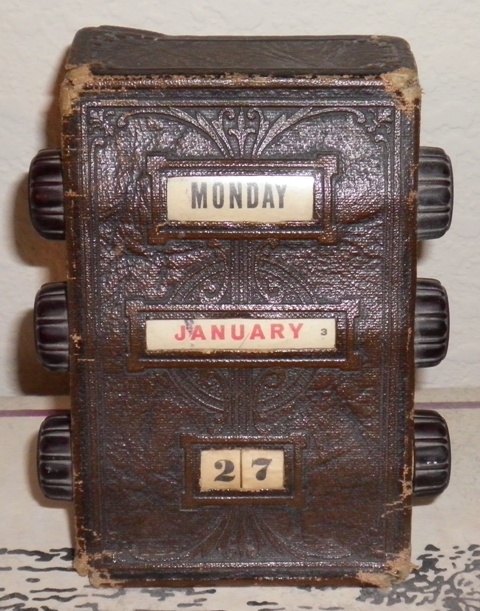
For the first three years, I could feel the grief surging as each twenty-seventh crept up on me, but today I only knew the date by the calendar. Even so, I might not have noticed if I hadn’t advanced his perpetual calendar.

perpetual calendarAbout a month before he died, he told me he wanted me to keep the calendar. It was special to him — a family heirloom and a relic of his childhood — and he didn’t want me to throw it away with the rest of his effects. Which I probably would have done. I thought such calendars silly because if you don’t remember to advance the calendar each day, the calendar loses its effectiveness. He, of course, had the discipline to advance the calendar. No matter where we lived, no matter the state of his health or the stresses of our life, he always advanced the calendar first thing every morning.

And now so do I. It has become a way of honoring his life, of remembering him, of being connected to him in a small way. For a long time, I felt connected to him through grief. (Odd, that. It was the feeling of being disconnected from him that grieved me in the first place.) Now that my grief has waned, there is nothing to connect me to him. Unlike many who have lost someone important to them, I have never had a visitation, a sign, any indication that he still exists somewhere. He is simply gone — gone from my life, anyway.

The tears are gone, too.

It seems strange now that I grieved so deeply. I can barely remember loving someone so profoundly that his death tore me apart. Can barely remember that shattered woman who screamed her pain to the uncaring winds. Was that really me or simply a character in the book of my life? (I meant this as a metaphor, but I did write a book about my life, or rather my life of grief. That seems strange, too.)

We live each day as it comes, deal with each pain and sorrow, and somehow, through the years, we become something other than we were. I am no longer a schoolgirl dealing with the small dramas of grades, cliques, unacceptance. No longer a young woman desperately and radiantly in love with a man. No longer an adult struggling to live while her soul mate was dying. No longer a grieving woman.

At the moment, I am thrust in the role of caregiver for my 97-year-old father and homeless brother, but someday, I won’t be this woman, either. I don’t know what will become of me, don’t know what I will become (other than older), but chances are, I still will be advancing that ancient calendar in honor of the life that meant so much to me.

***

Pat Bertram is the author of the suspense novels Light Bringer, More Deaths Than One, A Spark of Heavenly Fire, and Daughter Am I. Bertram is also the author of Grief: The Great Yearning, “an exquisite book, wrenching to read, and at the same time full of profound truths.” Connect with Pat on Google+. Like Pat on Facebook.
Is It Cheating to Look at the Solution of a Puzzle Before You’ve Finished?

When you are working a puzzle, such as a crossword puzzle, and you come to the end of what you can do on your own, do you consider it cheating to look at the solution for hints so you can finish the puzzle? Do you see checking the answer as part of the fun of doing puzzles? Or do you abandon the puzzle half-finished to keep from cheating? If you do consider it cheating to check the solution for an answer you have no way of figuring, do you also consider it cheating to ask someone, to use a crossword puzzle dictionary, or to look online for the answer to the clue? Do you find yourself shying away from more difficult puzzles because you can’t do them without cheating?

This has nothing to do with anything, of course, I’m just curious what you think. I did a hard Sudoku this morning and had to check the solution to keep going. I used to consider it cheating to check the solution when I got stuck, but after realizing how many puzzles I wasted by not jump starting the puzzle, I understood it was simply a way of working the puzzle and had wasn’t dishonest.

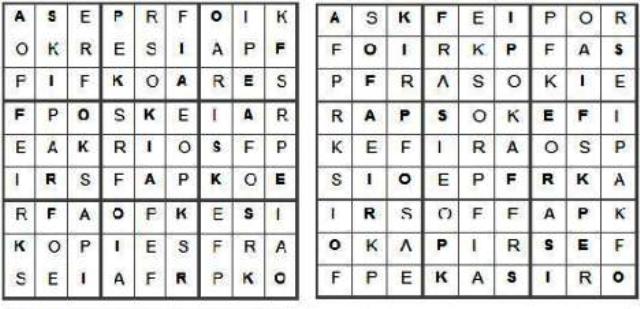
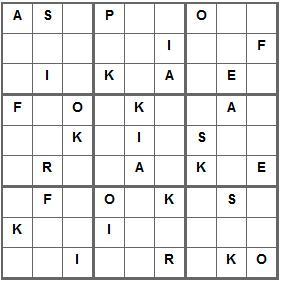
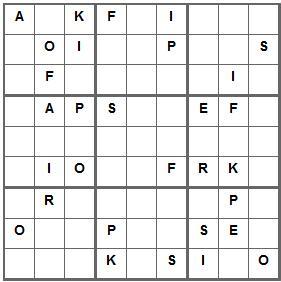
Just for fun, here are a couple of A Spark of Heavenly Fire Sudoku. You work these exactly as you do number Sudoku, but you use the letters from A Spark of Fire. (A, S, P, R, K, O, F, I, E). If you don’t know how to do Sudoku, you can find the directions here: http://www.sudoku.ws/rules.htm You should be able to print out the puzzles to make them easier to work.

ashf-sudoku4ashf-sudoku

Click here for solutions:

solution

***

Pat Bertram is the author of the suspense novels Light Bringer, More Deaths Than One, A Spark of Heavenly Fire, and Daughter Am I. Bertram is also the author of Grief: The Great Yearning, “an exquisite book, wrenching to read, and at the same time full of profound truths.” Connect with Pat on Google+. Like Pat on Facebook.