Is Life Too Short for Anything but Happiness?

“There comes a time in your life, when you walk away from all the drama and people who create it. You surround yourself with people who make you laugh. Forget the bad, and focus on the good. Love the people who treat you right, pray for the ones who don’t. Life is too short to be anything but happy. Falling down is a part of life, getting back up is living.”

This quote from José N. Harris’s book Mi Vida: A Story of Faith, Hope and Love, that’s posted all over Facebook, is really making me think what life is all about.

leapWe want to be happy of course, but Harris makes it seem as if anything but happiness has no real place in life. But . . . When someone dies, is that supposed to make us happy? When we have a painful or fatal disease, is that supposed to make us happy? When people all around us are suffering torments about which we can only guess, is that supposed to make us happy?

Are we supposed to walk away from children who don’t make us happy or throw them out of the house and force them walk away from us? Are we supposed to abandon an aged parent that doesn’t make us happy? Age changes people, and seldom for the better. In many cases, the elderly get mean and demanding and selfish, putting unbearable burdens on their caretaking children, but is that a reason to abandon them?

Are we supposed to walk away from people who need us because we can’t handle their suffering? This happens all too often to people whose mates are dying, especially if it’s a slow death, and it happened to me. At first, people were concerned and supportive, but as the dying continued for months and then years, people faded away because they couldn’t handle my suffering. I couldn’t walk away because I was tied to the pain and agony through love and caring for my dying mate, and that unhappiness became intensified when I found myself alone with no one to talk to because everyone else was concerned only with happiness. In fact, there was a note of disdain to those who walked away, as if somehow I brought the disaster on myself.

Perhaps it is understandable, this abandonment of people who are unhappy, but it’s not very kind. It’s not as if we chose to be unhappy — we had our trauma thrust upon us. We did the best we could to survive under appalling circumstances. Those who abandoned us couldn’t deal with our unhappiness for the duration of a phone call, yet we had to deal with it every minute of every day. Was I supposed to be happy my life mate/soul mate was dying? Was I supposed to act as if my life were fun and games? I did what I could to find peace during those times, did what I could to separate my feelings from his. He was the one dying, after all. I only had to live.

It’s ironic, actually, all this demand for happiness from Christians, for isn’t the whole point of Christ that he suffered for us? He didn’t come to Earth to be happy for us, but to suffer for us. So why our insistence on being happy?

I do think we need a certain amount of happiness, and it’s our responsibility to be as happy as possible, but to just walk away from those who, through no fault of their own, cause us unhappiness seems a bit too self-centered to me. I do understand that we shouldn’t have to deal with abusive situations or situations that destroy us, but a little unhappiness never hurt anyone.

***

Pat Bertram is the author of the suspense novels Light Bringer, More Deaths Than One, A Spark of Heavenly Fire, and Daughter Am I. Bertram is also the author of Grief: The Great Yearning, “an exquisite book, wrenching to read, and at the same time full of profound truths.” Follow Pat on Google+. Like Pat on Facebook.

Applying the Lessons of Grief

Yesterday I talked about disconnecting yourself from a defunct relationship, one where there is no hope of ever reconciling and yet you still feel a sense of connection to your loved one. I said:

To a certain extent, time disconnects us from our past relationships — the longer we are separated, unless we cling hold on to the past, the weaker the connection. Simply living helps us disconnect — the more we live, the more new, unshared memories we make, the more the connection recedes. Going back to where we were before we made the original connection also helps.

This was good advice as far as it goes. My situation was the opposite. After the death of my life mate/soul mate, I couldn’t feel any sort of connection, just a vast emptiness where he used to be, a terrible goneness. Time didn’t make any difference, at least not by itself. The truth is, if we don’t do what we can to heal those wounds ourselves, time doesn’t do much of anything except perhaps offer a different perspective. As Rose Kennedy wrote, “It has been said, ‘time heals all wounds.’ I do not agree. The wounds remain. In time, the mind, protecting its sanity, covers them with scar tissue and the pain lessens. But it is never gone.”

In my case, the person I needed to disconnect from was . . . me. The coupled me. My shared life was defunct, so I did what I could to develop memories of my new life alone. Since I can’t physically go back to where I was, I’ve tried to go there mentally. Remembering who I was before him has helped tremendously in moving past him. I had a life before our shared life, and I have one afterward — it’s just a matter of connecting those two lives with the best of both. and to pick up the pieces of me when I was alone.

My problem now is that I need to disconnect from another person, one with whom I have an ongoing relationship, and I don’t know how to do it, don’t know if it’s possible or even if it’s even a charitable thing to do.

A have a problematic sibling who is depressed, possibly bi-polar, probably an alcoholic, verbally abusive, full of fury, manipulative, desperately needy, and relentless in pursuit those needs. (He’s also brilliant and exceedingly creative, and spent most of his life composing music and writing songs that have never been sung.) He has been nearby for several months, and therein lies the problem since his anger now seems to be focused on me. (He thinks I have it easy being here looking after my father, and doesn’t see how stressful it is being torn between the two of them, as I have been my whole life.) If I could find out what he wanted, perhaps I could help, but he ischange cagy (paranoid is more like it) and talks around his needs. (He hates being a charity case, hates when people do things for him, and hates even more when people don’t.) He won’t go for treatment, blames everyone else for his problems, and doesn’t know how to take care of himself. Mostly, it seems as if he is lost inside a whirlwind of unfocused energy.

I’m trying to disconnect mentally from him so that his words don’t wound. I’m trying to disconnect emotionally from his problems, because I can’t see the situation clearly if I am bleeding for him. I’m trying to disconnect from his anger, because if I don’t, I absorb that anger and . . . well, let’s just say I don’t want to spend the rest of my life in prison for manslaughter.

I do okay most of the time, juggling his needs and my father’s. Physical activity and outings with friends help dissipate my stress, and if those don’t work, short bursts of tears do. I can’t go back to where I was before he came into my life, because he has always been there. I used to think I’d never be free until he was dead, and maybe that’s true, but it’s not how I want to live my life — wishing someone were dead so I could live free. What I really wish, though, is that he were strong, healthy, happy, and somewhere else.

I am taking the lessons I learned from grief and applying them to this situation as well as I can. Despite our shared genetics, I tell myself he is a separate person with his own journey. (I wrote “his own demons” but replaced it with “journey” since I know nothing about demons, not even the euphemistic kind.) He is not me. His anger is not mine. Just because he says something, his words don’t make it so. His problems are not of my making, even though he likes to tell me they are. My solutions are not necessarily his solutions.

Although I’ve talked around this situation before, alluding to a family problem with roots going back to childhood, I haven’t talked specifically about it out of loyalty to him. But blogging is the best way I have of putting things into perspective, and my writing about this situation now is a way of distancing myself from him even further, since I know how irate he would be to have me mentioning him. But as Anne Lamott said, “You own everything that happened to you. Tell your stories. If people wanted you to write warmly about them, they should’ve behaved better.”

***

Pat Bertram is the author of the suspense novels Light Bringer, More Deaths Than One, A Spark of Heavenly Fire, and Daughter Am I. Bertram is also the author of Grief: The Great Yearning, “an exquisite book, wrenching to read, and at the same time full of profound truths.” Follow Pat on Google+. Like Pat on Facebook.
Grief: Going Back to the Beginning

A friend is grieving the loss of a relationship, the ending of which was not her choice. Every time she finds a bit of peace and thinks she’s moved beyond her grief, she ends up right back where she started, feeling bereft, lost, disconnected, and angry. Even worse, she still feels connected to her lover even though there is no chance of their ever getting back together.

I explained the spiral nature of grief, that we do not necessarily go through steps but instead keep revisiting the same states over and over again, so she shouldn’t be surprised that her grief doesn’t stay gone. I also mentioned the tasks speedof grief, such as making an accommodation with the loss, finding a place in our minds for the inconceivable, coming to a realization that, no matter how deeply two people were connected and how much they shared, they are separate persons with separate lives.

She listened, then asked, “How do I disconnect?”

Good question. To a certain extent, time disconnects us from our past relationships — the longer we are separated, unless we cling hold on to the past, the weaker the connection. Simply living helps us disconnect — the more we live, the more new, unshared memories we make, the more the connection recedes. Going back to where we were before we made the original connection also helps. In my case, since I can’t physically go back to where I was, I have tried to go there mentally, to remember who I was before I met my now deceased life mate/soul mate, to pick up the pieces of me when I was alone.

While looking back is not always a good thing, sometimes it doesn’t hurt to see where we were, how far we’ve come, and where we are now. The truth is, relationships change us, and the longer the relationship, the more it changes us, sometimes without our even knowing. Good relationships help us grow, to become better than we are. And each growth spurt takes us further away from our pre-relationship selves. This isn’t a bad thing, of course, but it’s one of the reasons for the loss of identity so many of us feel when we lose our long time mates. We no longer know who are without that relationship.

I gained a lot from my shared life, but I also lost. Too many years of having to live according to the constraints of his uncertain health stole my spontaneity. Too many years of always having a companion to do things with or to talk things over with, as wonderful as that was, made me uncertain and even fearful of living alone. Remembering what I can about who I was before him has helped tremendously in moving past him. I had a life before our shared life, and I have one afterward — it’s just a matter of connecting those two lives with the best of both.

In my friend’s case, she’s actually going to go back to the town she was before she fell in love, and see if she can pick up the pieces of who she was.

***

Pat Bertram is the author of the suspense novels Light Bringer, More Deaths Than One, A Spark of Heavenly Fire, and Daughter Am I. Bertram is also the author of Grief: The Great Yearning, “an exquisite book, wrenching to read, and at the same time full of profound truths.” Follow Pat on Google+. Like Pat on Facebook.
Beginning the New Year with a Clean Slate

This time of year, there are hundreds, maybe even thousands of posts giving hints on how to keep one’s New Years resolutions. Some of the advice is even good:

  • Make your resolutions public. While we might easily break what amounts to a promise to ourselves, if we tell others, we have at least a modicum of incentive to keep going.
  • Make small, realistic resolutions for change rather than large, sweeping resolves. Bad habits cannot be broken over night; if it were that easy to change, all of us would be perfect.
  • Be specific. Instead of resolving to lose weight, for example, make a pact with yourself to be at least a couple of pounds lighter by the end of the year. Plan how you will lose that weight.
  • Instead of making resolutions, set goals. Once a resolution is broken, it is broken, and it seems futile to continue, but with goals, if we fail one day, we can pick up our banner the next day and continue charging into the future.

Despite all this advice, by this second day of the new year, many of us have already abandoned our resolves, and by the end of the first week, most of us will have given up. Only 8% of us will keep those resolutions until the end of the year.

This sad statistic makes us seem wishy-washy at best and lazy at worst, but I wonder if there is something else at work here rather than a lack of . . . well, a lack of resolve.

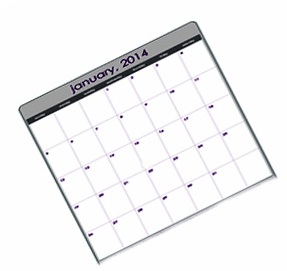
In response to my New Year’s post, Coloring My New Year, writer Malcolm R. Campbell (whose first book The Sun Singer will soon be republished by Second Wind Publishing!!) commented: “January 1 does have a clean-slate kind of feeling to it. Perhaps it is that fresh new calendar. Maybe it’s our constant reminders to ourselves to start writing 2014 (on checks and documents) rather than 2013. For some, it’s a line in the sand between old habits and new dreams. We can use it, the new calendar, to motivate ourselves one way or another.”

And then I realized why it’s so hard to maintain our New Years goals or stick to our resolutions.

We don’t lose the resolve. We lose the clean-slateness. After only a few days, the sense of a new beginning dissipates. We’ve become used to writing “2014.” We’re back into the routine of our lives, probably more tired, more broke, and fatter than we were before the holidays. And somehow, in the comfort of our old lives, we forget the idealism we had when embracing a new year. We forget that for a moment we believed anything was possible, that we could become better, stronger, healthier, wiser, richer, more beloved if only we . . .

I abandoned the practice of making resolutions when still a child after I realized that by the end of that first week, I’d completely forgotten my resolution. (I only remembered when the next new year rolled around and I had to, once again, make that same undoable commitment.)

As an adult, I don’t make resolutions, though during the past couple of years I have tried to make each day special, to become a bit “more” by the end of they day than I was at the beginning, even if was only by a well-chosen word, the glow of a smile, a laugh shared, a moment of appreciation for the world around me.

The truth is, whether we feel it or not, each day does begin with a clean slate.

What are you going to do with your today?

***

Pat Bertram is the author of the suspense novels Light Bringer, More Deaths Than One, A Spark of Heavenly Fire, and Daughter Am I. Bertram is also the author of Grief: The Great Yearning, “an exquisite book, wrenching to read, and at the same time full of profound truths.” Follow Pat on Google+. Like Pat on Facebook.
Coloring My New Year

I’ve never really celebrated New Year’s because it doesn’t mean much to me. It’s a relatively arbitrary date. The calendar numbers change, but that’s all. It’s not a universal new beginning. The Chinese New Year this year is on January 31, the Jewish New Year is on September 24, the Persian New Year is March 20, the Korean New Year is January 31, the  Tibetan New Year begins on January 31, and various communities in the Hindu religion have different dates — January 14, March 31, April 14, April 15.

calendar_2014January 1 is not even the beginning of a new season or of a solar cycle such as a solstice or an equinox. Nor is there any personal demarcation — no black line separates the old from the new. The world is no different today from yesterday, nor are we. We carry the old year with us because you have the same problems, sadnesses, hopes, fears.

There is a newness to January 1, though, and that is the newness of a new calendar.

Like school kids with stiff new clothes and a satchel full of crayons, unread books, and blank paper, we are ready to set out on an adventure, trembling with both trepidation and excitement. Our new calendars have 365 blank squares. How will we use those squares? With notations of appointments and special days, of course. Perhaps with reminders of bills to pay and chores to do. But many of those days will be blank. What we will do with those blank days? Will we search for happiness or a new love? Will we recommit to an old love? Will we strive to attain a better level of health? Will we experience new things, meet new people, visit new places, sample new foods?

I do feel that particular newness today, that hope.  I’ve had marvelous adventures the past past year — going to Seattle to see Shen Yun, riding in a limousine, hiking with the Sierra Club, making new friends, attending parties and performances. I’ve walked hundreds of miles in the desert, posted 500 bloggeries (365 on this blog alone), learned dozens of delightful new words (my favorite is eupathy), shared many meals, laughed untold times, and exchanged thousands of smiles. It hasn’t all been wonderful, of course, but somehow I found the strength and courage to deal with the trying times. I cried when I needed to, threw my grief into the blogosphere, talked about (or rather, talked around) a heartbreaking family situation. And I survived. Even thrived.

And now I have 365 blank days on my new calendar. I plan on getting out my box of crayons and coloring those days brightly.

I hope your days will be filled with wonder, new adventures, and much joy.

Happy New Year.

***

Pat Bertram is the author of the suspense novels Light Bringer, More Deaths Than One, A Spark of Heavenly Fire, and Daughter Am I. Bertram is also the author of Grief: The Great Yearning, “an exquisite book, wrenching to read, and at the same time full of profound truths.” Follow Pat on Google+. Like Pat on Facebook.

Online Dating: Shopping For Men

You can shop for anything on the internet nowadays, even a relationship. In the pre-electronic days, you met someone, fell in love, and hoped that your lifestyles, wants, and needs would somehow mesh or that you’d be able to compromise enough to find a mutually satisfying life. With online dating, you can bypass all that and look for someone to fit your lifestyle.

massesThe problem with shopping for a relationship when you are no longer young is that not only do you already have a lifestyle that works for you, you also have a lot of baggage — family, children, pets, and especially highly individual and possibly eccentric opinions or preferences. These things are a problem even if you’re not looking for a serious relationship.

In my case, I don’t have much baggage except for my 97-year-old father, but I do have a lot of crotchets. I cannot tolerate smokers (I am allergic to smoke.) Unpleasant odors make me nauseous. I have never owned either a pair of high heels or jeans. (This normally wouldn’t be an issue, but a surprising number of men want women who are as comfortable in heels as they are in jeans.) And I’m not fond of dogs. (There, I said it. It’s probably un-American, but it’s the truth.)

Even more problematic are all my dichotomies. Like most women, I appreciate men who make me laugh, but I seldom find self-professed funny guys to be funny. I have no interest in discussing politics — most men who discuss such things seem naïve at best, boring at worst — and yet I like people who look beyond themselves.  I like people who can write or at least express themselves well, but I don’t necessarily like writers. (But of course, I would never correct bad grammar. A friend once sent a love letter to her fiancé oversees, and he returned it with corrections in red. They still got married, but it didn’t last long.) I like people who are intelligent and think of more than their motorcycles or other toys, but I don’t particularly want to have deep conversations with them. I don’t like perfectly toned people (I actually find six-packs unattractive, which isn’t a problem since so few men of my age — or any age — have them), but I don’t like huge bellies, either.

Worst of all, when I am with someone, I like to be the center of their attention (and make them the center of my attention). I don’t like competing with pets and children, phones and televisions. This might seem selfish of me, but it’s not much of a relationship if one of the people can’t find time to pay attention to the other. The problem is that it’s almost impossible any more to find people who can focus their attention, and I don’t want to waste a minute of my life dumbly watching my companion having a relationship with a smartphone.

I suppose it’s no surprise that I’m sitting here alone tonight, but the truth is, I’m way past the stage of wanting to compromise. One woman I know who joined a dating site at an advanced aged could only get dates if she downplayed her intelligence, lopped a few years off her age, and posted a younger photo of herself. (Sheesh. We haven’t come far at all if women still have to play the “stupid” game to keep from intimidating the men.)

I suppose, if I really wanted to meet someone, I could fudge my statistics, but I am what I am, or rather, what I am becoming, and there’s no reason to hide it.

Besides, I don’t particularly like shopping for anything on the internet.

***

Pat Bertram is the author of the suspense novels Light Bringer, More Deaths Than One, A Spark of Heavenly Fire, and Daughter Am I. Bertram is also the author of Grief: The Great Yearning, “an exquisite book, wrenching to read, and at the same time full of profound truths.” Connect with Pat on Google+. Like Pat on Facebook.
Online dating sites: Truth and Surmise

I signed up for an online dating site, not to look for a lifetime partner or even a serious relationship, but to see if I could meet people and maybe make friends. Although I am doing well 45 months after the death of my life mate/soul mate, I am still plagued by loneliness, and I thought it would be fun to have someone to go out with. There are so many things I haven’t done. During the early years with my deceased mate, we concentrated on building a business, and during the later years, we had to contend with ill his health and the ensuing financial restraints.

dancingMy wants are minor — maybe go bowling or dancing, play miniature golf, go on a picnic or for a drive to the beach (after we get to know each other! I’m not about to get in a car with someone I recently met online). I’m not looking for a deep thinker, a romantic partner, or someone to pamper me. Nor am I looking for someone whose lifestyle will mesh with mine — after all, I’m still looking after my almost 97-year-old father, and have an early curfew. (He doesn’t mind being alone during the day but is nervous about being alone at night.)

I went into the experience planning to do whatever I could to meet people. To that end, I sent about 50 charming messages to local men around my age who said interesting things on their profiles. I got two monosyllabic responses and one argumentative one. (I didn’t understand that. I only mentioned what was on his profile. How can he argue with what he himself had said?)

Even the men who posted on their profiles that they would respond to anyone who messaged them didn’t respond.

When I mentioned this experience to a friend, she sheepishly admitted that she too had joined a dating site, and even before she posted a photo or filled out any of the information, she was inundated with messages — from women. Turns out that she’d somehow signed up as a male.

This made me wonder about the ratio of women to men on such sites. By my lack of connections and my friend’s great number of messages and flirts (flirts are like “like”s on Facebook, but if you click “send a flirt,” the site sends messages that say you’re interested in that person), I assumed the ratio would be 10:1. Ten women to one man. In fact, the sites are fairly even in their numbers, with men slightly outnumbering women. At least that’s what the various sites profess. According to one comment I found on the article What Is the Ratio of Men to Women on Dating Sites?, the real ratio of men to women is 4:1, which is a closely guarded secret, because if men knew how much the dice is loaded against them they would not bother signing up. To keep the numbers balanced, some sites kept women on the books after their subscription had run out.

Further research indicates that some of the best-looking folks on the site are generated by the site itself, which makes sense, especially on the sites for older people. In their forties and fifties, men tend to look better than women, but after sixty, men seem to age much more quickly. I realize this is an unfair assessment, and might be false, but the truth is, the men who look as if they were around my age turn out to be ten to fifteen years younger. The ones my age look ten to fifteen years older, perhaps because of all that wind in their face because of motorcycle riding. (Almost all of the men whose profiles I checked out had a photo of themselves posed by a motorcycle. Figuring that turn about was fair play, I posted a photo of me and my car.)

Since men tend to be the ones to initiate a contact, supposedly women’s inboxes generally have more messages than men’s do. If this were true, you’d think the men would see my messages. But here’s another kicker: Most of the paid subscription sites let you sign up for free. You can set up a profile and even look at photos, but anything more than that, you have to pay for. Another friend signed up for the free version of the same site I am on to help me look for possible matches, and even with a blank profile (except for my age and location), she has several messages and flirts. We can only figure that these messages are generated by the site to pique her curiosity and get her to sign up.

The truth is, the sites do not indicate whether the people you see even subscribe to the site. I could be sending messages to a) people who don’t exist or b) people who can never see the messages since they didn’t pay.

Online dating is big business. As of June 18, 2013, online dating generates revenues of $1,049,000,000 each year. Yep. All those zeros. More than a billion dollars every year.

There are 54 million singles in the USA, and 40 million who have tried online dating. (40,000,001 if you include me.)

And here’s another truth according to Statistic Brain:

A woman’s desirability online peaks at 21
At 26, Women have more online pursuers than men
By 48, Men have twice as many online pursuers as Women

Which is probably why, on a site geared to people older than 50, you can sign up as young as 18.

To be honest, I don’t know what all this means. Some people do find love online. Most people probably don’t but won’t admit it. Who (besides me) is willing to tell the world that she signed up for a dating site and got not a single date? (I know four women my age who signed up. One went on a date, had fun, but the guy shied away afterward. Another woman got one date after six months, but when she talked to him on the phone, she ended up cancelling their date because she couldn’t stand him. Two others didn’t get any dates at all.)

I still have 158 days left on my paid subscription, so I’ll let you know what if anything happens in the next 5 months.

***

Pat Bertram is the author of the suspense novels Light Bringer, More Deaths Than One, A Spark of Heavenly Fire, and Daughter Am I. Bertram is also the author of Grief: The Great Yearning, “an exquisite book, wrenching to read, and at the same time full of profound truths.” Connect with Pat on Google+. Like Pat on Facebook.

Grief and Imagining the Unimaginable

My grief upsurge on Christmas took me by surprise, but it shouldn’t have. I already knew that grief doesn’t stay gone. I can be fine, even happy, ready to take charge of my life, but sometimes when I embrace the future I suddenly find myself falling back into grief because every step forward takes me further away from the one I love. And each of those steps has to be mourned.

I thought signing up for a dating site would be one of those steps, but although the decision was hard — it took one entire sleepless night — it didn’t bring me grief, perhaps because I’m not looking for a serious relationship. I did think it would be fun to meet people, maybe go on a few dates, but the site turned out to be anticlimactic. Nothing has come of my fishing in the online dating pool. Not a single date. Not even a real message or connection, which I find strange. I frequently make connections over the internet. All sorts of interesting people find their way to me online. Many of my offline friends were once solely online friends. Many other online friends will one day become offline friends when we finally meet in person. And yet, on a site geared to bringing people together, I can’t make a single connection.

Still, I don’t feel bad about spending the money. The important thing for me was to make the decision. I could never imagine myself doing such a thing as online dating, and that is why, in the end, I signed up. As William Arthur Ward wrote, “If you can imagine it, you can dream it. If you can dream it, you can become it.” It’s not so much that I want to dream about meeting someone. I just need to practice imagining the unimaginable so that perhaps someday I can dream a wondrous future for myself, or maybe even dream a better me.

I thought making the decision to join would be the tough part, but the most difficult thing has been making an effort to answer the site’s questions about what I am looking for in a friend/date. The questions remind me that I once had what I was looking for. Remind me that I’m taking one more step away from him and our life together. Remind me that I am alone.

And so it should have come as no surprise that grief visited me once again.

Eventually, perhaps, I will be so far away from him that any additional steps will cease to be a cause for mourning. But there will always be things to mourn. I talked to a woman today whose husband died eight years ago, and though she has a fulfilling life, she still has times of grief, especially around Christmas, his birthday, their anniversary.

I don’t mind anymore that grief doesn’t stay gone. In fact, I welcome the tears when they come because they connect me to a time that is rapidly receding from me. I worry that I’m forgetting him and our life together, forgetting the sound of his voice, forgetting even what he looked like, and grief helps me remember that once I loved immeasurably.

Even though we want to hurry through grief as fast as possible, grief is important. It helps us grow beyond who we are, helps stretch us beyond what we can accept. Maybe even helps us imagine the unimaginable.

Grief took me somewhere deep inside that I didn’t know existed. I never imagined there could be such pain. If there is something so awesomely painful as grief hiding in us, ready for the right catalyst to bring it to the surface, it seems to me there could be other unimaginable states — wondrous states — that need a catalyst to bring them out. This is the thought I hold on to, and who knows — it might even be true.

***

Pat Bertram is the author of the suspense novels Light Bringer, More Deaths Than One, A Spark of Heavenly Fire, and Daughter Am I. Bertram is also the author of Grief: The Great Yearning, “an exquisite book, wrenching to read, and at the same time full of profound truths.” Connect with Pat on Google+. Like Pat on Facebook.

Resuming My Lonely March Into the Future

Sometimes the hardest thing we have to do is keep marching into the future, especially when the person who connected us to the world lives in our past.

My life mate/soul mate meant more to me than anything or anyone else for almost thirty-four years. His death forty-five months ago brought me more pain than I could ever have imagined, and it still brings me pain, particularly when
I remember the reason he’s out of my life — that he’s dead. Death is incomprehensible to me, and maybe always will be. Even more incomprehensibly, he died relatively young. 63. That’s hardly any age at all in a time when so many live into their nineties.

I do well most of the time. I know I can’t live in the past, especially not the past where we were happy. (A lot of the time during the last decade or so as his health declined, we weren’t happy, but it didn’t matter as long as we were together.) I try to concentrate on today, make what plans I can for the future, add new people to my life in an attempt to combat my loneliness. Mostly, I try to become a person who can survive such a tragic loss, maybe even one who can thrive.

And yet, on Christmas afternoon, I couldn’t stop crying.

It’s odd — Christmas didn’t mean much to us. We weren’t big on celebrations or traditions, but by default, we created our own traditions. Since we couldn’t work or run errands or do any of our other usual tasks when the world was shut down, we spent the day watching movies and nibbling on finger foods — cheese, meats, crackers, fruit, vegetables.

I spent a quiet day this Christmas. I fixed a festive meal for my father, went for a walk, then watched a movie with a plate of food in my lap. And that’s when my forward thinking collapsed, and all I could think of was the past.

I’ve signed up for an online dating service, and even have been trying to connect with people, but today I remembered why I’m trying to move on with my life, and something inside of me rebelled. I don’t want to move on. I want what I had. I want to go home to him, ask his forgiveness for whatever I did that made him leave me, see if we can reconnect. But he didn’t leave me, at least not voluntarily. He died.

I’m tired. I’m tired of his being dead. I’m tired of trying to move forward alone. Tired of trying to fill a void that seems endlessly deep.

But what other choice do I have? I allowed myself that time of sadness on Christmas, but now that it has run its course, I’ll steadfastly resume my lonely march into the future.

***

Pat Bertram is the author of Grief: The Inside Story – A Guide to Surviving the Loss of a Loved One. “Grief: The Inside Story is perfect and that is not hyperbole! It is exactly what folk who are grieving need to read.” –Leesa Healy, RN, GDAS GDAT, Emotional/Mental Health Therapist & Educator.

Holiday Greetings

Merry Christmas, Happy Holidays, Season’s Greetings, Peace and Joy, Warmest Wishes, Happy Solstice, Good Yule, Noel, Good Cheer, Good Tidings, Merry Xmas, Happy Holy Holidays, Warm Greetings, Holly Jolly Holidays, Let it Snow, Ho Ho Ho, Feliz Navidad, Joyeux Noel, Mele Kalikimaka, Buon Natale, Buone Feste Natalizie, Feliz Natal, Nollaig Shona, Fröhliche Weihnachten, God Jul, and all the other greetings of this day from those of us out here in the desert!

***

Pat Bertram is the author of the suspense novels Light Bringer, More Deaths Than One, A Spark of Heavenly Fire, and Daughter Am I. Bertram is also the author of Grief: The Great Yearning, “an exquisite book, wrenching to read, and at the same time full of profound truths.” Connect with Pat on Google+. Like Pat on Facebook.




