Pat Bertram is the author of Grief: The Inside Story – A Guide to Surviving the Loss of a Loved One and Grief: The Great Yearning, “an exquisite book, wrenching to read, and at the same time full of profound truths.” Bertram is also the author of the suspense novels Unfinished, Madame ZeeZee’s Nightmare, Light Bringer, Daughter Am I, More Deaths Than One, and A Spark of Heavenly Fire.
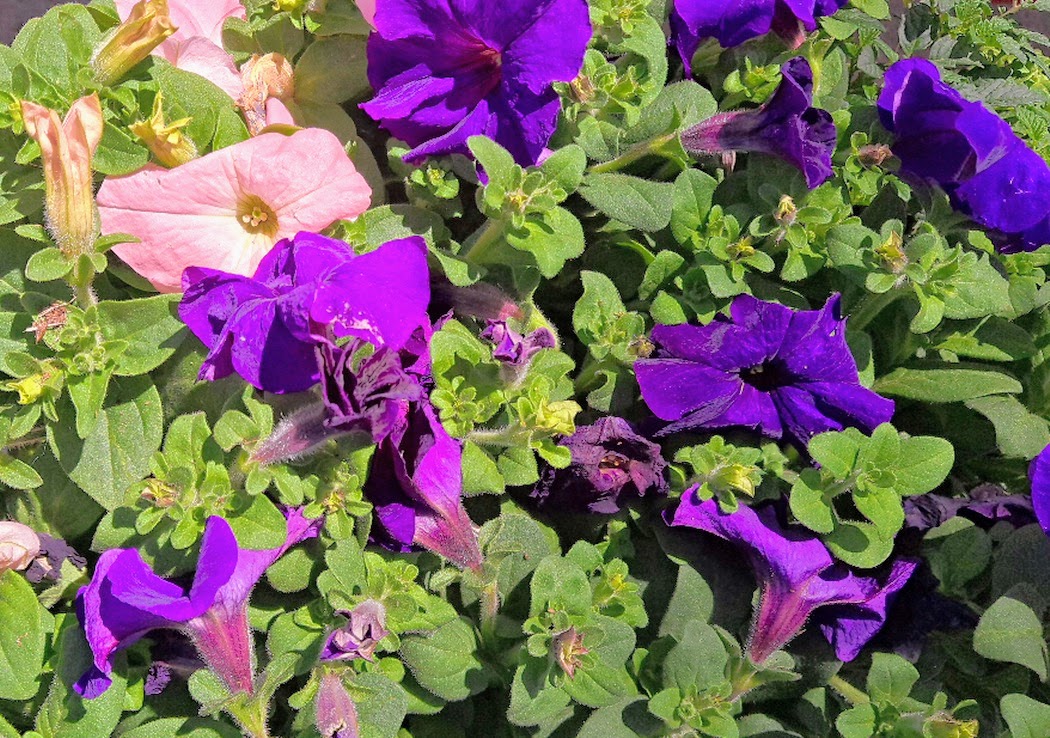
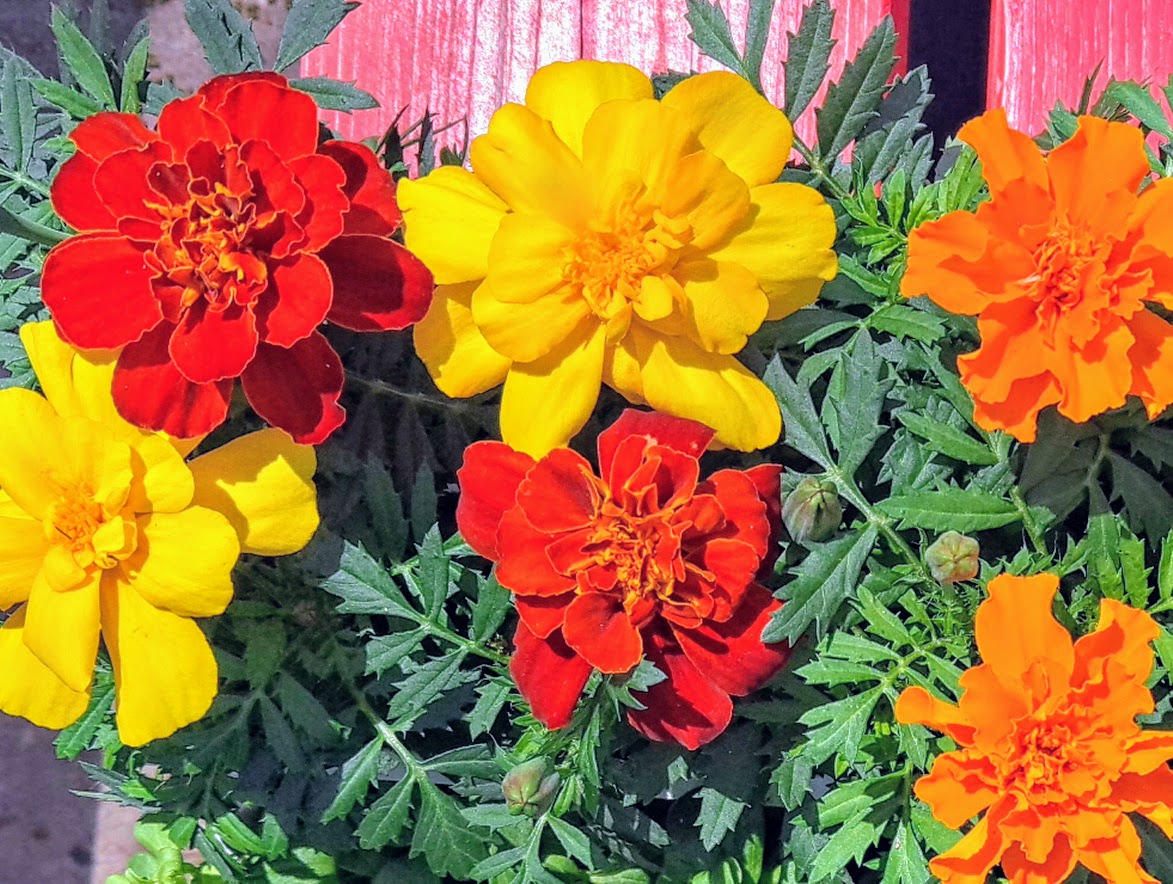
Today was a day for celebration. I received flowers from my employers.
And a goodie-filled celebration station from my sister.
I also received a special gift for my house — the replacement greengage plum trees arrived today, and I have a commitment from my contractor to get them planted as soon as possible. I feel good about these trees. March 7th seems to be a lucky day for me. After all, this is the anniversary of the day I closed on my house, and for sure, that was a lucky day! So I have every expectation of these trees doing well.
While March 27th, the anniversary of Jeff’s death, is a day for me to reflect on the vagaries of life, March 7th is a day for me to celebrate the joys of life, serendipitous occasions, and unmade wishes come true.
I never wished for a house, never really even wished for a home of my own, never wanted the responsibility, and yet through a series of unlikely events such as actually finding a nice place I could afford in an area with an atmosphere that feels comfortable, here I am. It’s as if life reached inside me, pulled out a wish I’d never considered, and made it come true.
I suppose it’s fitting that the anniversaries of the two most life-changing events of my latter years occur in the same month. I’m glad this one comes first, though — I wouldn’t ever want to feel as if this house is a consolation prize for losing the love of my life. The two are separate events, and yet . . . not. Because obviously, if Jeff were still here, I wouldn’t have a house.
But that’s not a conundrum for today. Today is about celebration. And gratitude. Because I am so very grateful I have a lovely home in a nice town, with friends, a nearby library, a job. And people to help me celebrate.
I’ve been saying that The Bob hasn’t affected me much at all. Even the stay-at-home mandates and quarantine times haven’t been a problem since they fed into my natural inclination to be a quasi-recluse. But as it turns out, The Bob has affected me, though so far, it hasn’t infected me.
Admittedly, it will be hard for me ever to get back into the socializing that I’d tried so hard to accomplish, but I don’t think it’s so much a lack of inclination (though there is that, too) but rather a hesitation to open myself to the possibility of getting sick. Because of The Bob, I am conscious of how disease spreads through even small gatherings, and I’m not sure I want to open myself up to that quite yet. It’s possible I’ll never again want to be that vulnerable, though never is a very long time.
Still, except for allergies (because of the winds, this is not a good area to live if one is allergic to dust), I haven’t been sick a single day since The Bob arrived in town. And oddly, it arrived here long before the P word was even mentioned. (P=Pandemic.) There was a horrendous flu that roared through here in late December 2019 before anyone had heard of The Bob. In retrospect, it seems as if that flu was The Bob, and is probably why this town seemed to offer a natural immunity for a while. I’d never understood how it got here, but I recently found out that a woman came directly here from Wuhan to visit a friend of hers, and so started that horrid pre-Bob flu season.
I didn’t get sick during that first wave, though I’d been around a lot of the people who got sick, and I didn’t get sick during subsequent waves, not even after I was directly exposed a couple of months ago, leading to a time of quarantine. Nor did I catch a cold or laryngitis or any of the other illnesses going around. This is the longest I’ve ever gone without even a cold, and I’m sure it’s because I see so few people. I suppose I should say so few different people. Because of my job, I do spend time with people, it’s just that they are the same people every day.
Not only am I leery of crowds, but I am leery of travelers. People who hang around where they live come in contact with a relatively small group of people (relative to the world’s population, that is), but travelers are within a couple of degrees of coming in contact with a vast number of people. (If you’re sitting next to someone on an airplane, for example, you’re not just in contact with them, but also one degree removed from everyone they have been in contact with, and two degrees removed from everyone those contacts had been in contact with.) And after all, that’s how The Bob originally spread, not just to here, but to everywhere.
When my sister reneged on a visit to come see me, I was actually relieved. Though I would have liked to see her, I wasn’t sure what sort of extra, unwanted baggage she would carry off the plane, and I was glad not to have to deal with it.
I’ve been taking care of a house for a friend who’s been out of the country for almost a year, and he called today to tell me he was back and to ask if he could stop by so I could bring him current on all that happened when he was gone. It’s not something I would have ever done before The Bob, but I asked him if it was okay if we waited a week. Although he’s not in quarantine (apparently, there is no quarantine for vaccinated folks, though they can still get sick from The Bob, and can still transmit The Bob to others), I couldn’t help but think of all those people he was in contact with during his very long and arduous trip from halfway around the world.
Luckily, he was okay with my request. Even more luckily, from my point of view, he has a lot of work to catch up on, so I don’t have to feel guilty about his being alone for the week. Of course, even if he wasn’t okay with my putting off our get together, he’d have to agree if he wants me to continue looking after his house when he leaves again. And, of course, because of how The Bob has affected me, not only do I not feel guilty, I don’t feel guilty about not feeling guilty.
I sometimes watch Judge Judy reruns with the woman I help care for, and boy is that an eyeopener! I know that the cases are chosen specifically because of the bizarre nature of either the problem or the people involved, so I try not to let that interfere with my concept of the world today, or rather my concept of the people in the world. (I already have a poor opinion of people in general, though individually, I like people just fine.) Still, I can’t help but be appalled by people and their behavior. It makes me wonder if, despite the already low regard I have for them, I have greatly overestimated the intelligence and integrity of humanity.
But, as I said, I try not to extrapolate any greater meaning from this small segment of the human population.
What is an eyeopener, however, is how often people who are in the wrong will sue their victim. It’s not as if they are trying to scam the person — they truly seem to believe as if they have right on their side. Several times, people who have tried to cheat the system by getting childcare costs or elder care costs they didn’t really qualify for will sue their accomplice for not turning over their share of the funds. (In a couple of cases, the defendant applied to be a certain person’s caregiver, even though they weren’t going to be doing the job, and the litigant wanted their share of the money.) Sometimes, a person who is getting childcare from the other parent of their child even though they share joint custody (in which case, neither parent should have to pay the other) will sue for additional funds. Or someone who is driving without insurance and who makes an illegal turn will sue the person with the right of way who ran into them so they can get the money to fix their uninsured car.
What interests me from a writer’s point of view, is the total belief in the rightness of their cause. I don’t often see this in books — too often antagonists make excuses to themselves (and eventually to the cops who catch them) for their behavior. If they truly believed they were in the right, they wouldn’t need to justify their actions. They would simply know they were the victim. (Even burglars who get shot at when breaking into a house don’t deny their crime; they just believe there shouldn’t have been any repercussions.) Every time I watch this behavior — the belief of the wrongdoer that they are the rightdoer — I remind myself to use this for a character in my next book (whenever that might be).
Another eyeopener is the constant and ubiquitous use of “had.” For example, “I had went to the store.” If all the “had”s were edited out of the show, I’m sure the shows would be at least five minutes shorter. It’s surprising to me that while Judge Judy feels compelled to scold people for using fill words like “basically,” idioms like “like,” and bad grammar, she never mentions all the “had”s. I suppose she picks whatever most offends her at the time. Or whatever seems most rant-worthy.
What amuses me most are the obvious signs that people have been coached. People who use such constructions as “Basically, like I had went to the store” simply do not use words such as “property” when referring to their stuff or “altercation” when referring to a kerfuffle.
It also makes me laugh to think that humans named themselves “homo sapiens sapiens” when there seemingly is so little sapience involved in human interactions. A better term, perhaps, especially after watching the people who come before Judge Judy, would be “homo unsapiens.”
What if God decided S/He didn’t like how the world turned out, and turned it over to a development company from the planet Xerxes for re-creation? Would you survive? Could you survive?
Numbers are important in our lives. Or at least, we’ve made them important. Today seems a significant day, a rare Twosday — not only is it a day of twos (2/22/22), but it’s also Tuesday.
Dates are important to us; if nothing else, the numbers on the calendar make it easier for us to navigate our complicated lives. More than that, we give some numbers on the calendar a special significance. For example, we make a big deal about New Year’s Day (1/1) even though it has no real significance other than a change of calendars. In fact, the new year in other cultures starts on a different day.
Temperature numbers are especially significant to us. This morning when I got up, it was 7 degrees. I don’t really need the number to tell me that it is cold — a brief step outside would fulfill the same function — but somehow, knowing the number makes it official.
And yet, when it comes to age, especially an elder age, any concern a person might have about growing older is met with a dismissive, “Age is just a number.”
Age is not just a number. It tells us the time on our biological clock. We only hear about “biological clocks” when it comes to childless women nearing the end of their reproductive years, and yet time is ticking for all of us. We might not know the end, but we do know the end is coming, and the older we are, the more the end looms.
A friend who was about to turn seventy was really freaking out about her age, and she was embarrassed about her reaction to the birthday, but to me, her reaction was totally understandable and nothing to be embarrassed about. In fact, seventy is a significant birthday and worth freaking out over.
All through their sixties, people can convince themselves they are still middle-aged — late middle age, perhaps, but still solidly in the middle years. Then comes seventy, and any pretense of still being young are gone. Especially now, with the pandemic and all, seventy-year-olds are stigmatized as “elderly.” True, they are elderly, but not as eld as they will become. That dang clock is clicking louder and louder as it counts down the last years of life. Oh, sure, they might still have two or even three decades left, but changes will be coming more rapidly.
There is not a significant physical change between the ages of forty and fifty. Nor between fifty and sixty. Or even sixty and seventy. But there is a huge difference between seventy (with the blush of middle age still on one’s cheeks) and eighty (which by anyone’s definition — except perhaps an eighty-year-old’s — really is old). An informal poll tells me that seventy-five is when most people notice a substantial change, but still, at seventy, there are signs of decrepitude. Mentally, people may feel the same, but physically, by seventy, most people are slowing down. Joints hurt. Doctor visits are more frequent. Medications aren’t just a quick cure but are a permanent fixture. The possibility of a frail old age, once unthinkable, becomes . . . thinkable.
When you’re young, old age is for other people. Youth is eternal. Until it’s not. And suddenly, there you are, wondering who the old person is looking back at you in the mirror.
It’s not really a surprise, then, that people want to believe that age is just a number. To think beyond the number is to accept truths that people might not want to accept. Still, when you’re at peace, when the aches and pains are momentarily absent, when the ticking clock silently recedes into the background of your mind, then you feel like . . . you.
When my sister was 35, she asked my mother, who was then in her seventies, how old she felt, and my mother said she thought of herself as thirty-five. My sister thought it wonderful that she and our mother were the same age. I don’t know how much longer after that my mother continued to think of herself as thirty-five. It’s not the sort of thing she and I ever talked about. But no matter how she felt, she did start having health issues, and she definitely showed her age. Then, a few years later, after my brother died, she suddenly grew old and ill and died within the year.
Valentine’s Day is a difficult day for people who are alone, especially those who are alone because of the death of their beloved.
For many who are left behind, it’s generally hard seeing couples you used to hang out with, doing things, making plans. It’s even harder when they tell you about it, with no regard for how it makes you feel. (It makes you sad, then mad, then sad again.) It’s hardest of all on Valentine’s Day, especially for the romantics who made a big deal about the day.
Jeff and I did not celebrate the day, which makes this no different from any other day for me, but it’s still, it’s hard to ignore this celebration of couplehood. So this year, I didn’t ignore it. I made heart cookies. I was going to pass them out to everyone I know, but making these embossed and painted cookies is a huge undertaking. Since I greatly underestimated how long it would take and the effort I would need to expend, I was only able to make a few. I reserved them for the woman I work for and another one or two people who are alone today. (Including me. Though I generally don’t eat cookies, I figured since I was one of those who are alone today, I might as well indulge.)
Making the cookies for some reason made the day seem more like Valentine’s Day when I was very young, where all the kids in my class brough valentines for one another. The valentines and the sentiment didn’t really mean anything back then. It wasn’t even something just between friends. It was mostly a break in the routine, something fun to do.
And so it was this year. Making these cookies was simply a break in my routine, something fun to do. Besides, I had a heart-shaped cookie cutter that had never been used, and what better day to use it than today?
Next year, perhaps, I’ll get started early and make enough to spread around a bit more, but for this year, it was enough — enough for me, I mean — to make an effort.
At the beginning of the movie Chocolat, on a winter day, a sly wind blows in from the north, bringing a chocolatier and her six-year-old daughter to town, and the people and the place will be forever changed.
At the end of the movie, after all the changes, the narrator changes her tune, and instead of calling the north wind “sly,” she called it “clever: “But still the clever north wind was not satisfied. It spoke to Vianne of towns yet to be visited, friends in need yet to be discovered, battles yet to be fought…”
Yesterday, a north wind blew through here, though I don’t know how sly or clever it was. It simply blew, fierce and cold.
I suppose it’s just as well. As romantic as the north wind’s gifts might be, a chocolate store would be too tempting. I wouldn’t listen if it spoke to me of towns yet to be visited since I’m still settling into my not-so-new town (my three-year anniversary of moving here is coming up in another few weeks). I’m not actively looking for new friends in need or otherwise, though I am always appreciative when I do make new friends. As for battles or any kind of strife? Not my style. I’m more into peace and contentment and even laziness.
What my north wind did bring was frozen air. As I walked home from work, wrapping my coat tightly around me and bending into the wind to keep from being blown off my feet, I could see what looked like the beginning of a snow shower, but the barely visible ice particles never made it to the ground. At least not during my walk. There was some snow this morning when I woke, though luckily not enough to have to sweep away.
I always walk home from work (well, not always — there was one cold evening when it rained too heavily to be safe, so I did accept a ride then), but last night, I almost turned back to catch a ride. By then, I was halfway home so it wouldn’t have done me any good. I tried walking backward, as I used to do when the wind blew into my face, but apparently, as well as my knees are behaving, they didn’t appreciate the backward maneuver. Still, I got home safely, and though the wind blew through the night, by this morning it had moved on to tempt other folks in other place with dreams of towns yet to be visited, friends in need to be discovered, and battles yet to be fought.
“Research” is a rather innocuous word with various definitions, such as “careful or detailed study,” “studious inquiry,” and “collecting information about a particular subject.” This word didn’t used to present a problem, but nowadays, the word “research” has become a trigger for contempt of others.
Some people are contemptuous of those who find out their information via Facebook or other such sources, but the truth is, depending on who your friends are and how committed they are to the truth and serious research, you can be steered toward all sorts of interesting, scientific, and thought-provoking articles.
Some people are contemptuous of those who Google a subject, read an article or two and call it research.
Some people are contemptuous of those who read a scientific paper but don’t go beyond that to do any of their own thinking or collecting any additional information.
Because “research” is such a trigger word, I have become uncomfortable talking about the research I’ve done for my books, though my research was not of the Facebook or Google or reading a couple of articles variety. My research was done before I knew what any of those online things were — before I’d ever even used a computer — and entailed reading hundreds of books, presenting all sides of the issues I discussed in my novels, as well as spending a lot of time in libraries. It’s because of all the research I did for A Spark of Heavenly Fire, my novel of a pandemic that preceded the real world one by a decade, that I am leery of any “research” people currently tell me about and expect me to believe. There have been so many shenanigans over the years, and suddenly, we are to believe that those in control of the drugs (any drugs) have our best interests at heart.
I mentioned a few weeks ago that when the woman I take care of is napping, I read her Reader’s Digest Condensed Books, and recently one of the books that showed up was novelization of troubles in the pharmaceutical industry. Thalidomide, anyone? Fen-phen? Eugenics? DES? Statins?
Oops. I didn’t mean to get into that. This wasn’t supposed to be about my distrust of the drug companies but simply a discussion of how the word “research” has become an emotional quagmire. But despite the quagmire, I really don’t have to feel bad about calling the information I get for my books “research,” because if nothing else what I do certainly falls under the category of collecting all sorts of information about a particular subject, or even several subjects, since each of my three “conspiracy” novels focused on a different area of study.
***
What if God decided S/He didn’t like how the world turned out, and turned it over to a development company from the planet Xerxes for re-creation? Would you survive? Could you survive?
A Colorado lawyer who specializes in getting money for automobile accident victims advertises constantly when I am watching Judge Judy with the woman I help care for. I’m sure he’s on there other times, too, but obviously I wouldn’t know since I don’t watch during those other times.
The commercials first caught my attention (well, second since the first attention grabber is the prevalence of the ads) because all the people he features act as if they won the lottery. “I was in a terrible accident, but he got me $100,000!” Big smiles all around.
This reminds me of the movie Office Space where one character had been in an accident, was in a multitude of casts and wincing from the pain, but he threw a party because he’d won the “accident” lottery and would never have to work again. All the other characters were extremely envious of his disability.
What really prompted this post, though, is that this attorney’s most recent commercials target people in the armed services. He talks about having JAG lawyers on retainer, but he doesn’t speak clearly so I hear “jaguars.” Cars? Cats? He doesn’t specify, so I opt to believe he retains a bunch of fat cats (well, sleek cats) to help solve people’s problems, though what a feline could do, I don’t know except perhaps intimidate the opposition.
Can you imagine a lawyer going into court surrounded by jaguars? Now that would be an interesting trial to watch!
As you can see, I have nothing much to say. Even though the water discrepancy hasn’t been resolved, I paid my water bill for the 19,000 gallons of water I didn’t use, though I did enclose a note explaining the situation. I wanted it on file. (Too much Judge Judy, I think. Document everything!)
I also spent time on FB, trying once more to find a place to ask for a real person to check out my blog to see that it doesn’t go against their standards, but all I found were the myriad notes I’d already sent with a brief message from them thanking me for the message. Too bad I dislike Twitter and Pinterest (neither of them has ever brought anyone to my blog) otherwise I’d hang out there.
The good news (for me) is that’s it’s warming up again. This weekend should be particularly nice, so I will be able to go out walking without having to slosh through mud and icy puddles. Even better, the grass should be okay without any additional watering, so I will not have to do any work. I can just enjoy my time in the sun.
Hopefully, things will remain go okay so that I can continue to have nothing much to say.
One’s concept of old and young seem to change as the years pass. I remember when I was very young asking my aunt how old she was. I think she was in her forties, but she answered, “Twenty-nine.” Then she and my mother laughed. I had no idea what the joke was. To me, back then, twenty-nine was unfathomably old. And now? Unfathomably young.
For many years, I looked young for my age, so the one time I asked for a senior discount that was advertised, I thought there might be a problem proving I was old enough, but the clerk (just a kid) told me she’d already given it me. What a come down that was! I never bothered asking for a discount again; I didn’t think my ego could handle it.
Now I do look my age, even to my age-adjusted eyes. Even if I didn’t look old, I’d know I was because people seem so dang young. I watch the news sometimes with the lady I help care for, and it seems to me that people reading the news are a bunch of children playing at being newscasters. They’re not that young, from mid-thirties to early forties but still, they look like kids to me. But then, to the woman I care for, I look young. “You’re just a kid,” she tells me.
Not that it matters, really. I once was young, and now I’m not. It’s all part of the cycle of life.
Oddly, unlike my aunt, I never told anyone I was twenty-nine. Even when I was twenty-nine, I doubt I told anyone my age. The topic just doesn’t come up. Or perhaps other people aren’t as rude as I was when I was young. Come to think of it, I don’t know what prompted me to ask my aunt her age. I really wasn’t at all rude when I was young. I’m not rude now that I’m not young, either.
This last part has nothing to do with age, but is a follow-up to my water meter dilemma. The meter reader was just here. He checked the meter, and says it’s working fine, that I have no leaks though somehow the meter shows another 4,000 gallons used in the past three weeks, which is impossible. Normally, one person uses about 3,000 gallons a month, and that includes, all indoor and some outdoor water usage, which is what I use in the summer. But it’s winter, and in the winter, I use half of that amount.
I suppose this is more proof that I’m not just a kid anymore; if I were, I wouldn’t have to deal with this mess.
***
Pat Bertram is the author of intriguing fiction and insightful works of grief.
As I was leaving the house this morning to walk to the library (in nineteen-degree weather!) it suddenly struck me as strange that no one cares when I leave. No one cares when I get home. No one cares if I stay home or stay away. Obviously, I care, at least to an extent, but for the most part it doesn’t matter because wherever I am, there I am.
A lot of people care, not just about me but also that I am safe and well and that we can visit occasionally, but for the daily comings and goings? No one.
I’m surprised it took me this long to realize the strangeness of this situation, though it really shouldn’t have been a surprise. The first couple of months after Jeff died, being alone didn’t seem strange, just so very, very sad. I couldn’t stand coming home to an empty house, not because it was empty, but because I forgot it was empty. I’d unlock the door as always, ready with an “I’m home!” and then it would strike me . . . again . . . that he was gone, and full-on grief would slam into me.
For the next few years, I took care of my aged father, and when he was gone, I was so busy clearing out the house and getting it ready for sale that I didn’t really notice that no one cared whether I came or went. When the work was done, that huge house was so empty that I noticed the echoes but not much else. Also, by then, I was involved with dance classes, so my dad’s house was mostly a place to spend the night.
The years after I left my father’s house were spent traveling or renting rooms in other people’s houses, and I was blogging about my activities, so I didn’t notice that no one was around to pay attention to my comings and goings.
When I bought this house, it was such a new and wonderful experience — both owning a house and making a home in a new place — it didn’t really strike me that no one particularly cared about when I left the house.
But now, it’s been almost three years since I bought the house. Although the thrill and the feeling of being blessed isn’t gone, I am more aware of being alone. (Not lonely. Just aware of aloneness.) That awareness could be why I talk to Jeff’s picture, and why I tell the photo when I am leaving, but a photo doesn’t care.
Now, almost twelve years after his death and all the moves I’ve made and all the things I’ve done, I’ve suddenly realized how strange this living alone is. It’s nice, of course, being able to do what I want and go where I want without regard to anyone else. But it’s also . . . not sad, exactly, but . . . strange.
“I am Bob, the Right Hand of God. As part of the galactic renewal program, God has accepted an offer from a development company on the planet Xerxes to turn Earth into a theme park. Not even God can stop progress, but to tell the truth, He’s glad of the change. He’s never been satisfied with Earth. For one thing, there are too many humans on it. He’s decided to eliminate anyone who isn’t nice, and because He’s God, He knows who you are; you can’t talk your way out of it as you humans normally do.”
Grief Books By Pat Bertram
Available online wherever books and ebooks are sold.
Grief: The Inside Story – A Guide to Surviving the Loss of a Loved One debunks many established beliefs about what grief is, explains how it affects those left behind, and shows how to adjust to a world that no longer contains the loved one. “It is exactly what folk need to read who are grieving.”(Leesa Heely Emotional/Mental Health Therapist & Educator ).
Grief: The Great Yearning is not a how-to but a how-done, a compilation of letters, blog posts, and journal entries Pat Bertram wrote while struggling to survive her first year of grief. This is an exquisite book, wrenching to read, and at the same time full of profound truths.
Other books by Pat Bertram
Available online wherever books and ebooks are sold.
While sorting through her deceased husband’s effects, Amanda is shocked to discover a gun and the photo of an unknown girl who resembles their daughter. After dedicating her life to David and his vocation as a pastor, the evidence that her devout husband kept secrets devastates Amanda. But Amanda has secrets of her own. . .
When Pat’s adult dance classmates discover she is a published author, the women suggest she write a mystery featuring the studio and its aging students. One sweet older lady laughingly volunteers to be the victim, and the others offer suggestions to jazz up the story. Pat starts writing, and then . . . the murders begin.
Thirty-seven years after being abandoned on the doorstep of a remote cabin in Colorado, Becka Johnson returns to try to discover her identity, but she only finds more questions. Who has been looking for her all those years? And why are those same people interested in fellow newcomer Philip Hansen?
When twenty-five-year-old Mary Stuart learns she inherited a farm from her recently murdered grandparents -- grandparents her father claimed had died before she was born -- she becomes obsessed with finding out who they were and why someone wanted them dead.
In quarantined Colorado, where hundreds of thousands of people are dying from an unstoppable, bio-engineered disease, investigative reporter Greg Pullman risks everything to discover the truth: Who unleashed the deadly organism? And why?
Bob Stark returns to Denver after 18 years in SE Asia to discover that the mother he buried before he left is dead again. At her new funeral, he sees . . . himself. Is his other self a hoaxer, or is something more sinister going on?