Taking “A” Things With Gratitude

When it comes to life the critical thing is whether you take things for granted or take them with gratitude. ~~ G. K. Chesterton

For the rest of November, I’m going to take for gratitude some of those things I often take for granted — an entire alphabet’s worth! Since today is the first day of this surge of gratitude, I am giving thanks for “A” things.

I am especially grateful for:
Ability to appreciate. Not just to see, taste, hear something, but to admire it, to recognize its importance and value.

Accelerators. We depend on our vehicles for important things such as going work or to the grocery store where we hunt and gather our food, but we also use them to go see sights far away. Without an accelerator, we wouldn’t be able to do anything with those vehicles except sit in them and dream of other places.

Age. Perhaps youth is wasted on the young as we are often told, but age has its place. Despite the ebbing of energy and health that age might bring, having a few decades of life behind us helps bring perspective, appreciation, perhaps even wisdom, though these things are not prerequisites for growing old. Jerks remain jerks forever, it seems. But still, I have a hunch age would be wasted on the young.

Air. Air gives us life, but it also makes us one with the world, flowing into our bodies via our lungs, and flowing out again. Deep slow intakes of air can calm us. Cool air on a hot day or warm air on a cold day brings us comfort.

Ankles make it easier to walk, to dance, to balance. Without ankles, our lower legs would be like stumps. And who doesn’t admire a well-sculpted ankle?

Arms. We take our arms for granted, but those who have lost an arm through war or an accident or illness know the value of those appendages. Even old, saggy arms are beautiful, especially when they are cradling a baby, hugging a friend, swinging loose and free when we take a walk.

What “A”s are you taking for gratitude today?

***

Pat Bertram is the author of the suspense novels Light Bringer, More Deaths Than One, A Spark of Heavenly Fire, and Daughter Am I. Bertram is also the author of Grief: The Great Yearning, “an exquisite book, wrenching to read, and at the same time full of profound truths.” Connect with Pat on Google+. Like Pat on Facebook.
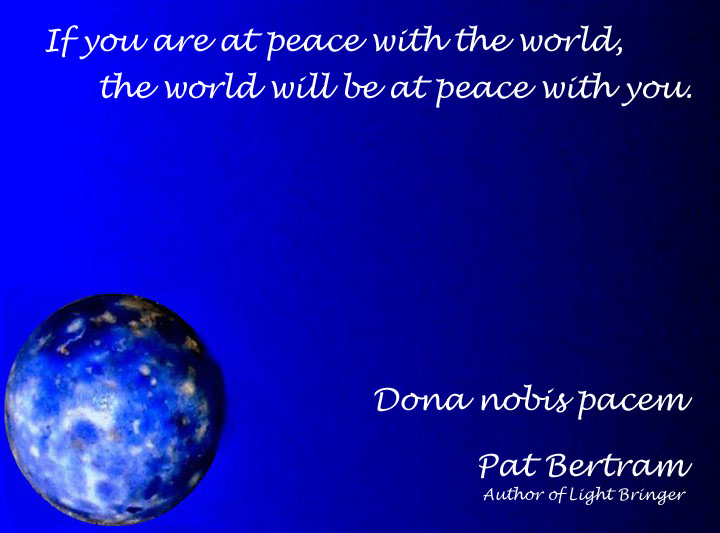

Dona Nobis Pacem

Thousands of bloggers from all over the globe are Blogging for Peace today.

One subject. One voice. One day.

Words are powerful . . . this matters.

***

Pat Bertram is the author of the suspense novels Light Bringer, More Deaths Than One, A Spark of Heavenly Fire, and Daughter Am I. Bertram is also the author of Grief: The Great Yearning, “an exquisite book, wrenching to read, and at the same time full of profound truths.” Connect with Pat on Google+. Like Pat on Facebook.

Taking Things With Gratitude

California sunriseWhen you arise in the morning, give thanks for the morning light, for your life and strength. Give thanks for your food, and the joy of living. If you see no reason for giving thanks, the fault lies with yourself. ~~Tecumseh

When it comes to life the critical thing is whether you take things for granted or take them with gratitude. ~~ G. K. Chesterton

Gratitude is an integral component of health, wholeness, and well-being. According to a research project from the University of California, developing an attitude of gratitude makes us happier, healthier, more alert, able to sleep better, and better able to handle stress.

Since I’ve been going through a resurgence of grief lately (I call it grief, but it’s really more like self-pity), I’ve decided to devote the rest of this month to being grateful for oh, so many things — air, beauty, comfort, desert, energy, friends — an entire alphabet full!

Tomorrow is the day I Blog4Peace, but the day after, the fifth of November, I’ll begin my twenty-six days of gratitude, one for each letter of the alphabet.

Feel free to join me if you wish.

***

Pat Bertram is the author of the suspense novels Light Bringer, More Deaths Than One, A Spark of Heavenly Fire, and Daughter Am I. Bertram is also the author of Grief: The Great Yearning, “an exquisite book, wrenching to read, and at the same time full of profound truths.” Connect with Pat on Google+. Like Pat on Facebook.

Excerpt From “Grief: The Great Yearning” — Day 214

GTGYthmbI’ve come a long way in the three years since I wrote the following journal entry.  I still don’t understand the nature of life or death. Still don’t understand the point of it all, but the questions don’t haunt me quite as much as they did during the first years after the death of my life mate/soul mate.  I’m learning to live without him, learning even to want to live without him. Sometimes I see his death as freeing us — me — from the horrors of his dying, and I don’t want to waste the sacrifice he made.
I still yearn to talk to him, though. I miss talking to him, miss his insights, miss the neverending conversation. (“Neverending” is a misnomer — the conversation that began the day we met and continued for decades until he got too sick to hold up his end of the dialogue, did eventually end.) He was easy to talk to. He never misunderstood what I said. I could make a simple comment to him, and he understood it was a simple comment. He didn’t make a big issue out of it, just answered back appropriately. It seems now every remark I make to anyone becomes a major deal as I try to explain over and over again what I meant by the first remark. It’s exhausting.

I’m  grateful we met and had so many years together. Grateful for all the words we spoke to each other. Grateful I once had someone to love. Grateful that when my time comes to die, he won’t be here to see me suffer. Grateful he won’t have to grieve for me or be tormented by unaswerable questions.

Excerpt from Grief: The Great Yearning

Day 214, Grief Journal

Life/death has me very confused. I still don’t see that a person lives after they are dead. What survives, if anything? The part of us we never knew—the un-sub-conscious? If so, how would we know who we were after we were dead? Is it just the energy in our bodies that is released? If so, for sure we would not know who we were.

On the other hand, without some sort of afterlife, life simply does not make sense. What’s the point of it all? To survive? For what—more survival until there is no more survival? To help others? Why? So they can survive? For what?

If there is life after death, what do you do with eternity? You have no ears to hear music, no eyes to read or watch a movie, no legs to walk, no hands to caress another, no mouth to talk, no brain to think. Sounds like a horror movie to me. And what will we do if Jeff and I meet again? Bask in each other’s light? That would get boring after a minute or two.

I guess it doesn’t really matter. Whether life ends or continues after death, this is where I am now. So what do I want from the rest of my life? I don’t know. I’ve never really wanted much. I never even wanted happiness—I thought other things were more important, such as truth. But now? I truly do not know what I want, except that which I cannot have. I yearn desperately to talk to Jeff—not about anything in particular, just to talk. It’s like a voice hunger, or a word hunger. A dozen times a day I think of something I want to say to him, to ask him, to marvel at. Sometimes I just want the feeling of connection. I still yearn to put my arms around him and protect him from what will happen, but it’s already happened, and anyway, my touch never had the power to heal.

I know I’m strong enough to handle this—after all, I am handling it—but I DON’T WANT TO!!

Click here to find out more about Grief: The Great Yearning

***

Pat Bertram is the author of the suspense novels Light Bringer, More Deaths Than One, A Spark of Heavenly Fire, and Daughter Am I. Bertram is also the author of Grief: The Great Yearning, “an exquisite book, wrenching to read, and at the same time full of profound truths.” Connect with Pat on Google+. Like Pat on Facebook.

I’m going to Blog for Peace. Will You?

Blog 4 PeaceOn Monday, November 4, people all over the planet blog for peace. This year, I’m going to join the the Blog Blast for Peace, and you can join the movement, too. You make your own peace globe/statement or simply choose one pre-made at http://blogblastforpeace.com, and become – a peace blogger.

Peace bloggers believe that words are powerful, and that this event matters.

So, check out the above website or check out on Facebook: https://www.facebook.com/BlogBlastForPeace.

How To Blog For Peace The short version:

1. Choose a graphic from the peace globe gallery http://peaceglobegallery.blogspot.com/p/get-your-own-peace-globe.html or from the photos on Facebook https://www.facebook.com/BlogBlastForPeace#!/BlogBlastForPeace/app_153284594738391 Right click and Save. Decorate it and sign it, or leave as is.

2. Send the finished globe to blogblast4peace@yahoo.com

3. Post it anywhere online November 4 and title your post Dona Nobis Pacem (Latin for Grant us Peace)

Sounds cool, doesn’t it? See you on November 4!

***

Pat Bertram is the author of the suspense novels Light Bringer, More Deaths Than One, A Spark of Heavenly Fire, and Daughter Am I. Bertram is also the author of Grief: The Great Yearning, “an exquisite book, wrenching to read, and at the same time full of profound truths.” Connect with Pat on Google+. Like Pat on Facebook.

And So Grief Goes . . .

When you lose a soul mate or any person who connects you to the world in a significant way, you are born into the world of grief. At first, like any infant, you count your age in days, then weeks, and finally months and years.

I am long past counting the days and weeks since the death of my life mate/soul mate, though I can figure it out. (In case you’re curious, I calculated that it’s been 1,310 days or 187 weeks.) I’m even past counting the months. Today is an anniversary of his death, but without stopping to figure it out, all I know is that it’s been more than three and a half years but less than four.

numbersThis is a significant development. People who have never had to deal with the death of such an important person in their lives were spooked by my counting the days for so long, thinking I was unhealthily obsessed with the past, but that wasn’t the case at all. The days were milestones, ways of proving to myself that I could get through my grief one day at a time. And I have mostly gone through it. The horrendous pain, angst, and confusion of those first months isn’t even a memory. I can’t imagine anymore what I went through, can’t imagine how anyone could go through such a series of losses and come out the other end stronger and able to face whatever traumas life has in store. (In my case, not only did I lose my life mate/soul mate, I lost shared hopes and dreams, my most devoted fan, my best friend, and my home.)

When I talk about my grief, people assume I mean I still mourn him. To me, grief is the process, the whole spectrum of grief-related advancements including healing and rebuilding one’s life. The spectrum flows from the deepest black of despair to the brightest white of joy. Mourning is the sadness, the tears, the screams, the soul-deep pain — the physical manifestation of grief. I am long past the soul-deep pain, but I am still a long way from joy, so although I seldom mourn him any more, I still consider myself a child of grief.

Someday, that too will pass. Grief has taught me what we already know: things change. I never thought I’d laugh again, never thought I could live again. And yet here I am, all these months later, laughing and enjoying myself on occasion. I never thought I could forget him, and yet he is not always on my mind. For so long, I couldn’t bear the thought of settling down anywhere when I leave here (I am temporarily staying with my 96-year-old father, looking after him so he can be as independent as possible). All I wanted was to keep on the move. Travel See what life has to offer. I still think of leading such a spontaneous and unsettled life, but I am also weighing the possibility of settling down. I used to fear stagnation, but I am surer of myself and my solitary place in the world, and I doubt I would stagnate. I would do . . . something.

And so grief goes . . .

***

Pat Bertram is the author of the suspense novels Light Bringer, More Deaths Than One, A Spark of Heavenly Fire, and Daughter Am I. Bertram is also the author of Grief: The Great Yearning, “an exquisite book, wrenching to read, and at the same time full of profound truths.” Connect with Pat on Google+. Like Pat on Facebook.

Only Human?

At least three times in the past few days, people have reminded me that we’re only human, and each time I could feel myself sliding down our evolutionary tree until my knuckles were dragging on the ground.

(Interestingly, that fall isn’t as far as it once was. Recent finds have shown that what scientists once assumed were three different species have been idenwarriortified as normal variations in the physical features of a single species. But we lay folk already knew that, didn’t we? It’s only common sense that not every member of a species has exactly the same physicality. The shortest living person measures 21.5 inches. The tallest measures 101 inches. I’m sure craniums also have big discrepancies, as do bones and bone density.)

Saying that “we’re only human” masks the truth of us, and believing it allows us to accept the basest part of our natures without feeling the need to aspire to anything more. Sure, we’re human, but we’re also divine, or at least have a glimmer of divinity in us. Even those who don’t believe in God believe we are sparked by something eternal — an energy that can neither be created nor destroyed.

We were born with god-like powers:

The power to interact with the world around us, to become part of the fabric of creation. (Life flows through us, the air becomes part of us, the very earth itself enters our body by way of the food we eat. We are creatures made of stardust.)

The power to participate in creation by way of procreation, making art, writing, living the life only we can lead.

The power to love, to laugh, to sing, to dance, to feel grief and joy, to be compassionate, to forgive.

The power to grow, to transcend who we are and become more of what we were meant to be.

Rob McNamara wrote, “Life will not let you divide the sacred and the mundane. You cannot separate the unsubstantial from the significant for they are married to a union fundamental to the very fabric of existence.”

Yet saying we are only human divorces us from the sacred and leaves the mundane. Why should we aspire to so little?

***

Pat Bertram is the author of the suspense novels Light Bringer, More Deaths Than One, A Spark of Heavenly Fire, and Daughter Am I. Bertram is also the author of Grief: The Great Yearning, “an exquisite book, wrenching to read, and at the same time full of profound truths.” Connect with Pat on Google+. Like Pat on Facebook.

Leading an Elegant Life

Elegance. Such an elegant word, evoking images of times gone by, when clothes gracefully draped the human form, and people wrote with stylish hands.

Several times lately, I’ve stumbled across the word elegant in reference to both language and living, and I’ve become enamored with the idea of leading an elegant life. When people speak of elegance, they generally refer to things — the materiality of life — such as elegant dress or elegant furnishings, but what does that have to do with life itself?

According to my dictionary, elegance means pleasingly graceful; excellent, splendid. According to Wikipedia, elegance is a synonym for beautiful that has come to acquire the additional connotations of unusual effectiveness, simplicity and focusing on essential features.

So an elegant life would be a life of grace, excellence, effectiveness, and simplicity. Finding the essence of life and paring away that which is cumbersome, unattractive, or unnecessary. Overcoming the limits we have set for ourselves (or that others have set for us). Dreaming of becoming more of who we are.

Sounds lovely, doesn’t it?

During these past years as I’ve struggled to find a way through grief after the death of my life mate/soul mate, I’ve often talked about wanting more, though I have never quite known what I meant by “more.” Well, I still don’t know the specifics of what I mean, but at least I have a better way to describe what I want — an elegant life.

I have a hunch aspiring to lead an elegant life is not an easy task, but beauty and elegance never come without a price.

And it just so happens I have the rest of my life to spend on the pursuit of elegance.

***

Pat Bertram is the author of the suspense novels Light Bringer, More Deaths Than One, A Spark of Heavenly Fire, and Daughter Am I. Bertram is also the author of Grief: The Great Yearning, “an exquisite book, wrenching to read, and at the same time full of profound truths.” Connect with Pat on Google+. Like Pat on Facebook.

Identity Theft and Facebook

Identity theft is the fastest growing crime in America. In 2010, the total loss attributed to identity theft was $13.2 billion. In 2012, the loss was $21 billion.

According to the FFC, the number of identity theft incidents has reached 9.9 million a year, about 19 every minute. Even worse, studies show that it’s becoming more common for someone close to the victim to be the thief. In 32% of identity theft cases, a family member or relative was responsible for stealing the identity. Another 18% were victimized by friend, neighbor, or in-home employee. The average loss per incident is $4,930.

burglarThe moral of the story is, be careful about giving out personal information. If someone calls you asking for such information, be very suspicious. If you make the call, such as to your bank, it’s probably okay (and necessary) to give out the information.

Just as important is to be careful what you post on Facebook and other sites. So many security questions that institution and various sites ask, such things as mother’s maiden name, the name of your first pet, or the street you grew up on, are routinely mentioned on FB, and con artists can use such information to gain access to your life. (Only 28% of identity theft cases involve credit or financial fraud. Phone, utility, bank and employment fraud make up another 50% of the cases.)

And of course, you know that you’re supposed to use passwords and PIN numbers that are not easy to guess or are not recorded anywhere.

One thing no one mentions is “liking” pages on Facebook or even off Facebook. I’ve liked things and then never been able to unlike them, and forever after, those products or programs are linked to me. “Liking” has become entwined in the whole marketing milieu, letting your friends and fans (and potential victimizers) know more about you than you ever wanted them to know.

Of course, I have nothing of any monetary value, so I doubt anyone would ever care to steal, but still, I try to be careful.

Makes me wonder — what if someone had their identity stolen, and it turned out to be a good thing for them. Could be an interesting story.

***

Pat Bertram is the author of the suspense novels Light Bringer, More Deaths Than One, A Spark of Heavenly Fire, and Daughter Am I. Bertram is also the author of Grief: The Great Yearning, “an exquisite book, wrenching to read, and at the same time full of profound truths.” Connect with Pat on Google+. Like Pat on Facebook.

Stop Wasting Food!

A few days ago I wrote Haunted by an Image of Pizza, a post about the huge mounds of half-eaten pizza I saw in dumpster behind a restaurant. I’ve always believed that food was sacred, and that it was a sin to waste anything edible. I despise food fights in movies and scenes where people trash leftovers instead of carefully saving them. Too often, the characters take a few bites of food and scrape the rest in the trash can or garbage disposal, and this ruins the movie for me. It shows a pattern of disregard for food that viewers consciously or unconsciously pick up on.

Besides, how can I empathize with a character who wastes food? I never waste food. I buy only what I can eat before the food goes bad, and when/if I cook, I always store what is left. Leftovers is a term I never use. I believe there is no such thing as leftover food, just a precooked meal. (And to way of thinking, if food smells and looks fresh, it’s still edible. Expiration dates seem more like an expiration of liability than the expiration of food. I’ve eaten eggs that are still fresh two weeks after the expiration date, and canned goods a year or even two after the date.)

Someone left a comment on that post that I would like to share with you. I ended my blog with “I can’t do anything about the situation, either to help the homeless fellow or deal with the discarded food, but still, the image stays with me.” She responded:

Why do you feel like you can’t do anything about the situation? Who do you think can? I will link a couple of articles and a video that I think you (and everyone else) should read/watch. Note the quote “Everybody is waiting for somebody else to take action.”

http://www.thinkeatsave.org/index.php/stop-wasting-food

http://www.themindfulword.org/2011/designed-starvation-food-waste/

http://www.ted.com/talks/tristram_stuart_the_global_food_waste_scandal.html

I can’t emphasise enough that this IS everybody’s responsibility, especially those of us in the privileged position to live in countries with surplus food as opposed to none, and you CAN do something to help the situation.

People are starving all over the world, yet we are so greedy, we order/cook/buy more than we can eat, and throw away the rest. The world produces enough food to feed each person on the globe 2,700 calories per day. (Read more at http://www.themindfulword.org/2011/designed-starvation-food-waste/#yh1IrXaCweEPe6J8.99). No one needs to go hungry.

We’ve been taught that the aesthetics of food is important, and we can be taught that food with blemishes and such things as crooked carrots can be pleasing, too.

As Mahatma Ghandi said, “The world has enough for everyone’s need, but not enough for everyone’s greed.”

***

Pat Bertram is the author of the suspense novels Light Bringer, More Deaths Than One, A Spark of Heavenly Fire, and Daughter Am I. Bertram is also the author of Grief: The Great Yearning, “an exquisite book, wrenching to read, and at the same time full of profound truths.” Connect with Pat on Google+. Like Pat on Facebook.