Haunted by an Image of Pizza

I saw something unsettling the other day that I can’t get out of my mind. A homeless man was standing at a dumpster behind a pizza place, feasting on discarded slices. That wasn’t the unsettling thing since it seemed oddly normal — we humans have origins as hunter/gatherers, finding food wherever we might. It wasn’t even that the food had been previously nibbled on, because it hadn’t been. Most of the slices of pizza were whole.

PizzahuttWhat haunts me is the sheer bulk of the discarded food. Hundreds of slices of pizza. Huge bags full. Mounds of it. (Did you ever see Space Balls? Pizza the Hutt? The piles of pizza looked like that.)

I have such a respect for food, that even seeing food wasted in a movie, such as a food fight, turns my stomach. Somehow I had assumed others had the same respect for comestibles. And yet, there was a dumpster full of food that people had ordered and not eaten.

Ignoring the dubious designation of pizza as food, it is edible, and supplies needed calories. Only in a society that views food as disposable and calories as something bad can such a situation occur. I don’t know what the solution is, or if there is a solution. Restaurants can’t really donate used food to homeless shelters, though some restaurants do donate leftover food. (I was a at a family-style dinner once where they kept bringing huge platters of food long after everyone had eaten their fill, and those platters of food were taken to a nearby shelter. They could have fed an army that night with our leftovers alone.)

I can’t do anything about the situation, either to help the homeless fellow or deal with the discarded food, but still, the image stays with me.

***

Pat Bertram is the author of the suspense novels Light Bringer, More Deaths Than One, A Spark of Heavenly Fire, and Daughter Am I. Bertram is also the author of Grief: The Great Yearning, “an exquisite book, wrenching to read, and at the same time full of profound truths.” Connect with Pat on Google+. Like Pat on Facebook.
Do the Dead Miss Us?

I had an odd dream last night. The setting wasn’t very detailed — just a simple bed in the middle of an empty white room that my waking self doesn’t recognize. I was lying in the bed, the white sheet pulled up to my chest. My deceased life mate/soul mate walked into the room wearing only white underwear. I got the impression he was coming from somewhere else or someone else, and that we weren’t still together. He stopped by my feet, gave them an affectionate rub, then came around to the empty side of the bed. He bedlay on the bed on top of the sheet, cuddled up close to me, and said softly, “I miss you.”
I woke, and tears came to my eyes. I’ve been keeping myself busy lately, and haven’t been thinking about him much, and the dream reminded me how much I missed him. I lay in bed waiting for a full-blown grief upsurge, but after a minute or two, I simply went back to sleep.

This is the closest I’ve ever had to what I would consider a “visitation” dream, and it’s left wondering if it was some sort of real encounter.

In various updates about grief on this blog, I mention that I talk to him, and I always make a facetious remark about his silence, such as this comment in a letter to him I posted a few days ago: so far you’ve been mum about your situation. Just one more thing to hate—the silence of the grave. (Well, the silence of the funerary urn.)

Could the dream have been an attempt to contact me? I don’t really believe it, but still, this is the first of the handful of dreams I’ve had about him in the past three and a half years that ever mentioned how he might be feeling. Could it be that the dead miss us as much as we miss them? Could they be feeling as amputated as we do?

Whatever the truth of the dream, it adds one more facet to this strange and incomprehensible state we call grief.

***

Pat Bertram is the author of the suspense novels Light Bringer, More Deaths Than One, A Spark of Heavenly Fire, and Daughter Am I. Bertram is also the author of Grief: The Great Yearning, “an exquisite book, wrenching to read, and at the same time full of profound truths.” Connect with Pat on Google+. Like Pat on Facebook.

I Am Not an Authoress!!!!

Recently, someone called me an authoress, and I could feel the word grate up and down my spine. What an atrocious word to use today! It’s even worse than co-ed, a despicably sexist and patronizing term. (Coed is short for coeducational and refers to the women who were allowed into previously all male colleges and universities. Perhaps it had meaning back in the nineteen-thirties, but its use today is demeaning. It says men are educated, and women are co-educated. Like a pilot and co-pilot. So please, do not use co-ed. Student is sufficient, or woman student if you have to differentiate.)

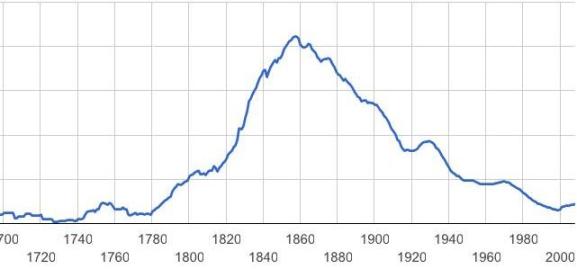
Authoress is an old term and was used as early as 1485. It grew in popularity until the mid 1800’s and found it’s nadir in 1998. Now “authoress” is on the rise again. Why? Not only is it old fashioned, of use only in historical dramas or other historical contexts, it is ugly and demeaning and redundant since “author” includes both males and females. According to the free dictionary, author means a) The writer of a book, article, or other text. B) One who practices writing as a profession.

If I had to describe myself as an “authoress,” I would never admit that I am a published writer. I even refuse to accept a friend request on Facebook from anyone who uses “authoress” as a title before or after her user name. Of course, I don’t friend anyone who uses “author” as a title either because I have doubts about their sincerity in wanting to be a friend.

If I need to describe my writing self, I tell people I’ve written books. I give them my card to show them what books I have written. Sometimes I even tell them I am a writer. Even though I tend to believe that an author is one who makes a living at writing and I have not yet achieved that status, I have even called myself an author once or twice.

But authoress? Never!

Use of "Authoress"

Use of “Authoress”

***

Pat Bertram is the author of the suspense novels Light Bringer, More Deaths Than One, A Spark of Heavenly Fire, and Daughter Am I. Bertram is also the author of Grief: The Great Yearning, “an exquisite book, wrenching to read, and at the same time full of profound truths.” Connect with Pat on Google+. Like Pat on Facebook.

Excerpt From “Grief: The Great Yearning” — Day 197

I’ve come a long way in the three years since I wrote the following letter.  I still don’t understand the nature of life or death. Still don’t understand the point of it all, but I am embracing life, trying to create my own meaning out of small occurrences.  I’m learning to live without him, learning even to want to live without him. Sometimes I see his death as freeing us — me — from the horrors of his dying, and I don’t want to waste the sacrifice he made.

I still wish I could go home to him when my current responsibilities come to an end, but even that desire is waning. It took me a long time to feel the truth — that he is gone from this earth, and I am here. I still miss him, and I probably always will, but I’m learning to be comfortable in my own skin again. When one of “our” things disappears from my life through attrition, it no longer pains me — they are merely things, not “us”.

I’m  grateful we met and had so many years together. Grateful I once had someone to love. Grateful that when my time comes to die, he won’t be here to see me suffer. Grateful he won’t have to grieve for me.

Excerpt from Grief: The Great Yearning

Day 197, Dear Jeff,

It’s been a while since I’ve written, but I’ve been thinking about you. Are you glad you’re dead? You said you were ready to die, to be done with your suffering, yet at the very end you seemed reluctant to go.

I didn’t want to throw you away. Despite all the problems with your restlessness and the disorientation from the drugs, I wasn’t ready for you to leave me. I still am not. Nor do I want to go back to where we were that last year, waiting for you to die. We were both so miserable, but honestly, this is even worse. I can live without you. The problem is, I don’t want to, and I don’t see why I have to.

I want to come home. Please, can I come home? I have a good place to stay, but without you, I feel homeless. Sometimes I watch movies from your collection and imagine you’re watching with me, but that makes me cry because I know you’re not here. Your ashes are, but you’re not.

I broke a cup today, one more thing gone out of the life we shared. Our stuff is going to break, wear out, get used up. I’ll replace some of it, add new things, write new books, and it will dilute what we shared. Is there going to be anything left of “us”? I feel uncomfortable in this new skin, this new life, as if it’s not mine. As if I’m wearing clothes too big and too small all at the same time.

There’s so much I hate about your being gone—hate it for me and hate it for you. It might be easier if I knew you were glad to be dead, but so far you’ve been mum about your situation. Just one more thing to hate—the silence of the grave. (Well, the silence of the funerary urn.)

Adios, compadre. If you get a chance, let me know you’re okay.

***
Click here to find Grief: The Great Yearning in print or on Kindle from Amazon.


***

Pat Bertram is the author of the suspense novels Light Bringer, More Deaths Than One, A Spark of Heavenly Fire, and Daughter Am I. Bertram is also the author of Grief: The Great Yearning, “an exquisite book, wrenching to read, and at the same time full of profound truths.” Connect with Pat on Google+. Like Pat on Facebook.

The Art of Miscommunication

It’s amazing to me that we ever manage to communicate with one another at all.

A couple of days ago, I talked to my artist sister about the purpose of art and writing and what it means in this winner-take-all world. I mentioned that if you’re not one of the people who by chance happen to be discovered and so have a large audience and hence enough money or validation to continue working on your art, it seems that you have to do it for yourself. My sister said, “You think I do art for myself?” The conversation continued without my following through on her remark, but it stuck with me, so the next day I texted her:

If you don’t d531da618f5363c22_mo art for yourself, who/what do you do it for?

She responded: Absolutely. It’s just that we get confused and try to fit art into rigid and societal structures. Art needs to be free. Otherwise it’s not art, not alive.

Me: So you do it for the art?

She: Because it needs to be done and some are called to do it. It’s not my art or yours. Just art. Creative energy manifest. We need art and artists. It’s actually what makes us divine.

Me: Your first response was beautiful, but it didn’t answer my question. What question were you answering?

By then we were both confused, so we talked on the phone. She said she answered my question. I looked at my first text again and again until it finally hit me. What I thought was a direct and simple question had struck her as a statement or a rhetorical question meaning that if we don’t do art for ourselves, there’s no one else to do it for.

Even more than the strange miscommunication, what interested me about the exchange is that I have recently come to the same conclusion. Writing is art, divine, eternal, a way of participation in creation. Selling books is commerce, mundane, a thing of the world.

We need artists, whether painters, sculptors, dancers, or writers even if no one but the artist sees the work. It adds to the total creative energy and happiness of the world, makes us better persons and, as my sister pointed out when we talked on the phone, if you are doing art, you are not out committing crimes or being inhuman to other humans.

***

Pat Bertram is the author of the suspense novels Light Bringer, More Deaths Than One, A Spark of Heavenly Fire, and Daughter Am I. Bertram is also the author of Grief: The Great Yearning, “an exquisite book, wrenching to read, and at the same time full of profound truths.” Connect with Pat on Google+. Like Pat on Facebook.

If You Are Sick Of Hearing About My Loss . . .

Someone left a comment a couple of days ago saying she is tired of hearing about my loss and so is cancelling her subscription to this blog. To be honest, I don’t really blame her. I never expected the death of one man (my life mate/soul mate) to have such an impact on my life that I could feel the ripples of his absence three and a half years later. I certainly never expected to still be mentioning my loss after all this time (it seems a bit pathetic), but I can’t ignore the single most significant event of the past few years of my life. Everything I am, everything I will be stems from that loss.

Death is such an inhuman and inexplicable event that our brains scurry around trying to solve the enigma of a presence that has become an absence. Some people are lucky enough to believe in a benevolent God and a beatific afterlife. Others of us strive to find meaning, and if we don’t succeed in finding it, we have to create meaning.

For now, this bSierra Club conditioning walklog is my meaning. Or rather, the means to my meaning. I was so stunned at all I felt after his death, so shocked at how little I understood such profound grief despite having lost a brother and my mother that I used this blog as a way of helping other bereft find their way through the labyrinth of pain. I wanted to let them know they are not crazy if they continue to feel grief long after their family and friends (and blog readers) have become tired of their sorrow. The truth is, we too get tired of our loss, but we have no choice but to continue our struggle to live.

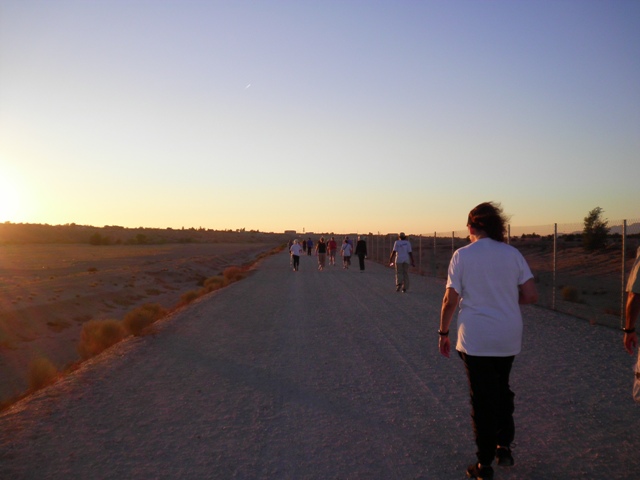
And it is a struggle. I realized long ago that the only way I could make sense of his death is to do things that we wouldn’t have done together, or to do things that I wouldn’t/couldn’t have done while he lived. Even though I am no longer actively grieving and in fact am quite happy at times (I seldom cry any more, and if I do, it’s only for a moment or two), I still honor my loss with all that I am doing. I continue to blog about grief, take night walks with the local Sierra Club, travel a bit, write, amble in the snake-infested desert, and do things I am not necessarily comfortable doing.

Although it might seem as if I am still bemoaning my loss by continuing to mention his death, the truth is, I am not embracing loss. I am embracing life — my life. I’m still not convinced life is a gift — there is way too much pain in the world — but my loss is the means of my future gain. I will not waste the freedom his death brought to me. I will not waste the courage he bequeathed me. I will not waste what is left of my life, even though I have to continue alone.

It seems to me that my struggle to create a meaningful life is worth writing about. So, if you are sick of hearing about my loss, feel free to unfollow me, but I am going to continue to blog about my life, and my life includes his death.

***

Pat Bertram is the author of the suspense novels Light Bringer, More Deaths Than One, A Spark of Heavenly Fire, and Daughter Am I. Bertram is also the author of Grief: The Great Yearning, “an exquisite book, wrenching to read, and at the same time full of profound truths.” Connect with Pat on Google+. Like Pat on Facebook.

In the Company of Married Women

I had lunch with some friends today, which would have been nice though not particularly significant if it weren’t that all the women were married. Since the death of my life mate/soul mate, most of my friends have been my fellow bereft — my sisters in sorrow — but gradually I’ve been meeting women who are still coupled. Today was the first time I found myself in the company of only married women.

I was actually okay — no tears — but it did make me sad to listen to these women talk about their husbands’ irritating qualities. Although I sympathized, I wanted to cry out to them to treasure every momenluncht, even the most exasperating incidences, because in the end, every moment spent with the person you love (or once loved) is a golden moment.

But I kept my mouth shut. Anything I said — even a gentle request to give their husbands an extra hug that night — would have seemed as if I were chastising them, and if my words didn’t strike such a note, I would still have turned the focus of the conversation from them and their comfortable confidences to me and my uncomfortable realities. Besides, until you have lost your mate, you simply cannot understand how precious every moment is. You’re caught up in the daily struggle to maintain your autonomy in the face of someone else’s wishes, the struggle to get all of the day’s chores finished, the struggle to find a harmonious balance between aging bodies and youthful spirits. You don’t have the energy to focus on distant tragedy.

So, I’m telling you what I would have liked to say to them. Smile at your mate instead of ignoring or arguing with him. Give him an extra hug and maybe a kiss. Thank whatever powers you believe in that no matter how irritating he might be, you have him for one more day. This is an incredible gift I am giving you — a memory to treasure if ever you should become one of us bereft.

***

Pat Bertram is the author of the suspense novels Light Bringer, More Deaths Than One, A Spark of Heavenly Fire, and Daughter Am I. Bertram is also the author of Grief: The Great Yearning, “an exquisite book, wrenching to read, and at the same time full of profound truths.” Connect with Pat on Google+. Like Pat on Facebook.

I Am a Three-and-a-Half-Year Grief Survivor

Three and a half years ago today, my life mate/soul mate died of inoperable kidney cancer. It seems an impossibly long time ago, as if I knew him in another life. It also seems as if it’s only been a few months since I last saw him.

Yesripplesterday I watched his version of Fly Away Home (he edited out parts of movies he/we didn’t like, such as heavy drama and prolonged arguments, which makes what he did leave in very personal). When Jeff Daniels told Anna Paquin that she had to continue the flight by herself, that she had to leave him behind and follow her dream, it seemed as if were a message to me from my mate to just go on with my life, follow whatever dreams I can muster, and leave him behind. (In fact, he often told me I’d have to that very thing — just leave him behind. He was losing his sight, his hearing, his strength, and he didn’t want me to hang around if he became a lingering invalid.)

Well, now I do have to leave him behind. Or maybe he left me behind. (I still don’t have any firm belief about what actually happens when one dies.) Either way, I am becoming comfortable with being single in a coupled world. I don’t panic about growing old alone as I did at the beginning — it seems oddly inevitable, as if it had been written long ago.

During all these painful months and years, those who have lost their mates often told me that around the four-year mark, they found a renewed interest in life, and so it is with me. I find myself coming alive again. Feeling eager to do new things, meet new people. I’m becoming more active physically — taking exercise classes and walking with a group two or three nights a week in addition to my solitary desert walks.

It seems fitting, in a way, all this physical activity. During the first months after we met, I was often restless, going for long ambles around the city (Denver had an interconnecting system of parks and parkways, and I could walk for hours along greenbelts). And now I am again restless, needing more than a single walk to get me through the day.

I still don’t know where I am going with my life, don’t know what I want other than to be more than I am (though at the same time, I am more accepting of who I am and how I look than ever before). Lately I find myself wishing on the first star I see at night, but the only thing I can think of to wish for is to be spectacular. I’m leaving it up to the universe or fate or a future me to decide what “spectacular” means.

It seems strange that of all the grief updates I’ve posted during the past three and a half years, this one is more about me and less about him, and that too is how it should be since my life is now more about me and less about him. I still miss him, still feel his absence in my life the way I once felt his presence, but I no longer feel as if I am a remnant of a shattered couple. I am just me — a woman alone who one day might be spectacular.

***

Pat Bertram is the author of the suspense novels Light Bringer, More Deaths Than One, A Spark of Heavenly Fire, and Daughter Am I. Bertram is also the author of Grief: The Great Yearning, “an exquisite book, wrenching to read, and at the same time full of profound truths.” Connect with Pat on Google+. Like Pat on Facebook.

Everything Happens For the Best — Oh, Yeah?

Twice today I was told, “Everything happens for the best.” Everything? Is it best when a child dies? When an earthquake hits? When people lose their home and end up on the street? In books, everything does happen for the best, whether good or bad. That is the point of writing — to make sense of senseless happenings. There has to be a lesson to be gleaned from the story events — perhaps character growth or a fitting resolution. If the story events happened without reason, the way things happen in life, readers would throw the book across the room and never pick up another one.

Venice Beach PierOddly enough, our brains do that same work for us. When a tragedy has passed and we have come to terms with it, when we have found a way to live despite the pain life dishes out, we often look back and think, “Everything did happen for the best.”

Sometimes now I feel that the death of my life mate/sould mate and my ensuing grief all happened for the best. If he hadn’t died, our lives would have remained on the same treadmill of pain (him) and despair (me). His death set me free — free from his illness, free from the financial constraints that his illness caused, and even free from the chains of such a deep love.

He almost died twenty years ago, and so every day I made a point of recognizing and appreciating his continued existence in my life. Because I knew our time together would be cut short (and it was, just not as short as that earlier brush with death would have indicated), whenever there was a choice of doing something with him or by myself or even with another person, I always chose him. And so, gradually the chains of love were forged. Now if there is an opportunity to do something, being with him is not an option, which has opened my life to many new possibilities.

But was his death really for the best or is my brain simply doing what it can to make sense of everything that happened in the past two decades, and especially the past few years? His death ended our pain and set us both free, but what would have happened if he could have gone into intermission? Would I have ended up in the same place even if the tragedy hadn’t occurred? It’s impossible to tell, but I do know not everything happens for the best. We make the best of what happens. It’s called life.

***

Pat Bertram is the author of the suspense novels Light Bringer, More Deaths Than One, A Spark of Heavenly Fire, and Daughter Am I. Bertram is also the author of Grief: The Great Yearning, “an exquisite book, wrenching to read, and at the same time full of profound truths.” Connect with Pat on Google+. Like Pat on Facebook.

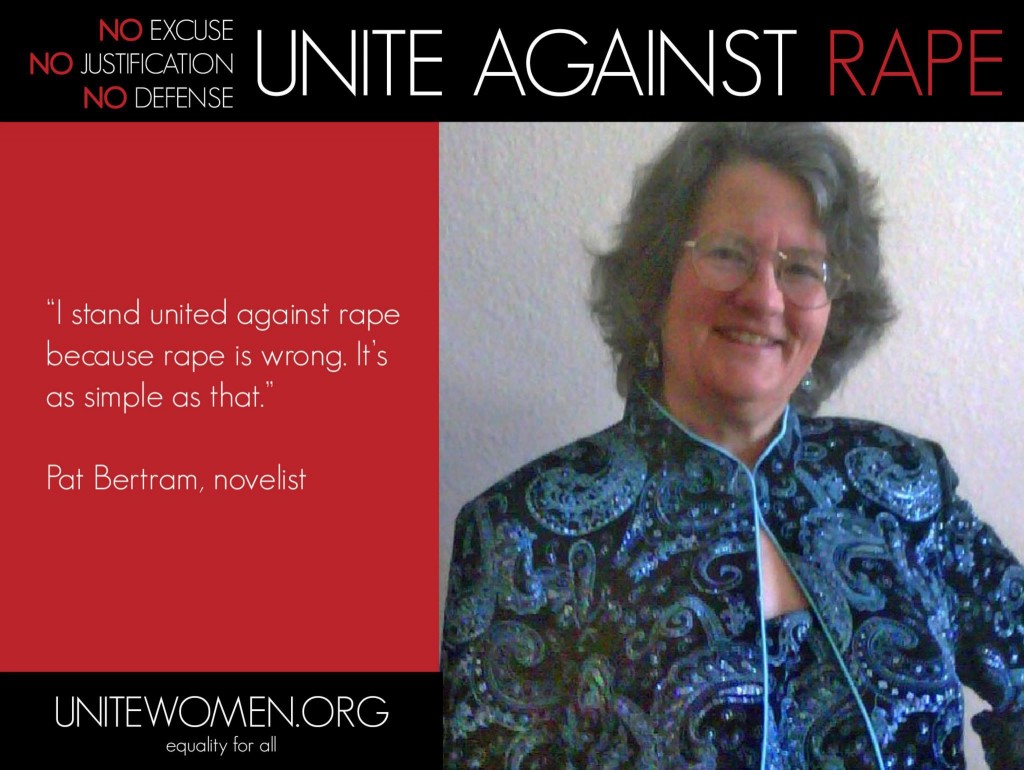
I Am a Guest on the UniteWomen.Org Blog!

A couple of weeks ago I asked for help in finding a topic for a guest blog for UniteWomen, a national non-partisan grassroots organization, whose mission is to end inequality for women that stems from prejudice and discrimination and to defend and advance the human and civil rights of women and girls.

Unite+Against+Rape-Pat+Bertram-1024x770I narrowed the wonderful suggestions down to two since more than one person suggested each of the topics.  One suggestion was to write about the compassion of strangers during grief . The other suggestion was to expand what I had written in  Help! I Need a Guest Blog Topic. (I’d written: Oddly, I’ve never felt disempowered as a women, perhaps because I seldom define myself by gender, religion, nationality, age, or any other consideration. I am simply . . . a being in flux. I have felt powerless at times, but not because of being a woman. The powerlessness came from being in situations greater than my abilities. Sometimes I developed the necessary abilities, other times I simply endured. Either way, somehow I moved beyond the powerlessness and here I am — still strong, still developing my abilities, still learning to empower myself.)

I wrote both posts and let UniteWomen choose which one they wanted. They chose the one about the compassion of strangers. The blog has now been posted and you can see it here: “Comfort In the Company of Strangers.”

The other article, I posted on this blog. You can see it here: Grief and the Loss of Identity.

A big thank you to everyone who suggested topics! Even if I didn’t use your topic, I’m still planning on someday writing the posts you suggested. They were all great topics.

***

Pat Bertram is the author of the suspense novels Light Bringer, More Deaths Than One, A Spark of Heavenly Fire, and Daughter Am I. Bertram is also the author of Grief: The Great Yearning, “an exquisite book, wrenching to read, and at the same time full of profound truths.” Follow Pat on Google+. Like Pat on Facebook.