The Kind of Fiction I Grew Up On

On Malcom Campbell’s blog post yesterday, BOOK BITS: ‘Black Beauty,’ Plagiarism, Donna Small, Larry McMurtry’s ‘Custer,’ Book stories for the election, he described “traditional fiction” as the kind of fiction we grew up on before novels started getting whittled down to novella-lengths and forced into marketing categories. Dare I say, literary fiction is what’s left after publishers and booksellers have sliced and diced readers and books into every possible pigeonhole, slot and category they can possibly imagine? We are, I think, so scared of making our own decisions about what we read these days, that we cannot pick up a book without knowing how it’s been tagged, labeled, categorized and genrefied.”

Ah! Now I have a term for the sort of fiction I write, and it’s the perfect term — traditional fiction. My novels are not genre fiction in any way, and those who try to fit the stories into such pigeonholes end up not liking them. There is not enough romance for the romance readers, not enough horror for the apocalyptic crowd, not enough villainry for the thriller lovers, not enough grue for the horror aficionados, not enough science or fantasy for the scifi folks.

Each of those elements has a place in my books, of course, since each aspect is part of the story’s big picture (in the same way those elements make up the big picture of our lives), but none overwhelms the basic intent of my stories, which is to tell a satisfying tale with archetypal characters and classic themes that can last beyond the fads of the day. In other words, a traditional novel.

In A Spark of Heavenly Fire, for example, there is plenty of horror, such as the gruesome end of those afflicted with the red death, but generally the horror is more subtle than visceral — empty streets instead of bodies piled everywhere, struggles to maintain a semblance of normality instead of rioting. The experiments done on humans during both the hot wars and the cold wars twentieth century are not experienced first hand by the characters, but the slow reveal of those old horrors affect them deeply nonetheless.

A Spark of Heavenly Fire explores the theme of love in all its guises, not just romance, but friendship, caring, trust. There is love mixed in the villainry, too, because someone had to have lovingly created the organism that caused the red death. Unlike genre stories, there is no hero trying to stop the villain before he can release his “baby.” The deed had been committed before the story even began. We don’t see the story from the villain’s eyes as in a thriller, and it’s only at the end that we realize with what love and glee the villain had set his creation free.

More than horror or history, romance or mystery, A Spark of Heavenly Fire is the story of ordinary women who found only failure in the ordinary world where everyone else seemed to find success, but when the world turned upside down, they found their place and their worth, and they came alive. As Washington Irving wrote, “There is in every true woman’s heart, a spark of heavenly fire, which lies dormant in the broad daylight of prosperity, but which kindles up and beams and blazes in the dark hour of adversity.

This is the kind of fiction I grew up on as a reader, the sort of traditional story that digs deep so that what affects the characters also affects the readers, the sort of ungenrefied story I have always loved. And it’s the kind of fiction I grew up on as a writer. It was halfway through writing A Spark of Heavenly Fire that everything clicked and I became a writer.

***

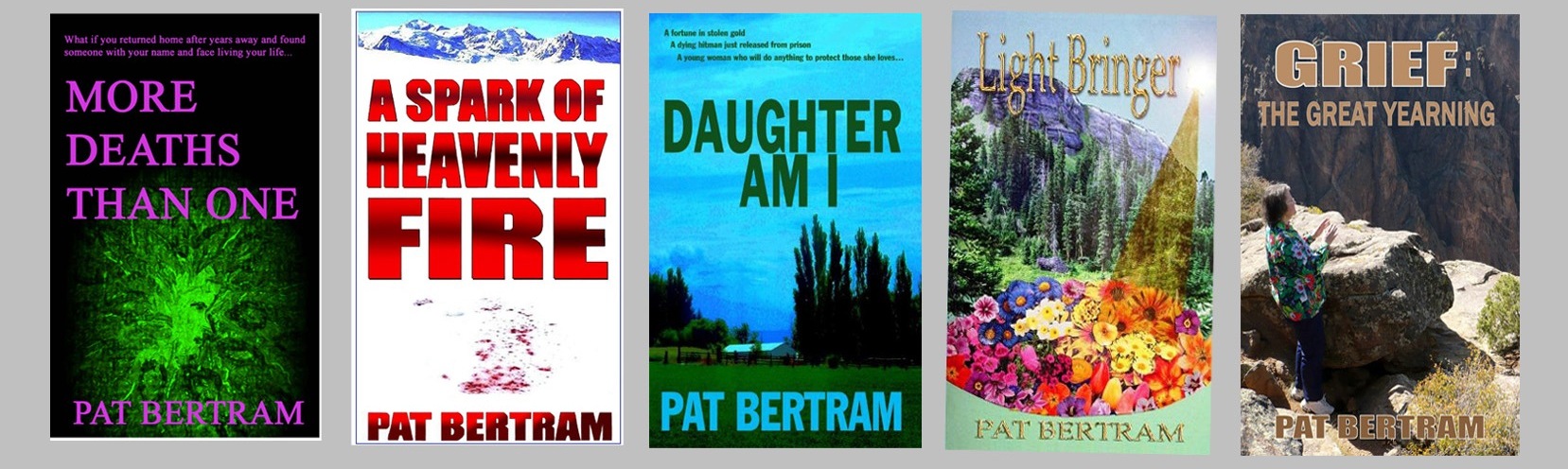
Pat Bertram is the author of the conspiracy novels Light Bringer, More Deaths Than One, A Spark of Heavenly Fire, and Daughter Am I. Bertram is also the author of Grief: The Great Yearning, “an exquisite book, wrenching to read, and at the same time full of profound truths.” Connect with Pat on Google+

The Queen of the Witches by Pat Bertram — A Halloween Fable Just for Fun

Once upon a time,
Long ago and far away,
Lived the queen of the witches,
Griselda the Gray.
If you think all witches are tall and thin,
You are wrong about that.
Griselda the Gray was short
And extremely fat.
Like everyone else,
Griselda tried to be good.
Griselda never did anything bad
Like normal witches should.
This upset the other witches
Because they had to copy their queen.
They had to be nice
When they wanted to be mean.
So they all got together
And mixed up a brew.
They gave it to Griselda
When they were all through.
The brew was so rotten
Griselda had a fit.
She screamed and yelled
And hollered and bit;
She howled and cackled
And made such a noise
That the other witches were happy
And began to rejoice.
“Griselda is bad
And we are glad.
Griselda is ghastly
So now we can be nasty.
Oh, what a happy, horrible day!
Hurrah for our queen, Griselda the Gray!”

The moral of this story is that witches should
Never try to be very good.

***

Pat Bertram is the author of the conspiracy novels Light Bringer, More Deaths Than One, A Spark of Heavenly Fire, and Daughter Am I. Bertram is also the author of Grief: The Great Yearning, “an exquisite book, wrenching to read, and at the same time full of profound truths.” Connect with Pat on Google+

Sample Sunday

If you’ve been wanting to check out my books, now is your chance to read the first chapter of each novel online.

More Deaths Than OneBob Stark returns to Denver after 18 years in SE Asia to discover that the mother he buried before he left is dead again. At her new funeral, he sees . . . himself. Is his other self a hoaxer, or is something more sinister going on?

Click here to read the first chapter: More Deaths Than One

***

A Spark of Heavenly FireIn quarantined Colorado, where hundreds of thousands of people are dying from an unstoppable, bio-engineered disease, investigative reporter Greg Pullman risks everything to discover the truth: Who unleashed the deadly organism? And why?

Click here to read the first chapter of: A Spark of Heavenly Fire

***

DAIWhen twenty-five-year-old Mary Stuart learns she inherited a farm from her recently murdered grandparents — grandparents her father claimed had died before she was born — she becomes obsessed with finding out who they were and why someone wanted them dead.

Click here to read the first chapter of: Daughter Am I

***

Thirty-seven years after being abandoned on the doorstep of a remote cabin in Colorado, Becka Johnson  returns to try to discover her identity, but she only finds more questions. Who has been looking for her all those years? And why are those same people interested in fellow newcomer Philip Hansen?

Click here to read the first chapter of: Light Bringer

***

Pat Bertram is the author of Light Bringer, More Deaths Than One, A Spark of Heavenly Fire, and Daughter Am I.All Bertram’s books are available both in print and in ebook format. You can get them online at Second Wind Publishing, Amazon, B&N and Smashwords.  At Smashwords, the books are available in all ebook formats including palm reading devices, and you can download the first 20-30% free!

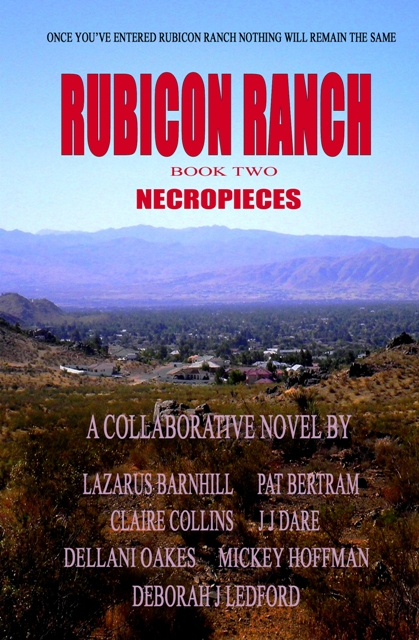
Rubicon Ranch: Necropieces — The Story Continues

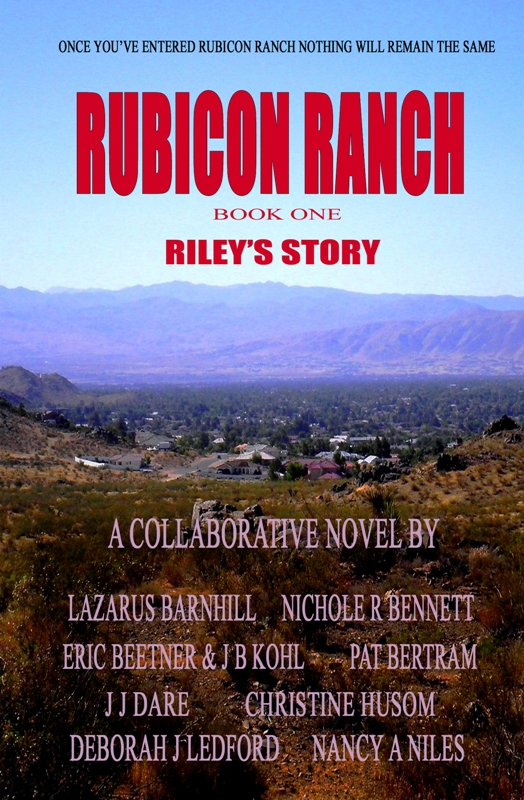
Rubicon Ranch is a collaborative and innovative crime series set in the desert community of Rubicon Ranch and is being written online by the authors of Second Wind Publishing. Seven authors, including me, are involved in the current story — Rubicon Ranch: Necropieces.

Residents of Rubicon Ranch are finding body parts scattered all over the desert. Who was the victim and why did someone want him so very dead? Everyone in this upscale housing development is hiding something. Everyone has an agenda. Everyone’s life will be different after they have encountered the Rubicon. Rubicon Ranch, that is.

Although some of the characters were introduced in Rubicon Ranch: Riley’s Story, a previous collaboration, Rubicon Ranch: Necropieces is a stand-alone novel. The first chapter will be posted on Monday, June 11, and one chapter will be posted every Monday after that.

We hope you will enjoy seeing the story develop as we write it. Let the mystery begin! Whodunit? No one knows, not even the writers, and we won’t know until the very end!

Chapter 17: Melanie Gray
by Pat Bertram

Melanie stood at the window of her upstairs office, waiting for the photos of Eloy’s dog to finish printing.

Waiting. Always waiting.

Still waiting for Alexander to come home or call, though he had been dead for more than three months. Still waiting for the sheriff to investigate her husband’s accident—if in fact it had been an accident that killed Alexander. Still waiting for her grief to end and her life to begin.

The printer chugged as if deliberating over each line of data. Finally, it spit out the last photo of the puppy. Melanie shook her head at the amateurish product. She’d used high-grade photo copy paper, and the image was a good one, but the picture didn’t have the hard finish of a professionally developed photo.

This was the first place they’d lived where Alexander hadn’t set up a darkroom. She wouldn’t have known how to use the equipment even if she had it, but the absence of the chemical smells underlined the absence of her husband. They were only going to stay in this rental property a short while, just long enough to do the job and move on, and setting up a darkroom wouldn’t be worth the trouble, or so Alexander had claimed. He’d never said where their next job would take them, but he’d seemed anxious about the assignment. And now it didn’t matter. He was dead and she was . . . waiting.

Melanie fanned out the printed photos. Four eight-by-eleven pictures of the puppy, each a different pose, each charming. She printed a fifth page with smaller versions of the images, gathered up the papers, stuffed them in a large Manila envelope, and headed outside.

The cloudless sky was pale blue, and though not particularly hot, the air felt oppressive and humid. The small effort of walking the few steps to Delano Road made Melanie’s skin feel sticky. Normally she would have taken this as a sign that a storm would soon be passing through, but nothing appeared to work normally in Rubicon Ranch.

A curtain in the front window of the Sinclair house twitched. Was someone watching her? Melanie quickened her steps and let out a sigh of relief when she’d passed the house. She hesitated in front of Eloy’s place. The old man’s empty chair stood empty. She’d planned to hand him the photos and slip away before he could get awkwardly avuncular again. So, now what? Wait for him?

Waiting. Always waiting.

Melanie marched to the front door and rang the bell. Silence. Not even a bark or a yip from the puppy. Had something happened to the old man? Maybe he’d meddled in something he shouldn’t have.

In the months she’d lived here, she hadn’t seen Eloy do anything but sit on his front porch and glower at everyone who went by, and the recent change in him seemed suspect. If he’d wanted a dog, a monstrous canine would have better fit his image, but he’d gotten a puppy, for cripe’s sake. And what did he mean when he’d said Morris wouldn’t be bothering her any longer? Why would he make her welfare his concern? Besides, she knew how to take care of herself—Alexander had made sure of that, insisting she take lessons in self-defense and weaponry before they started traveling to dangerous locales. They’d lived in a whole alphabet of perilous countries, from Afghanistan to Zambia, and she’d survived them all.  When they’d moved here to Rubicon Ranch, she’d felt safe for the first time in years, but this quiet community had turned out to be the deadliest place of all.

Melanie pressed the doorbell once more on the off chance the old man and young pup were simply napping, but the chimes still elicited no response. Grateful she didn’t have to talk to the old man, she slipped a corner of the envelope beneath the welcome mat to anchor it. Wondering why that most unwelcoming man had a welcome mat on his porch, Melanie trudged to the street.

Moody half walked, half trotted toward her, a hand raised in greeting. “I need to talk to you.”

Melanie waited for her neighbor. “I need to talk to you, too. A couple of weeks ago Morris told me—”

“That Alexander had been taking photos of necropieces for him? I overheard my father talking to you that day. I’m sorry he upset you. He won’t bother you again.”

Anger surged through Melanie, temporarily displacing the sorrow that weighed on her. “Why does everyone think I need protection? I’ve dealt with worse things than a nasty old man who needed to be exterminated.”

Moody held up her hands, palms out. “Sorry. I didn’t realize protection was an issue with you.”

Melanie gritted her teeth to keep from blurting out a denial. She remembered that Moody had once been a psychologist, and any further discussion would give the woman fodder for more assumptions. She pivoted on one foot, getting ready to walk away, then turned back. Her neighbor might be a psychologist and a Sinclair, but she was the only one who could explain why Morris had accused her of killing Alexander.

“Your father mentioned something else that day. He said Riley told you she’d seen me messing with our car.”

Moody blew out a breath. “The bastard lied. Riley only said she’d seen someone messing with the car. That’s all. Never mentioned a name. I didn’t believe her, though. If you knew Riley, you’d know she loved to cause mischief. Even I found it hard to discern when she was telling the truth.”

“But could she have seen someone messing with the car?”

Moody put a finger to her chin and said slowly, “It’s possible. Generally, Riley’s lies were quite detailed—more like stories—but she made the remark about the car in an offhand manner. Are you thinking someone deliberately caused your husband’s accident?”

“Sheriff Bryan told me the accident looked suspicious, but . . .”

“You don’t trust him.”

Melanie focused on the peak of a distant knoll. Did she trust the sheriff? She lowered her gaze to meet Moody’s. “I think he has . . . agendas.”

Moody nodded. “That’s my take on the sheriff, too. I also think he’s on a quest for redemption, whether he’s aware of it yet or not. I’ll let you know if I recall anything else Riley said about your car or Alexander.”

“Thank you.” Melanie turned and started walking up Delano Street toward the desert.

“Wait. Please?”

Melanie stopped.

Waiting. Always waiting.

“I need to warn you about Jake,” Moody said, a new urgency in her voice.

Melanie spun to face the woman. “Are you trying to protect me again? I can take care of myself.”

“Yes. You said. But Jake . . . Jake’s my brother. He wears a cloak of righteousness, but his heart is as black as the rest of the Sinclairs’.”

Melanie frowned at her neighbor. Moody was a Sinclair, too. Could she be warning Melanie that as Morris’s daughter, Moody also had a black heart? A lifetime with Alexander should have prepared her to deal with the Sinclairs, but she sensed nuances of evil in the family next door that made Alexander’s machinations seem like child’s play.

“You don’t believe me,” Moody said flatly.

“Why are you worried about me all of a sudden?”

“I haven’t seen Jake in years, and he just showed up. Supposedly he’s been in the area for several weeks participating in some sort of revival, and he heard about Morris being missing. So now he’s come to . . .”

Interested despite herself, Melanie said, “So now he’s come to—what?”

Moody shrugged, a strange look on her face. Fear, maybe? She glanced toward her house, then fixed an intense gaze on Melanie. “He knows about you. Knows you found the foot yesterday. Don’t believe a word he says. And whatever you do, don’t get yourself in a situation where you are alone with him.”

Melanie watched her neighbor hurry back to Morris’s house. As Moody walked up the driveway, the door opened, and a man walked out.

Melanie gave a start. Morris! Couldn’t be. This man looked younger than the writer. Must be Jake, the son.

Jake glared at Moody, then turned his head toward Melanie. He seemed to study her, the Sinclair dead-fish stare frozen on his face.

And then he smiled.

Melanie fled to the desert. She inhaled the humid, creosote-scented air, trying to remove the stench of the Sinclairs from her nostrils, but no cleansing breath could remove the memory of that evil leer.

Forget the Sinclairs. Focus.

Melanie took a swig of water from her canteen, screwed the cap back on, and reached in her pocket for her little digital camera. Thinking of the last photos she took, the photos of Eloy’s dog, she wondered if her photos would be better if she had professional equipment. She made a mental note to ask the sheriff about her husband’s cameras—Alexander had taken them when he left on that fatal car trip, and they hadn’t been returned to her.

Melanie shot a few photos at random—a jogger in red shorts, a wadded fast food wrapper that looked like a yellow rose nestled in the scrub, a frisky puppy running circles around an old man. Captain and Eloy. Seeing Eloy in the desert again made her shoulders itch. Too much strangeness. Too much change.

She picked her way up the steep rock-strewn track to the top of the knoll, past the place where she’d found Riley’s body stuffed in a television console, past the place where she’d found the foot. She stopped to snap a few shots of the vast desert wilderness spread out before her, a sight that never failed to bring her comfort.

Distant shouts rising above the whine of idling motors caught her attention. She cut to the left until she glimpsed the altercation. Two people, one in red racing gear and one in silver, were standing by a canoe, balancing motor bikes with one hand while gesturing with the other.

“No!” bellowed the red-garbed racer. He hopped on his red bike and sped toward Melanie.

The silver racer got on his bike and chased after his companion. “Someone got chainsaw massacred. We have to call the cops and tell them we found a part of a body.”

“No,” yelled the red racer again. “We can’t. My mom will kill me. I’m supposed to be home looking after my little sister.”

They hurtled past Melanie, still shouting. She took pictures of the two boys, then of the canoe. She’d often seen the abandoned canoe in her treks, but until today, the boat had always been turned upside down. Apparently the boys had found something hidden beneath the canoe. A necropiece.

Could she take a chance that the boys hadn’t seen her, and so pass on calling the sheriff? She hadn’t found the body part, but she felt sure the sheriff would use her presence as an excuse to lay the blame at her feet. She sighed and pulled her phone out of a pocket. Even if the boys didn’t say anything, the sheriff would eventually find out she had been in the vicinity of more death. Not notifying him would seem more suspicious than making the call.

She talked to the dispatcher, explained the situation, described the boys and gave directions on how to find the canoe from Tehachapi Road.

“Wait right there,” the dispatcher said. “Someone will arrive as soon as possible.”

Melanie shoved the phone in her pocket, and shifted from foot to foot.

Waiting. Always waiting.

To hell with that. If the sheriff wanted her, he knew where to find her.

Melanie turned away from the canoe and tramped across the desert expanse, heading toward the storm clouds gathering on the horizon.

A Place Where I Can Connect With Myself And The Mystical World

It’s amazing we ever manage to communicate with each other, considering that different words mean different things to different people. We do have common ground, though, so perhaps that keeps us connected. We know basically what words mean, such as “desert,” “reading,” “writing,” but we also imbue the words with our own connotations, and that’s where it gets interesting.

For most people around where I am staying, “desert” means a place of rattlers, a place to ride dirt bikes, ATVs, and other noisemaking machines, a place to honk their dogs. (That’s what I call it anyway. They let their dogs run free and drive behind them, honking to keep the animal from straying too far.). But for me, “desert” means a place away from the bustle of everyday life, a place where i can connect with myself and the mystical world around me, a place where I get in touch with the truth inside me (the truth that resides in all of us.) Even those who do see the desert as a place away from every day life, see it as a place to run, all the while connected to an ipod or whatever is connected to those wires coming out of their ears.

For most people, “reading,” fiction, in particular, means entertainment, a way to kill a few hours, an indulgence in fantasy. There’s nothing wrong with that, of course — it makes people happy and fuels the book industry — it’s just not what reading means to me. For me, “reading” means a place away from the bustle of every day life, a place where I can connect with myself and the mystical world of books, and get in touch with the truth inside me. It came as a real shock when I discovered that’s not what reading means to others. It’s often true that people see reading as a place away from the bustle of every day life, but for most people it’s an escape from themselves, not an escape into themselves.

Writers each have their own meaning for the word “writing.” Most often it’s the same as reading — to entertain, to communicate with readers. Sometimes they don’t know what it means to them, except that it fulfills a need. Occasionally, it means a way of making money. It should come as no surprise that writing, for me, means a place away from the bustle of every day life, a place where I can connect with myself and the mystical world of my own story, and get in touch with the truth inside me. Writing bloggeries, such as this one, helps me figure out what I think, but writing fiction puts a “face” on what is inside me, creating a metaphor or a parable for my thoughts and experiences.

I’ve never been one to count words since the number of words don’t count. What counts is what the words say, what they mean. I’ve never been one to inform others of how my writing is going since the writing is for me. Once the book or bloggerie is published, however, it becomes something else, not something that was written so much as something to be read. Does that make sense? I might have walked too long in the desert this morning, and brought some of its mysticism back with me.

Murder in the Wind

Murder in the Wind is an anthology of crime/mystery short stories contributed by the authors of Second Wind Publishing. Murder, mayhem and the unexpected are rife in each riveting story.

I’m a bit biased, but my favorite story is “The Stygian Night” by . . . drum roll . . . me! As a reviewer said, “In this delicious little story by the master of misdirection, Pat Bertram so draws us into the fantasy life of would-be author Silas Slovatksy that we scarcely recognize a “real” story unfolding in the background.” Poor Silas, he wants so much to be an author, but he just doesn’t get it.


***

Excerpt from “The Stygian Night”:

It was a dark and stormy night.

Silas Slovotsky leaned back in his chair and studied the words he’d typed into his computer.

He grinned. Perfect. The very words he needed to set the scene. And they had the added benefit of being true. It was a dark and stormy night. Except for his porch light, of course. And the thunder and lightning—

He leaned forward and peered at the computer screen. Did the sentence seem a bit trite? Maybe he needed to spiffy it up. He opened his thesaurus to the word “dark” and ran a finger down the page. “Stygian”. That might work.

He cleared his computer screen and typed: It was a stygian night.

Nope. Didn’t have the euphoniousness of the original sentence. Perhaps if he reread what he’d already written he could figure out how to proceed.

He printed out the manuscript he’d been working on for the past four months and read the single page. Dark as Night by Jack Kemp.

A thrill ran up his spine. He could see it on the shelf in the bookstore. Kemp, King, Koontz. He’d chosen his pseudonym specifically so the reviewers could call them the unhallowed trinity. And he deserved the accolade.

A knock on the door startled him out of his dream.

Who could that be? His friends—all two of them—knew he didn’t like to be disturbed when he was writing.

***

A few of the other stories included in the anthology are:

 “A Whiff of Murder” by Lazarus Barnhill: Barnhill reintroduces a pivotal character from The Medicine People. Old, wiser, sober and cynical, Bob Vessey hasn’t lost his touch in examining crime scene evidence.

“Hanging Around” by J J Dare: This marvelous tale begins playfully with squirrels sporting around a human body, hung seventy feet off the ground and quickly suspends the reader.

“This Time” by Claire Collins: A swiftly moving, smoothly written love story that turns into serial murder and mayhem. Well, all’s fair in love and revenge.

“The Strange Disappearance of Comrade Wang” by Mickey Hoffman: Becka, an innocent and vulnerable girl, finds herself at the mercy of the authorities in a strange and hostile place.

“Murder at the Manor” by Juliet Waldron: To read Waldron’s work is to be not transported but immersed in different, distant times and places. We genuinely regret it when her story ends.

“The Spot” by Deborah J Ledford: The Spot is just what Ledford hits in this awesome little tale of revenge, remorse and restoration.

How does your environment/upbringing color your writing?

Because I’ve always lived in the shadow of mountains, mountains always shadow my writing. This is especially true in Light Bringer. The story begins when a baby is found on the doorstep of a remote cabin in the shadows of the Rocky Mountains, and continues years later when the foundling, now an adult, returns to the high country to find out who she is. The mountains in my novel are both protective and secretive — the hills protect those who live in their shadow, yet the mountains also harbor terrible and awesome secrets that threaten those same people.

Whenever I needed a hiding place for the secrets of the ages in Light Bringer, I searched maps for isolated mountain ranges, and ended up with a library beneath the Ahaggar Mountains in Algeria, ancient artifacts beneath the Beishanmai Mountains in the Gobi Desert, and experimental spacecraft beneath the McDonnell Ranges in Australia. I’d heard about  the mountains in Australia where the experiments were being done, and in my research I’d come across hints of what lay beneath the Ahaggar Mountains, but the Gobi location was strictly a guess, though later I discovered that in fact, caves deep inside the Beishanmai Mountains were repositories for ancient treasures.

Maybe the mountains themselves were helping with the book.

Here are some responses from other authors about how their environment colors their writing. The comments are taken from interviews posted at Pat Bertram Introduces . . .

From an interview with: J. P. Lane, Author of “The Tangled Web”

I’ve traveled from an early age and I’ve lived in several countries, so maybe that’s the reason The Tangled Web trots around the world a bit. I chose Prague as one of the locations, because I’d been to Prague the year before I started writing it and the memories were still fresh. The familiarity with the Hispanic characters comes from having lived in Miami for twenty years and having had a lot of Hispanic friends and work associates. I also lived in Puerto Rico at one point. And there’s the Jamaican dialect in the book. Only someone who’s lived in Jamaica for some length of time could write that.

From an interview with: Dale Cozort, Author of “Exchange”

I grew up in a fair-sized city, but I spent a lot of time with relatives in the country, so I probably write rural life a little more authentically than someone without that experience. I also have a computer background, so there is always a little bit of the techie in my stories. I have to dial that back so it doesn’t get in the way of the story.

From an interview with: Sherrie Hansen Decker, Author of “Love Notes”

Love Notes is my first Christian inspirational novel and certainly reflects some of my deepest beliefs about my Christian heritage. In other of my books, the main characters have been rebelling against the very faith Hope clings to in Love Notes. So yes, my Christian beliefs definitely color my writing, whether in shades of guilt or hope. In Love Notes, I love it that Hope’s strong faith is intact even though she’s lost everything dear to her, including her husband, who died in a tragic car accident. Tommy has everything a man could want, yet he is cynical and discontented and very short on faith. In the end, Tommy finds hope, joy, peace and love where he least expects it — as have I on several occasions!

What about you? How does your environment/upbringing color your writing?

(If you’d like me to interview you, please check out my author questionnaire http://patbertram.wordpress.com/author-questionnaire/ and follow the instruction.)

Rubicon Ranch: Necropieces — The Story Continues

Rubicon Ranch is a collaborative and innovative crime series set in the desert community of Rubicon Ranch and is being written online by the authors of Second Wind Publishing. Seven authors, including me, are involved in the current story — Rubicon Ranch: Necropieces.

Residents of Rubicon Ranch are finding body parts scattered all over the desert. Who was the victim and why did someone want him so very dead? Everyone in this upscale housing development is hiding something. Everyone has an agenda. Everyone’s life will be different after they have encountered the Rubicon. Rubicon Ranch, that is.

Although some of the characters were introduced in Rubicon Ranch: Riley’s Story, a previous collaboration, Rubicon Ranch: Necropieces is a stand-alone novel.

We hope you will enjoy seeing the story develop as we write it. Let the mystery begin! Whodunit? No one knows, not even the writers, and we won’t know until the very end!

Chapter 9: Melanie Gray
by Pat Bertram

Melanie locked the front door of the house and turned around to face the day. It was clear and warm with a platinum sun shining in an azure sky. She felt her spirits rise. With such lovely weather, things couldn’t be as bad as they seemed. She marched down the driveway, and her spirits plummeted as fast as they had risen. The sheriff’s tan Navigator, like a brooding predator, loomed in the driveway of the Sinclair house next door.

Melanie had tried to forget Sheriff Seth Bryan and the conflicted feelings he had aroused in her, but apparently she hadn’t succeeded. She could feel the emotions rushing back to fill the emptiness inside her. She still couldn’t tell if she’d felt more drawn to him or more repelled by him. With any luck, she’d never have to explore those feelings. As soon as he finished his business and left the area, she could forget him again.

She heard the sound of his voice, though not his words, and for a moment she considered dashing back into the house to avoid any encounter with him, but then she realized the truth. The sheriff had no interest in her. It had been almost three months since she’d last seen him, and in all that time, he had made no effort to contact her.

She lifted her chin. She didn’t need him or any man. They were all worthless creatures who had no regard for anyone but themselves.

Still, it wouldn’t hurt to see what he was up to.

She took a few steps forward so she could see the front door of the Sinclair house. The sheriff looked the same as he always had. Jeans and a white shirt with a badge on the shoulder clothed his lean, flat-bellied body, and a navy blue ball cap with a yellow “Sheriff” embroidered on it covered most of his dark brown hair. And he still wore those ridiculous mirrored sunglasses.

The sheriff and Moody seemed to be standing closer together than politeness dictated. Could something be going on between the two of them? Movement in the passenger seat of the Navigator caught her attention. Deputy Midget. If the sheriff intended anything shady, surely he wouldn’t bring a deputy along to witness his behavior? Then this must be an official visit.

Moody looked okay — happy, even. It had been very quiet the last week or so without “The Sounds of Silence” blaring at all hours, and she’d probably been enjoying herself in Morris’s absence.

The sheriff starting walking toward his vehicle. Melanie squatted to retie a shoelace, hoping he wouldn’t catch sight of her. She might have the courage not to seek refuge in the house, but she had nothing to say to him.

When she heard the sheriff’s Navigator slowly moving down the street, she squelched a pang of disappointment. As annoying as his attentions were, at least they had reminded her she was alive. She’d been living with the dead — or rather memories of the dead—for way too long.

She arose with only the slight aid of one hand to push her erect, and angled her steps to the right of her driveway, intending to head up Delano Road to the desert. She paused, took two steps to the left.

The Daily Indecision is how she’d come to think of this inability to act. “Sounds like a newspaper,” she said aloud. “They’d print both sides of every story since the editor would be unable to decide which view to stand behind. Or maybe the paper would be blank because they’d never be able to decide which stories were newsworthy. And since when do you talk to yourself?”

Since Alexander died. She often wandered in the desert, trying to understand her husband’s death and her grief, and she’d gotten in the habit of talking aloud to him, hoping he could help make sense of her chaotic thoughts. He never responded. But then, he’d seldom replied even before he died.

When had their relationship become all about him? And why hadn’t she noticed the change? She sighed. Probably because she’d spent so much time online doing research for the coffee table books she and Alexander wrote. Well, she wrote. He took the photos. After his death, she discovered he’d somehow squandered the advance for the book about the Mojave Desert they’d contracted for, so now she needed to take the photographs in addition to writing the text. She thought she’d become good at shooting photos, but just this morning she’d received an email from her publisher:

“Some of your photos are usable, but most are uninspired. You take photographs, but the great photographers, like Alexander, make photographs. And when they make photographs, they make love. We feel the empathy between the external and internal events.”

Whatever that meant.

“What it means,” she said aloud, “is that you have work to do.” She took five resolute steps up Delano Road, then stopped. She could see Eloy Franklin hunched on his porch like a land-locked amphibian, watching everything that went on in his vicinity.

After all the turmoil the neighborhood had gone through recently, after all the deaths, she thought that things would have changed, but there Eloy sat, as unapproachable and forbidding as always. She’d smiled at him a couple of times when she passed in front of his house, but he’d never acknowledged her efforts at friendliness by so much as a nod.

Unable to stand the thought of Eloy’s scrutiny, she turned left. The sheriff’s navigator hadn’t gotten far, only a few houses away. The vehicle still moved slowly, as if the sheriff were looking for something. Trying to see the neighborhood through his eyes, Melanie peered down Delano Road. A petit woman held a camera to her face, either taking photographs or hiding behind it. Did Sheriff Bryan think the woman was Melanie? Melanie smiled to herself. Whatever faults the man might have, mistaking one woman for another was not one of them. Melanie had seen the woman several times before; she was shorter, prettier, and younger than Melanie, and had the clear luminous complexion of someone with a mixed race heritage.

Beyond the woman, a skinny man lurched along the side of the road. Melanie had also seen him several times before, and he worried her. Anger seemed to crackle around him, like lightning right before it strikes.

The Navigator’s siren blared, and the vehicle shot down the street and tore around the corner onto Tehachapi Road, heading east.

A dark cloud seemed to lift from the neighborhood, and Melanie’s indecision disappeared. She turned right, past Moody’s house, past the strange no-man’s land that separated the Sinclair land from the Franklin land, past Eloy’s house.

The wilderness beckoned.

*     *     *

Melanie stood at the crest of knoll and surveyed the expanse of desert. Somewhere out there, midst the creosote bushes and cacti, a photograph she could make waited for her — an image so compelling, viewers would immediately sense her empathy with the subject.

But how did one get emotionally connected to something as vast and as alien as the Mojave Desert? Then she remembered Alexander saying he looked for a significant detail. By focusing on a single feature, by making it the heart of the photo, the rest of the scene came into focus.

Crap. I’ll never get the hang of photography. Damn you, Alexander, for putting me through this.

She heard a sound closing in on her from behind, a leisurely whup . . . whup . . . whup. She turned and froze, transfixed by the raven gliding by. It flew so close she could see the brown pupil of its bright black eye and the purple and blue sheen of its feathers. She’d never seen such a huge bird—the body looked bigger than a cat, and its wings spanned at least three feet, maybe four. For a moment, it seemed to hang motionless, then a graceful wing beat stirred the air and propelled it forward.

Melanie fumbled with her camera, almost in tears. She’d had a perfect opportunity to make a photograph, but she’d become so lost in the moment, she’d forgotten all about taking a picture. Alexander wouldn’t have forgotten. His camera had been an extension of his hands, his eyes. He never let anything get between him and an image he wanted to capture. Not even Melanie. Especially not Melanie.

Then she heard it behind her again, the whup . . . whup of wing beats. And this time she held her camera ready. As the second raven passed her, she caught the image. Joy burst inside her.

I did it!

Only then did it strike her as odd that the two ravens had been so focused on their goal that they hadn’t seemed to notice how close they’d been to her.

The first raven had already disappeared, but she watched the second one descend behind a rocky outcrop thirty feet away.

She followed a barely perceptible track through the scrub to where six or seven ravens pecked at what looked to be the carcass of a small animal. A rabbit, maybe. Thinking how wonderfully the image of this raw savagery would contrast with the majesty of the flying raven photo, she crept closer. And gagged.

The ravens weren’t feeding on a rabbit, but something oddly familiar and totally out of place.

*     *     *

Melanie waited for Sheriff Bryan and Deputy Midget to pick their way up the rock-strewn path to the top of the hill. The sun glinted off the sheriff’s mirrored sunglasses, making him appear soulless.

When he drew near, Sheriff Bryan grunted. “I wish you’d stop finding bodies in such out of the way locations.”

“I didn’t find a body. I found . . .” She swept out a hand, showing the track and which direction he should travel.

The sheriff furrowed his brow at her, then followed the track. Deputy Midget trailed after him. Melanie brought up the rear.

Sheriff Bryan stopped by the outcropping. “A boot? You called me here to see crows playing with an old bloody boot? You must really be desperate to talk to me.”

“Desperate?” Melanie stared at him, the heat of anger flushing through her body. “Are you really so self-absorbed that you think I called you here on a pretext? I didn’t call you. I called dispatch and told them exactly what I found. It’s not a pretext, and they’re not crows. They are ravens.”

The sheriff and his deputy exchanged shrugs, then proceeded forward. The ravens squawked, rose as one, and circled above them, as if protecting their treasure.

Sheriff Bryan squatted, then whipped his head around, lips drawn back in a rictus, and faced Melanie. “A foot? That’s what you found, a foot?”

Midget took a step back. “It looks like something out of Morris Sinclair’s books.”

“Necropieces,” Bryan said, turning back to the foot.

“So where’s the body?” Midget asked.

“Maybe there isn’t one. Someone could have been illegally dumping medical waste.” Bryan rose and loomed over Melanie. “What do you know about this?”

She studied him for a moment, wondering what was going on behind those sunglasses. “Are you accusing me of something?”

The sheriff cocked his head like a raven getting ready to peck at its prey. “The person who calls in a report is always suspect.”

Conflict: Desire Meeting Resistance

In fiction, conflict is desire meeting resistance.

Many authors, professional and amateur, confuse bickering with conflict, but unless there is an element of desire, such as one of the characters wanting information that the other doesn’t want to give, then there is no conflict, merely disagreement. I learned this particular lesson when writing Light Bringer. I had a lot of historical information I needed to impart, so I had a group of people arguing about various theories in the hope that the scene would seem more immediate, but since there was no compelling desire, just the relatively unimportant desire of the characters wanting to be heard, the dialogue came across as bickering rather than conflict. I kept the sections because they were a more interesting way of presenting the material than a lecture, and they did show the personalities of the characters in a fun and humorous way, but they didn’t have the immediacy true conflict would have brought to the piece.

In a novel, there are many conflicts. Characters can be in conflict with each other, they can be in conflict with the environment, they can be in conflict with themselves. As disparate as these conflicts seem, in essence they are the same. Characters want something and someone or something is preventing them from getting it. The greater the forces keeping the characters from fulfilling their desires, the greater the conflict, and hence the greater the tension. Time constraints add urgency to a conflict, and become a source for conflict themselves, as when one character needs (desires) to rescue another before a bomb goes off.

So, to ramp up the conflict in your novel, figure out what your characters want and who or what is keeping them from getting it, show or tell the reader what is a stake (this is very important — if the reader doesn’t know what the characters want and doesn’t know what is at stake, then the conflict is muted) and then let the characters fight it out. It’s as simple as that.

An Excerpt From Light Bringer with Bickering Characters

They barely had time to exchange more than a few words when Philip heard a thundering knock.

“That’s Faye.” Emery went to let her in.

Faye strode into the living room with all the delicacy of a drill sergeant. “Who’s this?” she barked, fixing her gaze on Philip. “Oh, yes. Now I recall. Toothbrush, toothpaste, shaving cream, disposable razors.”

Philip recoiled, wondering if this woman in the royal blue, turquoise, and orange dress was crazy, then he remembered she clerked at the grocery store where he’d purchased those very items. “Over-qualified for her job,” Emery had told him, “but there aren’t a lot of opportunities for an ample woman in her fifties.”

He stepped forward. “I’m Philip.”

She grabbed his extended hand and pumped it as if trying to draw water. Or blood.

“Glad you could join us,” she said.

A brisk rap seemed to catch her attention. She dropped Philip’s hand and bellowed, “Go away, you gormless lummox. We don’t need your kind here.”

“Let me in, you draggle-tailed witch,” came a muffled voice from outside.

She opened the door and in walked a sharp-featured man wearing a yellow pullover shirt and plaid golfing pants.

“So how many widows and orphans did you fleece today?” she asked.

“Stupid ostrich! You know I’m retired.”

“Now you spend all your time trying to hit defenseless balls and hitting on show ghouls.”

He looked down his nose at her. “Show ghouls? That the best you can do? And anyway, Doreen is a sweet girl.”

She punched him on the arm.

An elderly, bow-legged man with a face the color and texture of walnut shells pushed past them.

“Gil isn’t coming,” he said, throwing up his hands.

Faye rolled her eyes. “Always so dramatic, Chester.”

Chester lowered his arms. “Aren’t you going to ask me why?”

“Oh, all right. Why?”

“He has a meeting with Santero. Santero’s selling his antique store.”

Faye hooted. “Antiques! Junk’s more like it. Broken rocking chairs, moldy patchwork quilts, and dusty canning jars. Who’d buy a place like that?”

“It’s a good location,” Emery said. “A downtown corner, not far from that monstrosity Luke’s remodeling into a bed and breakfast. Must be worth a bundle.”

Brian nodded. “The building’s in good condition, too — all new plumbing.”

“Well, anyway,” Faye said, “we don’t need Gil. Counting Philip there’s six of us.”

Philip held up his palms. “I’m not playing.”

“Nonsense.” She seized him by an arm and dragged him to the table.

He shot a beseeching look at Emery, who merely grinned.

“If he doesn’t want to play, he doesn’t have to play, you overbearing hag,” the golfer said. By process of elimination, Philip decided he must be Scott, the ex-banker.

Faye stuck out her tongue at Scott. “Flush you.”

***

Want to read more? You can find the first chapter here, download the first 20% of Light Bringer here, or buy the book from  Second Wind Publishing, Amazon, B&N and Smashwords.

The Flaw of Flawed Characters

I cringe every time I see authors brag about their “flawed characters” as if that’s a good thing. Apparently, somewhere along the line, writers were told not to write perfect characters but to give them flaws, and so writers everywhere are assiduously flawing their characters. Well, they are wrong.

There is no such thing as a perfect character. If a character can do everything, meet every challenge the first time, and do it all without damaging a single hair on his/her head, the only thing perfect about that character is that it is perfectly boring, which makes it far from a perfect character. Adding flaws to such a character only compounds the problem, making the character not only boring but trite. Aren’t you sick of the cynical detective struggling with a drinking problem? Or the overextended single mother struggling with the rebellious teenager? Or the lonely person struggling to find love but who is too stupid to see the love disguised as a friend or even enemy? Well, you might not be, but I sure am.

The best characters are not flawed characters, but those facing terrible dilemmas who are forced to work against their strengths. If they have a lot of knowledge, they are most compelling when they need to act without being able to use the knowledge, perhaps using logic, intuition, or snap judgments instead. If they have armed services experience or strong physical skills, they are most interesting when forced to use their minds and wits. If they tend to be serious, they are most fun when forced to rely on their humor, or vice versa. Anything else is just cheap.

One thing most people say about my main characters is that they are real. And guess what? There isn’t a flawed character in the bunch. Not a single character drinks too much (okay, Kid Rags in Daughter Am I might tipple, but he never gets drunk or lets his drinking get in the way of business). Not a single character cheats on his or her spouse. Not a single character is mean. Not a single character makes stupid mistakes. Not a single character is self-absorbed. (Well, Jeremy King, the world-renowned actor in A Spark of Heavenly Fire is focused on himself, but that isn’t a flaw but the personality trait that makes him a great actor.) Not a single character gets into fights just for the sake of proving how flawed they are — all the fights are to protect themselves or others. Every character acts to the best of his or her ability at all times, and if the best isn’t good enough, they get better.

Instead of flaws, my characters have character traits. For example, in Daughter Am I, at first the hero Mary Stuart tends be a bit of a pushover, going with the flow because she simply doesn’t care enough about the outcome of any situation to fight over it. When she makes the decision to find out who her grandparents were and why someone wanted them dead, she becomes almost obsessive in her quest, even going so far as arranging a meeting with a notorious hit man and various other shady characters. And when she finds something to care deeply about — the octogenarians who accompanied her on her journey — she becomes steely in her determination to protect them at all costs. Are these traits indications of flaws? Of course not. They are indications of a true-to-life character grabbing her destiny with both hands and going along for the ride. Flaws would only get in the way.