Pat Bertram is the author of Grief: The Inside Story – A Guide to Surviving the Loss of a Loved One and Grief: The Great Yearning, “an exquisite book, wrenching to read, and at the same time full of profound truths.” Bertram is also the author of the suspense novels Unfinished, Madame ZeeZee’s Nightmare, Light Bringer, Daughter Am I, More Deaths Than One, and A Spark of Heavenly Fire.
I spent several hours this morning clearing out weeds and weedy grasses. I didn’t even make a dent — the growth (except for some things I want to grow) is overwhelming. I can’t imagine living in a climate where it rains all the time, though this past week where it’s rained so much (and yes, it did finally rain last night about 1:30 AM), I’ve had a glimmer of what it would be like. There would be a lot of good things about it — no time spent watering, no coaxing plants to grow in the arid climate, no dealing with plants dying because of a single day’s neglect. And it would be a lot cooler. Maybe. But keeping on top of weeds and such? Yikes.
My current plan is to do what I can, and when the annuals start dying off this fall, dig up the whole area where the weeds are now too deep seated for me pull easily, and replace them with a different sort of plant. I’m finding that I prefer clumps of flowers, like echinacea, New England asters, and four o’clocks, to single flowers because they are easier to weed. They also tend not to be as weedy, so that helps.
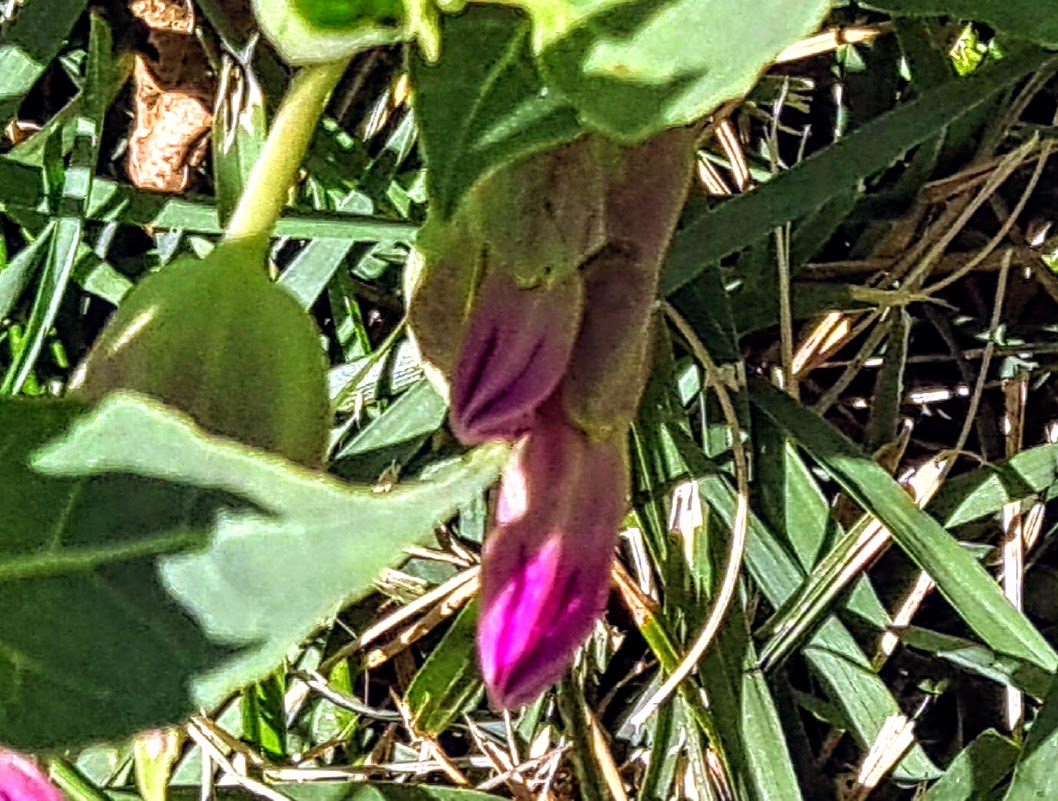
The wild four o’clock is blooming, mostly when I’m not around, but I did capture a couple of the flowers late yesterday afternoon. They are pretty, and when blooming in masses, must be awesome.
I hadn’t planned to write another gardening post so soon, and I certainly didn’t want to bore people with talk of the weather, but this morning’s exertions wore me out, and so there’s not much else in my head to blog about.
I’ve been playing a new game lately called, “Will it rain?” It’s a simple game, with no rules, no challenges, no rewards. All I do is track the possibility of storms with a weather app. You’d think it would be simple, a quick check to see what the day’s weather would be, and then the weather happens.
But not here, not now. Last night when I went to bed, there was a 75% chance of it raining in the early morning hours. It didn’t rain, so I checked the app when I got up, and it said there was a 95% chance of rain before noon. Again, it didn’t rain. So I checked the app again, and it said there was a 50% percent chance of rain by 3:00 o’clock. Not only did it not rain, but the sun came out and the temperature shot up about ten degrees more than was forecast. Now the app says 15% chance of rain after 7:00.
So, will it rain? Apparently, no one knows.
It wouldn’t matter what the forecast is, but with so many rain days that turned out to be non-rain days, I should probably water my lawn, but I certainly don’t want to oversaturate it. When we were getting rain, I got mushrooms in my lawn, and the brown spots where the grass died didn’t get any less brown.
I’ve decided worrying about the lawn is a foolish occupation of my worry time. Not that I schedule a time to worry, you understand, it’s just that there always seems to be something niggling at me. In the fall, I will have to reseed a few areas where the grass has receded (it hasn’t just receded, it’s flat-out disappeared, but I liked the reseed/recede homophone). I will also have to dig up the Bermuda grass that is launching a full-scale attack on the finer grass, so it doesn’t really matter if I have five spots to reseed or ten spots. So, since it’s already in the schedule, it’s not worth worrying about.
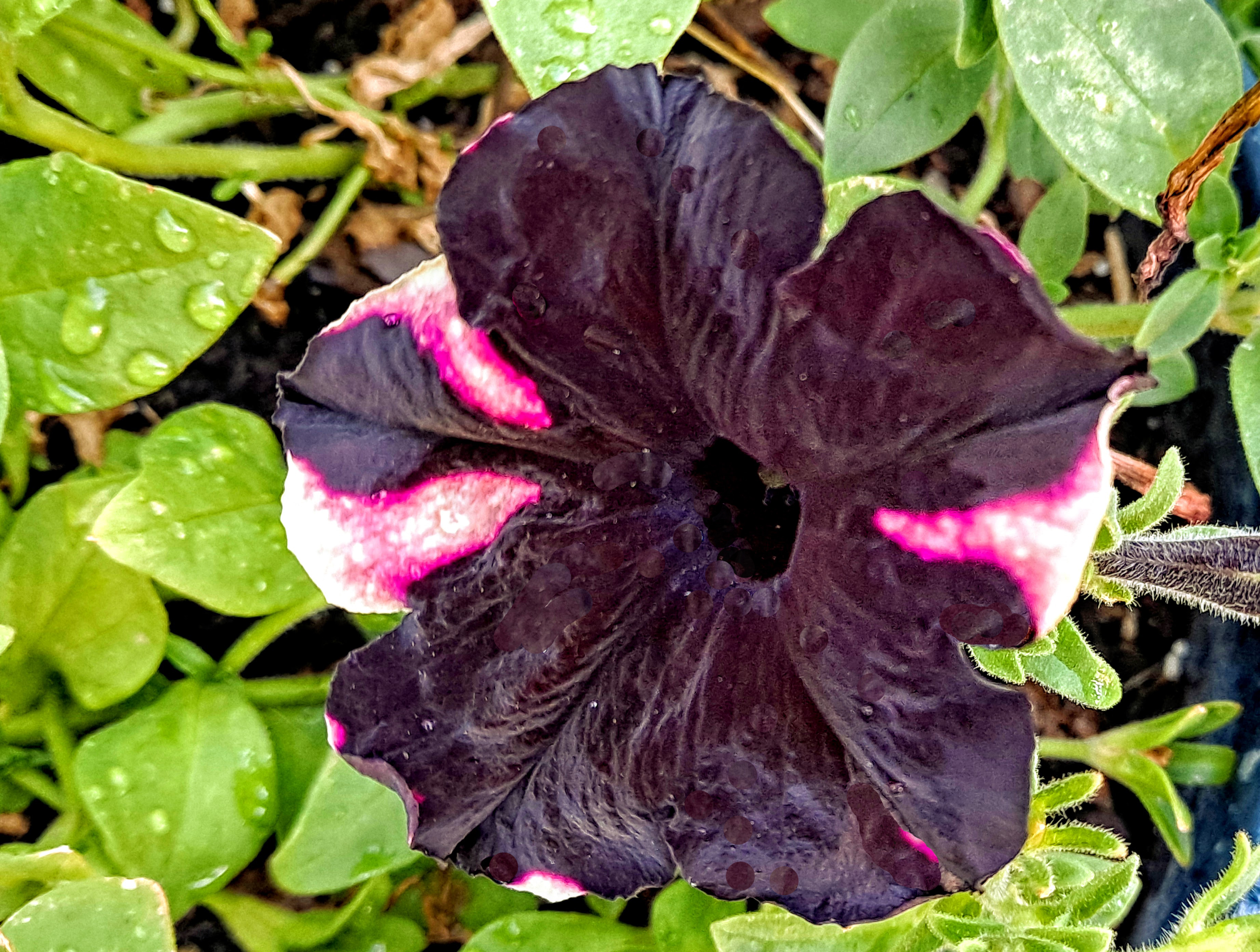
I had been wondering about when to mow with all the rainy days we were supposed to have, but today, when the sun came out, I went out and did the chore. I also took photos of flowers, which I’m sure comes as no surprise to you. The dark purple petunia with the pink highlight is one of the petunias that grew itself from last year’s petunias, though those petunias had no pink highlights.
Tomorrow looks as if it will be a repeat of today, starting out with a 68% chance of rain, so lucky me — I get to play the game again.
***
What if God decided S/He didn’t like how the world turned out, and turned it over to a development company from the planet Xerxes for re-creation? Would you survive? Could you survive?
I was surprised, many years ago, to learn that Colorado had a monsoon season. “Monsoon” always made me think of places like Thailand and Singapore with their afternoon deluges that brought traffic to a standstill, and Colorado seldom gets that sort of rain, which makes “monsoon” seem a strong word for the weak rains we sometimes get in July and August.
Although most people associate “monsoon” with deluges, a monsoon is actually a shift in the wind. In the case of Colorado, that wind shift brings moisture from the Gulf of California and the Gulf of Mexico into the state. According to the Colorado Climate Center, the monsoon “usually happens when a strategically centered high pressure (with clockwise flow around it) and low pressure (with counterclockwise flow around it) settle in over the region.”
The erratic and unpredictable nature of this North American monsoon is why the forecasters seem unable to tell us when or where or how much it’s going to rain. There have been days recently when they predicted 10% chance of rain, and we ended up with a steady downpour. Other days they have predicted a 90% chance of rain, and we ended up with nary a drop. And some days the forecast changed so frequently, no one and nothing had any idea what was going to happen, not even the weather itself.
This week, rain or no, we seem to be centered solidly in the monsoon wind pattern. The days are still and dry, but most evenings we have at least a splattering of rain. A couple of nights ago it rained for several hours, the longest rain we’ve had all year. It rained a bit last night, and after a respite of — perhaps — no precipitation tonight, there’s a chance of rain every evening for the rest of the week.
I have learned a couple of things during this monsoon week: 1) the browning of certain areas of my lawn isn’t due to lack of moisture, and 2) this is not a good time of year for hanging baskets. I’ve had to settle those hanging plants firmly on the ground so they don’t take flight in the late-night winds. By the time the winds are gone and I hang up my plants again, it will probably be too late in the season for flowers. Still, plants are nice, wherever they are.
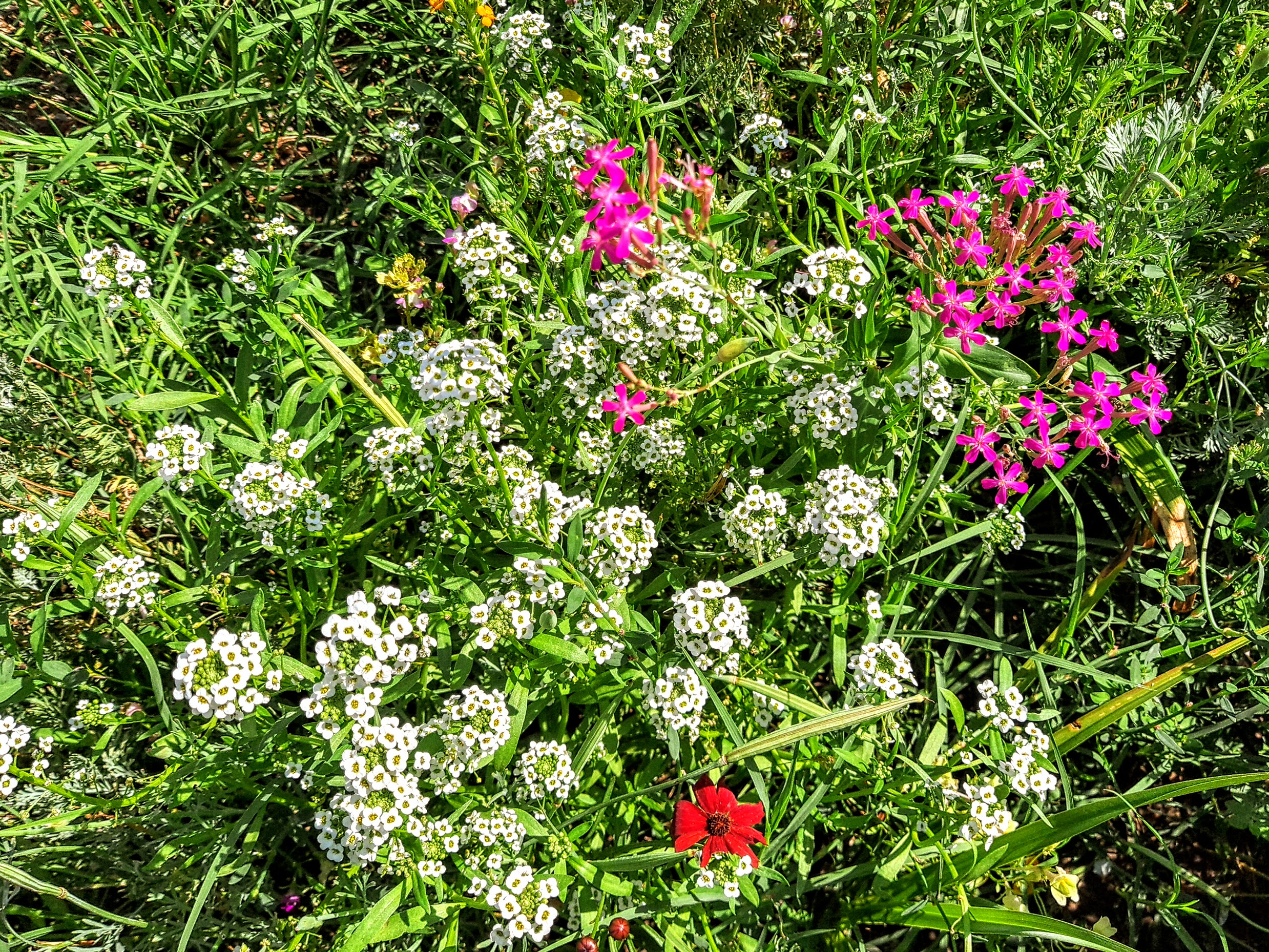
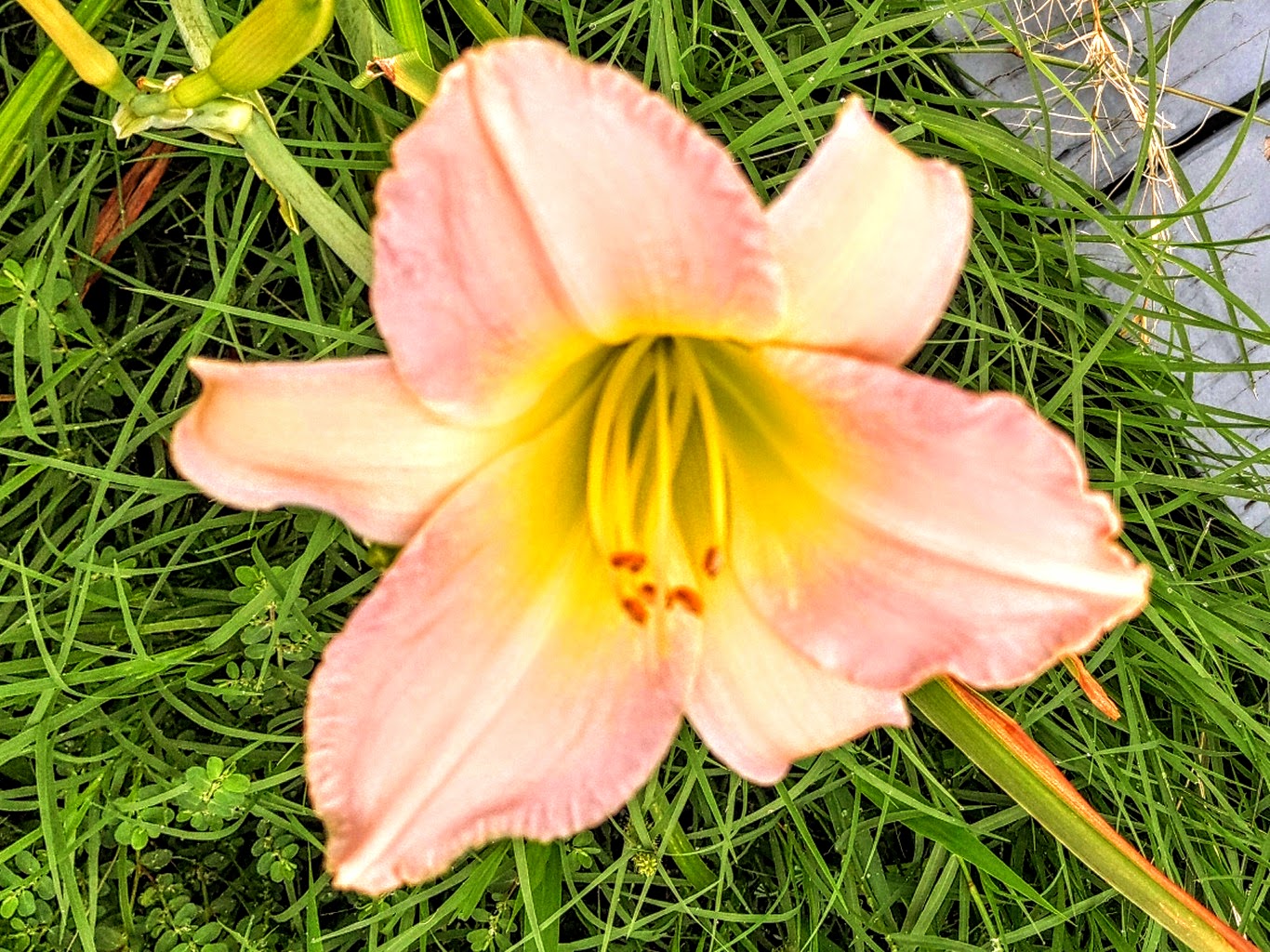
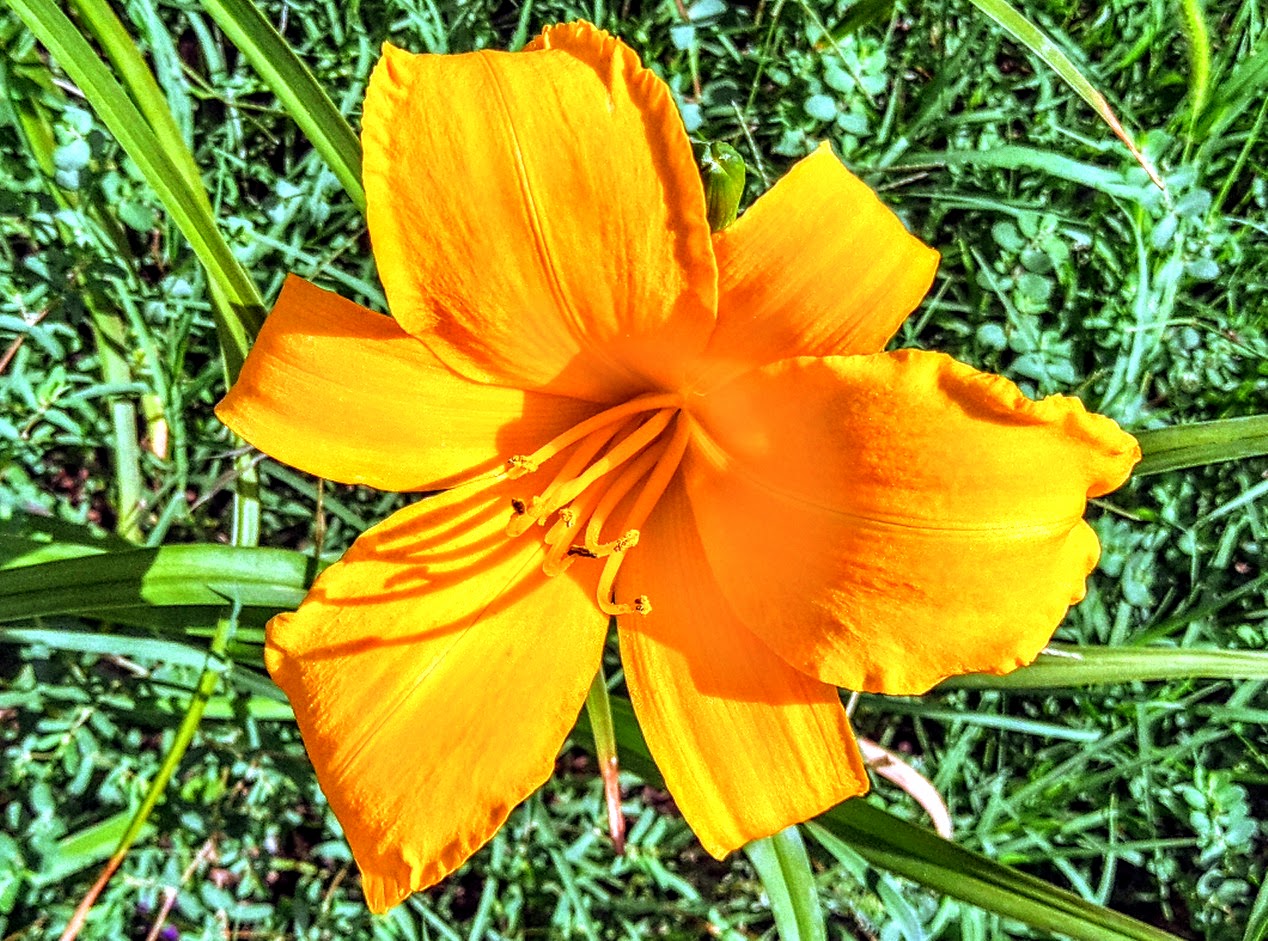
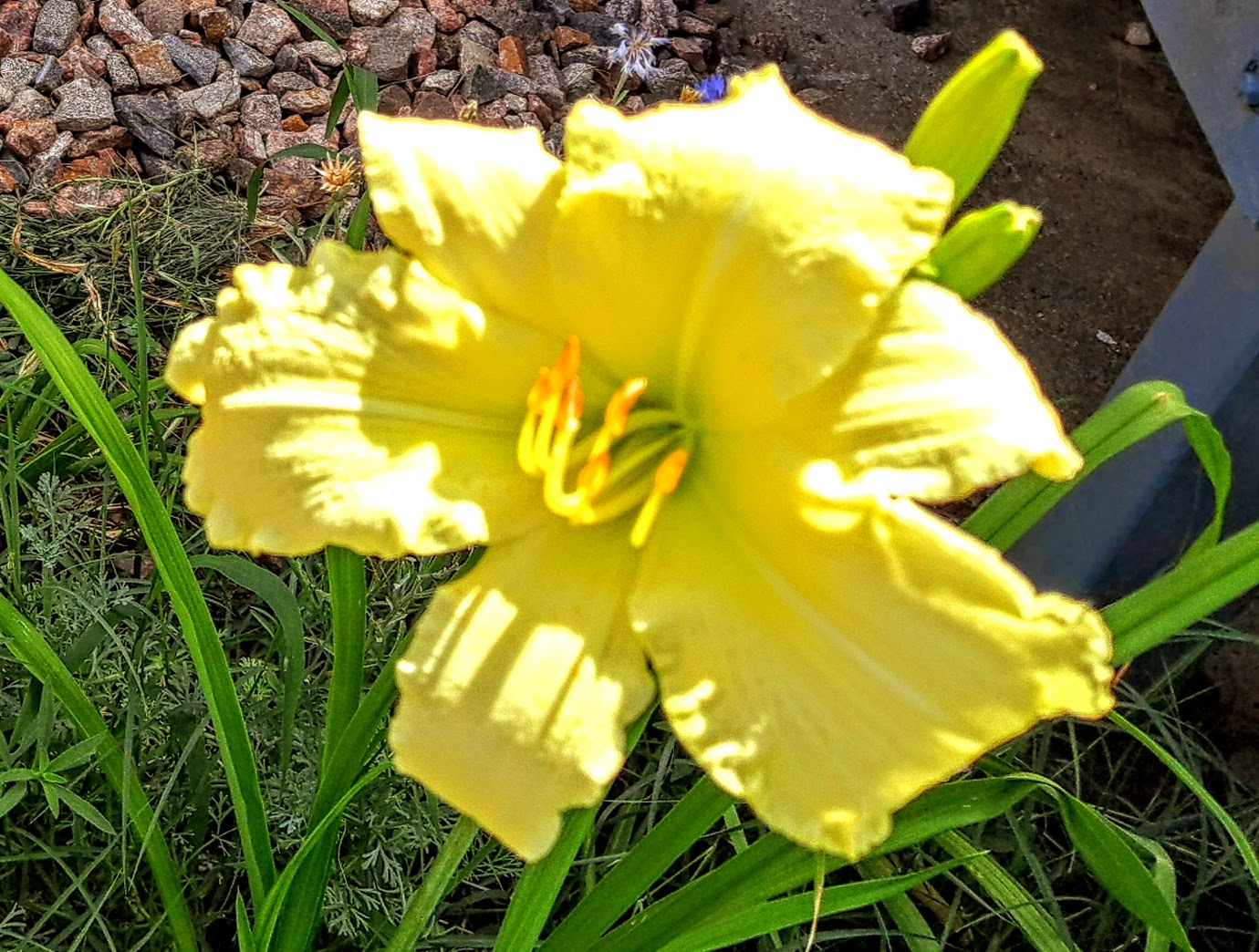
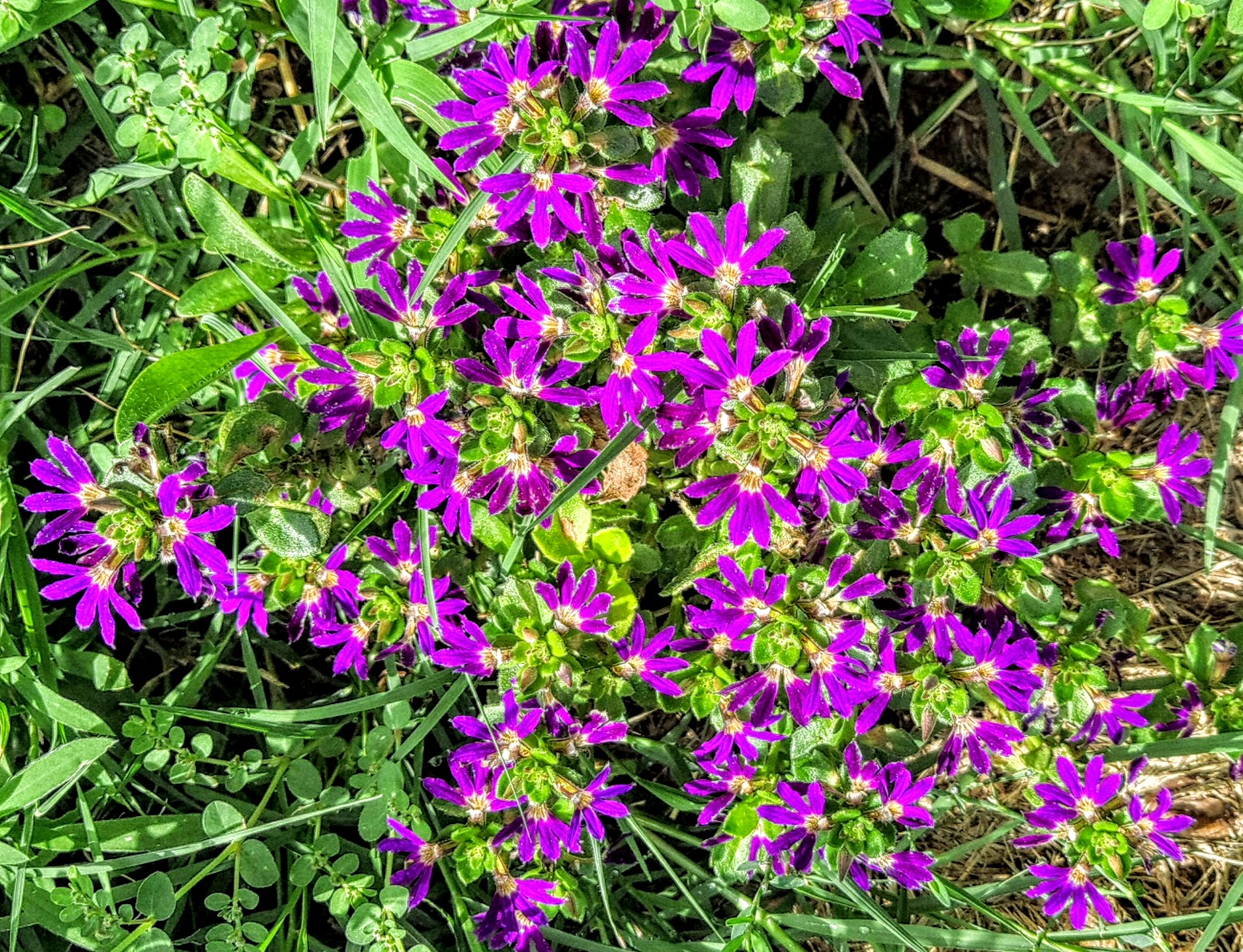
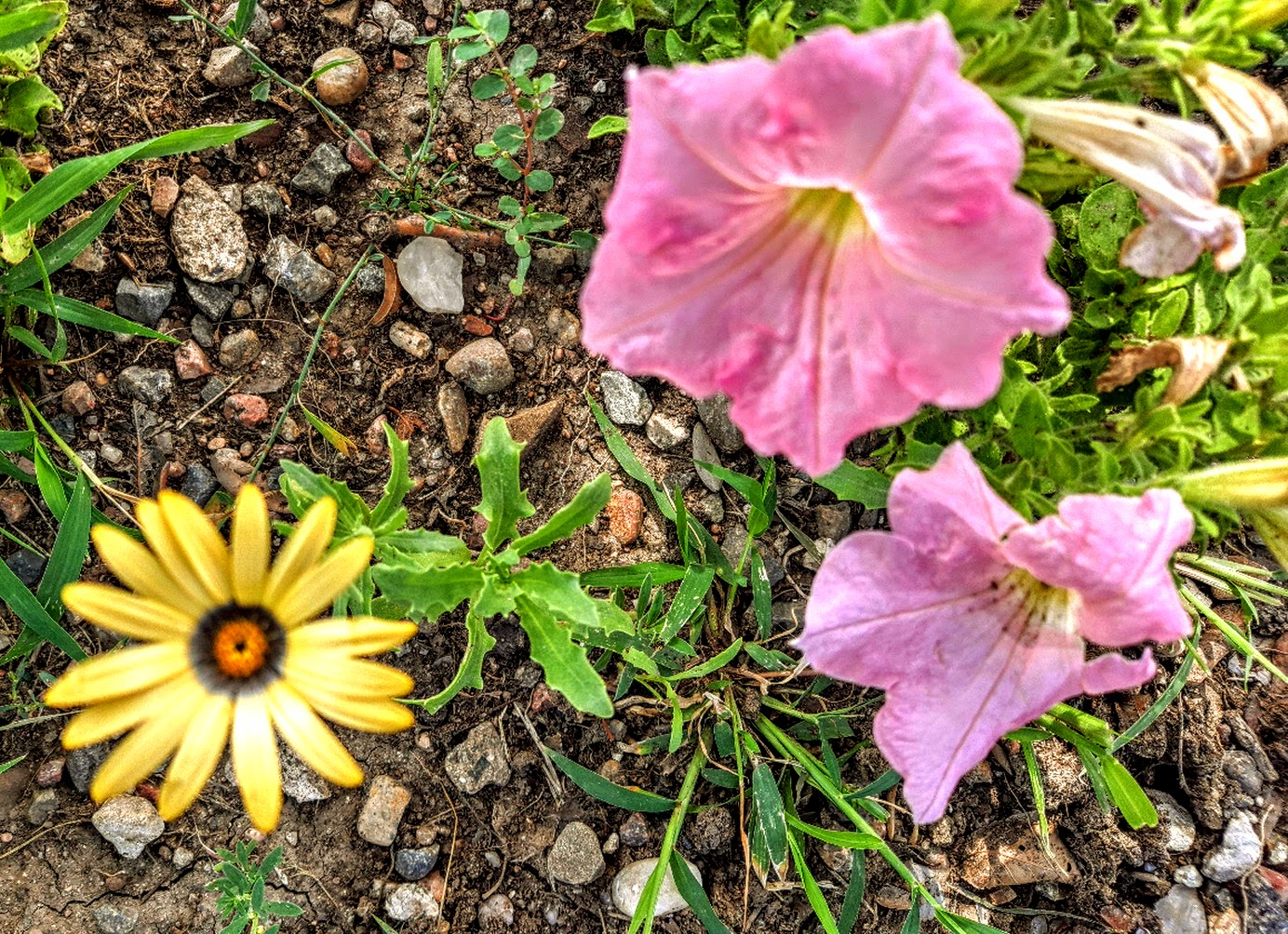
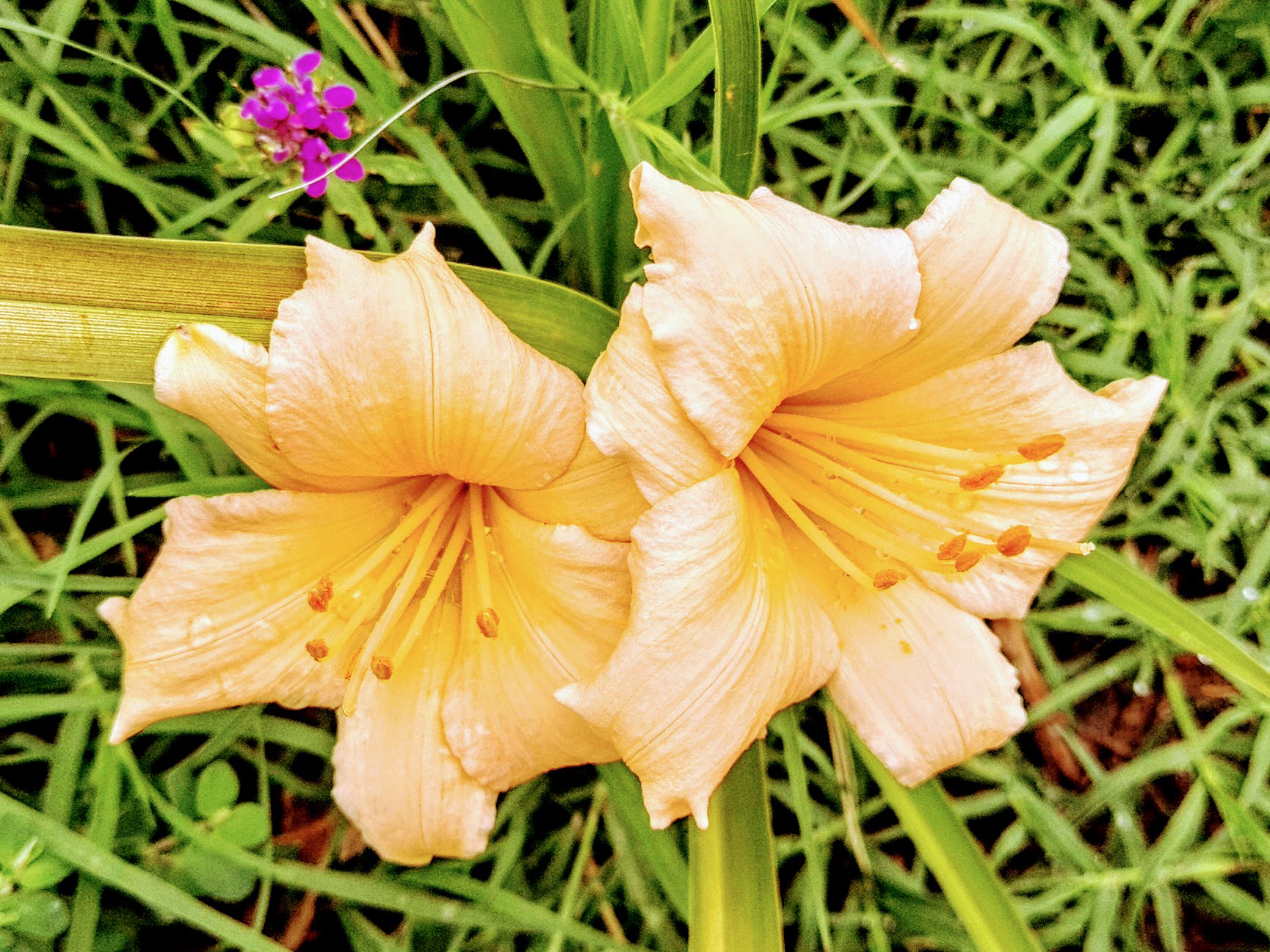
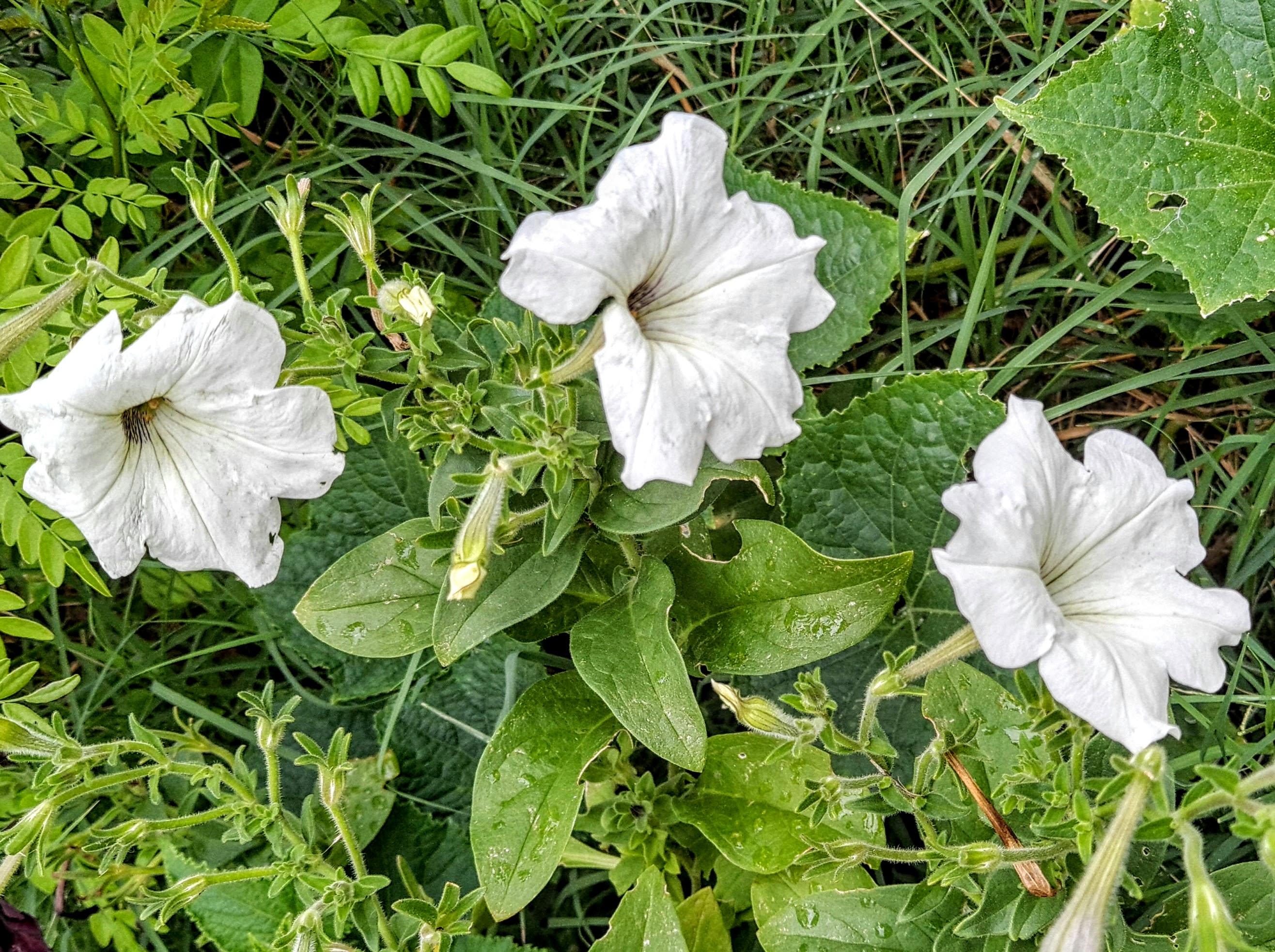
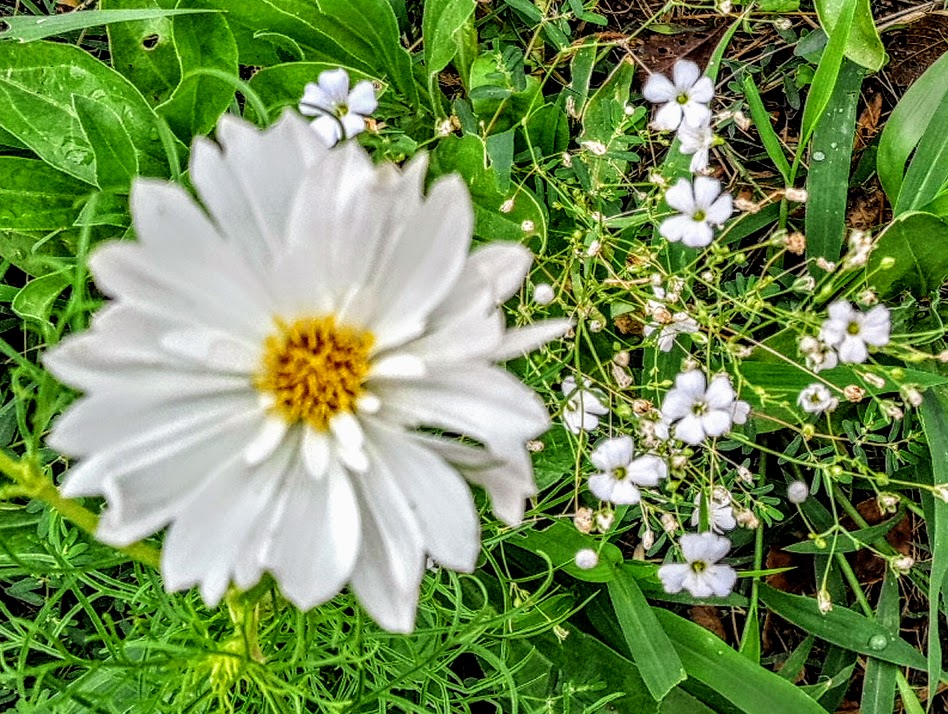
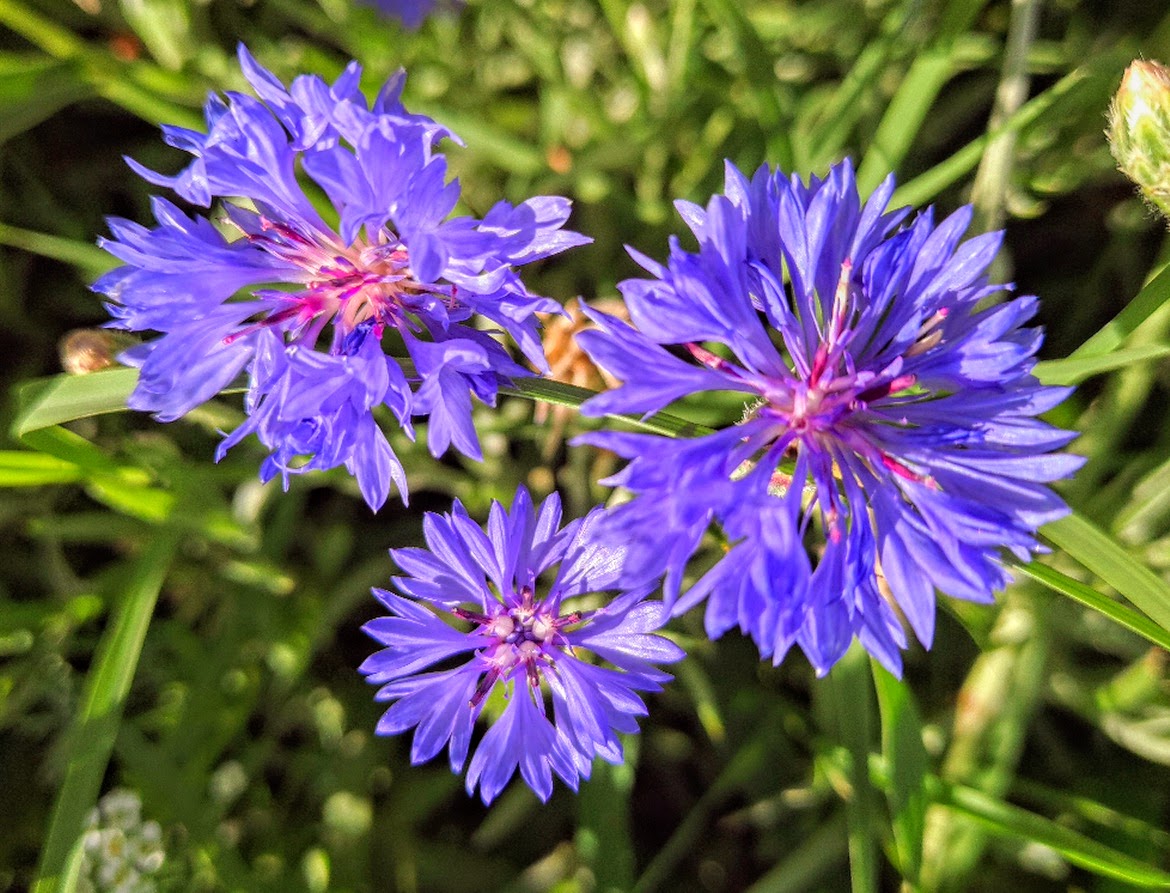
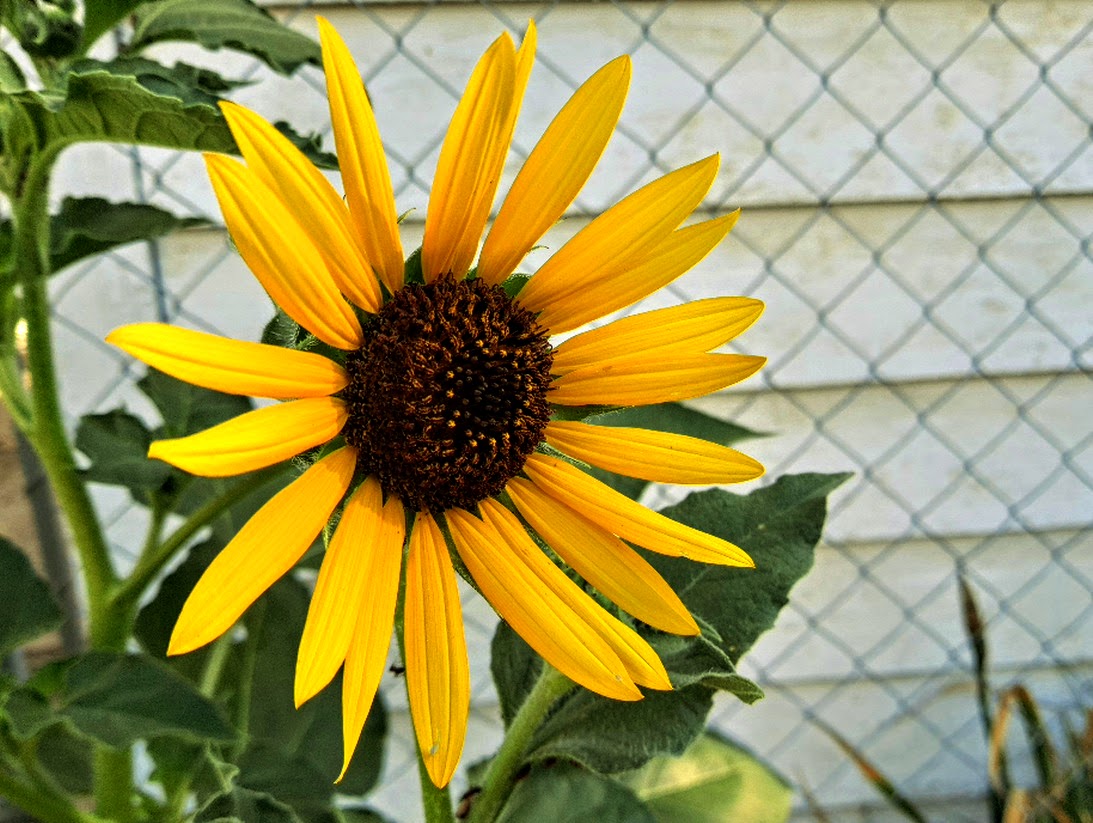
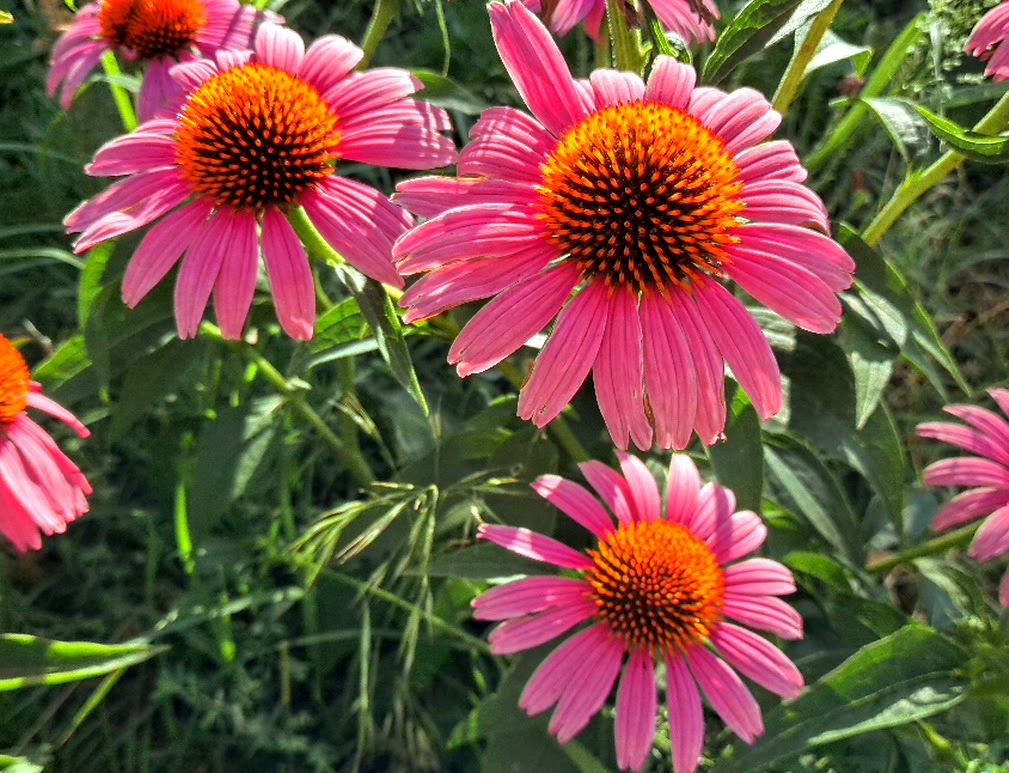
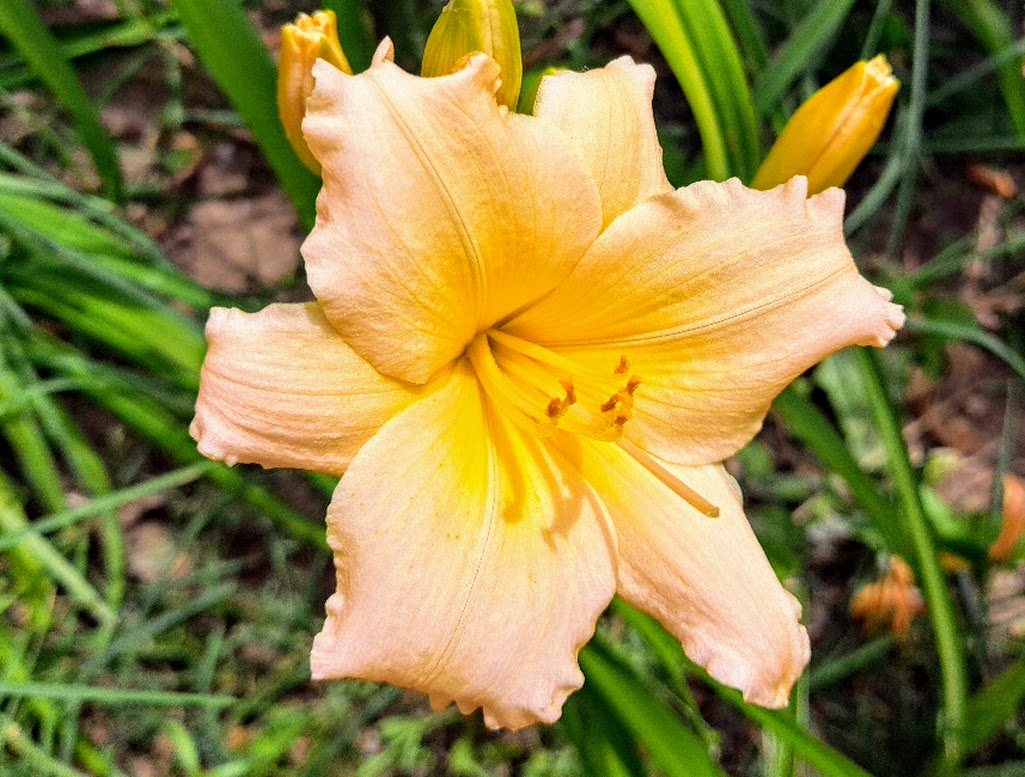
Well, some plants. The rain sure is making the weeds spring up! And it’s making the already sprung-up weeds grow horrendously fast. I’ve cleared out the tallest weeds, though my garden patches have been neglected. Luckily, as you can see, I still managed to find a few flowers to photograph.
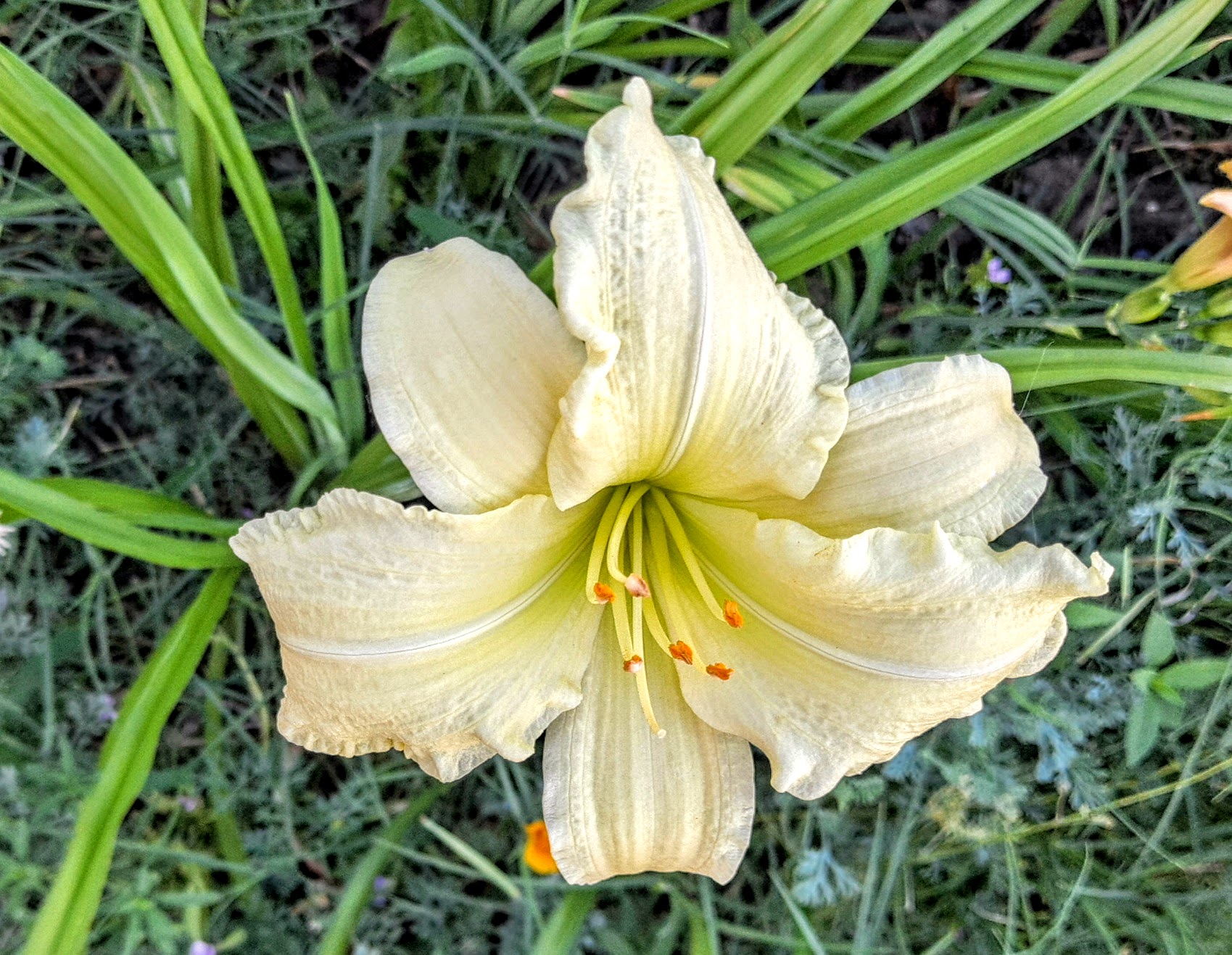
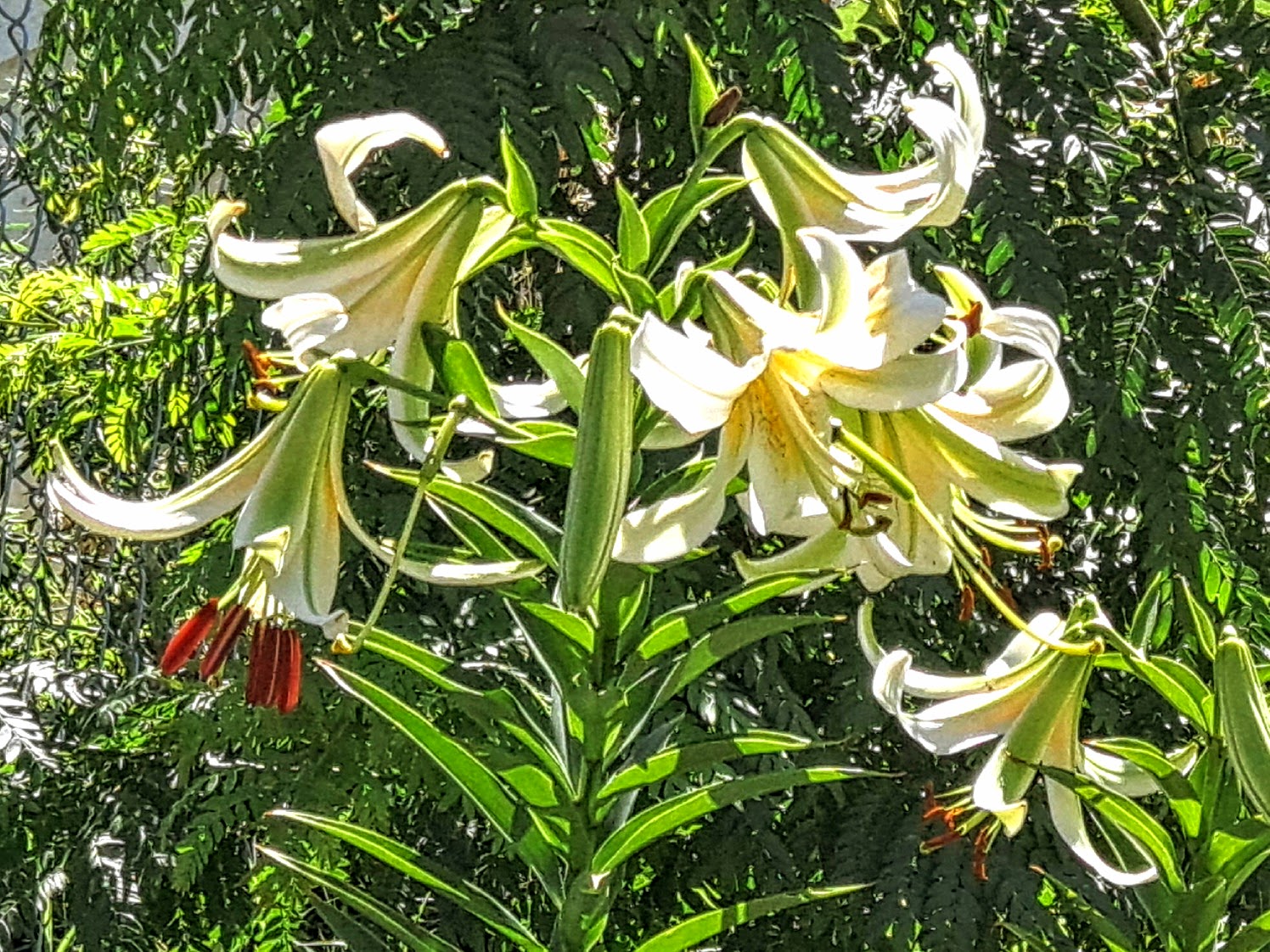
Incidentally, all the white flowers pictured are volunteers, planting themselves where they’ve been assured a warm (and wet) welcome.
A girl asked an artist how he knew when his painting was perfect, and he answered, “It’s never perfect, so I’ve learned to celebrate the small perfections.”
His response resonated with me because that is how I’ve learned to view my garden (as well as the rest of my life). When people drive by my house, they might see the finished art piece of my yard, but I see all the problems — the patches of brown grass and the encroachment of weed grasses in the lawn, the insect-nibbled flowers and the annuals past their prime, the overgrown areas and the undergrown areas, and all the other issues that make a landscaped yard less than picture perfect.
Celebrating the small perfections keeps me focused on what I can control. Not that I can control what blooms and what doesn’t, but there’s way too much that is beyond my control —weather, weeds, and insects being prime examples.
I can control the work that I do, and I can appreciate the results of that work, whether it turns out to be what I hoped for or not.
At this time of year, when the tomatoes seem to be wildly overshadowing all the other plants in their vicinity (even though I thought I allowed enough room, apparently, I didn’t), and when it’s obvious what will have to be changed for next year, it’s important for me to celebrate the beauty that I find in various nooks and garden spots.
It’s especially important to celebrate the small perfections when the rains and cool downs don’t happen. A garden is a collaborative effort between the gardener, nature, and the environment, and when one of those collaborators falls down on the job (what I view as their job, that is), there’s not a whole lot I can do about it.
Gardening is a learning experience — a growth experience in more ways than one — and while I am learning how to perfect my garden, I still manage to find some small thing (or several small things) to celebrate every day.
***
What if God decided S/He didn’t like how the world turned out, and turned it over to a development company from the planet Xerxes for re-creation? Would you survive? Could you survive?
This morning I was outside before the sun came up — I needed to water before it got too hot to be outside — and I noticed that my wild four o’clock plant had buds.
I came inside and set my alarm for four o’clock so that I wouldn’t miss the blossomed flower. When the alarm went off, I braved the heat (105˚ F), but alas, no flower.
Aha! Daylight savings time! Maybe the four o’clock plant is now a five o’clock plant! It’s five o’clock as I write this, so I peeked out the window, and still no blooms.
According to a couple of articles I stopped to read, the plant won’t flower in the heat, so it waits for the temperature to cool off a bit, which means it could be a seven o’clock or even an eight o’clock plant. Or it might not flower at all. In fact, although I got the plant almost three years ago, this is the first year it even came up, so I’m grateful for that, anyway.
Luckily, the heat will break tonight, and next week will be considerably cooler, with some highs in the eighties and some around ninety. Most days even come with a possibility of rain.
I am so looking forward to a bit of cool. The searing sun is not at all pleasant. The only things I know that appreciate the heat are tomatoes. And zinnias.
It’s funny to think that not that long ago I was thinking the cold would never end, and lately I’ve been thinking the heat will never end. (Just because the seasons have always changed doesn’t mean that they always will.) Luckily, if the weather forecasters have any credence (which up to now, I haven’t seen much of that), it will cool down for a few days anyway.
Then, perhaps, my four o-clocks will bloom.
***
Pat Bertram is the author of intriguing fiction and insightful works of grief.
I spent the morning outside. I hadn’t really planned to. Since it rained last night, I didn’t have to water today, and I figured the ground would be too sodden to weed my flower gardens, so I thought this would be a good day to take it easy.
Still, I had to go outside to toss out the furnace filter I’d just changed (after being very careful going down those old basement stairs), and I needed to reattach a motion-activated light that had somehow become unattached from its perch on the side of the house (I was especially careful going up the ladder since I’m not sure it’s something I should be doing), and because I was outside anyway, I pulled a weed or two.
A couple of hours later . . . Yep, that weed or two turned into a massive cleanup of one of the two uncultivated areas of my yard. It’s not as if the area needed it — the weeds were only waist high. (I’m being ironic here, if you can’t tell. Not about the weeds being waist high, because they were, but about the area not needing to be weeded.) I would have to clear it out eventually — I will be ordering some purple echinacea and Goldsturm black eyed Susans to plant there this fall, so this gave me a head start on the project.
Speaking of which, the echinacea that I planted last year came in a five-inch pot, and they did well. The price has gone up quite a bit, so I’m considering getting plants in three-inch pots, which are half the price, but obviously smaller. Would that be a foolish economy? Obviously, for the same budget, I could get twice as many of the smaller pots, so if a couple of the plants died, I’d still be ahead of the game, but am I sabotaging myself by getting the smaller ones? Or does it sound like a smart choice? I sure don’t know.
But I’m getting off the topic of spending the morning outside . . . After I finished my chores, I took a few photos of flowers. I love how this morning glory turned out — as if the sun were rising from its center!
About then, a friend stopped by and we sat in the comfort of my gazebo (me with dirt still under my fingernails) to chat for few minutes. Next thing we knew, the church bells were tolling the noon hour. Yikes! Those hours do tend to disappear on a person.
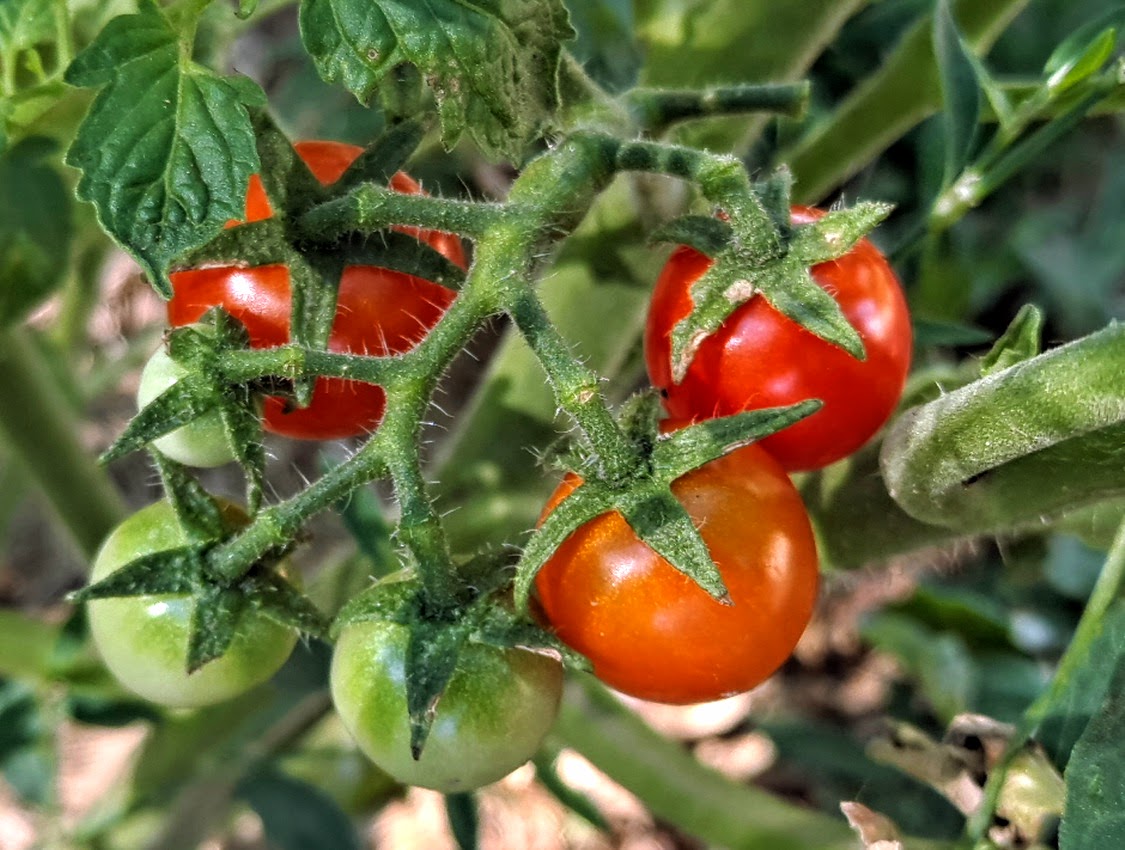
We said our goodbyes. She headed out to finish her errands, and I went to harvest my cherry tomatoes. All three of them!
And then finally, I went back inside.
What a nice midsummer’s day!
Only it isn’t a midsummer day. It’s merely a day in the middle of summer. A quick Google search to find out when midsummer really is told me that midsummer is celebrated around the summer solstice, which we call the first day of summer. So confusing!
Still, whatever you call it, I spent a pleasant — and unplanned — summer day outside.
***
What if God decided S/He didn’t like how the world turned out, and turned it over to a development company from the planet Xerxes for re-creation? Would you survive? Could you survive?
I had a wonderful surprise last night, and you’ll never guess what it was. Aww, shucks. You guessed it. And here I thought I was being subtle and crafty.
Last night’s surprise downpour was anything but subtle, though it was crafty how it slipped in past the weather forecasters’ crystal ball. The meteorologists all said there was almost no chance of rain for the near future, and a few hours later — deluge!
I was thrilled to see the rain for many reasons. One, we needed it. Two, it was a lovely sight — and sound. Three, I was dreading today and having to be outside to water when it was so dang hot.
I also dreaded today because I’d signed up to work at the museum, and although I would have liked to help, I simply did not want to go meandering about in the afternoon heat. I lucked out on that, too. Because of the rain cancelling my morning chores, when a friend called and asked if I wanted to go to the “big city” with her (big only in comparison to this town; anyone anywhere else would consider it a miniscule place) I jumped at the chance to get away for a bit. Shortly afterward, I got a message that the time to help at the museum was changed from the afternoon to the morning, but it was too late; I was already on my way out of town.
So the day I dreaded turned out to be not so dreadful. Even better, I got to see my yard from a different perspective (from the street as we drove away from my place), and it looked pretty good for having to survive such a searingly hot summer.
It’s funny that although we are in the midst of summer (“midsummer” sounds much more romantic than it actually is), I only have three months to come up with and to write a mystery for the museum’s October event.
A friend is doing research for me on a tale she was told as a youngster — something about the military, the Cheyenne, gold, a cave, pictographs, and a totem pole. There was also a hanging, but I don’t remember if that’s part of that story she told me or a different one. (Not only did I talk to her yesterday about what she remembered, I also leafed through a book that gave some of the history of this area, and all that input is jumbled together in memory.) I sure hope she can track down some people who might remember the story because it sounds interesting (more interesting by far than this heat, that’s for sure!). If necessary, I could use those same themes to create my own story, but since it’s for the historical museum, I’d just as soon the mystery have some basis in fact.
But for now, it’s a matter of waiting to see what transpires, both with the story and with our midsummer weather.
We could see a few more showers tonight, but since it’s in the forecast, I wouldn’t be surprised if the rain passed us by — those crystal balls the forecasters are currently using seem rather murky and not at all trustworthy. Because I don’t have my own private rainstorm tucked away somewhere that I could trot out on days like today, I’ll just have to hope that everything again turns out for the best.
***
What if God decided S/He didn’t like how the world turned out, and turned it over to a development company from the planet Xerxes for re-creation? Would you survive? Could you survive?
This heat sure is zapping any energy I might otherwise have had. I still do my early morning yard chores, but the effort required to slog my way through the heat leaves me without any resources for the rest of the day. Even when I’m finished and am inside with the air conditioner going, I can still feel that lack of interest in doing anything. Except for reading, of course. That I can do anywhere or at any time, though I have to admit, few books can hold my interest enough to keep me awake for very long. Naps anyone?
It’s times like this when I can feel the pendulum swing of life. Here we are, stuck in a slough of over 100-degree temperatures, but it wasn’t that long ago when the temperatures were dipping below 0 on the Fahrenheit scale. On a day-to-day basis, the pendulum of the seasons might not seem as if it is moving, but it is. In another six months, we’ll be back to those frigid temperatures.
Another pendulum I could feel today is the one that regulates how I feel about my yard and the work I’m putting into it. A few months ago, I was enchanted with the way everything looked and how everything was going. Now I am definitely unenchanted (meaning the enchantment is at an end) though the pendulum hasn’t yet swung all the way to disenchanted (meaning disillusionment and disappointment). And perhaps the pendulum might not swing that far. My love affair with my garden was a shallow one, based entirely on its looks. As the old flowers and plants die off and late-bloomers blossom, and as (perhaps) the rather bleak look of midsummer desiccation gives way to a more robust autumn look when cooler temperatures favor cool-temperature plants, such as New England asters, chrysanthemums, and my grass, then I might become enchanted again. If not, there’s always next spring and the inevitable pendulum swing.
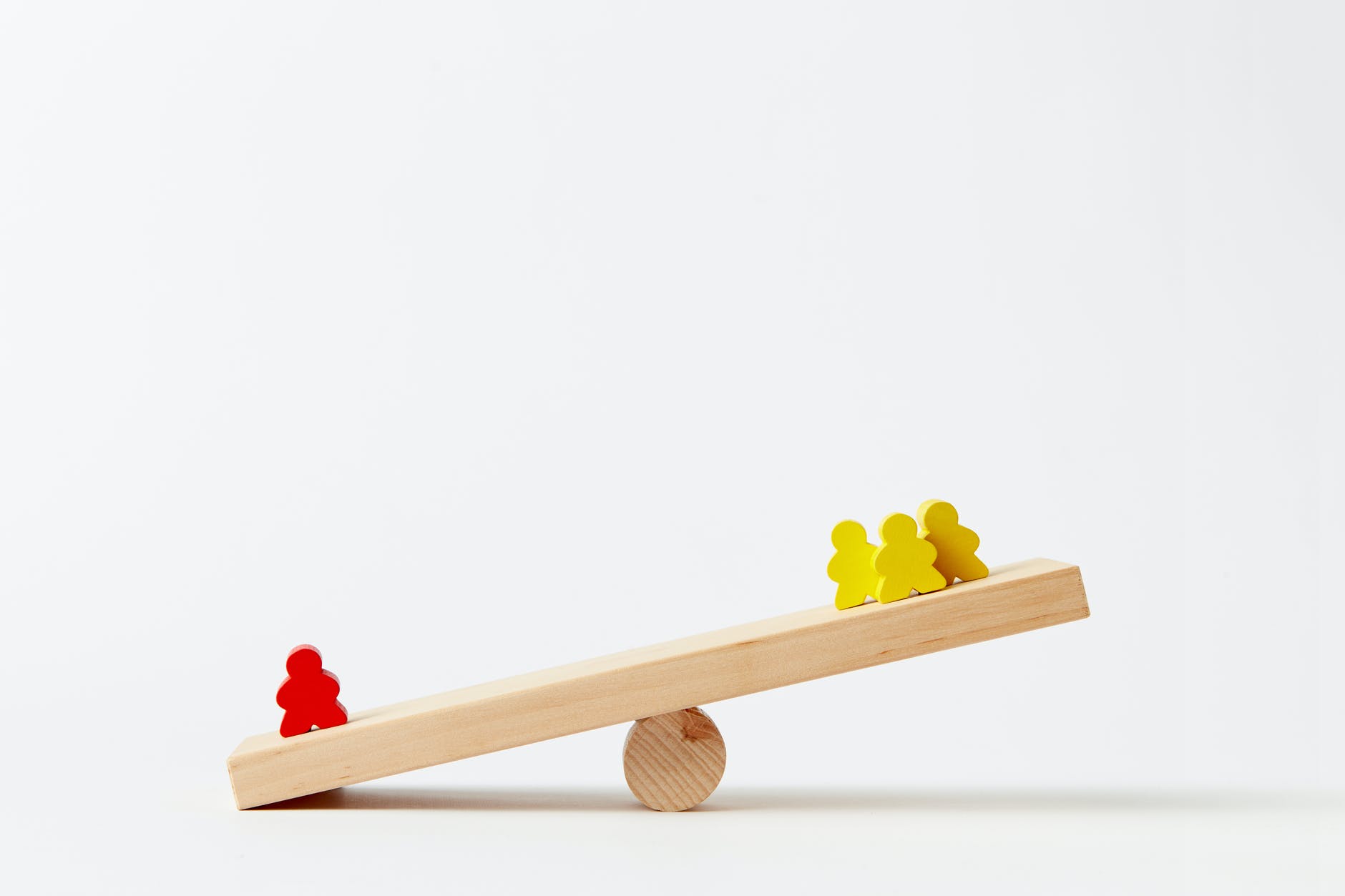
I try not to be too influenced by wild pendulum swings because life is so much more comfortable on the fulcrum. I do, as much as possible, try to remain emotionally centered without going to extremes of moods. (Grief was an aberration, an insane one-sided, one-way swing of the pendulum of life, though even then, I tried to find whatever balance I could.) Still, even centered as much as possible on the fulcrum, small daily mood changes can seem immense when influenced by the out-of-my-control swings of nature.
And especially when the heat wipes me out, leaving me without the energy to balance on the fulcrum.
When I first started working outside this past spring, it felt as if my yard were an extension of my house — an outdoor room, perhaps. Now the outdoors feels hostile and alien, a place that I cannot control, at least not in the way I can control the “climate” inside my house. We can’t control the inside one hundred percent, of course. So much is still out of our control, such as bugs that find their way inside, appliances that go wonky, as well as any number of things that can go wrong. But at least inside (so far anyway) I don’t have to deal with searingly intense and dangerous heat, slime molds, dead birds (well, one, anyway — I found it on my front lawn when I went out to mow today), clouds of grasshoppers that chomp on non-suspecting plants, grass that turns brown and desiccates overnight.
The past few days, dealing with all those vexatious issues, I haven’t even felt like sitting in my gazebo to enjoy a few minutes of rest after my hard work. I’ve just gone inside, closed the door, and felt glad to be in a more familiar place.
At least for a while, that is, until the phone rings. And oh, does it ring! In the past couple of days, I’ve received maybe forty calls from entities with names like “Spam Risk,” “Haitian Chick 5,” and “Telemarketer.” I don’t answer (well, I do, but I hang up immediately; if not, the calls go to voice mail, and then I have to delete all of them) so I don’t know if there are real people behind the calls or if it’s all robots. But it doesn’t matter who is calling — the ring always startles me, though I have it on low. And I turn the phone off at night to keep from being awakened.
Apparently, after the slowdowns and shutdowns and sheltering-in-place during the past couple of years, the telemarketing machine gave us a bit of a break, but now it’s going full bore, trying to make up the money they think they lost. (Though why, with all warnings about spam and identity theft and fraud, people are still buying into these scams, I don’t know. They blame the “old people,” but my generation and even the one before me are tech savvy and wary. Or so I thought. But maybe we’re losing what few brain cells we have left, and what we once knew we no longer do?)
But luckily, it’s cool inside, so there’s that. And I have books to read and food to eat. And, if necessary, I can mute the ring so I don’t hear it at all to give my poor frazzled nerves a break.
Even luckier, I was able to leave all the rest of my vexations outside where they belong.
***
What if God decided S/He didn’t like how the world turned out, and turned it over to a development company from the planet Xerxes for re-creation? Would you survive? Could you survive?
Sometimes gardening it too much like life to suit me. Come to think of it, gardening isn’t “like” life, it is life. All those plants and other living creatures go through the same sort of life cycles we do, with ups and downs, growth and stagnation, illness and death. They might not have to deal with the angst of their traumas, but we — in this case “I” — suffer the angst for them.
This has been a particularly confusing time for me garden-wise. The sun desiccates plants so quickly, that what was thriving yesterday, is all but dead today. I’m glad I took a photo of these petunias yesterday because today, not only are the flowers gone, but the plants themselves look as if they might not make it through another drastic heat wave.
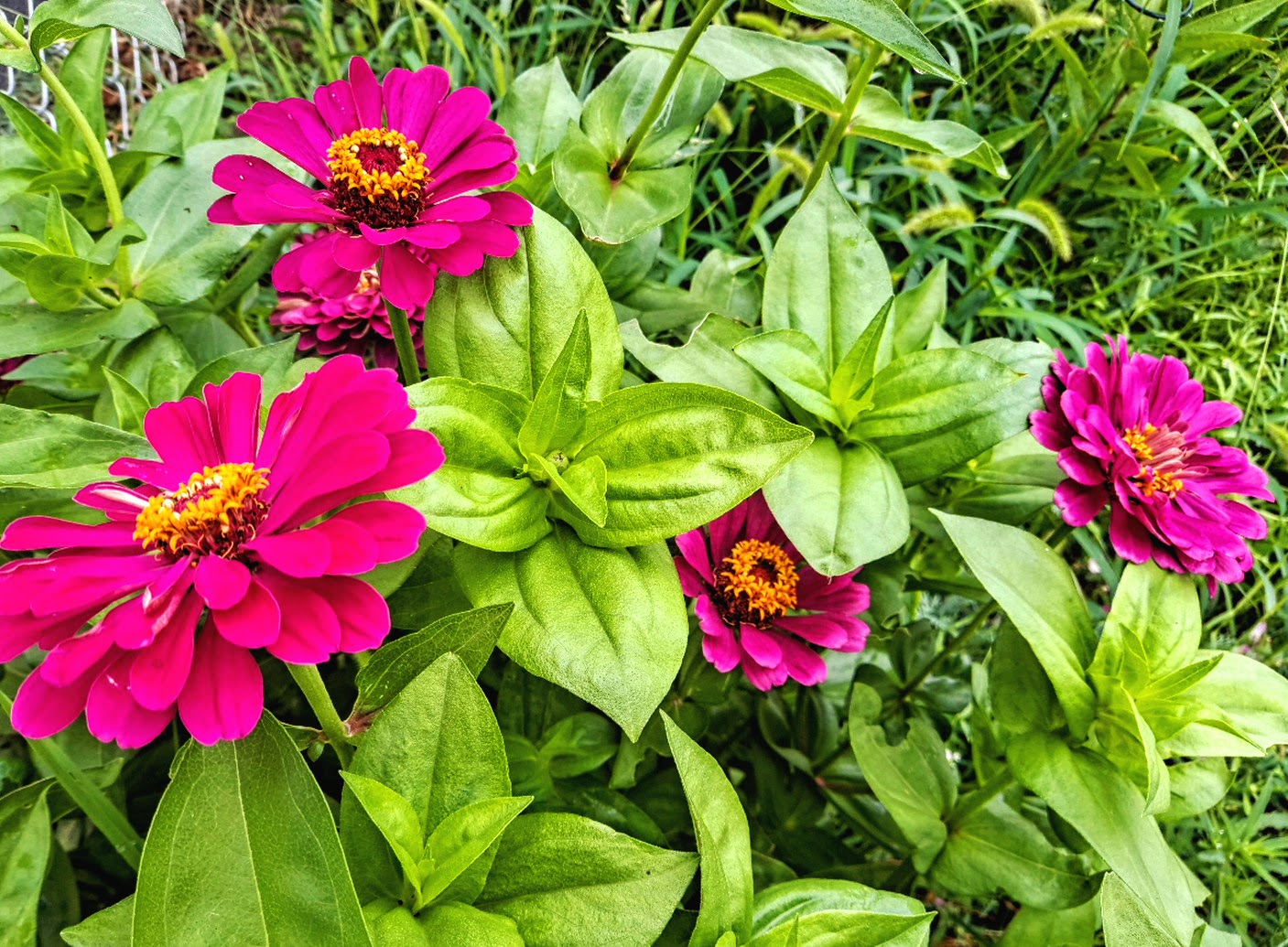
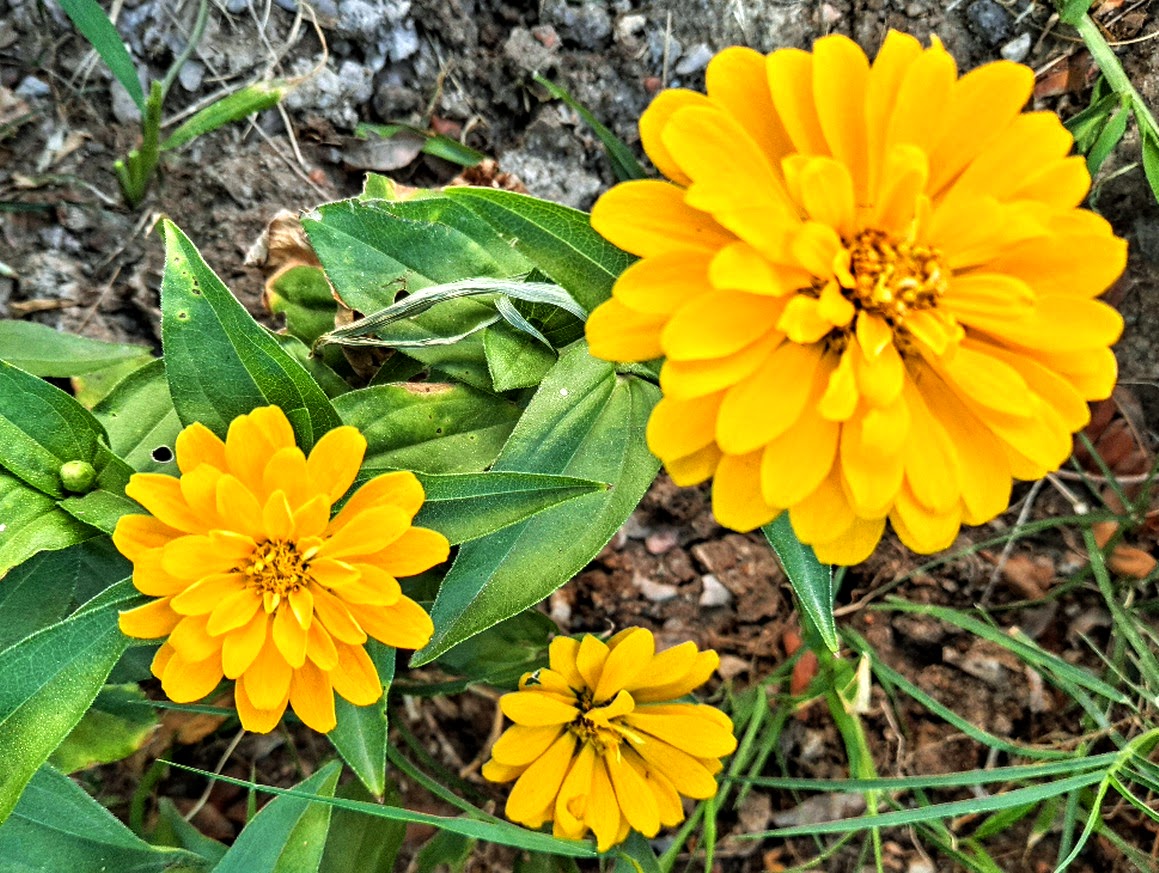
The same thing happened to the zinnias, though I don’t know why. They generally like this climate and this area especially — at one time, 92% of all zinnia seeds were grown in this valley not far from here. Luckily, only the flowers desiccated. The plants themselves seem strong enough to produce more blossoms.
The grass especially confuses me. The large area of the lawn that had turned brown about a month ago was doing well until last night, and now it’s even worse than it was the first “brown” time. As if that weren’t bad enough, I’ve been infested with slime mold in a different area of the lawn. How the heck does such a dry climate even have slime mold spores? And how can a certain area be moist enough for the slime mold to take hold when the area all around it is gasping for a drink? (A while back, a cat with diarrhea left its offering in that very spot, so all I can think of is that it somehow ingested the spores and was generous enough to share.) Even though I clean up the slime mold every morning and sprinkle the grass with baking soda, it grows again overnight in a different spot.
And no, I didn’t take a picture of the white blob. I wanted to get rid of it as quickly as possible; I certainly didn’t want to memorialize the creature. (I suppose it’s a creature, though it’s not an animal, a fungus, or a plant but an amoeba. A smart amoeba. Supposedly these plasmodium can solve problems even though they don’t have a brain. Sheesh. As if the life of a garden — and gardener — wasn’t horror enough.)
Another issue I encountered was with a hen and chick plant that flowered. This rooster, as the blooming rosette is called, came right on time. (They flower about every three years.) One gardener told me the flowering stage was the end of the cycle and to pull up the whole rosette so the “chicks” could grow. After I did that, I found out the flowers produce seed, so I could have left it until the rosette died on its own. See? Too much like life. Either way, the chicks will soon become hens. And that, too, is life.
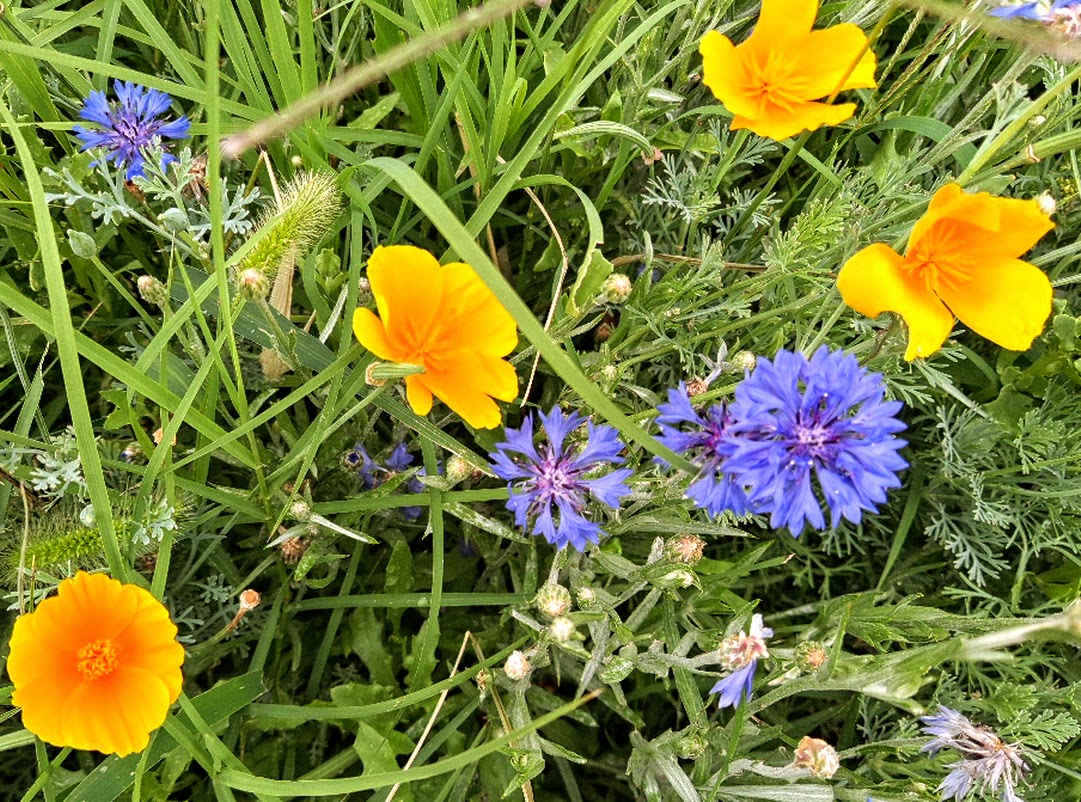
Although I have enjoyed the wildflowers, I’m not sure if I’ll buy more seeds to plant next year. (I still have some left over, so I can change my mind about planting them at the last minute.) The blooms are staggered, so there’s not a lot of color at any one time, and the mass of plants mask weed and weedy grass growth. I’ll need to completely clear out some of the wildflower areas since that will be the only way to get rid of the weeds, but it won’t be a problem since most of the flowers were annuals anyway. The flowers that went to seed won’t be affected — the seeds should still grow.
One thing that does so very well here is the magnus echinacea no matter how the weather or the gardener treats it. I’m considering getting a lot more of those plants for problem areas.
And that, too, is like life — when one thing comes to an end, you do your best to find something else to start.
“I am Bob, the Right Hand of God. As part of the galactic renewal program, God has accepted an offer from a development company on the planet Xerxes to turn Earth into a theme park. Not even God can stop progress, but to tell the truth, He’s glad of the change. He’s never been satisfied with Earth. For one thing, there are too many humans on it. He’s decided to eliminate anyone who isn’t nice, and because He’s God, He knows who you are; you can’t talk your way out of it as you humans normally do.”
Grief Books By Pat Bertram
Available online wherever books and ebooks are sold.

Grief: The Inside Story – A Guide to Surviving the Loss of a Loved One debunks many established beliefs about what grief is, explains how it affects those left behind, and shows how to adjust to a world that no longer contains the loved one. “It is exactly what folk need to read who are grieving.”(Leesa Heely Emotional/Mental Health Therapist & Educator ).
Grief: The Great Yearning is not a how-to but a how-done, a compilation of letters, blog posts, and journal entries Pat Bertram wrote while struggling to survive her first year of grief. This is an exquisite book, wrenching to read, and at the same time full of profound truths.
Other books by Pat Bertram
Available online wherever books and ebooks are sold.
While sorting through her deceased husband’s effects, Amanda is shocked to discover a gun and the photo of an unknown girl who resembles their daughter. After dedicating her life to David and his vocation as a pastor, the evidence that her devout husband kept secrets devastates Amanda. But Amanda has secrets of her own. . .
When Pat’s adult dance classmates discover she is a published author, the women suggest she write a mystery featuring the studio and its aging students. One sweet older lady laughingly volunteers to be the victim, and the others offer suggestions to jazz up the story. Pat starts writing, and then . . . the murders begin.
Thirty-seven years after being abandoned on the doorstep of a remote cabin in Colorado, Becka Johnson returns to try to discover her identity, but she only finds more questions. Who has been looking for her all those years? And why are those same people interested in fellow newcomer Philip Hansen?
When twenty-five-year-old Mary Stuart learns she inherited a farm from her recently murdered grandparents -- grandparents her father claimed had died before she was born -- she becomes obsessed with finding out who they were and why someone wanted them dead.
In quarantined Colorado, where hundreds of thousands of people are dying from an unstoppable, bio-engineered disease, investigative reporter Greg Pullman risks everything to discover the truth: Who unleashed the deadly organism? And why?
Bob Stark returns to Denver after 18 years in SE Asia to discover that the mother he buried before he left is dead again. At her new funeral, he sees . . . himself. Is his other self a hoaxer, or is something more sinister going on?