To Everyone Who Has Shared This Day With Me

I am always touched by the comments left on this blog from those who are also struggling to live and find meaning after the death of the one person who meant more than anyone else in the world. So often I feel as if I am merely indulging myself by continuing to chronicle my progress through grief and into a renewed interest in life, especially when all I have are dreams and tentative plans that might come to naught. The comments left here show me how narcissusconnected we are, those of us on this difficult path. Although our situations are different, although our grief is individual, many of us face the same blank future that we need to color with dreams, goals, fantasies, interests, and especially a renewed love of life.

It’s as if we are children again, carefully building our futures one dream at a time. As when we were children, these dreams might not come true, but they help us expand our “what is” into new paths of “what might be.”

It could be our time of life that makes this struggle so complex. Although young widows have the same struggles we do, life is still rushing in their veins. Often they have small children, which makes their loss at once easier and more difficult — easier because they have built-in meaning so they don’t have to go searching for it, more difficult because they have to raise the children alone without that special person to share in the joys (and worries) of caring for the young ones. (Please know I am not denigrating anyone’s loss. All losses are unbearably painful, but each of us has our own unique set of collateral losses to deal with.)

As we age, we lose many things we counted on, not just people but jobs, stamina, health, and we need to find a way around these limitations to some sort of revitalization otherwise the last decades of our life would be nothing more than waiting for entropy to win. When grief and the destruction of a shared life are thrown into the mix, it’s even more difficult to find a way through the murk to joy.

And yet, somehow we do find our way. Today is the 47th 27th since the death of my life mate/soul mate. (For those of you who are arithmetic-challenged, that means in one month it will be four years since his death on March 27, 2010.) Despite my complicated and sometimes stressful situation — looking after my 97-year-old father and dysfunctional brother — I am happier than I ever imagined I could be four years ago. And I expect to become even happier.

Life is full with new friends, new activities (mostly physical pursuits, which is odd considering that until recently, I preferred a more literary life), and new dreams.

None of us knows what the future holds, but those of us who have survived a profound loss seem especially aware of that truism, and we try to live each day to its fullest. It’s all we have. It’s all anyone has — this day.

To everyone who has shared this day with me, whether in person or online with a comment, thank you. You have made this day a joyful one.

***

Pat Bertram is the author of the suspense novels Light Bringer, More Deaths Than One, A Spark of Heavenly Fire, and Daughter Am I. Bertram is also the author of Grief: The Great Yearning, “an exquisite book, wrenching to read, and at the same time full of profound truths.” Follow Pat on Google+. Like Pat on Facebook.

Dreaming of Adventure

I’ve been spending way too much time lately thinking/talking/writing about hiking the Pacific Crest Trail, especially since I doubt I will ever travel more than small pieces of it. There are many problems to deal with when hiking the length of the trail — food (two pounds a day is recommended), water (either too much in the high sierras, with swollen rivers and icy trails, or too little in the deserts), heavy packs, wind, ticks and other unfriendly insects — and I would prefer a trouble-free life.

Still, just thinking and researching the logistics of such an adventure are an escape from my life. In looking after my 97-year-old father and dealing with a dysfunctional brother, I amcamping always aware of others, either listening for signs of distress from my father or listening to my brother’s moans and cries without knowing if these sounds come from pain or are a way of manipulating me. When one is hiking alone, away from civilization, away from other hikers, even, one only has to listen to oneself, only has to fulfill one’s own needs. That idea is restful to me. One foot in front of another, nothing to think about, no one to worry about.

Even more that that, thinking about such an adventure is like working a puzzle, helping to keep my mind active and alert despite too much loss of sleep. I’ve even gone so far as to join a few Facebook groups, including a couple just for woman hikers. Lots of good information in those groups, lots of things to consider. Planning such a trip gives me a new way of looking at ways of life we take for granted. Modern plumbing, for example, has made basic body functions easy for us. But what if there isn’t a restroom for hundreds of miles? How does one keep clean? How does one remain infection-free?

Thinking about living an adventurous life (simply thinking about it, not living it) has also helped me past the last hurdle of grief, giving me something to concentrate on besides what I have lost. It’s been almost four years since the death of my life mate/soul mate, and I have adjusted to life without him. In fact, sometimes I forget that I once had a different life, that once someone loved me. I don’t want to forget — I loved him deeply — but I can’t spend the rest of my life yearning for him, can’t be always looking to the past. Thinking about a life on foot makes me realize that, whether my life will be on my feet or on my behind, I do still have a life.

Throughout all these years of grief, I have been afraid of the future alone, afraid of becoming the crazy cat lady (sans cats, of course), afraid of settling somewhere and waiting for entropy to take its course. Thinking about other possibilities — hiking the PCT, walking to Seattle, car camping, going abroad and just winging it, taking a freighter to New Zealand — helps me realize that I don’t have to moulder. I can live. I can be adventurous. I can take chances. I can try new things. I can learn new things. I can become the sort of person who could hike the PCT if she so desires.

I don’t know what I want to do, and there’s no reason to make any plans since my stay here at my father’s house could continue for many more years. But I can prepare. In fact, tonight I will take a backpack on my Sierra Club walk (I walk with the club three nights a week) and fill it with a five pound weight. Five pounds is heavy! I cannot imagine trying to carry thirty pounds for any distance, but at least, this will be a start.

But a start of what? Maybe someday I’ll find out.

***

Pat Bertram is the author of the suspense novels Light Bringer, More Deaths Than One, A Spark of Heavenly Fire, and Daughter Am I. Bertram is also the author of Grief: The Great Yearning, “an exquisite book, wrenching to read, and at the same time full of profound truths.” Follow Pat on Google+. Like Pat on Facebook.
A Retrospective of Grief

Another 27th. This is the 46th twenty-seventh of the month I have survived since the death of my life mate/soul mate death on March 27, 2010. At the beginning of my grief, each minute, hour, day seemed unfathomably long. I felt as if I lived years during that first month. I still don’t understand how I made it through that eon. The pain started out unbearable and got progressively worse. Each breath took such effort that it seemed as if it would be easier to stop breathing altogether. And yet I continued to breathe, one agonizing gulp of air at a time.

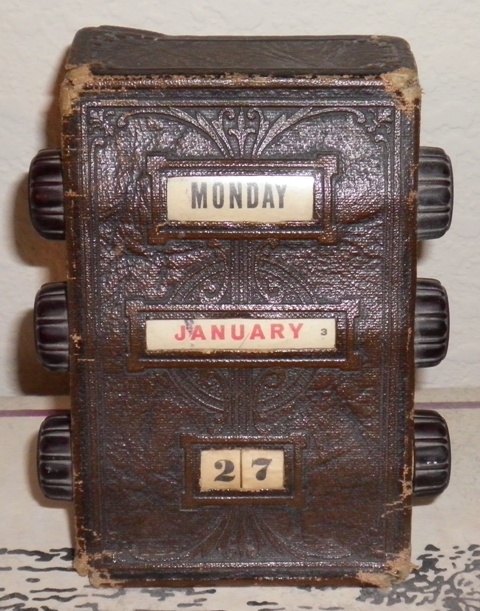
For the first three years, I could feel the grief surging as each twenty-seventh crept up on me, but today I only knew the date by the calendar. Even so, I might not have noticed if I hadn’t advanced his perpetual calendar.

perpetual calendarAbout a month before he died, he told me he wanted me to keep the calendar. It was special to him — a family heirloom and a relic of his childhood — and he didn’t want me to throw it away with the rest of his effects. Which I probably would have done. I thought such calendars silly because if you don’t remember to advance the calendar each day, the calendar loses its effectiveness. He, of course, had the discipline to advance the calendar. No matter where we lived, no matter the state of his health or the stresses of our life, he always advanced the calendar first thing every morning.

And now so do I. It has become a way of honoring his life, of remembering him, of being connected to him in a small way. For a long time, I felt connected to him through grief. (Odd, that. It was the feeling of being disconnected from him that grieved me in the first place.) Now that my grief has waned, there is nothing to connect me to him. Unlike many who have lost someone important to them, I have never had a visitation, a sign, any indication that he still exists somewhere. He is simply gone — gone from my life, anyway.

The tears are gone, too.

It seems strange now that I grieved so deeply. I can barely remember loving someone so profoundly that his death tore me apart. Can barely remember that shattered woman who screamed her pain to the uncaring winds. Was that really me or simply a character in the book of my life? (I meant this as a metaphor, but I did write a book about my life, or rather my life of grief. That seems strange, too.)

We live each day as it comes, deal with each pain and sorrow, and somehow, through the years, we become something other than we were. I am no longer a schoolgirl dealing with the small dramas of grades, cliques, unacceptance. No longer a young woman desperately and radiantly in love with a man. No longer an adult struggling to live while her soul mate was dying. No longer a grieving woman.

At the moment, I am thrust in the role of caregiver for my 97-year-old father and homeless brother, but someday, I won’t be this woman, either. I don’t know what will become of me, don’t know what I will become (other than older), but chances are, I still will be advancing that ancient calendar in honor of the life that meant so much to me.

***

Pat Bertram is the author of the suspense novels Light Bringer, More Deaths Than One, A Spark of Heavenly Fire, and Daughter Am I. Bertram is also the author of Grief: The Great Yearning, “an exquisite book, wrenching to read, and at the same time full of profound truths.” Connect with Pat on Google+. Like Pat on Facebook.

Excerpt From “Grief: The Great Yearning” — Day 288

GTGYthmbI’ve come a long way in the three years since I wrote the following journal entry.  Saturdays have ceased to be difficult, though I still don’t understand the nature of life or death. Still don’t understand the point of it all, but the questions don’t haunt me quite as much as they did during the first years after the death of my life mate/soul mate.  I’m learning to live without him, learning even to want to live without him. Sometimes I see his death as freeing us — me — from the horrors of his dying, and I don’t want to waste the sacrifice he made.

I still yearn to talk to him, though. I miss talking to him, miss his insights, miss the neverending conversation. (“Neverending” is a misnomer — the conversation that began the day we met and continued for decades until he got too sick to hold up his end of the dialogue, did eventually end.) He was easy to talk to. He never misunderstood what I said. I could make a simple comment to him, and he understood it was a simple comment. He didn’t make a big issue out of it, just answered back appropriately. It seems now every remark I make to anyone becomes a major deal as I try to explain over and over again what I meant by the first remark. It’s exhausting.

I’m  grateful we met and had so many years together. Grateful for all the words we spoke to each other. Grateful I once had someone to love. Grateful that when my time comes to die, he won’t be here to see me suffer. Grateful he won’t have to grieve for me or be tormented by unaswerable questions.

Excerpt from Grief: The Great Yearning

Day 288, Grief Journal

Saturday, again. I stayed in bed all morning reading because I did not want to get up and face another Saturday. Friday nights and Saturdays continue to be difficult. I watched movies last night until my private witching hour of 1:40am.

The longer Jeff is gone, the more I see what I’ve lost. When we were together, everything was normal, so I couldn’t see how extraordinary our lives were. We created all our own recipes and fixed all our own meals, built our own business, spent years researching the mysteries of the world. And we had such wonderful marathon talks that lasted for days. We didn’t try to convince the other of our position—we each brought truth and thought to the conversation, and together we created a greater reality. There was no reason to argue—it was never about his opinion versus mine. It was about the truth—the truth as far as we could reconstruct it together.

A woman who lost her mate four months after I lost Jeff asked me the other day if I loved Jeff more now than when he was alive, and in a way I do. The problems of his growing ill health got in the way the last few years, clouding my vision of him. Now that those problems and my reaction to them are no longer a factor, I can see the truth of him again (or at least more of the truth than I did) and the love shines through.

Grief comes and goes, but love stays. And grows.

Click here to find out more about Grief: The Great Yearning

***

Pat Bertram is the author of the suspense novels Light Bringer, More Deaths Than One, A Spark of Heavenly Fire, and Daughter Am I. Bertram is also the author of Grief: The Great Yearning, “an exquisite book, wrenching to read, and at the same time full of profound truths.” Connect with Pat on Google+. Like Pat on Facebook.

Applying the Lessons of Grief

Yesterday I talked about disconnecting yourself from a defunct relationship, one where there is no hope of ever reconciling and yet you still feel a sense of connection to your loved one. I said:

To a certain extent, time disconnects us from our past relationships — the longer we are separated, unless we cling hold on to the past, the weaker the connection. Simply living helps us disconnect — the more we live, the more new, unshared memories we make, the more the connection recedes. Going back to where we were before we made the original connection also helps.

This was good advice as far as it goes. My situation was the opposite. After the death of my life mate/soul mate, I couldn’t feel any sort of connection, just a vast emptiness where he used to be, a terrible goneness. Time didn’t make any difference, at least not by itself. The truth is, if we don’t do what we can to heal those wounds ourselves, time doesn’t do much of anything except perhaps offer a different perspective. As Rose Kennedy wrote, “It has been said, ‘time heals all wounds.’ I do not agree. The wounds remain. In time, the mind, protecting its sanity, covers them with scar tissue and the pain lessens. But it is never gone.”

In my case, the person I needed to disconnect from was . . . me. The coupled me. My shared life was defunct, so I did what I could to develop memories of my new life alone. Since I can’t physically go back to where I was, I’ve tried to go there mentally. Remembering who I was before him has helped tremendously in moving past him. I had a life before our shared life, and I have one afterward — it’s just a matter of connecting those two lives with the best of both. and to pick up the pieces of me when I was alone.

My problem now is that I need to disconnect from another person, one with whom I have an ongoing relationship, and I don’t know how to do it, don’t know if it’s possible or even if it’s even a charitable thing to do.

A have a problematic sibling who is depressed, possibly bi-polar, probably an alcoholic, verbally abusive, full of fury, manipulative, desperately needy, and relentless in pursuit those needs. (He’s also brilliant and exceedingly creative, and spent most of his life composing music and writing songs that have never been sung.) He has been nearby for several months, and therein lies the problem since his anger now seems to be focused on me. (He thinks I have it easy being here looking after my father, and doesn’t see how stressful it is being torn between the two of them, as I have been my whole life.) If I could find out what he wanted, perhaps I could help, but he ischange cagy (paranoid is more like it) and talks around his needs. (He hates being a charity case, hates when people do things for him, and hates even more when people don’t.) He won’t go for treatment, blames everyone else for his problems, and doesn’t know how to take care of himself. Mostly, it seems as if he is lost inside a whirlwind of unfocused energy.

I’m trying to disconnect mentally from him so that his words don’t wound. I’m trying to disconnect emotionally from his problems, because I can’t see the situation clearly if I am bleeding for him. I’m trying to disconnect from his anger, because if I don’t, I absorb that anger and . . . well, let’s just say I don’t want to spend the rest of my life in prison for manslaughter.

I do okay most of the time, juggling his needs and my father’s. Physical activity and outings with friends help dissipate my stress, and if those don’t work, short bursts of tears do. I can’t go back to where I was before he came into my life, because he has always been there. I used to think I’d never be free until he was dead, and maybe that’s true, but it’s not how I want to live my life — wishing someone were dead so I could live free. What I really wish, though, is that he were strong, healthy, happy, and somewhere else.

I am taking the lessons I learned from grief and applying them to this situation as well as I can. Despite our shared genetics, I tell myself he is a separate person with his own journey. (I wrote “his own demons” but replaced it with “journey” since I know nothing about demons, not even the euphemistic kind.) He is not me. His anger is not mine. Just because he says something, his words don’t make it so. His problems are not of my making, even though he likes to tell me they are. My solutions are not necessarily his solutions.

Although I’ve talked around this situation before, alluding to a family problem with roots going back to childhood, I haven’t talked specifically about it out of loyalty to him. But blogging is the best way I have of putting things into perspective, and my writing about this situation now is a way of distancing myself from him even further, since I know how irate he would be to have me mentioning him. But as Anne Lamott said, “You own everything that happened to you. Tell your stories. If people wanted you to write warmly about them, they should’ve behaved better.”

***

Pat Bertram is the author of the suspense novels Light Bringer, More Deaths Than One, A Spark of Heavenly Fire, and Daughter Am I. Bertram is also the author of Grief: The Great Yearning, “an exquisite book, wrenching to read, and at the same time full of profound truths.” Follow Pat on Google+. Like Pat on Facebook.
Grief: Going Back to the Beginning

A friend is grieving the loss of a relationship, the ending of which was not her choice. Every time she finds a bit of peace and thinks she’s moved beyond her grief, she ends up right back where she started, feeling bereft, lost, disconnected, and angry. Even worse, she still feels connected to her lover even though there is no chance of their ever getting back together.

I explained the spiral nature of grief, that we do not necessarily go through steps but instead keep revisiting the same states over and over again, so she shouldn’t be surprised that her grief doesn’t stay gone. I also mentioned the tasks speedof grief, such as making an accommodation with the loss, finding a place in our minds for the inconceivable, coming to a realization that, no matter how deeply two people were connected and how much they shared, they are separate persons with separate lives.

She listened, then asked, “How do I disconnect?”

Good question. To a certain extent, time disconnects us from our past relationships — the longer we are separated, unless we cling hold on to the past, the weaker the connection. Simply living helps us disconnect — the more we live, the more new, unshared memories we make, the more the connection recedes. Going back to where we were before we made the original connection also helps. In my case, since I can’t physically go back to where I was, I have tried to go there mentally, to remember who I was before I met my now deceased life mate/soul mate, to pick up the pieces of me when I was alone.

While looking back is not always a good thing, sometimes it doesn’t hurt to see where we were, how far we’ve come, and where we are now. The truth is, relationships change us, and the longer the relationship, the more it changes us, sometimes without our even knowing. Good relationships help us grow, to become better than we are. And each growth spurt takes us further away from our pre-relationship selves. This isn’t a bad thing, of course, but it’s one of the reasons for the loss of identity so many of us feel when we lose our long time mates. We no longer know who are without that relationship.

I gained a lot from my shared life, but I also lost. Too many years of having to live according to the constraints of his uncertain health stole my spontaneity. Too many years of always having a companion to do things with or to talk things over with, as wonderful as that was, made me uncertain and even fearful of living alone. Remembering what I can about who I was before him has helped tremendously in moving past him. I had a life before our shared life, and I have one afterward — it’s just a matter of connecting those two lives with the best of both.

In my friend’s case, she’s actually going to go back to the town she was before she fell in love, and see if she can pick up the pieces of who she was.

***

Pat Bertram is the author of the suspense novels Light Bringer, More Deaths Than One, A Spark of Heavenly Fire, and Daughter Am I. Bertram is also the author of Grief: The Great Yearning, “an exquisite book, wrenching to read, and at the same time full of profound truths.” Follow Pat on Google+. Like Pat on Facebook.

Grief and Imagining the Unimaginable

My grief upsurge on Christmas took me by surprise, but it shouldn’t have. I already knew that grief doesn’t stay gone. I can be fine, even happy, ready to take charge of my life, but sometimes when I embrace the future I suddenly find myself falling back into grief because every step forward takes me further away from the one I love. And each of those steps has to be mourned.

I thought signing up for a dating site would be one of those steps, but although the decision was hard — it took one entire sleepless night — it didn’t bring me grief, perhaps because I’m not looking for a serious relationship. I did think it would be fun to meet people, maybe go on a few dates, but the site turned out to be anticlimactic. Nothing has come of my fishing in the online dating pool. Not a single date. Not even a real message or connection, which I find strange. I frequently make connections over the internet. All sorts of interesting people find their way to me online. Many of my offline friends were once solely online friends. Many other online friends will one day become offline friends when we finally meet in person. And yet, on a site geared to bringing people together, I can’t make a single connection.

Still, I don’t feel bad about spending the money. The important thing for me was to make the decision. I could never imagine myself doing such a thing as online dating, and that is why, in the end, I signed up. As William Arthur Ward wrote, “If you can imagine it, you can dream it. If you can dream it, you can become it.” It’s not so much that I want to dream about meeting someone. I just need to practice imagining the unimaginable so that perhaps someday I can dream a wondrous future for myself, or maybe even dream a better me.

I thought making the decision to join would be the tough part, but the most difficult thing has been making an effort to answer the site’s questions about what I am looking for in a friend/date. The questions remind me that I once had what I was looking for. Remind me that I’m taking one more step away from him and our life together. Remind me that I am alone.

And so it should have come as no surprise that grief visited me once again.

Eventually, perhaps, I will be so far away from him that any additional steps will cease to be a cause for mourning. But there will always be things to mourn. I talked to a woman today whose husband died eight years ago, and though she has a fulfilling life, she still has times of grief, especially around Christmas, his birthday, their anniversary.

I don’t mind anymore that grief doesn’t stay gone. In fact, I welcome the tears when they come because they connect me to a time that is rapidly receding from me. I worry that I’m forgetting him and our life together, forgetting the sound of his voice, forgetting even what he looked like, and grief helps me remember that once I loved immeasurably.

Even though we want to hurry through grief as fast as possible, grief is important. It helps us grow beyond who we are, helps stretch us beyond what we can accept. Maybe even helps us imagine the unimaginable.

Grief took me somewhere deep inside that I didn’t know existed. I never imagined there could be such pain. If there is something so awesomely painful as grief hiding in us, ready for the right catalyst to bring it to the surface, it seems to me there could be other unimaginable states — wondrous states — that need a catalyst to bring them out. This is the thought I hold on to, and who knows — it might even be true.

***

Pat Bertram is the author of the suspense novels Light Bringer, More Deaths Than One, A Spark of Heavenly Fire, and Daughter Am I. Bertram is also the author of Grief: The Great Yearning, “an exquisite book, wrenching to read, and at the same time full of profound truths.” Connect with Pat on Google+. Like Pat on Facebook.

Resuming My Lonely March Into the Future

Sometimes the hardest thing we have to do is keep marching into the future, especially when the person who connected us to the world lives in our past.

My life mate/soul mate meant more to me than anything or anyone else for almost thirty-four years. His death forty-five months ago brought me more pain than I could ever have imagined, and it still brings me pain, particularly when
I remember the reason he’s out of my life — that he’s dead. Death is incomprehensible to me, and maybe always will be. Even more incomprehensibly, he died relatively young. 63. That’s hardly any age at all in a time when so many live into their nineties.

I do well most of the time. I know I can’t live in the past, especially not the past where we were happy. (A lot of the time during the last decade or so as his health declined, we weren’t happy, but it didn’t matter as long as we were together.) I try to concentrate on today, make what plans I can for the future, add new people to my life in an attempt to combat my loneliness. Mostly, I try to become a person who can survive such a tragic loss, maybe even one who can thrive.

And yet, on Christmas afternoon, I couldn’t stop crying.

It’s odd — Christmas didn’t mean much to us. We weren’t big on celebrations or traditions, but by default, we created our own traditions. Since we couldn’t work or run errands or do any of our other usual tasks when the world was shut down, we spent the day watching movies and nibbling on finger foods — cheese, meats, crackers, fruit, vegetables.

I spent a quiet day this Christmas. I fixed a festive meal for my father, went for a walk, then watched a movie with a plate of food in my lap. And that’s when my forward thinking collapsed, and all I could think of was the past.

I’ve signed up for an online dating service, and even have been trying to connect with people, but today I remembered why I’m trying to move on with my life, and something inside of me rebelled. I don’t want to move on. I want what I had. I want to go home to him, ask his forgiveness for whatever I did that made him leave me, see if we can reconnect. But he didn’t leave me, at least not voluntarily. He died.

I’m tired. I’m tired of his being dead. I’m tired of trying to move forward alone. Tired of trying to fill a void that seems endlessly deep.

But what other choice do I have? I allowed myself that time of sadness on Christmas, but now that it has run its course, I’ll steadfastly resume my lonely march into the future.

***

Pat Bertram is the author of Grief: The Inside Story – A Guide to Surviving the Loss of a Loved One. “Grief: The Inside Story is perfect and that is not hyperbole! It is exactly what folk who are grieving need to read.” –Leesa Healy, RN, GDAS GDAT, Emotional/Mental Health Therapist & Educator.

Gifts Worth Treasuring

For the most part, I’m finished with grief (at least as finished as I will ever be). Still, sometimes grief comes to visit once again, taking me completely by surprise. I was at a Christmas party today (my second one this week! I’m turning into a party animal). It was with people from my exercise group, and we had one of those white elephant gift exchanges where people brought a gift that would be given anonymously to another guest. The presents were all in a pile, and when our number was called, we went to pick out a gift, so the gift I chose wasn’t geared toward me. It was just an unspecified gift from an unnamed giver.

Wgift4hen I opened it, I found a picture frame, which would have been okay, but it was meant as a memorial for someone who had died, and was inscribed with a long tackily sentimental poem/prayer about God taking the person too soon. Tears came to my eyes. I was stunned that someone would give such a gift at Christmas to a stranger, and distressed that I got it. Up until then, it had been a festive afternoon. I was in a small group with a couple of women I knew and two I hadn’t met before but enjoyed talking with. We’d spent a lighthearted couple of hours, and the reminder of my life mate/soul mate’s death at such a time took my breath away.

I showed the women the frame, then set it upside down on the table. A few minutes later I looked at it again, wondering if I had overreacted. But I teared up once more. One of the women took the frame out of my hand and replaced it upside down on the table, saying, “I bet you’re one of those people who pick at sores, too.” We laughed. And there the frame stayed. When I left, one of the women hugged me and said she’d take care of it for me.

If I hadn’t lost someone, it would have been a curiosity, would maybe even have elicited a laugh at such a thoughtless donation. As it is, I not only feel sad that he’s gone, I feel bad that I was such a poor sport. But such are the ways of grief — we don’t always act the way we would want to when reminders of our loss take us unaware.

The best thing about the situation was the caring response from the women I was with, and the laughter they brought to the occasion. Those are truly gifts worth treasuring.

***

Pat Bertram is the author of the suspense novels Light Bringer, More Deaths Than One, A Spark of Heavenly Fire, and Daughter Am I. Bertram is also the author of Grief: The Great Yearning, “an exquisite book, wrenching to read, and at the same time full of profound truths.” Connect with Pat on Google+. Like Pat on Facebook.

Wise Women of Cyberspace

I’ve met many wise and wonderful women online while struggling to find my way through grief, women who gave me the courage to do what was necessary — accept the pain, feel each emotion as it arose, and somehow find a way to live with it. One such woman and I would talk on Facebook about grief now and again — she was three years ahead of me in the process, and had found a new direction in her life, which gave me hope that someday, I too, would manage to find peace and even renewed life.

She posted one of her comments from our conversation on her blog today, Patience, Wallowing and Defragmentation, and explained how the lessons she learned while dealing with grief have helped her in dealing with health issues.

The conversation she referred to in her blog took place two years ago, but that wasn’t the end of our discussions. Just a couple of months ago I wrote: “It is sinking in that I couldn’t make him well when he was alive, and I can’t keep him with me now that he’s dead. As much as I hate his being dead, in a way, it has nothing to do with me.”

She responded:”That’s the toughest part — realizing that their death has nothing to do with us and that we are all, while connected through a web of energy, uniquely created beings following our own individual path. Regardless of how connected we are to some people in some ways, their path is theirs and ours is ours.”

It’s this knowledge that his death belongs to him and my life belongs to me that has helped me move beyond my mourning. My grief for him cannot make him alive once more, cannot change one facet of his life or his death. Of course, I had little choice in my grief — it came from somewhere so deep inside that I’d never know such a place existed. Grief still wells up on its own now and again, but I don’t try to hold on to it, don’t try to hold on to the past, don’t try to hold on to him. And perhaps, that takes the most courage of all — letting him go.

Lucky for me, I had such a wise woman giving me counsel.

***

Pat Bertram is the author of the suspense novels Light Bringer, More Deaths Than One, A Spark of Heavenly Fire, and Daughter Am I. Bertram is also the author of Grief: The Great Yearning, “an exquisite book, wrenching to read, and at the same time full of profound truths.” Connect with Pat on Google+. Like Pat on Facebook.