One week from today will be the third anniversary of “wedding” my house. It seems a weird way of describing the purchase, but the house offers me much that has been missing from my life since Jeff’s death — stability, a home, comfort. It also offers safety and security, at least as much as is possible in turbulent times. Of course, it can’t offer companionship or conversation or love, though it does give me something to love and care for, which is important when one is alone and hasn’t any inclination for pets.
Because of this upcoming anniversary, I feel as if I should get the house a gift, though the house is spoiled enough as it is, with all the money I’ve lavished on it — not just a new foundation for the porch, but a basement floor, landscaping, sod, a garage, and a whole slew of minor gifts.
Still, if I think of something, I might consider getting something to honor the occasion.
The traditional third anniversary gift is leather, though there isn’t anything of leather my house and I need. Come to think of it, I can’t even remember the last leather thing I bought. I doubt there is even a single strip of leather on my shoes.
The modern third anniversary gift is glass, but even though I do have and do use things of glass, I don’t need anything beyond what I have. I wouldn’t mind another goblet to add to my collection of miscellaneous goblets, but there isn’t room in the cabinet, and besides, I seldom use stemware. My water receptacle of choice is an old glass peanut butter jar because I can put a lid on it to keep from spilling and to keep bugs out in the summer. (Too many times at night I’d reach over for the glass of water on my bedside table and miss. By the time I got out of bed and cleaned the mess, that would be the end of any chance of sleep. Even worse are the times I accidentally drank a bug a night. Eek.)
In the end, I doubt I’ll get anything to mark the occasion. After all, I celebrate this wonderful house and home every day.
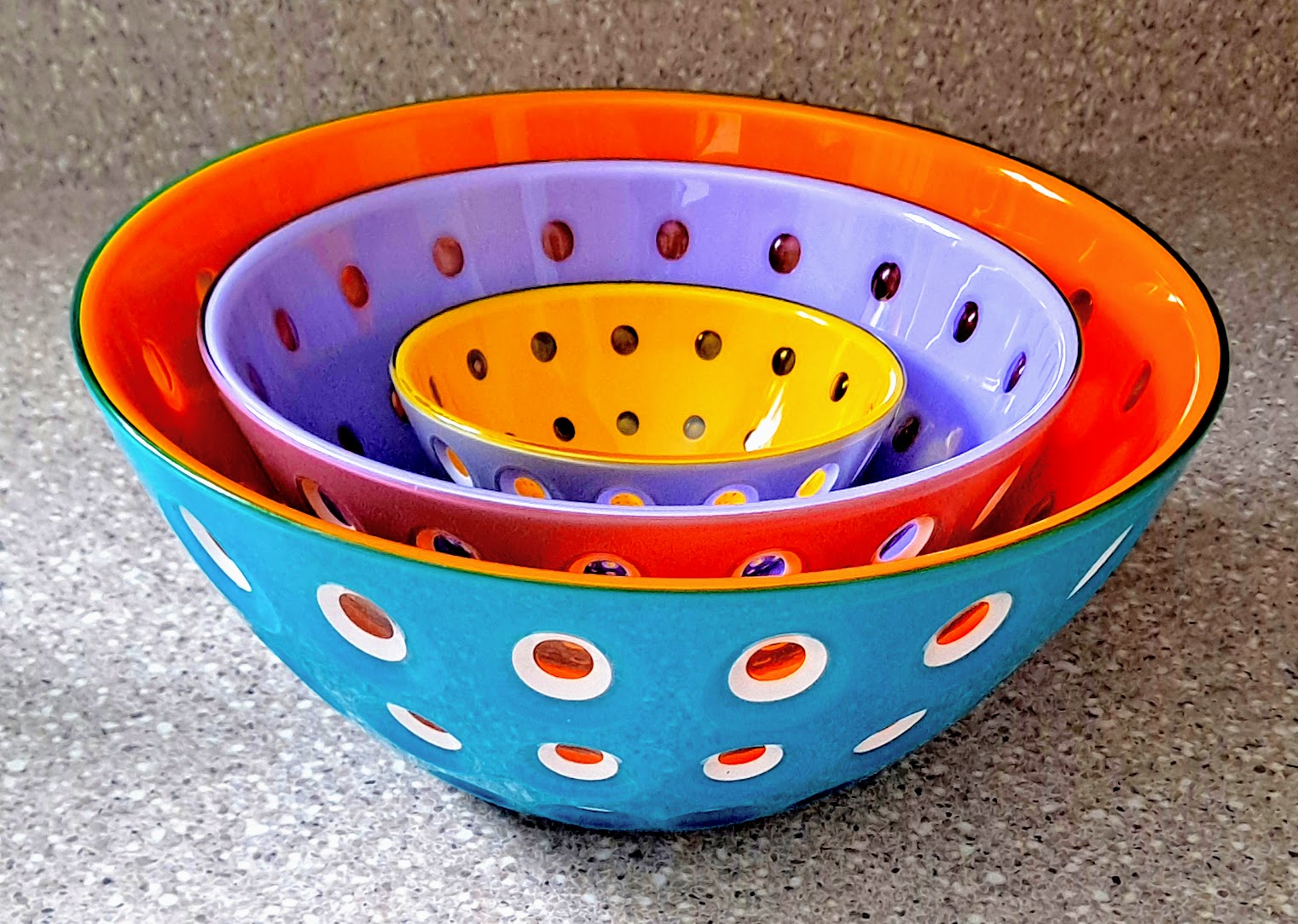
I did get a present from my sister, though, which is very nice. She thought these bowls would make me smile, and they do. The house has yet to let me know what it thinks of our gift.
***

Pat Bertram is the author of Grief: The Inside Story – A Guide to Surviving the Loss of a Loved One. “Grief: The Inside Story is perfect and that is not hyperbole! It is exactly what folk who are grieving need to read.” –Leesa Healy, RN, GDAS GDAT, Emotional/Mental Health Therapist & Educator.












 Bertram's Blog
Stitches of Togetherness
January 30, 2022 — Pat BertramSmall talk — conversation about unimportant or uncontroversial matters — is a staple of my life now. When I visit with friends, we talk about small town life, ourselves, their pets and children and grandchildren, people we know. The only time I have a conversation about something more vital is if I know they more or less feel the same as I do because I simply have no energy to discuss anything anyone feels passionate about. Their passion for their beliefs about the “issues” of the day exhausts me.
For many years, I didn’t engage in small talk. At least not that sort of small talk. Jeff and I talked about everything that was important, both in our lives, in history, in health, in myth, in the world. We generally agreed, and if we didn’t, we’d discuss things, listening to each other without interruption, until we came to a middle ground. Mostly, though, through the decades, we formed our ideas in tandem. These ideas weren’t based on feelings but on in-depth reading (thousands upon thousands of books) on a multitude of subjects, including many things we didn’t necessarily agree with but wanted to know more about.
Then there was the other sort of talking we did. Small talk so small it wasn’t really small talk, more like the stitching that holds two lives together. You know the sort of thing I mean. Things said more or less in passing: “We didn’t get any mail today.” Or “I saw so-and-so today.” Or “They were out of something at the store today.” Or “I’m home!” Nothing of importance beyond the moment.
Several years ago, I wrote that one of the collateral aspects of losing a life mate was having no one to do nothing with. Although Jeff and I worked and played and talked for more than three decades, we often did nothing together. We were just there, a presence in each other’s lives. I’ve found other people to fulfill some of the roles he played in my life, such as someone to do something with, but I have no one to do nothing with.
I’m now realizing it’s the same with talking, and why I so often talk to his photo. I have people to talk with, both small talk and sometimes larger talk, but there’s no one around for the smaller than small talk. If I am sad or lonely, I can call someone, or I can go to the library and chat with the librarians while they check out my books, or I can do any number of things. But there’s no one around for the sub-small talk. I can’t call someone to say, “I didn’t get any mail today.” Just the effort to call would turn the idle comment into something it wasn’t meant to be and would give my not getting mail an importance it didn’t deserve. And yet, a shared life is made up of these passing comments, these “stitches” of togetherness.
Those stitches are another of the many things no one really notices until they are gone. In my case, other things were so much more overwhelming — not just the pain and angst of his being dead, but the silence of my life, the yearning for one more word or smile from him, the lack of someone to do nothing with, the stark aloneness of being alone (it’s completely different having alone times in a shared life than being alone in an unshared life).
When grief started leaving me, I became engrossed in other activities, such as dancing and traveling, moving from place to place and trying to figure out what to do with my life. So many of those activities are no longer a factor. I’ve bought a house and moved to my perhaps final home, so now the subtler and more permanent aspects of living alone after the death of a life mate are making themselves felt.
And apparently, this lack of “stitching” is one of those aspects.
***
Pat Bertram is the author of Grief: The Inside Story – A Guide to Surviving the Loss of a Loved One. “Grief: The Inside Story is perfect and that is not hyperbole! It is exactly what folk who are grieving need to read.” –Leesa Healy, RN, GDAS GDAT, Emotional/Mental Health Therapist & Educator.