Weather and Walking

The good news is that the latest snowstorm didn’t seem to affect my upcoming tulips except perhaps to encourage a few more to break through the ground.

The bad news is . . . well, there really is no bad news. There is bad news elsewhere, of course, but within my personal gated community (i.e., my fenced-in property), all is well

We did have horrific winds yesterday, but the only damage they did was to blow away the petals of the crocuses that had already bloomed. There are a few more crocuses coming up, so any bloom time that was cut short will be more than offset by the new blossoms. Today is a gorgeous day, blue skies, still air, and warming temperatures. By the weekend, it will be astonishingly warm — in the low eighties. Wow! If there are no winds accompanying those glorious temperatures, it should be a good day for walking.

I never used to let weather get in the way of my taking a walk, but I do now, especially when it’s slushy or windy or too hot or too cold. Unfortunately, I also let other things get in the way — work, too much to do, too tired, and all the other things that knock me out of routine. Last summer gardening was the culprit. Any work in the yard had to be done early before the day heated up, and by the time I finished watering and weeding and all the other small tasks necessary to take care of a yard, it was too hot to spend any more time outside, so the walking fell by the wayside. If all that weren’t enough, then there was the whole knee issue that really put the kibosh on walking.

With any luck and my knees willing, this summer I’m hoping to be able to do both the yard work and take a walk, but I seem to have lost the compelling urge to walk once I moved here. (Even when my knees prevented me from walking, I still felt the compulsion, but now I don’t.) So much of the walking I did for more than a decade was grief-induced. Grief seemed to keep me on the move, though I’m not sure why. Perhaps I was trying to run away from grief. Maybe I simply needed to relieve the stress of grief. It could be I needed the Zen of walking to keep me centered. Possibly the training for an epic long hike kept me focused on the future rather than the past. Most probably, it was a bit of all those things. With much of my grief-induced problems resolved, the impetus for walking isn’t there especially since my current walking paths lead me only around town rather than through nature, so now I have to rely on discipline to get me out there, and that is in short supply.

Once I am back in the habit of walking, it won’t be a problem keeping the habit going. Well, it won’t be a problem until the wind rises, slush happens, it gets too hot, my knees go wonky again, or work and chores intervene.

Even today, though I am looking forward to a walk, it’s possible that I will have to go to work instead. In that case, I’ll try again tomorrow, and if that doesn’t work out, then the next day. Or the next one after that.

***

Pat Bertram is the author of Grief: The Inside Story – A Guide to Surviving the Loss of a Loved One. “Grief: The Inside Story is perfect and that is not hyperbole! It is exactly what folk who are grieving need to read.” –Leesa Healy, RN, GDAS GDAT, Emotional/Mental Health Therapist & Educator.

Grief is Universal

I got an email from Germany today from someone I didn’t know. It was written in German, and one of the few words I recognized was “sex,” so I assumed it was some sort of spam. (The subject line in the email was: Trauer, Sex, Hauthunger und Minimierung.) I was scrolling down to find the “unsubscribe” link when I noticed a translation of the email, and realized it actually was a message to me, a response to my blog post: Grief, Sex, Skin Hunger, and Minimization. I wondered how he got my email, but when I checked that blog, there it was, posted for all to see. (It’s actually not an email address; it’s more of a forwarding service that WordPress offers.)

Until I saw my email address in the body of the post, I thought I got his comment via email in error, so I went ahead and posted his comment on the blog. I hope he’s okay with that, because he had done what I asked in the post — added to the discussion about sex and grief. I did respond to his email and told him what I did, so if he wants me to remove the comment, I will.

Two things came to mind when I read his comment.

First, that intense grief over the death of spouse seems to be universal. The lack of information not just about the realities of grief but also the various affects grief has on us and the additional losses (such as the loss of sex and the problem with skin hunger) also seems to be universal. We all tend to suffer in silence, thinking we are the only ones who are dealing with such pain. Although I mostly kept quiet in my offline life, here on this blog, I’ve been anything but silent, which turned out to be a good thing. Now people all over the world know my experience and my belief that grief is hard, grief takes a long time, and grief should not be suffered in silence.

Second, many men don’t remarry and aren’t interested in remarrying, despite the prevalent idea that men who lose a wife immediately remarry, not just to have someone to take care of them, but so they can have sex. Some bereaved men don’t miss sex in general, though they intensely miss sex with their wives. Some men do remarry, but often it’s to have someone to be emotionally intimate with because for many men, their spouse is the only emotional support they have, the only person they feel comfortable hugging or talking about personal issues with.

These are just generalities, of course. Although I have learned that despite the cliché, not everyone’s grief at the loss of a spouse is different from everyone else’s — grief for many of us followed the same pattern and timeline — when it comes to marriage and new relationships, the cliché is true: everyone is different. We will each of us find our way to a new relationship when we feel the need, when the time is right, or when we meet the right person.

In my case, it’s a done deal. I’m okay most of the time with the idea of growing old alone (the idea of it, you understand; not necessarily the reality of it). I certainly don’t want to have to deal with the possibility of caring for someone else in their old age, especially since I’d be old myself. Besides, there’s no room in my house for another person, and I won’t give up my house for anyone. But this sort of life isn’t for everyone, though it is forced on so many of us without our having a choice in the matter.

***

Pat Bertram is the author of Grief: The Inside Story – A Guide to Surviving the Loss of a Loved One. “Grief: The Inside Story is perfect and that is not hyperbole! It is exactly what folk who are grieving need to read.” –Leesa Healy, RN, GDAS GDAT, Emotional/Mental Health Therapist & Educator.
Body Memory

Occasionally during the past few days, I’ve been overcome by a momentary sense of panic and dread, as if I’d forgotten something I was supposed to or as if something terrible was about to happen. It’s not a big deal, more of a frisson than true panic, but I can’t think of anything that is currently happening (or not happening) that would prompt such a feeling.

Although I would have thought I was long past the time of grief-related body memory, this feeling seems like something being resurrected from the past. Twelve years past, to be exact.

At this time twelve years ago, I was dealing with Jeff’s various end of life issues, such as terminal restlessness and confusion. Some people, toward the end, can’t sit still, and so it was for Jeff. Because of the cancer that had spread to his brain as well as the potent pain killers he needed, he was unsteady on his feet, and he tended to fall. So, sleep-deprived me stayed with him all night, pacing with him, getting him to back bed in the hopes he could fall asleep, and then pacing again.

I didn’t talk about any of this back then, at least not here on my blog, because it seemed such a betrayal of him, but after he died, which seemed to me to be the ultimate betrayal, all bets were off, so I wrote about what I felt. Until then, I had hospice to talk to.

Many people are leery of hospice, perhaps confusing them with the Hemlock Society, but I only have good things to say about the hospice in western Colorado. Although they were scheduled to come once a week (we were settling in for the three to six months the doctors said he had left to live), he deteriorated so fast that I called the hospice nurse every day with some issue I had not previously encountered, and she always responded, first by phone, and then with a visit.

During the past twelve years, I hadn’t thought about that time very often — his death and my grief were such traumatic experiences that they overshadowed everything else — but if it hadn’t been for hospice, I have no idea how I would ever have known what to do for him. Would never have known what was happening.

Next week, it will be twelve years since we admitted him to a hospice care facility. Although hospice is mostly an at-home program where they help the family and give them the tools to take care of their loved one, this particular hospice also had a nursing facility to take care of the patient for short stays to give the caregiver a rest. Oddly, although his admittance was for my benefit because it had been many days since I slept more than an hour or two — I’d been staying up all night with him and was totally exhausted — I didn’t sleep any better when he was away, knowing he was with strangers, and he was dying alone. (He didn’t die alone, though. I was with him when he took his last breath.)

There are a lot of things I can barely remember from five and ten years ago, but that whole month from twelve years ago is seared on my brain and in my body, apparently for all time.

Instead of exacerbating my grief (and despite the momentary pangs of panic), these memories today are accompanied by gratitude for the nurse and social worker who helped me through the worst time in my life.

[Hospice helped with my father, too, but by then I knew a lot about dying (from an outsider’s point of view; obviously, I know nothing about dying from the point of view of one who is dying), so although I was grateful for their help, they weren’t quite the angels of mercy that the first hospice people were.]

I wasn’t so far gone in grief after Jeff died that I neglected to thank the women who helped me with Jeff — I did, sincerely — but over the years, I haven’t often thought of that time.

And now, twelve years later, I am remembering with love and gratitude, and also, apparently, with panic and dread, though it seems silly since there is absolutely nothing I can do to change even a moment of the past.

***

Pat Bertram is the author of Grief: The Inside Story – A Guide to Surviving the Loss of a Loved One. “Grief: The Inside Story is perfect and that is not hyperbole! It is exactly what folk who are grieving need to read.” –Leesa Healy, RN, GDAS GDAT, Emotional/Mental Health Therapist & Educator.

Handling the News

For much of human history, news only traveled as fast as a man could run. Later, it traveled only as fast a horse, and later, as humans expanded over the face of the earth, news traveled as fast as the wind via sailing ships.

Now, news is instantaneous. What happens in one part of the world is instantly known, so not only do we have to deal with what we see, hear, feel in our personal space, and deal with what we learn from friends and neighbors about what is going on in our nearby vicinity, we have to deal with crisis all over the world. And if that wasn’t bad enough, we are constantly being inundated with stories of decades-old atrocities, lest we forget.

It makes me wonder how all this affects us. I know how it makes us feel emotionally, and it sometimes even goads us do something, no matter how futile. But for a species that grew up in relatively newsless societies, it can’t be good for us. Even if the news is true, even if the reasons for the news as well as the backstory we are being fed is true, what possible difference can knowing make? Well, the cynical me says that it keeps those of us dealing with collateral damage, such as higher prices, pacified, because no matter how bad it gets here, it’s worse elsewhere.

Still, all day, every day, we are forced to confront and be saddened by events that a couple of hundred years ago we would never have heard of until long after those events were over.

If I sounds uncompassionate, it’s because I have my own mission (not one I chose, but one that was thrust on me because of my grief writing), succoring those reeling from the death of a spouse. Just yesterday, a woman contacted me because so much of what I have written about grief over the loss of someone intrinsic to our lives struck a chord with her. In this case, it was my saying that all grief is not the same because all losses are not the same. She’s been dealing with the typical non-support and dismissiveness we all had to deal with, such as the loss of a spouse being compared to the loss of a pet. (I’m not getting into this discussion again. I know people deal with grief for any number of losses, but the truth is, if a pet dies, it doesn’t leave you with a reduced income and three young children to raise by yourself as well as the loss of your sense of identity, the exile from your coupled friends and dozens of other horrendous changes to your life, any one of which would be occasion for grief.)

If it weren’t for modern means of communication, I wouldn’t hear from these grieving people, but I do. And it’s personal because they contact me specifically. Is their sorrow any worse than the sorrow of someone interviewed on television? Truthfully, I don’t know. As with much of life, I have no answers, just one heck of a lot of questions.

Still, I can’t help but wonder if we’re equipped to handle all the news that’s being fed to us.

***

Pat Bertram is the author of Grief: The Inside Story – A Guide to Surviving the Loss of a Loved One. “Grief: The Inside Story is perfect and that is not hyperbole! It is exactly what folk who are grieving need to read.” –Leesa Healy, RN, GDAS GDAT, Emotional/Mental Health Therapist & Educator.

Hard Things Are Hard

I came across this saying the other day: Hard things are hard. At first thought, the adage seemed redundant (as so many sayings do), but on second thought seemed right on the mark. This reminder about hard things being hard is particularly relevant when it comes to grief since many people who are in pain after the death of a loved one come to me searching for quick and easy ways to go through grief. I keep reminding people that grief is hard. And it is. There is no easy way to get through grief because hard things, like grief, are simply hard and there is no way around it.

There are some ways you can deal with intense grief to help get you through the first soul-searing minutes, hours, days — cry, scream, pound a pillow — but these things only relieve the stress of grief. (The death of a child or a spouse is the most stressful life experience, and the stress is one of the reasons that grievers have a 25% greater chance of dying from all causes than non-grievers.) They don’t relieve grief because no matter what you do, your loved one is still gone.

As grief continues, as it does, there are other things a person can do in addition to crying and screaming such as walking or attending a grief support group or saying “Yes.” Too often grievers refuse all invitations because it simply is too painful to be around people. For those who lost a spouse, it is especially painful to be around those who are still happily married. Yet if you get in the habit of saying no, the invitations stop. Chances are, some invitations would stop anyway, like those from other couples — not only do they not want to be reminded that what happened to you can happen to them, but they feel as if the situation will be too uncomfortable for everyone. It’s not a particularly nice reaction to someone else’s grief, but it is, unfortunately, a very human reaction.

Mostly, though, there’s nothing you can do but the hard thing — feel your grief. As painful as it is, grief is a process, a means of moving you from your shared life to a new life. When your life has been entwined with someone else’s, it takes time to unbraid that life and create something new. All that work is painful because although it is necessary, it is not something you want to do. It’s not something you think you can do. And yet, you do it without even knowing you are doing it.

If it were simply an emotional process, grief would be hard enough, but it’s also a physical process, a physical response to a perceived danger. You might lose your grip, your appetite, your health. Your body is flooded with adrenaline and other hormones in an effort to get you to fight or flee from the untenable situation. Brain chemistry goes haywire. You feel as if you are in a fog, numb, and totally overwhelmed because your brain simply doesn’t work. Your brain is on overload, trying to understand something that cannot be understood. So many things go wrong, making you wonder if you’re crazy, but you’re not crazy. You’re grieving. And it’s hard.

Hard things are hard. Sad to say, but really is that simple.

***

Pat Bertram is the author of Grief: The Inside Story – A Guide to Surviving the Loss of a Loved One. “Grief: The Inside Story is perfect and that is not hyperbole! It is exactly what folk who are grieving need to read.” –Leesa Healy, RN, GDAS GDAT, Emotional/Mental Health Therapist & Educator.

Upcoming House Anniversary

One week from today will be the third anniversary of “wedding” my house. It seems a weird way of describing the purchase, but the house offers me much that has been missing from my life since Jeff’s death — stability, a home, comfort. It also offers safety and security, at least as much as is possible in turbulent times. Of course, it can’t offer companionship or conversation or love, though it does give me something to love and care for, which is important when one is alone and hasn’t any inclination for pets.

Because of this upcoming anniversary, I feel as if I should get the house a gift, though the house is spoiled enough as it is, with all the money I’ve lavished on it — not just a new foundation for the porch, but a basement floor, landscaping, sod, a garage, and a whole slew of minor gifts.

Still, if I think of something, I might consider getting something to honor the occasion.

The traditional third anniversary gift is leather, though there isn’t anything of leather my house and I need. Come to think of it, I can’t even remember the last leather thing I bought. I doubt there is even a single strip of leather on my shoes.

The modern third anniversary gift is glass, but even though I do have and do use things of glass, I don’t need anything beyond what I have. I wouldn’t mind another goblet to add to my collection of miscellaneous goblets, but there isn’t room in the cabinet, and besides, I seldom use stemware. My water receptacle of choice is an old glass peanut butter jar because I can put a lid on it to keep from spilling and to keep bugs out in the summer. (Too many times at night I’d reach over for the glass of water on my bedside table and miss. By the time I got out of bed and cleaned the mess, that would be the end of any chance of sleep. Even worse are the times I accidentally drank a bug a night. Eek.)

In the end, I doubt I’ll get anything to mark the occasion. After all, I celebrate this wonderful house and home every day.

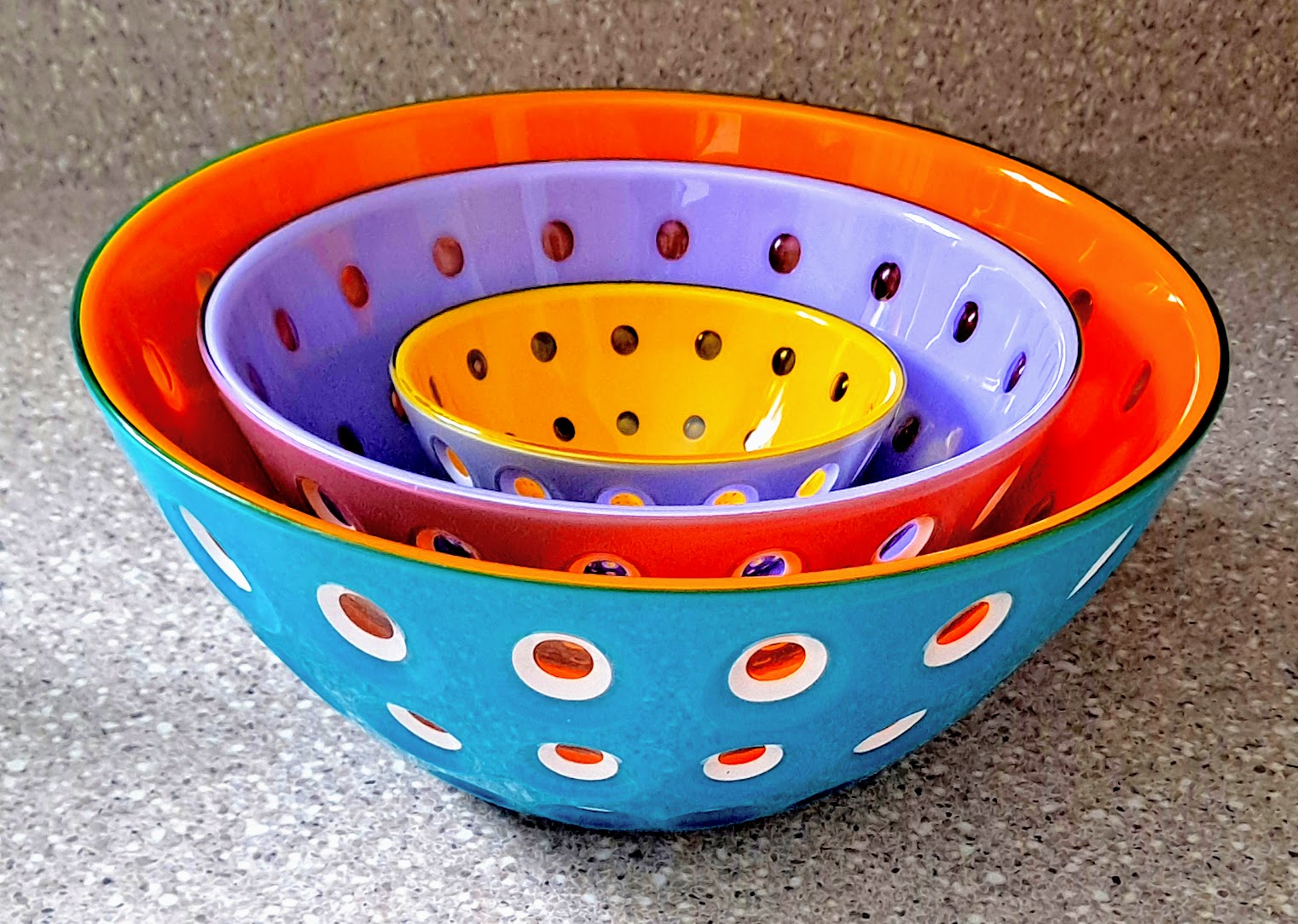
I did get a present from my sister, though, which is very nice. She thought these bowls would make me smile, and they do. The house has yet to let me know what it thinks of our gift.

***

Pat Bertram is the author of Grief: The Inside Story – A Guide to Surviving the Loss of a Loved One. “Grief: The Inside Story is perfect and that is not hyperbole! It is exactly what folk who are grieving need to read.” –Leesa Healy, RN, GDAS GDAT, Emotional/Mental Health Therapist & Educator.

An Itch to Camp

I just finished a book where the characters went camping in the mountains, and it made me itch to go camping again. The fact that the campers in the novel ended up dead or maimed didn’t affect that yearning, and maybe even made it stronger for some perverse reason — perhaps for the feeling of putting in a total effort, pitting oneself against nature. Chances of my ending up with a wilderness guide who is also a serial killer like the characters in the book aren’t that great especially since I never used a guide on any of my treks, and probably never would.

The book I am reading now takes place not far from the Organ Pipe Cactus National Monument, which is intensifying the camping itch. I so enjoyed that area that it was one of the few places where I extended my stay. Not only did it feel as if I were living in a southwestern botanical garden, but I met some interesting people. One woman, who was the age I am now, more or less stayed there all winter, even though there is a limit to how long you can stay at one time. The people running the place let her stay because the place wasn’t packed, and because of her financial situation, I think. She camped out for long periods of time because she was alone and her teacher’s pension didn’t afford her enough money to live otherwise. I often thought I would do what she did, and in fact I’d planned on it, figuring I would go north in the summer and south in the winter, but fate intervened and I ended up with a permanent place to stay.

Despite the itch, I will probably never go camping again, though “never” is a long time. For now, I’m still enamored of my house, and don’t particularly want to spend a night away (I’d worry more about the house than my own safety, which seems a recipe for disaster). But as time goes on, and the feeling of newness wanes while the feeling that the house will still be safe waxes, I might head for the hills.

Although I stopped at many campgrounds on the cross-country trip I took several years ago, I didn’t visit any of the most prominent national parks, such as Yellowstone and the Grand Canyon. And while I took several trips back to Colorado when I was away, I didn’t camp out here either. So there are a lot of unlived adventures if I ever want to answer the itch.

Apparently, despite my saying “never” to camping, I haven’t totally given up the idea since I’ve kept all my camping gear — all the big and heavy stuff for campground camping and all the super lightweight stuff for backpacking.

It’s funny, though, how different things are when you are leading an intermittent nomadic life (periods of staying in one place punctuated by periods of being on the move). I was able to take chances back then because I was still under the influence of grief and felt I had nothing to lose, so any worry about driving a car that’s a half century old into remote areas was shoved to the back of my mind. Now that particular worry doesn’t want to be shoved. And rightly so, perhaps.

But who knows. I might be considered elderly (statistically speaking), but I’m still a young elderly and haven’t yet reached my dotage, so many things are still possible. Perhaps even camping.

***

Pat Bertram is the author of intriguing fiction and insightful works of grief.

Making an Effort

Valentine’s Day is a difficult day for people who are alone, especially those who are alone because of the death of their beloved.

For many who are left behind, it’s generally hard seeing couples you used to hang out with, doing things, making plans. It’s even harder when they tell you about it, with no regard for how it makes you feel. (It makes you sad, then mad, then sad again.) It’s hardest of all on Valentine’s Day, especially for the romantics who made a big deal about the day.

Jeff and I did not celebrate the day, which makes this no different from any other day for me, but it’s still, it’s hard to ignore this celebration of couplehood. So this year, I didn’t ignore it. I made heart cookies. I was going to pass them out to everyone I know, but making these embossed and painted cookies is a huge undertaking. Since I greatly underestimated how long it would take and the effort I would need to expend, I was only able to make a few. I reserved them for the woman I work for and another one or two people who are alone today. (Including me. Though I generally don’t eat cookies, I figured since I was one of those who are alone today, I might as well indulge.)

Making the cookies for some reason made the day seem more like Valentine’s Day when I was very young, where all the kids in my class brough valentines for one another. The valentines and the sentiment didn’t really mean anything back then. It wasn’t even something just between friends. It was mostly a break in the routine, something fun to do.

And so it was this year. Making these cookies was simply a break in my routine, something fun to do. Besides, I had a heart-shaped cookie cutter that had never been used, and what better day to use it than today?

Next year, perhaps, I’ll get started early and make enough to spread around a bit more, but for this year, it was enough — enough for me, I mean — to make an effort.

***

Pat Bertram is the author of Grief: The Inside Story – A Guide to Surviving the Loss of a Loved One. “Grief: The Inside Story is perfect and that is not hyperbole! It is exactly what folk who are grieving need to read.” –Leesa Healy, RN, GDAS GDAT, Emotional/Mental Health Therapist & Educator.

The Thing About Time

The anniversary of buying my house is coming up next month. It’s all still so fresh to me — the surprise and amazement, the joy far outweighing the frustrations — that it seems inconceivable I’ve been here three years. The time simply slipped through my fingers, three years gone in a flash.

During my first years of grief, time seemed to pass slowly, probably because I was grasping onto time itself, counting down the minutes, the hours, the days, as if time were a lifeline keeping me from falling into the black hole of agony and angst. But even those years passed, and the twelfth anniversary of Jeff’s death will also be coming up next month.

It is interesting to me that the anniversaries of these two life-changing events — Jeff’s death and the buying of my house — occur in the same month. The dates are three weeks apart, so my celebrating the house won’t bleed over into my honoring his life, though it wouldn’t make any difference if it did. Next month won’t be the emotional roller coaster it might appear to be, with the happy anniversary coming up at the beginning of the month and the sad one at the end because time tends to even things out. The highs get eroded and the lows gradually get filled, perhaps with the sediment of the erosion.

Also, although on the face of it, the two events don’t have anything in common, they are inextricably entwined in my mind because of the enigma — if Jeff hadn’t died, I wouldn’t be here. I couldn’t have one without the other. I sometimes wander around the house, wondering how he would fit into my life and my house, and I can’t see it.

But it doesn’t matter. It can’t matter. He’s gone. He will never have to fit himself into my current life. It is confusing, nonetheless.

Still, time passes, and there will come a time I will never even think of trying to fit him into my life. I might even break my relatively new habit of talking to his photo. (In fact, that would probably be a good idea. It reminds me . . . again . . . that he is gone and that any sense of connection is just an illusion, which makes me feel alone. And sad.)

It’s funny to me that my car’s fiftieth birthday passed without my remembering. You’d think that would be a significant date, considering that the car has been with me most of my life and has outlasted almost all relationships, but apparently not since I lost track of the days. It’s possible, with enough time, Jeff’s date will also pass unrecognized, not that I would forget him, but that I would lose track of the days. And the same goes for my house.

That’s the thing about time. It passes, and with its passing, all things pass, too.

***

Pat Bertram is the author of Grief: The Inside Story – A Guide to Surviving the Loss of a Loved One. “Grief: The Inside Story is perfect and that is not hyperbole! It is exactly what folk who are grieving need to read.” –Leesa Healy, RN, GDAS GDAT, Emotional/Mental Health Therapist & Educator.
Things I Don’t Want to Write About

I’m sitting here mentally sifting through possible blog topics to expound on for today’s posts, but there’s so much I don’t want to write about, I’ve already written about, or don’t know enough to write about and don’t care to delve deeper into the matter.

I don’t want to write about is the advertisement that appears on top of the page when I have opened a document in Word. I bought the program, so I shouldn’t have to deal with further encroachments from Microsoft, but as discreet as the ad is, it still appears and there’s nothing much I can do about it. Well, I can click on the X to remove it, but it appears again the next time I open Word. So, there’s no real point in talking about something I have no control over.

I also don’t want to write about the “nothings” that are exchanged with a spouse. I had lunch with a friend yesterday (she brought a picnic to my house, which was a real treat) and we got to talking about all the nothings we say to a spouse in passing. Her example was walking by her husband when he was watching the news, catching what someone was saying, and commenting, “Oh, she’s such a liar,” as she passed on by. These nothings aren’t anything you can really call and talk to a friend about when you live alone because then the nothings become a something. You’d have to explain the situation, explain why you think the person is a liar, explain why you’re telling your friend, and a passing comment becomes a huge discussion that quickly gets out of control. It’s an interesting topic, these nothings, but I’ve already written about it, already written about talking to the photo of Jeff, just asides — the nothings — as I make the bed when I get up in the morning or unmake it when I get ready for bed at night.

I still don’t want to write about The Bob. Despite everyone thinking they know what is going on because of whatever “research” they have done, so often the research is at odds with what people experience. I know people who got the jab and then died of The Bob, but that sort of thing is shoved under the carpet because it doesn’t fit the narrative. I suppose The Bob has been around long enough that the truth might be out there somewhere, but this is an example of something I don’t care to delve deeper into. Nor does it matter. Whatever truth I would find (assuming there is such a thing) wouldn’t change anything, and since it wouldn’t make any difference, I just let it go.

Something else I really don’t want to write about, at least not in a whole post, are all the death dates in my head. Or that were in my head. A couple of blog readers are coming up on the anniversary of their spouse’s deaths, and I remember the dates, but soon those dates will be gone from my memory, which is good. Otherwise, practically every single day I’d be reminded of someone who lost a child or a spouse, and it’s too much for one person to handle. It’s enough for me to remember my own dates (Jeff, parents, brothers) without heaping other people’s sorrow on top of my own. Though, to be honest, I do remember everyone I’ve spoken or written to about their grief over the death of their loved one, just not the exact day of their loss.

Well, what do you know! It turns out that I ended up writing about all the things I didn’t want to write about after all. Just goes to show . . . hmm. I don’t know what it shows other than that I have something to post for today’s blog.

***

Pat Bertram is the author of intriguing fiction and insightful works of grief.