An Emotionally Neutral Day

I’m sitting here with a blank “page” in front of me, doing my daily mental scrounge for a blog topic. A reader wants me to write about Grief and Peace, and I will because it’s a great topic, but I need to put it off for a while. Although I’ve been fine during the day, I felt a bit sad the past couple of nights. I’m feeling emotionally neutral at the moment, and I want to keep it that way, so I’m staying away from blogs and books that might turn what was a tiny dent of sadness into a sinkhole of despondency.

For most of my life, I read a book a day. The only vacation from reading I ever took were six or seven years after Jeff died. I started out reading as always, but every book I read set me off on a crying jag. Either a couple got together, which made me sad because Jeff and I were no longer together. Or the couple didn’t get together, which made me sad since Jeff and I were no longer together. Or people died. Whatever happened in a novel — be it gruesome or horrifying, mysterious or charming — set me off, so I stopped reading fiction and didn’t start again until I was housebound after I destroyed my wrist, arm, and elbow. (Which, incidentally, are doing well. Although there is some pain that could be the beginning of the post traumatic arthritis the surgeon promised me, I have full mobility of the wrist though he said I never would. But that was before he understood I would do the exercises he gave me. It shocked him, I think, because he told me almost no one ever did what he asked them to do.)

I am back to reading a book a day, but occasionally one of those endings — togetherness, apartness, or death — get to me. This time it was the togetherness, and I felt sorry for myself at being alone. Not that I mind. I generally prefer being by myself, but sometimes . . . sometimes it does get to me.

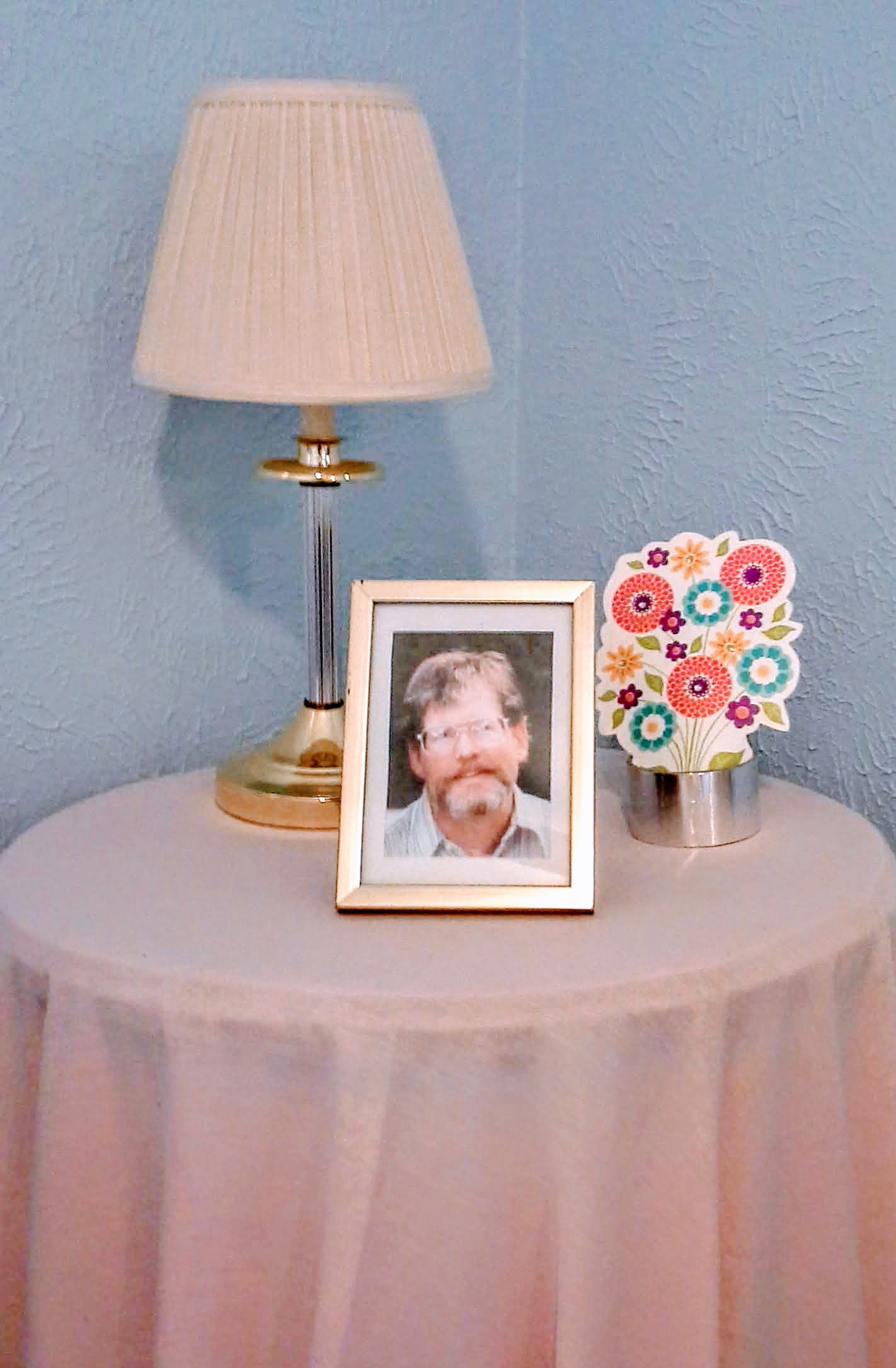
It’s not that I want a relationship. I don’t. And I certainly wouldn’t know what to do with a relationship if one came my way. It’s more that the relationship I did have has become nothing more than me talking to photograph.

I’m over that sad spell, probably because I talked it out. (Jeff was always a good listener, but he seems to be even more so now.) To be on the safe side, I made sure all the books I got from the library yesterday were emotionally neutral mysteries or thrillers. (Emotionally neutral because none of those authors ever make me care about their characters.) I’m also writing an emotionally neutral blog today and will save the Grief and Peace piece for another day.

Speaking of going to the library: a couple of times I left without getting a slip that tells me the due date, and both of those times, something happened so that I had to contact the library to make sure everything was okay. The librarian and I joked about that yesterday, and guess what? I left without getting a due date receipt. I sure hope that doesn’t mean there will be a problem because that would sure put a dent in my emotionally neutral day.

One thing did happen that tipped the neutrality a bit — I harvested a few cherry tomatoes! Delicious.

***

Pat Bertram is the author of Grief: The Inside Story – A Guide to Surviving the Loss of a Loved One. “Grief: The Inside Story is perfect and that is not hyperbole! It is exactly what folk who are grieving need to read.” –Leesa Healy, RN, GDAS GDAT, Emotional/Mental Health Therapist & Educator

The Quiet After the Questioning

As I talked to Jeff when I was getting ready for bed the other night, it suddenly dawned on me that I no longer asked myself — or him — the hard questions, or any questions at all, for that matter. It could be a good thing, perhaps a sign that I have reached an accommodation with life and death. It might be a not-so-good thing, possibly resignation or stagnation or exhaustion from trying to make sense of it all. Or it could be something else, neither good nor bad, maybe just letting my mind filter out the unanswerable questions. Most probably, it’s simply an acceptance that so much of what we want to know is unknowable.

But oh, at the beginning of my grief, there were way too many questions. Those questions kept my brain so busy trying to come up with solutions, that I often felt muddled and unreal.

Even years after his death, I was haunted by the hard questions. You know the ones: Who are we? Why are here? Is this all there is? Where did our loved ones go? Will we see them again? What is the meaning of life? And probably the most haunting of all, what is the meaning of death?

It wasn’t only grief that brought out these questions. When I was young, I’d often pondered such questions during my quest for truth and a greater reality, and I’d come to believe that God is the spirit of creativity that fuels the universe, and we are each a part of that creativity. For most of my adult life, I was content believing that our spirit/energy returned to the whole . . . until Jeff died. Then all of a sudden, I didn’t want that to be the truth. I wanted him to continue existing as him, as the man he was, not as part of an amorphous energy source.

And so the questions pounded at me. Not just the hard questions I mentioned, but others, too, such as: was it fate that we met, fate that he died? If he’s in a better place, why aren’t I there? If life is a gift, why was it taken from him? Is he proud of the woman I’ve become? Would he still like me if we were to meet?

It seems as if all I had were questions, but now? The questions, although they remain unanswered, don’t haunt me, at least not at the moment. The main effect of this silence is . . . well, silence. And the main effect of that mental silence is a struggle for blog topics.

For a while, I was invested in trying to come up with answers as to what this “Bob” situation is all about, but eventually I realized that with most of the questions I’ve asked over the years, there is no real answer, just a lot of speculation, and eventually, speculation loses its luster.

I must admit, I do enjoy not having my brain roiling with unanswerable questions.

Luckily, I still manage to find something to blog about. Luckily for me, that is, though perhaps not for you.

***

Pat Bertram is the author of Grief: The Inside Story – A Guide to Surviving the Loss of a Loved One. “Grief: The Inside Story is perfect and that is not hyperbole! It is exactly what folk who are grieving need to read.” –Leesa Healy, RN, GDAS GDAT, Emotional/Mental Health Therapist & Educator

Nothing is Something

In a book I just finished reading, a kid insisted that nothing was something. The comment was irrelevant to the story; it was just one of those things authors throw in there because they can. My mind did not skim over the idea as it normally would have, nor did it start philosophizing about somethings and nothings. Instead, my mind immediately shifted to thoughts of the “nothing” that is left behind after someone intrinsic to our life dies. That void inside us — that nothing — is definitely a something. We feel it in the very depths of our being long after the loved one leaves us.

The definition of “nothing” is “the absence of a something or particular thing that one might expect or desire to be present.” And boy, do we desire the presence of our loved one. We also expect them to be present. For years, every time I answered the phone, I expected it to be him telling me I could come home. I knew it was impossible, and of course, that expectation came to naught.

That expectation as well as the great yearning that so consumed me during the first years of grief are finally gone, replaced by . . . I’m not sure what, exactly. It’s not really nostalgia, more like a restructuring of his absence. Instead of yearning for him, I talk casually to him. Or rather, I talk to his picture. The photo — the same one I could not look at for years after he died because it brought me great pain — sits on the bedside table on the opposite side of where I sleep. I’ve gotten into the habit recently of telling him I miss him, talking about my day, and asking him about what’s going on with him. This is a very short conversation, mostly just a few sentences on my part as I get ready for bed, and none on his part. Though to be honest, if that photo ever answered me, I’d be scared out of whatever wits I have.

Despite this new, rather pleasant permutation of my grief, I can still feel the void he left behind as a physical thing. I shouldn’t be able to feel that — right? — because after all, a void by definition is an empty space. And yet, there it is, an emptiness, a nothingness that seems to color my life, just as his somethingness once colored it.

And, after more than eleven years of his being gone, it’s beginning to look as if that nothing/something inside me will be a permanent fixture for the rest of my life.

***

Pat Bertram is the author of Grief: The Inside Story – A Guide to Surviving the Loss of a Loved One. “Grief: The Inside Story is perfect and that is not hyperbole! It is exactly what folk who are grieving need to read.” –Leesa Healy, RN, GDAS GDAT, Emotional/Mental Health Therapist & Educator

Widow’s Brain

A friend whose husband recently died mentioned, quite frantically, that she isn’t able to think or keep any thoughts in her head anymore. Although she worried that such a state was abnormal, which it normally would be, it is perfectly normal for a new widow or widower. During that first year of grief and sometimes beyond, almost all of us have to deal with some sort of mental fogginess. This state is more commonly known as “widow’s brain,” and though I used the term in the title of this blog, I generally refrain from the term because men also suffer from this condition.

As bad as the shock and pain and fogginess are that first year, they do seem to offer some sort of protection. Although we know the deceased loved one is gone, we don’t KNOW it, don’t really want to know it. We feel their goneness, of course, in the very depths of our being, but one part of us holds out hope that, as impossible as it may be, the whole thing is a test. When we get through that first year, all will be well. Then, of course, dawns the 366thday, and we are faced with the unpalatable and undeniable truth that their being dead is no test, no mirage created out of a foggy brain, but the reality of our situation. Because of this raw realization, sometimes the second year is worse than the first. It was for me, and it was for many widows and widowers I know.

Although the friend didn’t ask for my advice, I still suggested that she be patient with herself and not make any important decisions without thinking and thinking again. Very few people understand the reality of this brain fog —the grief-induced amnesia, dazedness, and fogginess that shroud us after the death of a life mate — but it is a real condition. And we need to protect ourselves from ourselves as best as we can.

As I wrote in Grief: The Inside Story — A Guide to Surviving the Loss of a Loved One:

The whole brain is involved in the grief process, but the prefrontal cortex is the part of the brain that seems to contribute the most to brain fog. The prefrontal cortex is considered the executive branch of the brain and is associated with rational thinking and making sense of emotions, developing and pursuing goals as well as coordinating the brain’s activities. Because we grievers are on total emotional overload, our prefrontal cortex is unable to process all the information it is being fed from all parts of the brain. The more we try to suppress our emotions and try to think our way out of grief, the more overloaded the brain becomes.

Although short-term memory loss, inability to concentrate, missing memories and memory gaps are common, they all add to the general chaos and stress of grief, and make us feel as if we are crazy. Or worse. Denise, a Facebook friend, said she felt like she had a traumatic brain injury after the sudden death of her husband. But we are not crazy. We did suffer a traumatic brain injury of sorts when we lost the person fundamental to our lives, and now we are overwhelmed by the shock and horror and stress of that loss.

Although this fog numbs us to protect our hearts and bodies from the worst effects of losing our life mates, it can be a financially damaging condition.

Three finance professors from major business schools investigated Danish CEOs who lost someone significant in their lives, and they found that family deaths were strongly correlated with declines in firm operating profitability.

So yes, the newly bereaved need to be cognizant of brain fog, widow’s brain, whatever one calls the state, be patient with themselves, and be aware of the possibility of making disastrous decisions.

***

Pat Bertram is the author of Grief: The Inside Story – A Guide to Surviving the Loss of a Loved One. “Grief: The Inside Story is perfect and that is not hyperbole! It is exactly what folk who are grieving need to read.” –Leesa Healy, RN, GDAS GDAT, Emotional/Mental Health Therapist & Educator

Grief and Medication

I generally stay away from talking about medication when it comes to grief because it is a sensitive — and personal — topic. I have a firm belief that grief is not a medical condition that needs to or can be treated by drugs, and though this belief extends only to myself and not to others, I worry that my talking about the subject will make people think I am being judgmental of those who need medical help, and I am not. We all deal with grief the best we can, however we can.

Still, medication is a topic that needs to be addressed because many people don’t realize there is an alternative. Not an alternative to the pain, of course, because that comes with the territory of grief, but an alternative to drugs.

Learning the truth about grief — that we are not crazy; that no matter what we are feeling, it’s natural; that others have felt what we have felt; that grief, no matter how painful, is a process that will help us become a person who can survive the loss — goes a long way to weaning ourselves from a dependency on drugs.

Alice, an older woman I met in an online grief forum, took anti-depressants after the death of her husband because she thought her emotions, the physical reactions, the endless tears were abnormal, and no one told her otherwise. What she really wanted and needed was the reassurance that her grief was a normal reaction to an abnormal situation. We expect to be able to slide comfortably into old age with that one person we love more than anything, and when that person dies, excruciating pain and angst are normal reactions.

There’s no way we can learn about the normality of such grief except from people like me who are willing to talk about their experiences because the medical establishment has decided that anything but a mild grief is an abnormal condition, and the things we see in movies (and don’t see) seem to agree with that opinion. How many movies have you seen where a woman (always a woman!) is told about the death of her husband, and when she starts crying and screaming, a doctor is there to jam a hypodermic into her arm? A lot. On the other hand, the complex and painful experience of grief for a spouse is not something we see on television shows, in movies, or read about in novels. Fictional folks (when they are not being drugged into oblivion) shed a fictional tear or two, perhaps go on a fictional spree of vengeance, then continue with their fictional lives unchanged.

It seems as if this current reliance on drugs to “treat” grief is more about hiding than helping. In today’s world, grief needs to be hidden almost from the beginning so that it doesn’t offend other people’s sensibilities, so that it doesn’t bring the specter of negativity into other people’s lives. Drugs also hide your grief from yourself so you don’t have to face the raw reality of death. Drugs are good for that. They can hide your grief to a certain extent, but that’s all they can do. They cannot bring the deceased loved one back.

Some people do need medical help, of course, and they should get it. As Leesa Healy (RN, Emotional/Mental Health Therapist & Educator) wrote: “There are absolutely times when a therapist is required to nudge a person from being stuck, but the fact of the matter is that psychiatry since 2000 has become completely dependent upon what I call the drug/work model . . . i.e. create a diagnosis . . . create a drug . . . back to work for you. At least this is true in Australia and yes I’m qualified to say so (in case anyone wonders). Western psychiatry is leading us down a road of becoming the living dead and the risk is many folk are walking this journey willingly, unaware of the consequences so focused are they on the short-term fix. And who can blame them. It is not only our habit to avoid pain, but also, the very structure of any capitalist society is allowing us less and less time to be ‘truly human’.”

There were times I wanted the pain of being “truly human” gone since my grief was almost more than I could handle, but I wanted even more to feel sorrow that Jeff was dead. Well, actually what I wanted was him here, alive and healthy, but since I couldn’t have what I really wanted, I owed him my sorrow. I owed “us” my sorrow. He deserved to have someone grieve for him, to have someone feel the imbalance of the world without him in it. For me to have gone seamlessly from a shared life to a solitary life without a backward glance or a tinge of pain would have dishonored him. To not feel at all would have been way more of a medical problem than feeling too much.

Although medicine and psychology are the branches of science that have taken charge of grief and how it is described and understood, an anthropological approach — listening and observing — better captures the truth of the situation. Anthropology is the science that deals with the origins, biological characteristics, and social customs and beliefs of humankind, all of which pertain to grief. Few people listen to us bereaved; instead, they try to tell us how we feel. That is why support groups work. If the medical and scientific establishment won’t listen to us, we need to listen to each other, to observe how others are dealing with their grief, to talk about our own situation.

That’s the approach I took — listening, talking, writing, explaining what I learned about grief. I also walked. I was too restless to do much else (except cry) and as it turns out, walking is a good way to deal with grief, not just because of the sedative nature of walking but because it quiets the brain and lets the brain do the work of grief. When we’ve lost a person intrinsic to our lives, our brain goes into overdrive. So much of daily life is habit, and when that habit is suddenly disrupted, the brain tries desperately to identify new patterns and to find alternatives. Adding to the overdrive (and to the brain fog that is normal the first year of grief) is our need, however futile, to try to think our way out of grief. Walking helps put the brain back in its default mode — stream of consciousness. By simply feeling and not trying to make sense of grief, by letting thoughts drift through without trying to catch hold of any one of them, we can rest our brain and perhaps even open ourselves to new insights.

Not everyone is able to deal with grief in its raw state; in fact, many people are so traumatized they need extra help. As always, my mission, to the extent I have a mission, is to help people understand the nature of grief so they can deal with that cold, lonely road as best as they can — with or without medication.

***

Pat Bertram is the author of Grief: The Inside Story – A Guide to Surviving the Loss of a Loved One. “Grief: The Inside Story is perfect and that is not hyperbole! It is exactly what folk who are grieving need to read.” –Leesa Healy, RN, GDAS GDAT, Emotional/Mental Health Therapist & Educator

Getting Over Grief

People often ask me how to get over grief, but the truth is (despite the title of this piece), we never get over grief for the simple reason that the person being mourned is gone for the rest of our life on Earth. Still, over time, the focus does change from the past and from our lost love to the future and perhaps a new love.

At the beginning, our focus — when it’s not on what we have lost — is about breathing. Taking one breath after another. Generally, breathing is simple. It’s something we do without thinking. But after the death of a person intrinsic to our life, such as a spouse or soul mate, it’s as if they took our breath with them when they left us, and breathing becomes something we need to focus on. A breath in, a breath out. Such a painful thing, those breaths! Adding to the complication is that so often we don’t want to breathe. We’d just as soon it was all over for us, too, and yet, we are compelled to continue taking those breaths.

As the years pass and the pain begins to subside, we hold on even tighter to our pain because grief is all that connects us to our lost love. During all those months and years, grief does its job, changing us into a person who can survive without the person we most loved. And gradually, a new love creeps into our life. Actually, I should say, a new focus comes into our life. Whatever it is that we find to focus on, it’s compelling enough to take our mind off our pain and sorrow and loneliness for a short time. And over the next months and years, all those “short times” add up. New memories are made. The past lessens its demands. The future becomes more compelling. And life goes on.

This new love or focus doesn’t have to be a person. It can be almost anything. Visiting museums. Hiking. Planning epic adventures. Yoga. Dance classes. Traveling. A new home. Gardening. For me, it was all of those things.

I tried so many things at the beginning. I wrote about my grief. I walked for hours. I visited museums. I went on day trips with people from my grief group. I took yoga classes. Sometimes, I could forget myself and my pain for minutes at a time, but nothing held. When the moment passed, I was right back where I started, in full grief mode.

It wasn’t until I started learning to dance that the focus lasted more than the moment. I started thinking about dancing, started practicing at home. Although grief didn’t leave me alone for long, it did start to lose its intense hold on me, and I could finally focus on something other than my loss and my pain.

As grief further eased its grip on me and I could sometimes imagine a future, I dreamed of — and planned — epic adventures. I was going to visit independent bookstores all over the country to see if they would sell my books. I was going to walk up the coast to Seattle. I was going to hike the Pacific Crest Trail. I was going to take a freighter to New Zealand. I was going to go on a year-long camping trip. I was going to drive cross-country in my vintage VW. I still have the research I did for all these adventures, but in the end, the only one I followed through with was my 12,500 cross-country road trip as well as a north/south trip along the western coast and several trips from California to Colorado.

A couple of years ago, I changed my focus yet again when I bought a house and found a place to call home.

And now, what I find compelling enough to propel me into the future is gardening.

I’m far enough away from my focus on grief that I seldom get snapped back to those early months, but for the first seven years, no matter how compelling my current focus was, I often found myself blindsided by grief.

I’m not sure how a person goes about finding a new focus. I tend to think that when a griever is ready, a new focus — a new love — appears, rather than needing to search for it, but however it happens, the readiness and the new focus are part of this process of change we call grief.

***

Pat Bertram is the author of Grief: The Inside Story – A Guide to Surviving the Loss of a Loved One. “Grief: The Inside Story is perfect and that is not hyperbole! It is exactly what folk who are grieving need to read.” –Leesa Healy, RN, GDAS GDAT, Emotional/Mental Health Therapist & Educator

Doing the Best We Can

Yesterday was the third anniversary of my older brother’s death. He’d been homeless, possibly bipolar, and driven by rage. As another sibling said, “I will probably always be tormented by thoughts of the torture his demons inflicted upon him.”

We are a myth-making species, and the myth another sibling has adopted is that our homeless brother took upon himself the demons that haunted our family so the rest of us could be free. It’s a pretty myth that allows her to make sense of his life, and for all I know, it could be true, but I can’t shrug off his problems that easily.

My brother hated Jeff, partly, I think, because my brother felt abandoned when he discovered he and I weren’t in the same boat — loners with never a chance at a real relationship. He also felt he should be the one to look after me, though he couldn’t even look after himself.

Back when his problems started showing up, no one even considered the possibility of mental illness; they just thought he was a troublemaker. He and my father were so much alike. They both thought they knew the right of things, and they often fought. For most of my life, they used me as the rope in their game of tug-of-war, and I wasn’t smart enough or hard enough to discover a way out. I remember as a young woman thinking I’d never have any peace until they were both dead, and that the depressed me to no end, not only that I would think such a thought, but that it might be true.

For many years with Jeff, I did managed to evade much of their conflicts and the despair those conflicts (and my divided loyalties) engendered in me. After Jeff, died I went to look after my then ninety-three-year-old father, and when my brother showed up shortly afterward, the fighting escalated. And again, I was caught between the two of them. This lasted until my father’s death.

Oddly, although I often think of my brother, I don’t usually think of the horror those demons put us through. I think of the irony that because of his homelessness and his demons, I have a home. It was his death that started a whole cascade of events that led me here, to this house. In a way, I benefitted from his demons, though I don’t feel guilty. It’s just something I ponder.

We can never know the truth of someone else’s life. I learned this after Jeff died. I was wailing to a hospice social worker that he hadn’t had much of a life since he was so often sick, and she told me that he did have a life. It might not have been a happy life, but it was his life. It took years for that particular lesson to soak in because our lives had been so entwined and we thought so much alike that it was often hard to tell who had what thought first, but the truth is, it was his life. I might have been a part of his life, but I wasn’t the whole of it.

It’s the same with my brother. Whatever I think of his life, the choices he made and those that were thrust on him, I try to allow him the dignity of owning his own life.

One other thing I’ve learned from all of this — the conflicts, the deaths, and especially my grief — is that we all do the best we can with what we are given. It’s hard sometimes to separate out the unfairness of life, since some people are given so much — good physical health, good mental health, wealth, joy, companionship — while others get by on a paucity of such gifts.

And even when we, in hindsight, think that others could have, should have done better with their meager gifts, if we’d been inside their heads, with their demons poking at us, we might realize that yes, they did the best they could.

If there is anything I do feel guilty about, or at least unsettled by, it’s that I was right all those decades ago. It’s only now that both my father and my brother are gone that I’ve truly found peace. It’s a horrible thought, made even worse by the truth of it. The one mitigating factor is that if my belief is true — that we all do the best we can — then not only did they do the best they could, but so did I. It’s not as if I wished them dead. I didn’t. I simply wished for peace, not just for me, but for them, too.

***

Pat Bertram is the author of Grief: The Inside Story – A Guide to Surviving the Loss of a Loved One. “Grief: The Inside Story is perfect and that is not hyperbole! It is exactly what folk who are grieving need to read.” –Leesa Healy, RN, GDAS GDAT, Emotional/Mental Health Therapist & Educator

Sociological Aspects of Grief

Ours is not a culture that values emotions except for those we label positive, such as love and joy and happiness. We are taught that being emotionally stable means to show a determinedly happy face, to hide our sorrows, to show public anger only in matters of what we deem to be injustices. Because of this cultural conditioning — and the lack of any enlightenment on the subjects of death and grief — the wild grief at the loss of a life mate shocks us, terrifies us, and angers us. It also tears the fabric of society, leaving us isolated, living a lie, and being manipulated by other people’s feeling about our grief.

Although we all pride ourselves on being independent individuals, we are, at bottom, herd animals. Society functions to keep each of us in our place. If we need space to be our own person, to feel what we feel or to think our own thoughts, we either have to fight for the right (hence all the vituperative political discussions we are subjected to during an election year) or we have to keep our thoughts and feelings to ourselves. Big brother and sister are watching us, but it’s not the “authorities” who are doing the watching; it’s our friends and neighbors and family. For example, I know several women who did not want to get the “Bob” vaccine for various reasons, but their families more or less blackmailed them into getting it. (“We won’t come to visit you unless you’re vaccinated.”)

If we are grieving, those same sociological effects are at work. People try to chivvy us out of our grief with blatant platitudes. They try to cheer us up because society needs us to be happy and productive, not morose and sad and grieving. They urge us to move on because they need us to move on, not because we need to.

The more they try to bring us back to the fold (yes, the sheep metaphor was chosen on purpose), the more it isolates us, and so the more we withdraw. We stop talking about our grief. We try to act “normal” around others so they don’t know how we are still suffering. For the most part, the only way to deal with our pain is to keep it to ourselves.

Oddly, while they are trying to pull us in, they themselves are pushing us away. Our grief triggers the survival mechanisms of those around us. To avoid facing the unfaceable (death), people close to us will indulge in self-protective behaviors that shut us out.

Sometimes old friends, especially couples, draw away from us. The death of our spouse and the demise of our couplehood change the dynamics of our friendships. People fear we will now be uncomfortable in the company of couples. At the same time, they are uncomfortable with us because all unwittingly, we are a reminder of how fragile life — and couplehood — really is.

A strange aspect of all this is that when we do start to “move on,” whatever that means, it’s also the wrong thing to do. Society, in the guise of friends and family, acts as if it has the right to say when it’s time. If we move on too soon (meaning finding someone else to keep company with or even marry) that’s every bit as bad as holding on to our grief too long.

I dislike the cliché that everyone’s grief is different because during the past eleven years of writing about grief and talking to people in person, in emails, or in the comment section of my blog, I have discovered that there are more similarities than differences in grief when it comes to the loss of a spouse. A new connection or even remarriage, however, is an area where the cliché is true: everyone is different. We will each of us find our way to a new relationship when (if) we feel the need, when the time is right, or when we meet the right person.

It’s no one’s business but our own if we struggle on alone or if we find comfort in the presence of another person, though often family and friends disagree.

I know someone who basically lost his children after he remarried. The teenagers would have nothing to do with him or his new wife, and chose to live with their mother’s sister. The preteen remained at home, but she made their life hell until he finally agreed to let her go, too. It’s only now that the children are on their own that a couple of them realize they made a mistake and are finally talking to him. (One still refuses to speak with him.)

Ironically, one woman’s daughter urged her into another marriage, then hated her mother for following through, perhaps because the daughter thought the new groom would not just be a replacement for her father but would be her father, and it came as a shock when the fantasy did not hold true.

As a blog reader pointed out, it’s possible his grown children’s lashing out over his new relationship might be their way of avoiding the painful process of coming to terms with the fact their mother is gone. I wonder if part of the lashing out is also resentment because of what they assume is his too easy acceptance of their mother’s death. And, of course, it’s that sheep herding thing in action: they need their remaining parent to be what they need him to be, not what he needs to be.

No matter what societal pressures are put on a bereaved person, the person’s grief is theirs alone. And how they deal with it going forward is also up to them.

When we are new to grief, so often we are told to look for support from our family and friends, and in an ideal world, this would be a good idea. But we don’t live in an ideal world — we live in a herd. It’s just another one of the ironies of grief that sometimes the very people who should be offering emotional support are the very people are adding to the whole quagmire of painful emotions we call grief.

***

This post was written at the request of a fellow griever. If anyone wants me to write about a certain aspect of grief, feel free to leave a suggestion. Since little of grief is truly unique to any one of us, chances are I went through whatever you’re concerned about.

***

Pat Bertram is the author of Grief: The Inside Story – A Guide to Surviving the Loss of a Loved One. “Grief: The Inside Story is perfect and that is not hyperbole! It is exactly what folk who are grieving need to read.” –Leesa Healy, RN, GDAS GDAT, Emotional/Mental Health Therapist & Educator

Letting Go

Jeff and I had such a deep almost cosmic connection that for many years, I thought I’d be pulled into death when he died. It didn’t really bother me; it just seemed as if that’s the way it would be. Later though, as he neared death, it began to seem unfair. Because he was five years older than I was, I felt that if I died when he did, I’d be cheated out of five years of my life.

About a year before he died, I hugged him and accidentally touched his left ear. I know now cancer had metastasized all the way up his left side and into his brain, but at the time, all I knew was that he pushed me away, wincing in agony. Some part of me closed down at that moment, and a voice deep inside me said, “He might be dying, but I have to live.” During that year, we went our separate ways, he to dying, me to living. Then, six weeks before he died, he made the connection with me again. He needed to talk about what was happening to him so he could gather courage to face what was coming, and during that daylong conversation, I remembered why I’d fallen in love with him all those years ago.

Because of the disconnect during our final year, a year where I felt dissociated from him and our life, I didn’t expect to grieve, so the depth of my pain stunned me. I struggled for many years to deal with the wreckage of our shared life. Although he did not pull all of me into death with him, apparently, he did pull part of me into the abyss, and that hole — that amputation — will always be a part of me.

Well, I’ve had those five years I was afraid I wouldn’t get, and six more besides, but mixed in with all the other chaotic feelings of grief were feelings of shame and guilt and betrayal that in the end, my love wasn’t strong enough to keep him here. And it wasn’t strong enough to take me where he had to go. I know he wouldn’t have wanted me to be dragged into death with him, which could be one of the reasons he dissociated from me during that last year. He wanted me to have a happy life after he was gone. In fact, almost the last thing he ever said was to assure me that things would work out for me.

This guilt wasn’t strictly survivor’s guilt because I realized neither of us had a choice. That voice inside me didn’t say “I want to live.” It said, “I have to live.”

And he had to die. With all that was wrong with him, he couldn’t have survived.

Still, whether this is a case of survivor’s guilt or not isn’t the issue. The issue is that many people have similar feelings of shame and guilt when they lose a mate. As if we somehow failed them. As if we failed the test of love. As if we don’t deserve to continue to live. As if our “letting” them die was a shameful act. (In fact, someone said that to me, “How could you have let him die?”)

We feel ashamed too of our feeling that all of this is unfair, but we have that sense of terrible unfairness for a good reason. It is unfair that they died. It is unfair that we have to live this half-life without our mates while others continue their shared lives.

And then, as our shared life begins to fade into the shadows of yesterday, we feel as if we’re doing something shameful when we forget them for a minute or two.

At some point, though, we learn to just let these feelings go. They are truly not important and perhaps don’t even reflect the truth. During their last days and even months, we didn’t always act in the saintliest manner. Even if we knew they were dying, we didn’t KNOW it. We thought it would always be the way it was — our struggling to live despite the death sentence hanging over us. I do know the truth, though. No matter how we now view our behavior both before and after they died, we did the best we could. If we could have done better, we would have, but it’s almost impossible to be our best, most loving selves when dealing with the chaos of end times.

And we’re still doing the best we can despite our mates not being here. Although we often think we have a choice, we don’t always. People don’t choose to have fatal accidents or die from terrible diseases. Those of us left behind didn’t choose our fate, either. It wasn’t a case where we had to decide which of us died and which lived. The choice was out of our control.

I can’t tell you not to feel guilt or shame that you are still living and your beloved is not because everything to do with death, dying, and grief defies logic. We feel what we feel. Still, if you sense that these feeling are getting the best of you, try to let them go. You don’t need to feel guilt or shame. There are enough torments with all the things that life throws at us during the long years of grief that we don’t need to torment ourselves.

***

This post was written at the request of a fellow griever. If anyone wants me to write about a certain aspect of grief, feel free to leave a suggestion. Since little of grief is truly unique to any one of us, chances are I went through whatever you’re concerned about.

***

Pat Bertram is the author of Grief: The Inside Story – A Guide to Surviving the Loss of a Loved One. “Grief: The Inside Story is perfect and that is not hyperbole! It is exactly what folk who are grieving need to read.” –Leesa Healy, RN, GDAS GDAT, Emotional/Mental Health Therapist & Educator

Grief and Gardening

When I was out weeding earlier, it dawned on me that grief and gardening have something in common. With gardening, you have to concentrate solely on what is within arm’s reach. If you think of the whole yard as a single entity, you’d never get anything done because the totality of the work involved is immense, more than one mind can hold. So the only way to get a yard or garden the way you want is to do what you can when you can and hope that someday the whole will be worth it.

That’s pretty much the same as grief, though with grief, you also have to deal with a whole lot of pain and trauma and sorrow. The totality of the loss and the pain is beyond the comprehension of most of us, so all we can do is concentrate on each day, each hour, sometimes even each minute. As with a garden, you can only hope that there is something at the end of all the grief work you’re doing that will be worth it.

Nothing, of course, will ever be commensurate with the death of that one person who was intrinsic to your life, but there needs to be the hope that someday, somehow, you will find a new way of being — of being you alone, not you as half of a couple.

It’s a long time coming, that hope. For years, most of us can’t even imagine having any sort of hope, and yet we get up each day, survive each minute the best we can, deal with all the tasks that can’t be put off. That all of this is accompanied by tears or anger or screaming or any of the other ways we have of dealing with the pain and stress of grief doesn’t mitigate the hope that getting up each day signifies. Even if we don’t feel hopeful, the mere act of living shows hope. A rather despairing sort of hope, to be sure, but hope nonetheless.

It’s only in retrospect that I can see the bigger picture of grief. For a very long time, all I had were the small increments, though over the years, the increments did expand from seconds and minutes to hours and days, and finally to years. And now I am in a place where I have a house and yard and garden and thoughts of bigger pictures.

I can’t say that that all the grief work was worth it to get me here because while the work of a garden might be worth it, “worth it” is meaningless when it comes to grief. Once I lived a shared life and now I don’t. In the end, after years of pain and sorrow and grief, that might be all it comes down to.

But I am here. And I am surviving on my own. That has to mean something.

***

Pat Bertram is the author of Grief: The Inside Story – A Guide to Surviving the Loss of a Loved One. “Grief: The Inside Story is perfect and that is not hyperbole! It is exactly what folk who are grieving need to read.” –Leesa Healy, RN, GDAS GDAT, Emotional/Mental Health Therapist & Educator