Unplanned Joys

Today was a day of unplanned joys. You can’t plan such a day. Well, you can I suppose, but too many things have to come together, and some of those things — such as the weather — can’t be counted on. But today, the weather was perfect. Truly a joy.

Despite the lovely weather, I wanted a change from my typical morning of weeding. Not that the weeds were all gone — they’re not, and may never be gone, though come winter, they should go dormant along with almost everything else. But I needed to do something different, so I decided to clean my house. There was only a thin veneer of dust, but once that veneer was gone, it became apparent just how dingy the floors and furniture had become. But now, what a joy! Everything sparkles like new, or as new as a 94-year-old house can be.

Still charged with energy, I took a brief walk — also unplanned until the very minute I put on my walking shoes and headed out the door. When I came back, a friend came to visit. Admittedly, the visit had been planned. Because of her health issues, I hadn’t seen her for a long time, and we needed to catch up. We sat out in my gazebo, enjoying each other’s company, the lovely day, and the cool breeze. It was great seeing her, and even greater seeing how well she’s doing. (That part was one of the unplanned joys since I had no idea what to expect.)

After she left, I took a brief break for lunch, and then I got a text from another friend who wanted to know if this was a good time to visit. She and the woman she looked after had been wanting to come see my yard and try out my gazebo, but the weather has been a problem — too windy or too hot or too rainy. Well, today was none of those things, and so they finally were able to come.

I enjoyed showing off my yard and flowers, trying (but not succeeding) to disregard the areas of dead grass. I know I’ve said I won’t let those brown spots bother me, but it’s hard not to notice the dullness in comparison with the bright emerald green of the healthy areas. Luckily, my friends only looked at what was there, not what wasn’t.

Before they left, I showed them around my house. Which makes me wonder — did cleaning the house today somehow put all these unplanned joys into effect? Or was it merely a happy chance that today of all days, I felt like cleaning? Not that it matters — it just felt good to know the house looked its best.

And now, here I am, visiting with you. That, too, is a joy, though a planned one.

***

Pat Bertram is the author of intriguing fiction and insightful works of grief.

Imagine a Rainy Climate

I spent several hours this morning clearing out weeds and weedy grasses. I didn’t even make a dent — the growth (except for some things I want to grow) is overwhelming. I can’t imagine living in a climate where it rains all the time, though this past week where it’s rained so much (and yes, it did finally rain last night about 1:30 AM), I’ve had a glimmer of what it would be like. There would be a lot of good things about it — no time spent watering, no coaxing plants to grow in the arid climate, no dealing with plants dying because of a single day’s neglect. And it would be a lot cooler. Maybe. But keeping on top of weeds and such? Yikes.

My current plan is to do what I can, and when the annuals start dying off this fall, dig up the whole area where the weeds are now too deep seated for me pull easily, and replace them with a different sort of plant. I’m finding that I prefer clumps of flowers, like echinacea, New England asters, and four o’clocks, to single flowers because they are easier to weed. They also tend not to be as weedy, so that helps.

The wild four o’clock is blooming, mostly when I’m not around, but I did capture a couple of the flowers late yesterday afternoon. They are pretty, and when blooming in masses, must be awesome.

I hadn’t planned to write another gardening post so soon, and I certainly didn’t want to bore people with talk of the weather, but this morning’s exertions wore me out, and so there’s not much else in my head to blog about.

Maybe tomorrow, I’ll have some wisdom to impart.

Or not . . .

***

Pat Bertram is the author of Grief: The Inside Story – A Guide to Surviving the Loss of a Loved One. “Grief: The Inside Story is perfect and that is not hyperbole! It is exactly what folk who are grieving need to read.” –Leesa Healy, RN, GDAS GDAT, Emotional/Mental Health Therapist & Educator.
Playing the Rain Game

I’ve been playing a new game lately called, “Will it rain?” It’s a simple game, with no rules, no challenges, no rewards. All I do is track the possibility of storms with a weather app. You’d think it would be simple, a quick check to see what the day’s weather would be, and then the weather happens.

But not here, not now. Last night when I went to bed, there was a 75% chance of it raining in the early morning hours. It didn’t rain, so I checked the app when I got up, and it said there was a 95% chance of rain before noon. Again, it didn’t rain. So I checked the app again, and it said there was a 50% percent chance of rain by 3:00 o’clock. Not only did it not rain, but the sun came out and the temperature shot up about ten degrees more than was forecast. Now the app says 15% chance of rain after 7:00.

So, will it rain? Apparently, no one knows.

It wouldn’t matter what the forecast is, but with so many rain days that turned out to be non-rain days, I should probably water my lawn, but I certainly don’t want to oversaturate it. When we were getting rain, I got mushrooms in my lawn, and the brown spots where the grass died didn’t get any less brown.

I’ve decided worrying about the lawn is a foolish occupation of my worry time. Not that I schedule a time to worry, you understand, it’s just that there always seems to be something niggling at me. In the fall, I will have to reseed a few areas where the grass has receded (it hasn’t just receded, it’s flat-out disappeared, but I liked the reseed/recede homophone). I will also have to dig up the Bermuda grass that is launching a full-scale attack on the finer grass, so it doesn’t really matter if I have five spots to reseed or ten spots. So, since it’s already in the schedule, it’s not worth worrying about.

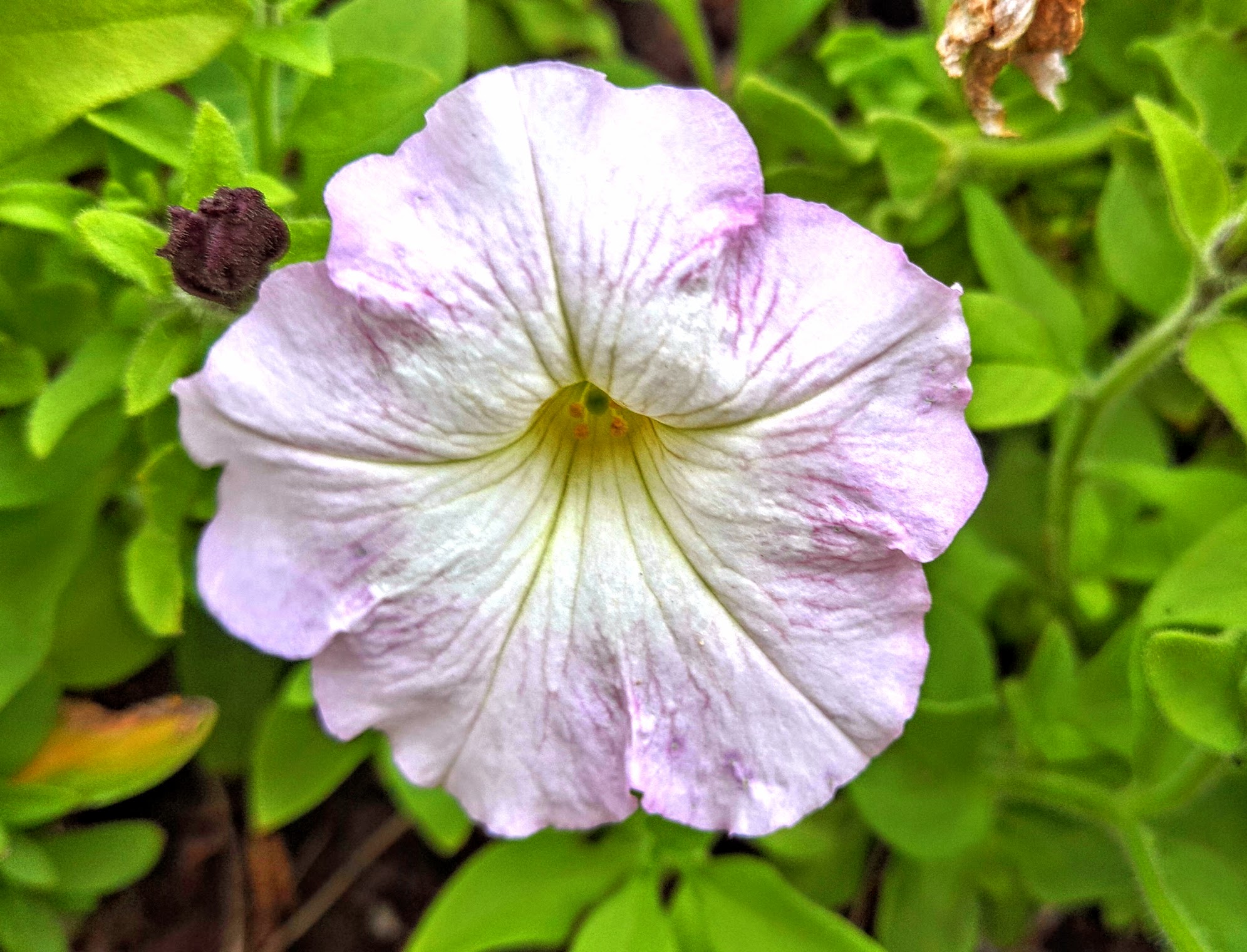
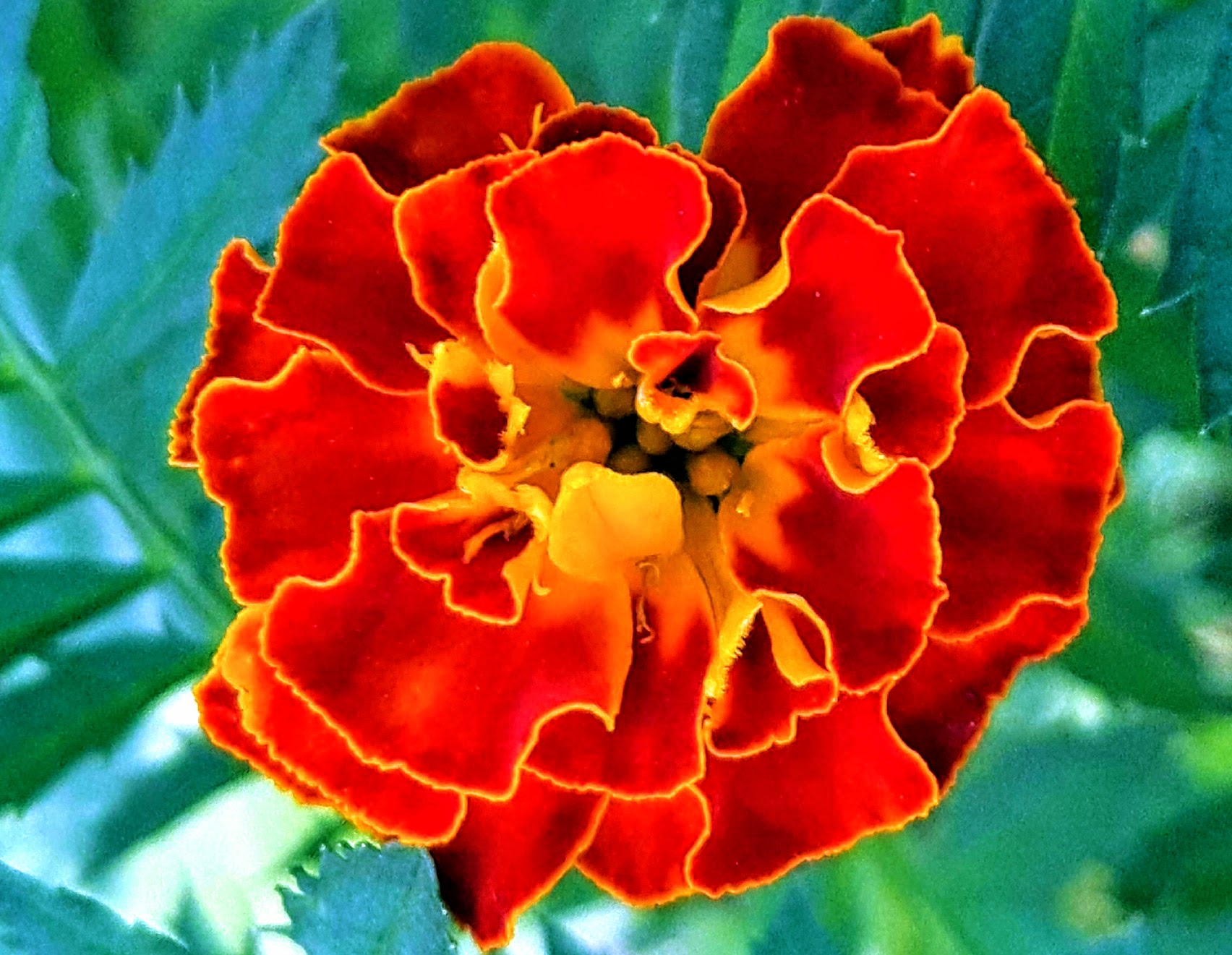
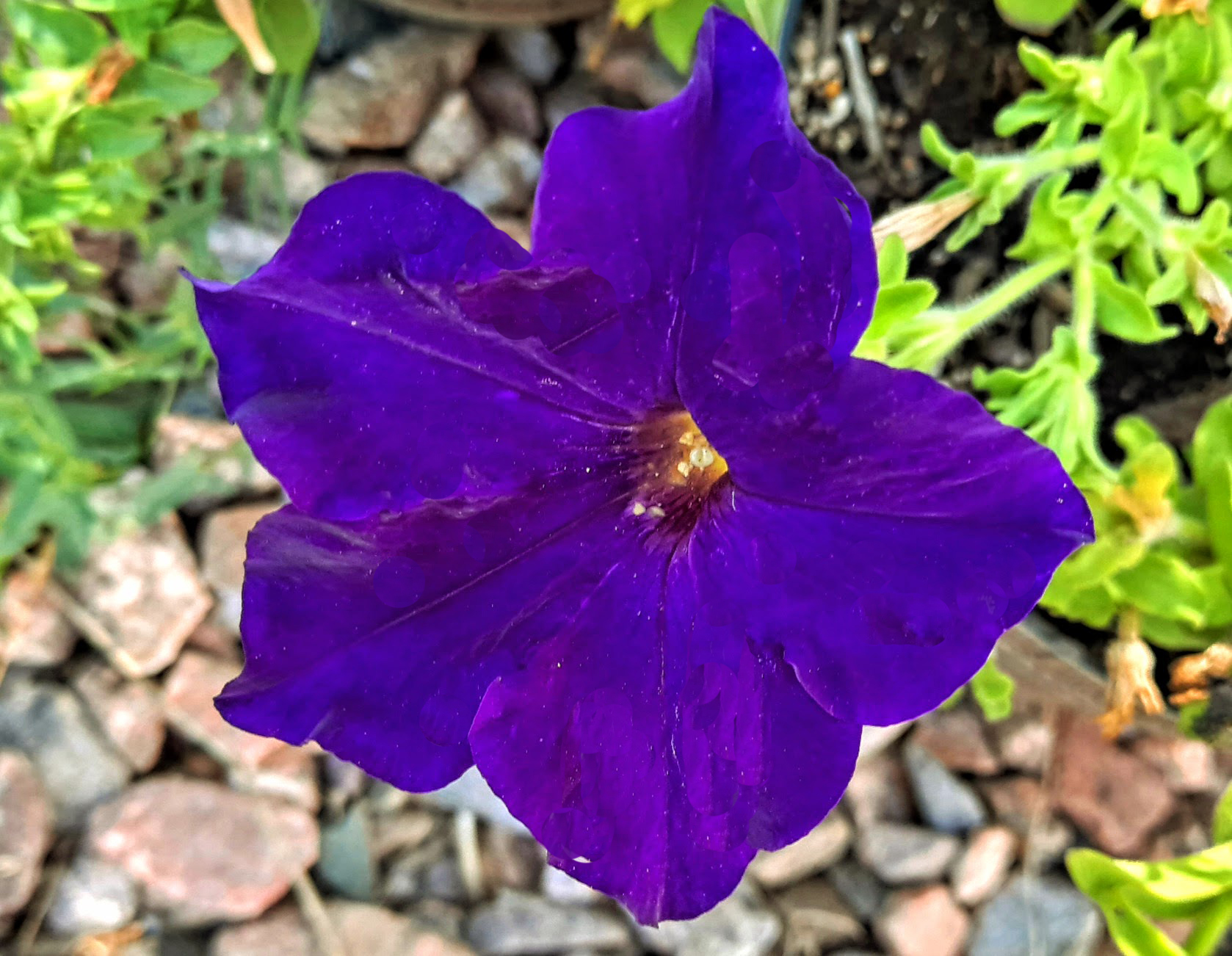
I had been wondering about when to mow with all the rainy days we were supposed to have, but today, when the sun came out, I went out and did the chore. I also took photos of flowers, which I’m sure comes as no surprise to you. The dark purple petunia with the pink highlight is one of the petunias that grew itself from last year’s petunias, though those petunias had no pink highlights.

Tomorrow looks as if it will be a repeat of today, starting out with a 68% chance of rain, so lucky me — I get to play the game again.

***

What if God decided S/He didn’t like how the world turned out, and turned it over to a development company from the planet Xerxes for re-creation? Would you survive? Could you survive?

A fun book for not-so-fun times.

Click here to buy Bob, The Right Hand of God.

Apprenticeship

Sometimes I feel as if I am serving an alchemical apprenticeship as I continue my transformation into an old woman. You notice I said “old woman” rather than a “wise old woman,” because I’m not sure wisdom is something that can be apprenticed. Neither can old age, actually — we get there or we don’t — and yet there are things we can do to make aging easier.

My apprenticeship is about learning the art of living when it doesn’t seem as if life is worth living anymore. So many frail elders are beset by an existential crisis, especially when they are the last ones left of their family. (Or even if it only feels as if they are the last ones left.) It is a valid point — is life worth living when everyone you have loved has died? When you have little control over your life and yourself? When your body continually fails you? When it’s hard to see, hear, feel? When your days extent too far behind you and —even though you know you have an expiration date — seem to extend too far ahead? When all anyone cares about is how old you are, not about you and how you are dealing with your great age?

A vast old age (or even a frail younger old age) leaves elderly people feeling as if they have outlived their usefulness, as if there is nothing left to live for, as if they don’t belong here. I’m hoping, in this apprenticeship I have apparently taken on, that the lessons I learn now will become habit, so if (when?) I go through my own age-prompted existential crisis, the tools for continuing to live as full a life as possible will be at hand.

I have no idea what I will be feeling in those hopefully still-distant years. My experience with grief has taught me that we cannot imagine how we will feel about anything until we get there. I do look to the elderly people I know and have known in recent years, see how they are feeling and acting (or not acting), and try to extrapolate from them what I might need to know. One advantage I have is that existential crises are not uncommon for me, the big ones being when I hit adolescence, when allergies (and the prescribed allergy medication) tossed me into a black hole of depression, and when Jeff died. Too often, people sail along fine their entire life until they become physically incapacitated in some way, and then . . . wham! Along come all problems and thoughts that were held at bay by activity.

To this end, I celebrate the small beauties of the day — a flower, a pretty stone, a smile. I look for something to care about and to focus on — for now, it’s my yard, but when that becomes too much for me, I hope something else will come along to give my life focus. I look for something to be grateful about every day. Admittedly, it’s hard to think about one’s life here (especially if that life feels insignificant) when a person is focused on what comes next after this life. So along with the gratitude, I look for something to ground me, to connect me to life and to Earth. Right now, as with so much else, that grounding comes from my garden, from dealing with the literal ground rather than a mental one.

I am also paying attention to the ways my body works and doesn’t work to try to figure out what muscles I might need to exercise to make sure I can do for as long as possible the simple things we take for granted — stand, sit, walk, swallow. Yep, swallow. About a month ago, I was downing a vitamin when it slipped straight past my esophagus into my lungs. Yikes! Scared the heck out of me. So I researched the mechanisms of swallowing and learned that in order for the windpipe to be blocked off, it’s necessary to swallow with the tongue pressed onto the roof of the mouth. The only thing I can think of is that day I forgot how to swallow and relaxed my tongue and throat, and then . . . oops. I’m very lucky that it wasn’t worse. The pill (a capsule) was innocuous and eventually, it dissolved with no lasting effects. Now I am mindful of where my tongue is when I swallow anything. And if I don’t feel like taking the vitamins, I don’t. Even though I do feel as if they are helping me, they can’t help if I can’t swallow them.

It’s all part of the apprenticeship. There is no grade to this apprenticeship, nor is there any reward except that I get to live another day. When I feel more as if I “have to” live rather than I “get to” live, I remind myself that today is not given to everyone, and I find a way to mark the occasion. I hope I can continue to do so. If nothing else, having such a tool at my disposal will help make all the coming years worth living.

***

Pat Bertram is the author of Grief: The Inside Story – A Guide to Surviving the Loss of a Loved One. “Grief: The Inside Story is perfect and that is not hyperbole! It is exactly what folk who are grieving need to read.” –Leesa Healy, RN, GDAS GDAT, Emotional/Mental Health Therapist & Educator.

Monsoon Season Flowers

I was surprised, many years ago, to learn that Colorado had a monsoon season. “Monsoon” always made me think of places like Thailand and Singapore with their afternoon deluges that brought traffic to a standstill, and Colorado seldom gets that sort of rain, which makes “monsoon” seem a strong word for the weak rains we sometimes get in July and August.

Although most people associate “monsoon” with deluges, a monsoon is actually a shift in the wind. In the case of Colorado, that wind shift brings moisture from the Gulf of California and the Gulf of Mexico into the state. According to the Colorado Climate Center, the monsoon “usually happens when a strategically centered high pressure (with clockwise flow around it) and low pressure (with counterclockwise flow around it) settle in over the region.”

The erratic and unpredictable nature of this North American monsoon is why the forecasters seem unable to tell us when or where or how much it’s going to rain. There have been days recently when they predicted 10% chance of rain, and we ended up with a steady downpour. Other days they have predicted a 90% chance of rain, and we ended up with nary a drop. And some days the forecast changed so frequently, no one and nothing had any idea what was going to happen, not even the weather itself.

This week, rain or no, we seem to be centered solidly in the monsoon wind pattern. The days are still and dry, but most evenings we have at least a splattering of rain. A couple of nights ago it rained for several hours, the longest rain we’ve had all year. It rained a bit last night, and after a respite of — perhaps — no precipitation tonight, there’s a chance of rain every evening for the rest of the week.

I have learned a couple of things during this monsoon week: 1) the browning of certain areas of my lawn isn’t due to lack of moisture, and 2) this is not a good time of year for hanging baskets. I’ve had to settle those hanging plants firmly on the ground so they don’t take flight in the late-night winds. By the time the winds are gone and I hang up my plants again, it will probably be too late in the season for flowers. Still, plants are nice, wherever they are.

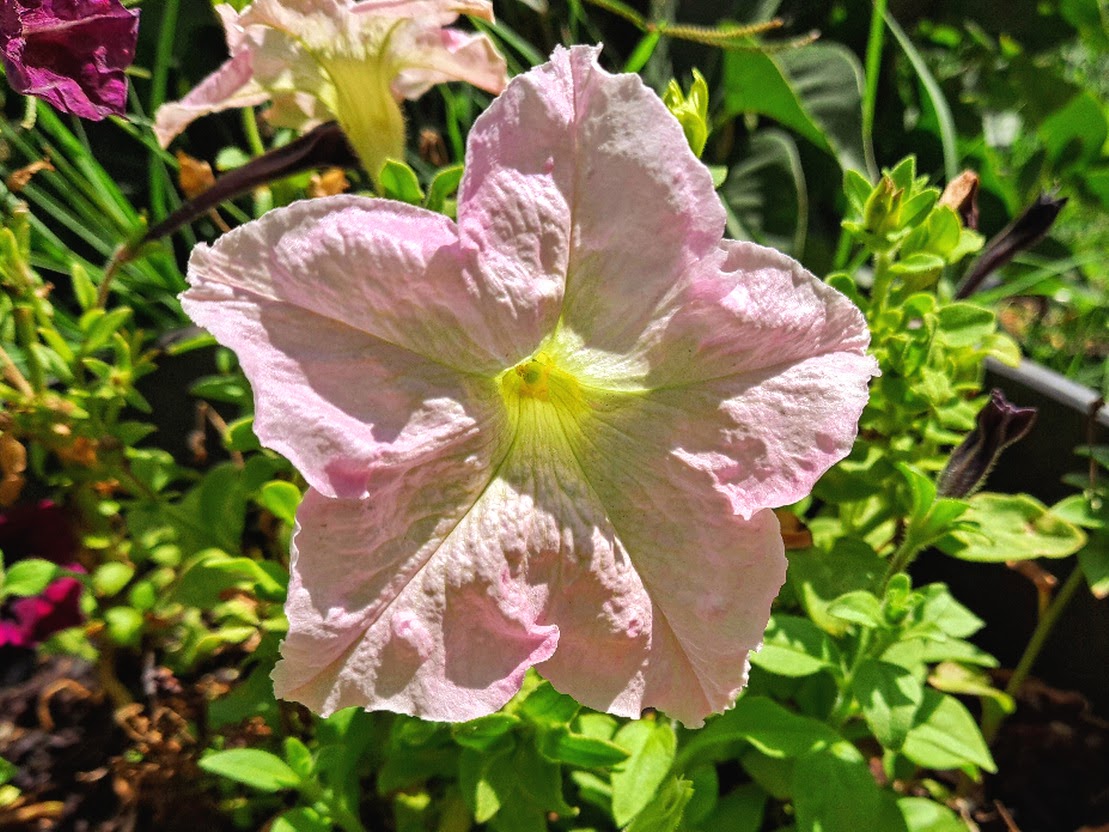
Well, some plants. The rain sure is making the weeds spring up! And it’s making the already sprung-up weeds grow horrendously fast. I’ve cleared out the tallest weeds, though my garden patches have been neglected. Luckily, as you can see, I still managed to find a few flowers to photograph.

Incidentally, all the white flowers pictured are volunteers, planting themselves where they’ve been assured a warm (and wet) welcome.

***

Pat Bertram is the author of Grief: The Inside Story – A Guide to Surviving the Loss of a Loved One. “Grief: The Inside Story is perfect and that is not hyperbole! It is exactly what folk who are grieving need to read.” –Leesa Healy, RN, GDAS GDAT, Emotional/Mental Health Therapist & Educator.
Wish Box

A character in the book I’m currently reading was given three wishes. She ended up giving two of the wishes away, which I didn’t know was possible in wish culture, but it was a smart thing for her to do since both those people became staunch allies when she needed them.

Any mention of wishes, of course, makes me wonder what I would wish for. I used to wish for enough money so that I didn’t have to worry about my financial situation, but that was easily taken care of. I decided not to worry. It doesn’t help my precarious situation, but at least I’m not worrying about it, and in the end, that’s what the wish was about.

Other than that, I’m not sure what I would want. I certainly wouldn’t waste a wish on world peace since politicians and other self-serving individuals would screw that up with their own wishes for dominance.

Then I remembered my wish box.

It’s been a while since I added to the box, though I should have been including any cards people sent me with wishes, such as wishes for a happy new year. Maybe I’ll remember to include such wishes later in the year. Meantime, I checked to see what my wish box included besides a couple of greeting cards.

The red origami envelope includes a wish for “something that I can be but haven’t thought of yet.” Hmm. Interesting wish. And a realistic one. Some of my best come-true wishes were wishes I never knew I had, such as taking dance classes, performing on stage, and owning a house. Limiting myself to what I know is simply too . . . limiting.

The other origami envelope contains a wish for me to sell thousands of copies of Bob, The Right Hand of God. Oops. That one sure went nowhere! But maybe . . . someday . . .

In the background of the photo is a copy of Neil Gaiman’s wish that a friend sent me: “I hope you read some fine books and kiss someone who thinks you’re wonderful, and don’t forget to make some art — write or draw or build or sing or live as only you can. And I hope, somewhere in the next year, you surprise yourself.” Some of that has come true, at least the part about reading, living as only I can, and surprising myself. I could do with more surprises, though. I wouldn’t like knowing that I know all there is to know about me.

I’m not sure where the stone heart came from, but “heart” certainly belongs in a wish box.

My favorite item at the moment is printed on the gray card with trees: small joys, simple goodness, hope renewed. It might not be worth wasting three wishes on those things (especially since I wouldn’t have any left to give away to people who desperately need wishes, as the character in the book did), but for sure, they are things for me to strive for.

***

What if God decided S/He didn’t like how the world turned out, and turned it over to a development company from the planet Xerxes for re-creation? Would you survive? Could you survive?

A fun book for not-so-fun times.

Click here to buy Bob, The Right Hand of God.

Celebrating Small Perfections

A girl asked an artist how he knew when his painting was perfect, and he answered, “It’s never perfect, so I’ve learned to celebrate the small perfections.”

His response resonated with me because that is how I’ve learned to view my garden (as well as the rest of my life). When people drive by my house, they might see the finished art piece of my yard, but I see all the problems — the patches of brown grass and the encroachment of weed grasses in the lawn, the insect-nibbled flowers and the annuals past their prime, the overgrown areas and the undergrown areas, and all the other issues that make a landscaped yard less than picture perfect.

Celebrating the small perfections keeps me focused on what I can control. Not that I can control what blooms and what doesn’t, but there’s way too much that is beyond my control —weather, weeds, and insects being prime examples.

I can control the work that I do, and I can appreciate the results of that work, whether it turns out to be what I hoped for or not.

At this time of year, when the tomatoes seem to be wildly overshadowing all the other plants in their vicinity (even though I thought I allowed enough room, apparently, I didn’t), and when it’s obvious what will have to be changed for next year, it’s important for me to celebrate the beauty that I find in various nooks and garden spots.

It’s especially important to celebrate the small perfections when the rains and cool downs don’t happen. A garden is a collaborative effort between the gardener, nature, and the environment, and when one of those collaborators falls down on the job (what I view as their job, that is), there’s not a whole lot I can do about it.

Gardening is a learning experience — a growth experience in more ways than one — and while I am learning how to perfect my garden, I still manage to find some small thing (or several small things) to celebrate every day.

***

What if God decided S/He didn’t like how the world turned out, and turned it over to a development company from the planet Xerxes for re-creation? Would you survive? Could you survive?

A fun book for not-so-fun times.

Click here to buy Bob, The Right Hand of God.

When Four O’Clocks aren’t Four O’Clocks

This morning I was outside before the sun came up — I needed to water before it got too hot to be outside — and I noticed that my wild four o’clock plant had buds.

I came inside and set my alarm for four o’clock so that I wouldn’t miss the blossomed flower. When the alarm went off, I braved the heat (105˚ F), but alas, no flower.

Aha! Daylight savings time! Maybe the four o’clock plant is now a five o’clock plant! It’s five o’clock as I write this, so I peeked out the window, and still no blooms.

According to a couple of articles I stopped to read, the plant won’t flower in the heat, so it waits for the temperature to cool off a bit, which means it could be a seven o’clock or even an eight o’clock plant. Or it might not flower at all. In fact, although I got the plant almost three years ago, this is the first year it even came up, so I’m grateful for that, anyway.

Luckily, the heat will break tonight, and next week will be considerably cooler, with some highs in the eighties and some around ninety. Most days even come with a possibility of rain.

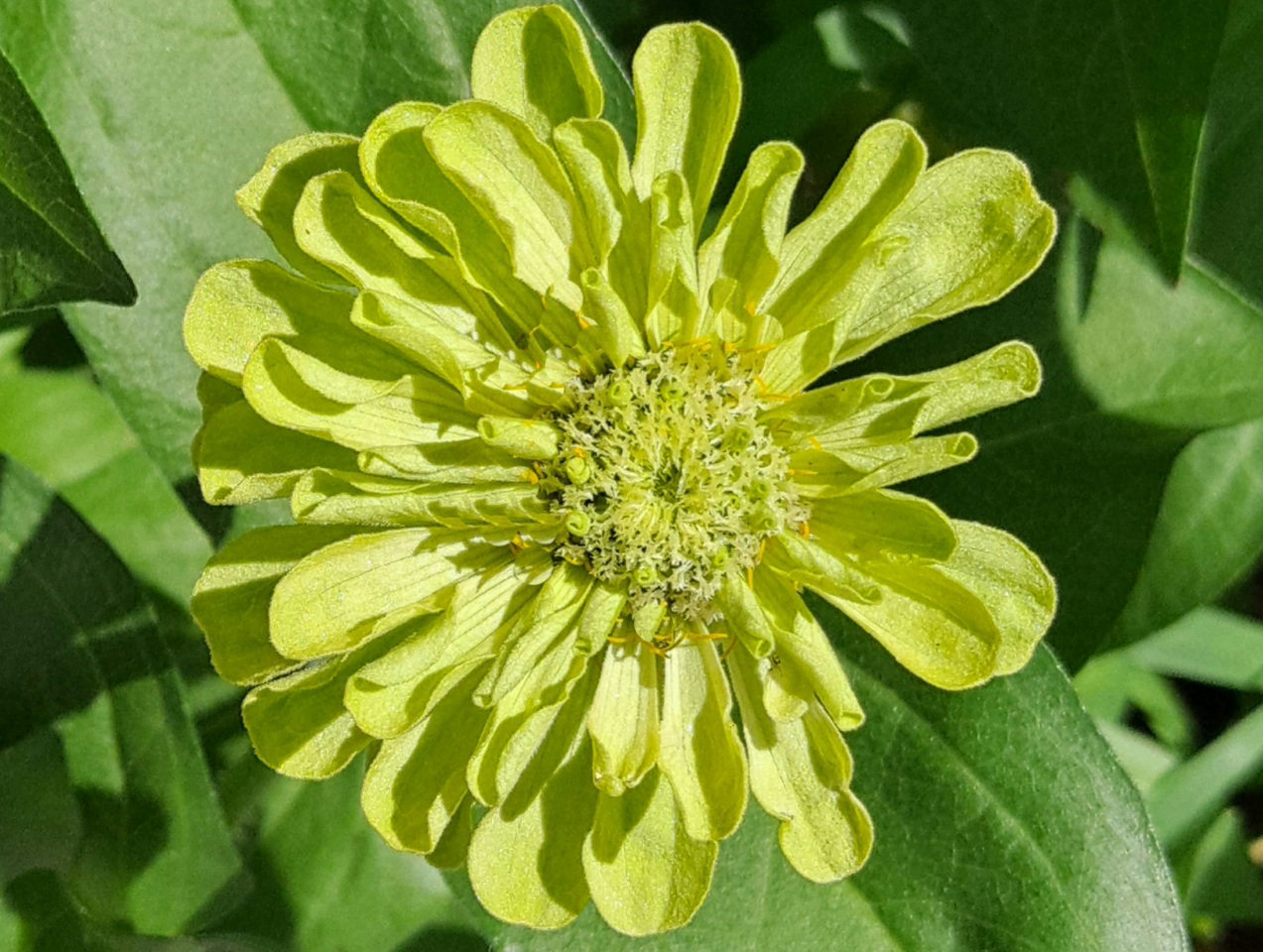
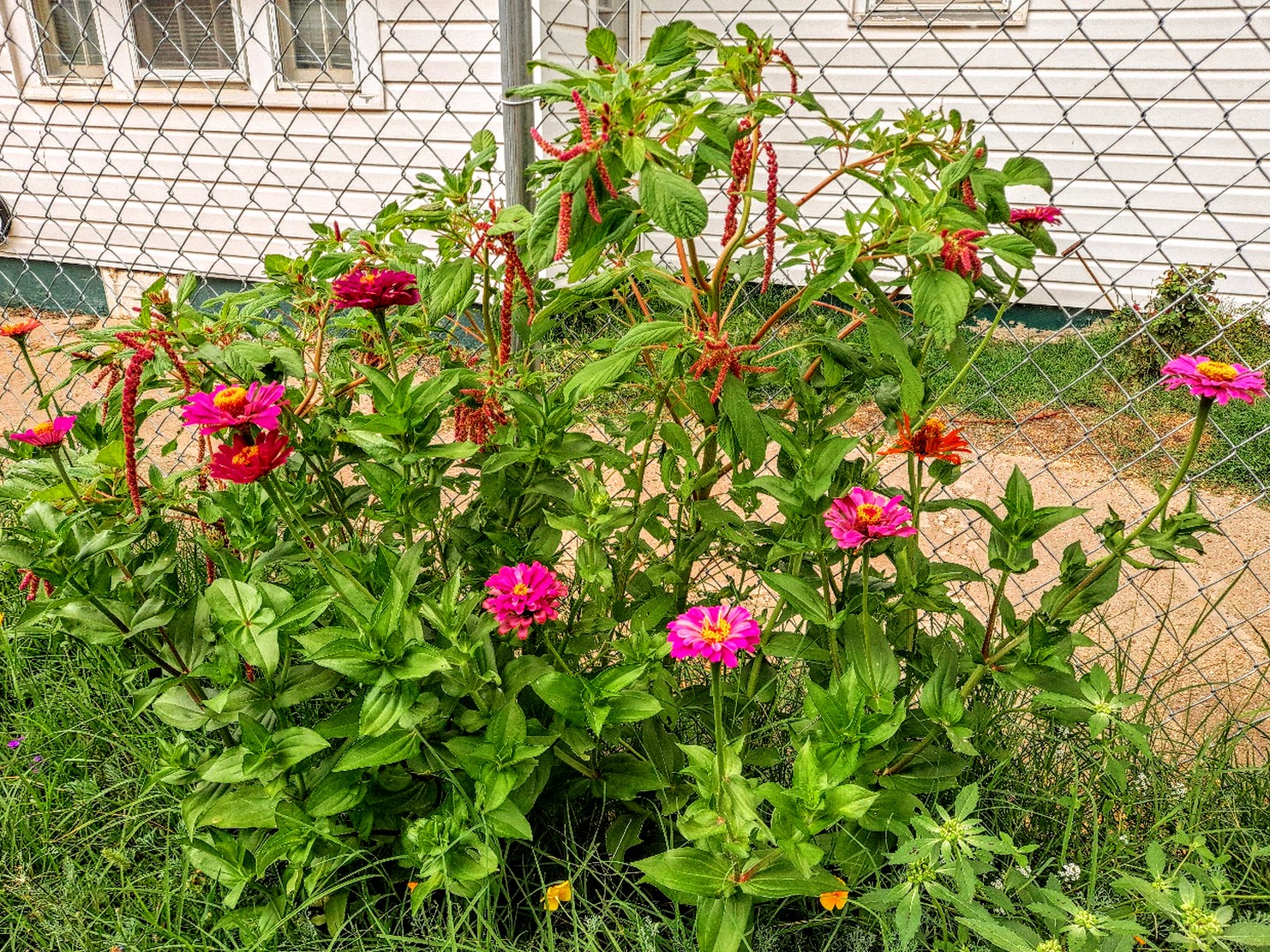
I am so looking forward to a bit of cool. The searing sun is not at all pleasant. The only things I know that appreciate the heat are tomatoes. And zinnias.

It’s funny to think that not that long ago I was thinking the cold would never end, and lately I’ve been thinking the heat will never end. (Just because the seasons have always changed doesn’t mean that they always will.) Luckily, if the weather forecasters have any credence (which up to now, I haven’t seen much of that), it will cool down for a few days anyway.

Then, perhaps, my four o-clocks will bloom.

***

Pat Bertram is the author of intriguing fiction and insightful works of grief.

Telling a Tarot Story

I don’t often deal out tarot readings for myself that make a lot of sense. The cards seldom tell me anything I don’t know, mostly because all I can do is read what I know into the cards. Even leaving me out of the reading, the cards still don’t make sense since they don’t seem to relate to one another. Today’s reading, however, delighted me because the cards all fit together to tell a story.

The deck I’ve been using this month is the Renaissance Tarot Deck, a deck that reflects interests of that period, using deities of Olympus and other mythological gods and goddesses. The ordinary folk, such as the court cards (ordinary in comparison with the classical deities, that is) are dressed in garments from the era.

I’ve never used this deck before because I wasn’t sure I liked the anatomically correct nakedness, but I’ve come to appreciate this deck. It helps knowing that the naked people aren’t people at all but various mythological beings. Still, in the photo accompanying this post, I castrated the poor fellows, lest I offend anyone with such “pornography.” (I have a hard enough time with how people perceive this blog without adding fuel to the fire.)

The first card, representing the past, was the eight of swords. The picture is Achilles grieving for his friend Patrocius, who was killed by the spear of Hector of Troy. The meaning of the card is emotional disaster, loss of a beloved person or a valued situation, a sadness that creates new strength and resolve.

The second card, representing the present, is the ten of cups. The picture is Psyche and Eros in perfect happiness, reunited in a marriage feast on Olympus. The meaning, of course, is happiness in love, balance in friendship, and joyful equanimity in oneself.

The third card, representing the future, is the two of cups. The picture is of Eros falling in love with Psyche. The meaning is love at first sight, the invisible and formidable bond between two people.

So, the story of the cards is loss, finding eventual joy and a new balance and, if this were a romance novel, finding a new love. But since this isn’t a romance novel, since the reading is only good until the next reading (tomorrow morning), and since the chances of me meeting and falling in love with someone this afternoon are nil, the future card has to mean that the bond between Jeff and me is still strong, in my own mind if not in fact.

Or something like that.

Whatever the cards actually mean (as opposed to what I say they mean), it does seem as if these particular cards tell a very linear and distinct story.

***

Pat Bertram is the author of Grief: The Inside Story – A Guide to Surviving the Loss of a Loved One. “Grief: The Inside Story is perfect and that is not hyperbole! It is exactly what folk who are grieving need to read.” –Leesa Healy, RN, GDAS GDAT, Emotional/Mental Health Therapist & Educator.
A Day in the Middle of Summer

I spent the morning outside. I hadn’t really planned to. Since it rained last night, I didn’t have to water today, and I figured the ground would be too sodden to weed my flower gardens, so I thought this would be a good day to take it easy.

Still, I had to go outside to toss out the furnace filter I’d just changed (after being very careful going down those old basement stairs), and I needed to reattach a motion-activated light that had somehow become unattached from its perch on the side of the house (I was especially careful going up the ladder since I’m not sure it’s something I should be doing), and because I was outside anyway, I pulled a weed or two.

A couple of hours later . . . Yep, that weed or two turned into a massive cleanup of one of the two uncultivated areas of my yard. It’s not as if the area needed it — the weeds were only waist high. (I’m being ironic here, if you can’t tell. Not about the weeds being waist high, because they were, but about the area not needing to be weeded.) I would have to clear it out eventually — I will be ordering some purple echinacea and Goldsturm black eyed Susans to plant there this fall, so this gave me a head start on the project.

Speaking of which, the echinacea that I planted last year came in a five-inch pot, and they did well. The price has gone up quite a bit, so I’m considering getting plants in three-inch pots, which are half the price, but obviously smaller. Would that be a foolish economy? Obviously, for the same budget, I could get twice as many of the smaller pots, so if a couple of the plants died, I’d still be ahead of the game, but am I sabotaging myself by getting the smaller ones? Or does it sound like a smart choice? I sure don’t know.

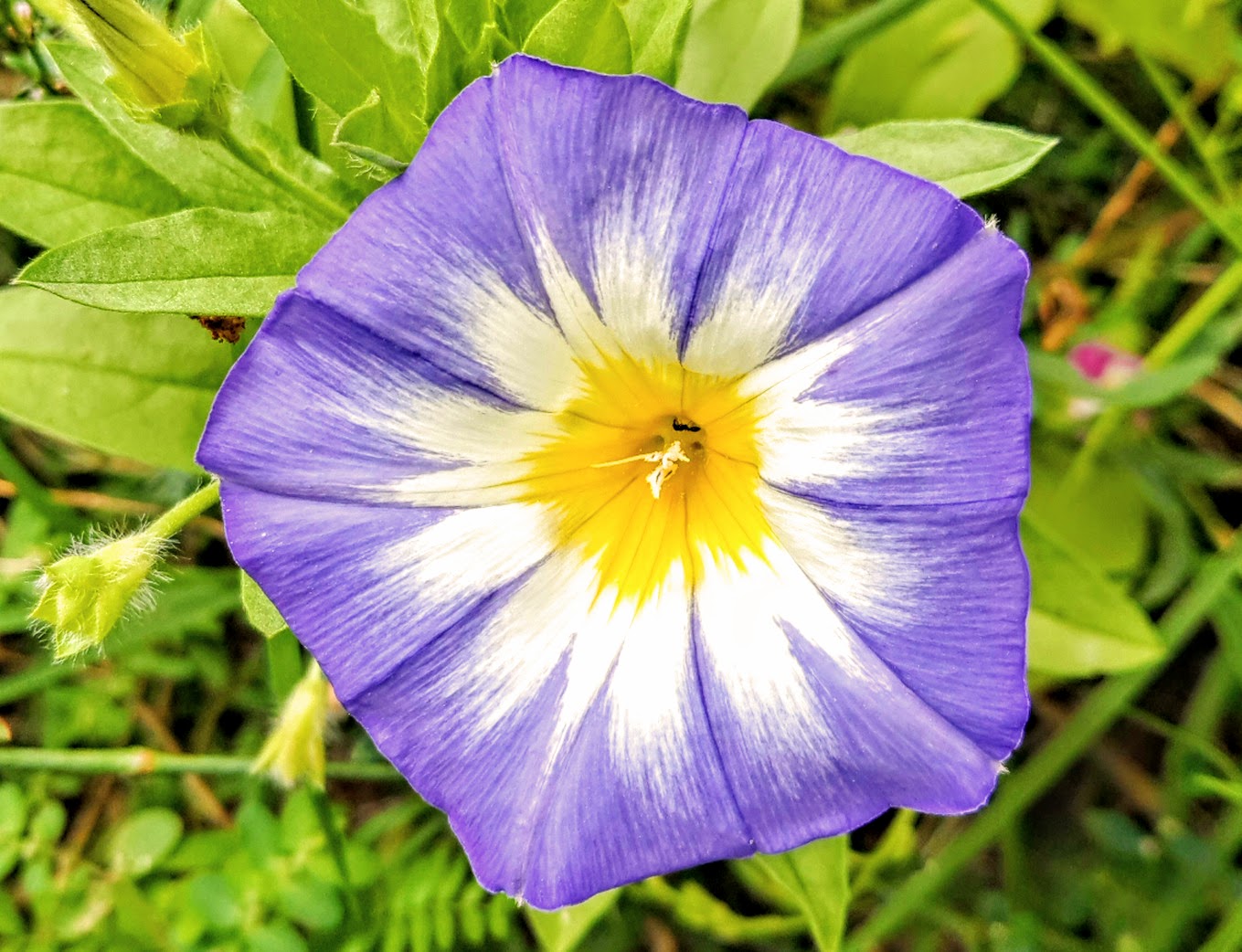
But I’m getting off the topic of spending the morning outside . . . After I finished my chores, I took a few photos of flowers. I love how this morning glory turned out — as if the sun were rising from its center!

About then, a friend stopped by and we sat in the comfort of my gazebo (me with dirt still under my fingernails) to chat for few minutes. Next thing we knew, the church bells were tolling the noon hour. Yikes! Those hours do tend to disappear on a person.

We said our goodbyes. She headed out to finish her errands, and I went to harvest my cherry tomatoes. All three of them!

And then finally, I went back inside.

What a nice midsummer’s day!

Only it isn’t a midsummer day. It’s merely a day in the middle of summer. A quick Google search to find out when midsummer really is told me that midsummer is celebrated around the summer solstice, which we call the first day of summer. So confusing!

Still, whatever you call it, I spent a pleasant — and unplanned — summer day outside.

***

What if God decided S/He didn’t like how the world turned out, and turned it over to a development company from the planet Xerxes for re-creation? Would you survive? Could you survive?

A fun book for not-so-fun times.

Click here to buy Bob, The Right Hand of God.