Impact of Owing A House

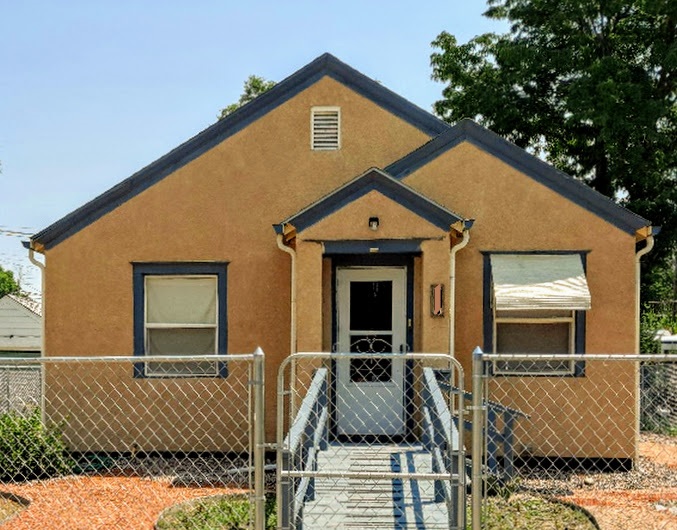
On my way home from the library yesterday, I passed the hardware store and exchanged a few words with the workers who were outside taking a break. When I continued on, it dawned on me that owning a house has had some odd impacts on my life, including this one. I had never before been on a first name basis with any hardware store employee. Nor has any hardware store employee ever known where I lived. One of the workers lives around the corner from me, but that’s just a coincidence. Mostly they know me because of deliveries they have made to my house.

I’m also on a first name basis with contractors and other laborers.

Those aren’t the only impacts on my life because of home ownership, they are just the ones that got me to thinking. Some of the changes to my life since moving here would be the same whether I owned or rented, such as a library within a few blocks, easy access to a grocery store, and nice neighbors. I tend to think the neighbors are a bit nicer to me because I own the house; after all, if I own, I am one of them and will be around for a long time if everything goes as planned. Also, I’ll take care of my property unlike most of the renters around here.

The most basic impact is a feeling of being at home. As long as Jeff and I were together, I always felt at home because as long as we were together, that was my home. After he died, I tried to find a sense of home in myself, and mostly succeeded. Oddly, until now, the feeling of being at home was strongest when I was camping in a national park because to a certain extent, the parks belong to me (to all of us), and when I paid my camping fee, that small plot of land was specifically mine for the nights I stayed there.

Almost as important as a feeling of being at home is peace of mind. For almost the entire decade after Jeff died, I was unsettled and uncertain. I often brooded about what I wanted, where I wanted to move, where I could afford to live, how to start over. That last point was a major one, because truly, how does one start their life from scratch? Well, I’ve done it — started my new life — so I don’t have to think about that anymore. Nor do I have to think about where to go because I’m here. And, since I’m working, I don’t have to worry how to pay for this new life.

Also, for the first time in a decade, I don’t think about what I have to get rid of. I got rid of a huge amount of stuff after Jeff died, and then again before I moved my things into storage after my father died, and yet again before I moved here. Even though the current philosophy seems to be that if you haven’t used something in a year, you should get rid of it, I don’t subscribe to that idea any more. I’ve gotten rid of so many things over the years I needed to repurchase, that as long as I have space, I might as well keep what I have. Obviously, as time goes on and I reach my expiration date, I’ll have to get rid of almost everything so no one will have the huge chore of sorting through my stuff when I’m gone, but until them, everything I own has a place. After the huge increase in possessions when I bought this house and furnished it as well as adding a garage, I’ve made no major additions to my possessions. Well, there are all the outside things I’m doing — the landscaping and plants and such — but those aren’t really possessions, they are simply additions to the property that will remain in place.

Having a permanent address is another benefit of owning my house since I won’t have to change the address until . . . well, until I have to because of age or whatever.

I’m sure there many other ways that home ownership has affected my life but they don’t come to mind at the moment. What does come to mind, however, is the thought — still so surprising to me — of how much I love owning my own home. I can feel it wrap around me like a well-worn and comfortable garment. Any place I’ve lived in the past was simply a place to park myself, but owning a house makes me feel as if I have a partner in life, as if the house and I are in this together. I take care of it, and so far, it has taken care of me.

And yes, I am exceedingly grateful for this blessing.
***

Pat Bertram is the author of Grief: The Inside Story – A Guide to Surviving the Loss of a Loved One. “Grief: The Inside Story is perfect and that is not hyperbole! It is exactly what folk who are grieving need to read.” –Leesa Healy, RN, GDAS GDAT, Emotional/Mental Health Therapist & Educator
Grief and Medication

I generally stay away from talking about medication when it comes to grief because it is a sensitive — and personal — topic. I have a firm belief that grief is not a medical condition that needs to or can be treated by drugs, and though this belief extends only to myself and not to others, I worry that my talking about the subject will make people think I am being judgmental of those who need medical help, and I am not. We all deal with grief the best we can, however we can.

Still, medication is a topic that needs to be addressed because many people don’t realize there is an alternative. Not an alternative to the pain, of course, because that comes with the territory of grief, but an alternative to drugs.

Learning the truth about grief — that we are not crazy; that no matter what we are feeling, it’s natural; that others have felt what we have felt; that grief, no matter how painful, is a process that will help us become a person who can survive the loss — goes a long way to weaning ourselves from a dependency on drugs.

Alice, an older woman I met in an online grief forum, took anti-depressants after the death of her husband because she thought her emotions, the physical reactions, the endless tears were abnormal, and no one told her otherwise. What she really wanted and needed was the reassurance that her grief was a normal reaction to an abnormal situation. We expect to be able to slide comfortably into old age with that one person we love more than anything, and when that person dies, excruciating pain and angst are normal reactions.

There’s no way we can learn about the normality of such grief except from people like me who are willing to talk about their experiences because the medical establishment has decided that anything but a mild grief is an abnormal condition, and the things we see in movies (and don’t see) seem to agree with that opinion. How many movies have you seen where a woman (always a woman!) is told about the death of her husband, and when she starts crying and screaming, a doctor is there to jam a hypodermic into her arm? A lot. On the other hand, the complex and painful experience of grief for a spouse is not something we see on television shows, in movies, or read about in novels. Fictional folks (when they are not being drugged into oblivion) shed a fictional tear or two, perhaps go on a fictional spree of vengeance, then continue with their fictional lives unchanged.

It seems as if this current reliance on drugs to “treat” grief is more about hiding than helping. In today’s world, grief needs to be hidden almost from the beginning so that it doesn’t offend other people’s sensibilities, so that it doesn’t bring the specter of negativity into other people’s lives. Drugs also hide your grief from yourself so you don’t have to face the raw reality of death. Drugs are good for that. They can hide your grief to a certain extent, but that’s all they can do. They cannot bring the deceased loved one back.

Some people do need medical help, of course, and they should get it. As Leesa Healy (RN, Emotional/Mental Health Therapist & Educator) wrote: “There are absolutely times when a therapist is required to nudge a person from being stuck, but the fact of the matter is that psychiatry since 2000 has become completely dependent upon what I call the drug/work model . . . i.e. create a diagnosis . . . create a drug . . . back to work for you. At least this is true in Australia and yes I’m qualified to say so (in case anyone wonders). Western psychiatry is leading us down a road of becoming the living dead and the risk is many folk are walking this journey willingly, unaware of the consequences so focused are they on the short-term fix. And who can blame them. It is not only our habit to avoid pain, but also, the very structure of any capitalist society is allowing us less and less time to be ‘truly human’.”

There were times I wanted the pain of being “truly human” gone since my grief was almost more than I could handle, but I wanted even more to feel sorrow that Jeff was dead. Well, actually what I wanted was him here, alive and healthy, but since I couldn’t have what I really wanted, I owed him my sorrow. I owed “us” my sorrow. He deserved to have someone grieve for him, to have someone feel the imbalance of the world without him in it. For me to have gone seamlessly from a shared life to a solitary life without a backward glance or a tinge of pain would have dishonored him. To not feel at all would have been way more of a medical problem than feeling too much.

Although medicine and psychology are the branches of science that have taken charge of grief and how it is described and understood, an anthropological approach — listening and observing — better captures the truth of the situation. Anthropology is the science that deals with the origins, biological characteristics, and social customs and beliefs of humankind, all of which pertain to grief. Few people listen to us bereaved; instead, they try to tell us how we feel. That is why support groups work. If the medical and scientific establishment won’t listen to us, we need to listen to each other, to observe how others are dealing with their grief, to talk about our own situation.

That’s the approach I took — listening, talking, writing, explaining what I learned about grief. I also walked. I was too restless to do much else (except cry) and as it turns out, walking is a good way to deal with grief, not just because of the sedative nature of walking but because it quiets the brain and lets the brain do the work of grief. When we’ve lost a person intrinsic to our lives, our brain goes into overdrive. So much of daily life is habit, and when that habit is suddenly disrupted, the brain tries desperately to identify new patterns and to find alternatives. Adding to the overdrive (and to the brain fog that is normal the first year of grief) is our need, however futile, to try to think our way out of grief. Walking helps put the brain back in its default mode — stream of consciousness. By simply feeling and not trying to make sense of grief, by letting thoughts drift through without trying to catch hold of any one of them, we can rest our brain and perhaps even open ourselves to new insights.

Not everyone is able to deal with grief in its raw state; in fact, many people are so traumatized they need extra help. As always, my mission, to the extent I have a mission, is to help people understand the nature of grief so they can deal with that cold, lonely road as best as they can — with or without medication.

***

Pat Bertram is the author of Grief: The Inside Story – A Guide to Surviving the Loss of a Loved One. “Grief: The Inside Story is perfect and that is not hyperbole! It is exactly what folk who are grieving need to read.” –Leesa Healy, RN, GDAS GDAT, Emotional/Mental Health Therapist & Educator

To Shirk or Not to Shirk

I was on my way out the door to take my car in to get the brakes fixed when I got a call from the mechanic cancelling the appointment. Even though he’d ordered the part in plenty of time, it turns out the company he ordered it from, which generally has next day service, had to special order it. So it won’t get here for a few more days. That’s the joy of owning a classic car! Luckily, I can still drive. The brakes work fine, but the warning light keeps coming on, so I never drive anywhere I would need to slam on the brakes in an emergency. Mostly I do what I’ve done for the past year and a half — drive the car slowly through town then head out on the four-lane highway until the end of the divided highway, then I come back and do whatever errands I need to do.

Because I can still drive, it’s not that big of a deal that he cancelled, but it did leave me feeling a bit lost as often happens when plans go awry. So I decided to clean house. There’s been a musty smell in here lately, though I’m not sure where it comes from — perhaps the dust I drag in from outside on my apparel, or maybe because I have to sleep with the windows closed due to the continual bad air quality alerts, or possibly because of the stale smoke blowing in from the fires on the west coast. I’ve let the dust build up more than I like lately since I’ve been spending so much time on my garden, and I thought this was the perfect time to get everything cleaned up.

Now the house smells like Murphy’s Oil and furniture polish. (I add the furniture oil to the diluted Murphy’s oil in the hope that it will help hydrate my 93-year-old unfinished wood floors, and so far it seems to work.)

Then I had to go check on the house I’m looking after for absent friends and take photos of some work that’s being done. And on the way back I picked up a few groceries.

I still have a few more things to do today (payback for yesterday, where I did nothing but lounge around and read), including going to work. My next planless day won’t come until the weekend, but that’s okay. It will be even more enjoyable since all my chores should be done and I won’t have any reason to feel guilty for being indolent. To be honest, I don’t feel guilty even if I do have reason to feel guilty — after all, there’s no fun in shirking one’s duties if there are no duties to shirk.

On the other hand, as I discovered today after all my work, there is fun — or at least a feeling of smugness — in not having shirked the day’s duties.

***

What if God decided S/He didn’t like how the world turned out, and turned it over to a development company from the planet Xerxes for re-creation? Would you survive? Could you survive?

A fun book for not-so-fun times.

Click here to buy Bob, The Right Hand of God

Surviving Air Quality Alerts

Denver had clean air long after smog choked other major cities, probably because in my youth, it was more of a cow town than a city. I remember being able to see the mountains from almost anywhere in town, but as the town grew into a city, fueled by the huge influx of people escaping the big cities in California and elsewhere, smog grew, too.

Ever since I left Denver, I’ve chosen to live in smaller places where the air is relatively clear. Where I live now is so far from any major city that I should never have to worry about air quality alerts, and yet lately the alerts come rather frequently. It has nothing to do with us; the problem is the smoke from wildfires in California being blown into Colorado and beyond.

Because of my smoke allergy, this has been a particularly rough time for me, with bad sinus headaches, lack of energy, and a bit of chest congestion. Admittedly, these problems are nothing compared to what people directly affected by the fires have to deal with, but I still have do what I can to protect myself. Today, after I watered my bushes and garden areas, I spent the day inside with the windows closed. Such precautions don’t really help much because the air seeps inside, and even after the air quality alert is cancelled, it takes days for my allergy symptoms to clear out.

Despite that, it was still a pleasant day. I lounged around most of the afternoon, reading and drinking tea.

Once this brief blog update is posted, my plans for this evening, to the extent that I have any plans, will be pretty much the same. Luckily, I have a fresh stack of books from the library as well as a large stash of tea.

***

Pat Bertram is the author of Grief: The Inside Story – A Guide to Surviving the Loss of a Loved One. “Grief: The Inside Story is perfect and that is not hyperbole! It is exactly what folk who are grieving need to read.” –Leesa Healy, RN, GDAS GDAT, Emotional/Mental Health Therapist & Educator

The Best Laid Plans

A friend asked me what my plans were for this weekend, and I admitted I had no plans. It sounds a bit pathetic, I suppose, not planning on doing anything, but that’s the way I like it. My favorite times are when I have no plans, no schedules, no appointments, just the day — pristine and full of possibilities — stretching before me.

Despite my lack of planning, I still ended up with a full day because with no plans in mind, I am open to spontaneity. I stopped by the library and visited with a friend who sometimes hangs out there. She mentioned a luncheon that the VFW was putting on to raise money, and added that a mutual friend wanted to go but had no one to go with her.

So I went with her.

I was a bit nervous because I still don’t like being around strangers especially since most people don’t seem to care about keeping their distance. Almost everyone was crowded inside, but we ate in solitary splendor on the tables outside. It was nice being sociable for a while, but I am just as glad that tomorrow will be another plan-free day. Perhaps I will spend it by myself. Perhaps something will come up and I’ll go gallivanting. Either way, I’ll enjoy the day — and enjoy having no plans — because come Monday, I have a lot of notations on my calendar.

Come to think of it, those days with plans and appointments are good, too, because things get done. Or at least the hope is that things will get done. Even when I make plans, those plans often go awry because things change or people cancel out on me. And that’s the worst sort of day for me — when I don’t get the luxury of waking up to a planless day, and I don’t get the satisfaction of accomplishment by following through on plans I didn’t want to make in the first place.

Am I confusing you? Don’t worry. I’ve confused me, too.

***

What if God decided S/He didn’t like how the world turned out, and turned it over to a development company from the planet Xerxes for re-creation? Would you survive? Could you survive?

A fun book for not-so-fun times.

Click here to buy Bob, The Right Hand of God

Looking Good!

It seems as if I wait and wait and wait, and nothing every gets done around here. Well, it seems that way because it’s true, the waiting part, anyway. When people do show up to work, however, they get things done quickly.

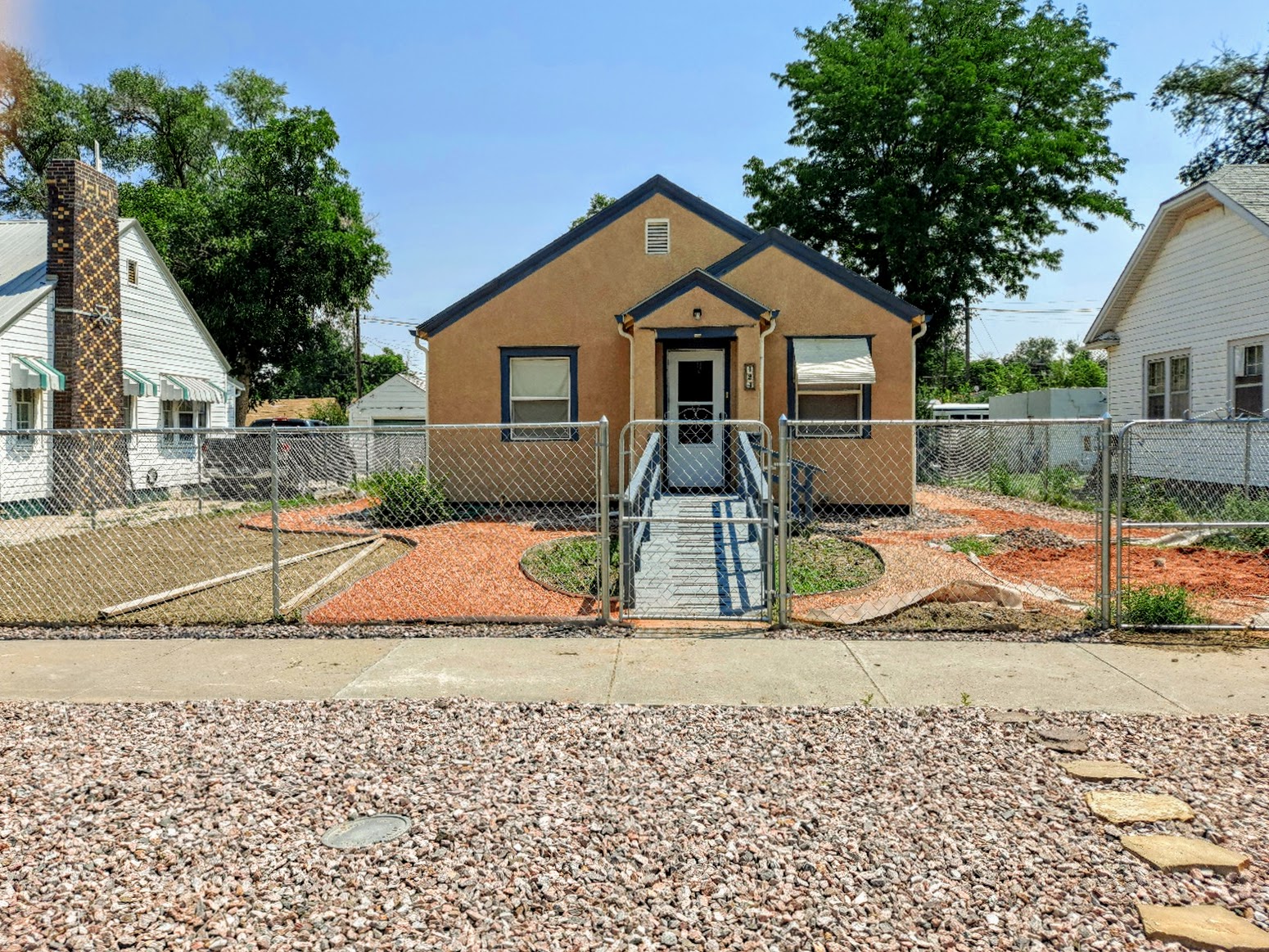
Because of work that was done last evening and this morning, the rocks around the house are mostly in place, and a good start was made on the pathway to the back yard.

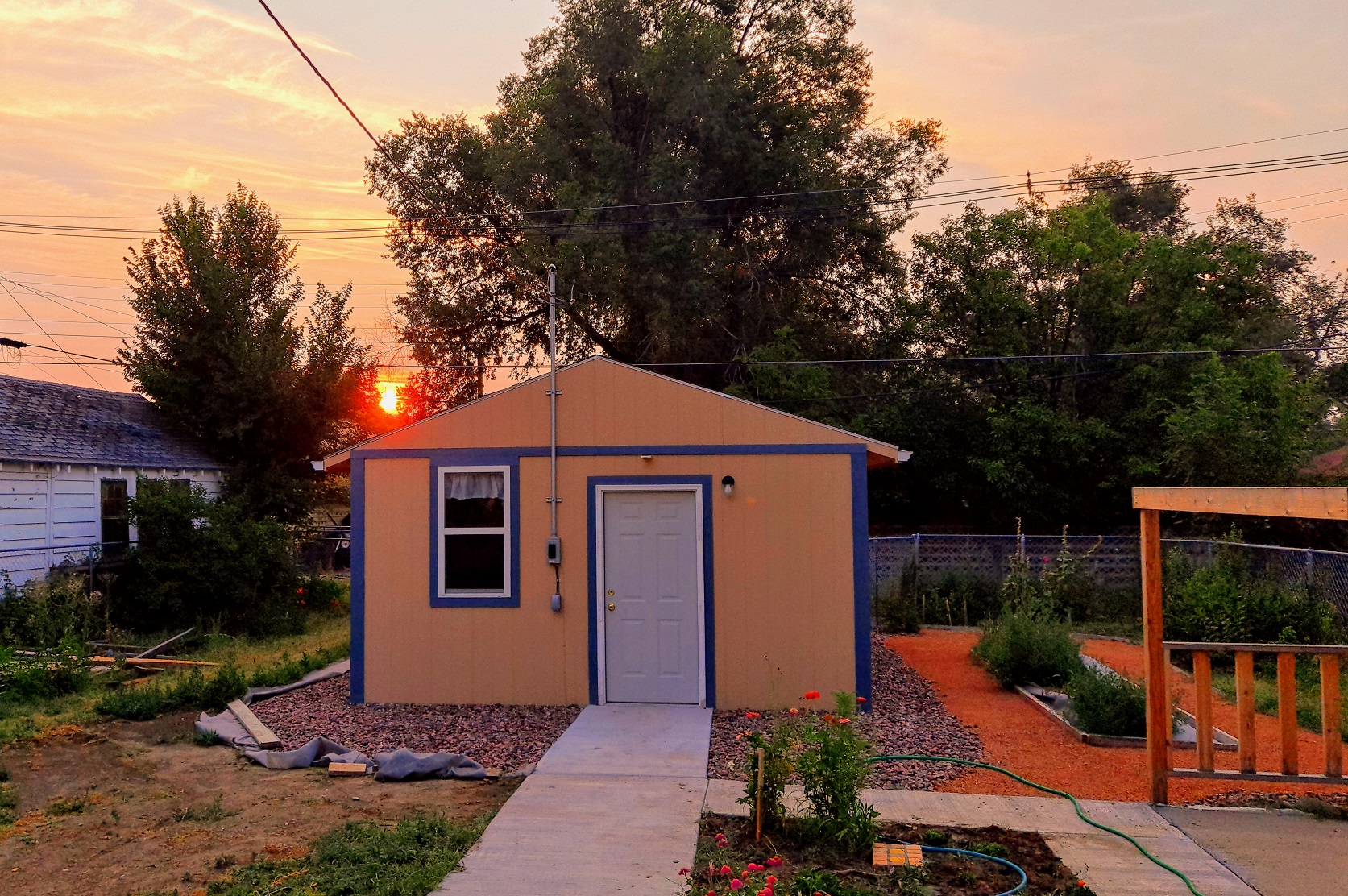
The pathway on the left as you’re facing the house, the one they’ve been working on, seems so very red, but it will fade to a pale terra cotta to match the path on the right. In the corner on the right, there will be a gray slag parking space. When I bought the house, a driveway ran beside the house all the way to the back. When the fence was put up, a double gate was installed to create access to that driveway. I don’t need the driveway anymore because my new garage is in the back off the alley, so a walking path went in next to the house. But since the double gate is still there, I figured I might as well make use of it. Hence, the parking space that will be laid sooner or later.

I’ll be putting sod in the left-hand corner of the yard. I’m afraid if I merely seed the area, weeds would take over before the grass could have a chance to grow. Besides, it will be nice to have a spot of green in the front yard. That’s assuming anyone will show up to do lay the sod for me.

I’m not sure when any workers will be back here, but for now I’m just glad that they got as much done as they did before they took off to do other jobs.

***

Pat Bertram is the author of Grief: The Inside Story – A Guide to Surviving the Loss of a Loved One. “Grief: The Inside Story is perfect and that is not hyperbole! It is exactly what folk who are grieving need to read.” –Leesa Healy, RN, GDAS GDAT, Emotional/Mental Health Therapist & Educator
Preparing to Plant

I hadn’t planned on working outside this morning, but it was cool enough that I thought I should continue preparing the soil for when my tulip bulbs arrive. (One company said they will send them this month; the other company said they will send them next month.)

As it turned out, although it was below eighty degrees Fahrenheit when I was out, the humidity hovered around 60%. That doesn’t sound like much, but when you’re used to humidity in the low teens, it’s a lot. And humidity, even more than high heat, makes me perspire.

I always thought it a silly cliché when movies show a bead of sweat dripping from the end of a character’s nose to indicate nervousness. After this morning, I know for a fact that sweat can drip off the end of a person’s nose, though in my case, it had nothing to do with a case of nerves but because of too much exertion in too much heat and humidity. Normally, I’d swipe an arm across my face to get rid of any unsightliness, but I’d sprayed my gardening clothes with permethrin to protect me from mosquitoes, and though the bug spray is supposed to be non-toxic to humans, I certainly don’t want it anywhere near my face.

So I dripped.

I desperately needed a shower when I was finished, but since a worker was here to lay rock around the house, I hesitated. There’s something about taking a shower when strangers are working close to the house that makes me nervous. I’m sure none of them ever stop to think, “The shower is running, so the woman is nekkid,” but still, prudence makes me hesitate.

Luckily, the worker went home to take a break, so I got my shower.

Unluckily, he never came back.

It just goes to show that I can only count on myself to get anything done, but since I’m not foolish enough or young enough or strong enough to lay the rock, I have to wait for people to come and stay long enough to do the work. I just wish they’d let me know what’s going on. I presumed he was coming back because he left tools out and the gates open, but who knows.

I’m just glad I got my tulip bed ready, so at least something was accomplished today.

***

What if God decided S/He didn’t like how the world turned out, and turned it over to a development company from the planet Xerxes for re-creation? Would you survive? Could you survive?

A fun book for not-so-fun times.

Click here to buy Bob, The Right Hand of God

Today’s Tarot

A new month means only one thing to me — a new tarot deck. Otherwise, one month is pretty much the same as another. Well, August is certainly not the same as December, but August is similar to the end of July and the beginning of September, so the months slide right on by without a lot of fanfare. Or at least they did until I started changing tarot cards at the beginning of every month.

This month, the deck I am using is one of the classic decks: the Rider Tarot. Also known as the Rider-Waite Tarot or the Rider-Waite-Smith Tarot, it is one of the most widely used tarot decks in the world, with over 100 million in print. The deck was created by Arthur Edward Waite, illustrated by Pamela Coleman Smith, and published in 1909 by the Rider Company. In 1971, US Games Systems purchased the publishing rights, and that is the deck that I have. The copyright on the original deck is in the public domain now, so the only rights US Games Systems owns are any changes made after 1971.

One of the decks in my collection is a color-it-yourself deck — the B.O.T.A. deck. I thought coloring the cards would be an interesting way to learn the tarot, and since I didn’t want to ruin what might be a collector’s item, and since the B.O.T.A. deck is still under copyright, I downloaded a black and white copy of the Rider deck to color. Although I printed the cards on cardstock, they are too flimsy to use, and anyway, I only got through the major arcana. Someday, maybe, I’ll finish coloring the cards. But for now, this month, I’m using an official deck.

I’m also continuing my two-card reading, though I changed the layout from “Need to know/need to let go” to “situation/major challenge.” The question I ask, as always, is “What do I need to know today?”

Although many people use the tarot to learn the future, I have a sure-fire method of discovering what the future holds — get up each day and live to the best of my ability. Because, of course, today is yesterday’s future. Learning the future by living the future is a better way of foretelling the future than the tarot, because the tarot is not meant to be a divinatory tool. It’s supposed to be a way to connect one’s inner and outer life, to find guidance and gain insights, and to help with personal growth. I haven’t noticed any difference in me or my life since I’ve been doing a daily reading. Either I already know me or I am too obtuse to see anything I don’t already know. I suppose I could ask the tarot which holds true, but I’m not sure it would help to know either of those things about myself.

In the final analysis, the tarot for me is more about the discipline of it, and the curiosity — seeing what cards show up with what frequency.

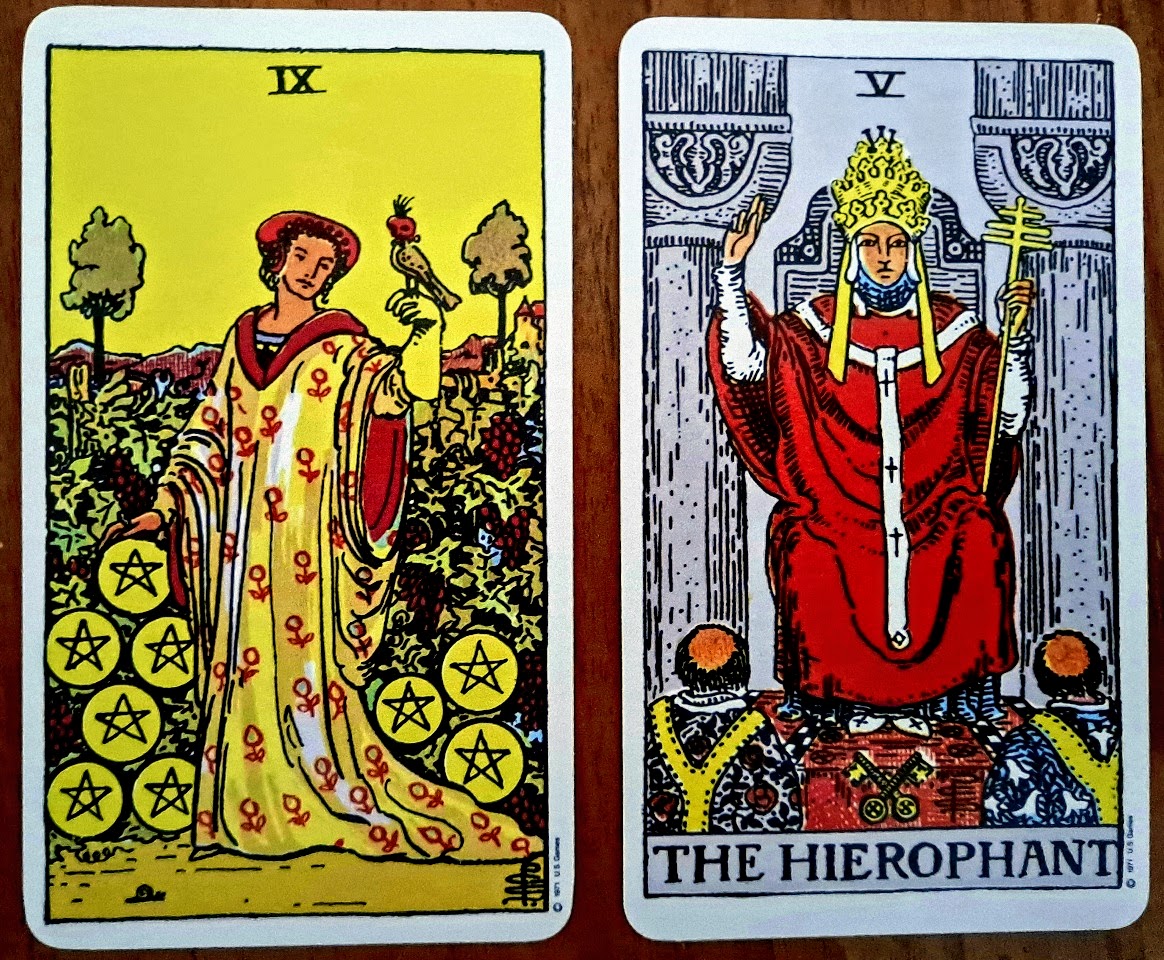
In today’s reading, the nine of pentacles tells me about my situation: a time of comfort and luxury, discernment and deep satisfaction. The hierophant tells me my challenge: to learn to embrace the conventional, at least some of the time; that it’s not necessary to always be unconventional.

Does that reading help me at all? Not particularly, though it does seem to have an element of truth. It did, however, give me a blog topic, which is a help. After 679 straight days of blogging (3,155 days total), a blog topic is not always easy to find.

***

Pat Bertram is the author of Grief: The Inside Story – A Guide to Surviving the Loss of a Loved One. “Grief: The Inside Story is perfect and that is not hyperbole! It is exactly what folk who are grieving need to read.” –Leesa Healy, RN, GDAS GDAT, Emotional/Mental Health Therapist & Educator

Air Quality Alert

We are under an air quality alert starting yesterday, continuing into today, and perhaps ending tomorrow. The bad air has nothing to do with anything around here — apparently, upper-level wind patterns are bringing in smoke from fires in states far to west of here, such as California and Oregon. Oddly, at the same time, we are under a flood watch, also not because of anything happening around here. We haven’t had much rain to speak of in months, though heavy rains in other areas of the state have pushed huge amounts of water into one of the local rivers.

It just goes to show that as isolated as we are out here on the eastern plains of Colorado, no place is really isolated any more.

Situations like this remind me of a bizarre conversation I had with a woman from my grief group in California. At the time, just like today, there were large swaths of wildfire in that state. I mentioned almost as an aside, that when I lived on the western slope of Colorado, a mere thirty miles east of the Utah border, I could always tell when fires were raging in California because of the strong smoke smell.

The woman became incensed, called me ignorant, and said that because of her science background, she knew that there was no way for me to smell smoke at that distance. I was flabbergasted, of course, and puzzled, not just because of her reaction to an innocent remark, but at how wrong she was. I don’t remember what exactly her background was, but I do seem to remember that although she wasn’t a scientist, she was telling the truth about her jobs having something to do with science. But she certainly wasn’t telling the truth about the inability to smell smoke that originated a thousand miles away. I explained about air currents, about jet streams, about wind, about all the ways smoke can be carried to distant places. I even mentioned studies showing that odors are made up of minute particles that bind to receptors in the nose, and that these particles can be blown in from far away, or merely waft in on a breeze.

Nothing I said made any difference. She continued to harangue me about her science background and my ignorance until I finally just shrugged and agreed that I didn’t have a science background, and refrained from mentioning the thousands of scientific books I’ve read.

Now that I live in an area that routinely gets inundated with out-of-state smoke, as well as the air quality alerts that result from that smoke, I’m frequently reminded of her and her utter belief that I couldn’t smell smoke that originated more than a thousand miles away.

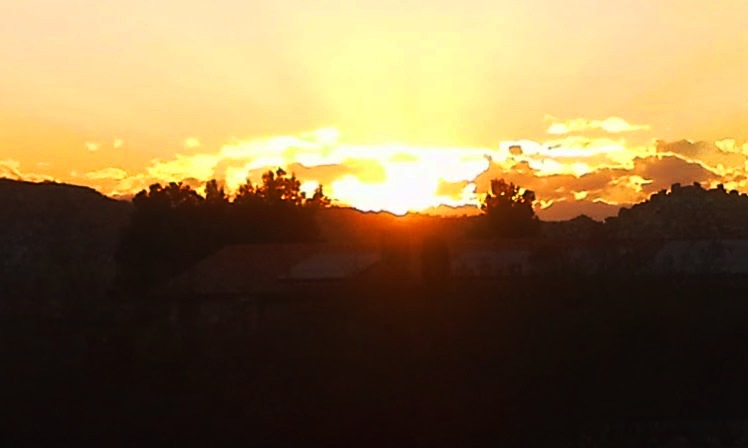
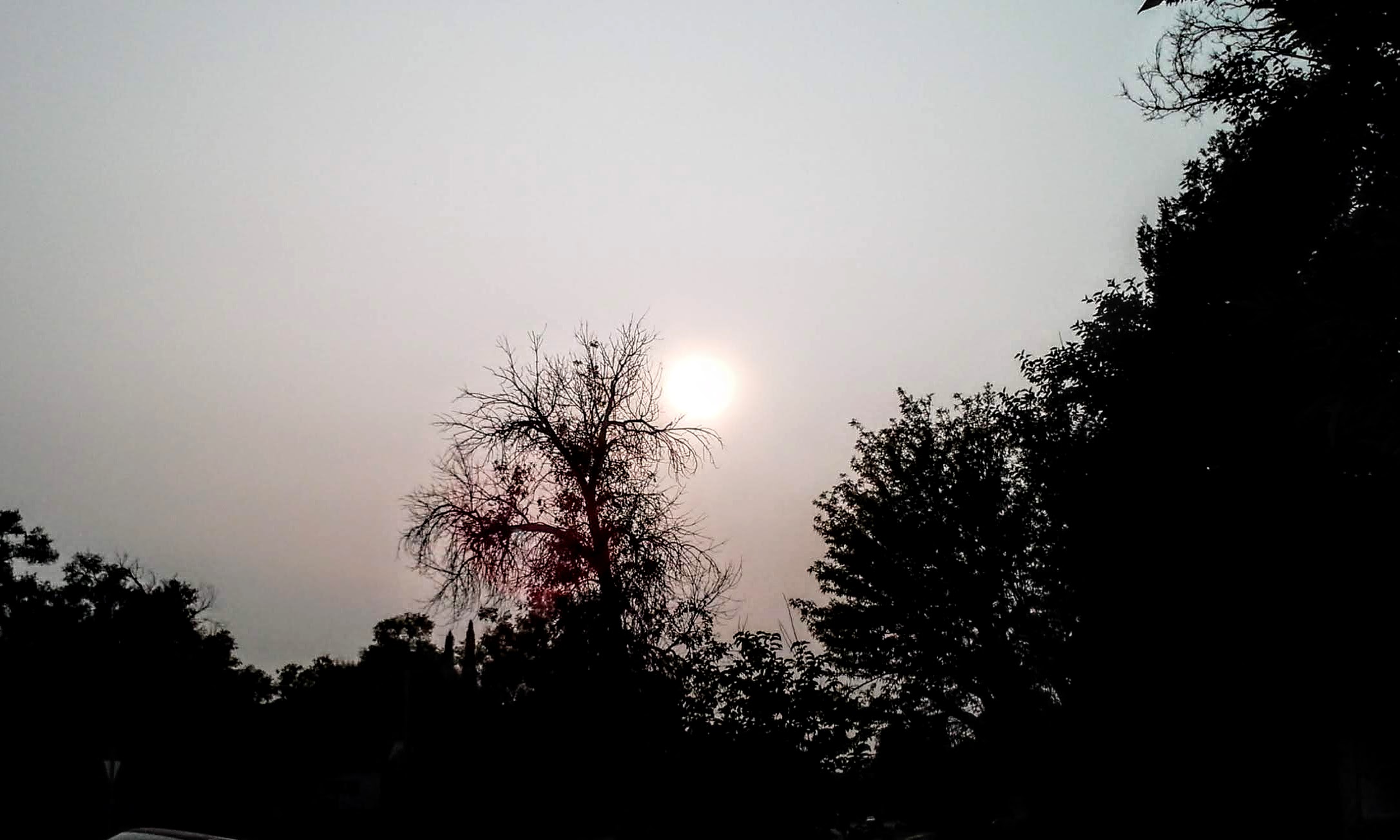
Incidentally, the fire in the photo is the sun as it was rising through the smoke this morning, and is not a result of an earth-bound fire.

***

What if God decided S/He didn’t like how the world turned out, and turned it over to a development company from the planet Xerxes for re-creation? Would you survive? Could you survive?

A fun book for not-so-fun times.

Click here to buy Bob, The Right Hand of God

Getting Over Grief

People often ask me how to get over grief, but the truth is (despite the title of this piece), we never get over grief for the simple reason that the person being mourned is gone for the rest of our life on Earth. Still, over time, the focus does change from the past and from our lost love to the future and perhaps a new love.

At the beginning, our focus — when it’s not on what we have lost — is about breathing. Taking one breath after another. Generally, breathing is simple. It’s something we do without thinking. But after the death of a person intrinsic to our life, such as a spouse or soul mate, it’s as if they took our breath with them when they left us, and breathing becomes something we need to focus on. A breath in, a breath out. Such a painful thing, those breaths! Adding to the complication is that so often we don’t want to breathe. We’d just as soon it was all over for us, too, and yet, we are compelled to continue taking those breaths.

As the years pass and the pain begins to subside, we hold on even tighter to our pain because grief is all that connects us to our lost love. During all those months and years, grief does its job, changing us into a person who can survive without the person we most loved. And gradually, a new love creeps into our life. Actually, I should say, a new focus comes into our life. Whatever it is that we find to focus on, it’s compelling enough to take our mind off our pain and sorrow and loneliness for a short time. And over the next months and years, all those “short times” add up. New memories are made. The past lessens its demands. The future becomes more compelling. And life goes on.

This new love or focus doesn’t have to be a person. It can be almost anything. Visiting museums. Hiking. Planning epic adventures. Yoga. Dance classes. Traveling. A new home. Gardening. For me, it was all of those things.

I tried so many things at the beginning. I wrote about my grief. I walked for hours. I visited museums. I went on day trips with people from my grief group. I took yoga classes. Sometimes, I could forget myself and my pain for minutes at a time, but nothing held. When the moment passed, I was right back where I started, in full grief mode.

It wasn’t until I started learning to dance that the focus lasted more than the moment. I started thinking about dancing, started practicing at home. Although grief didn’t leave me alone for long, it did start to lose its intense hold on me, and I could finally focus on something other than my loss and my pain.

As grief further eased its grip on me and I could sometimes imagine a future, I dreamed of — and planned — epic adventures. I was going to visit independent bookstores all over the country to see if they would sell my books. I was going to walk up the coast to Seattle. I was going to hike the Pacific Crest Trail. I was going to take a freighter to New Zealand. I was going to go on a year-long camping trip. I was going to drive cross-country in my vintage VW. I still have the research I did for all these adventures, but in the end, the only one I followed through with was my 12,500 cross-country road trip as well as a north/south trip along the western coast and several trips from California to Colorado.

A couple of years ago, I changed my focus yet again when I bought a house and found a place to call home.

And now, what I find compelling enough to propel me into the future is gardening.

I’m far enough away from my focus on grief that I seldom get snapped back to those early months, but for the first seven years, no matter how compelling my current focus was, I often found myself blindsided by grief.

I’m not sure how a person goes about finding a new focus. I tend to think that when a griever is ready, a new focus — a new love — appears, rather than needing to search for it, but however it happens, the readiness and the new focus are part of this process of change we call grief.

***

Pat Bertram is the author of Grief: The Inside Story – A Guide to Surviving the Loss of a Loved One. “Grief: The Inside Story is perfect and that is not hyperbole! It is exactly what folk who are grieving need to read.” –Leesa Healy, RN, GDAS GDAT, Emotional/Mental Health Therapist & Educator