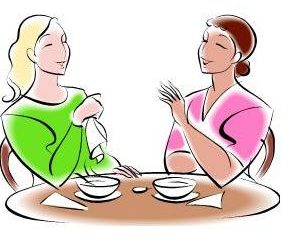
I made a new friend today. We’ve actually been friends (or at least friendly) for a couple of years, but until today, all of our conversations have taken place during transactions at her place of work. She’s retired now, so we decided to continue our friendship outside of the confines of her job.
I was going to invite her for tea at my place, but at the last moment decided it might be awkward, so I suggested we meet at Dairy Queen for coffee. I needn’t have worried. We had no problem talking about all sorts of things from The Bob to religion to the slap heard around the world. (Yep, even I and my sparse contact with the world at large heard about the slap.) In fact, in all that talking, we somehow forgot to order coffee. We’d like to make “having coffee” a weekly thing, but as my tea friends are aware, it’s often easy to let life get in the way and sometimes hard to make the effort. But we’ll see how it goes.
There were only two other customers in the restaurant most of the time we were there, a couple I thought I knew fairly well, but when they stopped to talk to my friend, they barely acknowledged me. Later, they came up to me, finally smiling in recognition. I wasn’t wearing a hat, you see, which is why they didn’t recognize me at first. It was cold when I walked to our meeting and so wore a stocking cap to keep my head and ears warm, and I took the hat off because it was too hot to wear inside. Apparently, “Pat in the Hat” isn’t easily identified when there isn’t a hat on her head. I didn’t purposely go to the D.Q on the Q.T., but if ever I do need to be incognito, I now know what to do — go hatless.
Still, the couple did eventually recognize me, and we had a nice chat before they headed out the door.
These three weren’t the only people I visited with today. On the way to Dairy Queen, I stopped at the bank and saw my contractor. We had a nice visit, catching up on each other’s news (nonexistent in my case) and talking about the work still needing to be done around my place.
I’ve often wondered what my social life will be like when my job inevitably comes to an end. I don’t want to go back to the senior center and play games. I don’t want to do the three-times-a-week lunches at the center or the once-a-month dinner put on by the churches. And, because of The Bob, it will be a long time before I am willing to be in a crowd or around a lot of strangers. I’m hoping, of course, to be able to have tea with friends more often, and perhaps if obligations aren’t tugging at me, it will be easier to make arrangements.
But then, going by today, I won’t need to do much of anything if I want to be social — just step out my door, do whatever it is I need to do, and chances are I’ll see someone I know. Of course, I’ll need to be sure to wear a hat so people will recognize me, but considering that warmer weather is coming, it’s a sure bet I’ll have on a topper.
***

What if God decided S/He didn’t like how the world turned out, and turned it over to a development company from the planet Xerxes for re-creation? Would you survive? Could you survive?
A fun book for not-so-fun times.
Click here to buy Bob, The Right Hand of God.














 Bertram's Blog
Stitches of Togetherness
January 30, 2022 — Pat BertramSmall talk — conversation about unimportant or uncontroversial matters — is a staple of my life now. When I visit with friends, we talk about small town life, ourselves, their pets and children and grandchildren, people we know. The only time I have a conversation about something more vital is if I know they more or less feel the same as I do because I simply have no energy to discuss anything anyone feels passionate about. Their passion for their beliefs about the “issues” of the day exhausts me.
For many years, I didn’t engage in small talk. At least not that sort of small talk. Jeff and I talked about everything that was important, both in our lives, in history, in health, in myth, in the world. We generally agreed, and if we didn’t, we’d discuss things, listening to each other without interruption, until we came to a middle ground. Mostly, though, through the decades, we formed our ideas in tandem. These ideas weren’t based on feelings but on in-depth reading (thousands upon thousands of books) on a multitude of subjects, including many things we didn’t necessarily agree with but wanted to know more about.
Then there was the other sort of talking we did. Small talk so small it wasn’t really small talk, more like the stitching that holds two lives together. You know the sort of thing I mean. Things said more or less in passing: “We didn’t get any mail today.” Or “I saw so-and-so today.” Or “They were out of something at the store today.” Or “I’m home!” Nothing of importance beyond the moment.
Several years ago, I wrote that one of the collateral aspects of losing a life mate was having no one to do nothing with. Although Jeff and I worked and played and talked for more than three decades, we often did nothing together. We were just there, a presence in each other’s lives. I’ve found other people to fulfill some of the roles he played in my life, such as someone to do something with, but I have no one to do nothing with.
I’m now realizing it’s the same with talking, and why I so often talk to his photo. I have people to talk with, both small talk and sometimes larger talk, but there’s no one around for the smaller than small talk. If I am sad or lonely, I can call someone, or I can go to the library and chat with the librarians while they check out my books, or I can do any number of things. But there’s no one around for the sub-small talk. I can’t call someone to say, “I didn’t get any mail today.” Just the effort to call would turn the idle comment into something it wasn’t meant to be and would give my not getting mail an importance it didn’t deserve. And yet, a shared life is made up of these passing comments, these “stitches” of togetherness.
Those stitches are another of the many things no one really notices until they are gone. In my case, other things were so much more overwhelming — not just the pain and angst of his being dead, but the silence of my life, the yearning for one more word or smile from him, the lack of someone to do nothing with, the stark aloneness of being alone (it’s completely different having alone times in a shared life than being alone in an unshared life).
When grief started leaving me, I became engrossed in other activities, such as dancing and traveling, moving from place to place and trying to figure out what to do with my life. So many of those activities are no longer a factor. I’ve bought a house and moved to my perhaps final home, so now the subtler and more permanent aspects of living alone after the death of a life mate are making themselves felt.
And apparently, this lack of “stitching” is one of those aspects.
***
Pat Bertram is the author of Grief: The Inside Story – A Guide to Surviving the Loss of a Loved One. “Grief: The Inside Story is perfect and that is not hyperbole! It is exactly what folk who are grieving need to read.” –Leesa Healy, RN, GDAS GDAT, Emotional/Mental Health Therapist & Educator.