Where Do We Go From Here?

I’m sure it won’t come as any surprise to those of you who follow my blog and my comments, but I am at a crossroads in my life. I’ve spent most of the past eight years learning to write, writing my four novels, studying the publishing industry, sending out query letters, dealing with hundreds of rejections, finally finding a publisher, preparing the books for publication, and then waiting for their release. Two of my novels have already been published and the other two will be published later this year — Daughter Am I in August and Light Bringer in November. Daughter Am I is in the proof stage right now, and I am doing the final edits of Light Bringer. (Have I mentioned how much I hate doing that? It’s the one phase of writing that I truly abhor — de-wasing the manuscript, getting rid of the justs and onlys, the ups and downs, and all the other extraneous words that only serve to dilute the story.)

Eventually though, the books will be put to rest — in readers’ hands, I hope. And then what? The overall theme for these four books has been public lies and hidden truths, but Light Bringer pulls it all together and kills the need to write any more on the topic. I do have another book in the works, which is about half finished. I thought I was writing a book about freedom vs. security, but it turns out that I write what I live, and so the book is really about change. Lots of changes. Perhaps the reason I haven’t been able to work on that particular manuscript is that I need to first rethink my journey as a writer and decide where to go from here.

Which brings me to tonight’s discussion. One thing I am rethinking is this group. Members come and go, though a few people have participated in most of the discussions. Considering the few participants recently, I’ve been wondering if I should disband the group, but the fact is, I still enjoy it. So, even if I end up monologuing, I will continue. But . . . should I restructure to make it more user friendly? Set it up at another time? Perhaps 7:30 to 8:30 pm ET? Change the focus of the discussions? We’ve talked about many different aspects of writing, but perhaps there are topics that you would like to discuss that we haven’t touched on. Perhaps you would like to post bits of writing for critiquing? (Though I have to tell you that I can’t really participate in such discussions — I no longer feel that I have the right to give my opinion about other people’s writing since I don’t follow the rules myself.) Also, I have become a bit self-conscious about asking people to host. It seems to be a bit of an imposition, especially since there are so few regulars. So do I continue doing that? Or do I post the discussions myself until someone volunteers?

Besides talking about where this group should go from here, let’s also talk about where we each will go from here. I know I’m not the only one at a crossroads. Some of you are getting published, others are doing the final revisions on their books or beginning the querying process. Still others are setting up new websites with a look to the future. Maybe together we can figure out the next step.

On Thursday, June 11, 2009 at 9:00 pm ET, the group No Whine, Just Champagne will discuss where we go from here, both as a group and as individuals. I hope you can make it. I’m interested in what you have to say. Everyone  is welcome to participate, and I hope you will!

Click here to join the live discussion: Where Do We Go From Here? If you prefer, you can leave your comments here on the blog. I would like to know where you are going.  

add to del.icio.us : Add to Blinkslist : add to furl : Digg it : Stumble It! : add to simpy : seed the vine : : : TailRank : post to facebook

Not Whining About “No Whine, Just Champagne”

Well, maybe I am whining a bit. I run a live chat group on Gather.com called No Whine, Just Champagne. We meet every Thursday at 9:00 pm ET for a live chat about writing. I have a few die hard members, but most of the original group has moved on to other activities. Some are still writing, but they don’t seem to have any interest in talking about it. Not that I blame them. I mean, after a while, what is there to say? You write or don’t. You try to better your craft or not. Either way, in the end, you can only write what is in you, and I’m not sure talking about it helps. Still, I enjoy the group, and I feel bad that it’s wasting away.

So, I am inviting you all to join the group. Actually, you don’t have to join the group to participate, though you do have to join Gather. Our discussion tomorrow will focus on where we want to go and what we want to accomplish as a group, and also where we want to go and what we want to accomplish as individuals. I hope you will stop by tomorrow night. Or tonight, depending on your time zone.

There are many writing discussions on the internet, but for sheer energy, you can’t beat a live discussion. So, please join us here: WHERE DO WE GO FROM HERE?

add to del.icio.us : Add to Blinkslist : add to furl : Digg it : Stumble It! : add to simpy : seed the vine : : : TailRank : post to facebook

Stream of Consciousness Blogging

I’ve often used this blog as a form of stream of consciousness writing, trying to work through story problems, trying to figure out who I am as a writer, basically just letting my mind wander onto the page, but now that I’m getting more than a few readers, I feel a bit embarrassed about it. People are kind, and they feel a need to respond to what comes across as an appeal, when it is mostly just me working things out. (I know that is gramatically incorrect, but it is correct in the context. It is me, and I am working things out.) So, do I still keep it up at the risk of alienating people? Or do I try to be more professional and do what other writers do — give tips on writing, give tutorials, and whatever else it is that they do?

The thing is, I no longer feel qualified to give people instructions on how to write or get published — or anything else, for that matter. I did not follow the rules I was expounding — though I do think I followed through with the major one: thou shalt not bore thy readers. So far, with all the comments and reviews I’ve received, no one said they were bored. Nor do I know how to get published by a major publisher. So all I can do is what I’ve done all along — whether it’s a book or a blog, or the short story I’m supposed to be writing but am not — try to write what only I can write.

Perhaps with all the focus on trying to conform to the wishes of the major publishers, writers lose their individuality, their voice, their uniqueness. And no, I am not condoning sloppy writing. No matter how iconoclastic we are, we still need to get our points across, and one does that with good grammar, great word choice, and proper punctuation.

I’m sure there are a few people out there laughing their heads off — we used to argue these points in the early days of this blog, with me taking the party line. Actually, I’m laughing, too. Who would have thunk it?

So what am I saying to me and to you with this particular bit of stream of consiousness blogging? Perhaps only this: write and have fun and worry about the rest later.

add to del.icio.us : Add to Blinkslist : add to furl : Digg it : Stumble It! : add to simpy : seed the vine : : : TailRank : post to facebook

30% of More Deaths Than One — Free at Smashwords

Both of my novels, More Deaths Than One and A Spark of Heavenly Fire are available at Smashwords. Smashwords is a self-publishing platform and online bookstore for indepedent ebook authors, publishers and readers. They offer multi-format, DRM-free ebooks, ready for immediate sampling and purchase, and readable on any e-reading device. (Kindle, Sony, Palm, Stanza, etc.) Many publishers (including Second Wind) are starting to use their services, which allows them to offer their books in all the ebook formats with little added expense. Why is this so important? As I’m sure you know, ebooks are the wave of the future, even for those traditionally slow to adapt to new technologies, such as the over 50 crowd. (Does this still hold true, I wonder? Most people I meet who enthusiastically embrace computers and the internet belong to that age group.)

The new demographics are:

  • People 50 or older are leading the way in adopting the Kindle, followed by those 18-34
  • People 35-49 prefer using their iPhones to read e-books
  • But most people (48%) are still using their computers or laptops to read e-books
  • While e-books are1.5% of the total book market, ebook sales grew 125% overall in 2008
  • E-book sales grew 183% among seniors aged 65+ and 174% among seniors aged 55-65

So whatever your choice of reading device — printed book, Kindle, Sony, computer — I’ve got you covered. (Do ebooks have covers? Perhaps that wasn’t as clever a word choice as I thought.) And, you can begin reading online immediately.

My Smashwords profile: Pat Bertram
Smashwords: More Deaths Than One
Smashwords: A Spark of Heavenly Fire
Printed Book: More Deaths Than One
Printed Book: A Spark of Heavenly Fire

add to del.icio.us : Add to Blinkslist : add to furl : Digg it : Stumble It! : add to simpy : seed the vine : : : TailRank : post to facebook

When Did the Realization “I Am a Writer” Hit?

The title of this bloggery is the topic of a discussion on Facebook hosted by Christine Husom, a fellow Second Wind author. My response was:

The realization that I am a writer hasn’t hit, and I’m not sure it will. I’m very involved with writing — I belong to various groups; I talk a lot about writing; and even when I’m not writing creatively, I’m writing: blogs and articles, comments and emails. But I don’t define myself as a writer. When you consider all that being a published writer entails — promotion, engendering good will, etc — writing is a small very small part of the whole.

Of course, when I’m accepting the Nobel Prize for literature a dozen years from now, perhaps then the realization will hit. (You do know I’m joking, right?)

A few people responded that of course I was a writer, and they are right — I do write, therefore I am a writer. I even have two books published. But the question was: when did the realization hit? And it never did. My journey to becoming a writer was a long, smooth (or almost smooth; let’s just forget about those 200+ rejections) journey from first draft to second, from second draft to edits, from edits to proof to copy-edits, from proof to finished book. I saw so many copies of my proofs that when I received the final book, it never struck me as being different from the proofs I’d struggled over. Even the demarcation between being published and not being published was smeared. A month or so before A Spark of Heavenly Fire and More Deaths Than One showed up in print, I noticed that they were available from Second Wind Publishing as ebooks. I don’t know how long they’d been on the site, but their availability made me a published author, and I wasn’t aware of it.

I’m sure if I was making a living off my writing, I’d define myself as a writer. And if I won the Nobel Prize, I might. But still  . . . I blog more than I write creatively, but I don’t call myself a blogger. I promote more than I blog, but I don’t consider myself a promoter. I sleep more than I promote, but I don’t call myself a sleeper. (Though some people might.)

But how I define myself isn’t the question. The question is: When did the realization “I am a writer” hit?  And my response holds true. I never did have that realization.

add to del.icio.us : Add to Blinkslist : add to furl : Digg it : Stumble It! : add to simpy : seed the vine : : : TailRank : post to facebook

No More Secrets

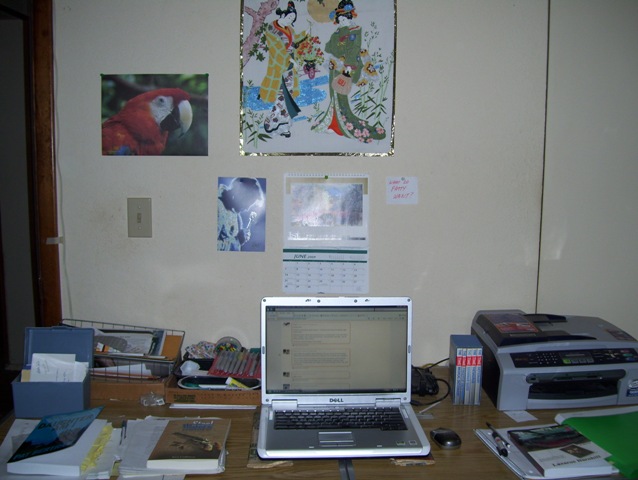
Ken Coffman, a friend from an online writing group left a comment on the thread:  Okay, Pat B, let me throw out a challenge. They say your work environment reflects the inner mind. So, let’s have a picture of your writing area, unedited. I thought it was funny that his book was sitting on my makeshift desk by the computer, so I took the photo and posted it to the group. His response: Okay, now we’re peering deep into your mind…yes, it’s all becoming clear. Few in the way of distractions. The desk can actually be seen in places. Laptop elevated by…newspapers? WIP. Card file. Geisha girl painting. Too late now, we know all, Ms. Bertram.

Why should he have all the fun? You might as well see the photo, then you, too, will know all. 

100_1046sm

To the left of the computer is Steel Waters by Ken Coffman. On the right of the computer is The Medicine People by Lazarus Barnhill. (I need to do a review of both books, which is why they are there.) The green folder to the right of that is my work in progress. The blue book way off to the left is the proof copy of my new book Daughter Am I, which will be published in July.

add to del.icio.us : Add to Blinkslist : add to furl : Digg it : Stumble It! : add to simpy : seed the vine : : : TailRank : post to facebook

A Whiff of a Treat and a Bit of a Cheat

One benefit of being published by a new, small independent press, is that you get to wear many hats. Second Wind Publishing is preparing an anthology of mystery/crime short stories to be released in September, and as a pinch-hitting copy editor, I get first look. I enjoyed Lazarus Barnhill’s novels, The Medicine People and Lacey Took a Holiday, so last night I printed out Barnhill’s story, “A Whiff of Murder” for a treat.

It’s been a very long time since I considered reading a treat. I still read prodigiously — it’s more than a habit with me, it’s akin to breathing — but I don’t necessarily enjoy it. (It’s like breathing polluted air, you need it, but it isn’t something you look forward too.) But I was right  –- “A Whiff of Murder” was a treat. It’s a fun story, with great detecting,  a touch of irony, and good characters (Barnhill brought back Robert Vessey from The Medicine People). All in less than 5,000 words.

Now I have to figure out how to write my own story. I have a beginning, though it’s a bit of a cheat. I wrote it for an online writing challenge —  to hook readers with the first 650 words of a novel. Since I had no intention of ever writing the novel, I just tossed out the most preposterous scenario I could think of. It wouldn’t really make a good novel — the humor would wear thin — but it would make a good short story. So now all I need is a middle and an end. And a touch of mystery. Or a crime. And some suspense. Hmmmm. Should be fun.

You’re welcome to join the fun. Second WindPublishing is sponsoring a short story contest, and the winner will be published in the anthology. You can find the information here: Murder in the Wind.

Let me know how you do. Maybe together we can figure out how to write a short mystery worthy of publication.

add to del.icio.us : Add to Blinkslist : add to furl : Digg it : Stumble It! : add to simpy : seed the vine : : : TailRank : post to facebook

Becoming Pat Bertram

I finally understand why books about writing suggest writing the first draft of a novel as quickly as possible, to forget the mechanics and just get the story on paper or in the computer. I’ve never been able to do that — the words come hard to me (or perhaps I enjoy the search for the right word too much). Either way, it takes me a long time to write a book. I also write longhand, which limits the number of words I can write at a sitting. Still, my work-in-progress has been taking longer than normal. In fact, I’ve been playing around with it on and off (mostly off) for more than two years.

I just finished typing up what I have written so far — 39,000 words. Very good words, actually. The book started out as a humorous apocalyptic fantasy, metamorphosed into horror, then turned into allegory (which is sort of ridiculous, because who reads allegory nowadays?) but it seems to have gradually swung full circle and become humorous again. I found myself laughing aloud at times, which is something I seldom do when reading, and never before at anything I wrote.

I’m anxious to get back to writing — the story deserves to be told. (And I hate the thought of wasting those hard won words.) The problem is, I am not the same person today as I was when I conceived the story. I’m not even the same as I was in January when I last worked on the book. The past two years have been filled with changes — learning how to use a computer, learning the Internet, finding a publisher, learning how to promote (or rather trying to learn), to say nothing of the wonderful people I have met and the friends I have made. It’s been a life changing experience, this becoming Pat Bertram, author.

So the question is, do I continue writing the book as I conceived it, do I try to wing it, do I do what I’ve been doing all along — writing when and what I feel like? A more important question that haunts me is that my first four books had a particular theme — how public lies and hidden truths affect our lives — and I have said what I wanted to say about that. So where do I go from here?

I don’t write short stories, but Second Wind is going to be putting out an anthology in September, and my publisher is tying to talk me into submitting a story. (You can submit one too. Second Wind is sponsoring a contest, and the winner will be published. You can find the details here: Mystery Contest.) So that will allow me to put off working on my manuscript for a while (which I’m sure is not what he had in mind), but eventually I will have to decide what I want to write. What I want to say.

In the end, it will depend on who Pat Bertram becomes. And of that, I haven’t a clue.

add to del.icio.us : Add to Blinkslist : add to furl : Digg it : Stumble It! : add to simpy : seed the vine : : : TailRank : post to facebook

Tips For Writing a Short Story

Second Wind Publishing is putting together an anthology of mystery/crime stories, and my publisher told me that my fans expect a story from me. My fans? All two of them? I doubt they’d care. Still, I considered writing a handful of 100-word stories, but to be honest, it’s hard to write a mystery in so few words. By the time I kill someone off, drop some clues, create a dectective to figure out who did the dastardly deed and why, I’ll have used up 100 words several times over.

Thinking perhaps it’s time to expand my literary horizons — all I’ve been writing lately are blogs, comments, and emails — I decided to give a short story some thought. But how does one write a short story? I went looking for tips, and found this great list at Happy Woman Magazine:

Never write about what you know, that would be boring. Instead think of an interesting skinny person that you know and try to imagine their life.

Use the word therefore a lot. It gives the impression that you have thought things through and therefore gives you an air of authority. (See what we mean?)

If you have trouble coming up with an ending or tying up loose ends pretend it was all a dream.

Your hero (or heroine) should have an interesting quirk or a dark mysterious past. They should also have blazing eyes when they are angry.

Don’t worry about spelling or grammar, that is what an editor is paid to do. You are an artist.

Though these suggestions are supposed to be funny, it did help me. I don’t want to write a mystery story, but I could write a spoof of one, or if not a spoof, something silly. Should be fun. Still, I’d have to follow the real tips for writing a short story, which are:

Have a clear theme.

Use only a few characters, and give them the characteristics they need to help develop the theme.

Make sure you have an arresting beginning, a solid middle that builds to a crisis, and a plot twist at the end.

Keep focused within a narrow time span, and make every word count.

You can find a good study on how to write short stories here: Short Stories: Ten Tips for Novice Creative Writers.

Now that you know how to write a short story, why don’t you write one and submit it to the Second Wind Publishing Mystery Contest? It could be your chance to get published!

add to del.icio.us : Add to Blinkslist : add to furl : Digg it: Stumble It! : add to simpy : seed the vine : : : TailRank : post to facebook

Pat Bertram And Lazarus Barnhill Discuss Writing as Destiny

Lazarus: The other day I was marveling at the uncanny string of events—starting with a writing contest on Gather.com—that brought me many wonderful new friends, saw the publication of my first two novels and empowered me to express my artistic vision in ways that I never imagined. When I read Julia Cameron’s book, The Artist’s Way, I began to wonder if in fact what I saw as a lucky string of chance events was really a matter of listening to a still, small voice that has always intended better for me than I could have imagined for myself.

In a nutshell, Julia Cameron says that, whether you call it destiny, the hand of God, or just the creative direction of the universe itself, our purpose is to create and we allow ourselves and others to stymie our creativity.

Bertram: Are we really fulfilling our destiny, though, or does it just feel like it? The solar system seems to be designed perfectly, with the planets constantly moving, yet staying out of the way of the other planets. But it wasn’t always so. At one time they were banging and crashing into all sorts of space debris, and over billions of years they annihilated everything in their path to end up the ordered system we know. So, is our writing destiny the same? Something we see only in retrospect, perhaps, with our brains trying to make sense of chaotic events?

Lazarus: Do you think when you write that you are fulfilling an essential aspect of your truest purpose for existing?

Bertram: I do think the universe itself is a creative power that we tap into, and that we are creative by nature. But . . . if we are all fulfilling our natures as writers, who is fulfilling their natures as our readers? Writers need readers, and now that there are (supposedly) more writers than readers, how can writing really be our destiny? Except personally, perhaps.

Lazarus: Cameron teaches two “sacred acts” in The Artist’s Way. The morning pages (3 pages you write when you first get up in which you allow your inner self to freely express itself) and the artist’s date (essentially, you have to have 2 hours a week in which you go off by yourself and do exactly what you want).

When I first started doing the morning pages, I was correcting my spelling and changing my word choices. All of that was stymieing the child inside me; and if I don’t let that child have a say, he disrupts whatever the grown up Laz wants to do

Bertram: Three pages when you first get up in the morning, just to express yourself? I never could understand how people can dash off the pages like that. It takes me an hour or two to write a single page. I try to be more spontaneous in my blogs, just to let the words and feelings flow, but it still takes me more than an hour to write 300+ words.

Lazarus: Whoa, Pat, sounds as if you’re a “blocked creative”

Bertram: Blocked creative? Maybe I just don’t have any ideas. Or maybe my inner child likes to play with words and sentence structure.

Lazarus: Well, seriously, what would happen if you just started describing how you were feeling at the given moment?

Bertram: Usually when I sit down to write I don’t feel anything but peace. Not a whole lot to say about that. And when I do let the words roll out, I usually end up with a silly character interview or something equally worthless except as a blog post. I really don’t have a lot to overcome. I figure my inner child is my outer child. Pat Bertram was two years old on May 17th. That’s when I started from scratch to create myself as an author rather than just a writer.

Most of my inner demons I let out while writing my first book. I don’t usually acknowledge it as my first book — it was too much me and not enough creativity. To say nothing of terrible writing. Still, it did help me work through the past and allow me to re-emerge as . . . still don’t know, actually. I’m still emerging.

Lazarus: How many stories do you currently have swirling around in your cerebellum?

Bertram: None. I know you don’t believe it, but it’s true. If I had any stories there, I’d be writing them.

Lazarus: How do you know when you’ve heard a worthy idea for a new novel?

Bertram: I don’t know. Mostly I have to put several ideas together. And I don’t have any ideas right now.

Lazarus: Do you often suffer from long “dry spells” in which you don’t have anything to write or you don’t know how to get started?

Bertram: Is it a dry spell if you don’t feel like writing? Or if you’re doing something else instead, such as promoting? Even when I’m writing, I have more non-writing time than writing time. I need to let things percolate.

Lazarus: Yes, I call it “marinating.” How long does it usually take for your stories to percolate. Do they progress in stages?

Bertram: Definitely stages. Even when I know where I am going with a story, I seldom know the details.

Lazarus: But I have the sense that you’re implying you can’t promote and really write creatively. Is that right?

Bertram: I have a one-track mind

Lazarus: But not obsessive?

Bertram: No, not obsessive. I just can’t commit to two projects at once.

Lazarus: Have you ever had the experience of being so hooked, engaged in a story that you turned your back on other pursuits just so you could write?

Bertram: No, not really.

Lazarus: You’ve completed four novels, though you told me Light Bringer is going through a final polish. How long do each of these projects take and usually how much time elapses between them?

Bertram: Light Bringer has been ongoing for eight years. Or thirty-eight if you include the research. It won’t be completely finished until it’s published later this year.

Lazarus: Thirty-eight years of research? So you’re bringing your entire life’s experience to bear on this piece.

Bertram: Yes. Everything I ever learned. And studied. Daughter Am I was the quickest — outlined in one day, written in a year. A couple of months usually elapse between books, mostly so I can type them up. I write long hand.

Lazarus: Pat, does the average reader perceive the deeper messages you conceal in your stories?

Bertram: I don’t know. The books are written so that even if they don’t see anything beyond the basic story, they should still like them. At least that’s the plan.

Lazarus: Had to back up and start over when you said that. So you acknowledge then that your books function at differing levels of depth; that there are meanings to be fathomed that someone reading just for enjoyment might miss?

Bertram: It’s possible that there are meanings people will miss. Heck, I missed some of it! When I proofed A Spark of Heavenly Fire, I saw themes that I didn’t put in there.

Lazarus: You didn’t put there? Is it fair to say that a really well written book will plumb emotional, human themes beyond the writer’s intention? And that’s what’s happened with your books?

Bertram: When a story flows, when everything is motivated, it makes sense that some ideas, emotions and themes show up that aren’t planned. If the characters are true, it has to happen. I am not saying that the characters do things that I don’t plan. Their actions are completely planned. But some underlying truths could emerge.

Lazarus: This is the contradiction in you that is so mysterious: you talk about being methodical, plodding, taking years to write a single piece; and yet at the same time you admit that the story flows from a place deep within you and parts of it emerge unannounced.

Bertram: I have a dual nature: half mystic, half logician.

Lazarus: Did you ever think that you are really “discovering” the story: that some mystical intentionality has dropped the clues of the story in your consciousness, in your experience and intended you to find them and fashion them together?

Bertram: Of course.

Lazarus: Then writing these stories is your destiny?

Bertram: So this is what you were leading up to.

Lazarus: It’s not like you didn’t see it coming.

Bertram: I don’t know if the stories are my destiny, but I do think they wanted to be written.

Lazarus: Yes! Wanted to be written. They wanted to be written by you. And I like the notion of “half way.” They came to you in pieces and only half conceived. They were waiting for you to complete them.

Bertram: But it’s also possible that mystical intentionality is myself.

Lazarus: Okay, that’s a realistic point of view.

Bertram: One thing that’s always puzzled me is that when I sit down to write, my mind goes blank. Other people can write a book a month. They can let the words flow. I have to dredge each word out of my mind. Yet, when my books are finished, there is an inevitability about them as if they were inspired, not perspired (at least it seems that way to me). But I don’t believe that they are “destined.” It’s all the little choices I make along the way that creates the inevitability. When you start writing, you have the entire world to choose from, but as you make choices — genre, setting, characters, plot, etc, etc, it narrows the story world and keeps narrowing it until it seems inevitable. Yet it all comes from the thousands of choices that we made.

Lazarus: I have one other question about the way you create these stories: is it possible it takes so long to write them because it is mentally strenuous for you to overcome your own internal resistance to writing?

Bertram: It’s possible. Yet when I started writing, I had nothing to overcome. I wanted to do it. It was only when I had four unsalable books that the logician in me decided it was silly to keep writing.

Lazarus: So now that you’re published (and selling! Unsalable my eye) can you tell the logician to take the back seat? Though Julia Cameron wouldn’t call it your logician. She would call it your Censor.

Bertram: Right now, the logician really doesn’t have anything to do with it. My problem is I don’t write books I know how to write. I have to learn how to write each book. And the one I’m doing now has me totally flummoxed. It’s truly a ridiculous project. Three distinct parts with distinct themes.

Lazarus: What? I thought you said you didn’t have a story rolling around in your head.

Bertram: It’s not in my head. If it were, I’d be writing to get it out of my head. It’s an incredibly silly/mystical/apocalyptical story. I started it when I thought I couldn’t get published — decided that I would write something totally unpublishable.

Lazarus: “Totally unpublishable.” (translated) “I’m writing this just for myself and the beauty of writing”?

Bertram: For something to do.

Lazarus: Oh, you are so perverse!

Bertram: After I started writing it, I got a computer and had to learn that. Then I got the internet and had to learn that. Then some idealistic publisher (Second Wind Publishing) decided to publish my books, so I had to learn how to promote.

Lazarus: Something else I want to explore. First let me ask if you saw Spielberg’s “Minority Report”?

Bertram: No.

Lazarus: Spielberg is to filmmakers what you are to novelists: intentionally convoluted. He makes these incredibly compelling movies and critics totally don’t even get them.

Bertram: I am not intentionally convoluted!!!

Lazarus: Okay, if you were an intentionally convoluted person and someone called you on it, wouldn’t you say you weren’t?

Bertram: You’re right, an intentionally convoluted person would not say they were convoluted, unless of course it would make them seem doubly convoluted by agreeing that they were.

Lazarus: But we need to tie this back in to your particular talent we’re talking about tonight. In the same way as “Minority Report,” More Deaths Than One is incredibly full of irony. It’s a very gratifying novel, even as it surprises the hell out of you.

Bertram: I’ve been wanting to ask you for months. When we talked that time, I asked if you were disappointed in More Deaths Than One, and you laughed and said no. Why the laugh?

Lazarus: . . . So I’m wrestling. Shall I let you off the hook by letting you ask me a question? Okay, but I won’t stay distracted for long. I laughed because the book was totally unexpected. I knew when I first read the initial chapter during the TruTV Search For the Next Great Crime Writer contest on Gather that it was written lights out. Where you took it in terms of 1) character development; 2) plot twists (I love plot twists); 3) ironic subthemes; and 4) emotional gratification was truly gripping and surprising. I laughed because anyone who knows anything about writing would know how good it is.

Bertram: Tell that to the 200+ people who rejected me.

Lazarus: Steinbeck submitted 40 novels (different novels) before he had one accepted. This says more about the publishing industry than you. Now back to the task at hand: “The devil in Ms. Bertram.”: Your romance vignettes that were published in Love Is On the Wind are the most ironic, humorous and biting pieces I think I’d ever read — but undeniably focused on romance. Beneath them one sensed an incredible bittersweetness. So my question is, why did you write like that? I guess what I mean is, you are a true romantic at heart — but I don’t think you believe in romance.

Bertram: I thought I was just trying to put a twist on a story.

Lazarus: So, what, you think I’m falling for that?

Bertram: Well, you silence me. I have no idea how to respond to that.

Lazarus: Either that or I got a little too close to home.

Bertram: Could be. But I never thought of myself as either romantic or unromantic.

Lazarus: Let me ask it in a more friendly way, . . . thinking . . . How about this: in your heart, there are things you want to say to romance readers, but you don’t really think they’ll hear them. Yes or no.

Bertram: I don’t know, but I don’t think so. I don’t like category romance. I think the stories are generally too trivial to be truly romantic.

Lazarus: Ah — there it is. If what you had written had been logical, dispassionate, then the answer would’ve been “no.” The answer is “yes.”

Bertram: Huh?

Lazarus: What you want to say is, “don’t trivialize love; go deeper.” Right?

Bertram: I guess. I read many books that are well written, but they leave me cold because in the end the stories are trivial. Love shouldn’t be trivial, but they make it so.

Lazarus: Okay. In your two published novels, you manage to take the subject of romance and examine it in a plethora of meaningful ways: pure attraction; devotion in the face of great hardship; true love lost and then recognized for its falseness; rescuing disguised as love. Yet despite the quality of the loving relationships you examine in your stories and the romantic element that is clearly present (and there is nothing trivial about them), you haven’t really give us a romantic story yet.

Bertram: The very first book I ever wrote was supposed to be a romantic story of love that transcended time and physical bonds, told with sensitivity and great wisdom. I quit a job when I was young to write that book, discovered I had no talent for writing and no wisdom, so twenty-five years went by before I tried writing that book again. That’s the one that I don’t acknowledge as a book. Someday I’ll get back to it. I know the basic story, but don’t know how to say what I want.

Lazarus: Have you read my novel Lacey Took a Holiday? It’s an intentional convolution of romance. As we would say in classical literature, “romance turned back upon itself.” The characters are both extremely flawed: the girl is a drunken prostitute; the guy is a bitter, widowed war veteran. They begin their relationship when he kidnaps her out of a brothel.

Bertram: I read it. It’s profoundly moving. The theme that I mentioned earlier that I saw in A Spark of Heavenly Fire was the theme of love in all its guises. You use that theme in your books, too. It’s especially apparent in The Medicine People, though the book is being sold as a mystery, like mine.

Lazarus: Yes, love in all its guises: you make Pippi an incredibly sympathetic character when it would have been so easy to turn her into someone we intensely dislike.

Bertram: Pippi was supposed to be the character I hated. It was supposed to be a silly sub-story about the unattractive woman getting what the attractive one didn’t. A childish theme, really.

Lazarus: Pippi embodies the woman searching for love. She ends up discovering that the only love she can trust is self-love. Suppose you wrote a sequel about Pippi. What would happen to her?

Bertram: I don’t know what will happen to Pippi. Haven’t thought about it.

Lazarus: I never realized it until now, but there is a tremendous comparison between the two women in A Spark of Heavenly Fire. It cannot be characterized simply the way you did: beauty loses out to plain. That’s what the unaware reader will get out of it. It’s much deeper than that. The women drive the story. It’s their strength that carries the day in the face of the plague, the atrocities and the recovery.

Bertram: Yes, the women drive the story. I wrote the book to prove a quote by Washington Irving: There is in every true woman’s heart a spark of heavenly fire, which lies dormant in the broad daylight of prosperity, but which kindles up, and beams and blazes in the dark hour of adversity.

Lazarus: I would like to share another thought about your writing — both your ability and what you’ve achieved. Let me preface it by saying that I’m no critic — which is to say that I really do understand literature as opposed to formulae. I feel what authors are saying in addition to recognizing the beauty in the way they say it.

Thus I feel the need to point out what you might not even acknowledge: you have a marvelous ability to write the longest parables in all of literature. A parable unglues the world as it is perceived and rebuilds it in a wiser and more beautiful way. That’s particularly true in A Spark of Heavenly Fire and even more so in the ironic, visceral More Deaths Than One.

Bertram: Again, you’ve silenced me.

Lazarus: You know, some writers will tell you that they treat their stories/books like children. You don’t do that. It’s something more than that with you. It’s metaphysical. A mystic statement.

Bertram: No, they’re not my children. One thing I have to believe: that these books will find a readership. That they have enough substance for people to talk about them. Do you think that’s possible?

Lazarus: I think your books are really mainstream books. The real difference between a mainstream book and a genre book is that a mainstream book intends to have something of merit to say. I think, with your books, there are several important realities: 1) They’d make damn good movies — which is to say they have great popular appeal and people will read them; 2) They could be studied in literature classes, and in that respect people will talk about them and discuss and learn; 3) I think to really, really get the lessons at the heart of your books you have to be a worldly, mature person. So if I say that people will have a lot to talk about in your work, I’m really implying all three of these things.

Bertram: This has been the most unlikely discussion.

Lazarus: Thank you, Pat, for the conversation. I look forward to being a writing colleague of yours. In the years to come, I anticipate reading many new works that evolve from that place where you have no new ideas, works that really do lurk in your inward being.

See also: The Most Unexpected Truth About Writing