Rubicon Ranch: Secrets — My Newest Chapter

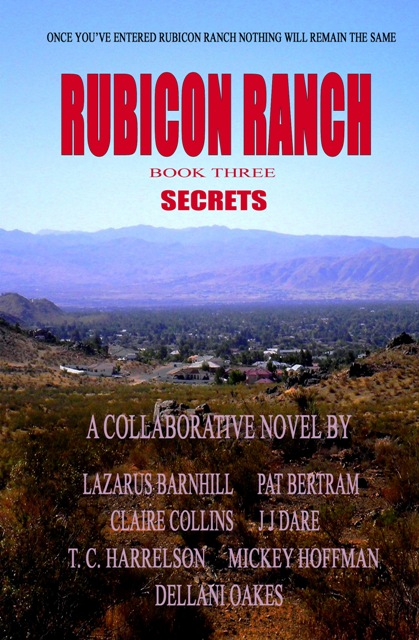
RRBookThreemidsizeRubicon Ranch is a collaborative and innovative crime series set in the fictional desert community of Rubicon Ranch and is being written online by the authors of Second Wind Publishing.

In the current story, the  body of a local realtor is found beneath the wheels of an inflatable figure of a Santa on a motorcycle. The realtor took great delight in ferreting out secrets, and everyone in this upscale housing development is hiding something. Could she have discovered a secret someone would kill to protect? There will be suspects galore, including a psychic, a con man, a woman trying to set up an online call-girl service, and the philandering sheriff himself. Not only is the victim someone he had an affair with, but he will also have to contend with an ex-wife who has moved back in with him and a jilted lover, both with their own reasons for wanting the realtor dead.

We hope you will enjoy seeing the story develop as we write it. Let the mystery begin! Whodunit? No one knows, not even the writers, and we won’t know until the very end! If you don’t want to miss further chapters, please go to the blog and click on “sign me up” on the right sidebar to get notifications of new chapters.

(If the Christmas theme seems unseasonal, well . . . considering how long it takes to write a book at the rate of a chapter a week, in a few months, the season will catch up to us!)

Chapter 15: Lydia Gavin
by Pat Bertram

Sunday, December 23, 5:25pm

Seth sat tall behind the desk in his tidy office, like a king receiving a subject. “What are you doing here?”

Lydia Galvin leaned back in the uncomfortable metal chair and gave the sheriff a serene smile, surprised to find that she felt no fear at facing him. “Your deputies brought me here.”

Seth glowered. “You know that’s not what I meant.”

“You want the whole story? I needed to get some groceries, so I walked up Delano Road to where I’d parked my car, and apparently your deputies found it and staked it out, because even before I could unlock the door, they jumped out of their vehicle, arrested me, and brought me here.”

“They didn’t arrest you. They just offered you a ride. I wanted to talk to you.” Seth gave Lydia one of his oh-so-familiar looks, the one that said she meant no more to him than an annoying insect.

“How did you know I was in the area?” Lydia kept her voice neutral, not wanting to seem confrontational. No point in arousing the beast in him until absolutely necessary.

“We checked out the bystanders’ videos of the burning crime scene, and there you were.” He drew in a quick breath as if upset with himself for responding. “But you’re supposed to be answering my questions. What are you doing in Rubicon Ranch?”

“Having fun. It’s quite a spectacle out there, you know.” Lydia crossed her legs, and felt a flash of satisfaction when he cut a glance at her thighs. All that running since she’d been fired had paid off—she now had the body she’d always wished for.

He remained calm, but his thinned lips and tensed shoulders told her how much that unruffled air cost him. “Why did you come to Rubicon Ranch?”

“Why do you think I came? To see what other lives you were ruining, of course. I had no intention of staying, I just wanted to check out Melanie Gray—according to the newspapers you two were quite a team—but then I met Nancy and when she let slip that you and she were sleeping together, I thought I’d hang around to see how you got out of that affair when it turned against you.” Lydia made a show of inspecting a fingernail. “I guess I’m lucky. You only ruined my career. Poor Nancy ended up in the morgue.”

“You think I killed Nancy?” Seth cocked his head like an eagle and stared at Lydia for a moment. Then he nodded. “I see. You think that by accusing me, I will assume that you’re innocent, because if you believed I killed her, then you couldn’t have.”

“Did you kill her?” Lydia waited for an answer that didn’t come. “She would have ruined you. She loved nothing but herself and power and money. She loved secrets, too, of course, but only because the secrets gave her power over people and were a source of great income. She said she used to be an actress and a model, but once when we had a few drinks, she admitted that was a front. She’d really worked as a call girl. I figured she gave up the life when she realized how much more lucrative secrets were than her body.”

Seth rose to his feet and paced the office. “You say she would have ruined me. Like you ruined me?”

Lydia forced out a small laugh. “I ruined you? No. You manipulated me. You began by treating me as if I were the most important woman in the world. You flattered me, paid attention to me, offered me words of love and the endearments I hungered for. When I was hooked, you stepped back, left me feeling bereft. And every time I spoke of leaving you, you’d pay attention to me again.” She felt tears beginning to gather behind her eyes. He doesn’t matter. Think of fire. Flames. Heat.

She drew in a deep breath, surprised Seth didn’t jump in to defend himself. He kept pacing the office as if she weren’t even there, which made it easier for her to confess. “You were my grand passion. I know you don’t believe that, but it’s the truth. I never expected you to leave your wife. I just wanted you to notice me. To put me first once in a while.”

Seth stood over her, his eyes icy as they locked onto hers. “But you turned me into the department. Said I misused my authority.”

“You did abuse your authority. I never wanted an affair with you. I had enough trouble with my husband. I didn’t need another abusive man in my life. You never knew about my husband, did you?” Lydia didn’t even try to modulate her bitter tone. “The great detective never noticed that his girlfriend had a husband who beat her. I wouldn’t have told your wife about us. Even though I threatened to tell her, I couldn’t have made our affair public. My husband would have beat me when he found out. And after you dragged your wife to my house so she could confront me, my husband did beat me. I had to go to the emergency room that time. But oh, no, everything that happened was my fault.”

“Good story,” Seth said. “Too bad none of it is true.”

“The all-wise Seth Bryan says it isn’t true, so that means it isn’t true?” Lydia shook her head sadly. “The law might be about what you can prove, but life isn’t like that. Some things are true no matter how much we don’t want to believe them.” Things like her husband’s abuse. Things like Seth’s disregard. Things like death and fire. “You men are all so blind you can’t see what’s in front of your eyes. I loved you but you threw me away, calling me a vituperative bitch. Yet Nancy, who didn’t love you at all and who truly was a vituperative bitch, you kept. But I’m through with all of you now.”

Seth sneered. “Turning into a lesbian?”

“That’s beneath even you, Seth, my love.”

“True. Perhaps the only true thing you’ve said today.” The phone rang. Seth took two long strides to the desk, and grabbed the receiver. “Yes?” A pause, then, “She’s home now? Stay there. Make sure she doesn’t leave. I’ll be there in just a few minutes.”

He hung up the phone, and turned to face Lydia.

She quirked her lips in an unamused smile. “Still on your wife’s leash? I’m surprised you haven’t killed her, too.”

“Just go,” he said wearily. “Keep my office informed of your whereabouts. We still have lots to talk about.”

Lydia rose, straightened her skirt, and settled the strap of her purse firmly on her shoulder. “There’s nothing left to say but good-bye. I didn’t kill Nancy. You did. But don’t worry, I won’t testify against you.

***

Pat Bertram is the author of the suspense novels Light Bringer, More Deaths Than One, A Spark of Heavenly Fire, and Daughter Am I. Bertram is also the author of Grief: The Great Yearning, “an exquisite book, wrenching to read, and at the same time full of profound truths.” All Bertram’s books are published by Second Wind Publishing. Connect with Pat on Google+

How Careless of Me to Have Lost Him

I don’t usually say I “lost” my life mate/soul mate. I just come right out and say that he died, but for some reason I used the word “lost” when explaining my situation to a new acquaintance. She said, “Whenever people tell me they lost someone, I want to say ‘how careless of you.’”

I didn’t take offense. She didn’t directly tell me I was careless, just said that was her inclination, and besides, I too have railed against the word “lost.” I didn’t misplace him. He died. But her words struck a chord with me. I do feel at times as if it were careless of me to have lost him. I should have loved him more, cherished him more, held him so tightly that death could not have wrested him from me.

And yet, I did love him that much for most of our shared life. About twenty years ago, he almost died, and afterward I gave thanks for every day I had with him, cherished every moment knowing how fleeting life could be. For many years he endured ups and downs with his health, and finally there were only downs. During those last few years, I did more things by myself in preparation for the time when I would be alone. I took long ambles, went on trips, found new solitary interests. And this became our life — he dying, me struggling to live.

During those final years, and especially the last one, he turned into a stranger, and I didn’t know how to handle it when he pushed me away except to keep my distance. He was unable to hold thoughts in his head long enough to carry on a conversation, so instead of dialogue, I got only repetitious monologues from him. I bristled at his words, sometimes even clenched my fists to keep from venting my frustration. I didn’t know what was happening to him, to us, and I didn’t know how to stop it.

Now, of course, I know what happened (inoperable kidney cancer that spread to his spleen, to his lungs, to his bones, to his brain), and I think how careless of me to have let one of those final words slip past unappreciated, to have let one moment of our togetherness pass unnoticed.

I was lucky, though. During his last weeks, we reconnected, and I remembered why I had loved him all those years. Once again I cherished every moment we had together, but when he took his final breath, I let him go. He’d been in pain for such a long time, and even if it had been in my power, I would not have kept him here to suffer more.

I’ve worked through my guilt and regrets. I even understand the dynamics of our last years together and realize we both did the best we could in an untenable situation, but still I wish I could go back and capture every one of those words I so carelessly let slip away.

***

Pat Bertram is the author of the suspense novels Light Bringer, More Deaths Than One, A Spark of Heavenly Fire, and Daughter Am I. Bertram is also the author of Grief: The Great Yearning, “an exquisite book, wrenching to read, and at the same time full of profound truths.” Follow Pat on Google+. Like Pat on Facebook.

For Love of the Story

I watched For Love of the Game last night, but a different version than the one that was released in theaters or on tape or DVD.

My deceased life mate/soul mate was sick for many years, and one way kept himself busy when he hadn’t the strength to do much else was to tape movies. He started with our favorites, then went on to taping good parts of bad movies, and finally edited movies that we didn’t like. (It’s rather amusing — he turned a few dreadful serial killer movies into sweet romances by ending the movie before the charming killer showed his evil side.)

baseballThe problem we both had with For Love of the Game was the constant intrusion of the backstory. Billy Chapel is pitching the last game of his career and he keeps stopping to reflect on his past — detailed flashbacks that would take up more than a few seconds between his pitches. Would fans in the stands really care that he was pitching a perfect game if he spent most of his time on the mound staring glassy-eyed into the past? Would he really be able to “clear the mechanism” so easily if his mind wasn’t on the game?

My version is told in chronological order, from the meeting of the girl in the beginning to the remeeting at the end. When Chapel is pitching, then, his pauses are short, and seem more evidence of exhaustion than anything else.

So why am I mentioning this? I’ve been working sporadically on my novel about a grieving woman. A few years ago I wrote many scenes or parts of scenes, and I’m trying to figure out the best way to arrange the scenes and tell the story. As it stands right now, the story begins when the funeral people deliver the urn with her husband’s ashes, which is a good place to begin. (In a classic beginning, either a stranger knocks on the door or the character goes on a trip.) The only trouble is, there is a vast backstory that needs to be told, which is okay because it is about a woman grieving, after all, and much of grief is about unwinding the backstory, figuring out who you are, where you are, and how you got to that point.

Sometimes — most times, actually — stories need to be told in chronological order. It might serve my story better if I began when the husband got sick. It would show her dealing with his illness and would explain how she ended up in love with someone else while her husband was dying. This way, there would need to be only a few mentions of the past, such as when the met, what happened to her parents, etc, and not the constant intrusions into the past that are required if I were to start with the knock on the door.

But . . . a gun plays a role in the story. Finding the gun and eventually discovering the significance of the gun makes the grieving wgunoman realize that she put so much of herself into the marriage, and if she doesn’t know who her husband is, then how can she know who she is? If I told the story chronologically, the gun wouldn’t show up until the middle of the book, and it would lose its significance.

I suppose the best thing for me to do is to forget about the chronology and just type up the scenes. Afterward, if necessary, I can edit the book and put everything in chronological order. Either way, it’s all for love of the story.

***

Pat Bertram is the author of the suspense novels Light Bringer, More Deaths Than One, A Spark of Heavenly Fire, and Daughter Am I. Bertram is also the author of Grief: The Great Yearning, “an exquisite book, wrenching to read, and at the same time full of profound truths.” Follow Pat on Google+. Like Pat on Facebook.

Help! I Need a Guest Blog Topic

I’ve been invited to write a guest blog for UniteWomen.org. This is a huge honor since the Facebook group alone has more than 80,000 fans, so of course I said yes. To be honest, though, I would have said yes even if they honly 800 “likes” — I’m a big fan of the woman who asked me, and I appreciate the work she does to help empower women.

Oddly, I’ve never felt disempowered as a women, perhaps because I seldom define myself by gender, religion, nationality, age, or any other consideration. I am simply . . . a being in flux. I have felt powerless at times, but not because of being a woman. The powerlessness came from being in situations greater than my abilities. Sometimes I developed the necessary abilities, other times I simply endured. Either way, somehow I moved beyond the powerlessness and here I am — still strong, still developing my abilities, still learning to empower myself.

(Grief was one of those situations where I felt powerless, but I embraced the experience and endured.)

I have a third way of getting through situations greater than my abilities, such as my current inability to decide on a blog topic — I ask my blog readers for their input.

The woman suggested several topics for the guest blog:

  • Anything relating to women’s rights, gender equality, your identity as a woman (in and/or out of the romantic partnership).
  • Re-establishing your identity as a woman after the loss of your partner.
  • Lessons learned — anything that would empower or inspire other women.
  • How writing can be very healing and that you would recommend it to anyone who has gone through trauma.
  • How female friends supported you through grief.
  • Whatever you want to say to 80,000 women who are struggling for equality.

She also suggested a post about women judging and criticizing other women, like those who told me to “get over it” when I was grieving, but I don’t want to do that one. Sounds too antithetical for the blog.

Do any of these topics strike you as being more interesting than the others? Or is there another topic besides those listed that I should consider doing?

***

Pat Bertram is the author of the suspense novels Light Bringer, More Deaths Than One, A Spark of Heavenly Fire, and Daughter Am I. Bertram is also the author of Grief: The Great Yearning, “an exquisite book, wrenching to read, and at the same time full of profound truths.” Follow Pat on Google+. Like Pat on Facebook.

What Next for Bertram’s Blog?

In three weeks, I will be celebrating the six-year anniversary of this blog. I will also be celebrating the two-year anniversary of daily blogging. (Two years ago, I responded to a challenge to blog for 100 days, and I just kept going.)

My first post on September 24, 2006 was tentative, a mere dipping of my pen in the metaphorical ink of the blogosphere. All that post said was:

Am I an aspiring writer? I have written 4 books, rewritten them, and will continue rewriting them until they are perfected.

No. I am not an aspiring writer. I am aspiring to be a published writer.

untitled2Not a bad statement of intent for a new blogger. In the beginning I wrote about my struggles to find an agent or a publisher, my attempts to learn all I could about how to become a bestselling author (still don’t know — drats!), my efforts at establishing my online presence. In the beginning, I used no photo of me, just an initial. I still hadn’t decided if I wanted to use a male pseudonym or any pseudonym at all. I’d also started writing a new novel that I now call my work-in-pause since it’s been sitting there, half-finished for almost six years. Later, after I found a publisher, I talked about my newly published books, and when ebooks, Kindles, and self-publishers burst on the scene, changing the face of publishing forever, I wrote various blog posts about the publishing industry, trying to make sense of it all and trying to find my place in the clamor

Three and a half years ago, my soul mate died. His death catapulted me into a world of such pain, that it bled over into this blog. My grief posts became not so much a way to escape, but a place to try to make sense of what I was going through, to offer comfort and be comforted, to find my way to renewed life.

This blog also helped me to re-establish my life as a writer because, after all, blogging is writing, too.

It’s nice to know that whatever life threw at me, whatever problems I encountered, whatever challenges came my way, this blog was here for me.

But now I don’t know where to go with my life, and I don’t know where to go with this blog. Except for occasional grief updates or excerpts from my book: Grief: The Great Yearning, I’ve said most of what I wanted to say about grief. And there’s nothing more to be said about the publishing industry. It has changed beyond my comprehension, so there’s no point in my writing about it. Besides, there is too much controversy still, with militant self-publishers jumping on anyone they think is casting aspersions on the phenomena. And there is too much controversy with sharing writing tips. Every time I tell what I have learned, other authors stomp on my words, proclaiming that it’s an author’s right to make up the rules. I just am not a contentious person, and I don’t like being pulled unwittingly into such imbroglios.

So, I have three weeks to decide if I want to continue daily blogging or if I want to go back to the way I started, just blogging when I had something to say. I need to decide what, if anything, I have to say — maybe I’ve said it all.

In the end, I’ll probably decide not to decide, and just keep on blogging. It’s become a way of life.

***

Pat Bertram is the author of the suspense novels Light Bringer, More Deaths Than One, A Spark of Heavenly Fire, and Daughter Am I. Bertram is also the author of Grief: The Great Yearning, “an exquisite book, wrenching to read, and at the same time full of profound truths.” Connect with Pat on Google+. Like Pat on Facebook.

An Open Letter to Militant Self-Publishers

Dear Militant Self-publishers:

It’s time to lay down your swords. The war has been won. Very few people care any more if the books they read are self-published or not. There are probably more self-published authors making a living by writing than traditionally published knightwriters, which mean you sell a whole lot of books.

If someone accidentally or even purposely impugns all self-published writers, let it go. Stop brandishing your swords as if this is some sort of war or civil rights movement. People have a right to their opinion. Some readers have been burned by buying poorly edited self-published books, and it is their prerogative to stay away from self-published books if they wish. There are way too many books on the market for anyone to read them all, so each person has a right to set their own parameters. It is also their prerogative to say so publicly.

And oh, while I’m at it, please stop comparing yourself to Dickens and John Grisham and other iconoclasts. These self-published authors from previous eras went against the flow of publishing, arranging to have the books printed and selling copies by hand. Being self-published today is about going with the flow. There are millions of you. You are an army with no enemy.

So just lay down your swords, take off your armor, and enjoy what you have accomplished.

***

Pat Bertram is the author of the suspense novels Light Bringer, More Deaths Than One, A Spark of Heavenly Fire, and Daughter Am I. Bertram is also the author of Grief: The Great Yearning, “an exquisite book, wrenching to read, and at the same time full of profound truths.” Connect with Pat on Google+. Like Pat on Facebook.

Ah, the Difference a Comma Makes!

One of my recycled blog posts was published in an ezine today, and apparently people are more interested in insulting me than in reading what I wrote.

The article was about striving for clarity in writing. I wrote;

There seem to be two vociferous groups of writers nowadays:

1. Self-published writers who insist that they can do everything their way without regard to grammar rules, publishing conventions, and even readers.

2. Writers who want to be published by the major publishing houses, and who scrupulously follow every dictate in the hopes it will bring them the acclaim they strive for.

ReadingI described each of the groups and ended by saying that the truth of good writing lies somewhere in the middle of those two groups.

Very simple, right? Wrong.

One self-published author commented: Bracketing all self-publishers as people who ‘do everything their way without regard to grammar rules, publishing conventions, and even readers’, is not true Pat, and you know it! If your point was merely to be controversial, you have certainly achieved it. Your obvious prejudice against self-publishers in general has done you no favours, believe me. Yes, some do ignore the rules, but then there are people like myself – best selling self-published authors who do obey the rules…

Another wrote: Your categorising writers into two groups is just plain silly. It smacks of snobbery and a failure to comprehend reality.

Huh? Doesn’t anyone read?

First, even if I believed self-publishers are all bad writers, which I don’t, I would never publicly come out and say it. Too many self-publishers are militant, fighting a battle that has already been won, and it’s simply not worth getting into the fray.

Second, I listed two “vociferous” groups. Those who strive for good writing are not vociferous. They simply write without insisting that their way is the right way.

Third, if you will notice, I did not say all self-published writers. I said “self-published writers who insist they can do everything their way.” If I meant all self-published writers, I would have written “self-published writers, who insist they can do everything their way”.

Ah, the difference a comma makes!

Maybe next I need to write an article about striving for clarity in reading.

***

For those of you who don’t understand the comma rule:

In the sentence “Self-published writers who insist that they can do everything their way”, the clause “who insist that they can do everything their way” does not have a comma before it, which means it’s a restrictive clause. It restricts the subject “Self-published writers” to those who insist they can do everything their way. Leaving off the comma means that the clause is an integral part of the subject, that the subject does not stand alone.

If I had meant all self-published writers, I would have used a comma. The comma would have alerted readers that the phrase “who insist that they can do everything their way” was a non-restrictive clause — merely a parenthetical remark describing all self-published writers, and it could have been removed without changing the meaning of the sentence. But, I did not use the comma. Hence, I did not make a sweeping generality that took in all self-published writers. The comment referred to a select few vociferous writers.

In my experience, those who insist they can write however they wish without regard to rules are self-published or plan to be, so my sentence as I wrote it was not pejorative. Writers who wish to pursue a different avenue of publishing know they have to follow the rules of whatever publishing company or agent they are trying to impress, and they will not vociferously proclaim they can write however they wish without regard to rules.

***

Pat Bertram is the author of the suspense novels Light Bringer, More Deaths Than One, A Spark of Heavenly Fire, and Daughter Am I. Bertram is also the author of Grief: The Great Yearning, “an exquisite book, wrenching to read, and at the same time full of profound truths.” Connect with Pat on Google+. Like Pat on Facebook.

Good Grammar is like Good Etiquette

I often hear new writers and self-published writers say that it’s okay not to follow the rules. That they can write however they want. That it’s more important to be creative than to be pay attention to grammar. That they need to break new ground.

Um. No.

Certain rules are necessary because they help clarify our writing and convey to the reader exactly what it is we want them to understand. I admit that in many cases readers don’t care. They just want something to titillate them. (How else can one explain the success of the appallingly awful 50 Shades of Gray?)

gift2Still, good grammar is like good etiquette. It’s a matter of respect. You might not think it necessary to thank someone for a gift, but that someone sure think it’s necessary. Besides, it’s the right thing to do, especially if you want them to continue sending you gifts. (Good grammar is also like good etiquette in that both are considered old fashioned and unecessary.)

I’ve given up trying to read self-published books because it’s too hard to weed the good books from the bad ones. So many self-published books seem to have been thrown in the Amazon river without any editing. If those authors don’t have the courtesy or respect to make sure the book is readable, then I certainly see no reason to give them the gift of my time and money. (Yeah, I know — it’s a different world out there. Many writers post a draft on Amazon and use reviews to find out what needs editing.)

A common problem involves wrongly used participial phrases that end in ing. According to The Elements of Style by Strunk and White, a participial phrase at the beginning of a sentence must refer to the grammatical subject.

The example Strunk and White give is: Walking down the road, he saw a woman accompanied by two children. Who is walking? He is, of course, since he is the subject of the sentence, and the ing phrase always refers to the subject. If the woman is walking, you have to rephrase the sentence: He saw a woman, accompanied by two children, walking down the road. You, I’m sure, would never have to worry about who is walking because you’d never use such an ambiguous sentence in the first place!

The other examples of wrong phrases Strunk and White give are humorous and show why it’s important to follow the rule (the parenthetical comments are mine):

Being in dilapidated condition, I was able to buy the house cheap. (If I was in dilapidated condition, how did I have the strength to buy the house?)

Wondering irresolutely what to do next, the clock struck twelve. (Hmm. The clock wondered what to do next? Smart clock!)

As a mother of five, with another on the way, the ironing board was always up. (Wow! That’s a lot of ironing boards!)

In case you don’t know how to rephrase the above sentences, here are my quick efforts:

Because of the dilapidated condition of the house, I was able to buy the place cheap.
As I wondered what to do next, the clock struck twelve.
A mother of five, with another on the way, I was never able to put the ironing board away.

Another ing problem comes from simultaneous actions, when an author has a character do something that’s physically impossible. For example: Pulling out of the driveway, he drove down the street. He cannot be pulling out of the driveway at the same time he’s driving down the street. He pulled out of the driveway, then drove down the street.

I know you know all this, but such sentence structures do slip into our writing. It’s up to us to wring the “ings” out of our work, and show respect for our readers.

***

Pat Bertram is the author of the suspense novels Light Bringer, More Deaths Than One, A Spark of Heavenly Fire, and Daughter Am I. Bertram is also the author of Grief: The Great Yearning, “an exquisite book, wrenching to read, and at the same time full of profound truths.” Connect with Pat on Google+. Like Pat on Facebook.

It Is What It Is

I talked to a friend today about the various problems we are facing in this, our fourth year of grief, and she said, “It is what it is.”

Robert Hartwell Fiske calls such sayings “quack expressions,” saying they “readily explain behavior that the dimwitted otherwise find inexplicable, and justify attributes that they otherwise find unjustifiable.”

He’s right to a certain extent, and yet . . .

My friend is anything but dimwitted. She, like me, is struggling with life, death, grief, change, and other life experiences that are inexplicable to everyone, dimwitted, brightwitted, or somewhere in between. Sometimes it truly is what it is, quack expression or not.

Desp077cite what the positive thinkers and those who believe we create our own reality profess, much of life is beyond our control. We don’t decide who lives and dies. We can’t choose who we love or despise (though we can choose what we do with those feelings). We can’t always help people who need to be helped. We can’t hurry along or slow down natural processes, such as childbirth or old age. Nor can we recreate the world to suit our desires. The sun always rises in the eastern sky and sets in a westerly direction. The moon always affects our world, though  myths tell of a time before the moon came to stay. And, as they say, time and tide wait for no man. (Though I suppose, being a woman and not a man, I should be able to sway such natural phenomena.)

It is what it is.

Lately, I’ve been struggling with a couple of situations that are not of my making, that I have no control over, that don’t affect me in a primary way (besides tearing me apart by conflicted loyalties). I can’t solve any of the problems that have arisen, can’t walk away from them, can’t change anything. All I can do is realize each situation is what it is, and let it go as best as I can. (It helps to realize that in a case of divided loyalties, my loyalties belong to myself.)

In my writing, of course, I stay away from such expressions since I like my writing to have a tinge of elegance, but life is not always elegant.

It is what it is.

***

Pat Bertram is the author of the suspense novels Light Bringer, More Deaths Than One, A Spark of Heavenly Fire, and Daughter Am I. Bertram is also the author of Grief: The Great Yearning, “an exquisite book, wrenching to read, and at the same time full of profound truths.” Connect with Pat on Google+. Like Pat on Facebook.

Open Sesame!

I had lunch with a friend today, and she asked if I was writing anything, so I told her the story of my grieving woman, one of the two moribund works I’ve been slowly resurrecting.

It was gratifying to see her rapt face as the story unfolded, and her attention gave me a boost of ambition to finish the story. To be honest, though, I don’t need the boost — I’ve been enjoying working/playing with the manuscript.

I say working/playing, because it isn’t work — work connotes toil and energy expended with perhaps a monetary reward at the end, and though I have been working on the book, it hasn’t been work. More like puzzle play. I wrote many of the scenes a few months after my life mate/soul mate died, attempting to deal with my grief and record the pain before I NaNoWinnerforgot some of the particulars. It’s been long enough now that the pain is mostly a faint and bewildering memory, so working on the book, even the agonizing scenes, isn’t a hardship.

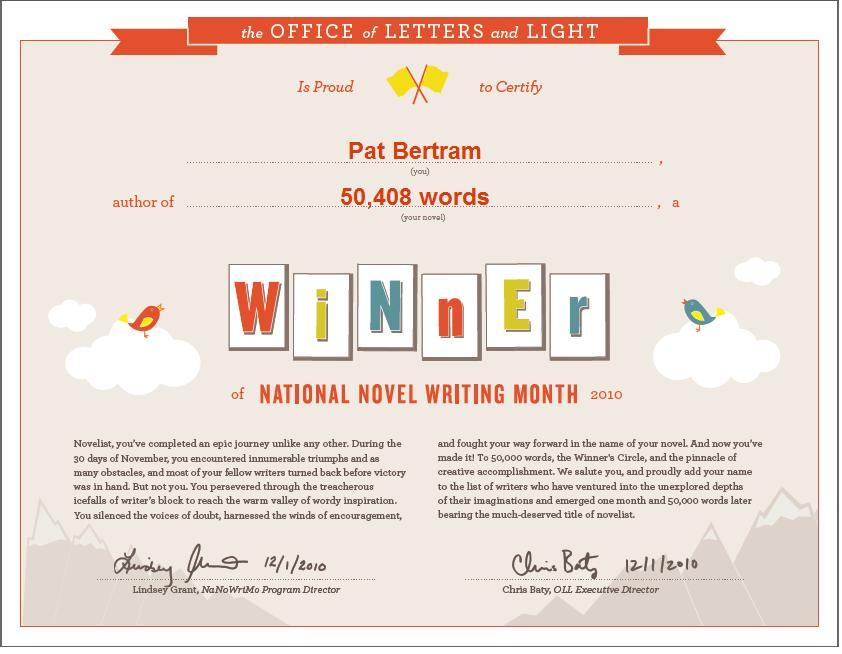
I started the novel as a NaNoWriMo project to see if I could meet the challenge of 50,000 words in a month. Despite being a slow writer, I did complete the required number of words, though to do so, each day I had to write whatever scene came to mind. I have a stack of scenes that have to be put into some sort of order before I do the difficult scenes, the fill-in sections, the transitions, the descriptions — all the parts that are hard for me to write but need to be included. That could take a while, since I only have about 40,000 words, which falls short of a full novel.

Now, however, I am typing up what I’ve written and trying to put the pieces of the puzzle together. For example, I have a flashback scene that shows her dying husband laboriously filling page after page with what looks like his daughter’s name, and he keeps talking about his “sesame.” (Like my life mate/soul mate, the poor guy is not able to find the correct words to say what he means.)

In another scene, my grieving woman checks his computer to see if she can find his estranged mother’s address so she can notify her of her son’s death, and she comes across a file labeled “journal.” She clicks on the file, curious, because she’d never known him to keep a journal, and finds it password protected. Though she tries all the passwords she’s known him to use, she can’t open the file.

Now here’s the problem — which scene should come first? The sesame flashback or the journal scene? “Sesame” of course, is short for “open sesame,” which is what his poor cancer-addled brain is calling a password, though she doesn’t know that. If the sesame flashback came first, would it be obvious when the journal scene comes around that he’d been trying to figure out the password? If the journal scene comes first, would it be obvious when the sesame flashback comes around that he’d been trying to figure out the password?

Oh, that all my problems should be so insignificantly significant!

***

Pat Bertram is the author of the suspense novels Light Bringer, More Deaths Than One, A Spark of Heavenly Fire, and Daughter Am I. Bertram is also the author of Grief: The Great Yearning, “an exquisite book, wrenching to read, and at the same time full of profound truths.” Connect with Pat on Google+. Like Pat on Facebook.