Interview With a Character

Three years ago when I was deep into my own grief, I started writing a book about a grieving woman. It’s been so long since I worked on the novel that while I remember the story, I don’t remember everything I wrote. Today I discovered something interesting. (Interesting to me, anyway.) Apparently one day I couldn’t think of anything to add to the story, so I interviewed the character. Here’s part of that interview:

Pat: Who are you?

Amanda: I don’t know. Isn’t that your job? To create me?

Pat: I was hoping you’d do it for me. Writers always talk about how their characters take over and do things the writers never intended. It’s never happened to me, but I thought perhaps this time things would be different.

Amanda: Different? Why?

Pat: Because you’re me. Or part me. The character of a grieving woman is based on me since I only know grief from my point of view, but the story is not my story. Well, it is my story since I’m writing it, but it’s not the story of my life. That part is made up, though I’m hoping some deeper truth will emerge from it.

Amanda: What sort of truth?

Pat: Hey! Who’s the interviewer here? I’m the one who’s supposed to be asking the questions.

Amanda: But you’re the one with the answers. So how can you be the one asking the questions? And anyway, you’re evading me. What sort of truth are you looking for?

Pat: The true sort. The universal sort. A truth that will mean something different to everyone who sees it.

Amanda: Clear as a bell.

Pat: Good thing you’re not the writer—clichés are so passé. But we’re getting off course here. Will people believe that a woman grieving her husband can love another man? Won’t they think that new love negates grief?

Amanda: Seems as if it’s your responsibility as a writer to make people believe what you want them to believe.

Pat: The problem is that you’re boring. How do I make you interesting? I mean, you sound like a whiner, always screaming, “I can’t do this.”

Amanda: But if you notice (and you should since you’re the one who wrote it), every time I say I can’t do something, I do it. Isn’t that the point you’re trying to make, that I don’t know who I am? That even though I’m in my fifties (cripes, couldn’t you have made me forty-something? Fifty sounds so old), I’m a chrysalis, or maybe I mean I’m in a chrysalis. I’ve been alive a lot of years, but never lived. I’ve defined myself by other people — first as a daughter, then wife, mother, and now cyber-lover. I need to learn how to define myself by myself, to find my home within me now that David’s death has stolen my home from me. He was my home, not the manse we lived in for the past fifteen years. I have to leave the manse, too, since I’m no longer the preacher’s wife. And anyway, the church is selling it.

Pat: I never asked you if you wanted to be a preacher’s wife. Would you rather be a different character? A cop, perhaps, or a CEO?

Amanda: I don’t know what I want to be — isn’t what the story is about? Me finding out who I am? A coming-of-age in middle age story? For that purpose, a preacher’s wife is as good as anything. Also could explain why I led such a sheltered life. A CEO probably wouldn’t have defined her life by her husband’s life. A preacher’s wife, by definition, defines her life by his.

Pat: I just thought of something — how about if I make you the preacher?

Amanda: Wouldn’t work story wise. I wouldn’t get kicked out of the manse when David died, I wouldn’t have defined my life by his, and I’d probably have been too busy to have an online affair. Until David got sick and was forced into idleness, he never had much time. I guess I’m stuck being the preacher’s wife until we can figure out who I will become.

***

Pat Bertram is the author of the suspense novels Light Bringer, More Deaths Than One, A Spark of Heavenly Fire, and Daughter Am I. Bertram is also the author of Grief: The Great Yearning, “an exquisite book, wrenching to read, and at the same time full of profound truths.” Follow Pat on Google+. Like Pat on Facebook.
A Novel About a Grieving Woman

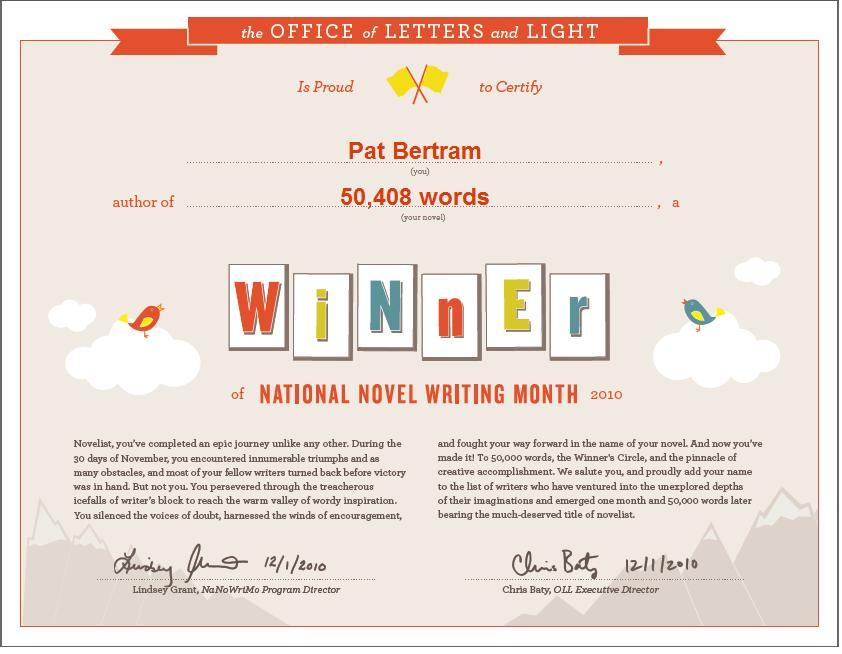
Several months after the death of my life mate/soul mate, I participated in the National Novel Writing Month. I’ve never seen the point of NaNoWriMo — if you want to write, write. You don’t need to be part of an international campaign to foist more hastily written tripe on an unsuspecting public. Still, in an effort to deal with my grief, I’d been trying all sorts of new things, and NaNoWriMo seemed like a challenge. I’ve always been a slow writer, and I wanted to see what would happen if I wrote without regard for any sort of cohesiveness or literary merit. Other people who had participated told me that when you let NaNoWinneryourself go, wonderful things happened, which, in my case, was not at all the truth.

Still, I did finish the word count. (And forgive me if I add that I see no benefit to counting words. What difference does it make if one person can write 10,000 words in a day, while another can only write 100?) What I mostly ended up with at the end of the month were disconnected scenes of a novel about a grieving woman. I wanted to get the emotion down on paper before I forgot the horror and agony of new grief, and that I did.

Well, now I’m typing up those long-fallow pages, and it’s been a surprise. The angst is there, but so is humor. How did I manage to write anything but the most sorrowful prose while still in the depths of grief? For example, here is a passage I typed up this morning:

Amanda made her way to the buffet table. The merry widows were huddled together, poring over the selection.

“Make sure Paula brings her meatballs to my funeral lunch,” Jackie said. “Katherine’s lime mold is something I’d just as soon not see.”

“You wouldn’t see it anyway,” Muffie cackled. “You’ll be dead. I like a good Jell-O mold, especially with marshmallows. Put that on my list.”

“Buffalo wings are my favorite,” Barb said. “They’re messy, so be sure to bring some of those wet wipes. Everyone will be dressed in their best, and I don’t want the men remembering me by stains on their ties.”

Amanda slipped away from the three long-time widows before they could see her. No way could she deal with them today. Usually she saw them as the fairy godmothers in the Disney version of Sleeping Beauty—brightly dressed, rotund, and into everyone’s business—but today they struck her more like the witches in Macbeth.

Would she become like them now that David was gone, with nothing better to look forward to than her own funeral? But there was Sam . . .

Okay, so it isn’t laugh-out-loud funny, but it is a lighthearted respite from the rest of the story. I wonder what other gems I’ll find that I’ve forgotten?

At the time I conceived the story, I wasn’t sure where to go with it — hence the disconnected scenes — but I don’t think I need to go anywhere with it other than finishing what I already have: a grieving widow, an angry daughter, a cyber lover, a gun, and hints of evil-doing by the dying husband (a preacher, incidentally, who supposedly led an exemplary life.) Sounds like an interesting story!

***

Pat Bertram is the author of the suspense novels Light Bringer, More Deaths Than One, A Spark of Heavenly Fire, and Daughter Am I. Bertram is also the author of Grief: The Great Yearning, “an exquisite book, wrenching to read, and at the same time full of profound truths.” Follow Pat on Google+. Like Pat on Facebook.

Another Stage of Waning Grief

Yesterday I wrote about how I am now feeling three and a third years after the death of my life mate/soul mate. I admitted I wasn’t feeling much. My life seems empty. There’s no oomph. No spark.

I wish I wanted something, was in love with something, felt something besides ever-fading sorrow. But I don’t know how to go from where I am to where I need to be.

And it’s not just me who feels this way. From the comments and emails I received, it seems as if many others who also lost their mates in 2010 feel the same as I do. Some people who lost their mates that year are in new relationships, have done something opening roseequally significant to jump-start their life, or have children to raise by themselves, but unless fate intervenes, the rest of us have to figure out how to accomplish a new beginning by ourselves. And we haven’t a clue how to do it.

I basically live the same way now as I did when I was coupled, but what took on significance when it was for “us” seems lame when it’s just for me. It’s not that I don’t think I’m worthy — of course I do because I am. It’s more that when the two of us were together, everything we did somehow seemed to help build our shared life. Every idea seemed to expand “us.” Every finished project seemed to fulfill “us.” Even something as simple as jointly preparing a meal was for “us.” Each of those things was also an act of love, a commitment to each other, even if it didn’t seem so at the time, which made them doubly or triply significant.

Now a meal is just a meal. A project finished is nothing more than a task completed. A bright idea is simply blog fodder.

If I were new, starting out in life for the first time, none of this would be a problem since everything is new and exciting when one is young, but I’ve done most of what I wanted to, or at least tried to do it. To be honest, the things I wanted to do were essentially cerebral — reading, researching, thinking, writing. I haven’t traveled the world but never wanted to. Haven’t lived lavishly but see no need for it. Haven’t partied till I dropped but never had the energy for it. I have done volunteer work but now there’s no cause I’m passionate about. (I’m still doing volunteer work, but it’s mostly online, so it doesn’t do much to give me something to live for.)

It’s possible this oomphlessness is simply another stage of waning grief — it generally takes four to five years to fall in love with life again (assuming one was ever in love with life) and most of us 2010ers are still many months away from that magic number. If this is the case, the emptiness will disappear by itself once I’ve come to term with it, or it will metamorphose into another equally confusing phase.

But it’s also possible this is what my life is, in which case I’ll have to find a way to make the insignificant happenings significant again, because frankly, spending the rest of my days feeling like this is unthinkable.

***

Pat Bertram is the author of the suspense novels Light Bringer, More Deaths Than One, A Spark of Heavenly Fire, and Daughter Am I. Bertram is also the author of Grief: The Great Yearning, “an exquisite book, wrenching to read, and at the same time full of profound truths.” Follow Pat on Google+. Like Pat on Facebook.

Fodder For the Facebook Machine

I have a discussion group on Facebook, Suspense/Thriller Writers, that is constantly evolving because of the site’s ever-changing policies, and what was once fun, has now turned into a burden.

In the beginning, when I was new to Facebook, the groups were pretty much worthless. They were mostly discussion groups where no one discussed, but I found a way to make it work. At the time, FB had separate areas for links and promos and such. I was fine with whatever anyone wanted to post — I just wanted the discussion group. And it was a great discussion group. Each week I’d ask a different author to pose a topic, I’d email the group members, and we’d have an interesting discussion. I learned a lot from those people.

Well, Facebook couldn’t leave well enough alone. They changed the group format, and since our original groups didn’t fit in with their new format — we had too many members — they planned to get rid of all of us. Eventually enough people complained, and they let our groups remain, but they changed them completely — got rid of the discussion forum, took away the ability for Facebookgroup administrators to send messages to the group, and combined everything else into one huge mess on the wall.

Members of the group left in droves. They couldn’t stand the constant barrage of promotion. Finally, we decided to ban any sort of promotion from the wall and turn it into strictly a writing discussion group. (No publishing, formatting, or promotion questions are allowed — this is strictly a group to discuss the craft of writing.) It actually worked well. As a thank you to the members for adhering to our rules, I set up a separate event every Saturday. Well, FB decided there was something wrong with that, and took away my ability to set up events. So I set up a separate group for promotion.

All went fine for a while until FB decided to change things again. Instead of ignoring groups, they decided to promote them — and the groups with the most members got the most promotion. Sounds great, right? Wrong! Now every author on FB who has a book to promote is made aware of our group, and we’ve been inundated with new members. Members, I might add, who don’t pay attention to the group rules, which are pinned to the top of the wall for all to see. (It’s amazing to me how often someone will “like” the rules or comment about how great the no promo rule is, and then immediately post a promo. I guess people think rules apply to everyone else but them?)

I spend way too much time every day deleting promos and banning those who posted the promo link. I used to give people the benefit of the doubt, but if I didn’t ban them, they’d simply post something else. (Doesn’t anyone get the point of soocial networking? You don’t constantly beat people over the head with the links to your books. You get to know them and then let them find you.)

I realize that FB is not a public site — we are all fodder for the great FB machine, and are subject to whatever changes they deem necessary — but all these machinations are burdensome. Still, the group is worth saving. How often on the internet, and especially Facebook, do you find a group of people who help each other with the craft of writing? So I’ll just deal with the frustration and hope that eventually the gods of Facebook decide to turn their attention elsewhere.

***

Pat Bertram is the author of the suspense novels Light Bringer, More Deaths Than One, A Spark of Heavenly Fire, and Daughter Am I. Bertram is also the author of Grief: The Great Yearning, “an exquisite book, wrenching to read, and at the same time full of profound truths.” Follow Pat on Google+. Like Pat on Facebook.
Move It Or Lose It! Back Up Your Files

In a recent post on the Second Wind Publishing blog, Move it or Lose it –by Sheila Englehart, Sheila talks about the importance of backing up files. Sheila Englehart’s paranormal novel Warning Signs was recently published by Second Wind Publishing, but some of her earlier works can never be published. As Sheila says:

fire damageRight now. Be honest. Exactly where are your treasured works saved? Desk drawer? Pen holder? Coffee mug? Decorative wooden box? External hard drive on the desk next to your computer?

I know that you’ve read many articles about the importance of back-ups and where to store them, but did you take action?

A storm just ripped through my neighborhood. Trees tore through power lines, blocked roads, and demolished homes. As I watched the 80 foot trees behind my house part like blades of grass, my first thought wasn’t getting to the basement for safety. No.

Is my backup in the safe? If a tornado takes my house, where would the safe land? … Continue reading →

***

Now that you’re back after reading Sheila’s article (if you cheated and didn’t read her article, please go read it) . . .

I do back up my files, but I’m not as careful as I should be. The disks and external drive are within a couple of feet of my computer, though I do send files from time to time to myself as attachments on emails. (That reminds me, I haven’t sent the most current version of my WIP to myself in a while. I’ll go do that right now.)

I have a partial manuscipt of another book I started a few years ago, but that is still on paper. I’d better type it up one of these days. Soon.

I hope you will take heed and back up your treasured works.

***

Pat Bertram is the author of the suspense novels Light Bringer, More Deaths Than One, A Spark of Heavenly Fire, and Daughter Am I. Bertram is also the author of Grief: The Great Yearning, “an exquisite book, wrenching to read, and at the same time full of profound truths.” Follow Pat on Google+. Like Pat on Facebook.

Rubicon Ranch: Secrets — My Newest Chapter

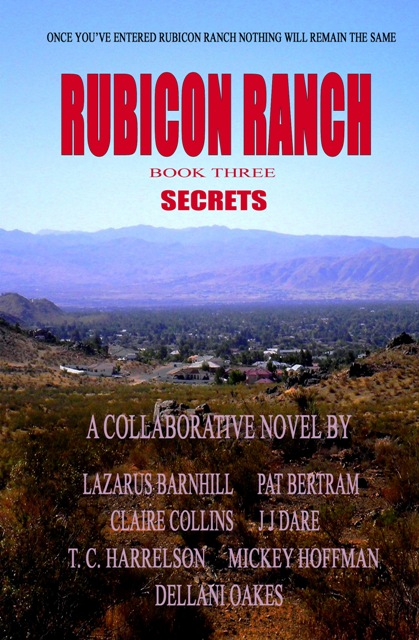
RRBookThreemidsizeRubicon Ranch is a collaborative and innovative crime series set in the fictional desert community of Rubicon Ranch and is being written online by the authors of Second Wind Publishing.

In the current story, the  body of a local realtor is found beneath the wheels of an inflatable figure of a Santa on a motorcycle. The realtor took great delight in ferreting out secrets, and everyone in this upscale housing development is hiding something. Could she have discovered a secret someone would kill to protect? There will be suspects galore, including a psychic, a con man, a woman trying to set up an online call-girl service, and the philandering sheriff himself. Not only is the victim someone he had an affair with, but he will also have to contend with an ex-wife who has moved back in with him and a jilted lover, both with their own reasons for wanting the realtor dead.

We hope you will enjoy seeing the story develop as we write it. Let the mystery begin! Whodunit? No one knows, not even the writers, and we won’t know until the very end! If you don’t want to miss further chapters, please go to the blog and click on “sign me up” on the right sidebar to get notifications of new chapters.

(If the Christmas theme seems unseasonal, well . . . considering how long it takes to write a book at the rate of a chapter a week, in a few months, the season will catch up to us!)

Chapter 15: Lydia Gavin
by Pat Bertram

Sunday, December 23, 2:20pm

Lydia sat by Zazzi’s pool, soaking up what rays she could. She had helped Zazzi open the umbrella over the patio table, but since it was too cold to sit in the shade, she’d moved a chair out into the sunlight.

Sun.

Fire.

Lydia stared up at the pale blue winter sky and shivered with delight at the thought of that burning ball overhead. Did the Goddess love fire as much as she did? Is that why she had created so many suns?

Lydia smiled, remembering the flames curling around the hideous living room furniture. She had lied to Zazzi about not being in the house when the fire had started, but she saw no reason to tell the truth. Zazzi sure as hell wasn’t being honest with her. Lydia might not be a cop any more, but she still had her cop’s nose, and that nose told her whatever business Zazzi operated didn’t bear scrutiny. Still, the woman had made her welcome and offered her a room for the night, which made Lydia think kindly of her. And anyway, Lydia had to admit her own life no longer could hold up under a close examination.

With Nancy and her prying eyes and magpie mentality out of the way, though, she was safe, at least for a while.

How much had Nancy known? In her mind, Lydia went over every detail of her husband’s death, and couldn’t see where she had slipped up. No one knew of her husband’s abuse, not even Seth. When she and Seth were naked together, she’d kept the lights dimmed so any welts and bruises wouldn’t show, and if he’d inadvertently aggravated the injuries, he’d mistaken her groans of pain as moans of pleasure.

She’d vowed that the beating her husband gave her for having the affair would be the last time he’d ever hurt her. Things were okay at first after she got kicked off the job—he’d liked the idea of a slave wife—but then came the day he’d lost a big case. He’d blamed her, of course, saying that she’d never be a proper lawyer’s wife. He’d raised a hand to her. She dashed away. He caught her at the top of the stairs. She pushed. He fell down the marble steps. Cracked his head. She stared at him for a moment, wondering if she should call an ambulance—he’d probably be okay with immediate care. Instead, she sneaked out the back door, went for a run, and left him to die.

Dozens of people had seen her jogging in her fuchsia shorts and lime green top, and though she’d been questioned, the cops never suspected her. Why should they? She had an alibi and she’d always played the loving wife in public.

But Nancy had found out. Or had she? When the realtor said in that oh, so ominous voice, “I know you killed your husband,” could she have been merely fishing?

It didn’t matter now. Nothing mattered but those lovely dancing flames. Even Seth’s love had never ignited her the way the heat of the fire had.

As she’d watched the flames devour the furniture, the stone Lydia had seemed to melt and flow like lava, and suddenly she’d been awash in a volcano of molten tears. She’d never known such life. Love. Ecstasy.

She’d managed to wrest herself away from the flames and rush outside before her new love could hurt her as much as her past loves, and although she wanted to continue her enthrallment with the blaze, she couldn’t bear to be around the gawkers. What could they know of the love that now burned in her heart? Only the paltry excitement of destruction kept them riveted to the scene.

Lydia had wandered off in a daze, and hadn’t come back to herself until Zazzi had confronted her. She’d managed to hide her rapture behind cop’s eye—that cold calculating look was not something you ever forgot how to give—keeping her secret safe in her heart.

Lydia stared up at the sun, and took a deep breath. The air smelled deliciously of smoke and ashes and charcoal and burnt offerings. Is this what the Goddess smelled every day of creation? Lydia stretched, like a cat on a warm hearth, and wondered where to go from here.

Home, probably. She could no longer remember why she’d come to Rubicon Ranch. Had she come just to be near Seth? To try to get back together with him? To get even? To remove her competition? To warn his new love of his philandering ways?

It hadn’t been hard to find out about his affair with Nancy. She’d simply followed him one day when he left the sheriff’s department and seen him meet with the realtor. She’d only made an appointment with Nancy to see what Seth preferred over her, but had stayed to watch the fun when she realized Seth had met his match.

Were all men so blind they couldn’t see what was in front of their very eyes? She had deeply loved Seth, wanting only the best for him, and he had thrown her away, calling her a vituperative bitch. Yet Nancy, who didn’t love him, and who truly was a vituperative bitch, he had kept.

But now she was through with men and their incomprehensible needs. She had found something better. Something that would never let her down. Something that would forever burn in her heart.

Fire!

***

Pat Bertram is the author of the suspense novels Light Bringer, More Deaths Than One, A Spark of Heavenly Fire, and Daughter Am I. Bertram is also the author of Grief: The Great Yearning, “an exquisite book, wrenching to read, and at the same time full of profound truths.” All Bertram’s books are published by Second Wind Publishing. Connect with Pat on Google+

Whose Story are You Writing?

Every story is someone’s story. Whether we are writing about war, child abuse, romance, murder, or any other topic, we must make readers care about a character. Readers want someone to root for, to bond with, to love. Once they have found that, they will be eager to read further.

Sometimes it’s hard for us writers to decide whose story we are writing. We create a lot of characters while writing our novels, and we fall in love with all of them, even the villains. We feel disloyal to our creations if we give one character more consideration than others, and we believe the story needs all those points of view. But the reader knows only what is on the page, not what is in our minds, and all those equally significant characters become confusing. Readers need to know whose story it is. Or whose story it mostly is.

One way for us to decide this is to figure out which character has the most at stake and which one will change the most. If we are lucky, the two will be the same, and we will know whose story it is. If not, we have to make the character who will change the most into the main story character while upping that character’s stakes.
A character with nothing to lose is not one people will care about. If someone in the story parachutes out of a plane for fun, readers might find it entertaining, but they won’t be concerned. But if someone wearing a faulty parachute jumps out of a plane into flames to save a child lost in the middle of a forest fire, everyone except the most curmudgeonly will care.

The same is true of character growth. A character who remains static, who learns nothing from experience, is not someone readers can love. A story is always about change, and since a story is also about a character, that character must grow, or should at least change in some small way. A timid character might learn to stand up for himself. An arrogant character might learn a touch of humility. The essence of the character does not need to change. A timid reporter who turns into superman is the stuff of comic books, not a realistic novel. But a character who grows, who learns, who comes back from his or her experiences with something to share, that is a character readers care about.

And that’s whose story it is.

***

Pat Bertram is the author of the suspense novels Light Bringer, More Deaths Than One, A Spark of Heavenly Fire, and Daughter Am I. Bertram is also the author of Grief: The Great Yearning, “an exquisite book, wrenching to read, and at the same time full of profound truths.” Follow Pat on Google+. Like Pat on Facebook.

How to Hook a Reader

The age of writing long descriptive passages (or even short ones) at the beginning of a novel has passed. Today people want to be drawn immediately into the story without wading through such excess. An editor might look at the first five pages before tossing aside your manuscript, but potential customers will give you a mere twenty seconds to draw them in. Once you have caught their attention, they might read a little further, and perhaps they will even buy the book. They certainly will not wade through five, ten, fifty pages until they get to “the good part.”

That “good part” must be right up front, especially if you’re a first-time writer. That’s all you have going for you — the ability to get off to a fast start and capture the reader’s attention. Your name certainly won’t do it; no one knows who you are yet. Your credentials might help, but only to establish your credibility after a potential reader has been hooked. And they will never be hooked by your ability to turn a clever phrase.

So what will hook the reader?  A character. Always a character. No one reads a book for a description of the weather, a place, or an issue. They don’t even want a description of the character. They want to meet him, to see life through his eyes, to bond with him. They want to know what he wants, what his driving force is. And they want to know who or what he’s in conflict with.

Without conflict, there is no story, but without a character for the reader to care about, there is no story either. Character and conflict are inextricably combined, and together they create the tension necessary to sustain a story. I know you think it’s okay to let the tension rise slowly, which it is, but the tension level at the beginning must be high enough to let the reader know something is going on.

I rewrote More Deaths Than One four times, and each time, the story fell flat. It wasn’t until I realized I’d spent too much time describing things or had Bob alone meandering through much of the story that the book took on life. I gave Bob a love interest, a server he met at a coffee shop.

More Deaths Than One begins:

“What do you think of a guy who embezzles from his own business?”

Bob Stark recognized the voice of the graveyard shift waitress, the attractive one with the black hair. He glanced up from his contemplation of the scars on the laminated plastic table and saw her standing by his booth, gazing at him, her eyebrows quirked. She seemed to expect a response, but he had no idea what to say. 

This isn’t the real hook, it’s just enough to capture your attention so I can reel you in for the punchline.

Reviewer Sheila Deeth said, The first three pages of “More Deaths than One” have to constitute a serious contender for the best opening scene of a novel. Two main characters are introduced, a garrulous waitress and a taciturn hot-chocolate customer. They meet. She talks, a lot. He reads the paper. “And Lydia Loretta Stark was dead. Again.” With two such immediately real and appealing characters, and a line like that, I’d challenge anyone not to want to keep turning the pages.

***

Pat Bertram is the author of the suspense novels Light Bringer, More Deaths Than One, A Spark of Heavenly Fire, and Daughter Am I. Bertram is also the author of Grief: The Great Yearning, “an exquisite book, wrenching to read, and at the same time full of profound truths.” Follow Pat on Google+. Like Pat on Facebook.

How Much of the Truth do We Owe to Others?

Today someone told me I was evil. It wasn’t a joke — the person meant it — and I had no response to that.

Being called an evil woman sounds much more romantic than what I am — someone who’s doing the best she can in a world gone awry. I admit my efforts sometimes fall flat, and once in a great while I make a given situation worse rather than better, especially when my loyalties are divided. As do we all. But that’s not being evil. That’s being human.

I don’t believe I’m evil, but the reason I couldn’t find a response to the accusation is that it made me wonder: If I am evil, would I know?

Think of all the wars begun in the name of God. Think of all the prejudice fomented by religious folk who adhered too closely to the dictates of the Old Testament. Think of all the pregnant teenagers thrown out into the snow by self-righteous parents. Think of all the people who have harmed others in the name of doing the “right” thing. Did any of these people believe they were evil? Of course not. I’m sure the devil wouldn’t even consider himself (or herself) evil. Like all villains, he/she is the hero of his/her own story. In his/her mind, he/she is the true force of the universe, while God is the evil one.

UntitledgThis person who believes I am evil based the assessment of me partly on lies I supposedly told, though I have no idea what those lies are. They can’t mean much in the big scheme of things, because I never lie for malicious purposes, though I do occasionally lie to protect me or someone else. And anyway, how much of the truth do we owe others? For example, if someone asks our weight, do we owe him/her the truth? If the person asking is a doctor or a health insurance company, of course, we owe them the truth, just as they owe us the truth about our medical condition, but otherwise divulging information about our weight is not a requirement. Offering a lie, perhaps giving a weight we are comfortable acknowledging, is usually more tactful and much easier than a direct refusal to answer.


We often lie without thinking about it, such as exaggerating our accomplishments a bit so that we come across both to ourselves and to others as being better than we are, but so often these lies are nothing more than hopes verbalized. Sometimes we downplay our accomplishments in the name of modesty. And sometimes we “fudge” the truth, not telling the truth, but not telling a direct lie, either, though the result is the same — a deception.

When it comes to friendship and other relationships, we do owe a certain amount of truth, especially the truth of who we are, but we don’t owe that truth to strangers or to those who don’t have our best interests at heart. In a perfect world, perhaps, we could tell everyone the truth, but in our particular world, divulging too much about ourselves is risky. And it’s especially risky when the person who is asking for our truth is not willing to give up any of his or her truth.

And then there are those who tell us the truth, or at least the truth as they see it, for only one reason, to cause pain.

Which brings me back to my evilness and the lies I supposedly told. I wish I could apologize for these unknown lies and whatever else led to this belief that I am evil, but it is impossible to talk to someone who will not listen. So I’m doing what I always do, dumping my worries and my wonderings onto this blog.

***

Pat Bertram is the author of the suspense novels Light Bringer, More Deaths Than One, A Spark of Heavenly Fire, andDaughter Am I. Bertram is also the author of Grief: The Great Yearning, “an exquisite book, wrenching to read, and at the same time full of profound truths.” Follow Pat on Google+. Like Pat on Facebook.

Reality vs. Delusion

“It is far better to grasp the Universe as it really is than to persist in delusion, however satisfying and reassuring.” — Carl Sagan

Is Carl Sagan right? When it comes to the cosmic universe, perhaps. When it comes to our personal universe, is it better to persist in delusion? Isn’t that what a dream is, a delusion? The dream might be attainable with luck and hard work, in which case it’s not a delusion. If it is not attainable, is it better to hold on to the dream or is it better to persist in delusion?

I used to think reality was important — I spent my life trying to get down to the rock bottom of “that which is” (as opposed to what we think is). I studied particle physics and quantum mechanics (for fun, can you imagine that?) and discovered that every La La Landparticle can be divided into smaller particles and those particles can be divided, until what you end up is nothing. Or a wave. Or a thought. Or something that changes every time you look at it.

I no longer know if reality is all it’s cracked up to be. If our perceptions can change ”that which is” at the quantum level, perhaps it can change life at the macro level where we live. If so, it might be better to persist in delusion.

I explore this theme of delusion (or illusion, which perhaps comes down to the same thing) in all of my books: What is truth? What is reality? Who are we, really – are we our memories, our experiences, our dreams? I also often explore similar themes in this blog. And I still don’t have an answer.

Reality feels real, while fantasy feels nebulous and silly, but what is fiction writing if not fantasy? We create worlds that never were with our words, and those worlds come alive in reader’s minds, so real, that readers discuss fictional characters as if they were real, and in a certain context, they are real. If the universe is thought, then perhaps they are even as real as we are. Thoughts might have created us in the same way we create characters.

Writing is a powerful tool for living. As we visual other facets of this world, we become better prepared for the vicissitudes of the “real” world.  Writers often write for others, needing to connect with readers, which is important. But even more important is writing for ourselves, creating worlds where our worst fears our vanquished and our dearest dreams are realized.

Can writing actually help us create our future? Some people believe that the more concrete one’s visualization, the greater the chance the vision has of becoming real. Symbols also have their place, perhaps reaching even deeper into our psyches than visualization does, and symbols are generally not reality but only representations of reality. In the same symbolical way our nightly dreaming sometimes connects us to things not of this world, perhaps fiction too can connect us to things not of this world.

Like Sagan, I’ve always believed it better to grasp the universe as it is than to persist in delusion, but perhaps it’s time to change my thinking.

***

Pat Bertram is the author of the suspense novels Light Bringer, More Deaths Than One, A Spark of Heavenly Fire, and Daughter Am I. Bertram is also the author of Grief: The Great Yearning, “an exquisite book, wrenching to read, and at the same time full of profound truths.” Follow Pat on Google+. Like Pat on Facebook.



