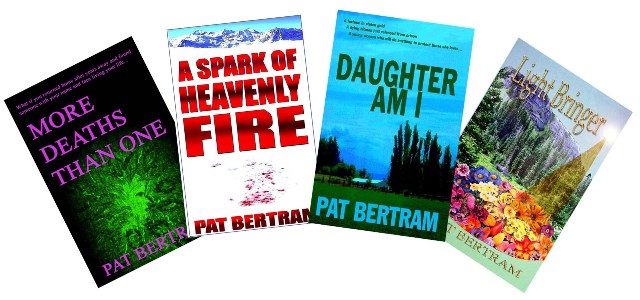
Where do you get the names for your characters?

Most of the characters in Daughter Am I are aged gangsters, and they kept the monikers they used when they were young. I patterned my gangsters after those in the 1930s movies, though in the book they didn’t actually reach their prime until the 1950s or even 60s. Some names I stole, like Kid Rags, which was the name of a 1900s gangster in Hell’s Kitchen, and others were inevitable, like the morbid wheelman named Happy.

Bob Stark in More Deaths Than One was so named because he was supposed to seem an “everyman,” hence the common first name. He was also supposed to be stark of speech and action, and so the surname was a reminder to make sure he didn’t get too flowery. Despite his name, Bob Stark turned out to be rather wordy at times and not the silent, uncommunicative loner I had planned.

Greg Pullman in A Spark of Heavenly Fire was named after Bill Pullman in While You Were Sleeping to remind me that Greg was good-looking and very nice.

Rena in Light Bringer was so named because it was short for Ahkrena, which was a word I created to be the name of an unknown ancient race. When the character was small and someone asked her name, all she could say was Rena. Her name was supposed to be a clue to her identity after her research uncovered stories of the Ahkrena, but when I discovered Sumerian creation myths, the book went a different direction. I got rid of Ahkrena, but kept Rena, since by then the character and her name had become intertwined

Here are some responses from other authors about how they named their characters. The comments are taken from interviews posted at Pat Bertram Introduces . . .

From an interview with Donna Small, Author of “Just Between Friends”

Names for characters are tough for me. I will write chapters using ‘ajdfjkd’ instead of names. I just have a hard time finding the right one for the character since I’m a huge believer in your name being having an impact on who you become. Both of my daughters play sports so I keep the rosters from their events and refer to them for different and unique names that will fit my characters. I also Google a lot!

From an interview with John Stack, author of “Cody’s Almost Trip to the Zoo”

Names are fun and usually mean something special. I use kids that I have taught, daughters, grandsons, and friends. Family can be cool because you can often capture their personality in the character and no one really gets offended.

From an interview with Smith Hagaman, Author of “Off the Chart”

You’ve heard the old story. Adam was naming the animals. God said, “What will you call that one?” Adam said, “Hippopotamus.” God said, “Well, you can call it anything you want to, but why Hippopotamus?” Adam looked at him puzzled, “Because it looks like a hippopotamus!” That’s how I get my names.

What about you? Where do you get the names for your characters?  (Or your children or your pets or your plants.)

(If you’d like me to interview you, please check out my author questionnaire http://patbertram.wordpress.com/author-questionnaire/ and follow the instruction.)

***

Pat Bertram is the author of the suspense novels Light Bringer, More Deaths Than One, A Spark of Heavenly Fire, and Daughter Am I. Bertram is also the author of Grief: The Great Yearning, “an exquisite book, wrenching to read, and at the same time full of profound truths.” Connect with Pat on Google+. Like Pat on Facebook.

Have you always wanted to be a writer?

I always wanted to be a reader. That’s really all I ever wanted to do. I did try writing a novel many years ago, but the words never came flowing out of me the way I thought they should — in fact, there were no words at all — so I accepted that I had no natural talent for writing. About ten or eleven years ago I decided phooey with talent, and I started writing again. I thought it would be a good way of taking my mind off my problems. I also read books about writing, publishing, and promoting, so basically I gave myself a crash course in the whole writing spectrum.

Here are some responses from other authors about whether they’d always wanted to be writers. The comments are taken from interviews posted at Pat Bertram Introduces . . .

From an interview with Siobhán Nolan, Author of “Old Man Harry”

No, I haven’t. I didn’t even consider myself a writer until I saw my book in print. That was only a few weeks ago, but there’s something so powerful about that moment when you hold your published work in your hands for the first time and can truly say to yourself, “Wow, I did it. I’m a writer.”

From an interview with Lazarus Barnhill, Author of “The Medicine People”

When I was a child of four or five, Wednesday nights were “dollar nights” at the Riverside Drive In: a whole car load of people could see the movie for a buck. My parents and sister would sit in the front seat and I’d sit in the back. Periodically during the show, I would say what the character on the screen was about to say. Eventually my parents got really tired of that and forbade it. But something took root in me even back then. As an elementary school child I would constantly start stories that ended up being only a page or two long — and made me feel like a failure. When I was in sixth grade I lay awake one night and created a story that involved every child in my homeroom class. With the blessing of Miss Roach (and, no, I did not make up that name), I laboriously wrote the story down — probably thirty-five or forty pages — and was given permission on the last day of school to read it to the class. With about five pages left (I was just about to be machine gunned by the villains, having recovered the money they stole from the bank), the principal came in and said that we were free to go to the playground or to stay inside. The students immediately bolted — not one even asking how the story ended. I decided then to write the sort of stories that people would not be able to put down . . . and I’m still working on that.

From an interview with J. P. Lane, Author of “The Tangled Web”

I’ve been a writer by profession most of my adult life, but there wasn’t any point when I thought I wanted to be a writer. I just fell into writing quite by chance – just the way The Tangled Web came about – by chance. There was no thought of wanting to write a book. One day, I sat down and started writing and about a year later, there was a novel on my computer. Mind you, I was an advertising and marketing writer and I also had articles published in major Florida publications, so I wasn’t exactly green when I ventured into the world of fiction. Advertising writing requires tremendous discipline, so I was already reasonably equipped to be an author.

What about you? Have you always wanted to be a writer? Or, like me, have you always wanted to be a reader?

(If you’d like me to interview you, please check out my author questionnaire http://patbertram.wordpress.com/author-questionnaire/ and follow the instruction.)

***

Pat Bertram is the author of the suspense novels Light Bringer, More Deaths Than One, A Spark of Heavenly Fire, and Daughter Am I. Bertram is also the author of Grief: The Great Yearning, “an exquisite book, wrenching to read, and at the same time full of profound truths.” Connect with Pat on Google+. Like Pat on Facebook.
Meet Malcolm R. Campbell and “The Seeker”

Malcolm R. Campbell is the author of the contemporary fantasies, The Sun Singer, Sarabande, The Seeker, and the satire, Jock Stewart and the Missing Sea of Fire. He is also a prolific blogger, posting interesting articles and reviews, and collecting Book Bits, the most fascinating and relevant book-related links on the internet.

I recently interviewed Malcolm to find out more about his new book and his writing practices. The interview is posted on my Pat Bertram Introduces . . . blog, but I’m posting a few responses here to whet your appetite to read more. I hope you will enjoy meeting Malcolm R. Campbell.

SeekerCoverMalcolm, What is your book about?

In The Seeker, David and Anne meet while working as seasonal employees at Many Glacier Hotel in Glacier National Park. He comes from the Montana high county where he is at home with totem animals, magic and mountain climbing. She comes from the Florida Panhandle where she is at home with botany, beaches and coastal swamps. Their intense summer romance leads them to believe they’ll be lovers forever. Typically, the realities of college life in separate towns get in the way. Then, when David’s intuition tells him Anne is in danger, he uses ancient magic to rescue her. However, cheating fate brings consequences and misunderstandings that threaten to drive them apart.

What inspired you to write this particular story?

The story was inspired by my work as a summer employee in Glacier National Park as well as my love of both the Rocky Mountains and the Florida Gulf Coast where I grew up. To my Florida friends, my going to Montana for summer work and Colorado for summer school was tantamount to traveling to another planet. The worlds are so different. So, I wondered whether two people from such diverse regions could maintain a relationship once the summer was fading away into the past.

How much of yourself is hidden in the characters in the book?

David Ward is very much like me. We both love climbing mountains, following our intuition, and consorting with totem animals. In the upcoming second and third books of the trilogy, my experiences are somewhat similar to David’s aboard a Vietnam-era aircraft carrier in The Sailor, and my work as a college journalism instructor leads to David’s teaching work in The Betrayed.

Tell us a little about your main characters. Who was your favorite? Why?

David’s grandparents, the medicine woman Katoya, and the sheep rancher Jayee, are very influential in his life. Katoya teaches in magic. Jayee teaches him logic and the practical work labor-intensive jobs. Katoya and Jayee come from different worlds, having married for reasons of necessity, so they’re at odds with each other about almost everything. I had fun writing about their love/hate relationship and how it impacted their grandson. Yet, I don’t let them steal the show from protagonist David Ward, a mountain climber who really would refer working on the railroad to going to college, and Anne who is a very earth-centered, environmentally conscious young woman who doesn’t like what we’re doing to the planet.

Click here to read the rest of the interview: Malcolm R. Campbell, Author of “The Seeker”

You can find Malcolm on his website at http://www.malcolmrcampbell.com as well as on his Facebook author’s page at https://www.facebook.com/Malcolm.R.Campbell.Author

image001

Uncertainty Is the Only Certainty

I started yesterday by seeing a quote online:

Uncertainty is the only certainty there is, and knowing how to live with insecurity is the only security. –John Allan Paulos

I thought Paulos’s words were interesting in light of the way I’d like to live after my present responsibilities end. Since I can’t bear the thought of settling anywhere, I am planning to live on the go, at least for a while, and see where serendipity and spontaneity take me. The uncertainty and insecurity of such a life style makes me a bit nervous, but I’d come to the same conclusion that John Allan Paulos did — that there is no certainty, and learning how to live with insecurity is the only security you can ever truly have.

Later, I read Malcolm R. Campbell’s blog Everything That Can Happen, Does Happen where he quoted Jane Roberts “The soul can be described for that matter, as a multidimensional, infinite act, each minute probability being brought somewhere into actuality and existence; an infinite creative act that creates for itself infinite dimensions in which fulfillment is possible.” – “Seth Speaks” (1972)

I read thUncertaintye Seth books once upon a time, but lost interest in Seth’s words when I realized that most of what he supposedly said had already touted in quantum physics, such as humans existing as possibility and electronic waves, which meant that his pronouncements could have come from Jane Roberts herself rather than from an all-knowing entity. (I also was disturbed by the assertion that Hitler was in a deep sleep for a thousand years. If time doesn’t exist outside of our material universe, then what difference does it make how long he was put to sleep?)

Although this might not seem to have anything to do with uncertainty, the idea that humans exist as possibilities, as an act rather than a physical being, is a variation of quantum mechanic’s uncertainty principle, which as far as I can tell says that everything exists in a state of infinite possibilities until it is observed or otherwise interacted with by another quantum object. (Actually, it says that either momentum or position of a particle can be precisely measured, but not both, and that the very act of measuring disturbs the measurement.)

And then, last night, quite coincidentally, I watched the 1994 movie IQ — just picked it blindly from a collection of movies. And there again, the uncertainty principle raised its head and took a long hard stare at me when Einstein and his cronies discussed the nature of the universe.

What does this mean? Probably nothing, though it does seem to show that uncertainty is the only certainty.

***

Pat Bertram is the author of the suspense novels Light Bringer, More Deaths Than One, A Spark of Heavenly Fire, and Daughter Am I. Bertram is also the author of Grief: The Great Yearning, “an exquisite book, wrenching to read, and at the same time full of profound truths.” Connect with Pat on Google+. Like Pat on Facebook.
Nothing is Trivial When Dealing With Grief

It’s amazing to me how the most trivial things can take on significance when it comes to the loss of the person who connected you to the world.

Yesterday I was clearing out a mini in-basket where my life mate/soul mate kept stamps and related items, such as postage rates and receipts. Up until now, I’ve just left the basket intact. In those first months after his death, I couldn’t bear to use the last stamps we ever bought together, so I set the basket aside and ignored it. Enough time has passed that those stamps now seem like ordinary, insignificant postage, so I dug them out, sorted through the papers in the basket, and threw away the outdated rates and receipts.

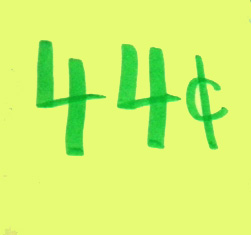
One of the things I found in the basket was a simple note he had written: 44¢. That’s all it said. He wrote it in green ink on yellow paper about two-and-half-inches square, so that despite his worsening vision, he could see at a glance what the current postage rates were.

I hesitated a moment before tossing out the note. As unimportant as the paper was, it seemed to be a symbol of how bit-by-bit, his erstwhile place in the world and my life was disappearing. Most of his things are gone now, and attrition has eliminated many of “our’ things — towels worn out, spoons lost, cups broken.

The first time I broke a cup, it about devastated me. I remember crying as if it were my heart and not a piece of crockery that had shattered. As I wrote back then, “I broke a cup today, one more thing gone out of the life we shared. Our stuff is going to break, wear out, get used up. I’ll replace some of it, add new things, write new books, and it will dilute what we shared. Is there going to be anything left of ‘us’? I feel uncomfortable in this new skin, this new life, as if it’s not mine. As if I’m wearing clothes too big and too small all at the same time.”

Still, I did throw out the paper. It seemed foolish to keep it, especially considering that postage rates have gone up since then. And I’m no longer newly bereft, clinging to anything of his to bring me comfort.

If the paper had remained in the trash, there would be story, but a little later, I retrieved the paper and put it back in the basket. My rationale was that someday, perhaps, I’d like to know what the postage rate was on the day he died. But grief has no rationality. I simply could not let go of that newly significant slip of paper.

***

Pat Bertram is the author of the suspense novels Light Bringer, More Deaths Than One, A Spark of Heavenly Fire, and Daughter Am I. Bertram is also the author of Grief: The Great Yearning, “an exquisite book, wrenching to read, and at the same time full of profound truths.” Connect with Pat on Google+. Like Pat on Facebook.

What Would You Like to Ask a Bookstore Owner?

In an effort to combat a certain online megastore from taking total control of the book world, I am going to initiate a program to interview book store owners and give them a bit of exposure on my Pat Bertram Introduces . . . blog,  To do this, I will need questions to pose. Obviously, I will need to ask where their store is located, hours, directions so people can find them. I’ll also need to ask what sort of books they carry and if they special order.

Basic information like that gets boring after a while, so I need some exciting or at least fresh and interesting questions to ask.

For example:

askingWhat book do you wish would sell better?

What little-known book would you like to see make it big?

What is your reading preference?

As you can see, I am having a hard time coming up with interesting questions. If you were going to interview a book store owner, what would you ask? (Ask as a reader, I mean. I know what you’d like to ask as an author!) If you were reading such an interview, what would you like to know? If you are a book store owner, what would you like someone to ask?

Thank you for your help!

***

Pat Bertram is the author of the suspense novels Light Bringer, More Deaths Than One, A Spark of Heavenly Fire, and Daughter Am I. Bertram is also the author of Grief: The Great Yearning, “an exquisite book, wrenching to read, and at the same time full of profound truths.” Connect with Pat on Google+. Like Pat on Facebook.

Three

Three is a powerful number that satisfies our deepest needs for symmetry. Three gods ruled the earth—Zeus, the god of heaven; Poseidon, the god of the sea; and Pluto, the god of the underworld. People worshipped the moon goddess as a triad, representing three phases of the moon. There were three Fates, three Furies, three Graces, three Harpies, three primary colors. Three times three was also a mystical number, hence the nine muses.

3

A few obvious threes from popular culture:

Three wishes. Three bears. Three little pigs. The Three Stooges. Three outs. Best two out of three. Three Faces of Eve. Three Days of the Condor. The Three Musketeers. Third time lucky. Love triangle. (The triangle itself is a divine symbol signifying the power of three.) Three is also a visually pleasing arrangement. And the number three signifies harmony.

balloons

So, to make your stories more powerful, harness the power of three.

1. When describing a character or scene, mention three attributes. Also, if a particular attribute needs to be fixed in the reader’s mind, mention it three times (and only three times) during the course of the book, and it will stick.

books

2. When devising a plot, follow the storyline of The Three Bears. The first time the hero tries to reach her goal, she fails but learns the risks. The second time she tries, she confirms that she’s doing things wrong, but she learns from her mistakes. The third time she tries, she gets it right. three bears

3. Look for patterns in your story. If your character has given his love flowers and perhaps made love to her in a flower garden, mention flowers once more to solidify the pattern.

4-11-11

I could give you more ways to make your stories more powerful, but since I’ve given you three suggestions, that should be enough. And if it isn’t, you can find more uses for this powerful tool here: The Most Powerful Tool at a Writer’s Command

***

Pat Bertram is the author of the suspense novels Light Bringer, More Deaths Than One, A Spark of Heavenly Fire, and Daughter Am I. Bertram is also the author of Grief: The Great Yearning, “an exquisite book, wrenching to read, and at the same time full of profound truths.” Connect with Pat on Google+

What is Wrong With Using a Prologue?

Most agents, editors, and publishers frown on prologues because they claim that readers skip them.

Perhaps that’s true. I myself am not a fan of prologues. Some writers have the appalling habit of using a prologue as an information dump, telling readers things they think they need to know rather than presenting the material a bit at a time when it is needed. Some writers have the even more appalling habit of augmenting a poor beginning with a prologue that is not really a prologue but more of an interlogue, an excerpt taken from the middle of the book, copied and pasted into a prologue. While this excerpt might create suspense and keep us reading through a less than stellar beginning, it is not necessary to the story since the material is a duplication, and we feel cheated when we reread it during the course of the book.

I don’t even have much use for true prologues, which present events that happen before the story begins. The main rule in writing is “everything in service to the story.” If a prologue does not advance the story, if it is not as exciting as the rest of the book, then it should be removed and any essential information presented during the course of the story.

Sometimes, however, a prologue is necessary, especially if important events take place years before the main story. Occasionally, lbmugto get past the stigma of a prologue, authors will label the pre-story chapter “Chapter One.” To call a prologue “Chapter One” does not make it any less of a prologue, and it confuses readers, who think they are reading one story and find out they are reading another.

Despite the cautions about prologues, I used one in Light Bringer. It is a true prologue in that the events take place thirty-five years before the present day action, but I do something that is frowned on even by those who see nothing wrong with prologues: I introduce a character who does not appear in the body of the work, only mentioned in dialogue.

When I rewrote Light Bringer before submitting it to Second Wind Publishing, I considered getting rid of the prologue but I kept it for three reasons: I wanted readers to experience for themselves the events that precipitated the story, it was the way I originally conceived it, and I loved the image of tiny footprints in the snow. The prologue might seem like a darling, a word used by William Faulkner to describe the parts we love but that have no real function in the story, but without the prologue, the story loses some of its immediacy. Being told of a radiantly special baby being found on a doorstep is entirely different from experiencing it for ourselves through the eyes of the staid woman who found her.

And if readers skip my prologue? Well, there’s not much I can do about that. The truth is, there is there is nothing wrong with a prologue as long as it has a hook at the beginning, has conflict, and is written with immediacy as a scene, just as with any other chapter.

If you’d like to read the prologue, click here: Light Bringer by Pat Bertram

***

Pat Bertram is the author of the suspense novels Light Bringer, More Deaths Than One, A Spark of Heavenly Fire, and Daughter Am I. Bertram is also the author of Grief: The Great Yearning, “an exquisite book, wrenching to read, and at the same time full of profound truths.” Connect with Pat on Google+

Life is a Great Big Canvas…

The words might not have originated with me, but the photo art is mine. I was trying to cheat and do a quick post since it’s so late, but this little bit of fluff took longer than a written post would have done!

Life is a great big canvas

***

Pat Bertram is the author of the suspense novels Light Bringer, More Deaths Than One, A Spark of Heavenly Fire, and Daughter Am I. Bertram is also the author of Grief: The Great Yearning, “an exquisite book, wrenching to read, and at the same time full of profound truths.” Connect with Pat on Google+

My Own True Grit

I started watching True Grit today, but had to stop because I couldn’t see the screen for all the tears. My deceased life mate/soul mate and I lived not far from Ridgeway where True Grit (1969) was filmed, and the scenery in the movie made me homesick, not just for the Rockies, which formed the backdrop of my life, but for him. As the movie played, I could almost hear his voice telling me about the filming of the movie, and I could almost feel the soft cool air of Colorado wafting through the open window.

Sometimes I have the urge to settle near there again when my responsibilities to my father end. The air would feel familiar. The light would be soothing to my eyes. The mountains would offer comfort and perhaps protection from harsh winds. But then what? I’d be alone with the mountains, and mountains, no matter how welcome or familiar, can’t offer companionship. Without my mate, I’d still feel lonely, still feel as if I were homeless, because he, of course, was my home.

In Figuring Out Where to Go From Here, I realized I didn’t have to settle anywhere, but could live on the go, writing as I went. It will be possible, at least for a while, especially if I can get some sort of crowd funding. And perhaps I will discover home within myself or even discover that the journey itself is home.

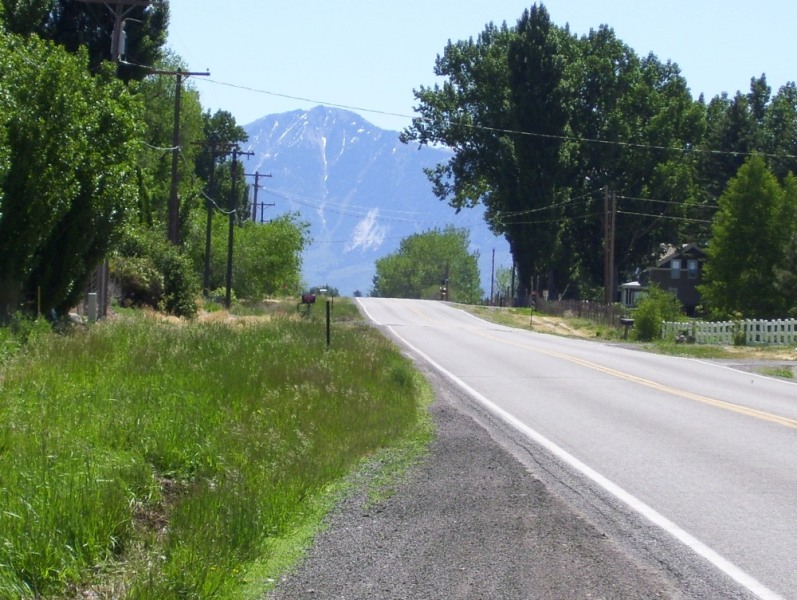
I haveMt. Lambornn’t been writing about this journey lately because my 96-year-old father is doing exceptionally well, so much so that it seems foolish to talk about my future since I might not be free of responsibilities for a long time. Besides, I don’t want my father or anyone else to think I am hurrying him off this earth. If the universe is unfolding as it should, then my soul quest (or at least the road trip part of the quest) will happen when the universe and I am ready.

Still, it is nice to know what I’m going to do when the time comes — put my stuff in storage and head out on my journey, broadening both my internal and external horizons. Since I want to live by whim, to relearn spontaneity and perhaps find serendipity, there really isn’t a lot of preparation for me to do in the meantime except to continue to get rid of that which is unnecessary so I can hit the road unencumbered by superfluous possessions, outdated issues, and useless notions. Eventually, I will need to prepare various giveaways and promotional materials, perhaps even a marketing plan, for visiting bookstores along the way, but now is not the time for planning but for dreaming.

The beauty of such a quest as the one I’m dreaming of is that if I am particularly homesick for areas where we lived, I could go and stay there for a while, recharge my soul’s batteries, and then continue on when wit, whim, and my own true grit dictated.

***

Pat Bertram is the author of the suspense novels Light Bringer, More Deaths Than One, A Spark of Heavenly Fire, and Daughter Am I. Bertram is also the author of Grief: The Great Yearning, “an exquisite book, wrenching to read, and at the same time full of profound truths.” Connect with Pat on Google+