
Today I will be . . . seeing red

XI’ve been posting daily resolutions on my Facebook status as a way of focusing my attention on something positive rather than the truth. For example, if I have a hard time putting one foot in front of the other, I will write, “Today I will be . . . energetic.” Or if I know I’m going to have to rise to a challenge, such as coming to an agreement with someone who refuses to see my side of the situation, I will write, “Today I will be . . . flexible.” Or forgiving, or whatever the situation calls for.

Today I discovered a great new word: apolaustic, which means “seeking enjoyment,” and that seemed an appropriate resolution for the day since fun hasn’t been part of my life much lately.

The trouble is, I think the goblins out there got things confused, and they’ve been having a bit of enjoyment at my expense. When I opened the pantry this morning, I noticed there were two boxes of cherry Jello-O where yesterday there were three. Unless I walk in my sleep (or unless my father does, since he’s been spending most of his time sleeping lately), that box of red gelatin powder simply disappeared. (And since he doesn’t know how to make it and I don’t eat it, it couldn’t have been consumed by either of us in a wild bout of sleepeating.)

I wouldn’t have thought anything more of the missing red gelatin (well, that’s not true at all — I’ve spent hours searching for the ridiculous thing because something cannot disappear for no reason and the puzzle puzzles me) but an hour or so later, a red vehicle went missing. (No, not mine — whew! And anyway, I’m not exactly a red car sort of person, though that might be something to think about in the future as I’m trying to decide who I want to be.)

I was out walking in the desert when I saw, about a tenth of mile in front of me, a bright shiny new red pickup truck parked on a rise. I hesitated about going forward because vehicles parked in the middle of the desert take away from the enjoyment (ah! My apolaustic moment!) of my solitary walk, and besides, they make me nervous. Maybe I’ve spent too much time in my fictional community of Rubicon Ranch where my character has a penchant for finding dead bodies in the desert, or maybe I’m just careful. Either way, after the moment of hesitancy, I went forward.

I lost sight of the vehicle for a minute or two as I went around a bend, and when again I looked for the red pickup, it was gone. From where I was standing, I had a panoramic view of the desert, and no red truck was in sight though it wouldn’t have been able to drive out of sight in the brief time it was out of my view. About a quarter of a mile away, a white pickup, a much older model, was slowly making its way along a rutted desert road, but no red truck. I climbed to higher ground, and still couldn’t catch a glimpse of red, and in that stark beige world, even a touch of crimson would have been readily apparent.

So, who is stealing red from my life, and why? Are goblins or other tricksters playing games at my expense? Usually, when I get back from my walk, my cheeks are red from the cold, but today, they were barely pink. Had the goblins also taken the color from my blood? If I had pricked a finger, would I have bled blue or green?

Maybe a better status update on Facebook would have been, “Today I will be . . . seeing red.”

***

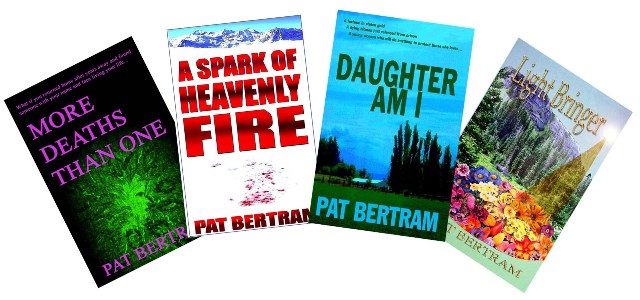
Pat Bertram is the author of the suspense novels Light Bringer, More Deaths Than One, A Spark of Heavenly Fire, and Daughter Am I. Bertram is also the author of Grief: The Great Yearning, “an exquisite book, wrenching to read, and at the same time full of profound truths.” Connect with Pat on Google+
What writer influenced you the most?

I’ve spent my life reading, so from a young age, “story” seeped into my conscious mind and steeped there until I began writing. In that way, all of the writers whose books I have ever read have influenced me, but if I had to pick a single author, it would be Taylor Caldwell. Caldwell told wonderful stories that showed history in the context of fiction, and I’ve tried to do the same. She also used a hundred words when a single sentence would have sufficed, and I’ve tried to do the opposite. And she overused words. In one novel, she used the word “inexorable” about a hundred times, and a couple of times I used the word in my own writings as an homage to her and a reminder to myself not to repeat unusual words. Such echoes resound in readers minds, as “inexorable” did in mine, and detract from the overall impression of the book.

Here are some responses from other authors about the writers who influenced them the most. The comments are taken from interviews posted at Pat Bertram Introduces . . .

From an interview with Rami Ungar, Author of “The Quiet Game: Five Tales To Chill Your Bones”

I’d have to say Anne Rice, Stephen King, and James Patterson. I discovered the first two when I was in junior high and high school, and they blew my mind. I knew after reading them, horror was what I wanted to focus on. I discovered James Patterson shortly before graduating high school, and I think he was the one who taught me how to write thrillers. To this day, I think of Alex Cross and James Patterson when I think about how I was able to write my thriller novel “Snake”.

From an interview with Juliet Waldron, Author of “Roan Rose”

At the moment, I’d say Cecelia Holland.

From an interview with Sherrie Hansen, Author of “Love Notes”

Maud Hart Lovelace, author of the Betsy Tacy books, set in fictional Deep Valley, Minnesota, my home state, greatly impacted my life as a young person. (Think Little House on the Prairie but set during the Victorian era.) Maud’s main character, Betsy Ray, longed to be a writer, and set the stage – really formed the expectation in my mind – that I would write a novel one day. The Betsy Tacy books are wonderful (and back in print thanks to Harper Collins). One of the guest rooms at my B&B is named “Heaven to Betsy” in honor of the tomes.

From an interview with Noah Baird, Author of Donations to Clarity

I picked up Still Life with Woodpecker by Tom Robbins when I was about 21. It was the book which really spoke to me. I’d always enjoyed reading, but it was the first book I felt like it was written to me. I loved Steinbeck, Twain, etc, but they were from another generation. Woodpecker was the literary equivalent of hearing Nirvana’s Smells Like Teen Spirit or Don McLean’s American Pie for the first time. I felt like someone else out there saw the world like I did. Christopher Moore, Tim Dorsey, and Carl Hiaasen are larger influences on me now, but Tom Robbins was the first to knock me down the rabbit hole.

What about you? What writer influenced you the most?

(If you’d like me to interview you, please check out my author questionnaire http://patbertram.wordpress.com/author-questionnaire/ and follow the instruction.)

Dreaming of a White . . . Everything

horseI hate dreaming. I hate that feeling of bizarre, unexplainable things happening, and I hate remembering my dreams because they are most often unpleasant. Even more than dreaming, I hate hearing about other people’s dreams, but . . . (you knew there’d be a “but,” didn’t you?) this blog doubles as a journal — one with a search function — and someday perhaps I might want to use last night’s dreamscape in a story, so I decided to recount it. Feel free not to continue reading. I won’t mind. Truly.
In my dream, I was walking in the desert under a clouded white sky. The sand was pure white and windswept. The desert wasn’t flat, but looked hilly like the desert I’m familiar with, and those knolls were also covered with white sand. No vegetation grew in that desert. No dark rocks relieved the expanse of white. The ground seemed hard, but still I left deep footprints in the sand as I walked. I hadn’t gone far, just about a quarter of a mile or so, and when I looked back, I could barely see my footprints, which were quickly being refilled by the white sand. With no vegetation or rocks standing out as landmarks to help me find my way, I feared getting lost, so I turned and followed my footprints back the way I came.

As I walked, three white horses sped across my path, then four white bunnies in a bunch, then one at a time, two small white squarish creatures I could not identify, and then finally, one immense white owl.

I thought, “I must be dreaming because such magical and mystical things don’t happen in real life,” but that world and my feelings of reality were so solid it didn’t feel like a dreamscape. Still, I tried to peel back the veneer of the dream and wake myself up, and when I didn’t wake, I figured it was no dream.

All the creatures passed into the whiteness of the desert except for the owl, who stood watching me. I stood, too, and looked at the work being done on a nearby fenced-in building — a small domed structure that apparently was a relic of conquistador days. Some boys had found a stash of lances and spears, and a woman was saying to the project manager, “We can let them have a couple. It won’t hurt anything.”

I laughed at that, which made my dreaming self think I really was awake since I had never heard myself laugh in dreams.

Eventually, I did awake from that dream, but into another dream where I told the man who’d been the project manager in the previous dream about the strangely solid and realistic-feeling dream I had. I woke from that dream into a third one that was muddled and nightmarish the way my dreams usually are, and then, at long last, I woke into the real world.

Or did I? Perhaps this is just another dream from which one day I will awaken.

***

Pat Bertram is the author of the suspense novels Light Bringer, More Deaths Than One, A Spark of Heavenly Fire, and Daughter Am I. Bertram is also the author of Grief: The Great Yearning, “an exquisite book, wrenching to read, and at the same time full of profound truths.” Connect with Pat on Google+

Rubicon Ranch: Necropieces — The Story Continues

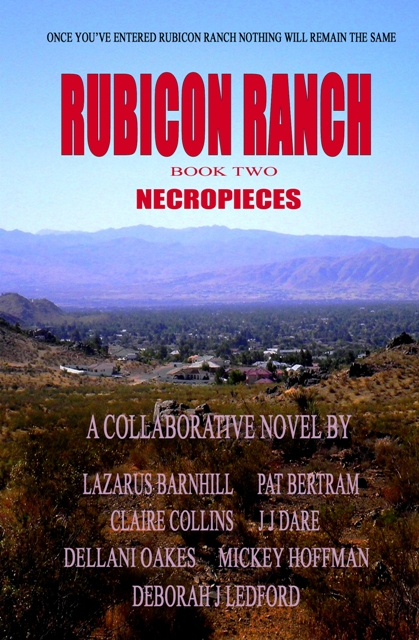
Rubicon Ranch is a collaborative and innovative crime series set in the desert community of Rubicon Ranch and is being written online by the authors of Second Wind Publishing. Seven authors, including me, are involved in the current story — Rubicon Ranch: Necropieces.

Residents of Rubicon Ranch are finding body parts scattered all over the desert. Who was the victim and why did someone want him so very dead? Everyone in this upscale housing development is hiding something. Everyone has an agenda. Everyone’s life will be different after they have encountered the Rubicon. Rubicon Ranch, that is.

Although some of the characters were introduced in Rubicon Ranch: Riley’s Story, a previous collaboration, Rubicon Ranch: Necropieces is a stand-alone novel.

We hope you will enjoy seeing the story develop as we write it. Let the mystery continue! Whodunit? No one knows, not even the writers, and we won’t know until the very end!

Chapter 34: Melanie Gray
by Pat Bertram

Sheriff Bryan turned off the highway onto Tehachapi Road and wound through Rubicon Ranch. Melanie gazed out the Navigator’s window at the beautiful houses. Although the buildings were typical California housing development architecture—stucco with tile roofs—many of the dwellings were custom-built, so none of the houses looked exactly like any other. Spanish, Moorish, and Mediterranean styles dominated, but Cape Cod designs, Greek revival porticos, and ranch-style houses were also prevalent.

It seemed strange, Melanie thought, that the lovely facades hid such horror—death, murder, dismemberment.

“When I took this job,” the sheriff said, “I figured Rubicon Ranch would be the least of my troubles. It seemed such a quiet place.” He shot a glance at her. “You find that funny?”

It had been so long since Melanie had smiled that it took a moment for her to realize her lips had quirked up in acknowledgment of their synchronized thoughts.

“Not funny, no. It’s just that the area does seem quiet and innocent, as if nothing bad could happen here. And from what I can tell, nothing bad happened until I came. First Alexander was killed, then Riley, then her father and her kidnappers, and now Morris. I know it’s foolish, but I can’t help feeling as if it’s all my fault.”

“Is it?” Bryan asked without a trace of friendliness.

“Note to self,” Melanie muttered. “Never confide in a cop.”

“What about if the cop confides in you? All hell is breaking loose in Rubicon Ranch, and I’d like to tell you what’s going on if that’s okay.”

“Ah, back to the nice cop. It’s amazing how you can do the good cop/bad cop routine all by yourself.”

“Bad cop?” He flashed a smile that could only be called a leer, but then he seemed to think better of it, and straightened his mouth into its normally stern lines. “Have you met Eyana Saleh? Egypt Hayes?”

“Haven’t met either of them.”

“It’s the same person. Petit woman, mixed heritage, new to Rubicon Ranch.”

“Oh! I’ve seen her. She’s always wandering around taking photos of the neighborhood. She’s beautiful and has such lovely skin. Eyana Saleh? That’s her name? It fits her. What has she done?”

“Right at the moment she’s in the hospital. Been beaten pretty bad. She’s not saying much, but one of her assistants found her and described the man she saw running from the house, and the description fits Jake Sinclair.”

“Have you arrested him yet?”

“He’s not going anywhere. He’s in the hospital too, just down the hall from Eyana. His arm was chewed almost to the bone.”

Melanie gaped at the sheriff. “Eyana ate him?”

“A coyote did, or so he says. Apparently, after he beat up Eyana, he ran off to the desert. That’s where the medivac helicopter picked him up. He’s not saying anything, either, though maybe when he finds out how unpleasant those rabies shots are, he’ll come clean. The doctor says it’s definitely a canine bite though he guesses it’s a domesticated creature. The only dog in the area that I know of that’s big enough to do so much damage so quickly is the bull mastiff Tara Windsor owns, but she’s keeping mum, too.”

“Tara Windsor is in Cabo with her pool boy.”

“What? How do you know?”

“My agent. She’s a celebrity hound.”

Sheriff Bryan tapped a long, well-shaped finger on the steering wheel. “So, a woman comes to town looking like Tara, telling everyone her name is Leia Menendez, wink, wink, leading everyone to believe that she’s the actress but is really Leia? Whoa. If Tara could act that good, she’d be a shoo-in for an Oscar. Playing Lizzy Borden, maybe. An axe was found in the Sinclair house under Jake’s bed. We think Leia put it there, but our witness is a bit unreliable since she was having hysterics at the time.”

“And here I thought the life of a cop was boring,” Melanie said. “All routine and paperwork.”

“Not boring enough. The witness is Nancy Garcetti, a real estate agent. She found Morris’s head in the Peterson house and went flying down the street, screaming all the way. She says while she waited for my deputies to arrive, she saw Tara Windsor sneaking around the side of the Sinclair’s house, and Tara was carrying something that looked like an axe. We can’t find any other witnesses, and Tara or Leia or whatever her name is, isn’t admitting anything.”

“Is it the axe that killed Morris?”

Bryan shook his head. “The ME says not. He says it’s animal blood, thin blood, like from a roast. Then, as if this isn’t enough of a circus, we have electric boy. Ward Preminger.”

“I know who you mean,” Melanie said. “He’s also new to the neighborhood. Seems to crackle with static electricity. Has a fixation with the Morris house.”

The sheriff turned onto Delano Road. “As near as we can figure it, Ward blamed Morris for his condition, though apparently his brain got rewired when he was zapped by lightning while trapped in a tornado. He—” The chirping of a cell phone interrupted him. Bryan pulled the device out of a sheath on his belt and held it up to his ear. “Yes,” he said. “Yes . . . Okay . . . Sure . . . Thanks . . . Be right there.”

He sheathed his phone. “I have to go. We got the preliminary autopsy reports.” He made a quick u-turn and pulled up in front of Melanie’s rented house.

Melanie climbed out of the vehicle and stood on the curb until the Navigator sped out of sight, then she trudged to her front door, unlocked it, and entered the silent house.

***

Pat Bertram is the author of the suspense novels Light Bringer, More Deaths Than One, A Spark of Heavenly Fire, and Daughter Am I. Bertram is also the author of Grief: The Great Yearning, “an exquisite book, wrenching to read, and at the same time full of profound truths.” Connect with Pat on Google+

Malcolm R. Campbell's avatarMalcolm's Round Table

patToday’s guest post about grief and coping with the death of a spouse or a life mate, is by author Pat Bertram (“Light Bringer,” “Daughter Am I,” “More Deaths Than One” “A Spark of Heavenly Fire”)  who, I’m happy to say, has stopped by Malcolm’s Round Table several times before for some great discussions.

Pat’s most recent book is “Grief: The Great Yearning.”

The Messy Spiral of Grief

I am no stranger to grief. In December, 2006, I lost my younger brother, and exactly a year later, I lost my mother. I thought I knew what grief was all about, but the grief over those deaths in no way prepared me for the depth and breadth of the grief I experienced after the loss of my life mate/soul mate.

I’d known he was dying, and I’d prepared myself for the inevitable — in fact, at the moment of his death…

View original post 528 more words

Rubicon Ranch: Necropieces — The Story Continues

Rubicon Ranch is a collaborative and innovative crime series set in the desert community of Rubicon Ranch and is being written online by the authors of Second Wind Publishing. Seven authors, including me, are involved in the current story — Rubicon Ranch: Necropieces.

Residents of Rubicon Ranch are finding body parts scattered all over the desert. Who was the victim and why did someone want him so very dead? Everyone in this upscale housing development is hiding something. Everyone has an agenda. Everyone’s life will be different after they have encountered the Rubicon. Rubicon Ranch, that is.

Although some of the characters were introduced in Rubicon Ranch: Riley’s Story, a previous collaboration, Rubicon Ranch: Necropieces is a stand-alone novel. The first chapter will be posted on Monday, June 11, and one chapter will be posted every Monday after that.

We hope you will enjoy seeing the story develop as we write it. Let the mystery continue! Whodunit? No one knows, not even the writers, and we won’t know until the very end!

Chapter 33: Melanie Gray
by Pat Bertram

Morris. Melanie shuddered, remembering her encounter with the famous author and his request for photos of necropieces. Well, now the evil old man was just a bunch of dead body parts himself.

The sheriff seemed to be focused on his driving, but a bird-like tilt of his head gave her the impression he was trying to hear her thoughts. Well, whatever other abilities Seth Bryan might have, she doubted he was clairvoyant. He never seemed to understand her or her point of view.

“I don’t know anything about Morris,” Melanie said. “And I’m not sure there’s much to know. Of all the people I’ve encountered in Rubicon Ranch, he seems the least opaque.”

The sheriff made a small noise that could have been a choke of laughter or a grunt of derision, but other than that, he remained silent.

“I mean, he is a despicable human being,” Melanie continued, “and whoever killed him should probably be given a medal for something . . . saving the earth, perhaps. But Morris doesn’t really hide what he is. He might have feigned Alzheimer’s, but that was simply because he felt like it. All that matters to him are his wants, and since he has the money to indulge himself in his evil fantasies, there is nothing to stop him.”

“Nothing?” Sheriff Bryan said quietly.

“Was nothing to stop him.” Melanie stole a look at the sheriff. Did her simple error in syntax make her seem guilty to him? She had no idea how his mind worked, and his eyes hidden behind those silly mirrored sunglasses gave her no clue.

She considered asking him if he knew who killed Morris, but he’d probably use that as an excuse to interrogate her about her neighbors, and she had nothing to say. She didn’t want to tell him about seeing the supposedly decrepit and curmudgeonly old Eloy Franklin laughing and frolicking with his dog as if he were a man half the age he pretended to be. Nor did she want to talk about the new people she’d seen wandering around the neighborhood as if it were a theme park—Murder World, or some such.

And she certainly didn’t want to talk about herself. She wouldn’t like to give the sheriff any hint of her true strength or deadliness, or he might decide to use the knowledge against her.

She stared out the window at the empty desert they were passing and wondered what he would think if she were to tell him about wrestling a boa constrictor in Costa Rica. The pale tan snake with its brown markings had been almost invisible hidden in the undergrowth, and she had tripped over it. Boas were tree-dwellers, so she wasn’t on the lookout for such a creature on the ground. She had since learned to be aware of everything in her surroundings, but back then, she was still unused to seeing danger lurking in innocent places. She figured out later the boa must have been sick or old or weak, otherwise she’d have been squeezed to death before she could unwrap the beast from around her torso. Still, it had taken all her considerable strength to save herself. And Alexander hadn’t lifted a hand to help. He had simply photographed the episode. Not exactly a knight in shining armor.

What would the sheriff have done in that situation? Kill the poor creature in an attempt to rescue the damsel in distress?

A low rumble that Melanie interpreted as a chuckle came from the man beside her. “I can hear your mental wheels spinning,” Bryan said. “Care to share what you’re thinking?”

“What are you, the thought police?” Realizing that perhaps she’d sounded too harsh for what could conceivably have been a guileless query on his part, she softened her tone. “I was just wondering if you were the knight in shining armor type, is all.”

Seth Bryan tapped the badge pinned to his left shirt pocket. “This is all the armor I need.” Then he smiled at her—a real smile that showed dazzling white teeth and a hint of a dimple. “Well, this badge and a bullet-proof vest.”

***

Pat Bertram is the author of the suspense novels Light Bringer, More Deaths Than One, A Spark of Heavenly Fire, and Daughter Am I. Bertram is also the author of Grief: The Great Yearning, “an exquisite book, wrenching to read, and at the same time full of profound truths.” Connect with Pat on Google+

Are People More Gullible Now Than They Used to Be?

badgeI got a notice from my bank telling about some of the latest scams to be aware of. In one such scam, a man claiming to be from the Social Security Administration in Georgia told the old woman that they would be sending her a new social security card. Then he asked for personal and bank information to verify that he was talking to a real person. The woman felt certain it was a scam and hung up the phone.

A friend of mine got a call from a woman claiming to be from the police fraud division, who then told her that her AOL account had been hacked. My friend also hung up, feeling certain it was a scam, but it turned out to be the truth.

Some people think we’re more gullible now, especially on the internet where we tend to take people at face value, but still, most people do have a healthy dose of skepticism when they receive messages such as, “Hi Linda, my name is John. I came across your profile and was taken by your smile. I must confess you are a very beautiful lady….I would love to get to know you please be nice enough to tell me a thing or two about you ok?” Calling me Linda was my first clue that this email wasn’t directed at me personally, but even without that, I knew it wasn’t on the level. If they were truly interested in me, they would have referenced an article I wrote or mentioned one of my ideas. I am much more susceptible to flattery about my writing than I am about my looks! Well, not susceptible. Let’s say appreciative.

I have a hunch it’s not that we’re more gullible now but that the scams are more detailed and often seem as if they could be true. If someone dressed as a cop came to your house and flashed a realistic-looking badge, wouldn’t you assume that he or she really was a cop? We all have a vague idea of what a cop’s shield looks like — we’ve seen thousands of them in movies and TV shows. Many of us have even seen them up close when we had to report a burglary or car accident, but we probably couldn’t tell the difference between a real badge and a fake one, especially if it were dark and we were scared. And chances are the badge wouldn’t be fake anyway — it could have been stolen.

Dick Clark once did a show called TV’s Bloopers & Practical Jokes, where they played tricks on people. I didn’t watch it very often because I truly hated it. I remember one scheme they pulled on Corbin Bernsen that was so elaborately detailed, they got real producers and directors to take him to lunch and make him believe he got a big part. I still remember his blank look when they laughed at him for being gullible. How could he not believe it was the truth? It was exactly the way it would have happened for real. That blank look remained only for a moment, but I remember it more than his good-natured laugh that came afterward.

Whether people are more gullible or not, we authors hope for at least some gullibility. If it weren’t for readers’ ability to believe in things that are not true, we’d be out of a job.

***

Pat Bertram is the author of the suspense novels Light Bringer, More Deaths Than One, A Spark of Heavenly Fire, and Daughter Am I. Bertram is also the author of Grief: The Great Yearning, “an exquisite book, wrenching to read, and at the same time full of profound truths.” All Bertram’s books are published by Second Wind Publishing. Connect with Pat on Google+

Reality and Truth, Fantasy and Lies

untitledvYesterday I proposed the idea that online we are who we say we are, that the truth of us comes out in our writings and postings. This topic is interesting to me because of something else I’ve been thinking about — reality and truth, fantasy and lies. I’ve always wanted to know what is real, but what if nothing really is? Then isn’t fantasy the same as truth?
So many of us still love men or women who are dead. For all practical purposes — since they are not here on Earth and do not respond to our attempts at having a relationship or even just a simple conversation — what is the difference between that and someone creating a fantasy lover for oneself? Or a reader getting immersed in the fantasy of a romance novel? Or a writer falling in love with her hero?

Yes, I know there is a difference on a cosmic level, assuming the person still exists somehow. And even if there is nothing beyond this, there is the difference that they once were real while a fantasy never was. But here, now, in an everyday sense — is there a difference?

The other day I watched the Goldie Hawn/Steve Martin movie Housesitter, and though it gets silly in spots, the story of a woman who created a fantasy life that became real intrigues me.

Hawn’s character changed herself all the time, which made me wonder, do we have to be ourselves, or can we recreate ourselves on whim? And if we do recreate ourselves — recreate the story we tell ourselves of our past, our backgrounds, our way of acting — is it a lie or just a pre-truth?

A corollary to my question is how much truth do we owe people? If we lie to con them or cheat them, of course that is wrong, but is it the lie that is wrong or simply the con that is wrong? If you recreate yourself because it seems like fun or because you’ve come to hate yourself, if the game goes beyond a certain point, do you owe people the truth? But by that time, what is the truth? What if you’ve become the person you were pretending to be?

Sometimes I get the impression that life is eternally elastic, a kaleidoscope of ever dizzying permutations that we rein back with our collective fantasy of life here on earth. If it were possible to break out of that collective fantasy, what then can we become?

***

Pat Bertram is the author of the suspense novels Light Bringer, More Deaths Than One, A Spark of Heavenly Fire, and Daughter Am I. Bertram is also the author of Grief: The Great Yearning, “an exquisite book, wrenching to read, and at the same time full of profound truths.” All Bertram’s books are published by Second Wind Publishing. Connect with Pat on Google+

Being Real Online: The Truth of Me

shadowIn a recent blog interview, someone asked me what I would do differently if I were invisible for a day, and I responded that for all practical purposes I am invisible. “Practical purposes” meaning “offline.” Some people responded that I was very visible, and they are right. I am visible online, but they (and you) don’t know if I’m visible offline, so basically, nothing would change if I were. I’d still be the same person — whoever that is.


I started out online with a certain persona — not fake exactly, but not entirely me. More of a slightly idealized version of me. The odd thing is that over the years, I have grown into that persona, so I don’t know which is the real me any more, but I think the fake one is the real one.

There’s been a lot of talk online lately about the truth of what we hear and see on the Internet, mostly because of Manti Te’o’s story. To be honest, I haven’t a clue he is or what is story is, but it did make me wonder if the people I meet are real.

I tend to take people at face value online, even though I suspect some of them are not who they say they are. For example, there are a few authors portraying themselves as hulking men with biceps and tattoos that I suspect are really women who are using not only pseudonymous names but also pseudonymous personas, but it doesn’t matter as long as they add a bit of color to otherwise staid discussions. And if they really are those men, that doesn’t that matter, either.

If the people who comment frequently on this blog — the ones I have come to think of as online friends — turn out to be not who they say they are, it wouldn’t change anything. Their insights add depth to the conversation and make me think. That is real even if they are not. But I would be willing to bet they are exactly as they seem.

I have met several people offline that I first became friends with online, and they were who and what I expected. In most cases, there wasn’t even a moment of uncomfortableness — we just continued our online relationship offline.

Of course, online we talked about books and writing, ideas and dreams, and that is hard to fake. I mean, if you don’t have ideas it’s hard to pretend that you do, or if you haven’t read books, it’s hard to make an intelligent remark about literary matters.

Maybe the point is that online we are who we say we are. Offline, we get so used to being what we’re not so that we don’t get in fights or so people don’t get angry with us or to get our way or so we can get a promotion or for any number of reasons, but online, what we are really doing is stream-of-consciousness writing, and that taps into the inner us.

If we are creatures made of stardust and electrons, if all our thoughts are particle waves or energy or whatever, maybe it’s easier to plug in to the essential spirit of people online since the Internet is an electronic medium. Online, you get a feel for people, for who they really are, not how they look or what they do for a living. Online, you’re not obese or crippled or ugly. Online, you don’t repel people with your awful smell or your terrible disease. Online, you’re just you.

Sometimes people take the freedom of the internet too far and, hiding behind fake personas, spew invective at the world. But that is true, too. It’s who they are. It’s the real people who are bogus, pretending to be affable when in fact, they are filled with anger and hate.

Are you wondering if I am real? You already know the answer. Whether I’m visible or invisible, fake or real, it’s my words that matter. My words tell you the truth of me.

***

Pat Bertram is the author of the suspense novels Light Bringer, More Deaths Than One, A Spark of Heavenly Fire, and Daughter Am I. Bertram is also the author of Grief: The Great Yearning, “an exquisite book, wrenching to read, and at the same time full of profound truths.” All Bertram’s books are published by Second Wind Publishing. Connect with Pat on Google+

Sharp Writ Book Awards Winner!

GTGYthmbLast night I was notified that Grief: The Great Yearning has been awarded 2nd Place in the 2012 Sharp Writ Book Awards Memoirs / Biography category. They said I’ll be getting a Certificate of Achievement and gold foil ribbon labels stating “Sharp Writ Book Awards Winner” that can be affixed to book covers, but today I got an email telling me it was a mistake, and I’ve been awarded 3rd place, which leaves me feeling ambivalent about the whole thing.

To be honest, I was already feeling ambivalent about winning an award for a book that I wish I’d never had occasion to write in the first place. Still, it’s an important book, and I’m pleased to see it getting any sort of recognition. More than that, I hope the increased visibility for Grief: The Great Yearning will help people find it when they need it. Grief is such an isolating experience, we need to know that whatever we feel, others have felt. Whatever seemingly crazy thing we do to bring ourselves comfort, others have done. And, as impossible as it is to imagine at the beginning, we do survive.

A fellow author and sister in sadness wrote: “Grief: The Great Yearning by Pat Bertram is a book of empathic understanding. How many recently bereft have looked to society’s guidelines for grieving and found these “norms” did not correspond to what they were feeling? How many were left confused and even more depressed because they were not “progressing” like the experts said they should? Bertram’s book is a comfort to those of us tossed into the grief whirlwind of disbelief and agony. The entire book is raw and real. Grief: The Great Yearning is a companion guide from someone who has already been there. It is a forever love letter.” —J J Dare, author of False Positive and False World.

A staunch supporter who works with the bereft wrote: “The grief journey is one of unbelievable pain to the psyche, to every part of our being. It’s a journey of missing the individual; spewing at the injustice of death, our powerlessness over death, our absolute lack of knowing what exists beyond death (despite claims to the contrary); replaying over and over our relationship with the deceased. All the while trying desperately to function in a world forever changed.

“If people were to ask me for an example of how grief can be faced in order for the healthiest outcome I would refer them to Grief: The Great Yearning, which should be the grief process bible. Pat Bertram’s willingness to confront grief head on combined with her openness to change is the epitome of good mental health.” —Leesa Healy, Consultant in Emotional-Mental Health.

***

Pat Bertram is the author of the suspense novels Light Bringer, More Deaths Than One, A Spark of Heavenly Fire, and Daughter Am I. Bertram is also the author of Grief: The Great Yearning, “an exquisite book, wrenching to read, and at the same time full of profound truths.” All Bertram’s books are published by Second Wind Publishing. Connect with Pat on Google+