A Time of Preparation

The lazy days are flowing one into the other, and it seems as if my life has come to a standstill, as if the stagnation I fear has already set in, but however I feel, the truth is, this has been a year of unprecedented adventure, change, and awe.

I started out the year in my father’s house, dealing with grief for all my dead while I cleaned out his “effects” and readied the house for sale. I gathered all my friends together for a Pre-Probate Party to celebrate the last days before his will went into probate, the last days I knew for sure I would have a place to live. Since then, I have never been without a place to live, though I stayed on couches, lived in a camper, house-sat a few times, and even rented a room for a couple of months. (Oddly, I am ending the year in this same precarious position as I started because my current room is in a house that’s for sale, and soon I will again be Stepping From The Known Into The Unknown.)

Sometime during those last days at my father’s house where I tried to imagine Unimagined Possibilities, I found myself with a new philosophy: Either Things Will Work Out Or They Won’t, which allowed me to stop worrying so much and instead let me enjoy the uncertainties of my new life. If things work out, obviously, I don’t have to worry, and if they don’t work out, there’s nothing I can do about it now because I have no idea in what way they won’t work out. Or things might work out in a way I couldn’t even fathom, which is what usually happens.

yahabibi

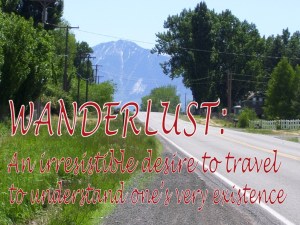
And so I drifted through my days. I continued to take the dance classes, which I love, but I dreamed of . . . more. Something epic. Hiking the Pacific Crest Trail or the as yet unfinished California Coastal Trail. Perhaps stepping foot on the Appalachian Trail (which a friend recently told me is pronounced Apple-atchian. Okay. Got it. Now I know the most important thing about the trail if ever I decided to hike a bit of it.) I also considered a more realistic venture since I do not think I have the ability to carry a heavy backpack for many miles — visiting national parks and day hiking to sample a variety of trails and terrains.
WANDERLUST

A friend, who knew my dreams of adventure, invited me to stay with her and volunteered to drop me off at trail heads and pick me up when I was finished with my hike so that I could experience adventure in a relatively safe manner. And so began two magical months of hiking along the ocean, losing myself in the forest (not getting lost geographically, more like letting the forest take me over), becoming one with . . . myself, perhaps. I am usually of two minds about everything, so I am often beset with doubts, worry, and internal discussions. But not up in the redwoods. Not by the ocean. There, I was simply me. Simply happy.

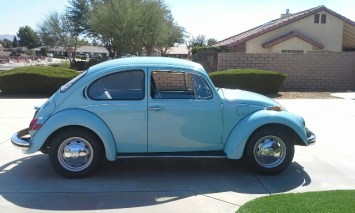
One of the things I had been of two minds about centered around my ancient VW bug, A Forty-Three-Year-Old Lemon. I considered replacing the iconic car with some sort of van I could turn into a mini-home, considered getting an automobile big enough to sleep in, considered, oh, so many possibilities, but in the end decided to keep the poor old thing a little longer. After all, how many people can say they have only owned one car in their whole life, a vehicle they bought new and kept going through the decades? And the way I figured, if I bought a new car now, in five years, it would be old. If I bought a new car five years from now, five years from now it would be new.

quotescover-JPG-10 copy

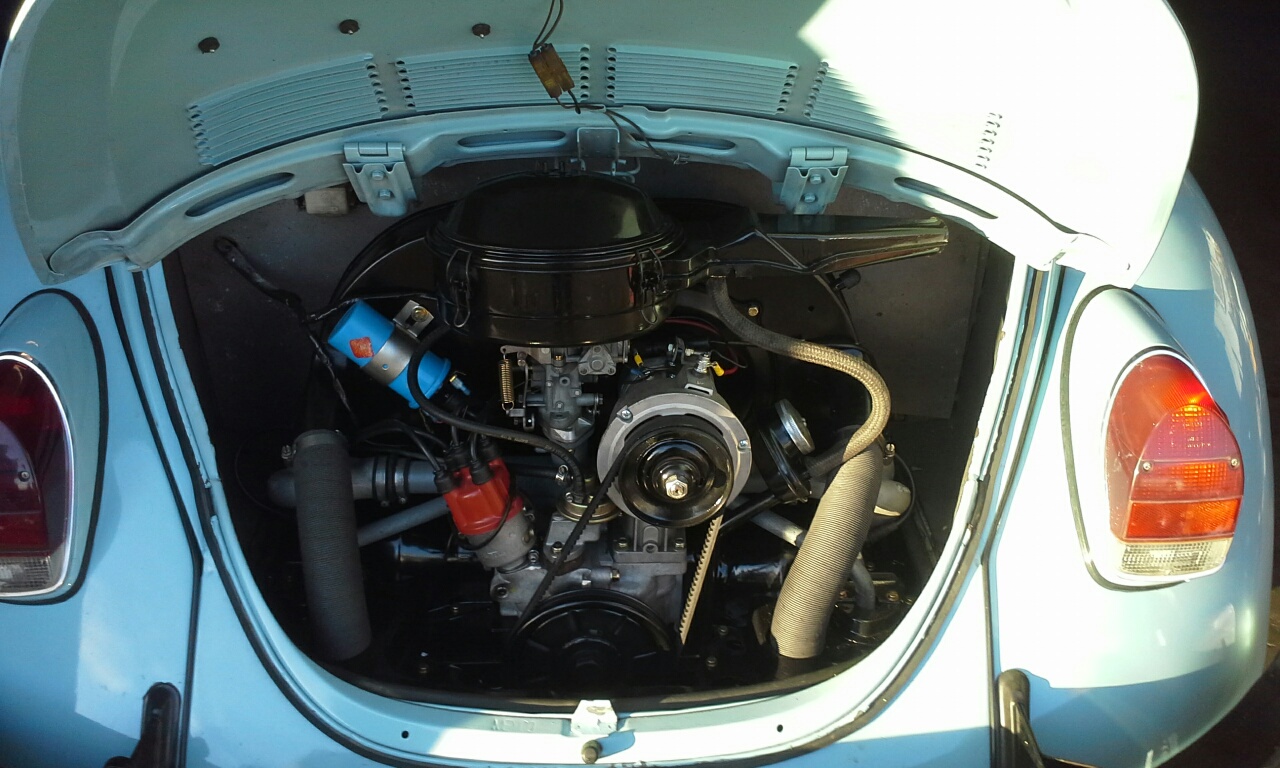
Still, if I were going on a long trip to visit parks and meet online friends, I would prefer to look like a near-classic lady in a near-classic car rather than a homeless woman in a rattletrap, so I found someone who would do the body work. All I wanted was a couple of holes patched and enough rust gone so it could be painted, and six months later, six months of learning to do without a vehicle, what I found at The Great Reveal!! was a full body restoration. And because the outside looked so beautiful, I had to have the inside reupholstered because it truly looked pathetic in relation to the lovely body. And then, when I took it to my mechanic for a tune-up before my cross-country trip and he expressed concerns about the engine lasting for all those miles, well, now I have a new engine, transmission, and a lot of other new parts, and Oh, My, My Erstwhile Lemon Is a Beauty!
20151003 135209 resized 1

Despite the awesomeness of this year, it seems to me as if it is . . . was . . . a time of preparation, not just for the coming year, but for a new way of living and thinking. I can’t go on a cross-country trip until I have put 500 miles on the new engine and have all the kinks worked out, but I am ready to meet the changes and challenges of both the trip and the coming year.

At least, I hope I am.


***

(Pat Bertram is the author of the suspense novels Light Bringer, More Deaths Than One, A Spark of Heavenly Fire, and Daughter Am I. Bertram is also the author of Grief: The Great Yearning, “an exquisite book, wrenching to read, and at the same time full of profound truths.”)

Wishing You All The Great Things This Season Has to Offer

10400972_10208469293876950_7551637971583726636_n

***

(Pat Bertram is the author of the suspense novels Light Bringer, More Deaths Than One, A Spark of Heavenly Fire, and Daughter Am I. Bertram is also the author of Grief: The Great Yearning, “an exquisite book, wrenching to read, and at the same time full of profound truths.”)
Oh, My, Isn’t It a Beauty!

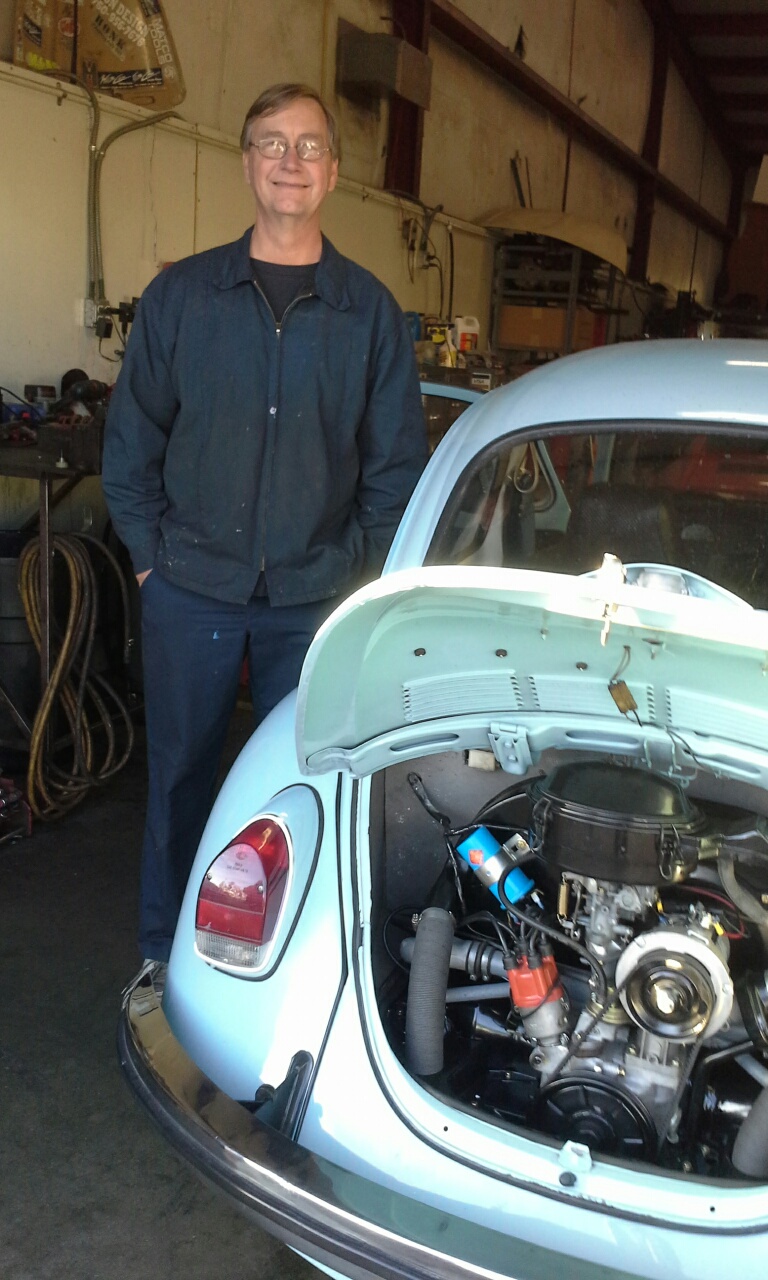
I got my car back today, exactly as the mechanic promised, everything new or rebuilt or upgraded— engine, transmission, clutch, firewall, cv’s, alternator, and a host of small parts. He said my VW is now the second best he’s seen, the best being an 2003 bug manufactured in Mexico that ended up in the USA and was somehow made legal. But compared to my car, that one is just a baby. Mine is . . . astonishing.

It is astonishing that the car kept going with only necessary maintenance for so many years. It is astonishing I have owned but one car my entire life. It is astonishing that I managed to find both a great body guy and a great air-cooled VW engine guy to do do the restoration, and that I had the money to pay them. And it truly is astonishing that a car I thought was almost moribund has risen from the dead and is now as new as a 44-year old vehicle can be.

Oh, my. Isn’t it a beauty!

***

(Pat Bertram is the author of the suspense novels Light Bringer, More Deaths Than One, A Spark of Heavenly Fire, and Daughter Am I. Bertram is also the author of Grief: The Great Yearning, “an exquisite book, wrenching to read, and at the same time full of profound truths.”)
***
Rebuilt engine

and the mechanic who did the work.

The Folly of Planning

I should know by now that making plans is an act of folly since life — and death — so often overrides those plans. And yet, still I plan.

For the past several months, I’ve been planning and preparing for a cross-country hiking/camping/backpacking trip. I bought whatever gear I thought I’d need, fulfilled my promises, cleared my schedule. In fact, I was just ticking off the last item on my list — an oil change and a tune-up — in preparation for my departure this weekend, when my plans fell apart.

I should have known this would be an ill-fated trip when not one, not two, but three people who had invited me for extended stays more or less disinvited me all within a couple of days of each other. I’d still planned to head out because ultimately this trip was about me and my relationship to the world, but my mechanic put the brakes on the whole thing, at least for now.

Apparently, although the car runs very well, and the engine could last for a couple of more years just driving around town, I’d need luck to do a cross-country trip, and despite my penchant for planning, luck is something I never plan on. I didn’t intend to push either myself or the ancient VW, so I probably would have been okay, but I bowed to the inevitable and am having the engine rebuilt. And the transmission. Eek.

It’s funny. I had the body work done because the engine and other mechanical parts were fine, but now that they are not good enough for what I have planned, I have no choice but to get the very expensive work done or else I would have wasted the small fortune I spent on the body. By the time it’s all done, I will have paid enough to have bought a new car. I certainly can’t fool myself into thinking that all this work makes the vehicle new — this folly of mine is still forty-four years old. And yet . . . what the heck. Everyone needs a folly at least once in their life, right? Besides, the bug is the only car I have ever owned, and I’m the only owner it has ever had. Such uniqueness should be celebrated, if only by a new engine.

Once the work is done, I still can’t set out. I need to drive it around town for at least five hundred miles to break in the engine and maybe take a short trip or two before I attempt a cross-country trip. So that’s what I’m planning.

Yep. Always planning, folly or not.

***

(Pat Bertram is the author of the suspense novels Light Bringer, More Deaths Than One, A Spark of Heavenly Fire, and Daughter Am I. Bertram is also the author of Grief: The Great Yearning, “an exquisite book, wrenching to read, and at the same time full of profound truths.”)
***

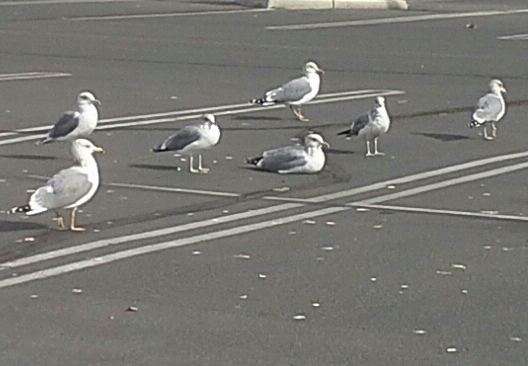
Makes me wonder what plans these seabirds had made — or not made — for them to end up in a parking lot in the desert, waiting for a ride back home.

The New Segregation

I am currently renting a room in a modular house in a modular neighborhood, if you can call this 55+ community a neighborhood. It seems more like a ghetto to me, a place where a single group is sequestered, though in this case, “ghetto” doesn’t have the usual slummy connotations, and the people choose to live here rather than are forced by mandate to occupy the area. Still, the place is segregated from the rest of the city, populated by a distinctive group of not wealthy, not young individuals. That these folk are a mixed lot, all colors, nationalities, and opinions, does not mitigate their age-related sameness.

old manOutside the gates of this so very depressing “park” where the manufactured houses seem dealt out like a game of solitaire, there is a high school. And every afternoon, while the aged walk the inside perimeter of their cage, the young folks mill around outside, waiting for their rides. Old. Young. And never the twain shall meet. Or something like that.

When did we become such an age-segregated society? It can’t be a good thing. Don’t the young and the old complement each other? One group bringing wisdom, the other youthful idealism? And yet, I don’t see a lot of idealism among the young or wisdom among the aged. (As the father says in the Kevin Bacon movie, She’s Having a Baby, “People don’t mature anymore. They stay jackasses all their lives.”)

I don’t know what I want from myself as I grow older, but I do know the thought of living in an old folks ghetto (or even in an upscale gated community for “active” seniors) gives me the creeps. Or maybe I’m just denying the inevitability of my own aging, though I don’t think so. I can’t think of anything more depressing than only dealing with old folks (though mostly I’m doing that now — the majority of my friends are considerably older than I am, and in almost all of my dance classes, I am the baby, though I am not so young for all that.)

Of course, since I won’t have the money to live in a gated community, even a downscale one, I doubt I’ll ever have the choice of ghettoizing or segregating myself, but the other amenities that will be available to me seem just as creepy. I don’t see myself joining senior-only groups, going on senior outings, partaking of early-bird specials for seniors, or living in any sort of senior-oriented neighborhood. I certainly don’t want to be one of those old folks who gain cachet from their advanced years, and who make sure everyone knows their age.

When I was young, my mother never told me I did something good “for my age.” If it wasn’t good, I got no credit. On the back end of my life, I want to live the same way. It (whatever “it” is) is good or not good in and of itself, not with consideration for age.

And yet, what do I know? Life changes us. Age changes us. As decrepitude creeps in, as I start making the accommodation for the end of life, maybe I’ll be glad to be surrounded by others of my ilk.

But not yet. With whatever “youth” I have left, I want to live life to the fullest, to experience the world as much as I am capable, to deal with people as individuals rather than as effects of their age.

***

(Pat Bertram is the author of the suspense novels Light Bringer, More Deaths Than One, A Spark of Heavenly Fire, and Daughter Am I. Bertram is also the author of Grief: The Great Yearning, “an exquisite book, wrenching to read, and at the same time full of profound truths.”)

Live in Peace

Two years ago, a man died. I didn’t know him, didn’t even know of him. His was just another anonymous death, one of the 155,000 people who die every day. But to his wife, he was not an anonymous statistic. His death was not one of the many. To her, his was the only death, a catastrophe of enormous proportions.

His death changed her world. His death changed her.

The effects of his leaving are still rippling in her life and the lives around her. I have yet to meet the woman except online, won’t meet her offline for another few weeks, but because of the shared experience of losing our life mates — our soul mates — we have become friends. Would she have chosen him over me and all the other friends she has made since he left? In a heartbeat. And yet here we are, two of the left-behinds, dealing with life as best as we can, making the most of a situation we did not choose, snatching at whatever happiness comes our way.


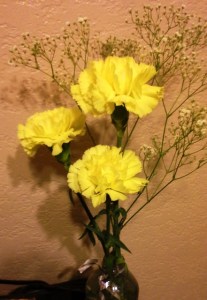
I don’t suppose it makes any difference to her that I’ve spent this day thinking of her and how much she still misses him. I don’t suppose it makes any difference that I feel how diminished the world is without him. In the two years he’s been gone, 262,000,000 people have been born, and yet the death of this one man — the death of any of us, actually — diminishes us all.

May he, and all our dead, rest in peace.

May we, and all the world, live in peace.

***

(Pat Bertram is the author of the suspense novels Light Bringer, More Deaths Than One, A Spark of Heavenly Fire, and Daughter Am I. Bertram is also the author of Grief: The Great Yearning, “an exquisite book, wrenching to read, and at the same time full of profound truths.”)

Ya Habibi!

Ya Habibi means “my darling” or “my beloved” in Arabic, and it’s the name of one of the songs to which we danced this past weekend. The experience was grueling, involving a ten-hour dress rehearsal on Thursday followed by two performances on Friday, one on Saturday evening, and a matinee on Sunday. Mostly we sat (or stood) waiting for our two 3-minute segments. Since the program was almost three hours long, that was a lot of waiting in an uncomfortable costume. Gorgeous raiment, but uncomfortable.

yahabibi

The experience was also awesome. We caused quite a commotion with our costumes, moves, and the whole lot of shaking that went on. It’s really incredible playing to a receptive audience, but truly, despite a few minor missteps, we were fabulous, and deserved the applause, hoots, and whistles.

yahabibi5

A friend took a couple of photos of us dancing (I am the one in the silvery mauve; the rest of the performers got left out of the photo) and even met me at the stage door with flowers. I felt like a star. And, in fact, as we were leaving the theater, the woman who dealt with the lighting said, “Here come the stars.”

?????????????

Ah, the joys of the limelight! I will be eternally grateful to my dance teacher for giving me this priceless opportunity.

***

(Pat Bertram is the author of the suspense novels Light Bringer, More Deaths Than One, A Spark of Heavenly Fire, and Daughter Am I. Bertram is also the author of Grief: The Great Yearning, “an exquisite book, wrenching to read, and at the same time full of profound truths.”)

Good Luck in Any idiom

The origin of “break a leg,” meaning to wish an actor good luck, has many possible derivations. Some researchers believe the term comes from vaudeville days where curtains were called “legs.” Since not all actors were able to get on stage, you wished each other well by telling each other to “break a leg,” or to get on stage. Breaking a leg is also an archaic term for bowing, so perhaps the term refers to curtain calls. And in Shakespearean days, the stage was often built on legs, and sometimes the folk crowding into the cheap seats would be so numerous, their raucous enjoyment broke the legs of the stage.

Whatever the meaning of “break a leg”, it doesn’t have any relevance here because it does not refer to dancers. In the case of dancers, you wish them “Merde,” short for “Merde à toi,” which apparently is an old French slang term for “good luck.”

Since I’m a UnitedStatesian What’s wrong with plain old “good luck”? It might not be traditional, but it’s an easily understood term if one speaks English, and I need all the luck I can get.

I have dress rehearsals the next couple of days, then four performances this weekend, and for some reason, I’ve been feeling a bit of trepidation. Not sure why exactly. I know the dances as well as anyone and better than most, though I seldom get through a dance without some small error, a costume malfunction if nothing else. (We are wrapped in veils ready for an unveiling at the end, and sometimes the veils unveil themselves prematurely. So not cool!)

My dance teacher seems to think I’ll do okay and attributes my trepidation to the unsettled nature of my life, which is entirely possible. And she reminded me of something else. However well or poorly we do, we are still dancing on stage. How cool is that, to be doing a belly dance (actually two belly dances!) before an audience even though most of us have no dance experience and none of us are young anymore. (I’m the youngest, come to think of it.)

So despite the harrowing days ahead, I will try to concentrate on the wonder of it all. Me. On stage. Dancing with my class. Swathed in veils and glitz and glitter and (hopefully) a brilliant smile.

Wish me luck in whatever idiom you choose.

***

(Pat Bertram is the author of the suspense novels Light Bringer, More Deaths Than One, A Spark of Heavenly Fire, and Daughter Am I. Bertram is also the author of Grief: The Great Yearning, “an exquisite book, wrenching to read, and at the same time full of profound truths.”)

Lonely in a Crowd

I spent most of the past three days alone, and I made an interesting discovery. It’s not being alone that makes me feel alone and lonely. It’s being with too many other people that makes me feel alone and lonely. Every grief upsurge I’ve had recently has come after spending too much time with people who don’t enrich my life. (I don’t mean you, of course!) So often when I am with others, I sit and listen. I can’t contribute anything to the conversation because they talk about things that have nothing to do with me or my life, nothing to do with anything but their own insular and insight-less agendas. So I sit. And listen. And slowly disappear.

ReadingA friend invited me to have Thanksgiving dinner with  her five-generation family, which was very nice, and I was invited to dinner and a movie Friday evening, but the rest of the time, I was alone. (Didn’t even have to see or hear my strange roommate because he’s gone for the week.) Yesterday I did nothing but read. Just lolled around with a book in one hand and fruit in the other, which made it a doubly fruitful day. Today was a repeat of yesterday, though I added a hike in the desert to round out my solitary festivities.

And I never once disappeared. Never had a single pang of loneliness.

As it turns out, this isn’t such a great discovery, this realization that other people make me feel lonely, because there’s not much I can do about it. Obviously, I can’t spend my life alone. (People need people. Isn’t that the general thrust of life, love, and happiness?) I suppose I could make an effort to talk more when I am in a crowd, maybe even try to steer the conversation to make it more about me, but if I had anything to contribute, I would already be commenting. The sad truth is, I have nothing to say. (Which is why I so seldom blog any more. No insights, no interesting observations, no emotional highs or lows to ponder makes for mighty boring reading.) Admittedly, most people have no problem talking when they have nothing to say, but I have never quite mastered the art of talking to no purpose. Pointless conversation seems . . . pointless.

Anyway, this is not the week to worry about such things. My belly dance class will be performing a couple of numbers in a dance program at the local college this coming weekend. I’ll be with people most of the time — dance classes in the morning, rehearsals in the afternoon or performances in the evening, so I’ll set this conundrum aside for another time and simply enjoy being part of this special event.

***

(Pat Bertram is the author of the suspense novels Light Bringer, More Deaths Than One, A Spark of Heavenly Fire, and Daughter Am I. Bertram is also the author of Grief: The Great Yearning, “an exquisite book, wrenching to read, and at the same time full of profound truths.”)

The Truly Creative Mind

A couple of weeks ago, I was discussing my work-in-progress with a friend. This WIP is about a murder in the studio where we take dance classes, and my idea is that each of us should have an unconscious hand in the murder. Ideally, each of our flaws would become a fatal flaw. For example, if one person hadn’t been late, if another person hadn’t left something behind, if a third hadn’t picked up something by accident, the poor woman wouldn’t have died.

We discussed possible flaws to assign to our classmates, then my friend said, “You know what’s wrong with you, don’t you.” I gave a rueful smile because I knew what she was going to say even before she said it: “You’re too sensitive.” (I don’t know how to work sensitivity into the story equation, so for now, I’m thinking my character’s flaw will be disdain, which I have to confess I sometimes feel when people say things that are patently untrue.)

This seems to be the consensus nowadays, that I’m too sensitive. I take things to heart, am sensitive to slights, hurt terribly by unintended insults, feel unfairness no matter who it’s directed at, wounded by disloyalty, and being ignored or shot down when I speak silences me completely.

I’m not sure why my sensitivity bothers others, but there it is. It would be a lot more comfortable for all concerned, of course, if I were able to accept with insouciance what anyone said to me, and yet, sensitivity has always been part of me. Grief blew whatever defenses I’d built to smithereens, and now everything bothers me, partly because I think people should feel honored that I have deigned to spend time with them. (I’m joking, of course, though there is an uncomfortable kernel of truth to the matter.)

To be honest, I’m not sure what being less sensitive will gain me. Why would I want to feel less? To insulate myself from unpleasantness? To ignore nuances of voice (both complimentary and chastising)? To accept other people’s view of the situation as the only reality?

I read something when I was a very young girl that has stuck with me throughout the decades because it seemed to be about me. I found this quote in the forward of a Pearl S. Buck book. (I was a precocious reader, having read everything in the children’s library by the time I was in second grade and everything in the young adult library before the fourth grade).

“The truly creative mind in any field is no more than this: A human creature born abnormally, inhumanly sensitive. To him… a touch is a blow, a sound is a noise, a misfortune is a tragedy, a joy is an ecstasy, a friend is a lover, a lover is a god, and failure is death. Add to this cruelly delicate organism the overpowering necessity to create, create, create — so that without the creating of music or poetry or books or buildings or something of meaning, his very breath is cut off from him. He must create, must pour out creation. By some strange, unknown, inward urgency he is not really alive unless he is creating.” —Pearl S. Buck.

I’m not as hypersensitive as Pearl Buck, at least not anymore, but I was that sensitive as a child and a young woman, and apparently, I am heading once again in that direction. I have a hunch this sensitivity is something that being so connected to Jeff all those years protected me from, because I didn’t feel so abnormally sensitive when he was alive. His presence seemed to give me a safe place to “incubate,” to be myself without fretting about my difference from everyone else (because I was like him). Then later, his long illness dropped me into a period of dormancy, of numbness, of simply getting through the days, weeks, years.

And now? Without the cocoon of our relationship or the numbness of his dying, I am thrown once more into the world to deal with life however I can, to feel whatever I can. I seem to have fallen into a period of relative joylessness, but one day, the joy will return, and what will I have gained if I have learned to shut myself off from my sensitivities?

Of course, if people considered my feelings first, debates about my hypersensitivity would be moot. And since that will not happen, all I can do is deal with the fallout as best as I can with walks and tears and chocolate. And blogging.

***

(Pat Bertram is the author of the suspense novels Light Bringer, More Deaths Than One, A Spark of Heavenly Fire, and Daughter Am I. Bertram is also the author of Grief: The Great Yearning, “an exquisite book, wrenching to read, and at the same time full of profound truths.”)