Pat As Protagonist

Ever since I mentioned that I am getting the itch to write again, I’ve been becoming more involved in the process. Not involved in the actual writing, you understand, but involved in the thinking of writing.

A blog reader I respect gave me a good reason for not doing a sequel to Bob: The Right Hand of God — he said what comes next is best left to the imagination of the reader. I appreciate that. I’m not sure I want to go back to that world, anyway. Being involved in a world in flux was interesting at the time, but if I were do an Adam and Eve sequel, it would be years later, the world would no longer be in flux, and Bob would have gone on to another job. Which would mean it would be like any story of young people roaming around a fictitious world doing . . . something. Still, I do see Eve standing at the gate of the compound (Eden), while the polka-dot snake urges her to leave. As fun as that beginning would be, I have no idea whatsoever about what comes after that. So I will leave her standing there, trying to get the courage either to listen to the snake or to stay where she is.

I doubt I’d ever again be able to write the sort of books I started with — those first four suspense novels were the reflection and culmination of all the research Jeff and I had done, first on our own, then during our years together. I don’t think I want to delve into conspiracy theories any more. No, that’s not true. I know I don’t want to delve into conspiracy theories any more. All the shenanigans of the past couple of years — politics, pandemics, propaganda — has made any possible fictional story seem pale by comparison.

I thought of writing a book about a woman who is looking in a mirror, and her reflection does something different from what she is doing, but I’m not sure I want to delve into that story, either. Sounds like madness — both the story and the writing of it — though it might make a nice short story. And I do need a couple of more short stories to fill out an anthology of my shorter works, but not quite yet.

I have no interest in writing anything more about grief, either fiction or non-fiction, mostly because I have nothing more to say. Any protagonist, however, would have to be an older widow, probably years after the death of her soul mate, because I can no longer imagine any other character. I certainly can’t imagine a young protagonist — I don’t remember what that was like. Nor can I imagine a happily (or unhappily) married protagonist. Secondary characters can be anyone, but to get into the head of a major character vastly unlike me takes a leap I can no longer make. That’s okay, actually. I’m fine with writing about an older woman on her own, trying to live life the best she can on her own terms. It might not be the sort of book that would be published by a real publishing house, but I have no intention of trying to get someone to publish any future books. I’m to the point where I have no interest in setting myself up for rejection. If I ever publish another book, I’ll do it myself.

I haven’t been able to figure out what the underlying theme of a potential novel would be. A mystery, of course, but beyond that, I didn’t really know until today. Three separate incidents — a conversation, an email, and a blog comment — all seemed to point the way.

The conversation was about my book Daughter Am I, and how much the reader enjoyed the way the young woman gathered up old folks as she went about her task of finding out who her grandparents were. It reminded me how much I enjoy that particular storyline. First there’s one character on a quest, then two, then three, then . . .

The email was part of a discussion with a friend about getting older and how this particular birthday (the same one I had a few months ago) is scary because it’s about stepping into the unknown future of aging. This is a decade of rapid aging, and it is scary if you think about how close we are getting to a time of infirmity, but we still just march along, doing the best we can. She also mentioned a show she’s watching about all sorts of misfits who try to change their lives by participating in a dance production, which sounds like fun.

And the comment was left on an old post: Resuming my Lonely March into the Future, about well, about resuming my lonely march into the future.

Oh, and there was a fourth thing — the perfect name for a fictional town popped into my head while I was writing this blog.

I wasn’t sure I wanted to write another Pat book because too many local people are asking me to write one in the hope that they will be in it, but I’m not interested in putting real people in my books any more, at least not where they can recognize themselves, because that really is a good way to lose friends, and since I am here for the duration of my life, I can’t afford to alienate anyone.

Combining all this, it seems as if my next book should be another Pat-as-protagonist book, about setting up house, gathering confederates (perhaps people who are all lost in some way), and marching relentlessly into the future despite wonky knees, all the while solving some sort of mystery. Perhaps a murder that had unknowingly been done in Pat’s house years before.

Of course, by the time I actually clear my head of all the clutter and sit down to write, I might end up with something completely different, but this “Pat moving to a new town, gathering misfits, and solving a crime” scenario seems to be where my mind is heading at the moment.

***

What if God decided S/He didn’t like how the world turned out, and turned it over to a development company from the planet Xerxes for re-creation? Would you survive? Could you survive?

A fun book for not-so-fun times

Planting Hope

Today is the first really cool day we’ve had for months, cool enough to make me realize that fall really is coming. When the outside temperature is in the nineties (Fahrenheit), it’s hard to believe that summer is coming to an end, so it seems rather silly to be preparing the ground for fall planting. We’ll be getting back into the nineties, at least for a few days now and again, but I am beginning to feel a bit of urgency.

The season really is changing. And if fall is coming (five more days!), that means winter is only three months away.

It will be strange, after all this time of working outside, to have a hiatus in the winter, but it will be good to give my poor old knees a rest. I’m just hoping they will hold up for all the planting I’m going to be doing this fall — a few magnus echinacea (a purplish pink coneflower), a bunch of lily trees (despite the name, they are not trees, just very tall lilies), a couple of hundred tulip bulbs, and a pound of wildflowers. I also need to transplant the New England asters because the clump is getting rather dense.

If I can’t get the wildflower area completely dug up and the old Bermuda grass roots removed, I’ll just hoe what’s left and hope for the best, but there’s no way to cut corners on the rest of the planting.

So much work! In the long run, I hope it will be worth it — I would certainly enjoy a beautiful yard. Mostly, though, it’s the doing, not necessarily the done, that intrigues me. And the not giving up.

Previously, whenever I started a garden of some sort and the plants didn’t do well, I shrugged it off as my not having a green thumb. (Which I don’t have, but I’m hoping that experience and research and luck will offset my lack of native ability.)

The last time I planted anything, the failure truly wasn’t my fault. The grasshoppers were voracious that year and they ate everything down to the ground — including a six-foot tree. Because of that, I now panic whenever I see one of those hideous brown hoppers, but so far, they are keeping their destruction to a minimum. If they get too bad, I might borrow the neighbor’s chickens and let them feast, though some of the hoppers seem almost as big as those chickens, so I’m not sure he’d want to take the risk.

Looking at what I’ve written today, I can see that I’ve used a whole lot of words to say what I came here to say: that the cooler temperature is a harbinger of the fall that will show up next week.

I’m not really sad to see gardening season end, nor am I glad. It’s all part of the cycle of life. And after the fall preparation and the winter hiatus, spring will come and all the hope I’ve been planting might come to fruition.

***

Pat Bertram is the author of Grief: The Inside Story – A Guide to Surviving the Loss of a Loved One. “Grief: The Inside Story is perfect and that is not hyperbole! It is exactly what folk who are grieving need to read.” –Leesa Healy, RN, GDAS GDAT, Emotional/Mental Health Therapist & Educator

An Itch to Write

I can feel an itch to write coming on — not just to do my daily blogging stint, or to write about grief, but to immerse myself in a story.

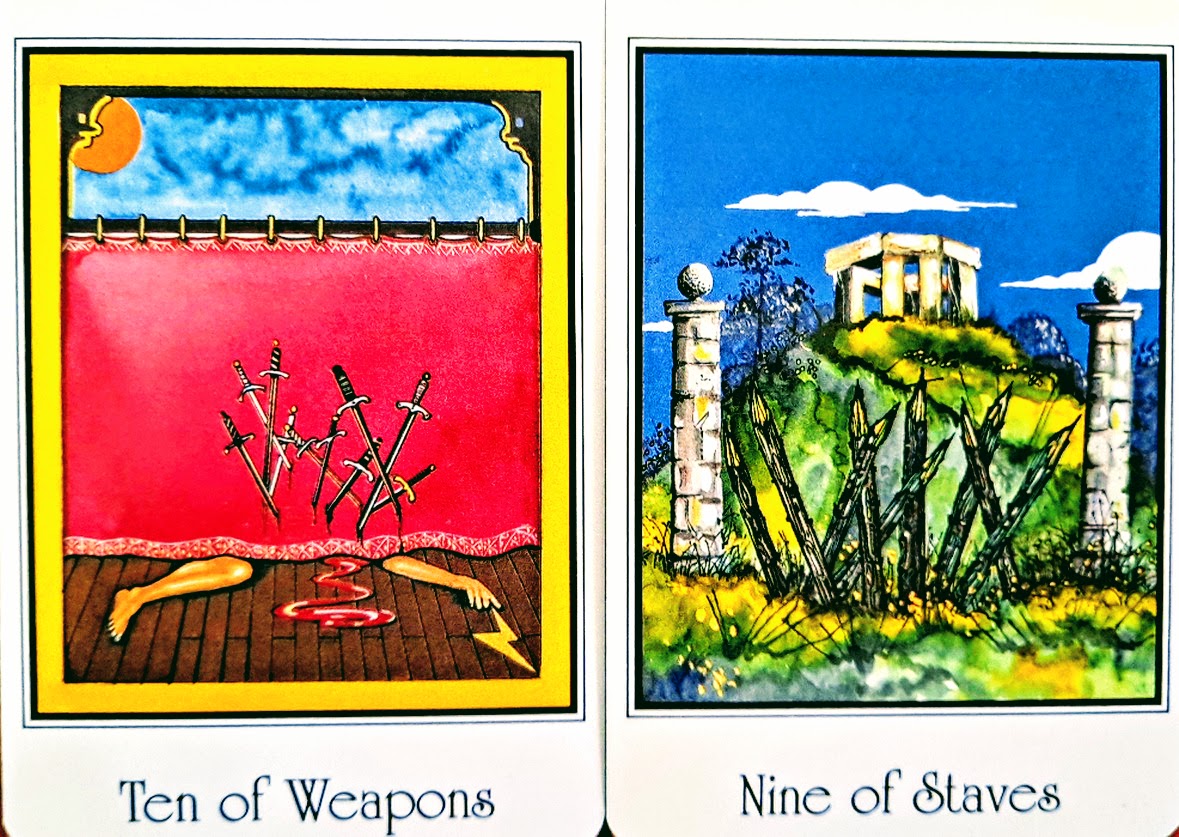
I’m not there yet. Too many things are calling for my attention to allow me to let “real life” take a back seat to a fictional life. “Real life” is in quotation marks because no one knows to what extent this life is real. It might be just a figment of our collective imaginations, a fiction that we create together. At least that’s what both the quantum physicists and the tarot seem to preach.

In my tarot readings this month, I’ve been getting the moon card rather frequently. The moon stands for imagination as a force. It also warns against the pitfalls of believing too much in what we perceive as reality, because what we observe can only reflect what is real the way that the moon reflects the light of the sun. This card might be echoing my interest in writing, or it might be that the card is creating that interest in me. It’s hard to tell with the tarot. Either way, it does seem to indicate a time of illusion.

Not that any of this has to do with writing specifically. It’s just that when I am focused on the outward life I see, I cannot focus on the inner life I might perceive.

As time goes on, my focus will change. As the hardscape of my yard becomes more fixed and my gardens become more viable, I will have a lot more free time (mental free time, that is), especially in the winter. My job will be coming to an end at some point. I originally agreed to a year and then contracted for another six months, but as I get even older, I’m not sure if anyone will trust me with their elders. My senzaburu (1000 origami cranes) will be done by the end of the year. And the hidden object game I have been fascinated by for the past year is becoming less fascinating now that I’ve opened all the locations. There is a new location every month, which revs up my interest, but even that might not be enough to overcome my creeping boredom with the game.

As my current areas of focus gradually become blurred, that’s when one of the stories rattling around in my brain will take root.

I’ll be interested in seeing which idea plants itself. (If you have a preference for any of these story ideas let me know.)

1) A sequel to Bob, The Right Hand of God, perhaps? If you end up with two characters named Adam and Eve, it seems almost an obligation to write their story. 2) A sequel to Madame ZeeZee’s Nightmare? After all, the main character (me!) is alive and well in Colorado, and seems to be calling out for a new episode in her fictional (and oh so murderous) life. 3) A ghost story? The only ghost I ever created is a ghost cat in Light Bringer, so it might be interesting to bring a different sort of ghost to life. It’s possible 2 and 3 could be the same story. 4) A novel of psychological terror where the poor protagonist isn’t sure if she is going crazy or if she is seeing ghosts? It’s possible 2, 3, and 4 could be the same story. 5) A story based on a tarot reading, with each twist and turn dictated by the cards? It’s possible 2, 3, 4, and 5 could all be the same story, a combination of any two or three or each could be a separate tale. 6) A completely different story, one that hasn’t made itself known to me yet.

All that is in the future. My current foci — my house, my yard, my job, the hidden object game, the tarot, the senazburu, my daily blog offering — are still with me.

But someday . . .

***

What if God decided S/He didn’t like how the world turned out, and turned it over to a development company from the planet Xerxes for re-creation? Would you survive? Could you survive?

A fun book for not-so-fun times

The Star and the Queen of Light

A couple of days ago, I mentioned how the two tarot cards I deal myself each day seem to relate more to each other than to me. Todays picks seem a particularly symbiotic pair — The Star and the Queen of Light.

This current deck is the i Tarocchi di Robot, one of the most fascinating of the decks in my collection. There is true irony is trying to delve deeper into the meaning of what it is to be fully human — which is what I understand is the purpose of the tarot — by using images of robots, the opposite of human (if anything can be considered an opposite).

The Star in this deck is about the experience of beauty, joy, fulfillment, finding inner harmony, to be centered and at peace. It’s also about hope, that light inside us that keeps us going even in the darkest times.

The Queen of Light in this deck correlates to the queen of pentacles in most decks. The suit of luci is about the light that creates rather than destroys, about the light that gives life. And that is typical of this queen because she is an earth mother type (since this is a robot deck, perhaps I should say she is a stellar mother type) filled with feminine creative energy, compassion, love, intuitive understanding, calm and balance.

Oddly, I glean the same message from these two cards as I did from the reading a couple of days ago: that my life is going well, and that I should continue to focus on creating a calm and balanced life for myself.

***

What if God decided S/He didn’t like how the world turned out, and turned it over to a development company from the planet Xerxes for re-creation? Would you survive? Could you survive?

A fun book for not-so-fun times.

Cheap Writing

I’m reading a book by an author I can generally tolerate despite his obviously manipulative style, but this particular book irritated me from the first page.

One of the characters is a teenager. And like almost all teenagers in adult books, this one is rebellious, insolent, arrogant, and downright nasty. And those are her good qualities. Well, her only qualities.

Since this author is so manipulative, it’s possible he chose the character as one who would be, with only a few strokes of his keyboard, instantly recognizable to his readership, but if so, why? Why do so many teenagers in books have to be like this? The character has ruined more stories for me than even the serial killers who so lovingly demonstrate every single cut and cherish every single drop of blood. It’s as if no one will believe that a teenager can be other than appalling, especially since the parent’s inability to deal with the inexcusable behavior often serves as a subplot. If the teenager is as nice as many I have met (and as placid as I once was), then bang, there goes that subplot, and the author would have to think of another one.

It’s also a cheap subplot (sometimes even the entire plot) because the more terrible you make the teenager, the more obvious the character arc when the kid grows up. Whatever happened to subltety?

I suppose, since this author tends to play with such archetypes rather than breathing life into a creature of his own, it makes sense he’d build a story on such a flimsy pretext. Unfortunately, as bad as things are at the beginning of the book, things promise to get a whole lot worse by the end. Assuming, of course, I stay to the end. I might consign the kid to the fires of unreadable books long before it gets to that point.

What I would really like to see is the opposite (and occasionally, an author does present such a change) where the parent is rebellious (without being abusive) and the teenager has to deal with the moodiness. Or even better — no teenagers at all.

I used to read young adult books way into my adulthood because I enjoyed the theme of a misfit standing up to the world and its conventions, finding a fit, and becoming their own person, but I seldom come across such a storyline any more. (That also used to be plot of the Regency romances I read in my youth — the main character was always a societal misfit who ended up finding a fit. But that storyline has been suffocated under the current fad for stories that skirt the edges of porn.)

Obviously, I can’t do anything about books with horrid teenagers except not read them, and if I had time to go to the library, or if I had other book to read, I wouldn’t give this one another minute of my time.

What I can do, though, is eschew such cheapness and triteness in my own writing.

And yes, I will write another novel one day.

Perhaps.

***

Pat Bertram is the author of Grief: The Inside Story – A Guide to Surviving the Loss of a Loved One. “Grief: The Inside Story is perfect and that is not hyperbole! It is exactly what folk who are grieving need to read.” –Leesa Healy, RN, GDAS GDAT, Emotional/Mental Health Therapist & Educator

More Tarot

I am continuing with my tarot studies — to the extent that doing a daily two-card reading can be considered studies — and even after more than a year, I’m not sure what to make of the cards. Although most cards do seem to resemble my life in some way, it’s the same sort of vague way that a newspaper horoscope represents one’s life. I am not learning anything about my life that I didn’t already know, and in fact, it’s my knowledge of my life that brings sense to the cards rather than the cards bringing sense to my life.

Now that I have progressed to a two-card layout (the first year was a daily one-card pick), I am noticing that even though the cards don’t seem to relate all that much to my life, they do seem to relate to each other.

For example, the other day, the cards I dealt out were the Empress and the Queen of Pentacles. As always, the question I ask is “What do I need to know today?” The first card represents my situation, the second the challenge I face.

Some readers interpret the Empress as the female principle the positive female attributes of creativity, love, abundance, intuition, nurturing, finding balance in our lives, connecting to the world through our senses. An earth mother archetype who loves beauty.

And some readers interpret the Queen of Pentacles as nurturing, filled with feminine creative energy, compassionate, hard-working, loving, intuitive. An earth mother archetype who enjoys the comforts and luxuries of life.

Such a correlation between the two cards! And a correlation between the cards and me too, I suppose, though these cards might be said to represent any woman. What I gathered from the cards is that my life is going well, and that I should continue to focus on creating a calm and balanced life for myself.

Since that’s what I am doing anyway, this personal interpretation might have nothing to do with the cards and everything to do with my own inclination. Which leads to another possibility — instead of me reading the cards, perhaps the cards are reading me.

***

What if God decided S/He didn’t like how the world turned out, and turned it over to a development company from the planet Xerxes for re-creation? Would you survive? Could you survive?

A fun book for not-so-fun times.

Grief and Peace

Studies have indicated that happiness is found mainly in retrospect. For example, happy children don’t know they are happy. They simply are happy. It’s only later, when they look back, perhaps after a terrible time in their adult lives, that they realize they had been happy in their early years. For another example, when someone is involved in a challenging situation that takes all their time and energy, they don’t realize until later they were happy. In fact, often while going through this “happy” situation, people think they are decidedly unhappy.

It happens with grief, too. Sometimes a couple isn’t particularly happy, but after one of the partners is deceased, the remaining person looks back and realizes that, despite the disagreements and difficulties, they really had been happy. Or after caring for a loved one during a long illness, the void they leave behind makes those painful days of being with the loved one seem akin to happiness.

Happiness might also be found in anticipation, in hopes for a time when joy might come again. Oftentimes, when someone has gone through a difficult time, they find it easy to look ahead to future happiness, but not when that difficult time is grief for a loved one, and especially not when the loved one is a spouse or soul mate.

The chaos of grief is so great, the blackness so opaque, the pain so all-consuming, that we cannot look to the future as a rosier time. How could there be happiness again when the person we loved more than anything, when the person whose very presence brought us happiness is dead? Chances are there will be happiness again. We change, our perspective changes, our focus changes, so the pain and yearning that once filled our being gradually shrinks into the essence of our souls. We still feel the loss, but like with bark that has broken to allow a tree to grow beyond its confines, our hearts and souls break and then expand to allow other feelings to exist alongside the pain.

Although I often offer a promise of future peace to grievers who show me their pain, I never promise happiness. In fact, I seldom mention the possibility because it’s no consolation. For a long time, the very idea of finding happiness without our deceased mate seems too much of a betrayal of our shared life.

But peace is attainable. Even in the days when the yearning for one more smile or one more word feels as if it will explode out of us, we can find brief moments of peace when the chaos is temporarily stilled, when the roar of pain and loss is temporarily silenced. As time goes on, these moments happen more frequently, and as even more time goes on, the duration of these moments is extended, until one day the peace begins to linger longer than the chaos.

When grievers call out to me in their pain, I want what any caring person wants — to ease their pain. But I, more than most, know that their grief belongs to them. It’s not up to me to take it away from them or even to add to the pain by “bleeding” for them, as people used to tell me they did. (Did they really think it eased my pain to have them bleed for me? That I bared my pain as plea for someone to take the burden of loss from me? If so, they were wrong. Baring my pain was a gift, to show other grievers that they are not the only ones who feel the pain and chaos of grief, that no matter how insane those feeling seemed, they were a normal reaction to an abnormal situation.)

All I can do is offer grievers a place to voice their pain and to send them a wish for (and a belief in) the possibility of peace.

So today, whether you are struggling with grief or trauma, or feelings of unworthiness and guilt for whatever happiness has come your way, I wish you peace.

***

Pat Bertram is the author of Grief: The Inside Story – A Guide to Surviving the Loss of a Loved One. “Grief: The Inside Story is perfect and that is not hyperbole! It is exactly what folk who are grieving need to read.” –Leesa Healy, RN, GDAS GDAT, Emotional/Mental Health Therapist & Educator

A Virus by Any Other Name

In the following scene from A Spark of Heavenly Fire, my novel about a novel disease that was first published in 2009, investigative reporter Greg and his editor Olaf are talking about an article on the pandemic Greg is hoping to write.

—-

“How’s the research coming, Greg?” Olaf asked, a shade too heartily.

“I feel as if I’m drowning in paper.”

“So I see,” Olaf said, laying a hand on the stack of articles. “Mind if I look?”

“Help yourself. They belong to the newspaper.”

Olaf settled himself in his customary chair with a handful of the papers. A minute later, he raised his head.

“How do these guys get anything printed? If my reporters turned in work as incomprehensible as this, they’d be out of here so fast they’d think they were flying.” He glanced at the papers and shook his head. “Even the titles are incomprehensible. ‘Imitating Organic Morphology in Micro-fabrication.’ I don’t even know what that means.”

“Me neither,” Greg said, thinking if he had to wade through this sort of stuff to learn about the red death, the earth would fall into the sun long before he read half of it.

Olaf tossed the sheaf of papers back onto Greg’s desk. “Better you than me.”

“What do these guys do?” Greg asked. “Take a course in obfuscation?”

“Probably. Convoluted writing and obscure terms are a way of intimidating the uninitiated, keeping the profession closed to non-scientists, and adding to the scientific mystique. Just think, if diseases had names like Bob and Carol and Ted and Alice, doctors wouldn’t make anywhere near the amount of money they do now.”

Greg laughed. “That’s an idea. They do it for hurricanes, why not everything else?” He mimed seizing the phone and dialing. “Mr. Olaf? I can’t come in today. I’ve got the Bob.” He hung up his imaginary receiver and looked inquiringly at his boss.

Olaf nodded. “Works for me.”

—–

And it works for me.

By the time this new virus was well-publicized, I was already sick of the fear mongering. For example, one of the first studies of the possible effects of this pandemic claimed that 80% of the world’s population would die. It was that first insane projection from which all the other insanity came.

The truth is, most people did not get infected, and of those infected, most did not get sick, and of those who got sick, most did not die.

Again, as with my post yesterday, I am not trying to denigrate anyone’s experience. For those who suffered deaths in the family, severe illness, isolation from family, or financial hardships, it was a terrible thing. But for most of us, the worst was the fear. It was reprehensible the way people who should have known better — the political hacks representing us, the media, the idiotic folks who put sick people into nursing homes where so many elderly lived — exaggerated the truth and caused immense (and in many cases, unnecessary) fear. There is a good chance we would not have been that much worse off if we had all just gone about our business, but too much jockeying for position was being done by people in power or people who wanted power, and truthfully, I think their tactics were so successful that they ended up buying into their own propaganda of fear.

And the manipulation is still going on. A vaccine of sorts is available for those want it, but the next move is to make the vaccine mandatory to “protect the vaccinated.” Huh? I thought the purpose of the vaccination itself was to protect the vaccinated. And if the vaccine isn’t a real vaccine, one that does protect the recipient, when are they going to get a real vaccine so that those who want to be fully protected can be? As with everything else that has gone on the past two years, the truth is hard to come by. What we are told might be the true truth, a semblance of the truth, or a wholly manufactured truth.

To keep from validating any of the shenanigans that is going on surrounding this virus, I have refused — and continue to refuse — to use any of the official names the parasite is given. Hence, “The Bob.” My own private rebellion.

I mean no insult to any Bob living or dead, of course. I named the disease many years ago back when I didn’t know any Bobs, and reusing the name for this virus seemed a good way to keep myself from succumbing to the fear and intimidation that the media and our so-called leaders apparently want us to feel.

Living In Fear

Almost all new books mention, in some way, “The Bob.” Of course, the authors don’t know enough to call it “The Bob,” so they call the virus by other names that don’t really mean much. It was bad enough living through the upheaval; it’s a whole lot worse having to relive it in books. Sometimes, the reference is simply a placeholder, to give people an idea of when the story takes place, which is never a good idea because it dates the book, and readers in the next few years who prefer only current books won’t be interested. Other times The Bob is a major plot point. Either way, it doesn’t interest me. It seems perhaps sacrilegious to say this, considering the trauma so many people suffered during the past year and a half, but whether The Bob is mentioned merely to set the time or is an intricate part of the plot, it seems . . . trite. And even worse than trite — a cheap shot to get people personally involved in the story instead of using good writing to get engage readers.

I could be wrong, of course. Others might like to see their “Bob” experiences from a different point of view, to gain a bit of perspective.

The author of the book I am currently reading talks about how worn down people are from more than a year of worrying about their families and themselves; how weary they are of having to wear masks and keep their distance from others; how exhausted they are from isolation and loneliness and grief; and especially, how tired they are of living in fear.

I do understand that many people got deathly sick, that loved ones died, that some people suffered tremendously from isolation, but those things alone, I would think, would preclude people from reading about the horrors they lived through.

Notice I say, “the horrors they lived through.” Despite what I wrote in the first paragraph, that it was “bad enough living through the upheaval,” the truth is, for me, it wasn’t bad at all. In fact, it made no difference to my life. Well, except for the mask, but since I was seldom around people and seldom went into a store, I rarely had to wear it.

I never worried about myself, never was afraid, never was lonely (except for a few times that had nothing to do with The Bob). Most of the people I cared about were already dead, and those still alive were taking care of themselves. I didn’t have any travel plans to call off, and as for local events, I’d mostly stopped going to those before they got cancelled. (I’d gained too much weight for one thing; the food was generally something I shouldn’t eat, for another.)

So I stayed home and read. I did see a few people, but always the same ones — the woman I worked for as well as an occasional friend or two. And that is exactly the life I would have lived even if The Bob had never made itself known.

I’m not denigrating anyone’s experience. I know it was a rough time for a lot of people, but it does seem strange to me that in this, as in so much else, what might be good for one person is terrible for another. Still, we each have our own nemeses.

I don’t know if it’s true, but I read that women with O positive blood got The Bob less frequently and not as bad as people with other blood types (it has to do with the protein coating on the cells). Unfortunately, it is definitely true that women with O positive blood are especially tasty to mosquitoes that carry various deadly viruses.

It just goes to show, if one thing doesn’t get us, something else will, though with the mosquitoes as with The Bob, I do the best I can. I won’t live in fear.

***

What if God decided S/He didn’t like how the world turned out, and turned it over to a development company from the planet Xerxes for re-creation? Would you survive? Could you survive?

A fun book for not-so-fun times.

To Buy or Not to Buy

The last two times Arbor Day Foundation sent me a gift to thank me for my donation (though really, it’s not so much as a donation as payment for the gift), the plants and bulbs were worthless. The plants were too tiny to plant, though in retrospect, I should have put them in a pot and babied them, but considering that I didn’t remember ordering them and didn’t even know what they were, it didn’t really matter what I did with them. The bulbs I got at the beginning of summer were a disappointment. Only one gladiolus bloomed, and I’m afraid if I dig up the bulbs like they suggest and replant them next year, the same thing will happen, so I’m going to cover them with some sort of mulch and leave them where they are. Maybe with an earlier start, they’d be okay.

Normally I’m not disappointed in the failure of Arbor Day Foundation “gifts” because I know how seldom they thrive, at least with me as their caretaker, but I was disappointed in the bulbs because the bulb collection they sent last year did well.

Because of the disappointment, I’d decided to toss away any further solicitations unread, but today, as I started to shred the card with my name on it, I noticed the most beautiful blooms. These are yellow, light orange, and apricot, and last year’s collection (the one that did well), was pink and purple.

I couldn’t do it. Couldn’t tear up the card, I mean. I know even if the bulbs bloom, they will never look like the photo, but even if one of the bulbs comes up, it will be a delight. So I’ve added this card to the stack of planting items to order this weekend when I have time to concentrate.

In my defense, I received a flower catalog yesterday, and though the gardens portrayed made me envious, I set aside the catalog and didn’t order from it, so perhaps my will power was all used up, and that’s why this gorgeous sunset-colored collection of bulbs got to me.

And the plants I’m not buying? Well, there is still plenty of time for me to change my mind, and if I remain steadfast and don’t change my mind, there’s always next year. So, it seems, when it comes to plants, bulbs, and seeds, my quandary is not “to buy or not to buy,” but “to buy now or to buy later.”

***

Pat Bertram is the author of Grief: The Inside Story – A Guide to Surviving the Loss of a Loved One. “Grief: The Inside Story is perfect and that is not hyperbole! It is exactly what folk who are grieving need to read.” –Leesa Healy, RN, GDAS GDAT, Emotional/Mental Health Therapist & Educator