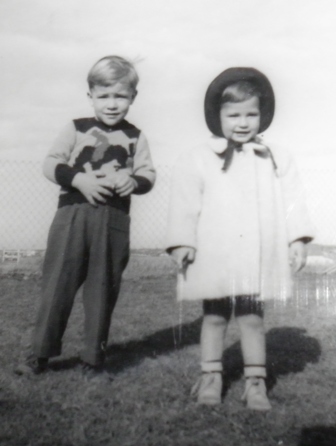
 I cannot even begin to make sense of the events of the last week, let alone the last year. It will take me a long time, if ever, to process the horror, heartbreak, grief of dealing with my dysfunctional brother’s presence, the trip to take him back to Colorado, and now his absence.
I do not miss him, of course, he was too abusive (when I heard a noise outside my window last night, I got scared thinking he’d returned), but he was such a major part of my life for the past fifteen months that his absence looms large. I don’t understand how I reconnected with him, don’t understand why he treated me so badly, don’t understand why I thought it important for him and his father to forgive each other. (Except that for my entire life, the two of them have used me as the rope in their tug of war, and I needed to be done with both of them.)
I don’t even understand how I became the one to take him back to Colorado. I don’t remember the sequence of events leading up to the trip, though I do know I refused to let my siblings just toss him on the streets of this dusty, windy, and hellishly hot town. (Partly because I knew he wouldn’t stay away.) I also refused to let them get him thrown in jail where he certainly wouldn’t get help for his many mental disorders.
And so, somewhere along the line, I agreed to take him and the stuff he’d collected back to Colorado. It’s odd that I did so. The very thought of the trip terrified me. I didn’t know if I could put up with his relentlessness and nonstop abuse for all those miles and hours. Knowing how violent my reaction to his verbal abuse was, I feared me as much as I feared him, and I didn’t think we’d survive it. The trip was almost as bad as I thought it would be, and though we came close to an accident several times, we both did survive, probably because of all the prayers and well wishes people sent our way.
He kept opening the door to the car while I was driving (I think he thought he was opening the window, though I don’t really know). One time he climbed into the back seat to sleep on top of all of his stuff, and when he climbed back into the front, he climbed over me, making it impossible for me to see. I pulled over, and helped him get untangled. Because I had to push his foot, it seemed as if I pushed him out the door, and so he refused to get back in the car. He stared at me for a few minutes, then went into a field and fell asleep. I finally got him back in the car, but when he left the moving car a little later, I took off without waiting for him, thinking maybe it would scare him enough to behave.
When I went back, I found him with rescue workers from the fire department, screaming for water. Apparently, he’d fallen asleep by the side of the road while he waited for me. They wanted to arrest him, said a police car was on its way, but I begged and pleaded for them to let me take him to Fort Collins. (A repeat of the night before when I had to beg the cops to let me take him away rather than arrest him. I’d said the car was all packed; just let us go. And finally they did.) The fire folk expressed concern for me, and I told them I’d be fine, that I’d been dealing with him for the past fifteen months. And they too let me go.
My brother demanded that we stop so he could get cold water, and when I did so and gave him the bottle, he clubbed me with it. (I don’t know why, and later, when I told him what he had done, he didn’t know either. He didn’t believe he’d done it, not even when I showed him the huge bruises on my upper arm.) I wanted so much to leave him there, and even planned to call the police to come get him, but I reminded myself to keep focused on my goal. And so, we continued the terrible trip.
The only way I can make sense of any of this trauma is to think in terms of “The Hero’s Journey” with him playing all the roles except hero. His moods change so rapidly, it would have to be a fantasy story, where sometimes the hero is driving a dragon, sometimes a little boy, sometimes a lost soul.
But I am no hero. Heroes don’t cry all the way home.
People think it strange that I cried. Well, so do I — I figured I’d be relieved to be done with him, but he was once my brother. I know some of the tears were simply a way of washing away all the emotions I’d felt, both his and mine. Some of the tears were pure grief since my brother is lost to me — I don’t know who that stranger is. And some of the tears were just plain sorrow for our unsolvable problems, both his and mine.
***
Pat Bertram is the author of the suspense novels Light Bringer, More Deaths Than One, A Spark of Heavenly Fire, and Daughter Am I. Bertram is also the author of Grief: The Great Yearning, “an exquisite book, wrenching to read, and at the same time full of profound truths.” Connect with Pat on Google+. Like Pat on Facebook.









 Bertram's Blog