How Mountains Shape My Stories

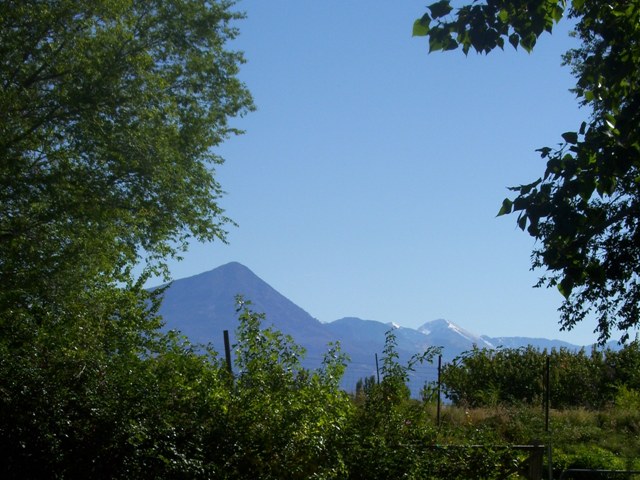
Because I’ve always lived in the shadow of mountains, mountains always shadow my writing. This is especially true in Light Bringer. The story begins when a baby is found on the doorstep of a remote cabin in the shadows of the Rocky Mountains, and continues years later when the foundling, now an adult, returns to the high country to find out who she is. The mountains in my novel are both protective and secretive — the hills protect those who live in their shadow, yet the mountains also harbor terrible and awesome secrets that threaten those same people.

Whenever I needed a hiding place for the secrets of the ages in Light Bringer, I searched maps for isolated mountain ranges, and ended up with a library beneath the Ahaggar Mountains in Algeria, ancient artifacts beneath the Beishanmai Mountains in the Gobi Desert, and experimental spacecraft beneath the McDonnell Ranges in Australia. I’d heard about  the mountains in Australia where the experiments were being done, and in my research I’d come across hints of what lay beneath the Ahaggar Mountains, but the Gobi location was strictly a guess, though later I discovered that in fact, caves deep inside the Beishanmai Mountains were repositories for ancient treasures.

Maybe the mountains themselves were helping with the book.
Excerpt from Light Bringer (Incidentally, though not all the treasures mentioned might have been found beneath the Ahaggar mountains, they do exist):

Of all the extraordinary things Teodora had seen since starting work on her current assignment, the library, deep within the Ahaggar Mountains in Algeria, had been the most stunning. She did not know who had created the library or how it had come into IISA’s possession, but she had the privilege of being one of the few people to have seen the place.

The passageways, dug thousands of years ago, were painted with pictures of cities that had crumbled to dust before history was born. Those tunnels led to a series of vast modernized rooms—climate-controlled, dust-free, computerized.

One room contained row upon row of glass cases, which protected manuscripts and scrolls too fragile to handle. Another room contained an untold number of clay tablets, some written in languages that had yet to be identified. A third room contained crystals and optical discs that held digitalized information, and other discs that gave off holographic images when spun. Though seemingly futuristic, they were relics of an incredibly remote past.

The final room contained bound books, most of which were less than two thousand years old. Tens of thousands of these books were alchemical texts that detailed such things as perpetual lamps, the manipulation of matter to produce force fields, and simple ways of creating sustainable energy. A few also talked about how certain churches in France were linked together to create a message, which pre-dated Christianity. These churches were built on ancient power points that had been mapped by astronomers and geomancers who wanted to warn future generations of the heavenly body that would come to destroy earth.

***

Pat Bertram is the author of the suspense novels Light Bringer, More Deaths Than One, A Spark of Heavenly Fire, and Daughter Am I. Bertram is also the author of Grief: The Great Yearning, “an exquisite book, wrenching to read, and at the same time full of profound truths.” Connect with Pat on Google+. Like Pat on Facebook.

How does your environment/upbringing color your writing?

Because I’ve always lived in the shadow of mountains, mountains always shadow my writing. This is especially true in Light Bringer. The story begins when a baby is found on the doorstep of a remote cabin in the shadows of the Rocky Mountains, and continues years later when the foundling, now an adult, returns to the high country to find out who she is. The mountains in my novel are both protective and secretive — the hills protect those who live in their shadow, yet the mountains also harbor terrible and awesome secrets that threaten those same people.

Whenever I needed a hiding place for the secrets of the ages in Light Bringer, I searched maps for isolated mountain ranges, and ended up with a library beneath the Ahaggar Mountains in Algeria, ancient artifacts beneath the Beishanmai Mountains in the Gobi Desert, and experimental spacecraft beneath the McDonnell Ranges in Australia. I’d heard about  the mountains in Australia where the experiments were being done, and in my research I’d come across hints of what lay beneath the Ahaggar Mountains, but the Gobi location was strictly a guess, though later I discovered that in fact, caves deep inside the Beishanmai Mountains were repositories for ancient treasures.

Maybe the mountains themselves were helping with the book.

Here are some responses from other authors about how their environment colors their writing. The comments are taken from interviews posted at Pat Bertram Introduces . . .

From an interview with: J. P. Lane, Author of “The Tangled Web”

I’ve traveled from an early age and I’ve lived in several countries, so maybe that’s the reason The Tangled Web trots around the world a bit. I chose Prague as one of the locations, because I’d been to Prague the year before I started writing it and the memories were still fresh. The familiarity with the Hispanic characters comes from having lived in Miami for twenty years and having had a lot of Hispanic friends and work associates. I also lived in Puerto Rico at one point. And there’s the Jamaican dialect in the book. Only someone who’s lived in Jamaica for some length of time could write that.

From an interview with: Dale Cozort, Author of “Exchange”

I grew up in a fair-sized city, but I spent a lot of time with relatives in the country, so I probably write rural life a little more authentically than someone without that experience. I also have a computer background, so there is always a little bit of the techie in my stories. I have to dial that back so it doesn’t get in the way of the story.

From an interview with: Sherrie Hansen Decker, Author of “Love Notes”

Love Notes is my first Christian inspirational novel and certainly reflects some of my deepest beliefs about my Christian heritage. In other of my books, the main characters have been rebelling against the very faith Hope clings to in Love Notes. So yes, my Christian beliefs definitely color my writing, whether in shades of guilt or hope. In Love Notes, I love it that Hope’s strong faith is intact even though she’s lost everything dear to her, including her husband, who died in a tragic car accident. Tommy has everything a man could want, yet he is cynical and discontented and very short on faith. In the end, Tommy finds hope, joy, peace and love where he least expects it — as have I on several occasions!

What about you? How does your environment/upbringing color your writing?

(If you’d like me to interview you, please check out my author questionnaire http://patbertram.wordpress.com/author-questionnaire/ and follow the instruction.)



