What advice you would give to an aspiring author?

My advice to aspiring authors varies depending on how cynical I am about the book business on a given day.

When I’m philosophical, I tell aspiring writers:

A book begins with a single word. Many novice writers get intimidated by the thought of writing an entire book, but all you ever need to write is one word. I know that’s not much of a goal, but in the end, it is the only goal. That’s how every book all through the ages got written — one word at a time. By stringing single words together, you get sentences, then paragraphs, pages, chapters, an entire book.

When I want to be encouraging, I tell aspiring writers:

Write your book. Rewrite it. Edit it Re edit it. Study the publishing business. Learn everything you can about good prose, story elements, promotion. With so many millions of people out there who have written a book or who want to write a book, the competition is fierce. A writer does not attain maturity as a writer until he or she has written 1,000,000 words. (I’m only halfway there.) So write. Your next book might be the one that captures people’s imaginations and catapults you into fame and fortune. Not writing another book guarantees you will never will reach that goal. It also keeps you from doing what you were meant to do.

When I’m cynical, I tell aspiring writers:

If you aspire to be a writer, write. That’s all it takes.

If you aspire to be a good writer, write — and read. Read how-to books about writing and read good books to absorb good writing.

If you aspire to be a bestselling writer, write, read — and gather luck. Less than 1% of 1% of writers ever attain that status.

Here are some responses from other authors about advice they give to aspiring writers. The comments are taken from interviews posted at Pat Bertram Introduces . . .

From an interview with Polly Iyer, Author of “Hooked”:

You’ve heard it before. Keep at it. Period.

From an interview with Sandy Nathan, Author of Tecolote: The Little Horse That Could

You’ll make more money as a brain surgeon.

From an interview with S. M. Senden, author of “Clara’s Wish”

Write from a place of knowing. Bring your experiences to what you write; be willing to invest a piece of yourself in your writing so it will be real to the reader.

From an interview with Tom Rizzo, Author of “Last Stand At Bitter Creek”

Read—not only for enjoyment. Treat your reading as a study lab, taking note of how the writer lures you into the story, how characters are introduced, and what makes you like or despise them. Reading soaks the brain with ideas and possibilities. And write, of course. Don’t wait for inspiration. Just write.

What about you? What advice would you give to aspiring writers?

(If you’d like me to interview you, please check out my author questionnaire http://patbertram.wordpress.com/author-questionnaire/ and follow the instruction.)

***

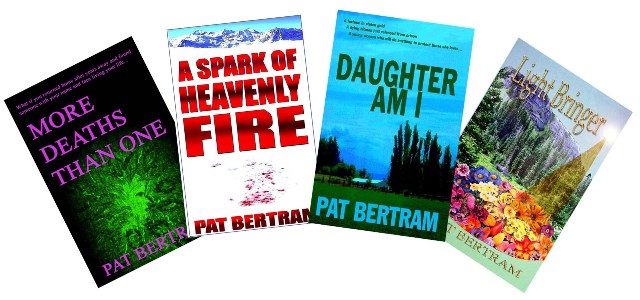
Pat Bertram is the author of the suspense novels Light Bringer, More Deaths Than One, A Spark of Heavenly Fire, and Daughter Am I. Bertram is also the author of Grief: The Great Yearning, “an exquisite book, wrenching to read, and at the same time full of profound truths.” Follow Pat on Google+. Like Pat on Facebook.

Where do you get the names for your characters?

Most of the characters in Daughter Am I are aged gangsters, and they kept the monikers they used when they were young. I patterned my gangsters after those in the 1930s movies, though in the book they didn’t actually reach their prime until the 1950s or even 60s. Some names I stole, like Kid Rags, which was the name of a 1900s gangster in Hell’s Kitchen, and others were inevitable, like the morbid wheelman named Happy.

Bob Stark in More Deaths Than One was so named because he was supposed to seem an “everyman,” hence the common first name. He was also supposed to be stark of speech and action, and so the surname was a reminder to make sure he didn’t get too flowery. Despite his name, Bob Stark turned out to be rather wordy at times and not the silent, uncommunicative loner I had planned.

Greg Pullman in A Spark of Heavenly Fire was named after Bill Pullman in While You Were Sleeping to remind me that Greg was good-looking and very nice.

Rena in Light Bringer was so named because it was short for Ahkrena, which was a word I created to be the name of an unknown ancient race. When the character was small and someone asked her name, all she could say was Rena. Her name was supposed to be a clue to her identity after her research uncovered stories of the Ahkrena, but when I discovered Sumerian creation myths, the book went a different direction. I got rid of Ahkrena, but kept Rena, since by then the character and her name had become intertwined

Here are some responses from other authors about how they named their characters. The comments are taken from interviews posted at Pat Bertram Introduces . . .

From an interview with Donna Small, Author of “Just Between Friends”

Names for characters are tough for me. I will write chapters using ‘ajdfjkd’ instead of names. I just have a hard time finding the right one for the character since I’m a huge believer in your name being having an impact on who you become. Both of my daughters play sports so I keep the rosters from their events and refer to them for different and unique names that will fit my characters. I also Google a lot!

From an interview with John Stack, author of “Cody’s Almost Trip to the Zoo”

Names are fun and usually mean something special. I use kids that I have taught, daughters, grandsons, and friends. Family can be cool because you can often capture their personality in the character and no one really gets offended.

From an interview with Smith Hagaman, Author of “Off the Chart”

You’ve heard the old story. Adam was naming the animals. God said, “What will you call that one?” Adam said, “Hippopotamus.” God said, “Well, you can call it anything you want to, but why Hippopotamus?” Adam looked at him puzzled, “Because it looks like a hippopotamus!” That’s how I get my names.

What about you? Where do you get the names for your characters?  (Or your children or your pets or your plants.)

(If you’d like me to interview you, please check out my author questionnaire http://patbertram.wordpress.com/author-questionnaire/ and follow the instruction.)

***

Pat Bertram is the author of the suspense novels Light Bringer, More Deaths Than One, A Spark of Heavenly Fire, and Daughter Am I. Bertram is also the author of Grief: The Great Yearning, “an exquisite book, wrenching to read, and at the same time full of profound truths.” Connect with Pat on Google+. Like Pat on Facebook.

Have you always wanted to be a writer?

I always wanted to be a reader. That’s really all I ever wanted to do. I did try writing a novel many years ago, but the words never came flowing out of me the way I thought they should — in fact, there were no words at all — so I accepted that I had no natural talent for writing. About ten or eleven years ago I decided phooey with talent, and I started writing again. I thought it would be a good way of taking my mind off my problems. I also read books about writing, publishing, and promoting, so basically I gave myself a crash course in the whole writing spectrum.

Here are some responses from other authors about whether they’d always wanted to be writers. The comments are taken from interviews posted at Pat Bertram Introduces . . .

From an interview with Siobhán Nolan, Author of “Old Man Harry”

No, I haven’t. I didn’t even consider myself a writer until I saw my book in print. That was only a few weeks ago, but there’s something so powerful about that moment when you hold your published work in your hands for the first time and can truly say to yourself, “Wow, I did it. I’m a writer.”

From an interview with Lazarus Barnhill, Author of “The Medicine People”

When I was a child of four or five, Wednesday nights were “dollar nights” at the Riverside Drive In: a whole car load of people could see the movie for a buck. My parents and sister would sit in the front seat and I’d sit in the back. Periodically during the show, I would say what the character on the screen was about to say. Eventually my parents got really tired of that and forbade it. But something took root in me even back then. As an elementary school child I would constantly start stories that ended up being only a page or two long — and made me feel like a failure. When I was in sixth grade I lay awake one night and created a story that involved every child in my homeroom class. With the blessing of Miss Roach (and, no, I did not make up that name), I laboriously wrote the story down — probably thirty-five or forty pages — and was given permission on the last day of school to read it to the class. With about five pages left (I was just about to be machine gunned by the villains, having recovered the money they stole from the bank), the principal came in and said that we were free to go to the playground or to stay inside. The students immediately bolted — not one even asking how the story ended. I decided then to write the sort of stories that people would not be able to put down . . . and I’m still working on that.

From an interview with J. P. Lane, Author of “The Tangled Web”

I’ve been a writer by profession most of my adult life, but there wasn’t any point when I thought I wanted to be a writer. I just fell into writing quite by chance – just the way The Tangled Web came about – by chance. There was no thought of wanting to write a book. One day, I sat down and started writing and about a year later, there was a novel on my computer. Mind you, I was an advertising and marketing writer and I also had articles published in major Florida publications, so I wasn’t exactly green when I ventured into the world of fiction. Advertising writing requires tremendous discipline, so I was already reasonably equipped to be an author.

What about you? Have you always wanted to be a writer? Or, like me, have you always wanted to be a reader?

(If you’d like me to interview you, please check out my author questionnaire http://patbertram.wordpress.com/author-questionnaire/ and follow the instruction.)

***

Pat Bertram is the author of the suspense novels Light Bringer, More Deaths Than One, A Spark of Heavenly Fire, and Daughter Am I. Bertram is also the author of Grief: The Great Yearning, “an exquisite book, wrenching to read, and at the same time full of profound truths.” Connect with Pat on Google+. Like Pat on Facebook.

What writer influenced you the most?

I’ve spent my life reading, so from a young age, “story” seeped into my conscious mind and steeped there until I began writing. In that way, all of the writers whose books I have ever read have influenced me, but if I had to pick a single author, it would be Taylor Caldwell. Caldwell told wonderful stories that showed history in the context of fiction, and I’ve tried to do the same. She also used a hundred words when a single sentence would have sufficed, and I’ve tried to do the opposite. And she overused words. In one novel, she used the word “inexorable” about a hundred times, and a couple of times I used the word in my own writings as an homage to her and a reminder to myself not to repeat unusual words. Such echoes resound in readers minds, as “inexorable” did in mine, and detract from the overall impression of the book.

Here are some responses from other authors about the writers who influenced them the most. The comments are taken from interviews posted at Pat Bertram Introduces . . .

From an interview with Rami Ungar, Author of “The Quiet Game: Five Tales To Chill Your Bones”

I’d have to say Anne Rice, Stephen King, and James Patterson. I discovered the first two when I was in junior high and high school, and they blew my mind. I knew after reading them, horror was what I wanted to focus on. I discovered James Patterson shortly before graduating high school, and I think he was the one who taught me how to write thrillers. To this day, I think of Alex Cross and James Patterson when I think about how I was able to write my thriller novel “Snake”.

From an interview with Juliet Waldron, Author of “Roan Rose”

At the moment, I’d say Cecelia Holland.

From an interview with Sherrie Hansen, Author of “Love Notes”

Maud Hart Lovelace, author of the Betsy Tacy books, set in fictional Deep Valley, Minnesota, my home state, greatly impacted my life as a young person. (Think Little House on the Prairie but set during the Victorian era.) Maud’s main character, Betsy Ray, longed to be a writer, and set the stage – really formed the expectation in my mind – that I would write a novel one day. The Betsy Tacy books are wonderful (and back in print thanks to Harper Collins). One of the guest rooms at my B&B is named “Heaven to Betsy” in honor of the tomes.

From an interview with Noah Baird, Author of Donations to Clarity

I picked up Still Life with Woodpecker by Tom Robbins when I was about 21. It was the book which really spoke to me. I’d always enjoyed reading, but it was the first book I felt like it was written to me. I loved Steinbeck, Twain, etc, but they were from another generation. Woodpecker was the literary equivalent of hearing Nirvana’s Smells Like Teen Spirit or Don McLean’s American Pie for the first time. I felt like someone else out there saw the world like I did. Christopher Moore, Tim Dorsey, and Carl Hiaasen are larger influences on me now, but Tom Robbins was the first to knock me down the rabbit hole.

What about you? What writer influenced you the most?

(If you’d like me to interview you, please check out my author questionnaire http://patbertram.wordpress.com/author-questionnaire/ and follow the instruction.)

Does One Have to be a Coffee Drinker to be a Writer?

I do author interviews on my Pat Bertram Introduces . . . blog, I have a constant feed of authors’ status updates in my Facebook feed, and I participate in several online discussion groups for writers. And always, one word seems to come to the fore: coffee. Coffee seems to be part of the writing ritual, and many authors claim to find inspiration in a cup of coffee. Hmmm. I don’t drink coffee. Am I missing a vital part of the writing process?

Here are some responses to the question of what writers drink while writing. The comments are taken from interviews posted at Pat Bertram Introduces . . .

From an interview with: J. Conrad Guest, author of Backstop and One Hot January

My morning sessions start with a pot of coffee and a trip to my humidor to select a cigar.

From an interview with: Coco Ihle, author of She Had to Know

I have a wonderful 16 oz. thermos mug that keeps my coffee hot, so I don’t have to get up so often for a refill. My right hand seems to be permanently crooked into the mug holding position.

From an interview with: P.I. Barrington, Author of Isadora DayStar

Coffee and Diet Coke are my working poisons. If I could get them both via an IV drip I would, lol!

From an interview with: John Paul Allen, Author of “Monkey Love”

Lots of coffee — two or three pots are a must.

From an interview with: Millicent Borges Accardi, Author of Injuring Eternity

I typically drink Peet’s coffee when I am writing or at my computer.

From an interview with: T. C. Isbell, Author of “Southern Cross”

Coffee, I drink vast mounts of coffee while I work.

From an interview with: Dr. Dorothy McCoy, Author of “The Manipulative Man”

I fix a cup of superb, fresh ground coffee (one should not skimp on coffee).

From an interview with: Jetta Stone, Author of “Silver Moon”

Chocolate and a cup of steaming strong brewed coffee.

From an interview with: Tom Rizzo, Author of “Last Stand At Bitter Creek”

Coffee. Is there any other?

From an interview with: Steven Hart, Author of “We All Fall Down”

Coffee. Oh yes — coffee.

See what I mean? Coffee. What about you? Do you have a favorite beverage that you drink while writing?

(If you’d like me to interview you, please check out my author questionnaire http://patbertram.wordpress.com/author-questionnaire/ and follow the instruction.)

***

Pat Bertram is the author of the conspiracy novels Light Bringer, More Deaths Than One, A Spark of Heavenly Fire, and Daughter Am I. Bertram is also the author of Grief: The Great Yearning, “an exquisite book, wrenching to read, and at the same time full of profound truths.” Connect with Pat on Google+

Are you writing to reach a particular kind of reader?

I am the reader I was writing for. There were stories I wanted to read and couldn’t find, so I wrote them. The dichotomy of this is that I always wanted to reach a large readership and make a living by writing, so it would have been more practical to write books that a large number of people would like. To be honest, though, I don’t like what the majority of readers like, so it would be impossible for me to write such a book. At least, if I write for myself, I know that one person will like the book. But I’m lucky — I’ve found others who like my books.

Here are some responses from other authors about the particular kind of reader they are trying to reach. The comments are taken from interviews posted at Pat Bertram Introduces . . .

From an interview with Alan Place, Author of “Pat Canella: The Dockland Murders”

I am not writing to any particular readers as my works cross genres. I think if you write to a type of reader you raise the chance of missing your target. Take Pat Canella, is she for the Mike Hammer fans, is she a ghost story or is she ladies who want a strong female lead?. OR is she all to everybody?

From an interview with Chuck Barrett, Author of “The Toymaker”

Absolutely. I like to write what I like to read—thrillers, with a touch of mystery thrown in just to keep the reader off balance…but enthralled. I like when a writer throws me a curve ball, so in like fashion, I throw a few myself.

From an interview with J. Conrad Guest, Author of One Hot January

The reader I wish to reach seeks something a little different—something that combines or mixes genres. A reader who enjoys the turn of a phrase, who believes how a story is told is as important as the story itself. I hope my readers remember the stories I tell long after they’ve closed the cover for the last time.

From an interview with Sandy Nathan, Author of Tecolote: The Little Horse That Could

Yes. I write for readers who are interested in making a difference and growing personally and spiritually. My readers also want a well written, fast paced, and extraordinary read that takes them to places they never imagined.

What about you? Are you writing to reach a particular kind of reader?

(If you’d like me to interview you, please check out my author questionnaire http://patbertram.wordpress.com/author-questionnaire/ and follow the instruction.)

How To Do an Online Interview

I have a couple of blogs where I promote other authors, and so few authors follow the directions, I’ve become convinced writers have no idea how to read. Or perhaps they believe the directions don’t apply to them? Even so, bloggers cannot post what they do not have. So, for all you authors out there who are promoting your books, if you wish to be a guest on someone else’s blog, please follow the bloggers’ directions. The directions are there for a reason, partly to make it easier for the blogger, but mostly to make the interview or guest post as pleasing and compelling as possible to attract readers for your books.

If bloggers ask for a link to your book cover, please provide one. You have posted your book cover somewhere on the internet, right? So, provide that link. (For example, I have posted all of my book covers on the right sidebar of this blog and on my website, so I could provide either link.) If bloggers are going out of their way to promote you and your book, don’t make it harder by making them search for a photo or a link because generally, they won’t take the time. And, as I said, bloggers cannot post what they do not have.

If the blogger gives you an option where you can choose from a list of questions, please choose questions to which you can give full answers. Responding, “I don’t know” to a question is a waste of your time, the blogger’s time, and the reader’s time. If you don’t know, pick a question to which you do know the answer. Giving monosyllabic responses is just as bad. You’re a writer, right? Supposedly you know how to hook readers. So hook them. Tell them something interesting. Most writers say they have no message in their books, that they just want to entertain, so be entertaining.

Almost as bad as “I don’t know” is saying “It’s difficult to describe.” You’re a writer. Take the time to find the necessary words. And please, do not respond to a question with, “You’ll have to read the book.” There are 130,000,000 published book as of this very moment, so people have plenty of options. They don’t have to read your book. You have to make them want to read your book.

For my Author Questionnaire, I begin with the question, “What is your book about?” It’s the hook, the reason why we are all at the blog — to know about your book. So, please, don’t start your interview with boring questions like, “Is this your first book?” Why would the reader care if it’s your first book if they don’t know what it is about? And please give the title of your book. If you’ve done your job right, people are going to want to learn more about your book, but if you haven’t provided a title, how will readers know what it is?

Proof your interview or guest post. If your interview is full of typos, people will assume that your book is full of typos. If your grammar is sadly lacking, people will assume your book is as ungrammatical. And if your interview is boring, people will assume your book is also boring. So please, spend time on your presentations. It does you no good to carelessly throw together an interview, guest post, or excerpt, and expect readers to instantly fall in love with you and your work.

But most of all, follow the directions. I ask people to submit their interview as a comment reply on the blog, yet every day I get a message from someone asking for my email address so they can send me their interview. Um. No. If I wanted it sent via email, I would have provided the address.

Only about 10% of the people who do interviews for me provide everything I ask, which is why I am writing this blog. It’s a way of getting rid of my frustration and at the same time remind people to FOLLOW DIRECTIONS!

(If I haven’t scared you off, click here to find the directions for my Author Questionnaire.
Click here to find the directions for my Character Questionnaire.
And click here to Let me post your excerpt!)



