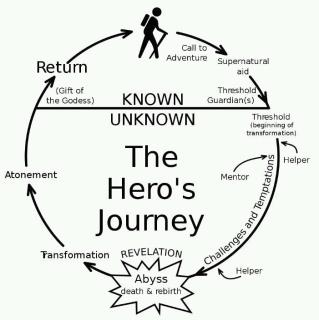
 I’ve often been seduced by the hero’s journey, an archetypal storyline where a reluctant hero is called to an epic adventure. This quest is at heart a transcendental and transformative journey, where an ordinary person from the ordinary world goes through a series of test, ordeals, encounters, and finally returns to the ordinary world, no longer an ordinary person but extraordinary — a hero — who has the ability to transform the world into something extraordinary, too. You know this story — you’ve heard it, seen it, read it hundreds of times in the guise of tales such as The Wizard of Oz, Star Wars, Lord of the Rings.
I used this same story for my novel Daughter Am I, my contemporary novel of a young woman — Mary Stuart — who goes on a dangerous journey to learn about her recently murdered grandparents. Her mentors and allies on her quest are six old rogues — gangsters and con men in their eighties — and one used-to-be nightclub dancer. By journey’s end, all their lives have been transformed.
I always wanted a taste of an epic adventure of my own, something that would change me — and perhaps my world — into something extraordinary. In a way, grief was such a journey. Grief is not so much a series of stages, at least not the ones we are familiar with. Instead, there are The Mythic Stages of Grief, a process of transformation, taking us from our ordinary shared life into a new life, one we couldn’t even imagine before that tragic “call.”
I thought my cross-country trip would be such a transformative adventure, and as wonderful as it was, I returned after five months and 12,500 miles, essentially the same as when I left.
For many years, I dreamed of an epic hike along the Pacific Crest Trail, thinking that such a journey — a real journey, not just a journey of the spirit — would be the quest I craved. It didn’t work out, and the death of that dream still haunts me.
Well, now here I am involved in a real-life epic adventure — a world-wide ordeal that is calling all of us to be heroic — and what is my duty? What is my quest? To stay home. That’s it. Stay home. Isolate myself. Where are the mentors and allies to help me along the way? Where are the great tests of courage? Without these essential elements of the story, it seems such a tepid — and sad — adventure, though there are enemies galore, whether it is The Bob itself, the conflicting tales we are being told, the fears that are beckoning us.
In the end, though, facing these enemies is no extraordinary challenge. Just ordinary life — or as ordinary as we can make it in our extraordinary isolation.
***
 Pat Bertram is the author of Grief: The Inside Story – A Guide to Surviving the Loss of a Loved One. “Grief: The Inside Story is perfect and that is not hyperbole! It is exactly what folk who are grieving need to read.” –Leesa Healy, RN, GDAS GDAT, Emotional/Mental Health Therapist & Educator.








 Bertram's Blog