Perplexed by the Anything-Goes Publishing World (Part I)

In a recent discussion on Facebook, someone mentioned the case of a self-published story that was being offered for sale on Amazon. A woman posted a review, stating her opinion that the work was far from ready for publishing, and she gave the writer several examples of how to improve, but the writer took these comments as insults. What ensued was a protracted argument between the writer and the reviewer.

The Facebooker who brought this exchange to our attention asked who was right and who was wrong. I thought the reviewer brought up some excellent points, gave wonderful suggestions for redoing the story without getting disrespectful about it. (And the reviewer could have gotten nasty. The story really was atrocious.)

I can’t imagine arguing with a reviewer as the author did, though. A couple of times I have privately asked a reviewer to remove a spoiler that gave away the ending (and the reviewers graciously complied) but the writer in this case had a terribly unprofessional and arrogant attitude. She more or less said she could publish whatever she wanted, it didn’t have to be perfect, and too bad if people didn’t like it. Unfortunately, there are millions like her, which leaves me continually perplexed by the entire book business today.

The major publishers have had control of publishing standards for way too long. I certainly have no love for conglomerates or corporate thinking, so I don’t object to a lessening of their control. On the other hand, many writers now think they don’t need any standards at all. They say they can write whatever they wish, however they wish. The prevailing attitude is that as long as the writer is satisfied with the book, that’s all that matters. They don’t care if their story is derivative, if the editing is slipshod, if typos litter the pages.

Some of these writers even manage to sell a significant number of copies of their books.

Self-published writers seem to be a militant lot, demanding the same respect as authors whose books are published by a traditional or an independent press, yet self-published authors adhere to no one’s standards but their own, while a book that was accepted by and released by a publishing company has had to live up to at least the publisher’s standards. But some self-published writers do adhere to a high standard of literacy while some bestsellers released by the major publishers have an appallingly low standard of literacy.

Does any of this matter? With texting and twittering, leaving out letters of words to shorten them or using number for letters is standard. (AFAIK, u cn rd this. Me 2. LOL) Eek. Whole novels have been written in such shorthand.

Do kids today learn grammar in school? Do they need to know grammar? With spell check and grammar check on their computers, probably not. So, if books today have grammar mistakes, punctuation mistakes, typos, do most people even notice? Those of us who have spent a lifetime reading do notice, but do we count? We value language, but is language important? Language is an evolving organism, so perhaps those of us who quail at poorly written and poorly copy written books are running a race that has already been lost. A new generation grows into adulthood every year along with a new generation of electronic toys and tools and together they spawn a new generation of idioms. A new language.

I don’t know why this new anything-goes publishing world perplexes me. Most writers seem thrilled with the new order of doing book business. They don’t have to take the time to research the business, finding out which agents will accept their genre and which publishers they can submit to without an agent. They don’t have to learn how to write query letters or learn how to write a description and a hook. They don’t need to learn to deal with rejection. And especially, they don’t need to learn how to improve their work to make it as near perfect as possible. They simply decide to publish. That’s all it takes.

And most readers seem thrilled to find myriad books to download to their new ereaders.

So perhaps it’s just me who worries about a lessening of standards. Perhaps this new frontier, this stampede to publish and be damned (or not) is what everyone else wants. It’s certainly not the first time in my life the world didn’t act in accord with what I thought was the right direction for it to take, and it certainly won’t be the last.

See also: Perplexed by the Anything-Goes Publishing World (Part II)

The Miraculous Resurrection of the Suspense/Thriller Writers Group on Facebook

A few days ago I talked about how when I first joined Facebook, I hadn’t a clue what to do, and how quite by accident, I became a moderator of an almost defunct writing group called the Suspense/Thriller Writers. I was trolling around the site, looking for groups that might interest me, and I stumbled on that particular group, which had but eight members. On the right sideboard was a button that said, “become a moderator of this group.” I was curious what becoming a moderator would entail, so I clicked the button. And that’s how I became the moderator of the group. To make it a viable group, rather than a typical Facebook group where people just posted book covers and other promotional bits, I decided to have weekly discussions.

We had some great discussions about improving our craft, but facebook, in it’s infinite wisdom (that is irony, in case you didn’t catch it) decided to get rid of the discussion boards. Without the discussion board and the help we offered each other, any serious discussions rapidly disappeared beneath the steady stream of self-promotion. So all we could do was post information about our books, and in doing so, we lost many of those serious about writing.

On Sunday, something miraculous happened. The members of the group began talking about what they wanted from the group and what they didn’t want. Mostly, what they didn’t want was blatant self-promotion, and especially from members who never bothered to participate in any group activities. So, we decided to limit such promotion to Saturday (and I’m hoping to make that a fun day where everyone gets together to talk about their books).

This is the first time in a very long time I’ve felt any excitement at being on Facebook. Not only did we reclaim our group, but I made new friends and reconnected to some long-time facebook friends who had disappeared from my newsfeed.

And today, something else miraculous happened. I found the link to our original discussion board!!! It’s still viable, just not linked to the group, so I don’t know if  it’s worth using, but all that great information is not lost, and losing the information worried me most of all.

So where did I find the link? Here on my blog!! I have a terrible habit of blogging about everything in my cyberworld, and once (or twice or who knows how many times!) I blogged about my facebook activities.  Three years ago exactly (well, minus one day — the post was November 14, 2008) I asked people to join the Suspense/Thriller Writers group, and listed some of the links. And darn if those links don’t still work! Wow!

So, if you’re interested in learning more about writing, meeting writers, networking, join the Suspense/Thriller Writers. All writers (and readers) are welcome. If you don’t think you write suspense, think again. Whatever genre you write, you still write suspense. Suspense at its most basic is making readers worry about what is going to happen to your characters. If they don’t worry, they have no reason to read. Besides, all genres make use of the same basic story elements: plot, characterization, scenes, description. So, see you on Facebook.

Speaking of facebook, you can friend me here: Pat Bertram, but if you want to friend me, be sure you tell me why (say you saw me on my blog or some such). I don’t friend everyone who asks, though I once did. I want to actually get to know the people I know. Also, you can “like” me here: Pat Bertram. I hope you do. “Like” me, I mean.

Introduction to Beth Groundwater, Author of “A Real Basket Case”

When I first joined Facebook, like many new members, I hadn’t a clue what to do, so I became a moderator of an almost defunct writing group called the Suspense/Thriller Writers. Sounds ho-hum, doesn’t it? But it was that simple. I was trolling around the site, looking for groups that might interest me, and I stumbled on that particular group. It had eight members at the time. On the right sideboard was a button that said, “become a moderator of this group.” I was curious what becoming a moderator would entail, so I clicked the button. And that’s how I became the moderator of the group. To make it a viable group, rather than a typical Facebook group where people just posted book covers and other promotional bits, I decided to have weekly discussions.

Brazen me, I picked people from the group at random (after an active membership drive I had over 1,500 members because those were the days authors were signing up for facebook  in droves. Or do I mean signing up in murders — you know, like a murder of crows. What else do you call a convocation of mystery writers?) and asked if they’d like to host a discussion. That was my introduction to Beth Groundwater. Three years ago — November 13, to be exact — I asked if she’d host a discussion, and she said yes. (One of the many strangenesses of Facebook is that the email discussion about the discussion is archived for all times, which is how I know the date, but the discussion itself, which took place on November 18, 2008, has disappeared into the great maw of Facebook’s yesteryear.)

It was an apropos discussion, too, considering all the changes Facebook has made. To lead off her discussion, Beth said, “I’d like to see the members of this group help each other figure out how to effectively use the features of Facebook to promote themselves and their books without turning off members of the network.” Today, without the discussion board and the help we offered each other, any serious discussions rapidly disappear beneath the steady stream of self-promotion. So all we can do is post information about our books, probably turning off the members of the network in the process.

The discussions may have disappeared from the group, but Beth is still there and still a class act.

The title of this post is Introduction to Beth Groundwater, Author of “A Real Basket Case,” but all I did was natter on about me and my running battle with Facebook. So, I’ll tell you what — if you click the link below, it will take you to my other blog where I am interviewing Beth. And that interview is all about her. I promise.

Click here for an interview with: Beth Groundwater, Author of “A Real Basket Case”

Facebook Has Finally Defeated Me

I signed up for Facebook back when authors were joining in vast numbers. None of us knew what we were doing there, we just knew social networking was the next step in trying to promote our books. I was already familiar with Gather.com, another social networking site, and since I had a writing discussion group on Gather, I decided to start one on Facebook. There were already hundreds of such groups, but mostly they sat fallow, so I did one thing no one else was doing — I sent the link for the discussion to the members of the group. There was a great response because, finally, we all had something to do on Facebook while we figured out how to use the site most effectively.

I kept these discussions going through several Facebook upgrades until  they  revamped the group format and got rid of the discussion boards. I still don’t see the rationale behind that, but I adjusted. I added the discussion app to my fanpage and moved the discussions there. We were getting back into the swing of things when . . .  FB revamped the fan page format and got rid of the discussion app. It’s better for all discussions to take place on the wall, they say. It makes for a better experience, they say. A better experience for whom? (Glad I asked that. Since they are making the pages more interactive, and since all businesses — especially big businesses and major corporations — have a page, they are making room for more commercial encroachment on facebook.)

Well, I moved the discussions back to the group walls, and they quickly disappeared into the great maw of self-promotion. I have nothing against authors promoting their books, but please!! Give us something more interesting than yet another plea to buy your book. Still, that isn’t the issue here. Nor are the discussions the issue. If people aren’t interested in discussing the finer points (and the not so fine points) of writing or reading, there’s not much I can do about it except stick to my No Whine, Just Champagne discussions on Gather or post them on the Second Wind Publishing group on Goodreads.

The real issue, the reason Facebook has defeated me, is the updated home page. There is a ticker along the right sidebar that ticks continually with inane messages. John likes Bill’s link. Bill commented on Janet’s status. John and Janet are now friends. Even that isn’t a problem. One quickly gets used to ignoring sidebars on the Internet. The problem is that if you are making a comment on someone’s link or status update when the ticker ticks, your comment ends up in appropriate places, such as when I left a “yay!” on someone’s update about having had a good day and it ended up on another person’s update about needing an operation. Ouch. Still, I can get used to doublechecking to make sure my comments hit the right spot and deleting those that don’t. What I cannot get used to is the new newsfeed — the constant stream of cutesy-poo animal pictures, sickly sentimental and fatuous sayings masquerading as images, and supposedly funny sayings and cartoons that lack an iota of humor.

Even that I can get used to, but Facebook has made it so easy for everyone to share this crap that they do. Over and over and over again. Yikes.

On the other hand, since people seem to like this new newsfeed, it’s possible the problem isn’t Facebook. Maybe it’s me. Maybe I’m just getting crotchety.

Leaving on a Jet Plane

My bags are packed, I’m ready to go, but I have a few minutes before I have to start donning my traveling togs, so I thought I’d say good-bye. Unlike Mary Travers, I do know when I’ll be back again — late Sunday night. I’m going to take notes and photos to show you, but most of all, despite 100% humidity (yikes!!), I’m going to have fun. It’s been so long since I’ve had fun, I’m not even sure what the word means any more, but I intend to find out.

I had an interesting revelation today, and oddly, it wasn’t even my revelation. I showed the preparations for my Scribbler’s Retreat Writer’s Conference presentation to a couple of people at different times the past two days. One said, “You have enough here for a book.” The other said, “This would make a good book.” And it would. I’m surprised I didn’t think of it, but sometimes we’re too close to things to see the truth. So, I haven’t even left for my conference, and I already have what I hoped to gain from it — a new direction and the confidence to go where it takes me.

Knowing I have something to do after my grief book is published will give me the impetus to type and edit the writings from my year of grief. My first year of grief. I’m still not over it, though I am healing every day. And perhaps I’ve outlived my stay at my grief support group. One woman brought a poem to read today, purportedly from our loved ones on the other side. At the end, everyone was wiping away tears but me. I was horrified by one of the lines: “everyday is the same here.” When I mentioned my horror, it sort of broke the mood. Ah, well. I’m mostly there for the hugs and to help the newly bereft however I can. They (whoever “they” is) say that grief brings strange blessings, and mine appears to be the ability to put into words what others are thinking.

The past few days have been so busy, I’m looking forward to doing nothing but sitting back and letting the plane take me where it wills. And even the five hour layover in Atlanta is even looking good. I was on top of the situation the whole time until Facebook decided to archive my old groups unless I acted immediately, so I couldn’t wait till I get back.

I have a favor to ask. If you belong to one of my facebook groups, and if you have time, will you go to the group, scroll down the wall (and click “older posts” when you get to the botttom of the page), look for discussion threads and make a comment? That brings the discussions to the top of the group page, and is a way of keeping them from getting lost. I’ll do it when I get back, of course, but any help will be appreciated.

My facebook groups: Suspense/Thriller Writers, Genre Book Club, and Second Wind Publishing.

I already did Help Support Independent Publishers,, but feel free to stop by and comment in a discussion anyway, especially the one where we are posting the first sentences of our books.

My ride is here. Gotta go!

What’s Next? Updating My Life.

It’s hard for me to believe, but exactly a week from now, the Scribbler’s Retreat Writers’ Conference will be over, my speech will all but be forgotten, and I will be on an airplane, probably over Kansas somewhere, heading back here.

I’m not sure what to think about that. I’ve used this conference as a beacon, something to light my way through the darkness of my grief, and soon I will have to figure out what to do when the conference is over. I’ll work on my grief book, of course, and I’ll have to figure out what to do with all my facebook groups. For some reason, they are “new and improving” them to the point of unusability, at least for my non-nefarious purposes. We had some great discussions, and the discussions will no longer be available. Don’t know what the point of that is. All of that collected wisdom just  . . . gone. I also can’t procrastinate too long in upgrading the groups, or I will lose all the members. Sheesh. What a mess.

To a certain extent, it’s the impetus I’ve needed to rethink my promotional efforts both for me and for my publisher, Second Wind. To that end, I will be doing something I’ve never considered — emailing lists. At least they are something I would have control over. Don’t worry — I won’t be adding anyone who doesn’t want to be on the list. (Unless you responded to giveaways, and most of those had a note to the effect that your email address could be used to notify you of future giveaways and contests.)

But after that? Haven’t a clue. I was talking to someone today about the conference, and she asked if I’d ever taught before “other than on the internet”, and it occurred to me that in a roundabout way I have been teaching writing all along. So perhaps I’ll do writing workshops here on this blog. It wouldn’t be that much different from my various online discussion groups, but it would be more structured. Perhaps post a tutorial every Sunday night? And something similar to my presentation for the conference — creating incredible but credible characters — would be a good place to start. Besides, I need a new focus for this blog.  Grief only goes so far.

I’m not in the throes of grief anymore, at least not much — I keep myself too busy. I figure, if my life mate doesn’t want me to be thinking about him, he shouldn’t have died. Can you detect a hint of anger here? He used to tell me I needed to keep a pilot light of anger. He said it would fuel without consuming me. And what do you know — there it is. And it does help.

Funny how life coalesces at times. Everything of my old life (both online and offline) seem to heading for another turning point. Of course, that could be an illusion (or a delusion), but it’s true that this is another time of many changes.

I’ll keep you posted. And for sure I’ll get photos of the conference.

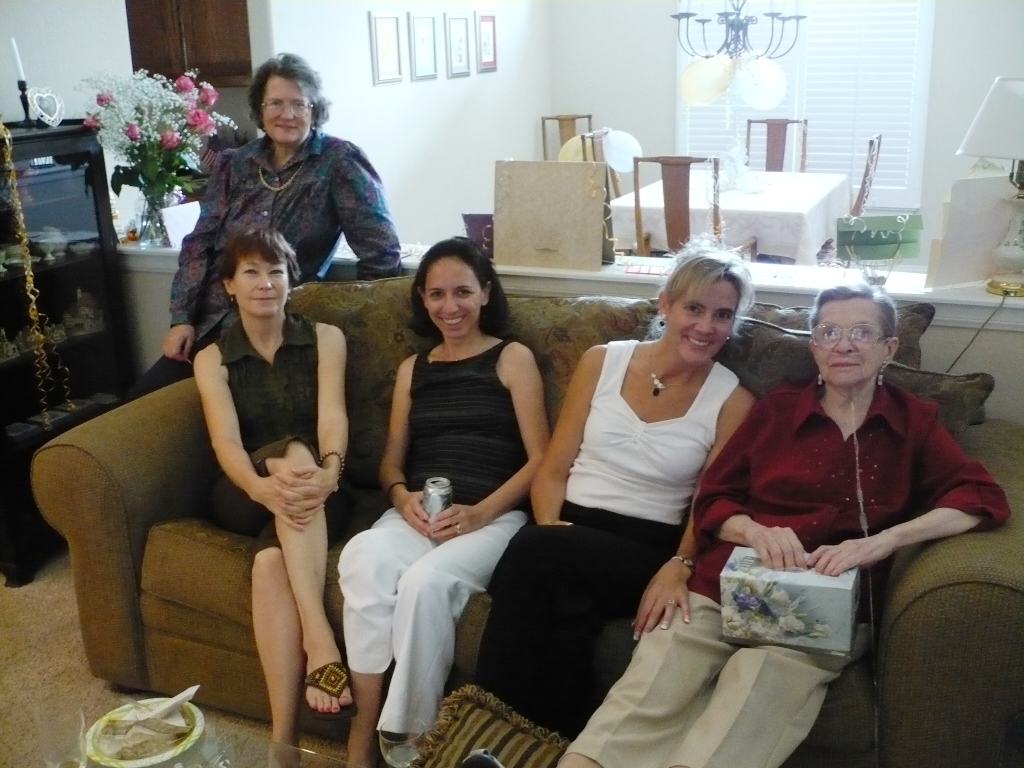
Speaking of photos, you’ve all seen the rather blurry photo of me I use as an icon. The photo accompanying this post is the picture it’s cropped from — my parent’s 60th wedding anniversary party, just a couple of months before my mother died. Happy mother’s day, Mom. Hope you’re at peace.

Ready or Not, Change is Coming Your Way

Most of my internet hangouts and hang-ups (meaning obstacles to smooth progress for those of you who are too young or too erudite to be familiar with the term) are going through massive changes. I checked in with MySpace (one of the aforesaid hang-ups — it never seemed to be worth the effort) and didn’t have a clue where I was or what I could or should do once I arrived. I did like some of the changes — it’s easier to find things, but the constant barrage of ads is enough to give one a headache. Still, it might have possibilities, though many long-time MySpace fans seem to be abandoning the site. They say Facebook is easier.

Facebook itself is going through major changes. Not only did they revamp the group feature, which will eventually undo everything I have accomplished on the site, it makes it virtually impossible to keep control of your identity. Anyone can add you to a group without your consent, and that means that their friends and the friends of their friends have access to your information. For me, that’s not a problem. I go by the assumption that everyone in the world will see what I post on the site, and so only post what I want people to see. So far, no one seems overly impressed.

Facebook is unveiling a new message system, which supposedly combines email, facebook messaging, instant messaging, and texting, which means you can interface with anyone, anytime, anywhere. Quite frankly, I have a hard enough time keeping track of the people I am connected to. Most of them I’ve never met, so gradually I’m checking them all, and weaning out those I would never, could never be friends with. Perhaps a page, with it’s unlimited number of potential fans, replaces the facebook profile, but so far I don’t see the point. I do have a fan page, but haven’t figured  out how to make it work for me. Maybe frequent status updates? Or even unfreqent ones?  I do know sending an update (a type of message, not a status update) does not work. No one reads them. Or at least very few. How do I know? I sent out a coupon for a free ebook and to over 1400 fans and only three people took advantage of it. Of course, that could be me — maybe none of my fans want a free ebook. In which case, I’m back to wondering why I even have a Facebook fan page.

WordPress is undergoing changes. They retired the theme I used when I set up the Second Wind Blog. Perhaps the new one will work. I’d like to add book covers to the sidebar to make it more like a website and offer visual-oriented people something to look at besides the header, and the new theme has an extra sidebar. My main problem with the change is what it portends. I did not know Wordpress retired old themes. What if they retire the theme I use for my many blogs? I always liked the color variations I created (green, blue, purple, red, orange) and I would not be pleased with a forced change. I don’t know that I’ve ever seen another blog that uses this theme, which I always thought was wonderful since I could be unique. But unique means obsolete in cyberspace. I guess I’ll just have to wait and see.

Twitter is also making changes. I like my twitter profile, and even left space for my fourth book, Light Bringer, which will be coming out in the spring of 2011, but now twitter has added more features, the main section where the tweets show up is off-center (I prefer my main reading pane to be smack-dab in the center of the screen), and my custom made screen is defunct.

The friends I’ve made online remains the best thing about the internet. I’m hoping that will never change.

How to Respond to “How Are You?”

A month or so ago, a Facebook friend, another woman who lost her mate, suggested I write a blog on what to say when people ask a griever, “How are you?” When I first realized that people were losing interest in my sad tale, I asked a bereavement counselor that very question. She said a good response is, “I’m coping,” which is the response I used for a few months. Now I just say, “I’m okay.” Even if I’m not okay, I tell people I’m okay. Or if I’m being polite, I say, “I’m fine, how are you?” There is nothing wrong with that — it’s a rote response to a rote question. Most people who ask how you are do not especially want to know. It’s an accepted conversation starter, a way for people to show token interest so they can move on to more exciting topics — themselves, for example.

Someone who comes back at you with, “No, really, how are you?” is someone who deserves no response at all, especially if they add, “this is me, remember?” If they need to remind you who they are, you don’t know them well enough to tell the truth. Besides, if you wanted to tell the person how you really were, you would have already done so.

People who truly care will ask a more specific question: “Did you sleep well,” for example, or  . . . I don’t know. Any question that shows genuine interest will suffice, and those you can respond to honestly if you wish. Or not. In the end, your grief is your business. People do not need to know you are still crying yourself to sleep every night, or that you miss him so much you can feel it like an ache in your bones, or that the world feels as if it’s aslant now that he is gone. Unless you want them to know, that is.

Even at the best of times, “How are you?” is a question without any response except “I’m fine,” or “I’m okay.” It always makes me wonder, “how am I in relation to what?” Are they asking about my health, my state of mind, my finances? With grief added into the equation, I wonder if they are asking how I am in relation to the way I was before he died, in relation to the way I felt immediately after his death, or in relation to nothing at all.

I have to admit, like everyone else, I usually ask the question, but as a part of the greeting, “Hi! How are you?” I don’t mind if someone comes back at me with, “I’m fine, how are you?” because that is the ritual. Once that is out of the way, we can settle down to a serious discussion. If the person is another griever, I don’t expect an in-depth response, I know how they are doing.

So, to recap a rather wordy and convoluted post, if someone asks how you are, “fine” is fine.

Surviving Facebook

Social networking is now touted as one of the best ways for authors to promote themselves, and perhaps it’s true. If most of us primarily sell books to friends, it makes sense, and sometimes even cents, that the more friends we have, the more books we will sell. So we sign up for MySpace and Goodreads, Twitter and Facebook and start collecting friends like so many stamps. If a thousand friends are good, then two thousand are even better. If two thousand are good, then let’s aim for ten thousand.

While frantically collecting friends, we forget two things. First, social networking is about being social. It does no good to have connections if, to them, we are merely a nameless face, or worse, a faceless name. Too many people use their book cover for an icon, though it seems to me it defeats the purpose. How does one make friends with a book cover? You are, or should be, aiming for long-term relationships. You don’t have to waste your time playing games with your connections, but you can comment on their status updates and photos, you can post interesting links and notes on your profile, you can participate in discussions.

Second, we forget that these online sites, especially Facebook and Goodreads, were set up for real-life friends to interact. They were not set up for promotion.

Goodreads automatically limits your activity, so it’s hard to abuse their system, but Facebook is a different matter. Several of my friends have had their Facebook accounts disabled because of “abusive” behavior, though they were doing what we all do — making connections with strangers. I have become good friends with many of the strangers to whom I sent friend requests, so by limiting myself to people I know would have greatly limited my Facebook experience. Still, Facebook says they aspire to be an environment where people can interact safely with their friends and people they know. Accordingly, they expect accounts to reflect mainly “real-world contacts.” They do not endorse contacting strangers through unsolicited friend requests as such requests may be considered annoying or abusive.

To prevent this type of behavior, Facebook has limits in place that restrict the rate at which you can use certain features on the site. Your account can be disabled if Facebook determines that you were going too fast when sending friend requests despite being warned to slow down, or because your friend requests were being rejected at a high rate. Your account can be disabled if you send too many of the same message, post too often to other people’s profile, or indulge in repetitive, promotional activities.

The problem is that Facebook does not tell you ahead of time what their limits are, so it’s a matter of guessing.

So far, I have survived Facebook. I have over 4, 000 friends. I administer one group and co-administer three others. I send weekly group messages informing people of the featured discussion. I have a fan page. I post daily status updates, feed my blog into my profile page, post links to sites where I am a guest.

So, how did I do it?

Every day, I added ten to fifteen friends — no more. When I reached 2500 friends, I stopped sending requests. The rest of the connections came from my accepting others’ requests. At the beginning, I accepted everyone, but now that I am nearing the limit Facebook allows, I am a bit more careful whom I accept. For example, I won’t accept requests from icon-less people unless I know them personally. (Here is the dichotomy of Facebook. You are allowed 5,000 friends, who are supposed to be people you know personally, but who in the offline world has that many friends and connections?)

Although it’s one of the things marketing coaches recommend, I never thanked people for accepting my friend request. Besides emphasizing that you’re not friends, the comment can trigger a warning from Facebook, especially if you post too many similar comments in one day. You can post almost anything you want on your own profile, but you are constrained by Facebook’s unwritten rules as to what you can post on other people’s profiles.

The best thing I can tell you about surviving Facebook is this: if you get a warning, stop. Do not use Facebook for at least a week. If you don’t heed this advice, and you get another warning within that time, your account will be disabled, and all your work will be wasted.

add to del.icio.us : Add to Blinkslist : add to furl : Digg it : Stumble It! : add to simpy : seed the vine : : : TailRank : post to facebook

Tweet-y Bird

I received a direct message from someone I was following on Twitter. (Notice I said was following? Anyone who sends me junk gets unfollowed.) The message included a link to a site that promised to automate my Twitter. It will find followers for me, it will Tweet for me, and it will read the feed for me. Well, perhaps I exaggerating a bit when it comes to the last point, but the first two are true. It makes me wonder what the point of it is. Who are we tweeting to? Birds? Bugs? Bots?

Even without signing up for the various sites that purport to help me live a tweeter life, I still participate in a bit of automation. Whenever I post a blog, WordPress automatically updates Twitter, which in turn updates MySpace and LinkedIn. Perhaps I am missing the point. I do know Twitter is supposed to about real people talking in real time about real subjects, but I have yet to participate in a real conversation. Occasionally I RT (retweet) someone’s update, sometimes I remember to return a #FF (Follow Friday), but for the most part I don’t see anything I want to comment on. As I said, I could be missing the point.

I’m rethinking my social networking time. After my blog tour, I’m going to be spending way less time on the computer. (Eyestrain, anyone?) I want to go more for quality than quantity. I used to friend everyone on Facebook I could, but now I unfriend anyone who spams me. I have a particular dislike of people who arbitrarily stick me in a group in order to send me junk, because even if I delete the message, I keep getting messages as long as anyone in the group responds. Don’t get me wrong — I like getting messages that are sent to me, specifically, and I always respond. I just don’t like anonymity. (If you knew me in offline life, you would be laughing at the irony of such a statement. Offline, I am the epitome of privacy.)

I’m looking forward to taking a step back from online activities. So much of it seems counterproductive, even foolish, that I will be better off working on my poor neglected WIP. At least I will have accomplished something.

Don’t worry, though. I bet none of you will notice any difference. I’ll still be blogging three or four times a week, will keep up with my discussion groups, will respond to genuine messages.

I’ll even tweet. And if I don’t, WordPress will do it for me.

add to del.icio.us : Add to Blinkslist : add to furl : Digg it : Stumble It! : add to simpy : seed the vine : : : TailRank : post to facebook