Web Building

I spent a good part of the day working on my website. It had to be updated anyway because of my new book, Bob, The Right Hand of God, but this is more than a simple update. Because of Adobe Flash being discontinued, my ancient website is becoming defunct (even though my site was a plain old non-flash site, with stationary photos and text), I have to learn a new website builder and redo the entire site.

It’s not really all that complicated; it’s more of a matter of learning how to find what I need and to decide what I want to say. To that end, I looked at various examples of author websites, and though it didn’t really help much, it made me feel as if I were doing something to further my “author-ity.”

One of the problems I have that other authors don’t is the variety of genres I work with. Most authors stick with fiction or non-fiction. If fiction, they write one sort of novel, such as romances or mystery or fantasy. If non-fiction, they stick to a certain topic. Although I do stick to one topic with my non-fiction books — grief — my novels span multiple genres.

Back when I was learning to write, all the books said to write in a recognizable genre. You can put romance elements in mystery, or mystery elements in romance, but basically, you need to brand yourself by making sure your stories are predominately one thing. Well, I didn’t do that — I can only write the books that are in my head, after all, and those books ramble all over the genre spectrum. But now I know why it’s important to do what the others said to do and not what I did — it makes it a whole lot easier to figure out what to focus on when promoting yourself, and especially in figuring out what to focus on for a website.

Do I focus on grief? After all, my grief books sell more than the others.

Do I focus on the fiction? After all, most of my books are novels.

For now, I’m doing what a lot of authors do — put up a photo of myself and a gallery of my book covers on the home page, and then feature each book on a separate page.

The hardest part is to find the site in progress. If I go to the web builder page, they don’t seem to recognize what I’ve already done, so I have to click the link in the email they sent when they informed me of the pending changes. (From what one of the tech people I talked to said, I gather there are two distinct builders on my site — a free one that they gave me in exchange for the defunct one, and one I will have to pay for after an introductory period. And it’s the free one that’s hard to find.)

Mostly though, it’s just a matter of doing the work. Luckily, the old site is still up, so I have time to figure it all out and then to do what I need to do to build my website.
***

Pat Bertram is the author of Grief: The Inside Story – A Guide to Surviving the Loss of a Loved One. “Grief: The Inside Story is perfect and that is not hyperbole! It is exactly what folk who are grieving need to read.” –Leesa Healy, RN, GDAS GDAT, Emotional/Mental Health Therapist & Educator
Genre vs. Traditional Fiction

Yesterday I wrote about traditional stories, the kind of untagged, unlabeled, uncategorized and ungenrefied fiction we grew up on. There used to be certain sections for genres in libraries and bookstores, but most books were shelved alphabetically under “fiction.” I read all types of books without discrimination, but I found the most satisfying books not with the genre stories, but in with the general fiction. And that’s the kind of book I tried to write.

I don’t know why genre became the core of the book business rather than the peripheral it once was, but it’s probably because of marketing — as one editor who rejected Light Bringer told me, “I loved the story, and your writing is excellent, but I don’t know how to sell it. It doesn’t have enough science fiction elements to be science fiction, and it has too much science fiction to be anything else.” (The truth is, Light Bringer was never meant to be science fiction. It a traditional story based on both modern conspiracy theory and the Sumerian cosmology, though I admit, it does have elements that are construed as science fiction. Luckily, I eventually found a publisher who publishes traditional fiction as well as genre.)

I don’t know what came first — readers’ need to buy books that fit into certain categories or book marketers’ need to funnel readers into those categories, but it doesn’t really matter. Either way, this genreization of the book business makes me an outsider, both as a reader and a writer. I have a hard time sorting through the 130,000,000 million books available to find ones I want to read, and I have a hard time fitting my books into the available genres. (When I have to give a category, I say “conspiracy fiction.” That’s not a genre, or at least I don’t think it is, but it gives me a pithy and realistic way of labeling my books.)

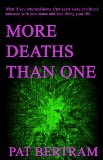
The hardest of my books to categorize, besides Light Bringer, is More Deaths Than One. It has many of the elements of a thriller, but the story is not about what happened to the main character (Bob) but who is he and how he reacts to what happened to him. In a thriller, there should be some sort of showdown between the hero and villain, but in More Deaths Than One, that showdown is given to an offscreen character, and Bob hears of it second hand. Some readers think the scene is a cheat. Even I think it’s a cheat, or rather I would think so if More Deaths Than One was a thriller. The hero should always be the one who performs the decisive action in the story, but in this case, the decisive action is not the discovery of the truth, but how Bob and Kerry (the woman he loves) deal with that truth.

I could have had the showdown and then Bob and Kerry’s scene afterward, but then their scene becomes anti-climactic. I could have had the two scenes concurrent — the showdown and their reactions, but there is no way Bob would have opened up to her with a dangerous creature in the room. And most of all, he would never have brought her to the attention of the villain since he would have wanted to protect her at all costs.

You’d think that with the emphasis on the two characters that More Deaths Than One is romantic suspense, but it is far more than that (and far less. Those who have read it for romantic suspense don’t like it because the romance isn’t forefront. Nor is the conflict a romantic one — Bob and Kerry get along from the beginning). More Deaths Than One is traditional fiction — a story that demanded to be written in a certain way, regardless of any genre conventions.

As Mickey Hoffman, author of School of Lies and Deadly Traffic, said, “What are you waiting for? Read this book. Now. More Deaths Than One is much better than any ‘bestseller’ out there. The plot is constantly surprising and intricate, the characters draw you into the tale and the overall writing is top notch.”

***

Pat Bertram is the author of the conspiracy novels Light Bringer, More Deaths Than One, A Spark of Heavenly Fire, and Daughter Am I. Bertram is also the author of Grief: The Great Yearning, “an exquisite book, wrenching to read, and at the same time full of profound truths.” Connect with Pat on Google+

Don’t Buy My Books

With millions of people out there urging you to buy their books, I’m going to do the opposite and tell you not to by mine. Considering the books that make it big in this anything-goes book world, chances are you won’t like my novels, anyway. Here’s the truth of it — don’t buy my books if:

You are looking for vampire, ghouls, zombies. There are no such beings in my novels, though there is a brief mention of zombies in A Spark of Heavenly Fire, and there are plenty of sub-humans, such as unscrupulous scientists and bureaucrats, but they bleed and eat the same as any human.

You are a romance junkie. Love is a theme in each of my books, but the conflicts are never romantic ones. The characters gradually fall in love as they band together against a greater villain than their own feelings could ever be.

You are a fan of Fifty Shades of Grey. There is no eroticism in my books, no women who want to be subjugated by men, no kinky sex. In fact, the only graphic sex scene is in More Deaths Than One. Each of my books had less sex in it than the previous one, so my last novel, Light Bringer, had no sex. The story did not call for it, and it never occurred to me to add a few gratuitous sex scenes to help the books sell. (Also, unlike FSofG, my books are well-written.)

You only read thrillers. Although my books all have thrilling moments, and although people often stay up late to finish reading one of my books, they are not thrillers as such. In thrillers, the reader knows who did it from the beginning and learns why from the villain since part of the book is told from the villain’s point of view. In my books, the villain’s identity is not revealed until the end, except in Light Bringer, where the villain turned out to be maybe not so villainous after all.

You want books that are the same as all the rest, only different. My books aren’t the same as all the rest. I’ve read over 15,000 works of fiction, and I made sure my books weren’t like any of them. The endings are not predictable. If by chance you do guess the ending, there will still be a bonus surprise for you.

You like stories with flawed heroes. Not one of my characters was purposely flawed to make them more interesting. They are real in their own right, struggling to survive as best as they can, learning the truth of themselves and their world, growing into who they need to become.

You like raunchy humor. There is much humor in my books, particularly Daughter Am I, but the humor comes from character interaction without a single tinge of raunch, or it comes from a sly sense of irony.

You like a particular genre. My books have no particular genre. When I was growing up, the libraries had small sections for genres such as mystery, science fiction, romance, westerns, but the rest of the books were all shelves alphabetically. That’s where my books belong — with the rest. When I have to pick a genre, I usually say the books are conspiracy fiction since they are all based on various so-called conspiracies. Some readers call Light Bringer science fiction , but to be honest, it was written as myth fiction — based on modern conspiracy myths and ancient cosmological myths.

You only “buy” free books. My books are not free, and except for rare promotions, they never will be free. You can, however, download 20-30% free at Smashwords to give you a sense of what my books are like. (You can find my Smashword’s profile here: Pat Bertram. Scroll down below the book trailers to find my books. Click on the one you’d like to download.)