
Grief Is Unique to Each Person

My mother, far right, on her 60th wedding anniversary

My mother, far right, on her 60th wedding anniversary

Today is my mother’s birthday. She would have been 91 if she had lived. Her life wasn’t cut short, nor was her death a tragedy — she’d lived a long life, and for the most part, her death wasn’t particularly horrendous. And even at the end of her life, she managed to get one last wish — to reach her 60th wedding anniversary.

One of the things so confusing about grief is the various lengths of lives and loves. Do you feel more grief if you’d been together for 60 years as my parents were? Do you feel less grief if you’d been together a matter of months?

I was with my soul mate for thirty-four years before death took him. After he died, I’d look at couples like my parents, and I’d envy them their long togetherness, but then I’d look at couples who had been torn apart before they ever had a chance to settle into their lives, and I would be grateful for the years I had with him.

Despite my envy/gratitude, I’ve concluded that when it comes to the loss of a mate, the length of time you were together isn’t a factor in your grief because you always grieve the entire life — everything you had and everything you didn’t have. If you’ve been together for most of your life, there is more of the past to grieve. If you had little time together, you grieve for all you never had. And in my case, I grieved for both the past and the future.

Many other factors are more important than the length of time you had together when it comes to grief. The depth of the connection matters, as does the interdependency of your lives. If you count on two paychecks to pay the bills, for example, and one of those paychecks evaporates, financial fear adds to one’s grief. If you are each other’s support group, providing a sounding board or hugs when necessary, then the loss of that support when you need it most adds to grief. Complications in the relationship can add to grief because you lose any chance of ever smoothing things out. Quick deaths add to grief because of the horrendous shock, and long dyings add to grief because of all the guilt and regrets that built up. And if you lose your mate when you’re relatively young, then you face many years without him, which adds to your grief.

All of these things combine to make grief unique to each person, but what isn’t unique is the sense of loss, the yearning, the hanging on the best we can until life opens up to us once again or until we find peace at the end.

***

Pat Bertram is the author of the suspense novels Light Bringer, More Deaths Than One, A Spark of Heavenly Fire, and Daughter Am I. Bertram is also the author of Grief: The Great Yearning, “an exquisite book, wrenching to read, and at the same time full of profound truths.” Connect with Pat on Google+


A Palliative for the Brokenhearted

warriorThree years ago, a yoga teacher and fitness instructor living in Holland got tired of the cold, and so her husband put in a transfer to a warmer climate.

Three years ago, I was living a thousand miles away from the high desert in another state, watching my life mate/soul mate die.

Six months ago, that teacher’s life and mine crossed paths. A friend asked me to accompany her to an introductory therapy yoga class (a class geared toward each person’s abilities and disabilites), and there I met the woman from Holland, who was teaching the class. (She wasn’t from Holland originally. She was actually from California, but she’d living all over the world for the past two decades.)

At that yoga class, I began to come alive. Grief pulls you into yourself, huddling you against the pain, and the thrust of her classes was to open us up to the universe, to new experiences, and to ourselves. My friend dropped out after those introductory classes, but I was hooked. Coincidentally, all the women who remained in the class were in various stages of recovering from the deaths of their husbands, and we formed a bond with each other and with our globetrotting teacher. It was a rare and magical experience, the electric highlight of my week, but magic has a way of dissipating. The teacher was offered a wonderful job in another city that used all of her skills (and paid her a phenomenal amount of money), and she couldn’t turn it down.

Although I felt devastated when she made her announcement, I am trying to consider the ending of the class as a graduation. When a student is ready, a teacher appears, or so it said, and in my case it was true. So perhaps it is also true that when the student is ready, the teacher disappears. Perhaps I have learned from her what I need to know to continue on to the next stage of my life.

But this is all prelude to what I really want to talk about. Whenever I have mentioned how distressed I was at the loss of this class, the response has universally been, “Find another yoga class.” Ummm. Yeah. Find another confluence of people and events that come together from thousands of miles away to create a magical, electric, and life-affirming moment. Sure, I’ll get right on it.

This seems to be the response for every loss. Get a new class, a new life, a new soul mate. Is it really that easy for people to do? Or is it simply that it’s easy to say, a palliative for the brokenhearted?

I realize that soon I will need to find a new life, but as I’ve mentioned in a previous post, it’s not as if I can go to the mall and search the aisles at Lifes ‘R’ Us until I find a new life that fits properly and looks good. I’ve never really wanted anything or anyone, but out of the blue, my life mate/soul mate dropped into my life, bringing (for a while anyway) radiance and excitement, and then later companionship, but now that he’s out of my life, I’m back to not wanting anything. If I did want something, I’d go after it, but I don’t want what is out there to get. (Or maybe I mean I don’t want what I know is out there to get. For example, I’d never considered doing yoga, had no interest in it whatsoever, and yet out of the blue, the yoga teacher dropped into my life.)

Mostly I’m taking the need for a new life in stride. Whatever happens, happens. Wherever I go, there I go. It doesn’t seem to really matter — something will drop into my life or it won’t. Either way, I’ll deal with it.

The only thing I know (or rather, suspect) is that I will not remain here in the high desert. Because of the yoga teacher and her class, for the first time I’d been contemplating staying in the area so I could continue taking instruction from her, and her getting a new job seems to be a clear sign that my future doesn’t lie here. But then again, I don’t really believe in signs . . .

***

Pat Bertram is the author of the suspense novels Light Bringer, More Deaths Than One, A Spark of Heavenly Fire, and Daughter Am I. Bertram is also the author of Grief: The Great Yearning, “an exquisite book, wrenching to read, and at the same time full of profound truths.” Connect with Pat on Google+
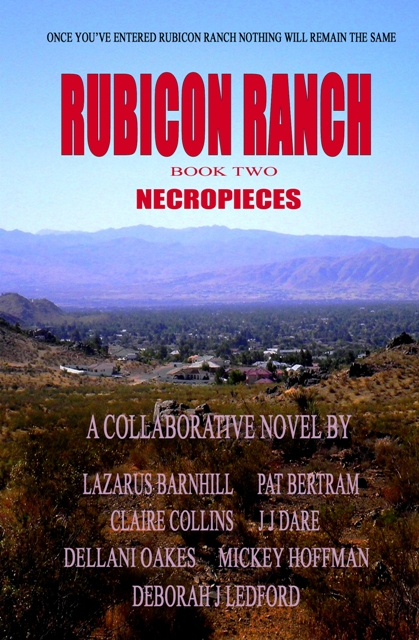
Rubicon Ranch: Necropieces — The Story Continues

Rubicon Ranch is a collaborative and innovative crime series set in the desert community of Rubicon Ranch and is being written online by the authors of Second Wind Publishing. Seven authors, including me, are involved in the current story — Rubicon Ranch: Necropieces.

Residents of Rubicon Ranch are finding body parts scattered all over the desert. Who was the victim and why did someone want him so very dead? Everyone in this upscale housing development is hiding something. Everyone has an agenda. Everyone’s life will be different after they have encountered the Rubicon. Rubicon Ranch, that is.

Although some of the characters were introduced in Rubicon Ranch: Riley’s Story, a previous collaboration, Rubicon Ranch: Necropieces is a stand-alone novel.

We hope you will enjoy seeing the story develop as we write it. Let the mystery continue! Whodunit? No one knows, not even the writers, and we won’t know until the very end!

Chapter 34: Melanie Gray
by Pat Bertram

Sheriff Bryan turned off the highway onto Tehachapi Road and wound through Rubicon Ranch. Melanie gazed out the Navigator’s window at the beautiful houses. Although the buildings were typical California housing development architecture—stucco with tile roofs—many of the dwellings were custom-built, so none of the houses looked exactly like any other. Spanish, Moorish, and Mediterranean styles dominated, but Cape Cod designs, Greek revival porticos, and ranch-style houses were also prevalent.

It seemed strange, Melanie thought, that the lovely facades hid such horror—death, murder, dismemberment.

“When I took this job,” the sheriff said, “I figured Rubicon Ranch would be the least of my troubles. It seemed such a quiet place.” He shot a glance at her. “You find that funny?”

It had been so long since Melanie had smiled that it took a moment for her to realize her lips had quirked up in acknowledgment of their synchronized thoughts.

“Not funny, no. It’s just that the area does seem quiet and innocent, as if nothing bad could happen here. And from what I can tell, nothing bad happened until I came. First Alexander was killed, then Riley, then her father and her kidnappers, and now Morris. I know it’s foolish, but I can’t help feeling as if it’s all my fault.”

“Is it?” Bryan asked without a trace of friendliness.

“Note to self,” Melanie muttered. “Never confide in a cop.”

“What about if the cop confides in you? All hell is breaking loose in Rubicon Ranch, and I’d like to tell you what’s going on if that’s okay.”

“Ah, back to the nice cop. It’s amazing how you can do the good cop/bad cop routine all by yourself.”

“Bad cop?” He flashed a smile that could only be called a leer, but then he seemed to think better of it, and straightened his mouth into its normally stern lines. “Have you met Eyana Saleh? Egypt Hayes?”

“Haven’t met either of them.”

“It’s the same person. Petit woman, mixed heritage, new to Rubicon Ranch.”

“Oh! I’ve seen her. She’s always wandering around taking photos of the neighborhood. She’s beautiful and has such lovely skin. Eyana Saleh? That’s her name? It fits her. What has she done?”

“Right at the moment she’s in the hospital. Been beaten pretty bad. She’s not saying much, but one of her assistants found her and described the man she saw running from the house, and the description fits Jake Sinclair.”

“Have you arrested him yet?”

“He’s not going anywhere. He’s in the hospital too, just down the hall from Eyana. His arm was chewed almost to the bone.”

Melanie gaped at the sheriff. “Eyana ate him?”

“A coyote did, or so he says. Apparently, after he beat up Eyana, he ran off to the desert. That’s where the medivac helicopter picked him up. He’s not saying anything, either, though maybe when he finds out how unpleasant those rabies shots are, he’ll come clean. The doctor says it’s definitely a canine bite though he guesses it’s a domesticated creature. The only dog in the area that I know of that’s big enough to do so much damage so quickly is the bull mastiff Tara Windsor owns, but she’s keeping mum, too.”

“Tara Windsor is in Cabo with her pool boy.”

“What? How do you know?”

“My agent. She’s a celebrity hound.”

Sheriff Bryan tapped a long, well-shaped finger on the steering wheel. “So, a woman comes to town looking like Tara, telling everyone her name is Leia Menendez, wink, wink, leading everyone to believe that she’s the actress but is really Leia? Whoa. If Tara could act that good, she’d be a shoo-in for an Oscar. Playing Lizzy Borden, maybe. An axe was found in the Sinclair house under Jake’s bed. We think Leia put it there, but our witness is a bit unreliable since she was having hysterics at the time.”

“And here I thought the life of a cop was boring,” Melanie said. “All routine and paperwork.”

“Not boring enough. The witness is Nancy Garcetti, a real estate agent. She found Morris’s head in the Peterson house and went flying down the street, screaming all the way. She says while she waited for my deputies to arrive, she saw Tara Windsor sneaking around the side of the Sinclair’s house, and Tara was carrying something that looked like an axe. We can’t find any other witnesses, and Tara or Leia or whatever her name is, isn’t admitting anything.”

“Is it the axe that killed Morris?”

Bryan shook his head. “The ME says not. He says it’s animal blood, thin blood, like from a roast. Then, as if this isn’t enough of a circus, we have electric boy. Ward Preminger.”

“I know who you mean,” Melanie said. “He’s also new to the neighborhood. Seems to crackle with static electricity. Has a fixation with the Morris house.”

The sheriff turned onto Delano Road. “As near as we can figure it, Ward blamed Morris for his condition, though apparently his brain got rewired when he was zapped by lightning while trapped in a tornado. He—” The chirping of a cell phone interrupted him. Bryan pulled the device out of a sheath on his belt and held it up to his ear. “Yes,” he said. “Yes . . . Okay . . . Sure . . . Thanks . . . Be right there.”

He sheathed his phone. “I have to go. We got the preliminary autopsy reports.” He made a quick u-turn and pulled up in front of Melanie’s rented house.

Melanie climbed out of the vehicle and stood on the curb until the Navigator sped out of sight, then she trudged to her front door, unlocked it, and entered the silent house.

***

Pat Bertram is the author of the suspense novels Light Bringer, More Deaths Than One, A Spark of Heavenly Fire, and Daughter Am I. Bertram is also the author of Grief: The Great Yearning, “an exquisite book, wrenching to read, and at the same time full of profound truths.” Connect with Pat on Google+

Thirty-Four Months of Grief

desert roadThirty-four months ago today, my life mate/soul mate died of inoperable kidney cancer. For thirty-four months now, I have been posting updates on my progress through grief, and that astounds me. Thirty-four months? How is that possible? Written out, it seems such a short time for him to have been gone, and yet it feels immeasurably vast — so many minutes, hours, days, weeks, months, and now years, spent trying to come to grips with what happened to us. For most of our lives we were connected by some mystical bond, a cosmic twinning, that kept us together even when times were rough. And then suddenly, in a single breath, that connection was broken. I am here, alone, and he is . . . well, I don’t know where he is or even if he is.

I never had survivor’s guilt for the simple reason that I wasn’t sure which of us got the worst end of the deal, but I have felt uncomfortable going on without him, as if somehow I were being disloyal. We helped fight each other’s battles, sticking up for each other, caring for each other, waiting for whichever of us happened to be lagging behind, always taking the other into consideration, and it feels as if I should still be doing so. But he is beyond my reach, beyond my care, beyond my consideration.

I have come to see that continuing the disconnect that began with his descent into death is one of the tasks of my grief. (Grief seems to be not so much about passing through stages, but more about completing tasks, such as processing the loss and learning to live again.) Until I understand within my depths that for all practical (earthly) purposes we are not one, I will never be able to embrace fully what life has in store for me. We are separate persons, each with our own experiences, our own journey, and our own destination. For a while, our paths crossed, but now, I have to continue as me, alone. No matter what I do, or think or feel, it cannot change the past. No matter how much I hate that he is dead, no matter how much I rail against the unfairness, no matter how much I miss him or wish desperately for one more word or smile, he is no longer in my life.

For most of those thirty-four months, this disconnect has seemed an impossible task, but there is a bit of light illuminating my path. Last week, when I went to my Yoga class, they asked how I was, and I said, without thinking, “I’m doing great.” It stunned me to hear those words come out of my mouth, because for more than five years, during the last of his dying and these many months of grief, I have had times of feeling okay, and I thought that was the best I could do. But at that moment, I did feel great. It didn’t last long, only about an hour before I began sliding into sadness again, but that hour stands as a beacon for what might be.

Up until that class, this year has been one of increased sorrow and tears, and such grief upsurges often precede or follow a deeper level of acceptance. It’s not so much that I am learning to accept his death — I accepted the truth of it from the beginning, though I hate it and will never be able to comprehend it — but I am learning to accept that I am alive, and that is a much harder thing to accept.

***

Pat Bertram is the author of the suspense novels Light Bringer, More Deaths Than One, A Spark of Heavenly Fire, and Daughter Am I. Bertram is also the author of Grief: The Great Yearning, “an exquisite book, wrenching to read, and at the same time full of profound truths.” All Bertram’s books are published by Second Wind Publishing. Connect with Pat on Google+

Rubicon Ranch: Necropieces — The Story Continues

Rubicon Ranch is a collaborative and innovative crime series set in the desert community of Rubicon Ranch and is being written online by the authors of Second Wind Publishing. Seven authors, including me, are involved in the current story — Rubicon Ranch: Necropieces.

Residents of Rubicon Ranch are finding body parts scattered all over the desert. Who was the victim and why did someone want him so very dead? Everyone in this upscale housing development is hiding something. Everyone has an agenda. Everyone’s life will be different after they have encountered the Rubicon. Rubicon Ranch, that is.

Although some of the characters were introduced in Rubicon Ranch: Riley’s Story, a previous collaboration, Rubicon Ranch: Necropieces is a stand-alone novel. The first chapter will be posted on Monday, June 11, and one chapter will be posted every Monday after that.

We hope you will enjoy seeing the story develop as we write it. Let the mystery continue! Whodunit? No one knows, not even the writers, and we won’t know until the very end!

Chapter 33: Melanie Gray
by Pat Bertram

Morris. Melanie shuddered, remembering her encounter with the famous author and his request for photos of necropieces. Well, now the evil old man was just a bunch of dead body parts himself.

The sheriff seemed to be focused on his driving, but a bird-like tilt of his head gave her the impression he was trying to hear her thoughts. Well, whatever other abilities Seth Bryan might have, she doubted he was clairvoyant. He never seemed to understand her or her point of view.

“I don’t know anything about Morris,” Melanie said. “And I’m not sure there’s much to know. Of all the people I’ve encountered in Rubicon Ranch, he seems the least opaque.”

The sheriff made a small noise that could have been a choke of laughter or a grunt of derision, but other than that, he remained silent.

“I mean, he is a despicable human being,” Melanie continued, “and whoever killed him should probably be given a medal for something . . . saving the earth, perhaps. But Morris doesn’t really hide what he is. He might have feigned Alzheimer’s, but that was simply because he felt like it. All that matters to him are his wants, and since he has the money to indulge himself in his evil fantasies, there is nothing to stop him.”

“Nothing?” Sheriff Bryan said quietly.

Was nothing to stop him.” Melanie stole a look at the sheriff. Did her simple error in syntax make her seem guilty to him? She had no idea how his mind worked, and his eyes hidden behind those silly mirrored sunglasses gave her no clue.

She considered asking him if he knew who killed Morris, but he’d probably use that as an excuse to interrogate her about her neighbors, and she had nothing to say. She didn’t want to tell him about seeing the supposedly decrepit and curmudgeonly old Eloy Franklin laughing and frolicking with his dog as if he were a man half the age he pretended to be. Nor did she want to talk about the new people she’d seen wandering around the neighborhood as if it were a theme park—Murder World, or some such.

And she certainly didn’t want to talk about herself. She wouldn’t like to give the sheriff any hint of her true strength or deadliness, or he might decide to use the knowledge against her.

She stared out the window at the empty desert they were passing and wondered what he would think if she were to tell him about wrestling a boa constrictor in Costa Rica. The pale tan snake with its brown markings had been almost invisible hidden in the undergrowth, and she had tripped over it. Boas were tree-dwellers, so she wasn’t on the lookout for such a creature on the ground. She had since learned to be aware of everything in her surroundings, but back then, she was still unused to seeing danger lurking in innocent places. She figured out later the boa must have been sick or old or weak, otherwise she’d have been squeezed to death before she could unwrap the beast from around her torso. Still, it had taken all her considerable strength to save herself. And Alexander hadn’t lifted a hand to help. He had simply photographed the episode. Not exactly a knight in shining armor.

What would the sheriff have done in that situation? Kill the poor creature in an attempt to rescue the damsel in distress?

A low rumble that Melanie interpreted as a chuckle came from the man beside her. “I can hear your mental wheels spinning,” Bryan said. “Care to share what you’re thinking?”

“What are you, the thought police?” Realizing that perhaps she’d sounded too harsh for what could conceivably have been a guileless query on his part, she softened her tone. “I was just wondering if you were the knight in shining armor type, is all.”

Seth Bryan tapped the badge pinned to his left shirt pocket. “This is all the armor I need.” Then he smiled at her—a real smile that showed dazzling white teeth and a hint of a dimple. “Well, this badge and a bullet-proof vest.”

***

Pat Bertram is the author of the suspense novels Light Bringer, More Deaths Than One, A Spark of Heavenly Fire, and Daughter Am I. Bertram is also the author of Grief: The Great Yearning, “an exquisite book, wrenching to read, and at the same time full of profound truths.” Connect with Pat on Google+
Rubicon Ranch: Necropieces — The Story Continues

Rubicon Ranch is a collaborative and innovative crime series set in the desert community of Rubicon Ranch and is being written online by the authors of Second Wind Publishing. Seven authors, including me, are involved in the current story — Rubicon Ranch: Necropieces.

Residents of Rubicon Ranch are finding body parts scattered all over the desert. Who was the victim and why did someone want him so very dead? Everyone in this upscale housing development is hiding something. Everyone has an agenda. Everyone’s life will be different after they have encountered the Rubicon. Rubicon Ranch, that is.

Although some of the characters were introduced in Rubicon Ranch: Riley’s Story, a previous collaboration, Rubicon Ranch: Necropieces is a stand-alone novel. The first chapter will be posted on Monday, June 11, and one chapter will be posted every Monday after that.

We hope you will enjoy seeing the story develop as we write it. Let the mystery continue! Whodunit? No one knows, not even the writers, and we won’t know until the very end!

Chapter 32: Melanie Gray
by Pat Bertram

Melanie trudged along the left side of the highway, facing traffic, the blister on her heel burning with every step. The sun had come out, and the road was now dry, but her shoes and socks remained wet from slogging through the flooded gutters back in Rojo Duro.

After Sheriff Bryan dropped his bombshell—Why did you do it, Melanie?—he had been called away, leaving the question hanging in the air. Two hours later, he still hadn’t returned, but a kid who looked as if he were straight out of the police academy brought her coffee. She had demanded the use of a toilet, and the young deputy ushered her to the lavatory. He wasn’t waiting for her when she finished, so she had simply walked out of the sheriff’s department. No one stopped her.

She’d now been walking for hours, but was still far from Rubicon Ranch. Maybe she should have returned to the interrogation room and waited for the sheriff, but if he still wanted her, he knew where to find her—at home in about seven more hours.

“See what you’ve done to me, Alexander,” she murmured, tears stinging her eyes. “Not only have you left me alone with only a ghost to talk to, you’ve turned me into an escaped prisoner.” Wearily, she scrubbed away the tears. She was sick of crying, sick of Alexander being gone, sick of the way her life was turning out. Once she’d felt strong, like a warrior, capable of anything. And now? Just a tired widow, at the mercy of her emotions.

A vehicle veered off the right lane, and pulled up alongside her.

“Get in,” Sheriff Bryan commanded.

Melanie wanted to refuse, but oncoming traffic gave her little opportunity to assess the matter, and besides, her blistered heel was throbbing with pain.

She scurried around the tan Navigator and slipped into the front seat. The sheriff stomped on the accelerator. The vehicle shot back into the right lane, narrowly averting a head-on collision with a white Subaru.

“Are you always so reckless?” Melanie asked.

“Are you always so reckless? What do you think you’re doing, walking along the highway like that?”

“Going home, where I would have been all day if your thugs hadn’t arrested me.”

“You weren’t under arrest. I just needed to talk to you, and I couldn’t get away.”

She gave him a narrow-eyed look. “So I’m not a suspect? Then why did you tell my publisher I was?”

He grinned. “It got you a bigger advance, didn’t it?”

She slumped in the seat as much as she could against the restraints of the seat belt, and folded her arms across her chest.

“You have to admit,” Sheriff Bryan said in a softer tone than any she had yet heard issuing from his mouth, “you need help.”

Melanie sat up straight and glared at him. “Help? Help? Who says I need help? Is that why you arrested me? To help me?”

“Now that’s the Melanie I know and love.” He must have sensed the indignant response she was about to hurl at him, because he added quickly, “It’s just an expression.”

Melanie dropped her head into her hands. Why did this man keep her so off balance? Was it that her grief made her vulnerable and any attention would send her reeling, or was there something more going on? Either way, she had to get a grip on her emotions. Warrior, she reminded herself.

She took a deep breath and blew it out slowly. “Why did I do . . . what?”

As cryptic as her comment sounded, he didn’t pretend to misunderstand her reference to the question he had asked in the interrogation room.

He sighed as he had done then. “Why did you shut me out when I poured out my heart to you? I was more open to you than I’ve ever been to any other woman. You could have at least told me you understood, even if you weren’t interested.”

She stared at him in total non-comprehension, and though he glanced at her, she couldn’t pick up any clues as to what he was thinking. She could only see herself in the mirrors of his sunglasses. And then all at once she understood.

During the investigation into little Riley’s murder, the sheriff had taken her to lunch and told her his story. How he’d been the fair-haired boy. President of his class in high school. Pledged the best fraternity in college. Dated a cheerleader and married her after graduation. Went into law enforcement. Hired on at the Greene City Police Department. Became a detective. Got his masters. Went up through the ranks like a shot. Became the youngest captain in the history of the force. Was on the fast track to becoming Chief of Police when he had an affair with a junior officer on the force.

He’d said that his wife knew about the other woman, that she stayed with him because he was the favorite son of Greene City, but when the affair came to light, he lost his job, his status, and his wife—at least temporarily. He claimed that though he was through with her, she wouldn’t give him a divorce because she still believed that one day he was going to be a major police chief, maybe in LA, and she was waiting to get a piece of that large salary in alimony payments.

What Melanie had taken to be a come-on—his letting her know that even though he was married, he was available—he’d apparently meant as a way of opening up to her. And she had run out on him.

But not because of the supposed come-on. Because of Alexander.

“You lied to me,” she said. “You told me you went to the scene where my husband died and came to the conclusion that it had not been an accident. The cops told me it was a hit and run, that someone had rear-ended the car with such force that Alexander crashed head-on into a concrete abutment, but when I went out the scene right afterwards, I didn’t see anything to indicate that another car was involved, so how could you have seen anything weeks later? It’s possible someone had tampered with the car as Riley said, but the only way to find that out was to investigate the vehicle itself. And you didn’t care enough to check it out.”

“Repeat that.”

“You lied to me,” Melanie said.

The sheriff held up a hand. “Not that. Riley.”

“It’s hearsay.”

“This isn’t a court of law. Just tell me.”

“Supposedly, Riley told Moody that she’d seen someone messing with our car.”

“Did she say who?”

“No. Morris accused me of killing Alexander. He said that Riley told Moody she’d seen me messing with our car. When I asked Moody about it, she told me Riley hadn’t mentioned any name, just that she had seen someone. Moody said she didn’t believe that Riley really saw anyone. But she believed it enough to mention it to her father.”

Melanie waited for the sheriff to say, “Aha! So you’re the one who murdered Morris!” But he didn’t say anything. Just rubbed his chin thoughtfully.

“And since we’re talking about Alexander,” Melanie said, “You never returned his cameras to me. I want them back.”

The sheriff turned his mirrored stare toward Melanie. “Cameras?”

“Yes. All of his cameras were in the car. Six of them. I want them back.”

“There were no cameras.”

“Where are they? They were in the car when he left that day. I put them there myself.”

“Ms. Gray, no matter what else you might think of me, I am a great law officer. I know my job. There was no indication in the report of any officers seeing cameras in the vehicle. And the report does not state that Alexander was rear-ended. It was a merely a surmise by one of the state troopers, and he had no business telling you that. Riley was right. Someone did tamper with your car. Someone very knowledgeable and very skillful. The brake lines were cut and the steering wheel loosened. I suspected that when I checked out the scene of the accident and found no skid marks. The car simply plowed into the abutment at a high speed.”

“Maybe the flex lines were worn through. That happened to me once.”

“The car was new. We sent the vehicle to a lab down the hill since we don’t have an automotive lab up here in the high desert, and I just got the results, which is why I wanted to talk to you today. All four metal brake lines were cut so precisely that when Alexander slammed on the brakes, he instantly lost hydraulic pressure in both the front and rear brakes at the same time. With today’s vehicles, cutting the brakes like that is almost impossible for a professional to do, and completely impossible for an amateur.

Melanie clutched her stomach, feeling the same sort of visceral grief as when she heard that Alexander was dead. Alexander . . . murdered? By a professional killer? An assassin?

“It’s not possible,” she said aloud.

“Alexander must have traveled a long way after his brakes failed—the closest brake fluid stain I found was about a mile and a half from where Alexander went off the road.”

“But supposedly when he died, he was texting a woman he was having an affair with. How could he have been texting her if his brakes broke more than a mile away from where he crashed? Wouldn’t he have dropped the phone and tried to control the car?”

“Yeah. I’m having a problem with that scenario, too. We need to talk to the woman, but the number Alexander was texting is out of service. It feels to me as if the phone with the texts was a plant to make everyone think exactly what the official report said—that Alexander lost control because he was texting while driving.”

Melanie put her hands on her head, trying to still the roiling thoughts. “I can’t deal with this right now. Take me home. Please.”

“I’m sorry,” the sheriff said in a soothing tone that might have been practiced but still managed to sound sincere.

For just a second Melanie wished he would stop the vehicle, put his arms around her, and hold her. “There’s just so much death. Alexander. Riley. Riley’s father. The Petersons. Morris.”

“That’s the other thing I need to talk to you about,” Sheriff Bryan said in his official voice. “Morris.”

***

Pat Bertram is the author of the suspense novels Light Bringer, More Deaths Than One, A Spark of Heavenly Fire, and Daughter Am I. Bertram is also the author of Grief: The Great Yearning, “an exquisite book, wrenching to read, and at the same time full of profound truths.” Connect with Pat on Google+

Grief: New Year’s Day and Beyond

eternityThis past New Year’s Day was the third one I have lived through since the death of my life mate/soul mate. That first New Year’s Day was one of relief. I’d managed to live through the worst year of my life, and I greeted the day with acceptance and looking toward the future, building hopes and creating dreams.

The second New Year’s Day was a day of dread. The last week of that year was one of waiting. No grief, no strong emotion. Just . . . waiting. But with the dawning of the new calendar year came the dread. I still don’t know why (to be honest, I’ve never totally understood the whys and ways of grief), though perhaps the dread came from an awareness of moving further away from our shared life. I could no longer say, “Last year, we . . .” “Last year, he . . .” There was just me, balanced precariously on the precipice of a life alone.

This third New Year’s Day inexplicably began with tears. Grief had been leaving me alone, and I hadn’t had a strong upsurge for a long time — I thought I was through with grief, to be honest — but when the calendar rolled over from 2012 to 2013, grief came calling once again. And once again, I do not know why.

A new calendar year has never meant much to me — it’s such an arbitrary date, beginning at staggered times around the world, and even celebrated on different dates in various countries and religions. Now that I am alone, however, I try to make a ritual of such things, to note the passing of the days. I need to know that I am still here and I am still alive. And despite the arbitrariness of the date, apparently something in me senses a change from one year to the next and reacts to it.

People tell me that it takes three to five years to find joy in life again, or at least to find a new beginning, and three months into this year will be my third anniversary of grief. It feels like a milestone, though I can’t even begin to guess what it will mean to me besides one more year further away from “us” and one more year closer to . . . I don’t know what.

But I can’t think of that now. If I’ve learned anything during these past two years and nine months, it’s the importance of taking life one step at a time. I’ve already taken three steps into this new calendar year. Tomorrow will be another step. Beyond that, the future will just have to take care of itself.

***

Pat Bertram is the author of the suspense novels Light Bringer, More Deaths Than One, A Spark of Heavenly Fire, and Daughter Am I. Bertram is also the author of Grief: The Great Yearning, “an exquisite book, wrenching to read, and at the same time full of profound truths.” Connect with Pat on Google+

A Child of Grief

My life mate/soul mate died thirty-three months ago today, and I found myself hesitating before writing this post. I worried it might seem as if I am trying to keep myself in the center of a drama, a drama that has long since lost its power and poignancy. But the truth is, even though I am not actively mourning — at least not often, and not much — grief still shades every moment of my life.

untitledvWhen people fall in love, when they are giddy with hormones, when they get caught up in the emotion of their love and the dream of a wonderful new life together, their friends and family never tell them,  “Okay. Enough. It’s time to get over your love and move on.” The whole world celebrates their love (or so it seems to the new couple), and everything they say and do for the rest of their lives is shaded by this focus on each other.


Grief reflects this process, though through a dark mirror. The newly bereft are buffeted by hormones, caught up in the emotion and pain of their loss, tormented by a future that no longer has any meaning, focused on someone who is no longer there. The loved one might be dead, but the love doesn’t die. (What do you do with love when it is no longer needed? I never have figured that one out.) And the bereft are told, “Okay. Enough. It’s time to get over your grief and move on.”

Other people get tired of our drama, but for us, it is always there — a blankness in our lives. An absence.

I am doing well, trying new things, preparing myself for a future alone. I have hermit tendencies, so to make sure that I don’t stagnate, I am planning adventures — simple excursions and experiences for today and complicated journeys for another time. From the beginning, I embraced my grief, wanting to process the guilts and regrets, the anger and fears as quickly as possible so I could charge into whatever the future held for me. I am now more determined than ever to celebrate life, and yet . . .and yet . . .

I am aware that if it weren’t for his death, I wouldn’t need to worry about my hermit tendencies. We were hermits together, friends in our solitude. Until those last years when he could barely drag himself out of bed, we did everything together, so there was no reason to plan solitary experiences or excursions. Every day with him brought the possibility of something exciting, even if only a long rambling conversation through history, science, philosophy and back to history, so there was no need to find a way to keep from stagnating. But now there is.

Grief has shaped my life in other ways. I am here in the desert because he is dead. I am taking care of my father because I am not needed elsewhere now that my life mate/soul mate is gone. I made new friends through my attendance at a grief support group, and those friendships have long outlasted the group. I am taking yoga classes, learning to find a new way to open to the universe because he is no longer here keeping me connected to the world.

His absence is still a very real presence in my life. I don’t feel his total goneness as much as I did at the beginning, but I am aware of his absence. My yearning to see him once more doesn’t claw at me the way it once did, but I am aware that I will never again hear his voice or be warmed by his smile. I am far beyond the days where I curled up, cradling my new pain and sorrow as if it were some sort of new born creature, but what those days did to me — stealing away the last of my naiveté, lightheartedness, and innocence — will remain with me forever.

I am a child of grief. No matter how adventurous or fulfilling my life might end up being, no matter who or what I grow to be, something deep inside of me will always be aware of the death that made these changes necessary, the absence that made them possible.

***

Pat Bertram is the author of the suspense novels Light Bringer, More Deaths Than One, A Spark of Heavenly Fire, and Daughter Am I. Bertram is also the author of Grief: The Great Yearning, “an exquisite book, wrenching to read, and at the same time full of profound truths.” Connect with Pat on Google+

Rubicon Ranch: Necropieces — The Story Continues

Rubicon Ranch is a collaborative and innovative crime serial set in the desert community of Rubicon Ranch and is being written online by the authors of Second Wind Publishing. Seven authors, including me, are involved in the current story — Rubicon Ranch: Necropieces.

Residents of Rubicon Ranch are finding body parts scattered all over the desert. Who was the victim and why did someone want him so very dead? Everyone in this upscale housing development is hiding something. Everyone has an agenda. Everyone’s life will be different after they have encountered the Rubicon. Rubicon Ranch, that is.

Although some of the characters were introduced in Rubicon Ranch: Riley’s Story, a previous collaboration, Rubicon Ranch: Necropieces is a stand-alone novel. A new chapter is posted every Monday.

We hope you will enjoy seeing the story develop as we write it. Whodunit? No one knows, not even the writers, and we won’t know until the very end!

Chapter 25: Melanie Gray
by Pat Bertram

Melanie paced her rented house, wandering through the great room to the bedroom, then up the stairs to her loft office to stare out the window. The clouds that had skirted Rubicon Ranch all day yesterday had settled over the town in the early morning hours. The rainstorm had now weakened to a soft drizzle, but floodwaters were swirling out of the desert and down the middle of the street like dirty bath water in search of a drain.

Melanie half expected to see body parts floating by, but it had been forty-eight hours since she had found the ravens breakfasting on the disembodied foot, so perhaps by now all the necropieces had been discovered. Shivering, she turned from the window, trudged down the steps to the great room and then into the bedroom. She’d spent most of the fifteen weeks since Alexander’s death roaming the desert, and she found it almost impossible to relax during this enforced incarceration. If she were any kind of photographer instead of an amateur shutterbug, she’d be out in the desert despite the rain, chronicling the way the runoff was recreating the desert floor, but her tiny camera wouldn’t stand up to the moisture, and then where would she be?

She plodded back through the great room and up the stairs again. Her cell phone rang, and for just a second, her spirits rose. Alexander! He was finally calling to tell her he was coming back. Just as abruptly, the realization that he was dead hit her like a physical blow, and tears spilled down her cheeks. Why couldn’t she remember that he would never come home? His body had been cremated and the ashes stored in a square brass urn sitting atop the dresser until she could take them high up into the Rocky Mountains in Colorado and scatter them.

By the time she reached her bedroom where she’d left her cell phone on the nightstand, the phone had stopped ringing. The tiny screen showed the number for her agent, and when the phone rang again, she considered not answering. What could the woman say that hadn’t been said a dozen times before? Melanie already knew her deadline had passed. She already knew she owed the publisher either the book or the return of the advance. She already knew . . . Oh, crap. It would be better to talk to Dottie and get it over with.

“Yes?” she said, hating the hesitancy she heard in her voice.

“Dahling!” Dottie chirped. “I’ve been calling and calling. Have I got good news for you! I’ve been talking to Jack, and he says you can have all the time you need to finish the desert book. He’ll even hire a photographer for you. And he’ll send you five hundred thousand dollars, though I’m sure I can get him up to a million.”

“What does he want from me? A kidney?” Jack Nolan, her publisher, had a reputation for wringing every last bit of creative effort from his authors while paying the least possible advance. He got away with it because, despite his miserly ways, he was scrupulously honest, remitting every penny of the royalties his authors earned.

Dottie chuckled. “So cynical, dahling. It’s perfect, really. You’re there. You know the people and the place. And from what I understand, you live next door to the Sinclairs.”

“No,” Melanie said, without a hint of uncertainty in her tone.

“You don’t live next door to them? My sources—”

“I mean, no. I will not write whatever book Jack wants me to write. I’m going to finish the desert book and then . . .”

“And then what? Knowing Alexander, he probably left you not only broke but also in debt. Someone is going to write the book about Morris Sinclair. It might as well be you.”

“Wait a minute,” Melanie said. “How do you know what’s going on here?”

Dottie laughed. “The whole world knows. It’s everywhere. On television, Facebook, Twitter. It’s such a delicious story. The author of the infamous ‘Necropieces’ series has himself become a series of necropieces. His fans don’t believe he’s permanently dead. They are holding vigils, waiting for him to come back to life. And his head was found in the house where that little girl died. Riley? Is that her name? The girl that was kidnapped as an infant and then killed by her biological father? How can you not want to write the story of Rubicon Ranch? It’s going to be huge. Humongous.”

“Not interested.”

“Wait! There’s more!” Dottie said. “You gotta love this stuff. One of the suspects in Morris’s murder is Tara Windsor.”

“Who?” Melanie asked.

“You had to be living out in the boonies somewhere not to have heard of Tara. Oh, right—you’ve been out of the country for the past umpteen years. Tara is an actress. She was in that movie with that actor, you know, the one with the gorgeous abs? No, I guess you don’t know. Anyway, it turns out the suspect isn’t Tara at all. Tara is in Cabo with her pool boy. Don’t you just love it?”

Melanie sank down onto the bed, suddenly weary. “No.”

“And then there’s you,” Dottie said slyly.

Melanie sat up straight. “Me? What about me?”

“The cops say you’re a suspect. You knew that, right? Jack says if you killed Morris and tell all the gory details, he’ll up your advance to two million.”

A suspect. Melanie had presumed the Sheriff’s insinuation that he considered her a suspect was his way of manipulating her and keeping her off balance, but if he or someone in the Sheriff’s department had given out her name, then she really had a problem. She heard the echo of herself screaming at Morris, “You leave me alone, Sinclair, or I’ll be shooting your dead body parts.” Could she have been more foolish?

“Do you know a good lawyer?” She gave a small laugh, wanting Dottie to think the question a joke, but fear clutched at her belly with clammy fingers. Maybe she’d have to write Morris’s story in order to pay for a defense attorney.

“You might not be a celebrity on a par with Morris or Tara,” Dottie said, “but you and Alexander have quite a following. Since there’s been mention of your involvement in Alexander’s death—”

“Who told you I was involved in Alexander’s death?” Melanie demanded.

“Just a guess.” Dottie voice sounded smug, as if she’d caught Melanie out in a secret. But there was no secret when it came to Alexander’s death. Just shoddy police work. “So many important deaths in such a small place make for a good story,” Dottie added.

“All the deaths are unrelated,” Melanie pointed out.

“Perhaps, but it’s more likely they are connected somehow. After all, Morris had autopsy photos of that little girl, and Alexander took some photos of necropieces for Morris.”

“You knew about that?”

“Alexander accidentally included a couple of the pictures when he sent Jack a batch of desert photos.”

Melanie sighed. “Maybe you’re right. Maybe Alexander’s death had something to do with Morris and the evil that this place seems to bring out in people.”

“So can I tell Jack you’ll write the book if he gives you an advance of a million dollars?”

“No. But you can tell him I’ll consider it.”

“Good girl. I’ll see what I can do about finding you a lawyer.”

Melanie set the phone on the nightstand, and put her head in her hands. Oh, Alexander. Look what you’ve done to me. She took a few deep breaths, determined not to cry, but when the tears spilled over anyway, she jumped to her feet, ran up the stairs, and plopped in front of the computer. Immersing herself in research always helped take her mind off herself, and she needed to know more about Morris before she could give Dottie her decision.

Typing “Morris Sinclair” into her search engine resulted in over two hundred million hits. Morris’s website. Book and movie sites. Thousands of fan sites and cult groups. Blogs. Articles. She narrowed her search to “Morris Sinclair biography” and managed to piece together the story of a highly narcissistic and anti-social man in his late sixties who had started out as a normal kid, turned into a troubled and rebellious teenager, and grew into a sadistic beast during his tour of duty in Vietnam.

After Vietnam, Morris married a woman he’d only known for a few weeks. He worked as a roughneck on an oilrig and wrote tales of terror on the side. When the stories were published, they found an immediate readership. He quit work to write fulltime.

Morris and his wife had three children, two boys and a girl. His wife committed suicide while the children were very young. Or perhaps Morris had killed her? That made more sense to Melanie—what mother would kill herself and leave her children to be raised by the devil incarnate?

Although the thought of a million dollars and the freedom it could buy tempted her, Melanie did not want to spend the next few months of her life immersed in the evil that was Morris. She was all set to call her agent and turn down the deal, when the doorbell rang.

She opened the door to find Lieutenant Frio and Deputy Midget standing on her doorstep, their faces set as if in stone.

“Ms. Gray,” Lieutenant Frio said, “we’d like for you to come with us. Sheriff Bryan wants to talk to you.”

Melanie held out her hands, wrists together, but Deputy Midget shook his head. “Sheriff Bryan says not to cuff you unless you give us trouble.”

“Can I get my coat?”

Lieutenant Frio threw Melanie a stern look. “You’re not going to try anything?”

“No.” Melanie darted into the bedroom, grabbed a trench coat from the closet and tucked her phone in the pocket.

Sandwiched between the two law officers, Melanie marched out to the tan Navigator parked at the curb in front of her house. Deputy Midget opened the back door of the vehicle, put a hand on her head to guide her through the opening as if she were a common criminal, then lowered himself into the front passenger seat. The right side of the Navigator sank, and the tires seemed to scream out for relief.

Lieutenant Frio peeled away from the curb. The tires sent up huge plumes of floodwaters that broke over the vehicle, and made it seem as if they were driving through a car wash.

Melanie stared out the window, though she couldn’t see anything but the backwash of water. If she strained her ears, she felt sure she could hear Alexander’s ghostly laughter. During all their years of living in countries with no civil liberties, they had never had a single problem with the authorities, and yet now, not even four months after his death, she found herself at odds with the law.

Maybe this arrest was just another of the sheriff’s games? She had never known what he wanted from her, though when they met after she’d found Riley’s body, he had focused his attention on her, and made her feel . . . seen. No one but Alexander had ever looked at her that closely, and even Alexander had stopped paying attention to her years before. Or maybe what had seemed like manipulation—the sheriff concentrating his attention on her and then ignoring her—had all been in her head, a widow’s cry to be noticed.

Once they hit the dry road of the highway, the thirty miles to Rojo Duro seemed to slip past in an instant. Deputy Midget ushered Melanie to a small room with two chairs and a metal table bolted to the floor, and left her alone.

A mirror on one wall had to be a one-way window, but Melanie put a finger against the glass to be sure. Finger touching finger without any space told her the truth—anyone could be watching her from the other side, and she would never know. She resisted the urge to stick out her tongue in a childish show of temper. Instead, she sat tall in a chair, hands folded on the table, and tried not to think of where she was. Tried not to think of her pathetic life. Tried not to think of her uncertain future.

Nine minutes later, Sheriff Bryan entered the room and locked the door behind him. He perched one hip on the table, and stared at her, no friendliness in his eyes.

After a long moment, he heaved a sigh and said, “Why did you do it, Melanie?”

***

Pat Bertram is the author of the suspense novels Light Bringer, More Deaths Than One, A Spark of Heavenly Fire, and Daughter Am I. Bertram is also the author of Grief: The Great Yearning, “an exquisite book, wrenching to read, and at the same time full of profound truths.” Connect with Pat on Google+

The Surprising Power of Grief

The power of grief still manages to surprise me. I thought I was moving beyond its reach, but apparently, no matter how well I do, it still has the power to bring me low.

I haven’t had a major upsurge of grief for quite a while now. (I can’t remember the last time, to be honest.) Partly, I’ve been aware of my triggers, such as Saturday (the day he died), and being hungry, angry, lonely, tired (H.A.L.T.) and I am especially careful at those times. I’ve put away his photo so I don’t catch sight of it unawares, and I try to look forward, not backward. Still, despite all that, yesterday grief came sweeping into my life, and I had to let it run its course.

Why yesterday? Perhaps because I’m keeping busy as the week heads into Saturday and I maintain that busyness as the new week leaves Saturday behind, so that now I am most vulnerable in the middle of the week when my guard is down.

Perhaps because it was Halloween, and traditionally, Halloween is the night when the dead are closest to us here on Earth.

Perhaps because on Tuesday, for the first time, I felt as if I were awakening to life again. Every step forward seems to be celebrated with an upsurge of grief at what is being left behind, and this was an immense step that could only be celebrated with an immense upsurge of grief.

Or perhaps there was no reason at all.

My life mate/soul mate died two and a half years ago, and despite all those months of grieving, despite all the thousands of words I have written to make sense of what I experienced, I still do not completely understand the forces at work when it comes to grief. All I can do when grief hits is what anyone does in a storm — ride it out the best I can and wait for the calm.

***

Pat Bertram is the author of the conspiracy novels Light Bringer, More Deaths Than One, A Spark of Heavenly Fire, and Daughter Am I. Bertram is also the author of Grief: The Great Yearning, “an exquisite book, wrenching to read, and at the same time full of profound truths.” Connect with Pat on Google+



