Life’s Little Bonsai

The delightful Juliet Waldron, Crone Henge blogger and fellow Second Wind author, left a comment on my blog yesterday, saying we are all life’s little bonsai, and this image has stuck in my head because it seems so true. Life and fate do their best to form us into whatever torturous configurations please them, and we’re left to do the best we can with whatever shape we’re given.

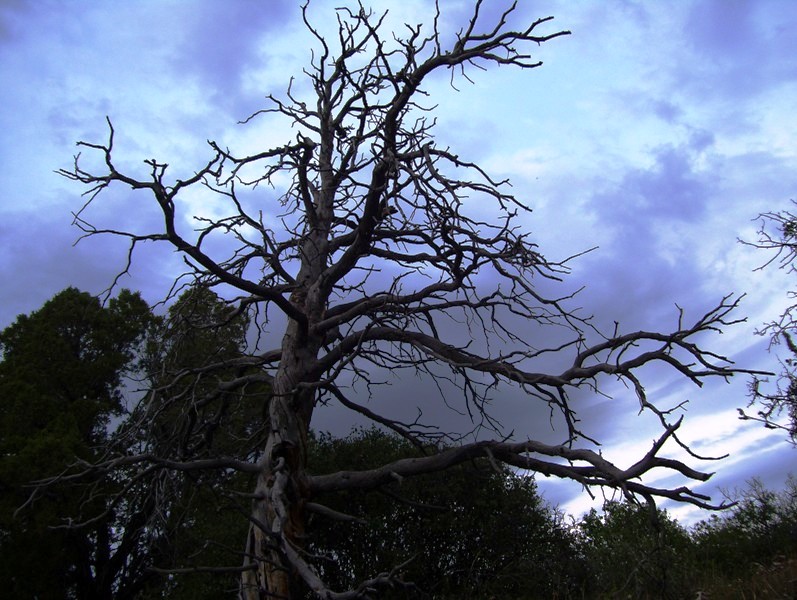
It seems fitting then, that I planted a Japanese black pine tree yesterday as a symbol of continuing my life despite the traumas and dramas thrown at me the past few years. I doubt I will torture the poor thing into a standard bonsai shape, though I suppose unrestrained growth could make it weaker, and that would be just as torturous for the poor thing as purposeful mutilation. (I don’t know why I worry so much about torturing the tree. Nature does the same thing to wild trees, as you can see from this photo I took at the Black Canyon of the Gunnison. And anyway, I just planted the seeds yesterday, so I am a long way from having to make a decision about caring for the pine.)

I’ve been checking the final edits for my grief book, which will be published in another two or three months, and I notice how often I acknowledge the pain of having lost my life mate/soul mate and then state my determination not to let life and fate destroy the possibility of any future happiness. Sometimes, now, for just a second, I can stand outside myself and wonder how the death of one man could have put me in such a state for so long. I mean, life does torture us with all sorts of traumas, it kills with impunity, and we all will face the same fate in the end. So why should this particular loss mean so much? Why should it hurt so much? Despite all these months of pain, I’m glad I grieved for him and didn’t just go on with my life as if nothing earthshaking and soulquaking had happened. His life—and death—shouldn’t pass lightly.

I wonder what he will think of the grief book. It’s so much of a love story, this story of ours, and we were both private people. (Some called us secretive, but we weren’t. We just kept ourselves to ourselves.) And soon the whole world (well, a hundred people anyway) will know the truth of our lives and will see how we dealt with being life’s little bonsai.

Sometimes I wonder if I’m being appallingly foolish for putting myself out there like that, and other times I figure it’s just another of the twists and turns that are shaping me.
Starting From Scratch

On Saturday, I waited for the old year to play itself out, on Sunday, I started the new year with a feeling of dread, and today . . . well, today I got on with my life. Every upsurge of grief seems to end with a new level of acceptance, a renewed determination to live. One of the factors one has to deal with during the second year of grief is realizing for the hundredth time that this new state of being without our loved ones is permanent, that there is no redo. You start from here, from scratch.

Scratch is a starting line for a race scratched in the dirt, and starting from scratch means you start at the beginning with no advantages, even if you’re the weaker contender. That’s exactly how this feels — a scratch beginning, no advantages. We bereft see other couples, some who have been together for decades longer than we were granted, and yet here, at our new beginning, we start alone, uncoupled. I try to see this as being given a chance for freedom, but freedom connotes not just freedom from something, but freedom for something. I am free of my worries for my dead life mate/soul mate (though oddly, sometimes I still worry. Is he warm, comfortable, happy?) but I have not yet discovered what I am free for. That will come, perhaps, with living.

Today, as a symbol of starting from scratch, I planted my Bonsai. Well, I planted the black pine seeds. Bonsai means potted tree, and a pot of dirt and a few seeds do not equal a tree. At least, not yet. I’ll just have to wait to see what happens. Who knows, in ten, twenty, fifty years, I might have my own little potted tree. That’s assuming, of course, that if the seeds sprout and if they grow, I’ll be able to snip off any of the precious growth. I mean, how would you like it if someone decided to make a potted plant of you, and snipped off a few fingers or even a limb just because they found it pleasing? Okay, so maybe I don’t quite have the hang of positive thinking, but I did plant the seeds, so that counts for something!

My grief book is also in the works. I got my manuscript back from my publisher today with the final edits. One editor had to give up on it — couldn’t see the words through her tears. The editor who finished the work said, You’ve written an exquisite book.  It’s wrenching to read, and at the same time full of profound truths.   I can see many of the sayings from the book being used as proverbs by grief counselors, such as “time is the currency of love.” You have many, many profound insights.

A nice way to start from scratch — with a new book and wonderful compliments. My grief book probably won’t be available for a couple of months, and that’s fine. I need time to get used to the idea. It’s a hard thing to do, putting oneself out there for anyone to gawk at. People are mostly kind, especially those who will find comfort knowing someone else feels what they did, but I worry about the first time I get a nasty review. It’s one thing to get a terrible review when it’s a story you made up. It’s something completely different when it’s your life.  What if someone tells me to just stop whining and get over it? Maybe I’m gathering disadvantages before I ever cross the starting line, so I won’t think about that.

There might not be a redo button in life, but there is “do,” and putting the book out there is doing something. And so is planting a tree. This might not be an auspicious beginning, but you can’t expect more when you’re starting from scratch.

After the Waiting Comes the Dread

So, no more 2011. I stayed awake until the year was officially over . . .  waiting . . .  but I felt no different when the clock hit 12:01 a.m. than I did at 11:59 p.m. It was the passing of a moment, that’s all. But this morning, I woke with a feeling of dread. I haven’t felt such a roiling since the months immediately following the death of my life mate/soul mate. I feel as if I’ve lost something precious that I can never get back, as if the world has changed in some unidentifiable way. I don’t know what that something is, though. It’s not the loss of 2011 — those are just numbers. It’s not the loss of my mate — he already died and cannot die again.

Perhaps it’s the past that I’ve lost? All that’s left for me now is today, and the rest of my today’s, however many there will be. (And considering the age my mother was when she died and the age my father is today, I could have a LOT of days.)

Perhaps it’s that irrational hope of reunion that I’ve lost? For a long time, I had the feeling that if I am strong, if I pass the test of living without him, if I face life with hope, then I will be able to go back home to our shared life. That feeling was very strong at the beginning, and I was careful to deal with all the challenges that grief brought me. But he never came back, never called, and of course, he never will, not in this life anyway (and this life is the life I am living).

Perhaps it’s the sense of togetherness that I’ve lost? During the months since his death, I’ve often felt as if this were still our life — his and mine — with the tasks of living now solely my responsibilty.  But the truth is, this is my life, and my life alone. He’s not here to help, to listen, to care. (I talk to him, especially when I am out in the desert, but so far he’s keeping silent.)

Despite all my losses, I hope I will be able to face the coming years and the coming changes in my life with courage and hope and generosity of spirit. I am in a transitional stage, and someday — perhaps before I’m ready — I’ll have to figure out where to live, what to do, how to grow old alone.

But for now, today, all I feel is dread.

Waiting for the End of the Year

I’ve survived, celebrated, or ignored many New Year’s Eves in my life. Mostly ignored. A new year merely meant starting over with a clean unmarked calendar and remembering to use a new number when writing the date. For the rest, it didn’t matter. I dragged my old self into the new year, along with all my old problems and frustrations, griefs and hopes, so that there was nothing intrinsically different from one year to the next.

Last New Year’s Eve, the end of the worst year of my life, I toasted the upcoming new year. That was the first time in my life I ever ushered in a new year with any sort of ceremony, but I thought it was important to put on a good show for myself. I needed the symbolism of looking forward to the future, building hopes and creating dreams, finding reasons to live when I could barely find a reason to get up each day.

And now here I am, three hundred and sixty-five days later, waiting for this year to end. I’m not celebrating the end of this year or toasting the new one. I’m simply waiting.

I mentioned in a couple of previous posts this week how grief snuck up on me again. This year ends the first full calendar year since the death of my life mate/soul mate. I can no longer say, “He died last year.” Our shared life is now more remote than ever. And so I’ve been grieving the end of this year. And the end is almost upon me.

I have no sense of the future tonight. I only feel, deep in my soul, that this is the end of something. I’ll be staying up until midnight, holding on to this year as long as possible. And then? I don’t know. The end of something, if only a year, should presage the beginning of something else, shouldn’t it? But I have no plans. No plans to make plans. No plans to plan to make plans. I’m not being negative, I simply have no sense of the future, of what that future might bring.

Right now, tonight, I only feel that this year is ending, and I need to see this year to its very end.

The Power of Grief

Even though grief has been with me on and off for twenty-one months, I still don’t understand where it comes from or where it gets its power.

Like most people, I used to assume that grief was merely the deep sadness we feel after the death of someone we loved, and that any feelings beyond that came from an innate weakness, an inability to cope, self-pity, or a desire to create drama and importance in one’s life. When my brother died, and then a year later when my mother died, I felt what I expected to — deep sadness but nothing more, which enforced my idea of what grief is.

But all deaths do not affect us the same. During my life mate/soul mate’s long illness, I thought I’d become inured to the idea of his death. I’d even looked forward to the end of his suffering. I knew I’d feel sad and lonely, but I had no concerns about being able to continue my life. I’m strong and independent, and have never minded being alone.

And then he died.

At first, I was glad his suffering was over. I just sat there numb, waiting for the funeral director to come and collect his body. But then, like an ever-growing tsunami, grief washed over me — grief such as I never knew existed. The continuous onslaught of intense emotions, physical reactions, and psychological torments, along with the inability to understand how totally gone he was made it impossible to sort out any one feeling from the global trauma.

I started blogging about grief when I realized most novelists got it wrong. (I can’t tell you how many times writers have dismissed the grief of their characters with a simple: He went through the five stages of grief. Sheesh. For most of us, the Kübler-Ross grief model doesn’t even begin to explain what we are going through.) I continued blogging about grief when I realized how important it was for me and my fellow bereft to try to understand what we are experiencing and why.

None of us are weak. None of us lack the ability to cope. None of us are self-pitying. None of us are self-indulgent, wallowing in grief for the sake of making ourselves feel important. None of us are drama queens, wanting to draw attention to ourselves or make people feel sorry for us. (We don’t feel sorry for ourselves, at least not often, so why should anyone feel sorry for us?) Nor have any of us chosen our grief. It was thrust on us with such power that we still reel from it months and perhaps even years later. We aren’t dwelling on our grief. It’s dwelling on us. Or in us.

Although everyone’s grief is different, grief does follow patterns of ebb and flow. For many of us in our second year, the eighteen month mark came with a huge upsurge in grief. And now the end of this year — the end of the first full year without our loved ones — is causing another upsurge. I do not know why this is so, I just know that it’s the latest manifestation of the process.

I’ve passed many (maybe most) of grief’s milestones, though I’m sure future milestones will surprise me as I continue this journey through grief. I can deal with these milestones. They come. They go. But no matter how I feel — sad or unsad — he is still and will always be dead. I can understand that he is out of my life, but I cannot understand his total goneness from this earth. Perhaps that unknowableness is where grief comes from. Perhaps that unknowableness is where grief gets its power.

***

Pat Bertram is the author of the suspense novels Light Bringer, More Deaths Than One, A Spark of Heavenly Fire, and Daughter Am I. Bertram is also the author of Grief: The Great Yearning, “an exquisite book, wrenching to read, and at the same time full of profound truths.” Connect with Pat on Google+. Like Pat on Facebook.

Grieving the End of This Year

I’ve been doing well, continuing on with my life after the death of my life mate/soul mate, and then suddenly, here I am, awash in tears again. I had no idea why this would be so, until I found out that so many others in my grief age group — those whose mates died in 2010 — are also going through an upsurge of grief. And now I know what triggered the tears, though I don’t know why.

The body/mind/soul remembers dates, anniversaries, emotional occasions long after the conscious mind has forgotten, which is why I know when Saturday (the day of his death) is coming around again — I can feel the sadness creeping up on me the day before. He died late Friday night or early Saturday morning depending on how you look at it, and my body seems to look at it both ways. But this upsurge in sadness has nothing to do with Friday or Saturday, or even with Christmas.

For those in my grief age group, this was our second Christmas without our loved ones. It was harder this year for some of us than our first Christmas without, perhaps because the truth is settling into our souls, and we know there will never be another Christmas with them no matter how much we yearn for it. (For this very reason, the second year of grief is sometimes harder than the first. The physical and psychical pain isn’t as great, but the emotional shock that protected us has worn off and the truth that they are never coming back has taken root along with a great clawing yearning to see them one more time.)

We’ve survived most of our firsts — the first birthday without, the first summer, the first Halloween, the first Thanksgiving, the first anniversary of their death — and now one more first is almost upon us. We are coming to the end of the first full calendar year without them.

Why would this ending be an occasion for an upsurge of grief? I don’t know. It’s particularly strange for me since I don’t see anything special about a new year — it’s such an arbitrary date — but apparently my internal datekeeper has made a note of it. And now I am grieving the end of this year, this first full calendar year without him.

Grief Update: Twenty-one Months

Twenty-one months ago, my life mate/soul mate died. How much is a month in grief time? A year? If that’s the case, then today I have reached my 21st birthday in the world of grief. Sometimes it feels as if twenty-one years have passed since his death, our shared life so distant that it could be a dream conceived in present-day loneliness. Other times, it seems as if a mere twenty-one days have passed, as if he recently left — or I did — and soon I will be going home to resume my life with him. Sometimes the pain of separation feels old, as if it is a long-faded scar, other times it feels fresh and raw. Sometimes I see him as clearly as if we’d just parted, other times I have to struggle to remember what he looked like.

During the first year after he died, I was focused on getting through the pain so I could start a new and wonderful life. Somewhere deep inside, beneath thought, resided the feeling that only a great good could offset such a trauma, and I wanted to be ready to embrace my new life. Perhaps something wonderful will happen, but so far, I’m still struggling with the same old life, still struggling with a vast and unending loneliness.

I’ve been making friends, trying to assuage my loneliness, but always I feel his absence. He was the only person who ever truly listened to me, listened beyond my words to the truth of what I was saying, and no matter what I said, he never filtered it through his own  prejudices, opinions, and emotions, but could talk dispassionately and intelligently about even the most passionate subjects. Electric energy crackled between us when we went on one of our ping-ponging conversational excursions from history to music to movies to philosophy to books to science and back again to history.  I know I should be grateful for having him as long as I did, and I am grateful. I should be glad we were able to converse the way we did since that is something so few people have. And I am glad. But still, life is bleak without his being here to pong my pings, conversationally speaking.

I’m trying not to think about where to go from here, trying to trust in the rightness of my path wherever it will take me, but to do so somehow makes me complicitous in his death, as if I’m agreeing it was right that he died. Oddly, back then, I was glad he died. He’d suffered enough, and death was the only way to end his agony. The further away I get from his death, the worse it gets because I only remember that he died. How can he be dead? I don’t even know what “dead” means, just that he is gone from this earth, and has been gone for twenty-one months.

What Grief Taught Me About Love

It always amuses me when I see “biographies” of young celebrities. “Biography” connotes more than a simple depiction of the facts of a life. It should tell us the person’s early influences, their failures and successes, their growth through adversity and grace during prosperity, and most of all,  how they ended up where they ended up. What does any of that have to do with an eighteen-, twenty-, or even thirty-year old celebrity? Sure we can see what their childhood influences are, but how do those early years affect their later ones? How do they carry themselves throughout a lifetime of success and failure? What did they learn? (Quite frankly, what is there to say about a person who acheives success at an early age and who maintains that success? So they struggled for a few years. So what? Many people struggle a lifetime and achieve nothing but old age.)

In fiction, the starting point of the story is when the character first encounters a major change that ruptures the status quo of his or her life, and it ends when s/he has established a new normal, a new status quo. In non-fiction, biographies especially, you expect the sweep of years, not merely a fraction of the life. (But then, who am I to say that biographies are non-fiction.)

When a person dies, you can begin to see the sweep of his life. It exists entire and whole in itself, without possibility of change. It is only then that you can make sense of that life, at least as it pertains to you. (I’m not sure we can ever truly make sense of another’s life, since so much of one’s life is internal and hidden from view.) So it is with me and my life mate/soul mate. I can see more clearly what we were to each other and why I still grieve his death.

What we had didn’t feel like love. After a few brief years of hope and happiness, our love was sublimated by the constraints of his growing ill health. It seemed that our cosmic love devolved into the prosaic things of life: cooking meals, doing errands, struggling to keep our retail business alive. And then it devolved further into simply surviving. Getting through the days as best as we could. We always knew we had a deep connection, though we never understood it and at times we both railed against it in our struggle to maintain our own identities, but we took that connection for granted. And what is that connection if not love?

It’s only when the story is ended that you can see the truth of it. And the truth is that love is not what you feel, but what you do. Love is being together, sharing good times and bad. It’s about not being afraid to explore who you are and what you will become. It’s about being together however you can for however long you can.

My wish for you, during this season of giving, is that you find enough love to last a lifetime.

Thinking Through My Fingers

Writing, to me, is simply thinking through my fingers. — Isaac Asimov

The art of writing is the art of discovering what you believe. — Gustave Flaubert

Occasionally, after writing about grief, I get concerned messages from readers or facebook friends suggesting that I might want to see a therapist. Or I get messages of pity, which is strange — why should they feel sorry for me when I don’t feel sorry for myself? The very word — grief — scares people, and worries them, and my use of the word gives people the wrong impression of me. Although I’m on a journey through grief, I don’t spend my days in bed crying my eyes out. I don’t shrink from life or hold myself stiff against onslaughts of pain. I haven’t numbed myself into unfeelingness. In fact, I live normally. I’ve come through the worst of the pain stronger (though not much wiser, at least not yet). I do still have grief bursts, but mostly I’m just . . . journeying.

The problem with continually putting my thoughts and feeling out there for anyone to see is that readers draw their own conclusions based on their own experiences, and sometimes those conclusions don’t reflect my truth. I don’t always like seeing myself through pitying eyes, so periodically I decide to stop writing about grief, and sometimes I do stop for a week or two, but I always come back to it because my message is an important one:

Grief is normal. If a friend or loved one is grieving, and it bothers you, get over it. It is not your problem. Give them the respect they deserve and the space they need to find their way through grief in their own time. (Admittedly, a small percentage of people have trouble and get stuck in one place, but if a person’s grief is fluid — continually changing — chances are she is doing just fine.)

Besides, whether I’m actively grieving or just processing what I’ve learned, writing about grief is a way for me to learn the truth. (And, as I explained yesterday, in my Grief is a Gift post, I have always been a truth-seeker.) So why should I let anyone’s “concern” stop me from thinking with my fingers and discovering what I believe?

Sometimes the discoveries surprise me. In a post a few days ago, What Do You Say to Someone Who is Grieving at Christmas?, I wrote: “Nothing you can ever say will bring the bereft what they most need: life to make sense once more. (That might not be what we most want, but it is what we most need.)” I didn’t realize this before I wrote those words, but it’s the truth. And in this post, I discovered something. I didn’t know until I saw the words, “my message is an important one” that I had a message, had something I wanted to impart with my grief posts.

So, as I continue on my journey through grief, I will still write about it — or not — depending on how I feel, not how anyone else feels.

Grief is a Gift

I did not choose grief. Grief was thrust on me. To be honest, I never expected to grieve. My life mate/soul mate had been sick for so long I thought I was used to the idea of continuing life alone. I thought we’d untwinned our lives and had set out on separate journeys, him to death, me to continued life. His death, however, opened a hole in the universe and the cold breath of eternity has seeped into my soul. I don’t know if the hole can ever be patched. I don’t know if I want it to be. I for sure don’t want to push thoughts of him out of my mind. Such thoughts, though they still bring sadness, help bridge the gap between his presence and his absence. (Absence is such a mild term to describe the unfathomable “goneness” of someone who is dead.)

I’ve come to view grief as a gift. Not many people agree with that, but for me, it is very much of a bequest, the last present he ever gave me. I’ve always been a truth-seeker, always wanted to see what was beyond the veil of everyday reality. (If you’ve read any of my books, you can see the pattern. Each of my novels seeks to reveal the lies that hold our culture together, from so-called conspiracy theories to biological warfare, from human experimentation to old time gangsters. Despite the disparate stories and themes, they are all united by my need for the truth.)

This hole that grief has opened, both into the universe and into the human psyche, might bring me to the truth I seek. And even if it doesn’t take me where I want/need to go, it’s still a gift. Not many people are privileged to find their cosmic twin, to be connected to another human, soul to soul, as we were, and grief is the price I have to pay. Sometimes the price seems too high and I’d like to fling the gift back where it came from, but other times, it almost makes sense, as if the universe is unfolding the way it should be.

From the beginning, even when the pain of his absence made it almost impossible to breathe, I’ve trusted my grief to guide me through the days, weeks, months. Despite the insanity of the feelings grief creates, I knew I was sane and well adjusted, and so I felt free to follow the wild and agonizing ride. I’ve learned much these past twenty months on how to survive, how to find sense in the senselessness, how to find peace within the sadness. I’ve found courage, patience, compassion, and a strength I didn’t know I had. I still don’t know where I am going — I can’t see the end of the road. For all I know, there might not be an end. The journey could be all there is.

My talk of grief gives people the wrong impression. I’m not sure that what I am feeling right now is strictly grief, at least not the way most people think of grief. But it’s not “not grief” either since I do still have upsurges of tears and sadness and loneliness. Most of the time I’m just . . . me. In fact, since I stopped watching the movies and television shows he taped for us, which caused horrendous upsurges in grief since we’d always watched the tapes together, I’ve been in sort of a limbo. Until we find another word than grief for the long-term effects of having lost someone important in our lives, I will continue to use the word “grief,” because whatever I do, whatever I feel is part of my grief journey.

And it’s all a gift.

I just hope I remember that during my next upsurge of grief.