My Changing Identity

Before I bought my house, I rented a room in a house. There were three of us — the owner, another tenant, and me. Sounds so Judge Judyish, doesn’t it? Though truly, my only problem was the owner’s careworker who used up one of my favorite spice mixes. But that was minor. And none of this introduction has anything to do with what I plan to write about except to explain why I watched certain movies.

A television and basic programming came with the room rent, but I didn’t watch until the last few months when it occurred to me that I might never have television programming again. (I actually have two televisions, one hooked up to a DVD player and one hooked up to a VCR, but I don’t have programming and I don’t watch any of the movies I’ve stockpiled.) Anyway, that Christmas, I watched Hallmark movies galore. In fact, I watched so many, I was able to tell when the next twist would come. (For example, twenty minutes before the finish, the couple had a huge misunderstanding, and then, five minutes before the end, they finally found out the truth and made up.)

One of the big drivers of such movies is that because of the main character’s problems or her parent’s problems, she has to leave her power job and adopted big city behind and move back to her hometown.

It always seemed such a contrived plot, especially since once she was there, her values suddenly changed, going from a power player to a more laid-back lifestyle. I didn’t have that experience moving here because I’ve always been something of a small-town person even though I grew up in Denver. Back then, though, there wasn’t so much driving every which way — we all more or less lived in our parishes and congregations in our own discrete neighborhoods. Each move I made as an adult took me to smaller towns, except, of course, when I went to look after my father in California, and even that conglomerate of three linked towns had a small-town feel, mostly, I think, because again, I mostly lived in one particular neighborhood, the only one close to the desert.

What I am discovering, however, that despite my feeling at home in this small town, the movie scenario, while trite, it isn’t all that contrived. I noticed that when I moved into a place of my own — a very nice place, probably nicer than I had any right to expect — my sense of self began to change. I was no longer one step away from being homeless but instead was fully homed. My habits changed and I became more of a neatnik than I ever imagined. (Well, except for my office. I still have piles of paper on my desk, heaped blanket and pillows on my daybed, and an empty cup on the bedside table.) I also became houseproud — proud that this house belongs to me as well as being proud of the way it looks and the way I keep it up.

I’ve settled into that version of me — the houseproud one — and now it looks as if I will have to rethink who I am based on the looks of the grounds the house sits on. I’m more of a dirt and weeds with a few scraggly flowers kind of person. And now . . . well, now I’m not. I’m the proud owner of an — almost — landscaped property with reddish paths meandering through brilliant green grass and skirting around bushes that are still too small to be noticeable. But one day those bushes will grow up, the wildflower sections will bloom, and I will live in a showplace.

This all seems so . . . not me. And yet, obviously, it is.

I just need to get my head around that.

***

What if God decided S/He didn’t like how the world turned out, and turned it over to a development company from the planet Xerxes for re-creation? Would you survive? Could you survive?

A fun book for not-so-fun times.

Click here to buy Bob, The Right Hand of God.
On the Road

Is there anything lonelier than watching Hallmark Christmas movies by yourself, in a motel room miles from anywhere, when you are alone? Probably, but at the moment, it doesn’t feel as if there is.

Of course, I could a) not travel, b) not watch television, or c) hmm. Can’t think of a c. A and b should be enough.

I won’t stop traveling, and the only time I watch television is when I stay with friends, but after a long though easy day of driving, I didn’t feel like listening to silence. (Odd, since silence is my favorite music.) Hence, the movies.

I am lost. Sort of. I took a wrong turning and don’t exactly know where I am since it was dark when I happened on this motel, but I don’t think I am so lost as know it is still months until Christmas.

But still . . . here I am.

The first movie I watched last night was simply trite, but the second was as irritating as a walk through a briar patch. One woman is marrying a friend’s fiance, and she can’t understand why the friend can’t forgive her because “I didn’t mean to hurt you. I just fell in love.”

It has never made sense to me if love is so compelling that any horrific betrayal in its name is forgivable, when death steals your loved one from you, you are (after a very short time of bereavement) supposed to simply shrug it off as if it didn’t change you and your life forever.

This dichotomy makes an already difficult situation even worse. Which is why I prefer silence to love songs, thrillers to romantic novels, being by myself than with couples.

I sound melancholic don’t I? But I’m not. Not really. Maybe I should get an early start today so I can stop before dark so I don’t get lost so I don’t need sound so I don’t watch idiot movies. It won’t solve the main problem of Jeff being gone, but it won’t make me feel bad.

Because after all — I am on the road! That is certainly something to celebrate.

Even if it isn’t Christmas.

***

(Pat Bertram is the author of the suspense novels Light Bringer, More Deaths Than One, A Spark of Heavenly Fire, and Daughter Am I. Bertram is also the author of Grief: The Great Yearning, “an exquisite book, wrenching to read, and at the same time full of profound truths.”)

The Length of the Chain Between the Imagination and the Stake of Reality

Last night I rewatched The Long Way Home, a 1998 Hallmark movie starring Jack Lemmon. While this is not his best movie (oh, wait — maybe it is. I never particularly liked most of his movies), it certainly spoke to me considering my present situation.

In a way, our circumstances are the opposite — I have too few loved ones left and he has too many. In my case, the house where I am living (my father’s house) will soon be sold out from beneath me, and I will be left to fend for myself. In his case, his children made the decision to sell his home after the death of his wife and have him move in with them. He is lost, doing not much of anything but sitting around, having accepted their belief that he needs to be protected from the death sentence supposedly conferred by old age. (He is only 75, which might be old, but not in my world where my mother lived strongly to 85, my father did it “his way” until he was 97, and my forever young dance teacher is 78 going on 48.)

But both Jack and I are poised on the precipice of a new life, struggling to find meaning, purpose, focus in the light of our losses.

I’ve been trying to envision various ways of continuing my life, perhaps traveling, and that is what Jack does — goes on a road trip. After a minor accident where he couldn’t make it home, he meets a college student on her way to Monterey where she will have to deal with her own family situation. Impulsively, instead of going back to his son and daughter-in-law, he decides to go with her, taking the long way home to his children in Kansas. (Kansas — a possible homage to the Wizard of Oz, the ultimate road trip / long-way-home movie?)

The main theme of this movie for me is freedom. The college student tells Jack, “Freedom is the length of the chain between the imagination and the stake of reality.” (She says it in such a way that it sounds like a quote rather than a spontaneous outburst, but I haven’t been able to find the citation anywhere.)

I never quite understood this quote, despite having seen the movie two or three times, but now I’m getting an inkling of what it means. Reality imposes such harsh rigidity on us, tying us to the necessities of taking care of others and ourselves, and keeping us bound to the inevitablity of death. And yet, and yet . . .

Our imaginations take us elsewhere, enabling us to envision other possibilities, which lengthens the chain that binds us, and sets us free to live not in the darkness left behind by our loved ones who are gone, but “in the light” of them.

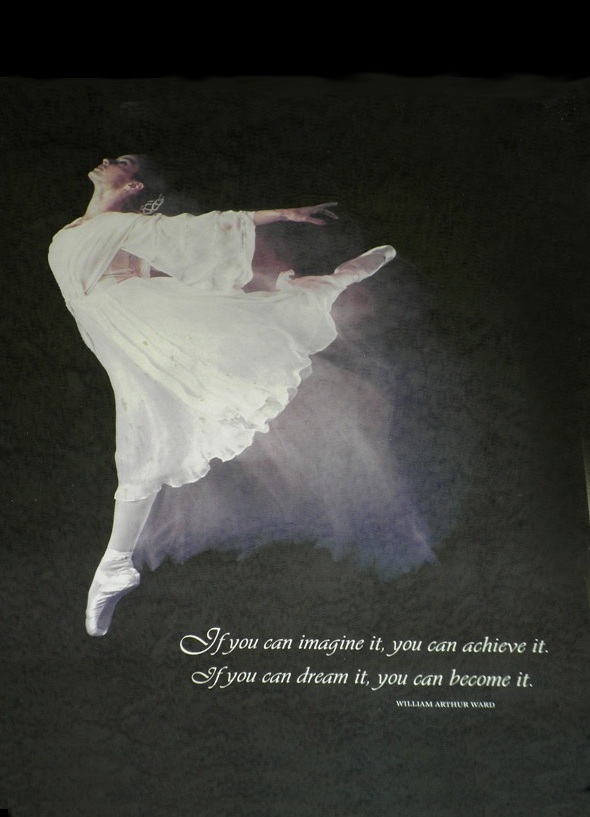
The poster that hangs above the door of “my” dance studio.


***

Pat Bertram is the author of the suspense novels Light Bringer, More Deaths Than One, A Spark of Heavenly Fire, and Daughter Am I. Bertram is also the author of Grief: The Great Yearning, “an exquisite book, wrenching to read, and at the same time full of profound truths.” Connect with Pat on Google+. Like Pat on Facebook.