Today I am a Published Author. I think.

A couple of days ago I noticed that Second Wind Publishing, the company that will be releasing my books, has More Deaths Than One listed for sale as a download on their ebook page. How long had it been there? Did its availability mean that I was a published author?

My books still aren’t available in print form. I know publishing delays are nothing out of the ordinary, but I feel a bit foolish for having frequently announced the imminent publication of More Deaths Than One and A Spark of Heavenly Fire. It seems as if they are always two weeks away from being published. When they are finally released, I am going  throw a huge online “Hallelujah!” party. (You are all invited, of course.)

Which brings me back to the point of this bloggery. I wasn’t sure if having a book available as a download qualified as being published. And if it does, how odd that I didn’t know. Shouldn’t it have been a momentous occasion? Shouldn’t such a milestone have caused a ripple in my life, a change? But no. Here I sat, doggedly de-was-ing another manuscript, not knowing I’d been elevated to published status.

Well, I can now truly say that I am a published author –an online friend bought the ebook.  I received an email from her today. She wrote: “I got the prize! The first Ebook! I want the first book in print too! So see to it that someone sends me one first!”

So, not only am I a published author with one sale to my credit, I received my first fan letter.

Now this is a momentous occasion. I can already feels the ripples.

add to del.icio.us : Add to Blinkslist : add to furl : Digg it : add to ma.gnolia : Stumble It! : add to simpy : seed the vine : : : TailRank : post to facebook

Last Day for the “More Deaths Than One” Contest

Today is the last day to enter my More Deaths Than One contest. (Entries must be received by midnight tonight EST.)

The premise:

A friend of mine found an obituary in the paper that could have been for his mother — the woman had the same name, lived in the same general area, was the same age, had the same number of children, and one of the children had approximately the same name and age as the friend. There was no relationship, merely coincidence but, joking, I said, “What if her son really is you?” That “what if” eventually became More Deaths Than One.

The contest:

Write at least a paragraph and no more than a page, telling how would you develop a story using this scenario. The three most imaginative entries will be posted on the Second Wind site for readers to vote on. The top entry will win an autographed copy of More Deaths Than One and your choice of two other books from Second Wind Publishing. You can find the entry form at: Second Wind Publishing.

We’ve already received some really great entries, including this one:

I would not develop the story. I am a reader, not a writer. I read and analyze books, not write them. Quite frankly, I am much more interested in seeing how the author Pat Bertram develops the story rather than how I would. How does she make the coincidence believable? How does she maintain the level of suspense throughout the novel? How does the story differ from other books written in the genre?  How is the book innovative? How does the story adhere to more traditional conventions of the genre? It is often said that those who can’t write, teach. On the contrary, writing and analysis (and teaching) are completely different skills, each worthwhile in its own right. I am not a writer. Rather, I am a reader who enjoys reading other authors’ books and using my imagination and analytical skills to review and share books with other readers.

It won’t be long until you can answer those questions yourself.

add to del.icio.us : Add to Blinkslist : add to furl : Digg it : add to ma.gnolia : Stumble It! : add to simpy : seed the vine : : : TailRank : post to facebook

“More Deaths Than One” Contest. Win Free Books!

Win an autographed copy of More Deaths Than One (my very first autograph!) and your choice of two other titles from Second Wind Publshing LLC.

The premise:

A friend of mine found an obituary in the paper that could have been for his mother — the woman had the same name, lived in the same general area, was the same age, had the same number of children, and one of the children had approximately the same name and age as the friend. There was no relationship, merely coincidence but, joking, I said, “What if her son really is you?” That “what if” eventually became More Deaths Than One.

Write at least a paragraph and no more than a page, telling how would you develop a story using this scenario. The three most imaginative entries will be posted on the Second Wind site for readers to vote on. The top entry will win an autographed copy of More Deaths Than One and your choice of two other books from Second Wind Publishing.

Rules:

One paragraph to one page of your own version of the “What if?” from above.
Submitted by Midnight (12:00) EST Monday February the 16th 2009.
Only one submission per person.

Judging:

Pat Bertram and Second Wind management will read over all the entries and decide which three are the best — completely subject to our personal opinions as publishers and writers. The three best will be published on the Second Wind website on or around February 23rd 2009. From then you will have a week to vote on the best of the three entries. The top voted entry will receive the books.

add to del.icio.us : Add to Blinkslist : add to furl : Digg it : add to ma.gnolia : Stumble It! : add to simpy : seed the vine : : : TailRank : post to facebook

A New Era in Publishing

When I was studying the publishing industry, trying to figure out how to get published, one thing bothered me. There you are, a debut author, and because the publisher does not promote you — spending their promotion dollars instead on the big names — your books sit on bookstore shelves or in warehouses until finally the publisher gives up on you and remainders your book. That is the best scenario, because if it is remaindered, at least it will still be available for a time. Generally what happens is that it is pulped. 25% of a publisher’s total output (including your beloved book) is destroyed. This after shipping costs incurred to and from the publisher’s warehouse.

My books, More Deaths Than One and A Spark of Heavenly Fire are being published by Second Wind Publishing, a so-called POD publisher, and because of it, I do not have to fear my novels succumbing to such a fate. Nor do I have to fear an inadvertent error showing up in thousands of volumes. As soon as an error is found, it can be corrected. Because of POD technology, there is no reason to destroy unsold merchandise. There is no reason to stop publishing a novel because it does not live up to the bottom-line demands of the traditional publishing houses.

Small presses today are where independent movie producers were in the late eighties and early nineties. They have the ability to publish books that need time to reach an audience, books that might not appeal to the masses but could still be loved by many (and turn a tidy profit in the process.)

Though POD still has the taint of vanity press, my books did go through a submission process, and I like knowing I was chosen. I like having a say in the editing, the cover choice, the arduous copy-editing. I even like promotion — what I’ve done of it, anyway.

So, new era in publishing? Good for us all. And I am pleased to be a part of it.

add to del.icio.us : Add to Blinkslist : add to furl : Digg it : add to ma.gnolia : Stumble It! : add to simpy : seed the vine : : : TailRank : post to facebook

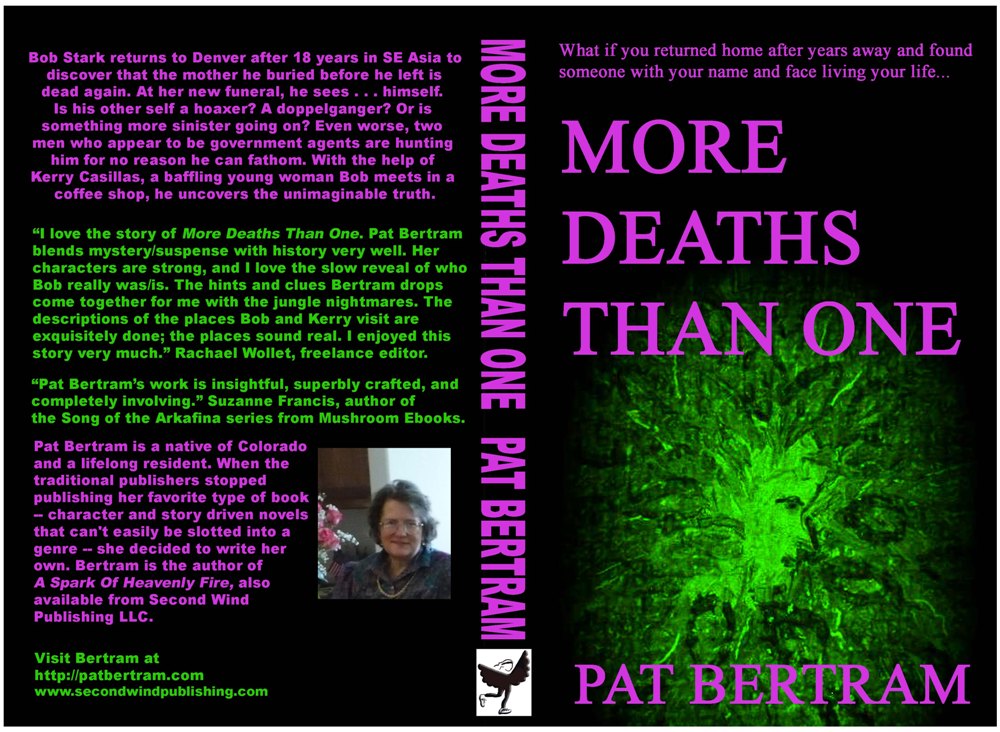
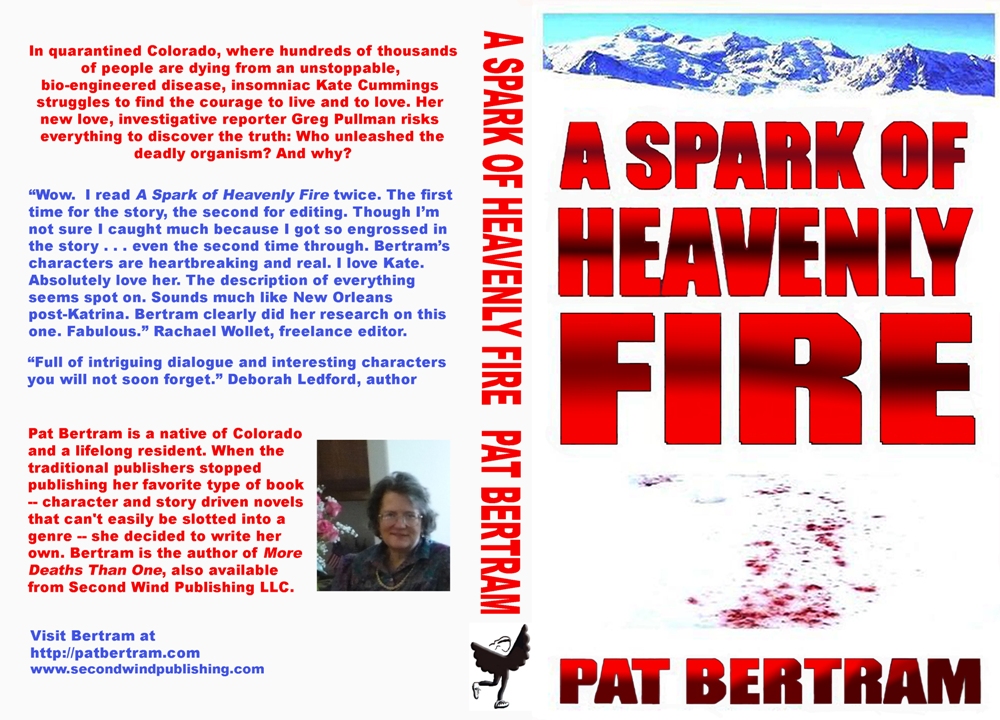
Sneak Preview of My Book Covers.

Front and Back Covers of More Deaths Than One

Front and Back Covers of More Deaths Than One

Front and Back Covers of A Spark of Heavenly Fire

Front and Back Covers of A Spark of Heavenly Fire

What If People Like My Books?

An odd thought struck me this morning: what if people actually like my books? Over the past few years, I’ve racked up hundreds of rejections. I told myself the agents and editors were only rejecting my query letters, because what else could they be rejecting? None of those I sent letters to had ever heard of me, so they could not be rejecting me personally. Nor did most request any part of a manuscript, so they could not be rejecting my novels. But others did request parts of the manuscripts, and found them wanting. Some did not like my characters, my setting, my matter-of-fact style, my inability to sweep them away. Some did not like that the books could not be easily slotted into a genre. The rest simply said the books did not fit with their list. I had a great attitude through all those rejections, and I didn’t think they affected me, but they must have, because I’ve been steeling myself against weak sales and less-than-stellar reviews.

Ever since More Deaths Than One and A Spark of Heavenly Fire were accepted by Second Wind Publishing, I’ve been so focused on figuring out how to sell my books (I even started a new blog, Book Marketing Floozy, to share what I learned and will continue to learn) that it never occurred to me people might read my books. Of course, one-fourth to one-half of all purchased books are never read, so perhaps those who buy won’t read, but what if they do?

Now that my publication date is nearing (actually, it’s not a date, more like a time — end of November), and my novels are about to be made available, I’m getting nervous. Only one person (a free lance editor I met in a writing group) read all four of my manuscripts, and she absolutely loved them. And an author I met through my blog read one of my manuscripts, and she thought it was brilliant. Although many people have read excerpts of my novels, no one else has ever read one all the way through. Soon my novels will be published.

And what if people like them?

How do You Solve the Problem of Exposition in Your Writing?

“Exposition is a device for introducing characters, to provide setting, for creating tone, to explain ideas, to analyze background. Exposition should be immediately related to the event that causes its presence. The subject should be relevant to the circumstances, otherwise it’s a distraction that does not contribute.” -Leonard Bishop, Dare to Be a Great Writer

We all know enough about writing to understand that in today’s market, we need to keep exposition should to a minimum. Despite that, we often have to support our premises with facts or explain the reasoning behind that premise.

For my novel Light Bringer, I created a discussion group for people who believed in conspiracies. While each argued for his or pet conspiracy theory, sometimes quite humorously, I was able to expose an alternate view of history without having one character giving a long and boring lecture. The group also functioned as a cast to pull from whenever I needed a character to play a bit part.

For Daughter Am I, I created a character who loved to lecture. Though perhaps he told too much, it did go to character.

For A Spark of Heavenly Fire and More Deaths Than One, I had characters go in search of the information because I thought that if characters wanted the information badly enough, readers would also want the information and hence tolerate the intrusion of fact.

So how do you solve the problem of exposition? Do you dump it in all at once to get it over with? Do you parcel it out a bit at a time? Do you have one character tell another? Do you have a character seek it out? Do they read it somewhere, such as in an article or online? And how do you make it interesting for the reader?

My writing discussion group No Whine, Just Champagne on Gather.com will exchange ideas about exposition during our Live Discussion on Thursday, October 16 at 9:00pm ET. Hope to see you there!

We Read Fiction to Make Sense of Life’s Disorder

Life is often disordered, but fiction cannot be. We read fiction to make sense of life’s disorder, and we demand that things make sense. No matter how well ordered the rest of the plot, when a stranger comes and simply hands the hero the one element he needs to complete his mission, we feel cheated. The hero should have to work for his goals.

This same order must be inherent in every bit of the book, characters as well as plot. Foolish and spontaneous actions, arbitrary decisions and behavior make the story unbelievable. A character can’t simply wake up one morning with a desire to change jobs, or go on a quest, or hunt for a murderer. While such whims are a part of our lives, they are not part of fictional characters’ lives. All their decisions must be motivated.

A character can wake up one morning with a desire to change jobs, for example, but the author needs to add a few words to explain why: a quarrel with a boss, a promised promotion that doesn’t materialize, a backbiting co-worker. If a character must quit on a whim, the author has to establish motive from within the character. Perhaps the character always acts on whim, in which case the author needs to show that. Or perhaps it’s June; the scents seeping in the open window remind the character of the long summer days of childhood, and he has an overwhelming need to experience that freedom again.

Readers will believe almost anything an author wants them to believe, as long as it is motivated.

At the beginning of my book, More Deaths Than One, (which can be seen by clicking on the My First Chapters link off to the right) I have Kerry, a graveyard-shift waitress, showing an interest in Bob, the quiet hero, who stopped by the coffee shop every night for a hot chocolate. I always thought it was enough that she was bored and was playing games with him, trying to get him to talk, but a reader told me she found Kerry’s motivation for involving herself with Bob a bit thin.

Because Bob is debilitated by headaches and nightmares, I need Kerry to push him into action when he discovers that the mother he buried twenty years ago is dead again and that he has a doppelganger living what could have been his life. If her motivation for involving herself with Bob isn’t believable, then the whole book falls apart.

I thought I was finished with Bob and Kerry. More Deaths Than One was the first book I wrote, also the third and the fifth, and now it looks like it might be the seventh.

In life, as in fiction, we have to work for our goals, but I wouldn’t mind if a stranger came and simply handed me a publishing contract.