All I Have Lost

Grief seldom visits me anymore, but last night, I couldn’t keep the tears from falling. I thought I’d gone through all the firsts — first Christmas after Jeff died, first birthday, first everything. But there was one first I hadn’t expected.

I’d gone to a women’s club Christmas dinner, and it turns out that husbands were invited. In all the years since Jeff died, although I’ve often been in the company of married women, this was the first time I’ve been in a group with mostly couples. I had no idea that such a first would be a problem. But it was. Since the couples wanted to sit together, I got shunted toward the end of the table, between two husbands, both of whom were faced away from me.

I didn’t know any of the men at the dinner, barely knew the women, didn’t know any of the people they talked about, didn’t understand any of the local issues they discussed, so there I sat . . . alone. Toward the end of the evening, a couple of women made the effort to talk to me, so I was able to keep my tears in check, but as soon as I got home, I started crying.

I thought I was over this part, this feeling out of place in a coupled world. I’ve been spoiled in that most of my new friends are widows (or once were widows). There is no feeling of being a third wheel or fifth wheel or any sort of wheel when I’m with them, so the feeling of being superfluous hit me hard. I’m still feeling sad and unsettled. In a little over three months, it will be ten years that Jeff has been gone. It doesn’t seem possible that I’ve lasted this long. It doesn’t seem possible that I can still feel so bad and for such a silly reason.

I’ve been doing a good job of looking forward instead of back, of not lamenting all I’ve lost, but last night, it was simply too much. I wanted go out into the dark and scream about the unfairness of it all, wanted to wail, “But I didn’t do anything wrong.”

But death doesn’t care about fairness. Death doesn’t care about rightness or wrongness. Death came ten years ago, and sometimes, like last night, I can still feel the cold winds of grief it left behind.

Part of me feels as if I’ve been playing a game, playing house, playing at being sociable, and I was suddenly brought back to the reality of my aloneness. Luckily, there’s nothing I have to do today, so I can find my center again before I once more put on my smile and act as if this life is what I wanted all along.

Don’t get me wrong — it is a good life. But sometimes, oh sometimes, I can’t help but think of all I have lost.
***

Pat Bertram is the author of Grief: The Inside Story – A Guide to Surviving the Loss of a Loved One. “Grief: The Inside Story is perfect and that is not hyperbole! It is exactly what folk who are grieving need to read.” –Leesa Healy, RN, GDAS GDAT, Emotional/Mental Health Therapist & Educator.
Grief Is a Process that Keeps on Taking

In a blog a couple of days ago, I mentioned that while our current culture emphasizes inclusivity, it manages to exclude a forgotten segment of our society — widows and widowers, especially older ones. I suppose this makes sense because so many people who embrace inclusivity are young folk, and they cannot even imagine the problems of losing the one person who matters more to you than anyone else and then being left to grow old alone.

The primary sociological problem of being widowed (as opposed to the emotional, spiritual, psychological problems of losing your life mate) is being forcedly single in a coupled world. The “triggers” reminding us of our lonely state are ubiquitous. Ads almost always show couples; even ads geared toward older people show couples. Ads about supporting one another in illness show couples. Books and movies often focus on couples. Songs constantly remind us of the importance of love, that loving someone can give our life meaning, that you’re nobody unless someone loves you.

We are showered with studies proving that sleeping (both literally and euphemistically) with someone enhances your health, that daily hugs make you healthy and strong, that merely being in the room with another person has health benefits. That’s all fine and dandy, but what does that have to do with the bereft? Once you’re alone, you can go weeks, sometimes months, without touching another person. (Did you ever wonder why the elderly like hospitals? People touch them. It’s not as simple as that, of course. Or perhaps it is.)

Many people find that the loss of their spouse creates a ripple of other losses, such as loss of their friends, especially if their friends were other couples. If they were a two-income family, suddenly the income is significantly reduced, and yet they end up paying double for many things such as hotel rooms. The bereft are often left on their own, without the resources they need, but even if that is not the case, they now have all the problems not just of widowhood, but of singlehood.

I recently came across an article that explains why being single is not so great. The article mentions five specific points.

  1. Single people make less than married people for doing the exact same job. Sometimes single people are seen as slackers, even if they’re not and sometimes the boss thinks that the person with a spouse and kids needs more money. The discrepancy can be as much as 27%.
  2. Single people work more. They are not allowed time off under the Family and Medical Leave Act, they don’t have as many excuses to take off from work, and of course they are often expected to work holidays and weekends because they don’t have family obligations.
  3. Single people pay more taxes. Married people can file as individuals to get the best tax rate, and more than half of married people get a bonus of up to $1300 a year.
  4. There is a social stigma to being single according to a recent study by Rutgers University. People wonder what’s wrong with you. Single men are considered stupid and dishonest. Single women are more likely to be harassed and treated badly at restaurants.
  5. Worst of all, single people don’t live as long as married folk are more likely to get sick. Married people have better immune systems, they generally have the choice of two insurance plans which gives them the best care, they have a support system (emotional as well as practical), and they have someone to help care for them when they are ill.

So, for all you folks who are lucky to still be married, who have not been forcibly removed from your spouse by death, don’t tell your widowed friends to get over it or to move on. Unlike a gift that keeps on giving, grief is a process that keeps on taking.

***

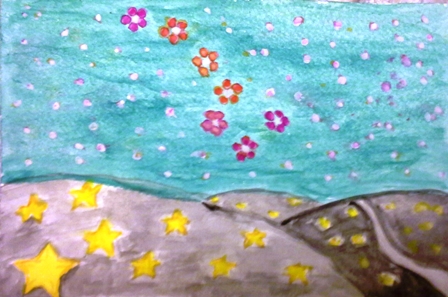
On a brighter note, here is my latest watercolor.

20170113_173153-1

***

(Pat Bertram is the author of the suspense novels Light Bringer, More Deaths Than One, A Spark of Heavenly Fire, and Daughter Am I. Bertram is also the author of Grief: The Great Yearning, “an exquisite book, wrenching to read, and at the same time full of profound truths.”) Connect with Pat on Google+. Like Pat on Facebook.




