Rubicon Ranch: Necropieces — The Story Continues

Rubicon Ranch is a collaborative and innovative crime series set in the desert community of Rubicon Ranch and is being written online by the authors of Second Wind Publishing. Seven authors, including me, are involved in the current story — Rubicon Ranch: Necropieces.

Residents of Rubicon Ranch are finding body parts scattered all over the desert. Who was the victim and why did someone want him so very dead? Everyone in this upscale housing development is hiding something. Everyone has an agenda. Everyone’s life will be different after they have encountered the Rubicon. Rubicon Ranch, that is.

Although some of the characters were introduced in Rubicon Ranch: Riley’s Story, a previous collaboration, Rubicon Ranch: Necropieces is a stand-alone novel. The first chapter will be posted on Monday, June 11, and one chapter will be posted every Monday after that.

We hope you will enjoy seeing the story develop as we write it. Let the mystery begin! Whodunit? No one knows, not even the writers, and we won’t know until the very end!

Chapter 17: Melanie Gray
by Pat Bertram

Melanie stood at the window of her upstairs office, waiting for the photos of Eloy’s dog to finish printing.

Waiting. Always waiting.

Still waiting for Alexander to come home or call, though he had been dead for more than three months. Still waiting for the sheriff to investigate her husband’s accident—if in fact it had been an accident that killed Alexander. Still waiting for her grief to end and her life to begin.

The printer chugged as if deliberating over each line of data. Finally, it spit out the last photo of the puppy. Melanie shook her head at the amateurish product. She’d used high-grade photo copy paper, and the image was a good one, but the picture didn’t have the hard finish of a professionally developed photo.

This was the first place they’d lived where Alexander hadn’t set up a darkroom. She wouldn’t have known how to use the equipment even if she had it, but the absence of the chemical smells underlined the absence of her husband. They were only going to stay in this rental property a short while, just long enough to do the job and move on, and setting up a darkroom wouldn’t be worth the trouble, or so Alexander had claimed. He’d never said where their next job would take them, but he’d seemed anxious about the assignment. And now it didn’t matter. He was dead and she was . . . waiting.

Melanie fanned out the printed photos. Four eight-by-eleven pictures of the puppy, each a different pose, each charming. She printed a fifth page with smaller versions of the images, gathered up the papers, stuffed them in a large Manila envelope, and headed outside.

The cloudless sky was pale blue, and though not particularly hot, the air felt oppressive and humid. The small effort of walking the few steps to Delano Road made Melanie’s skin feel sticky. Normally she would have taken this as a sign that a storm would soon be passing through, but nothing appeared to work normally in Rubicon Ranch.

A curtain in the front window of the Sinclair house twitched. Was someone watching her? Melanie quickened her steps and let out a sigh of relief when she’d passed the house. She hesitated in front of Eloy’s place. The old man’s empty chair stood empty. She’d planned to hand him the photos and slip away before he could get awkwardly avuncular again. So, now what? Wait for him?

Waiting. Always waiting.

Melanie marched to the front door and rang the bell. Silence. Not even a bark or a yip from the puppy. Had something happened to the old man? Maybe he’d meddled in something he shouldn’t have.

In the months she’d lived here, she hadn’t seen Eloy do anything but sit on his front porch and glower at everyone who went by, and the recent change in him seemed suspect. If he’d wanted a dog, a monstrous canine would have better fit his image, but he’d gotten a puppy, for cripe’s sake. And what did he mean when he’d said Morris wouldn’t be bothering her any longer? Why would he make her welfare his concern? Besides, she knew how to take care of herself—Alexander had made sure of that, insisting she take lessons in self-defense and weaponry before they started traveling to dangerous locales. They’d lived in a whole alphabet of perilous countries, from Afghanistan to Zambia, and she’d survived them all.  When they’d moved here to Rubicon Ranch, she’d felt safe for the first time in years, but this quiet community had turned out to be the deadliest place of all.

Melanie pressed the doorbell once more on the off chance the old man and young pup were simply napping, but the chimes still elicited no response. Grateful she didn’t have to talk to the old man, she slipped a corner of the envelope beneath the welcome mat to anchor it. Wondering why that most unwelcoming man had a welcome mat on his porch, Melanie trudged to the street.

Moody half walked, half trotted toward her, a hand raised in greeting. “I need to talk to you.”

Melanie waited for her neighbor. “I need to talk to you, too. A couple of weeks ago Morris told me—”

“That Alexander had been taking photos of necropieces for him? I overheard my father talking to you that day. I’m sorry he upset you. He won’t bother you again.”

Anger surged through Melanie, temporarily displacing the sorrow that weighed on her. “Why does everyone think I need protection? I’ve dealt with worse things than a nasty old man who needed to be exterminated.”

Moody held up her hands, palms out. “Sorry. I didn’t realize protection was an issue with you.”

Melanie gritted her teeth to keep from blurting out a denial. She remembered that Moody had once been a psychologist, and any further discussion would give the woman fodder for more assumptions. She pivoted on one foot, getting ready to walk away, then turned back. Her neighbor might be a psychologist and a Sinclair, but she was the only one who could explain why Morris had accused her of killing Alexander.

“Your father mentioned something else that day. He said Riley told you she’d seen me messing with our car.”

Moody blew out a breath. “The bastard lied. Riley only said she’d seen someone messing with the car. That’s all. Never mentioned a name. I didn’t believe her, though. If you knew Riley, you’d know she loved to cause mischief. Even I found it hard to discern when she was telling the truth.”

“But could she have seen someone messing with the car?”

Moody put a finger to her chin and said slowly, “It’s possible. Generally, Riley’s lies were quite detailed—more like stories—but she made the remark about the car in an offhand manner. Are you thinking someone deliberately caused your husband’s accident?”

“Sheriff Bryan told me the accident looked suspicious, but . . .”

“You don’t trust him.”

Melanie focused on the peak of a distant knoll. Did she trust the sheriff? She lowered her gaze to meet Moody’s. “I think he has . . . agendas.”

Moody nodded. “That’s my take on the sheriff, too. I also think he’s on a quest for redemption, whether he’s aware of it yet or not. I’ll let you know if I recall anything else Riley said about your car or Alexander.”

“Thank you.” Melanie turned and started walking up Delano Street toward the desert.

“Wait. Please?”

Melanie stopped.

Waiting. Always waiting.

“I need to warn you about Jake,” Moody said, a new urgency in her voice.

Melanie spun to face the woman. “Are you trying to protect me again? I can take care of myself.”

“Yes. You said. But Jake . . . Jake’s my brother. He wears a cloak of righteousness, but his heart is as black as the rest of the Sinclairs’.”

Melanie frowned at her neighbor. Moody was a Sinclair, too. Could she be warning Melanie that as Morris’s daughter, Moody also had a black heart? A lifetime with Alexander should have prepared her to deal with the Sinclairs, but she sensed nuances of evil in the family next door that made Alexander’s machinations seem like child’s play.

“You don’t believe me,” Moody said flatly.

“Why are you worried about me all of a sudden?”

“I haven’t seen Jake in years, and he just showed up. Supposedly he’s been in the area for several weeks participating in some sort of revival, and he heard about Morris being missing. So now he’s come to . . .”

Interested despite herself, Melanie said, “So now he’s come to—what?”

Moody shrugged, a strange look on her face. Fear, maybe? She glanced toward her house, then fixed an intense gaze on Melanie. “He knows about you. Knows you found the foot yesterday. Don’t believe a word he says. And whatever you do, don’t get yourself in a situation where you are alone with him.”

Melanie watched her neighbor hurry back to Morris’s house. As Moody walked up the driveway, the door opened, and a man walked out.

Melanie gave a start. Morris! Couldn’t be. This man looked younger than the writer. Must be Jake, the son.

Jake glared at Moody, then turned his head toward Melanie. He seemed to study her, the Sinclair dead-fish stare frozen on his face.

And then he smiled.

Melanie fled to the desert. She inhaled the humid, creosote-scented air, trying to remove the stench of the Sinclairs from her nostrils, but no cleansing breath could remove the memory of that evil leer.

Forget the Sinclairs. Focus.

Melanie took a swig of water from her canteen, screwed the cap back on, and reached in her pocket for her little digital camera. Thinking of the last photos she took, the photos of Eloy’s dog, she wondered if her photos would be better if she had professional equipment. She made a mental note to ask the sheriff about her husband’s cameras—Alexander had taken them when he left on that fatal car trip, and they hadn’t been returned to her.

Melanie shot a few photos at random—a jogger in red shorts, a wadded fast food wrapper that looked like a yellow rose nestled in the scrub, a frisky puppy running circles around an old man. Captain and Eloy. Seeing Eloy in the desert again made her shoulders itch. Too much strangeness. Too much change.

She picked her way up the steep rock-strewn track to the top of the knoll, past the place where she’d found Riley’s body stuffed in a television console, past the place where she’d found the foot. She stopped to snap a few shots of the vast desert wilderness spread out before her, a sight that never failed to bring her comfort.

Distant shouts rising above the whine of idling motors caught her attention. She cut to the left until she glimpsed the altercation. Two people, one in red racing gear and one in silver, were standing by a canoe, balancing motor bikes with one hand while gesturing with the other.

“No!” bellowed the red-garbed racer. He hopped on his red bike and sped toward Melanie.

The silver racer got on his bike and chased after his companion. “Someone got chainsaw massacred. We have to call the cops and tell them we found a part of a body.”

“No,” yelled the red racer again. “We can’t. My mom will kill me. I’m supposed to be home looking after my little sister.”

They hurtled past Melanie, still shouting. She took pictures of the two boys, then of the canoe. She’d often seen the abandoned canoe in her treks, but until today, the boat had always been turned upside down. Apparently the boys had found something hidden beneath the canoe. A necropiece.

Could she take a chance that the boys hadn’t seen her, and so pass on calling the sheriff? She hadn’t found the body part, but she felt sure the sheriff would use her presence as an excuse to lay the blame at her feet. She sighed and pulled her phone out of a pocket. Even if the boys didn’t say anything, the sheriff would eventually find out she had been in the vicinity of more death. Not notifying him would seem more suspicious than making the call.

She talked to the dispatcher, explained the situation, described the boys and gave directions on how to find the canoe from Tehachapi Road.

“Wait right there,” the dispatcher said. “Someone will arrive as soon as possible.”

Melanie shoved the phone in her pocket, and shifted from foot to foot.

Waiting. Always waiting.

To hell with that. If the sheriff wanted her, he knew where to find her.

Melanie turned away from the canoe and tramped across the desert expanse, heading toward the storm clouds gathering on the horizon.
Writing My Life

I’m writing a short story for the Second Wind Publishing holiday anthology, and it just occurred to me that the main character is the first one I have created since the death of my life mate/soul mate who isn’t a grieving widow.

I started a novel a couple of years ago, wanting to capture what it felt like to lose a spouse while my feelings were fresh, but I haven’t finished the book. The pain that seeps into the story is too raw for me to handle yet, and besides, I still don’t know what the point of the story is. Is it primarily to show what it feels like to grieve? Is it primarily the mystery of why her minister husband would get out of his deathbed to kill a neighbor? Is it primarily the mystery of who she is now that she is no longer a minister’s wife? Is it a story of renewal, love, acceptance? Unless I figure it out, that poor widow is doomed to grieve forever in the pages of that unfinished manuscript.

The next piece of fiction I attempted was in Rubicon Ranch, a collaborative mystery series I’m writing online with other Second Wind authors. My character is Melanie Gray, a writer whose husband died in a car accident, but certain inconsistencies are showing up in the investigation, pointing to something other than an accident. Melanie’s attempts to come to terms with her life and to find the truth of his death are a couple of the unifying themes in the series, though they are not the focus of the stories.

The third piece of fiction I wrote was “The Willow,” a short story I did for Change is in the Wind, a previous Second Wind anthology. My character in that story is a woman who found renewal in the spring of her second year of grief.

My fourth project is a steampunk collaboration I am doing with several authors I met online. It should come as no surprise that my character is grieving woman. The deaths of her husband and his mother are the catalyst for the story, since her father-in-law goes back in time to try to save them. This sentence hints that maybe her grief (and mine) is waning: Flo stood motionless and stared at her husband. She wanted to run to him, to embrace him, but he looked different somehow. Unapproachable. There seemed to be a bit of flabbiness around his middle, a discontented tilt to his head, a defeated slump to his shoulders. What had happened to the radiant young man she remembered? Had her vision of him changed over the past year, become idealized? Or had she stopped seeing the truth of him even before he died?

In the story I am currently writing, the character’s boyfriend doesn’t die. He leaves her. She doesn’t go into paroxysms of grief, at least not much, but she does cut her hair in an entirely unconscious symbol of mourning (so biblical!). I had her lopping off her long tresses more out rebellion than out of sorrow, since he had always demanded that she didn’t change.

It is strange to see such a pattern show up in my writing. From stark grief, to sustained grief, to a semblance of peace, to seeing the deceased as not so perfect, to easing the focus on grief. Apparently, no matter what I write, I am somehow writing my life (though oddly, the characters are getting progressively younger).

I’ll be interested to see what I write next.

Rubicon Ranch: Necropieces — The Story Continues

Rubicon Ranch is a collaborative and innovative crime series set in the desert community of Rubicon Ranch and is being written online by the authors of Second Wind Publishing. Seven authors, including me, are involved in the current story — Rubicon Ranch: Necropieces.

Residents of Rubicon Ranch are finding body parts scattered all over the desert. Who was the victim and why did someone want him so very dead? Everyone in this upscale housing development is hiding something. Everyone has an agenda. Everyone’s life will be different after they have encountered the Rubicon. Rubicon Ranch, that is.

Although some of the characters were introduced in Rubicon Ranch: Riley’s Story, a previous collaboration, Rubicon Ranch: Necropieces is a stand-alone novel.

We hope you will enjoy seeing the story develop as we write it. Let the mystery begin! Whodunit? No one knows, not even the writers, and we won’t know until the very end!

Chapter 9: Melanie Gray
by Pat Bertram

Melanie locked the front door of the house and turned around to face the day. It was clear and warm with a platinum sun shining in an azure sky. She felt her spirits rise. With such lovely weather, things couldn’t be as bad as they seemed. She marched down the driveway, and her spirits plummeted as fast as they had risen. The sheriff’s tan Navigator, like a brooding predator, loomed in the driveway of the Sinclair house next door.

Melanie had tried to forget Sheriff Seth Bryan and the conflicted feelings he had aroused in her, but apparently she hadn’t succeeded. She could feel the emotions rushing back to fill the emptiness inside her. She still couldn’t tell if she’d felt more drawn to him or more repelled by him. With any luck, she’d never have to explore those feelings. As soon as he finished his business and left the area, she could forget him again.

She heard the sound of his voice, though not his words, and for a moment she considered dashing back into the house to avoid any encounter with him, but then she realized the truth. The sheriff had no interest in her. It had been almost three months since she’d last seen him, and in all that time, he had made no effort to contact her.

She lifted her chin. She didn’t need him or any man. They were all worthless creatures who had no regard for anyone but themselves.

Still, it wouldn’t hurt to see what he was up to.

She took a few steps forward so she could see the front door of the Sinclair house. The sheriff looked the same as he always had. Jeans and a white shirt with a badge on the shoulder clothed his lean, flat-bellied body, and a navy blue ball cap with a yellow “Sheriff” embroidered on it covered most of his dark brown hair. And he still wore those ridiculous mirrored sunglasses.

The sheriff and Moody seemed to be standing closer together than politeness dictated. Could something be going on between the two of them? Movement in the passenger seat of the Navigator caught her attention. Deputy Midget. If the sheriff intended anything shady, surely he wouldn’t bring a deputy along to witness his behavior? Then this must be an official visit.

Moody looked okay — happy, even. It had been very quiet the last week or so without “The Sounds of Silence” blaring at all hours, and she’d probably been enjoying herself in Morris’s absence.

The sheriff starting walking toward his vehicle. Melanie squatted to retie a shoelace, hoping he wouldn’t catch sight of her. She might have the courage not to seek refuge in the house, but she had nothing to say to him.

When she heard the sheriff’s Navigator slowly moving down the street, she squelched a pang of disappointment. As annoying as his attentions were, at least they had reminded her she was alive. She’d been living with the dead — or rather memories of the dead—for way too long.

She arose with only the slight aid of one hand to push her erect, and angled her steps to the right of her driveway, intending to head up Delano Road to the desert. She paused, took two steps to the left.

The Daily Indecision is how she’d come to think of this inability to act. “Sounds like a newspaper,” she said aloud. “They’d print both sides of every story since the editor would be unable to decide which view to stand behind. Or maybe the paper would be blank because they’d never be able to decide which stories were newsworthy. And since when do you talk to yourself?”

Since Alexander died. She often wandered in the desert, trying to understand her husband’s death and her grief, and she’d gotten in the habit of talking aloud to him, hoping he could help make sense of her chaotic thoughts. He never responded. But then, he’d seldom replied even before he died.

When had their relationship become all about him? And why hadn’t she noticed the change? She sighed. Probably because she’d spent so much time online doing research for the coffee table books she and Alexander wrote. Well, she wrote. He took the photos. After his death, she discovered he’d somehow squandered the advance for the book about the Mojave Desert they’d contracted for, so now she needed to take the photographs in addition to writing the text. She thought she’d become good at shooting photos, but just this morning she’d received an email from her publisher:

“Some of your photos are usable, but most are uninspired. You take photographs, but the great photographers, like Alexander, make photographs. And when they make photographs, they make love. We feel the empathy between the external and internal events.”

Whatever that meant.

“What it means,” she said aloud, “is that you have work to do.” She took five resolute steps up Delano Road, then stopped. She could see Eloy Franklin hunched on his porch like a land-locked amphibian, watching everything that went on in his vicinity.

After all the turmoil the neighborhood had gone through recently, after all the deaths, she thought that things would have changed, but there Eloy sat, as unapproachable and forbidding as always. She’d smiled at him a couple of times when she passed in front of his house, but he’d never acknowledged her efforts at friendliness by so much as a nod.

Unable to stand the thought of Eloy’s scrutiny, she turned left. The sheriff’s navigator hadn’t gotten far, only a few houses away. The vehicle still moved slowly, as if the sheriff were looking for something. Trying to see the neighborhood through his eyes, Melanie peered down Delano Road. A petit woman held a camera to her face, either taking photographs or hiding behind it. Did Sheriff Bryan think the woman was Melanie? Melanie smiled to herself. Whatever faults the man might have, mistaking one woman for another was not one of them. Melanie had seen the woman several times before; she was shorter, prettier, and younger than Melanie, and had the clear luminous complexion of someone with a mixed race heritage.

Beyond the woman, a skinny man lurched along the side of the road. Melanie had also seen him several times before, and he worried her. Anger seemed to crackle around him, like lightning right before it strikes.

The Navigator’s siren blared, and the vehicle shot down the street and tore around the corner onto Tehachapi Road, heading east.

A dark cloud seemed to lift from the neighborhood, and Melanie’s indecision disappeared. She turned right, past Moody’s house, past the strange no-man’s land that separated the Sinclair land from the Franklin land, past Eloy’s house.

The wilderness beckoned.

*     *     *

Melanie stood at the crest of knoll and surveyed the expanse of desert. Somewhere out there, midst the creosote bushes and cacti, a photograph she could make waited for her — an image so compelling, viewers would immediately sense her empathy with the subject.

But how did one get emotionally connected to something as vast and as alien as the Mojave Desert? Then she remembered Alexander saying he looked for a significant detail. By focusing on a single feature, by making it the heart of the photo, the rest of the scene came into focus.

Crap. I’ll never get the hang of photography. Damn you, Alexander, for putting me through this.

She heard a sound closing in on her from behind, a leisurely whup . . . whup . . . whup. She turned and froze, transfixed by the raven gliding by. It flew so close she could see the brown pupil of its bright black eye and the purple and blue sheen of its feathers. She’d never seen such a huge bird—the body looked bigger than a cat, and its wings spanned at least three feet, maybe four. For a moment, it seemed to hang motionless, then a graceful wing beat stirred the air and propelled it forward.

Melanie fumbled with her camera, almost in tears. She’d had a perfect opportunity to make a photograph, but she’d become so lost in the moment, she’d forgotten all about taking a picture. Alexander wouldn’t have forgotten. His camera had been an extension of his hands, his eyes. He never let anything get between him and an image he wanted to capture. Not even Melanie. Especially not Melanie.

Then she heard it behind her again, the whup . . . whup of wing beats. And this time she held her camera ready. As the second raven passed her, she caught the image. Joy burst inside her.

I did it!

Only then did it strike her as odd that the two ravens had been so focused on their goal that they hadn’t seemed to notice how close they’d been to her.

The first raven had already disappeared, but she watched the second one descend behind a rocky outcrop thirty feet away.

She followed a barely perceptible track through the scrub to where six or seven ravens pecked at what looked to be the carcass of a small animal. A rabbit, maybe. Thinking how wonderfully the image of this raw savagery would contrast with the majesty of the flying raven photo, she crept closer. And gagged.

The ravens weren’t feeding on a rabbit, but something oddly familiar and totally out of place.

*     *     *

Melanie waited for Sheriff Bryan and Deputy Midget to pick their way up the rock-strewn path to the top of the hill. The sun glinted off the sheriff’s mirrored sunglasses, making him appear soulless.

When he drew near, Sheriff Bryan grunted. “I wish you’d stop finding bodies in such out of the way locations.”

“I didn’t find a body. I found . . .” She swept out a hand, showing the track and which direction he should travel.

The sheriff furrowed his brow at her, then followed the track. Deputy Midget trailed after him. Melanie brought up the rear.

Sheriff Bryan stopped by the outcropping. “A boot? You called me here to see crows playing with an old bloody boot? You must really be desperate to talk to me.”

“Desperate?” Melanie stared at him, the heat of anger flushing through her body. “Are you really so self-absorbed that you think I called you here on a pretext? I didn’t call you. I called dispatch and told them exactly what I found. It’s not a pretext, and they’re not crows. They are ravens.”

The sheriff and his deputy exchanged shrugs, then proceeded forward. The ravens squawked, rose as one, and circled above them, as if protecting their treasure.

Sheriff Bryan squatted, then whipped his head around, lips drawn back in a rictus, and faced Melanie. “A foot? That’s what you found, a foot?”

Midget took a step back. “It looks like something out of Morris Sinclair’s books.”

“Necropieces,” Bryan said, turning back to the foot.

“So where’s the body?” Midget asked.

“Maybe there isn’t one. Someone could have been illegally dumping medical waste.” Bryan rose and loomed over Melanie. “What do you know about this?”

She studied him for a moment, wondering what was going on behind those sunglasses. “Are you accusing me of something?”

The sheriff cocked his head like a raven getting ready to peck at its prey. “The person who calls in a report is always suspect.”

Sneak Preview of Rubicon Ranch: Necropieces

Rubicon Ranch is a collaborative and innovative crime series set in the desert community of Rubicon Ranch and is being written online by the authors of Second Wind Publishing. Seven authors, including me, are involved in the current story — Rubicon Ranch: Necropieces.

Residents of Rubicon Ranch are finding body parts scattered all over the desert. Who was the victim and why did someone want him so very dead? Everyone in this upscale housing development is hiding something. Everyone has an agenda. Everyone’s life will be different after they have encountered the Rubicon. Rubicon Ranch, that is.

Although some of the characters were introduced in Rubicon Ranch: Riley’s Story, a previous collaboration, Rubicon Ranch: Necropieces is a stand-alone novel. The first chapter will be posted on Monday, June 11, and one chapter will be posted every Monday after that.

We hope you will enjoy seeing the story develop as we write it. Let the mystery begin! Whodunit? No one knows, not even the writers, and we won’t know until the very end!

Chapter 1: Melanie Gray
by Pat Bertram

Melanie Gray woke with tears on her face. She sat up in the bed she’d shared with her husband Alexander, put her elbows on crossed knees, and cradled her face in her hands. The pain she tried to hide even from herself erupted, filling her chest with such agony she could only breathe in shuddering gasps.

She’d been doing so well, concentrating on shooting the photographs to finish their coffee table book on desert life, photos that Alexander should have taken, would have taken if he hadn’t died. So why the upsurge in grief? Then it came to her—today marked the third month since Alexander’s death.

Three months! Melanie saw the months marching on, one by one, each carefully counted while she grew old alone. She was only forty-three, which meant a lifetime of loneliness ahead of her.

I can’t do this.

But she’d already been doing it—living each shocking day as it came.

First, she’d found out that Alexander had died in a one-car crash under suspicious circumstances — maybe an accident, or maybe something worse, something she couldn’t bear to think about. Then she had discovered that he’d been texting a woman when he died, a woman who claimed to be his mistress. Finally, she learned that somehow he’d managed to spend the considerable advance they’d received for their book, leaving her with a six-month paid lease on this house, barely enough cash for groceries, and a book contract she needed to fulfill. No savings. And no car.

At least the desert was close, so she didn’t need a car to do her job. Rubicon Ranch, the bedroom community where they’d rented the house, bordered on the high desert of inland California, and offered gorgeous vistas, wildlife . . . and death.

“Damn you, Alexander! Why did you have to die? You were the one who was supposed to shoot the photos. I only wrote the words. If you’d paid attention to your driving, you’d still be alive, and I’d never have found that little girl’s body.”

Poor little Riley Peterson. Kidnapped as a baby, dead at age nine without ever knowing that her biological parents had spent her whole life searching for her.

Melanie let her tears fall for a few more minutes, took one more shuddering breath, and hauled herself to her feet. As bleak as her life seemed, as sad and as lonely as she felt, she was still alive. And she had work to do.

As always, she dressed in white — loose cotton pants, billowing long-sleeved top, wide-brimmed straw hat, flowing scarf. She checked her pockets to make sure she had her cell phone, camera, and extra memory card. Then she grabbed a canteen of water, slung the strap over her shoulder like a bandolier, and stepped outside.

A perfect early fall day. Clear blue skies, the deepest blue she’d seen since she’d moved to Rubicon Ranch. A hint of a sweet-scented breeze wafting up Delano Road. Temperatures in the high seventies, though they would probably rise to the mid-eighties by noon.

The grizzled homeowner across the street picked up a newspaper from his driveway, waved it at Melanie, turned, and stood still. Wondering what had caught his attention, Melanie followed his gaze.

A tan bullmastiff towed a pretty woman up the street. The woman’s dark hair, drawn into a ponytail, swished jauntily as she ran to keep up with her exuberant dog. What should have looked like a carefree moment seemed one of desperation to Melanie, as if the woman were running from demons only she could see.

“Funny how art often imitates life, eh?” came a deep voice from behind Melanie.

She jerked her head in the direction of the voice, and gaped at Morris Sinclair, her next-door neighbor, who had managed to sneak up on her without her noticing.

Morris, an international bestselling horror novelist had been a suspect in Riley Peterson’s death. The sheriff had declared the author innocent of the murder but guilty of buying stolen crime scene photos. And guilty of feigning Alzheimer’s. Melanie didn’t know how the sheriff had come to that conclusion. As far as she could see, if Morris had been feigning Alzheimer’s, he must have been trying to hide the truth — that he was insanely evil. Or evilly insane.

“Or maybe, in her case, life is imitating art,” Morris said.

“What are you doing here,” Melanie demanded. “Does Moody know you’re on the loose?” Moody, Morris’s daughter, had spent time in prison for the accidental death of a child. You’d think a man as perverse as Morris would be proud of her for that accomplishment, but he treated his daughter with even less regard than he treated everyone else.

“Am I my daughter’s keeper?” Morris intoned.

Melanie backed away from him. “I’m sorry. I don’t have time for this.”

“I know. You have to go out into the desert to shoot more of your little photos.” He bared his long, old-ivory-colored teeth at her in what might have been meant as a smile but came across as a predatory leer. Pointing a bony finger at her camera, he added, “You know how to use that thing, right?”

Melanie lifted her chin. “I do.”

“I’ll offer you the same arrangement I had with your husband.”

“You had an arrangement with Alexander?”

“Yeah. Alexander. Did you have more than one husband?”

Melanie stared at him in confusion, but when his dark opaque eyes met her gaze, she ducked her head.

“Alexander used to take certain . . . photos for me.” Morris raised his voice. “Photos of body parts.”

“Body parts?” Melanie asked. “You mean like arms and legs? You can find photos of those anywhere.”

“But I need amputated body parts. Dead parts. Lots of blood and gore. Necropieces.”

Melanie recognized the name of Morris’s most famous horror series — Necropieces — but none of his other words made sense. “You’re telling me Alexander took photos of amputated limbs for you?”

“And entrails. And organs. He loved shooting the images. Had a nicely developed sense of the macabre.”

“No,” Melanie said in a normal tone of voice. Then, all at once, the agony of the past few months gathered itself and launched a scream. “Nooooo.”

The word seemed to echo up and down the quiet street. She caught a glimpse of movement on the porch a couple of houses away, and she realized the old man who lived there, Eloy Franklin, had heard her shriek, but she didn’t care. She had enough of insanity and things that didn’t make sense.

“You leave me alone, Sinclair,” she shouted as loud as she could so that Morris would get the message, “or I’ll be shooting your dead body parts.”

“Every one of you bastards wants me dead!” Morris screamed, matching her decibel for decibel. He threw his arms wide as if to address the neighborhood. “Kill me! Kill me! Kill me. Cowards, every one of you! None of you have the guts to do anything but sit in your dark little caves and try to wish me away. Cowards! And you—” He turned to face Melanie. “I dare you. Kill me like you killed Alexander.”

Melanie gasped. “Alexander died in an accident.”

“An accident you created,” Morris said calmly, as if he’d never raised his voice. “Before that little girl died, she told Moody you’d messed with your car.”

“You’re lying.” Melanie’s words barely squeaked through her clenched teeth.

“Ask Moody.” Morris put a finger to his chin and cocked his head to one side. “So, will you take the photos for me? I’ll pay you well.”

The Story Behind Rubicon Ranch

Almost a year ago, I got the idea to write a collaborative novel online. I broached Second Wind Publishing authors with the concept, and I found eight other writers willing to participate in the experiment. It took a few months to hammer out the details, which seemed an endless task back then, but now I see as incredibly swift. The story was, after all, a committee production.

We started out with what we considered the most heinous of crimes — the death of a little girl. In the first chapter: Chapter 1: Melanie Gray — by Pat Bertram, which was posted on October 24, 2010, Melanie found the girl’s body stuffed in an abandoned television console when she was wandering in the desert, trying to come to terms with the death of her husband. Poor Melanie. So much death!

Each author created a character who might have a reason to kill little Riley. And each character was hiding something.

Could Kourtney and Jeff Peterson have killed their daughter, mischievous nine-year-old Riley, to protect their secret?

Moody Sinclair had once killed an eight-year-old boy. Has she killed again?

Fifteen-year-old Dylan McKenzie is a straight A honor student. By day. Did Riley discover the other Dylan, the one who prowls at night?

Cooper Dahlsing does strange things while sleepwalking. Could he have killed and not known it?

Mark and Jamie Westbrook, self-styled private investigators, show up to help solve the murder, but perhaps they had a hand in creating the crime?

Eighty-two-year-old Eloy Franklin sits on his porch and watches. But does he do more than watch?

Forty-three-year-old Melanie Gray found Riley’s body stuffed in a television console that had been dumped in the desert. But is she as innocent as she seems?

Sheriff Seth Bryan is bitter and cynical at having lost everything he values. Is he manufacturing crimes to bring him the notoriety he craves?

So many villainous characters! And until the very end, no one knew who committed the dastardly deed, not even the writers.

The novel was supposed to be a promotion stunt, but halfway through, it got derailed by life. One author had to deal with colon cancer, including three debilitating operations. Another author had to deal with a flooded house that was uninhabitable for six months. Still other authors had to deal with grief after the loss of significant people in their lives or heavy job pressures. When we started in again, we’d lost all our readers, so there was no longer any promotional value, but still we persevered.

And now the book is finished. You can read the entire novel online for free. If you prefer to read the book on an ereading device, Rubicon Ranch: Riley’s Story is available as a Kindle or in the ebook format of your choice from Smashwords. It’s also available in print from Amazon and Second Wind Publishing.

But . . .

That is not the end of Rubicon Ranch! Though some of the authors went on to other projects, enough wanted to continue the Rubicon Ranch saga, so we lassoed a few additional authors into creating characters. And now we have a new story.

Three months after finding the body of the little girl, poor Melanie is again wandering in the desert, still having a hard time dealing with her husband’s death, when she sees a congress of ravens pecking at a dismembered foot. Who was the victim and why did someone want him so very dead? Everyone in this upscale housing development is hiding something. Everyone has an agenda. Everyone’s life will be different after they have encountered the Rubicon. Rubicon Ranch, that is.

Although some of the characters from the previous collaboration are featured in the new story, Rubicon Ranch: Necropieces is a stand-alone novel. The first chapter will be posted Monday, June 11, 2012 on the Rubicon Ranch blog, and a new chapter will be posted every Monday after that.

I hope you will join us in this new serial adventure. It should be a devious tale.

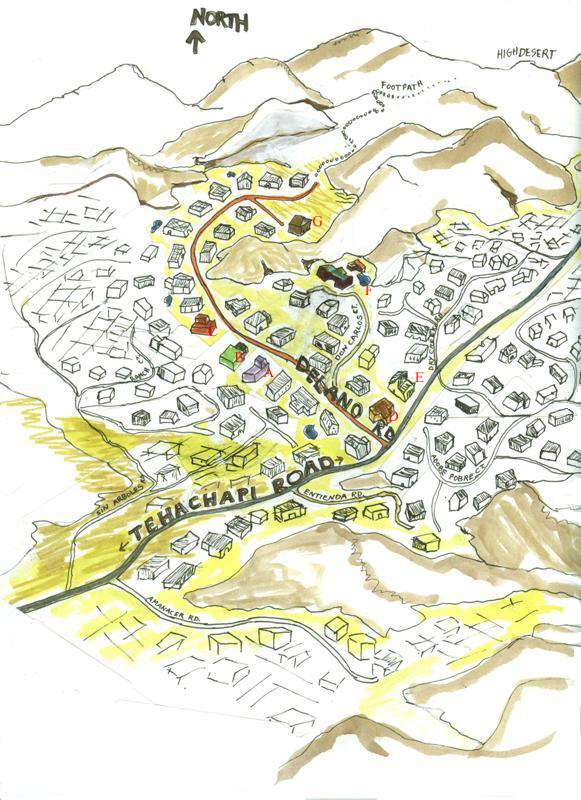
Map of Rubicon Ranch.
A) Melanie Gray
B) Moody Sinclair
C) Eloy Franklin
D) Leia Menendez
E) Ward Preminger
F) Egypt Hayes
G) the Peterson house

Rubicon Ranch — The Saga Continues

More than a year and a half ago, nine authors from Second Wind Publishing got together to write a novel online. We knew nothing more than that a little girl’s body had been found in the wilderness near the desert community of Rubicon Ranch. Was it an accident? Or . . . murder! But who would want to kill little Riley? Everyone in this upscale housing development is hiding something. Everyone has an agenda. Everyone’s life will be different after they have encountered the Rubicon. Rubicon Ranch, that is.

From that short proposal grew a novel with intriguing and nefarious characters, each completely different because each was created by a different author.

Jeff and Kourtney Peterson are Riley’s “adoptive” parents who didn’t go through legal channels to get the child they so desperately wanted. Would they kill to protect their secret?

Moody Sinclair had once killed an eight-year-old boy. Has she killed again?

Fifteen-year-old Dylan McKenzie is a straight A honor student. By day. Did Riley discover the other Dylan, the one who prowls at night?

Cooper Dahlsing does strange things while sleepwalking. Could he have killed and not known it?

Mark and Jamie Westbrook, self-styled private investigators, show up to help solve the murder, but perhaps they had a hand in creating the crime?

Eighty-two-year-old Eloy Franklin sits on his porch and watches. But does he do more than watch?

Forty-three-year-old Melanie Gray found Riley’s body stuffed in a television console that had been dumped in the desert. But is she as innocent as she seems?

Sheriff Seth Bryan is bitter and cynical at having lost everything he values. Is he manufacturing crimes to bring him the notoriety he craves?

***

Life sometimes got in the way of this collaboration, so instead of posting a chapter every week, we went through a long hiatus where the authors suffered variously from cancer, death of a family member, house flooding, job loss, but we picked right up where we left off, and now this experimental novel is finished!

The book will be published during the next couple of months, but you can read the entire story online here: Rubicon Ranch, Book One: Riley’s Story

But that is not the end!!! Next week, we will begin posting chapters to a book in the series, Rubicon Ranch, Book Two: Necropieces — Residents of Rubicon Ranch find body parts scattered all over the desert. Who was the victim and why did someone want him so very dead? Eight Second Wind authors are collaborating to create another innovative crime novel set in the desert community of Rubicon Ranch.

Again, we will be posting a new chapter every week. I hope you will join us as the Rubicon Ranch saga continues.

Grief: Love or Codependency?

Heavy winds today reminded me of a walk I took thirty-five years ago. (Weird, huh? Hadn’t thought about that day in a very long time.) It was a lovely spring evening, or rather, it would have been if it weren’t for the winds. But I was too restless to stay inside. This was about six months after I met the man I would spend the next few decades with, and like a homing pigeon, I headed for his store even though I knew he wouldn’t be there. I wanted to feel connected to him, even if in such a minor way.

When you fall in love, such bits of silliness are expected and excused. Apparently, they are understandable in the context of new love. But when you spend a lifetime with someone, and you still have that connection, people start looking askance, thinking that perhaps you’re codependent. And when he dies, leaving you feeling as if half of you died, too, then the pointing figures become more . . . pointed.

A few days ago I posted my latest chapter of the collaborative novel Rubicon Ranch that I’m writing with eight other authors. In my chapter, I wrote:

Tears welled up in her eyes as she remembered her husband when they first met. His hazel eyes had blazed with golden lights as he smiled at her, and young fool that she’d been, she’d been dazzled. They had a great life, or so it had seemed. She’d felt safe with him as they traveled the world over. And free. What need had she of a house, a car, kids when she had him?

Well, now she had nothing but debts. And doubts. Had Alexander ever loved her as she loved him?

Today I had a bizarre little exchange with a total stranger. He wrote: “This excerpt suggests your ‘young’ lady may benefit from CODA; this is like AA for Co-dependency; a peer support group[P2P] that provides support for individuals struggling to devise[and adhere to] a recovery plan[WRAP].”

I responded: “Maybe she simply loved her husband. Not all people who are deeply connected to another human being have codependency issues. Her surviving her spouse’s suspicious death confuses the matter, makes her wonder what was real. Perfectly normal behavior under the circumstances. Grief skews one’s perceptions.”

His response: “Kinda my point! How do we define for ourselves what is real love, or a symptom of dependency? …define for ourselves who is grieving; who is stuck in this codependency conundrum?”

There is no codependency conundrum here. Just because two human beings are depending on each other for love and support, it does not make them a therapist’s subject. And even if only one of the parties is in love, as might be the case in my story’s scenario, it still doesn’t make the one who loves codependent. Unrequited love is still love.

It’s very simple. Love means wanting what is best for the other. You help each other grow. You never expect the other to fix your individual problems, though you often take each other’s advice. You don’t cling, demand, or base your relationship on unrealistic expectations. Together you provided a safe environment where each can be yourself. And you support each other any way you can. No matter how connected you feel or how bereft you are when your mate dies, if the relationship helped make you grow, made you a better person, it is not codependency no matter how it appears to outsiders.

Admittedly, this exchange was about a character in a book, but I’ve had similar conversations with people about my grief, as if grieving for a life mate/soul mate is somehow . . . sick. As if it makes me un-well-adjusted. The truth is, I am very well adjusted, so much so that I’ve been willing to make my grief public in an effort to spread the word that it is okay to grieve.

And it is okay. Don’t let anyone blow off your grief.

Rubicon Ranch: A Collaboration

Rubicon Ranch is a collaborative novel I am writing online with eight other Second Wind authors. 

A little girl’s body has been found in the wilderness near the desert community of Rubicon Ranch. Was it an accident? Or . . . murder! But who would want to kill a child? Everyone in this upscale housing development is hiding something. Everyone has an agenda. Everyone’s life will be different after they have encountered the Rubicon. Rubicon Ranch, that is.

If you haven’t yet checked the story out, you can find what we’ve written so far at: Rubicon Ranch.  Here is the current chapter, told from the point of view of my character, Melanie Gray, a recent widow who found the child’s body.

Melanie had taken the long way home from the restaurant, winding for hours through Rubicon Ranch, stopping to shoot exotic blooms in landscaped gardens and dainty wildflowers in unkempt yards. By the time she reached Tehachapi Road, she was exhausted. She half expected the sheriff to come after her, but apparently he’d accepted her brush-off as final — if you can call a full-fledged tantrum a brush-off.

Why did he keep getting under her skin? He wasn’t her type. Not that she had a type. Alexander was the only man she’d ever loved, and she’d fallen for him so hard she could still feel the bruises twenty-three years later.

Tears welled up in her eyes as she remembered her husband when they first met. His hazel eyes had blazed with golden lights as he smiled at her, and young fool that she’d been, she’d been dazzled. They had a great life, or so it had seemed. She’d felt safe with him as they traveled the world over. And free. What need had she of a house, a car, kids when she had him?

Well, now she had nothing but debts. And doubts. Had Alexander ever loved her as she loved him?

“Are you okay?”

The voice startled Melanie. She scrubbed away her tears and looked around. An old woman with tan, leathery-looking skin and dark eyes shaded by a wide-brimmed straw hat was standing by an open mailbox, envelopes clutched in her hand.

“Are you okay?” the woman repeated as she closed the mailbox.

Melanie curved her lips in what she hoped was a friendly smile. “I’m fine. Just hot.”

The woman brushed a forearm across her brow. “Too hot for this time of day, that’s for sure. Tomorrow is supposed to be even hotter if you can imagine that. Well, at least all this sweat is good for the complexion. Keeps one looking young.”

Laughing, the woman minced up the sidewalk to her front door.

Melanie let the smile drop from her face, glad she didn’t have to pretend to be amused at the woman’s feeble joke. Nothing amused her any more. Not the irony of Alexander dying while texting. He hated texting. Said it was creating a new language and a cult of idiocy. Not the sheriff and his unsubtle attempts at flirtation. Not finding a little girl stuffed in a television set. Had that been someone’s idea of a joke? A fitting resting place for a child who watched too much television?

She hastened up Tehachapi, but her footsteps slowed as she reached Delano Road. This neighborhood had never been welcoming, but now it felt threatening, as if unseen storm clouds were gathering above the custom-made houses.

Maybe, finally, the sheriff was going to investigate the murderer instead of investigating her. Maybe, finally, he was going to turn his predatory gaze in the right direction.

She almost felt sorry for the villain.

Putting the “Who” in Whodunit

I’m collaborating with several other Second Wind Publishing authors to write a series of novels online on a blog. The first novel is about the death of a little girl. Her body was found in the desert outside a bedroom community that once had been a working ranch, hence the name of the series, Rubicon Ranch.

Collaboration is a bit of an over-statement. Rubicon Ranch is more of a cross between a round robin or campfire tale, with each author taking turns adding to the story, and a role-playing game. We each create and control a POV character, show who s/he is, what relationship s/he has with the deceased, and why s/he might want him dead.

I have it easy — my character, Melanie Gray, is a photographer/writer who wanders the desert taking photos for the coffee table books she used to write with her dead husband. (He wasn’t dead when they were working together, of course.) He died in a one-car accident while texting his mistress, though there are suspicious circumstances leading investigators to think that perhaps he was killed. Melanie has a talent for finding strange things in the desert, such as the child’s body stuffed in an abandoned television console in the first book, and the scattered body parts that will be found in the second book. This is all that leads the sheriff to suspect her.

The other characters, however, have to simultaneously prove that they are the murderer, yet also have a plausible explanation for why they acted guilty if they weren’t the murderer. (That’s because we don’t know whodunit until all the end of the book. So not only do readers of the ongoing story not know who the villain is, neither do we.)

In the first book, the authors solved the problem of simultaneously setting their characters up to be murderers while allowing for the possibility that they were innocent by giving their characters strange characteristics, such as sleepwalking, to keep the characters themselves from knowing if they were the killer.

In the second book that we are in the process of organizing, there is no way the killer can be unaware of having killed the victim. Even if by chance the character killed in some sort of fugue state, the character will still be faced with a dead body, which he or she will cut in small pieces and distribute it around the desert.

So how do you write a character from a strict third person limited point of view, from inside the character’s head, proving that your character is the killer, while at the same time giving yourself an out if the character turns out to be innocent?

Well . . . If your character has killed before, you can have him/her worrying about if the sheriff will find out what s/he did, without being specific as to which crime s/he is wondering about. You can have your character act guilty — perhaps desperately trying to cover something up. You can have him/her try to pin the murder on someone else, offering assistance to the sheriff, which would make your character seem guilty, but in the end (if your character is not the killer) have an alternate explanation. You can be hiding something in your house that can be construed as your having Morris’s body that you’re cutting up bit by bit. I’m sure you can come up with better ideas than these, but you get the idea.

I’m looking forward to seeing what the other authors come up with.

Meantime, if you haven’t checked out Rubicon Ranch, and wish do so, click here: Rubicon Ranch.

Rubicon Ranch: A Collaborative Novel

I am involved in a wonderful project with eight other Second Wind authors. Rubicon Ranch is an ongoing collaborative novel that we are writing online. It is the story of people whose lives have been changed when a little girl’s body was found in the wilderness near the desert community of Rubicon Ranch. Was her death an accident? Or . . . murder! But who would want to kill a child? Everyone in this upscale housing development is hiding something. Everyone has an agenda. Everyone’s life will be different after they have encountered the Rubicon. Rubicon Ranch, that is.

Each of us writers is responsible for the development of our own characters. My character is Melanie Gray. She has traveled the world with her husband, a world-renowned photographer. Together they authored many coffee-table books (she did the writing, he the photographs). One of the books told about mountains of the world, one about rivers, one about oceans, one about forests, and now they have a contract to do deserts. After they rented a house in Rubicon Ranch to begin their in-depth study of the southwestern deserts, he died in a car accident.

Now, not only does Melanie have to deal with the pain of losing her husband and figuring out what she’s going to do for the rest of her life, she needs to fulfill the publishing contract or she’ll have to reimburse the publishers, which she cannot do because the advance is all but spent. Since she is not a photographer, she roams the desert bordering on Rubicon Ranch, taking hundreds of photos, hoping that a few of them will accidentally end up being as brilliant as her husband’s photos always were. She finds the child’s body and takes photos of the scene after calling 911. At first she is a suspect but once the Sheriff has ruled her out, he requests her help in reading the desert and desert-related clues. Still, the sheriff does not trust her completely, thinking she is hiding something.

Chapter 26: Melanie Gray — by Pat Bertram

Fury, like wildfire flashed through Melanie. Fury at the sheriff for paying his silly games when people were dead, fury at herself for playing his fool.

She’d been flattered that he thought she could help with his investigation, but apparently the only thing he’d been investigating was her and how to get in her panties. And she’d fallen for it. Cripes, what an idiot! All her resolve not to let him get to her had been for nothing.

And that whole seduction scene—”So maybe, when I need you to help me, I won’t have to bully you. You’ll cooperate with me because you understand that getting my job done honestly is the most important thing to me.” Did he believe his own drivel? And anyway, how could she help when he wasn’t doing anything? It had been two days since Riley died. Didn’t they say that if they didn’t catch a killer within the first forty-eight hours that chances are he or she would never be caught? And the sheriff had wasted those precious hours trying to seduce her.

She’d fallen for Alexander’s crap and apparently she hadn’t learned anything, because here she was again, playing straight-woman for another unprincipled clown. Alexander, at least, had offered her adventure and marriage, and for a while he had even been faithful. But Seth? What did he have to offer? Nothing. He was married, and he was a taker. He’d take everything she had, which wasn’t much, just her integrity, and she’d be damned before she let him tarnish that with a tawdry affair. She’d seen the look in his eyes when he’d said “And I know you’d rather claw out my eyes and slash my throat than let me touch you.” And that look had belied his words. He seemed to think all he had to do was pretend to know her and she’d fall into his oh, so understanding arms.

“What?” he said, sounding as if he didn’t know exactly what was going through her mind. How could he not? He, Sheriff Seth Bryan, the great detective.

“As if you don’t know.” Melanie spit the words from between clenched teeth.

Seth’s brows drew together in an almost believable though comic look of confusion. “That’s such a typical womanish remark. I thought you were different.”

“You thought I was gullible and naïve. You thought since I put up with Alexander’s philandering, I’d put up with yours, too, but that is not going to happen. Only a fool gets involved with a married man, and whatever you think, I am no fool.”

Seth held up his hands, palms toward her. “Whoa.”

“Being a widow does not make me ripe for the plucking. I don’t need to be serviced like a bitch in heat. Believe me, the last thing I need in my life is a man, especially a married man. Calling it separate maintenance does not make you any less married.”

He flashed his teeth. “So you do like me. You’re protesting too much.”

“Not protesting enough, apparently, or else you wouldn’t have that silly grin on your face.”

He lost the grin. “What’s going on here? I thought we were having a nice meal while we went over the case.”

“You should be going over the case with your deputies. They, at least, seem to understand how inappropriate it is for you to include me in your investigation. Unless I’m still a suspect and you’re trying to get me to let down my guard and confess?”

“I told you, you were never a suspect.”

“As if playing with me, gigging me as you called it, is any better. So let’s discuss the case. What were the results of the autopsy? Was Riley murdered or was it an accident? If she was murdered, how was it done and who did it? Were there drugs in her system? Have you interrogated her parents yet to find out what they’re hiding? Have you found out who the dead man is and what, if anything, he has to do with Riley’s murder? You pretty much ignored me when I said he looked liked Riley, but then, that’s understandable. I never got a good look at the girl. All I saw was her jaw line, her nose, and her eyebrows, so whatever I blurted out after seeing the man’s corpse has to be discounted. Did the same person kill both of them? Or were there two different killers? Or . . .” Melanie paused to grab the thought that flitted through her mind. “Did he kill Riley and someone else kill him?”

Seth picked up his sandwich, dipped an end in the au jus, bit off a piece, and chewed slowly.

Melanie nodded. “That’s what I thought. You’re all talk.” She deepened her voice and mimicked him. “‘We have to solve these murders.’ Yeah, like there really is a we. Well, there was a we, but that was Alexander and me. You and I will never be a we.” A cough shuddered through her torso. She took a long drink of water, hoping she wasn’t coming down with a cold but was merely dehydrated from the strong air-conditioning and her rare monologue.

Seth gave her a searching look, opened his mouth and then closed it again with what sounded like a resigned sigh. She wondered what he’d been going to say and why he thought better of it, then she let out a sigh of her own. It didn’t matter. She had enough to do with grieving and fulfilling her book contract. She had nothing left for the sheriff and his investigation. Whatever he might think, she really didn’t know anything. Well, that wasn’t strictly true. She did know one thing.

She threw her napkin on the table and stood, ready to flee.

Seth gaped at her. “What’s going on?”

“I’m going home, Sheriff Seth Bryan. I’m through with your games. You lied about investigating Alexander’s accident. I saw the photos in the newspaper and I visited the scene of the accident. There was nothing there to indicate that the crash had been anything other than an accident. Perhaps someone had tampered with the car, but the only way to find that out was to investigate the vehicle itself. And you didn’t care enough to check it out.”

***

An additional chapter of the book will be posted every Monday. Please join in the adventure — it should be fun! We don’t even know whodunit and won’t know until the end. You can find the earlier chapters here: Rubicon Ranch