On Writing: Family

If a character has well-defined family members — that never-satisfied mother, that demanding great-aunt, that silent father — then we authors don’t have to create that character. The family does it for us.

The family of Mary Stuart in Daughter Am I truly helped create her. When Mary found out that she was the heir of grandparents she never knew existed, she had to find out who they were so she could find out who she was. Once I set the family dynamic, that determined the character of Mary. Her father was close-mouthed, wouldn’t talk about why he disowned his parents or why he told his daughter they were dead. He also bonded more with his daughter’s fiancé than with her. The mother seemed to be mostly a shadow of the father. Because of this, it was inevitable that Mary got engaged to the guy they liked, and it was also inevitable that she dumped him when she became her own person. And even that “own person” was created by family — turns out she was just like her dead grandfather, with his set of values, a desire to build his own life despite social conventions, and an intense loyalty. Even her “adopted” family helped create her. As she followed her quest to learn about her grandparents, she accumulated a crew of travel companions — all friends of her grandparents — who become a new family of sorts.

Rubicon Ranch, the collaborative novel I’m doing with some other Second Wind authors, is all about family. The birth family who’s been searching for the girl and who fall prey to con artists, the couple who wanted a child so bad that they kidnapped one, the old man who suspects his son of the crime, the woman who suspects her father, the boy who is being abused by his father, the sleepwalker who is still haunted by his dead sister, the woman who is grieving for her dead philandering husband. It’s interesting how the theme of family has evolved in such an extemporaneous project. We never planned this theme, but each of us separately chose to deal somehow with family skeletons.

The family of Bob in More Deaths Than One certainly helped create him, especially since that was the basis of the story. He comes home from an 18-year sojourn in Southeast Asia to discover that the mother be buried before he left is dead again. He goes to her funeral and sees his brother, but they had never been close, so he doesn’t make contact. Bob also sees himself, but a doppelganger isn’t really family, so it doesn’t have any part of this discussion.

Lack of family also helps define characters.

In my just-published novel Light Bringer, two of my main characters found each other when they were searching for their birth parents. Those characters were truly a product of their upbringing and their birth. That is the whole crux of the story — who the characters are and why they were birthed.

How does your character’s family make her who she is? (Or make him who he is.) How do they bind her? How do they set her free? Do they add to her conflicts, either internal or external, or do they help her on her life’s journey?
Finding Inspiration From Uninspiring Sources

Deserts have traditionally been mystical places where one goes to find inspiration, themselves, the meaning of life, but nowadays people use the desert as a park, a place of recreation rather than re-creation. They whiz by on dirt bikes and all-terrain vehicles, they honk their dogs (let the dogs out of the vehicle and and follow along behind, honking whenever the creatures go to far astray), they have drunken parties, and they dump trash, including old furniture.

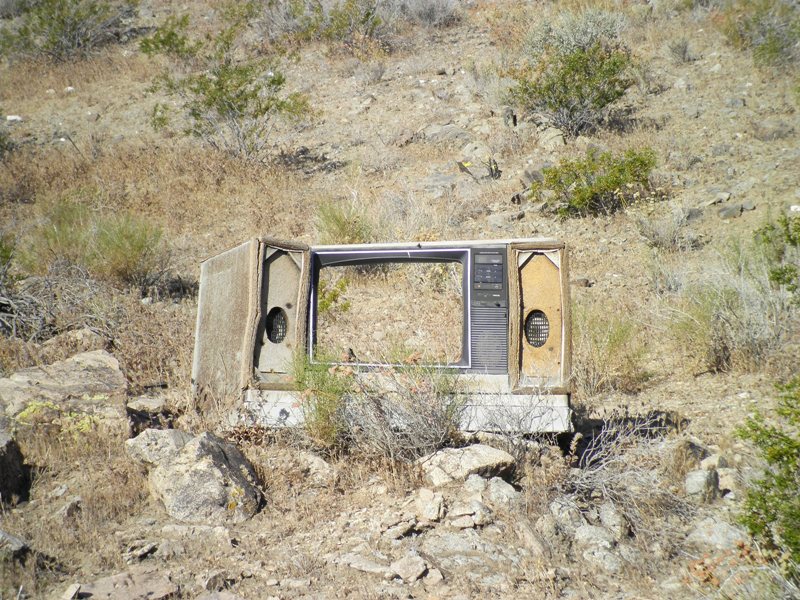
I used all of these bits to set the scene for the first chapter of Rubicon Ranch: A Collaborative Novel, a novel being written online by me and eight other Second Wind authors, especially the discarded furniture. I do believe I have seen enough old furniture in my walks to furnish a living room, but the piece that most captured my imagination was the television sitting out in the middle of nowhere. No road led to the television, just a footpath. Yet there it was. And so it appears in my chapter:

She turned around to get shots of the trail she’d just climbed and saw a glint of metal reflecting the sun. She squinted. What was that? A television? She found herself smiling—her first smile since Alexander died. She scrambled back down the trail. The television had been dumped a long time ago judging by the creosote bushes that had grown up around it, but footprints leading to the box suggested it had been visited recently. She took several shots from the trail, about fifteen yards from the television, then moved closer. The television had no screen, and she could see that something had been stuffed inside. A doll? She crept closer. Ten feet away, she stopped to take another photo, and the truth washed over her. Not a doll. Crammed inside the console was a child, a girl, her eyes half-eaten by some desert predator.

We’ve now posted the first six chapters of Rubicon Ranch, the latest one by Christine Husom, author of the Winnebago Mystery Series.  The most fun of a project such as this is that we do not yet know who killed the little girl (if in fact, she was killed) and we won’t know until all but the final chapter has been written. I hope you will enjoy following our story as we write it.

  • Chapter 1: Melanie Gray — by Pat Bertram
  • Chapter 2: Seth Bryan — by Lazarus Barnhill
  • Chapter 3: Jeff and Kourtney Peterson — by J B Kohl and Eric Beetner
  • Chapter 4: Dylan McKenzie — by Nancy A. Niles
  • Chapter 5: Mary “Moody” Sinclair — by JJ Dare
  • Chapter 6: Cooper Dahling — by Christine Husom
  • Rubicon Ranch Preview

    I am working on my next chapter for Rubicon Ranch, the collaborative novel I am writing online with eight other Second Wind authors. If you haven’t yet checked the story out, you can find what we’ve written so far at: Rubicon Ranch.  JJ Dare’s chapter is especially chilling. My chapter isn’t due for a while, but I need to get a head start, since who knows what writing projects I will be involved with when my turn rolls around again. Here’s a bit of what I wrote today:

    The sheriff poured two cups of coffee from an urn on a rosewood sideboard, set them on the table, and slid into a chair opposite Melanie.

    “What do you want with me?” she asked.

    He gave her an innocent look as if he didn’t know what she meant. “I just want to feed you.”

    “Yeah, feed me to the sharks,” she muttered.

    “You’re very clever, aren’t you?”

    She sat up straight. “What?” The word came out almost as a shriek. She modified her tone, but did not try to conceal her anger. “Are you suggesting that I had something to do with that little girl’s murder?”

    “Why do you assume she was murdered?”

    “You’re saying she wasn’t murdered?”

    “Did you know the girl?”

    “No. I might have seen her, but I didn’t pay much attention to what went on in the neighborhood. Wait! I bet she’s the one Alexander told me about. Right before his accident, he caught a little girl snooping around in our backyard.”

    “I never saw the report.”

    “Report? Oh, police report. He didn’t turn her in. Professional courtesy, he said. He was a bit of a snoop himself. Supplemented our income with photos of celebrities.”

    “Did he ever take photos of your neighbors?”

    Something in his expression—an added alertness—alarmed her. “Are you thinking Alexander might have been killed?”

    “Why do you ask that?”

    She shot him an exasperated look. “Having a conversation with you is like trying to talk to a four-year-old who has an attention disorder.”

    Introducing Rubicon Ranch: A Collaborative Novel

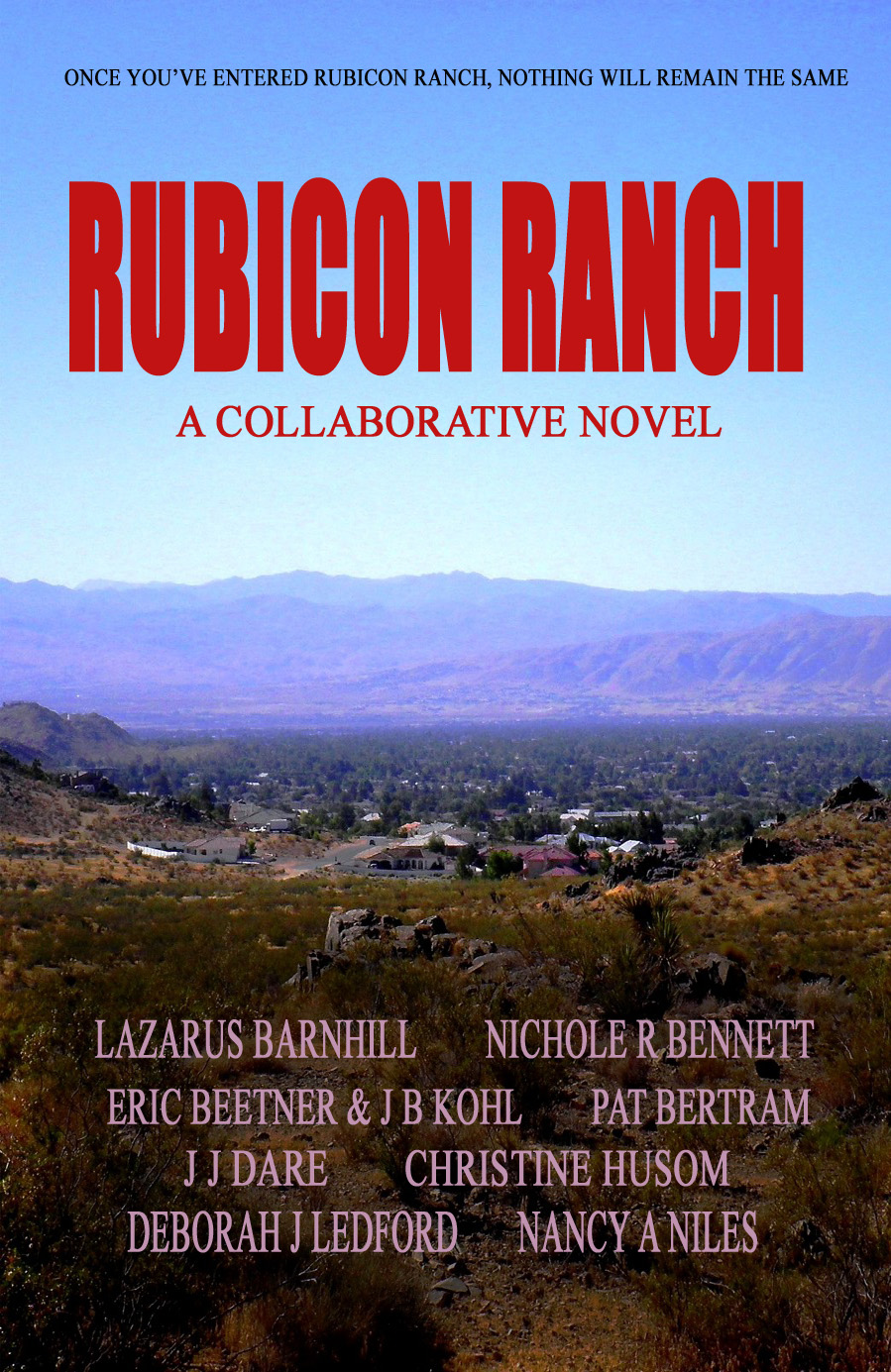
    I am involved in a wonderful project with eight other Second Wind authors. Rubicon Ranch is an ongoing collaborative novel that we are writing online. It is the story of people whose lives have been changed when a little girl’s body was found in the wilderness near the desert community of Rubicon Ranch. Was it an accident? Or . . . murder! But who would want to kill a child? Everyone in this upscale housing development is hiding something. Everyone has an agenda. Everyone’s life will be different after they have encountered the Rubicon. Rubicon Ranch, that is.

    Each of us writers is responsible for the development of our own characters. My character is Melanie Gray. She has traveled the world with her husband, a world-renowned photographer. Together they authored many coffee-table books (she did the writing, he the photographs). One of the books told about mountains of the world, one about rivers, one about oceans, one about forests, and now they have a contract to do deserts. After they rented a house in Rubicon Ranch to begin their in-depth study of the southwestern deserts, he died in a car accident.

    Now, not only does she have to deal with the pain of losing her husband and figuring out what she’s going to do for the rest of her life, she needs to fulfill the publishing contract or she’ll have to reimburse the publishers, which she cannot do because the advance is all but spent. Since she is not a photographer, she roams the desert bordering on Rubicon Ranch, taking hundreds of photos, hoping that a few of them will accidentally end up being as brilliant as her husband’s photos always were. She finds the child’s body and takes photos of the scene after calling 911. At first she is a suspect but once the Sheriff has ruled her out, he requests her help in reading the desert and desert-related clues. Still, the sheriff does not trust her completely, thinking she is hiding something.

    These chapters have already been posted:

    An additional chapter will be posted every Monday. Please join in the adventure — it should be fun! We don’t even know whodunit and won’t know until the end.




