“More Deaths Than One” Contest. Win Free Books!

Win an autographed copy of More Deaths Than One (my very first autograph!) and your choice of two other titles from Second Wind Publshing LLC.

The premise:

A friend of mine found an obituary in the paper that could have been for his mother — the woman had the same name, lived in the same general area, was the same age, had the same number of children, and one of the children had approximately the same name and age as the friend. There was no relationship, merely coincidence but, joking, I said, “What if her son really is you?” That “what if” eventually became More Deaths Than One.

Write at least a paragraph and no more than a page, telling how would you develop a story using this scenario. The three most imaginative entries will be posted on the Second Wind site for readers to vote on. The top entry will win an autographed copy of More Deaths Than One and your choice of two other books from Second Wind Publishing.

Rules:

One paragraph to one page of your own version of the “What if?” from above.
Submitted by Midnight (12:00) EST Monday February the 16th 2009.
Only one submission per person.

Judging:

Pat Bertram and Second Wind management will read over all the entries and decide which three are the best — completely subject to our personal opinions as publishers and writers. The three best will be published on the Second Wind website on or around February 23rd 2009. From then you will have a week to vote on the best of the three entries. The top voted entry will receive the books.

add to del.icio.us : Add to Blinkslist : add to furl : Digg it : add to ma.gnolia : Stumble It! : add to simpy : seed the vine : : : TailRank : post to facebook

Speaking of Writers . . .

Today was my day at the Second Wind Publishing Blog, and I posted an article entitled: “What Do You Call an Unpublished Writer?” If the truth be told, it’s a reworking of a bloggery I wrote over a year ago, but back then only a few people read it, so it’s practically brand new. What is also new (or rather eternally fresh) is that particular question, and it got me to thinking how only in the arts do people categorize themselves by their aspirations not their jobs. How many self-named actors in Hollywood or New York are restaurant workers with a few bit parts on their resumes and a head full of dreams?

It seems that writers, even more than actors, struggle with this identity. When do we become writers? When do we become authors? When can we call ourselves professional writers or novelists? It seems there are many steps on the path to becoming a writer, or at least to being able to call ourselves writers, and we have all sorts of definitions to prove that we are writers and other lesser beings are not. A writer writes — always. A writer has a compulsion to write. A writer . . . well, you get the picture. I have never been able to use such adages to define myself. I don’t write always. I don’t have a compulsion to write — it’s a choice.

I do know one thing, a writer does write some of the time. If a person has a novel in their head but nowhere else, that person might be a storyteller (not a bad title in itself) but not a writer. As for the rest of it, does it matter? Perhaps on the internet, where we are whatever we say we are, it makes a difference, but when we are alone with our words and our stories, we are simply being. Not being writers, but being the creat(e)ures we were meant to be.

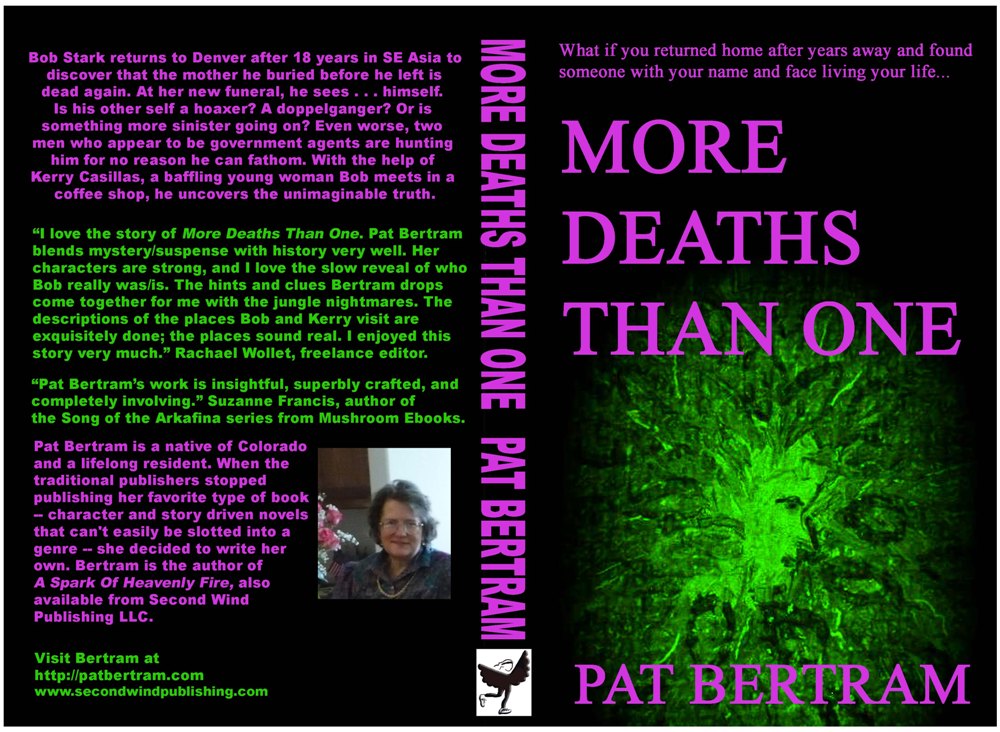
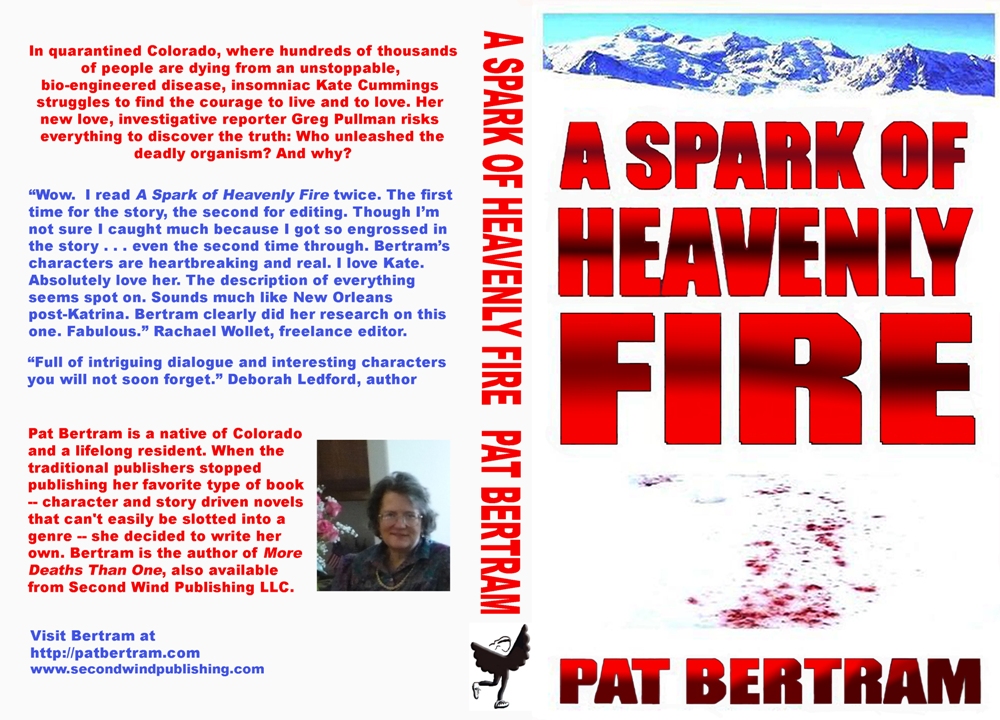
Sneak Preview of My Book Covers.

Front and Back Covers of More Deaths Than One

Front and Back Covers of More Deaths Than One

Front and Back Covers of A Spark of Heavenly Fire

Front and Back Covers of A Spark of Heavenly Fire

What If People Like My Books?

An odd thought struck me this morning: what if people actually like my books? Over the past few years, I’ve racked up hundreds of rejections. I told myself the agents and editors were only rejecting my query letters, because what else could they be rejecting? None of those I sent letters to had ever heard of me, so they could not be rejecting me personally. Nor did most request any part of a manuscript, so they could not be rejecting my novels. But others did request parts of the manuscripts, and found them wanting. Some did not like my characters, my setting, my matter-of-fact style, my inability to sweep them away. Some did not like that the books could not be easily slotted into a genre. The rest simply said the books did not fit with their list. I had a great attitude through all those rejections, and I didn’t think they affected me, but they must have, because I’ve been steeling myself against weak sales and less-than-stellar reviews.

Ever since More Deaths Than One and A Spark of Heavenly Fire were accepted by Second Wind Publishing, I’ve been so focused on figuring out how to sell my books (I even started a new blog, Book Marketing Floozy, to share what I learned and will continue to learn) that it never occurred to me people might read my books. Of course, one-fourth to one-half of all purchased books are never read, so perhaps those who buy won’t read, but what if they do?

Now that my publication date is nearing (actually, it’s not a date, more like a time — end of November), and my novels are about to be made available, I’m getting nervous. Only one person (a free lance editor I met in a writing group) read all four of my manuscripts, and she absolutely loved them. And an author I met through my blog read one of my manuscripts, and she thought it was brilliant. Although many people have read excerpts of my novels, no one else has ever read one all the way through. Soon my novels will be published.

And what if people like them?

You’ve Written “The End.” Now What?

Sherilyn Winrose, author of Safe Harbor, talks about her novel:

It’s been written, you’ve come to the conculsion of your story. Joy, Elation! Congratulations you’ve finished a full length novel. Many dream, many aspire, and you’ve completed the goal: to write “The End.”

When I was writing my first manuscript (ms) I had my best friend (the one person in the world who would tell me if it was crap) beta reading as I went. In as much I did clean up editing along the way. Little did I know how far from the finish line I was; probably a good thing in retrospect.

I bought books on how to query and be published. Very quickly I discovered I was a guppy swimming with sharks. One needs an agent to find a publisher. Agents like to take on authors who have an interested publisher. Huh? I need an agent to get a publisher, and to get an agent I need a publisher?

Confused, I set about sending queries and writing my next book.

What I didn’t know?

I had a first draft, not a finished piece. Reject letters came in and I kept writing.

Fast forward to a contest. I got out my ms and started to read in hopes of polishing it into a winning submission. Gasp! I wrote that? It’s littered with infomation dumps, saidisms, head hopping.. good gracious no wonder all I got were reject letters.

Time for the first real rewrite/edit. Good news? I still love my characters and the stories I’ve written. Bad news? As I learn and grow as a writer I find myself back in the orginal mss looking to clean them up.

The journey from “The End” to Published is a long road.  I made it, and stand as a testiment that hard work and perseverance does indeed pay off.

Sherilyn’s debut novel, Safe Harbor, is available through Second Wind Publishing.

Writing Discussion with Cliff Burns — Part II

When I asked Cliff Burns, author of So Dark the Night, if he’d like to guest host my blog, he responded that he’d rather have a discussion. I was thrilled. I enjoy talking about writing, but even more than that, I love learning how other writers approach the craft. This is the second part of our discussion.

BERTRAM: How do you see the “indie world.” Is there hope for independent authors? By that I mean, is there a chance for independent authors ever to make a living at writing?

BURNS: The technologies are still evolving. Obviously, the two major concerns for indie writers is a) preserving and protecting copyright so someone doesn’t rip off your ideas without credit and/or compensation and b) getting paid for your efforts. 

BURNS: Right now, I have two full-length novels on my site and a good number of short stories — all available for free download and reading. There’s a “Donation” button for those who wish to voluntarily leave a small stipend but admittedly few people have taken me up on the offer. But money has never really been the object to me — it’s more presenting my work without editorial interference. Soon I’ll be moving into the world of podcasting and POD printing and hopefully that will spread the word . . . and earn a bit more money. We’ll see.

BERTRAM: Is the book publishing business as we know it coming to an end? How will that effect the “indie world”?

BURNS: The era of corporate book publishing is coming to an end. Media giants swallowed up various publishers in the 1990’s, hoping to milk them for as much profit as they could. Unfortunately, business models don’t work that well with publishing; book-lovers are notoriously eccentric and eclectic in their tastes and it’s hard to predict or graph or pie chart a bestseller. J.K. Rowling came out of nowhere. Profits are not nearly as high, stable or predictable enough in publishing, which is why I think many of the Big Boys will be dumping their publishing arms in the next 3-5 years. And, as I’ve written, this is the best thing that could happen for readers and writers. Smaller, more intimate and committed publishers will supplant the media giants and better books will be released as a result. Lower advances but maybe larger royalties (though writers will have to stay on their toes and make sure the people keeping the books are honest with actual sales figures) . . .

BERTRAM: Did you happen to see the New York Magazine article about the book business not living happily ever after?

BURNS: The New York Magazine article was brilliant, I printed it to have around. Confirms my view that the corporates are on the verge of dumping publishing from their portfolio . . . and also my opinion that most editors and agents are idiots. Some of the money they throw around for the worst sort of crap infuriates me. And meanwhile, their midlist authors (the most interesting of the lot) get no promo, no notice . . . and so they’re dumped from the roster for under-achieving (a classic case of a self-fulfilling prophecy).

BERTRAM: I wonder if the insistence the major publishers have in slotting all novels into niches was one of the things that’s leading to their downfall. It used to be that most books did not fall into the genre category except for, obviously, the different genres. There used to be the genres, which were just a step up from pulp fiction, and at the other end of the spectrum was literary fiction. I liked the books that fell in between — books with readable styles that could not easily be categorized. What I like to read or write cannot be considered literature, but I do prefer fiction that isn’t quite as trivial as that which is on the market today.

BURNS: I’m with you, I like fiction that crosses all sorts of boundaries and defies easy categorization. But, unfortunately, (back to the corporate model), editors and agents like fiction that can be easily slotted. Someone who writes “in the tradition of . . .”. In other words, derivative stuff. Yet another Dan Brown or Stephen King knock-off. Is it the chicken or the egg? Do we blame readers for being undemanding, reading the same old crap over and over again or do we point the finger at editors and agents for not challenging readers? Or both? The corporate model of publishing does trivialize and does not encourage innovation of any kind.

BERTRAM: I guess what I’m really wondering is if people are still reading. I wonder if there are far more writers than readers, thanks to the self-publishing industry. Two of my novels are being released by Second Wind Publishing, a new independent doesn’t yet distribute to bookstores, but I don’t necessarily see that as a bad thing. With independent bookstores disappearing all over the world, it only matters what is available on-line. People keep pointing out to me that less than fifteen percent of books are sold on-line, but if the vast majority of books that are sold off-line are the grocery-store books by best-selling authors, does it matter?

BURNS: My colleague Alexandra Kitty (she runs an alt.news site) insists that people are reading as much, if not more than ever, they’re just doing so on-line (and free!), rather than shelling out money for books. The free culture of the internet creates a mindset of “why should I pay for something when I can get it for nothing on-line?”. And that pertains to newspapers, music piracy and, increasingly, publishing. I used to be on the local library board and I recall figures that indicated people were checking out more books, our numbers went up year by year. Could the expense of buying books have something to do with that?  Hardcovers are getting close to that fifty buck threshold and even paperbacks are pricey items (especially up here in Canada).

BERTRAM: It seems to me that this is one of the best times to try to peddle a book because of all the online resources, such as blogging and discussion forums. It also seems as if this is one of the worst times because of the hundreds of thousands of writers looking for readers. I’m hoping that someone like me who is willing to do the work to promote can reap the rewards.

CLIFF: Yes, everyone can claim to be a writer these days and the new technologies allow people to publish their crap, regardless of the quality of their work. How do we separate the wheat from the chaff? I chose to publish on-line, I chose the “indie” life because I detest the notion of anyone having control or input re: my writing. Some folks who don’t like me would say I’m doing it my way because I’m not good enough for traditional publishing. I say the quality of the work wins out in the end and I’m willing to let readers decide if my work is worth reading. But the surfeit of bad writing on-line drags down the professional status and quality of craftsmanship of those of us who struggle mightily to compose good work. I implore potential readers to use their critical thinking skills and don’t lump us all together.

Writing Discussion with Cliff Burns — Part I

Writing Discussion with Cliff Burns — Part III

Setting the Scene

Sherilyn Winrose, author of Safe Harbor published by Second Wind Publishing, talks about setting the scene:

I find when I’m writing it is like a movie playing in my head and I tend to get wrapped up in the action, dialog and characters, forgetting to paint the scene. So I find myself going back to add visuals later. Often times more than once. Doing sweeps for clothes, decor and so on.

What are my character’s wearing? Do I have the correct styles, fabrics for the period? Do I know the names of the fabrics, styles I’m using? Sometimes I don’t and have to looking for them or have long chunky sentences.

The Costume Gallery

The Fabric Store

Whether it’s a Regency or a Contemporary setting knowing what you are talking about takes a bit of research. 

What a character wears says as much about her as the way she interacts with other characters. Clothes can give subtle hints to things yet to be revealed, or negate the need to explain she’s modest or eccentric or at the top of fashion.

Where do our character’s live? An Arts and Crafts/Californian bungalow or a  Victorian style house. Do you know the different Victorian architecture styles?  As the author it’s your job to be precise in your settings.

Queen Anne is a specific Victorian type not a generic term for the era.  Queen Ann is my personal favorite.

Dave’s Victorian Houses

Are your characters Frank Lloyd Wright, free from clutter, streamlined? Or are they stuck in the eighties with dripping oil lamps and enormous water bed furniture? Or somewhere in between with Gustov Stickley’s clean lines which lend themselves to a homey feeling consistent with the Arts and Craft movement?

FM4 Furniture Styles

Clem Lambine’s Period Homes

As I see it; there should be nothing in a novel which doesn’t serve the purpose of the story. Whether it’s a chintz tea set, Mission style furniture, the color of the walls, carpet or lack there of.

While they might seem inconsequential, what you dress your story with adds layers to characters and the mood of the story. Can you imagine Dracula living in a 70’s split-level? How about Queen Victoria in a sod house?

Knowing what you are talking about can make the descriptive short and unobtrusive. Unless you are in Queen Elizabeth I court it shouldn’t take paragraphs or a page to set the scene or describe a gown.

When I find that I’ve done just that, a lot of it hits the cutting room floor in edits.

So does window dressing happen as you write your first draft?

Do you write in layers, going back to add color to the script?

Is any of the background conscience thought or does it just happen/dictated by the characters themselves?

Do you use back drops and accents as a means to propel the story, or just as fill?

When a Writer Defaults — Muse on Writing

Karl C. Klein, author of Unnatural Girl soon to be published by Second Wind Publishing, muses about writing:

I cover a lot of ground.
1)defaulting
2)modifiers
3)blonde/blond
4)OK/okay

Reminder: I don’t have the benefit of a formal education. This essay is from my observations. 

The difference between an archetype and a stereotype is vast. The archetype stands as bones upon which we hang flesh — a stereotype is a cardboard cutout we allow our readers to flesh out. I’ve come to call the use of stereotypes defaulting.  

People assume what they assume, shorthanding the world. (I know shorthanding isn’t a word.) We pre-decide many aspects of life. I believe this to be a gift from Darwin, but I’m not going into that aspect. I want to talk about literary fiction.  

When a writer defaults.  

Reading a short story some years ago, I was introduced to many characters. Finally, a new character entered the story. The writer wrote: 

“He was a black man.” 

I wondered about the racial background of all the other characters. I wondered why the writer found it important to mention his race and not the race of the other characters. I wondered: what does he really mean by “He was a black man.” 

The writer used a default. Obviously, all his characters were white, unless otherwise noted. But still, what does he mean by “He was a black man.” I think of the many, many black males I’ve known over the years, their similarities and their differences and realize the statement doesn’t tell me anything worthwhile. After all, Colin Powel and William Drayton (Flavor Flav) are both black men and from where I’m sitting, have little in common. 

“He was a black man” is meant as a default, a stereotype, a cardboard cutout, a straw man merely to take the place where a real character might stand. The reader has the responsibility to hang the flesh on this character based on the reader’s prejudgment of what a black man looks like and how he might act. 

Let’s bring another character into the room: “She was a blonde.” 

OK, now we have a story populated with Will Smith and Brittany Spears. 

Note: Blonde is a person, normally female, with blond-colored hair. This term in many circles is consider derogatory (The color of the hair is not the person. To say, “See that blonde over there” is akin to saying: “See those tits over there?”) To me, in literary fiction, I see ‘Blonde’ as a meaningless term, saying nothing about the character. The term blond refers to a range of colors from sun-faded wicker to light walnut. 

Allow me a copy and paste here, a snippet from a short story, “Remembering the 4th:” 

“Minutes before lunch, I found myself suspended against the lockers outside English class, angry faces like an animated Whitman Sampler pushed shouts at me. The walnut face holding me leached so close, I knew we’d be having pizza for lunch.” 

Let me backtrack a moment and say this: there’s nothing wrong with populating your work with straw men, allowing the reader to flesh them out. It’s been a style growing in popularity, some people arguing we should describe characters and scenes as little as possible, allowing the reader to be more involved in the creation of the story. I have no idea what the style might be called, but I call it ‘reductionism.’  

The rewrite of “Waiting for Godot:” 

The curtain opens, the stage is bare. For sixty minutes the audience stares, waiting for something to happen, imagining what Estragon and Vladimir might do if they were there. Now that’s existentialism.  

OK 

(Note: OK is the preferred spelling over okay, though I prefer okay, I write OK with clenched teeth just like I drop the *@%* comma between two independent clauses connected with a conjunction, though I hate that comma with the passion of 10,000 suns. However, I’ll only give up my comma splices when they peel the pen from my cold, dead hand). 

Anytime we drop something generic on the page, we’re defaulting. When we say ‘his eyes were brown,’ we’re assuming the reader is going to know what we’re talking about when in reality, brown for eyes is a generic color.  

Again, a copy and paste, this time from a book in process I’m editing as she writes, “As Time Goes By:” 

“I thought her eyes should be blue like the midday summer sky, but they were like oiled rawhide with splotches of suede and a baker’s chocolate corona.” 

(there’s that comma I hate with the passion of 10,000 suns) 

Note, too, the ‘midday summer sky’ is a different blue than a winter sky or even a morning sky. 

Another copy and paste from the same work: 

“Uncle Mike’s eyes are dark and rich like winter evergreen in the shadows but with a hint of moist soil. His hair’s black, almost blue with a curl flipping in the front like Superman. I had to look up, standing under him.” 

Let me address modifiers while we’re here. As the writer, we often get in the story and write from our point of view and not the character’s. We want to make a statement like “He was very tall,” which in reality is meaningless to the reader. First off, ‘very’ is not a very good modifier because it doesn’t say much.  

Substitute “damn” every time you’re inclined to write “very”; your editor will delete it and the writing will be just as it should be. —Mark Twain 

“Very” isn’t a very good modifier.

“Very” isn’t a good modifier. 

Both say the same thing. “Very” is great in dialog, particularly with excited tweens, but in narrative, similes and comparisons are better. 

“I had to look up, standing under him.”

is much better than:

“He was very tall.” 

Another example of ‘show’ instead of ‘tell.’ 

Another example from a short story: “Love Letters,” by Kacie Kameron: 

“I had the gift of a perfect love. 

I was fifteen, spellbound by his brown-green eyes, the color of wet cow dung, intoxicated by the moist sea air and hot summer morning.” 

I think when people say a story needs to open with a hook, this is what they’re talking about.  

“wet cow dung” is wonderful. 

Good writing is hard work. Great writing is damn hard work.

Diatribing Show-n-Tell — My opinion on writing

Karl C. Klein, today’s guest blogger and the author of Unnatural Girl, soon to be published by Second Wind Publishing, has consented to show and tell his views on writing:

I’m new to writing. I don’t have the benefit of a formal education. I’ve not been writing since before I born, having grabbed the doctor’s pen soon after sliding into the world, scribing some Hemingway-ese prose on my swaddling blanket.

I’m a newbie, a neophyte, a rookie, a babe, a novitiate, a novice, newcomer, fledgling, tenderfoot and a greenhorn.

I’m wet behind the ears.

I’ve been reading many critiques over the past couple years to the point where my teeth want to turn around in my head and eat my brain. (Normally I say “until my eyes bleed,” but since I’m going to climb all over cliches, I thought I’d use something fresh).

If we feel the need to suggest that someone not ‘tell’ but rather ‘show’ his or her story, he or she is not to have clue what we’re talking about. (Remember, I’m a neophyte, an outsider who doesn’t know the jargon.)

“Critics too often forget they’re supposed to help, not hurt.” Lewis Black, from his book.

“Show not tell” has become a cliche, something else a writer should avoid. On some critiques, I can see the critic with her chin raised, slashing at the air like swatting flies.

I have never in any of my critiques used the expressing in any way: “show not tell,” or in any form.

I think the writer, when told something like this, should ask: “Why?” and get a better answer than: “Agents and Publishers say so.” We can and should ask why if we don’t understand and we should demand an answer.

Here’s my general advice to writers seeking their voice (when we begin writing, that’s what we do in a long, painful process — we seek our voice, which is not to be mistaken with the generic voice ‘agents and publishers’ would like to mold their writers)

This applies to third person, but much to first person, too.

Let me get this out of the way:

Don’t preach — ever. If you want to make some spiritual, religious or social point, write an essay. It’s fine for your characters to have a point of view, but keep it real. (Which is not to say the story shouldn’t make a point — even my parabolic stories look like the message is incidental).

(here’s the show and tell in a way that’s easily understood):

Let your characters tell the story. In third person, I don’t want to hear nothing from the narrator. No opinions and no hyperbole. Nothing will set my teeth on edge quicker than in 3rd person the narrator stating: “She was beautiful!”

I think in the million and a half words I’ve committed to manuscript, I’ve used ten exclamations marks. Again, ‘showing.’

If you unfurl your scene clear and sharp, the characters should show the reader everything the reader needs to know without ‘stage direction’ (telling) or what I call “movie scripting.”

I say it this way: Have faith in your reader.

1) Don’t preach
2) Let the characters tell the story
3) Have faith in the reader
4) Avoid movie scripting
5) Avoid wordiness
6) Don’t default (assuming stereotypes as universal concepts)

Telling:
John walked into the room, approached the table, greeted Sally and sat on the chair. Sally greeted him back and asked if he’d had breakfast. John wasn’t one for breakfast, but knew it was polite to accept something offered. He told her no. She asked if he wanted eggs.

Better:
“Hi, Sally.” John dropped to the chair.
“Good morning. Had breakfast?”
“Nope.”
“Eggs?”
“Love ’em?”
“How do you like them?”
“Hell, I like ’em fine!.”

There’s a best kept secret rule in writing:.

Only one point-OH-view per paragraph. If you keep this rule in mind, you can cut out 96% of your ‘saids, asks, questioned,’ etc. Why do you wish to do that? I’m glad you asked.

If you look at the dialog above, you that see no ‘saids’ are needed. The quotes indicate direct speech and the way I laid this out, it’s obvious who’s saying what. Said’s would merely be wordy and get in the way. When reading, MOST people skip them anyway.

next line:

Sally got up from her chair.

“from her chair” is wordy. We can have faith in the reader to know she was sitting on a chair.

Sally stood.

When I do a critique, if I find the writing heavy with movie scripting, I’ll copy-n-paste a few paragraphs and mark in red what I find wrong, then rewrite the section, explaining each suggestion and why I feel it makes the writing better.

Needless to say, I invest a great deal of time in my critiques.

Good writers work in groups. Great writers work alone.

The Very First Book. The Very First Time.

Claire Collins, author of Fate and Destiny and Images of Betrayal, writes across many genres. She loves reading when she gets the time around her family and her work schedule. Collins, my guest blogger, speaks of how it feels to hold your published book in your hands for the first time:

The very first book…
 
Years of hard work, my heart and soul translated into words on a page, open for the world to see. This is the leap of faith for a writer. A manuscript is a very private thing until I let that first person read it. After the first person, I allowed other eyes to see my words. With encouragement and tons of edits, my private world that I created is sent out into the world. I almost cried when it made its debut on Amazon. I hadn’t even seen a copy of the book yet and I couldn’t control myself. Before I even knew what I was doing, I was clicking the “Complete order” button with overnight shipping. I paid full price plus expedited shipping for a book that I would soon receive multiple copies of thanks to my publisher. My friends laughed at me sympathetically but they all nodded with understanding. Most of them would do the same thing.
 
I was at work when my skinny little box arrived from Amazon. My family could hardly contain themselves as they waited at the front door for me to come in the house. They presented the box to me like it was a priceless family heirloom, meant to be handled with care. I tore the box open and held my book in my hands. A tear slid from the corner of my eye, but I was laughing at the same time. Those were really my words on the pages I flipped through. That was my title, my photo, my blurbs. This was my book. My husband was downright giddy watching me hold my book. It was better than Christmas. He got the camera and took a picture of me holding my book. In the quiet evening after the excitement died down and the children wandered off, I sat looking at my book, flipping through the pages. What if people hated it? Then again, what if people loved it? Since I am a first time author with a small publisher, most people will never even see my book or know it exists. Maybe when I write the fiftieth novel, people will be clamoring to own these first novels. I don’t know what the future holds in terms of book sales. I only know that nothing will ever replace the feeling of opening the box and seeing the very first copy of my book.

Claire Collins’s books are available from Amazon and Second Wind Publishing.