The Necessity For Grief

People keep telling me I’m courageous to write about my grief, and perhaps it does take courage to let people see me at my most vulnerable, especially when I remember that the grieving me will be living forever in cyberspace. Even if I find peace or new meaning or happiness, that vulnerable part will still be accessible to anyone with a connection to the internet. But that is a small price to pay to be able to get my message across.

I never had a message to impart, but after the death of my life mate/soul mate, I found I did have something to say, and it is this: it’s okay to grief. Such a simple message, really, and not just meant for the bereft, but also those connected to the bereft. Too often family and friends urge their bereft loved one to “move on,” “get over it,” “stop thinking about it.” And they need to know that it’s okay for the bereft to grieve. If they can’t handle their loved one’s grief, imagine how much harder it is for the bereft to handle the pain.

We live in a society that values cheerfulness at all costs, and sometimes, when it comes to grief, the cost of putting on a cheery mien to make others feel better is simply too high. Despite what people seem to think, happiness and joy are not the only allowable emotions. Grief is important, too. If the bereft shows no danger signs, such as drinking too much, blocking out family and friends for many months, suicidal impulses such as stockpiling pills, then it’s better to let grief take its course.

Grief is how we learn how to adapt to a world without — without our loved ones’ presence, without their friendship, without their support, without their love —and it is possible to learn how adapt well enough so that we can live, laugh, love again. Grief digs deep into our psyche, allowing us to ask the important questions that get lost in the activity of daily life: who am I, why am I here, and what’s it all about? Even more important, perhaps, grief helps us to grow in courage, strength, wisdom. It would be nice if happiness and easy living gave us such attributes, and sometimes they do, but more often growth comes with adversity.

Although we bereft often wish to be done with our grief, we would resist anyone who tried to take it away from us. It is ours. Its lessons are ours to learn. Its power to reshape us into people who can deal with anything is ours to grasp.

Apparently, as I’ve been writing this bloggerie, I’ve amended my message. Not only is it important to grieve, it is necessary.
A Different Level of Sadness

I reached a different level of sadness today, both better and worse. For twenty-five months now, I’ve grieved the loss of my life mate/soul mate. As much as I hate the word “loss” when it refers to death, it was an unbearable loss to me when he died. All my hopes were lost along with our shared life and too many collateral losses to enumerate here. At times I could barely breathe for the pain. But somehow, I have managed to survive.

I truly never expected to grieve — he’d been sick so long and had suffered so much, that I was relieved when he died. In fact, I wished that he would. I’ve had a hard time these past months remembering that his death was actually a good thing — all I could think was that he should never have suffered in the first place. And he shouldn’t have. No one should have to deal with such pain for so many years. He stayed away from drugs as long as he could, suffering unbearably, because he knew the truth: the same drugs that would relieve his pain would addle his mind and disorient him. He wanted to be himself as long as he could (though he already was drifting from himself — the cancer had invaded his brain, and the poor man could barely hold two thoughts in his head.)

I wrote once about grief and our lizard brain. That feral part of us eventually adapts to the different reality, and the effects of new grief pass — the nausea, dizziness, inability to sleep or the inability to stay awake, the inability to eat or the inability to stop eating, the loss of one’s grip, the loss of balance and equilibrium, the hormonal storms. And finally, even some of the emotional storms pass, and there are times when we can see a bit clearer.

As I’m learning to face my new truth — that I’m going to have to find a new way of life, a new focus and new meaning — I’m recalling how relieved I was that he died. I feel selfish and self-indulgent for wanting him back, for yearning for him, for begging one more word or smile from him. Even the thought that he might have stayed a while longer if he could to satisfy my selfish longings makes me weep for him and for me. He was terrified of lingering as a helpless invalid, and if he hadn’t died, if he had remained here with me, he would have been helpless. I’m glad he didn’t have to deal with that, glad he’s safe from further indignities, glad he’s spared pain and a reliance on drugs. (He was taking so many drugs that he feared becoming a drug addict but, knowing how little time he had left, I could tearfully promise him he would never become a drug addict.)

Can you tell that I’m crying as I write this? As I said, this is a new level of sadness — better because I am learning to be at peace with his death and the need for it, worse because I feel as if I’ve lost him yet again. Every step away from grief seems to bring with it a new and different grief. Not as breathtaking, perhaps, but still sorrowful.

I will continue to yearn for him, of course — that is the nature of grief — but perhaps (at least some of the time) I will remember that he deserves to be at peace, even if it’s the serenity that only death will bring.

Gather ‘Round and You Shall Hear . . . The Story of My Online Life

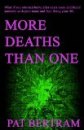
In October 2007, I entered a contest on gather.com — Court TV Search for the Next Great Crime Writer contest. The winner of the contest would win a $5,000 advance and a publishing contract. My entry, More Deaths Than One, was not a detective story, and it certainly is not a cozy mystery, but it is the story of a crime: identity theft. This theft is an actual theft of a man’s identity, not a paper one. So it did fit with the contest, though from reading the first chapter (all that was posted online for the contest), many people assumed it was a supernatural tale — as the blurb says, When Bob Stark returns home after spending eighteen years in Southeast Asia, he discovers that his mother Lydia Loretta Stark is dead again. When he attends her second funeral, he sees his brother, his college girlfriend, and . . . himself.

I did very well in that contest, too. As of November 17, 2007, I was ranked number one, but I finished up about sixth or seventh. (I could tell you it was because my mother died and I had to go to California for her funeral and I broke my ankle while there and was off the internet for a week so I couldn’t solicit votes, but the truth is . . . come to think of it, I don’t know what the truth is.)

The contest started out being great fun but devolved into all sorts of infighting, faked votes, and terrible reviews that were posted for no other reason than meanness. Still, it turned out to be a pivotal point in my online life and my writing career.

I became friends with many of the contestants, and casual acquaintances with others. (As Jeffrey Siger, one of the contestants said, it’s “sort of like the camaraderie born of battle or surviving a natural disaster: never to be taken as an endorsement of the event that engendered such strong ties among the the participants.”)

I met the group The Writin’ Wombats on Gather because of the contest, and ended up hanging around with them for all these years. Because of the contest, I eventually found a publisher. The link to the publisher’s website was posted on a Wombat thread, and since I was in querying mode, I immediately shot off a query letter. He loved my book A Spark of Heavenly Fire, and sent me a contract. Turns out, I already knew him through the contest, and he asked if More Deaths Than One was still available. It was. Second Wind Publishing has now published five of my books — four novels and one non-fiction book, Grief: The Great Yearning.

Until the crime writer contest, my online presence had been confined to my blog (I’d only had a computer and the internet a few months) but after the contest I posted articles on Gather, and I also migrated to other sites, such as Facebook, Goodreads, and Twitter. I mostly hang around Facebook now because of my discussion groups there, but I always return to Gather, especially on Thursday evening when I do a live chat with my No Whine, Just Champagne discussion group. I started out knowing only a few people online, now I know hundreds.

And all because of a contest.

So, what was the pivotal point of your online life?

Grief Update — Two Years and One Month

Grief continues to confound me. It is now two years and one month after the death of my life mate/soul mate. I would have thought I’d have moved beyond grief’s ability to disquiet me, but I still have times where tears rush in to fill the void he left behind.

Some of my grief now is the poking-at-a-sore-tooth-to-see-the-extent-of-the-pain kind rather than the overwhelming agony and angst of the first year. There are still sore spots, most notably the obvious one — that he is dead. I cannot fathom death. My mind just cannot work itself around the conundrum of a once living person being so very gone from this earth. And there is the corollary murmuring deep in my psyche, “and someday you will be gone, too.” But . . . gone where?

When my grief was new, I often wandered in the desert crying out in desperation, “Where are you? Can you hear me?” I don’t call out any more, though I still wonder where he is, if he is, what he is. I envy those who believe without a doubt that their deceased loved ones still exist and that they will see them again because I have no such constant belief, though I do have flickers.

One of the many paradoxes of my grief is that I hope he still exists somewhere, but for myself, I’d be okay with oblivion. Is his death worse for me if he still exists somewhere beyond my ability to connect with him? Or is it worse if he is completely deleted except for a spark of indestructible non-conscious energy? Either way, he is gone out of my life. Either way, I have to deal with the mysteries of death, love, grief, and what the heck am I going to do with the rest of my life?

I met my life mate when I was young and believed in fate and destiny and a mystical connection with the universe. I subscribed to the belief that when the student is ready, the master will appear. And he appeared. He was so radiant, it seemed to me he was a higher being come to earth to help me on my life’s quest. In the few ups and many downs of our shared life, I forgot that feeling. And no wonder — as he got sicker and sicker, his radiance dimmed and all but went out.

During that last year, when he could no longer carry on a two-sided conversation, he would lecture me on what I should do after he was gone. He kept saying, “Listen to me. I won’t always be here to teach you.” I didn’t accept that his dying was imminent, so these lectures aggravated me, as if he thought I was so stupid I couldn’t live on my own. (I’d give anything to hear one of those “lectures” again. How could I not have treasured every word?) But the point is, apparently, deep in his subconscious, he believed what I had once believed, that he came here to be my teacher.

There is not a single question (except the unanswerable ones such where he is and if he is) that has arisen in the past twenty-five months that I didn’t know the answer to. We had discussed everything, sometimes all day, day after day, year after year. He took me as far as he could, imparted his wisdom, and left.

If there is any truth to this scenario, rather than being the rather romantic idea created by a bereft woman grasping hold of life any way she can, then the question of what I am going to do with the rest of my life takes on even greater significance. What is so important about me and my life that this radiant creature would share half his lifetime and all of his long and painful dying with me? I suppose that is what I am left to find out.

Comment Spam

Sometimes the most amusing comments that are posted on the internet are the mangled bits of spam that clog the blogoshere. Here the most current ones that graced this blog:

1.Definitely believe that that you said. Your favourite justification seemed to be on the internet the easiest thing to understand of. I say to you, I definitely get irked while other folks consider worries that they plainly do not know about. You managed to hit the nail upon the highest and defined out the whole thing with no need side effect , people can take a signal. Will probably be again to get more. Thank you!

2. I was studying some of your content on this site and I believe this web site is very informative ! Continue putting up.

3. I merely needed to appreciate you once more. I do not know that the things that I would have done without the actual ways documented by you directly on such area of interest. It truly was the fearsome condition in my circumstances, in spite of this , looking up a skilled form you treated it forced me to weep with delight. I am grateful for this support and in addition have high hopes you have been aware of the great job you are carrying out educating quite a lot of people all through your blog. I identify that you haven’t got to recognize all of us.

4. A person essentially help to make critically articles I would state. This is the first time I frequented your website page and thus far? I surprised with the research you made to create this particular put up extraordinary. Magnificent job!

5. Its such as you learn my mind! You seem to grasp so much approximately this, such as you wrote the e-book in it or something. I think that you just can do with some % to force the message house a bit, but instead of that, this is great blog. An excellent read. I will certainly be back.

This last one actually makes sense, but then it would have to since it’s promoting a site called “genius love” (a site so dangerous, my internet protection wouldn’t let me check it out):

6. The difficulties you meet will resolve themselves as you advance. Proceed, and light will dawn, and shine with increasing clearness on your path.

Being Open to the Possibility of Joy

Helen Howell does one-card Joie de Vivre tarot readings on Facebook, and just out of curiosity I asked her, “Does the card promise me joy?” I have never been a joyful person, have never really thought happiness was that important —other things have always mattered more: contentment, truth, friendship. Still, it seemed the logical question to ask of a Joy of Living card. And this was Helen’s response:

To answer your question of does the card promise you joy?

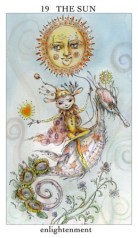
The Joie de Vivre has given me the Sun reversed.

Had this card been up the upright I would have said a definite yes, but the card is telling me there has been some disappointments from the past that still are with you. It says there can be happiness and joy, but for now it’s you that seems to be clouding it for yourself.

I wonder if the disappointment angle comes from maybe not totally getting the acknowledgement or success you hoped for in some part of your life? I think too this card is telling me that there has been a loss of something or someone that has taken the light out of your life a little. Did that loss provide the joy for you?

In this card the figure wears a suit of yellow, that’s the colour of mental activity. It seems to indicate that you have been thinking about things, giving a great deal of mental energy to this, but also note he wears a cloak of soft purple and that shows me that you have an awareness of this.

I like how the seahorse has green leaves around the sun flowers on its tail and also how a plant is growing in the foreground. Green symbolizes for us balance, adaptability, growth and potential. It seems to suggest that there is the potential here to adapt to circumstances better and bring things back into balance that will bring you the joy you hope for.

This is a number 19 card and it breaks down to 1+9 = 10 – this is the number of endings and beginnings all in one. It shows us that something has to be released before a new start can be made.

It appears to me that the Joie de Vivre is telling me that you need to stop blocking the joy from your own life. Be aware of how you think about certain things and this in turn will allow you the potential to adapt better to certain circumstances, which will result in a happier you.

I hope this has helped in some small way. I ask that you give me feedback and if you liked the reading.

I attach a link to the card, but remember this shows the card in an upright position and I drew it in reversed.

Thanks for allowing me to read for you.

Helen @ https://www.facebook.com/profile.php?id=1270902251

And here is my response:

Very interesting, Helen. I lost my life mate two years ago, and I am still struggling with grief. It’s not that the joy has gone out of my life, because I have never been a joyful person, but that the meaning has gone out of my life. I’m trying to find meaning in my life, in his death, in my writing, in the future. And yes, I think about it. And yes I am aware of how much mental energy I am giving to such thoughts.

Actually, I need balance more than joy. His death threw me and the world off balance, and my grief caught me by surprise since I knew he was dying. But I never understood what his goneness from my life would mean, never understood that it would bring me such an awareness of death, that it would shatter me.

This has been a time of great growth for me, and yet this is only the first part of my journey back to life. I’m taking care of my 95-year-old father, and when he is gone, I will have to find a place to live, a reason to live, something to care about. I’ll have to completely start over. I’m trying to see the good in that, but since I haven’t a clue what to do or where to go, mostly I’m just waiting.

I don’t know how to let go of my grief. Supposedly it takes three to five years, so perhaps it’s too soon.

***

What particularly interested me was Helen’s comment that I seem to be clouding my own happiness since other people have suggested the same thing, but to be honest, I don’t know how to dispel the clouds. Perhaps time and a willingness to face whatever life brings will take care of the matter. Or, as Helen points out, maybe I just need to be aware of how I think about certain things.

Throughout this grief journey of mine, the only future I’ve been able to envision is one of continued sadness and loneliness, and I’ve tried to prepare myself for such a life. But just because all I can see are sadness and loneliness, it doesn’t mean that’s all there will be. There could be joy. Maybe that’s all the Joie de Vivre card is telling me — be open to the possibility of joy.

Finding Time to Write

I’ve been trying to get back into writing, but I never seem to able to find the time. There are always so many things that need to be done. Take yesterday, for example. I started out the morning answering emails. I don’t get as many emails as most people, but still, writing responses to the ones that required my attention took me over an hour.

Then I wrote a simple blog post. It was a recap of on online discussion, so it shouldn’t have taken me long, but it did. I’ve heard that people should allocate twenty minutes to updating their blogs, but somehow, my twenty-minute blogs end up taking hours. Writing is how I think, and sometimes it takes a while for the thoughts to coalesce. Sometimes it takes a while to find the right words to express the thoughts. And sometimes it takes a while to edit and copyedit the article to make sure it’s readable and that my point is clear. All those “a while”s added up to three hours yesterday.

When I finally posted the blog, I took time out for a walk and a meal, then I returned to the computer and had an email conversation with a friend who had also suffered the loss of her mate. Since she seems to have reached a place of peace, I wanted to know how she did it. I know I can go on alone since I am doing it, but the thing that still makes me feel as if I’m about to fall off the earth is that he is dead. No matter how well I do, no matter how much peace I attain, he will always be dead. Of course she had no answers for me — one person’s way of learning to live without is not the same as another’s — but she did say something that struck a chord: “the world comes back.” This was an important conversation for me, and I’m glad I had the time to spend, but still, writing my side of the exchange took a couple of hours.

I love comments on my blog, and always enjoy communicating with those who do comment, but that takes time. Yesterday evening, it took me almost an hour to write my responses.

And finally, Facebook. Need I say more? Well, maybe I do. I had several messages that required replies, discussions that needed input, updates that cried out for comments. In all, that added a couple more hours of writing to my writing time.

That’s when I realized why I have no time to write — I spend all my time writing! So, to find time to write, all I need to do is stop writing.

Why is Writing Important?

With such a staggering number of books on the market and more to come, why is writing important? Only a small percentage of writers have ever made a living at writing (and most of those were people who wrote books on how to make a living at writing), and that percentage seems to be shrinking. More than 80% of books sell fewer than 100 copies. Maybe 50% sell only about ten copies or so. So, why write? The wonder of writing fiction is that a story born in one mind grows to full power in another mind. But what if you don’t have readers, or at least not many? And why take the time to learn the craft since some of the books that do sell are poorly written tripe?

If nothing else, this conundrum that writers face today makes us focus on what we get out of the writing process itself.

For me, writing is something that connects the parts of my life, even though I don’t always write. I once quit a job to write a novel, but found I had no intrinsic talent. I was young and didn’t have the wisdom to know that there are two types of talent — the intrinsic kind that’s called talent, and the learned kind that is in itself a kind of talent, the kind that that comes from trial and error. Even if I had known about the second kind, I didn’t have the patience to write the million words it supposedly takes to learn how to write, so when life got in the way, I let it. Other things simply were more important. (Some people believe you have to have a passion for writing, that it has to take precedence over everything else, but writing is not always “life” nor is life always “writing.” If one does not live, one has no reason to write.) Years later when my life had pretty much come to a standstill because of various misfortunes, I took up writing again, but when my life mate died, I lost the desire to write fiction. Perhaps one day the desire will come back along with a different focus and possibly a different talent.

Writing for me is also an emotional outlet and a way of discovering why I feel the way I do. While struggling to deal with the death of my long-time mate, I poured out my heart and my soul and my grief into journal entries, letters to my deceased mate, and blog posts. I don’t know if I could have survived without that outlet. A book compiled of some of the best writings of that time, Grief: The Great Yearning, has now been published, yet when I wrote during this time (except for the blogs, of course), I had no expectation of my words ever being read. I wrote for me.

Reasons for writing are as varied as those who write. For example, in a recent online discussion, horror writer Rob M. Miller said, “I write because I have something to say, and I want it to be heard.” Even if there was a chance he wouldn’t be heard, he would still write because, as he says, “I write to self-explore my mind, to self-medicate, to share my worldview.”

I like those reasons for writing. Too often when I ask writers why they write, they say they only want to entertain, which makes me cringe. If entertaining others is the only reason for writing, then why bother? The “others” can find a lot more entertaining things to do than to slog through someone’s unseasoned prose. But if you’re writing to share your worldview or to explore your mind, then your writing actually has value. Of course we want people to enjoy what we write, but entertainment can’t be the only reason to write, unless it’s for our own entertainment. Writing is a good way of passing the time. It’s better than watching television and it could change someone’s life, perhaps our own.

Writing Worth Reading

In a world where anyone can write a book and get it published regardless of  its merit or readability, authors have come to believe they can write however they wish. And of course, they can. Who is going to stop them? There are no longer any gatekeepers to the world of publishing. But still, writing is about communicating. If a writer cannot communicate what he or she wants to say so that another person can follow the story or article without sorting through typos, unruly punctuation, or poor sentence structure, then the writer has failed.

Whether we are bloggers, content producers for various websites, novelists, these are all tenets we must heed:

1. Use dynamic verbs and concrete nouns, and keep adjectives and adverbs to a minimum. Watch for word qualifiers such as “a little,” “quite,” “somewhat.” They undermine our authority and make our writing seem indecisive.

2. Action first; reaction second. Cause first, effect second. “He finished smoking his cigar, then he aired out the room.” Not: “He aired out the room after he finished smoking his cigar.” When we don’t use the proper sequence, our writing seems unfocused.

3. Use active voice; too much use of passive makes our writing seem muffled.

4. Don’t be clever just for the sake of cleverness, don’t complicate the obvious, and don’t be unconventional for the sake of being exotic; ultimately, our readers will feel used or confused, and we will lose them.

5. Punctuation, spelling, and grammar do count. Content is important, but what good is all our wisdom if we come across as dolts?

6. Strive for clarity, economy, grace, and dignity. We can string words together, but without at least a couple of these particular elements, our writing will not be worth reading.

Untaming Me and Embracing My Inner Savage

I watched The Sleeping Dictionary the other night, or at least as much of it as I have on tape. My life mate/soul mate recorded movies that he liked and often ended them before things got ugly, turning a painful movie into a touching one, so in my version, the story ends when John and Selima profess their love. (I had become so tuned to death and disappointment during his last years that I could not bear stories with unhappy endings or characters who fought instead of appreciating what they had. Watching his movies, I now understand he’d developed that same sensitivity. His version of Braveheart, for example, ends before William Wallace is tortured and killed.)

But I digress.

When the young headhunter first appeared on the scene in The Sleeping Dictionary, I was struck by his savagery. I don’t mean his cruelty — though today “savage” is synonymous with brutality, it originally came from a word that means “woods.” I’m referring to his elemental nature, his primal being, his untameness.

I am a highly civilized person. For the most part, I am considerate of others. I am never intentionally rude or bad mannered or insulting. I am not uncouth. I don’t make scenes in public (or private, for that matter). I seldom raise my voice. I listen more than I talk. I dress modestly. I use correct English and am not given to crudeties or foul language. If it’s in my power and nature, I almost always do what others ask. I try to be helpful. In other words, I am tame.

As I watched the movie, I wondered if the time had come to untame me, to embrace my inner primitive. I don’t know what or how to do that, but it’s something worth thinking about. I know your first thought — tattoos. Nope. Today tattoos are not a matter of primalness but of fad, and fad is the epitome of civilization.

It would be interesting to have totems, rituals, amulets that meant something to me and my life, that would help me connect to life or at least remind me of that connection. To find or develop such primal symbols, however, I would first need to know who I am, to know what meaning life has for me, but the death of my life mate/soul mate so devastated me that I no longer know who I am or how I connect to anything.

Now, as I write this, I realize that I don’t need to start a search for my inner primitive. I am already on that quest.

I walk in the desert (as primeval a place as there is around here) and pay attention to how my body and mind join to the earth. I feel how my feet connect with the ground (well, how my shoes connect. I am not so savage as to be willing to walk in rattlesnake country unshod). I feel the air coursing through my lungs, and the breezes touching my skin. I feel the heat of the sun and the coolness of my evaporating perspiration. I open my mind and feel new ideas flowing in and old ideas flowing out.

Maybe someday I will untame me — find out who I am at rock bottom and live according to my truth. And maybe I am living that way now.