One Thousand and One Days of Grief

clockAlthough yesterday’s post 1000 Days of Grief — and this one — might make it seem as if I am still counting the days of grief, I actually stopped counting after the first year. Once when I could not imagine ever being able to get through another hour, I counted to the 1000th day and marked it on the calendar. It seemed like a significant number — a guidepost — and I thought I should know the date. It is astonishing to me that I have managed to survive so many days since the death of my life mate/soul mate, but in truth, I am doing more than simply surviving. I am living.

Of the articles I have recently written, posts about celebrating various aspects of life outnumber my posts about grief, which puzzles me since I am not feeling at all festive. When you lose the person who connects you to the world, you have to find new ways of reconnecting to life, and apparently those celebratory posts are indicative of the changes in me, of how on a visceral level, my focus is turning away from death to life.

For so long, I didn’t feel right about embracing life when he was dead. I knew he wouldn’t want me to be sad, but frankly, he had no say in the matter, and for the most part, neither did I. Grief is a force, like a whirlwind, and all I could do was endure as best as I could until it lost its power. Even when the power of grief began waning, I still didn’t feel right about embracing life. It’s not so much that I had survivor’s guilt (especially since I wasn’t sure I still wanted to be here), but that it didn’t seem fair. If life is a gift, why was it taken from him?

Maybe he got the worst end of the deal by having to die so young. Maybe I got the worst end of the deal by having to live. This conundrum of who got the worst of the deal tormented me for a long time, but now I see that it doesn’t matter. It can’t matter. He died. I didn’t. That’s the way things are.

I’m starting to see myself as just me now, not as a shattered, left-behind half of a couple; starting to feel that whatever our life together meant, whatever our connection, this is my life. Not his. Not ours. Mine.

On a larger scale, perhaps, there is no such thing as “my life” and “his life” and “your life.” Maybe we are all somehow connected, like books on a library shelf, our stories interlocking and making a whole. But I cannot think of that larger scale right now. I need to be me, or rather, to find a new way of being, and oddly, this seems to be a typical leg in grief’s journey. I am taking a yoga class (therapy yoga, a gentler form of yoga that allows for one’s imitations) as part of my effort to open myself to new possibilities, and I recently discovered that, coincidentally, all the women in the class have lost their husbands. Our losses vary from one to ten years, but we are all striving for a new way of being, a new focus. We are also all trying to learn how to take care of ourselves in our old age since we won’t be growing old with anyone.

Whether I count the days or not, time is still passing, and at an increasingly rapid rate. On September 16, 2015, it will be 2000 days since his death. (No, I didn’t count those days, I used a decimal birthday counter.) What will I be like in another 1000 days? What will my life be like? If the changes come as rapidly as in the previous 1000 days, I doubt I will recognize me. Whatever happens, though, the number of days since I was born into this new life that his death forced on me, has little significance except as another guidepost. Each day stands alone. Each day finds its own meaning. Each day is mine to survive, or to celebrate, as best as I can.

***

Pat Bertram is the author of the suspense novels Light Bringer, More Deaths Than One, A Spark of Heavenly Fire, and Daughter Am I. Bertram is also the author of Grief: The Great Yearning, “an exquisite book, wrenching to read, and at the same time full of profound truths.” Connect with Pat on Google+

1000 Days of Grief

S1000 days have passed since the death of my life mate/soul mate.

1000 days. An incomprehensible number. At the beginning, I could not imagine living one more hour let alone one more day in such pain. And yet now 1000 of those days have passed and I don’t know where they went or how I survived them.

Even more incomprehensible, while I remember being in absolute agony those early months, beset by panic attacks, gut spasms, loss of breath, inability to grip things and hundreds of other physical and emotional affects, there is an element of blank to the memories, as if it were someone else in such distress. I remember screaming to the winds, though I can’t exactly recall what it felt like to be so stressed that only screaming could relieve the pain. I remember feeling as if I would die if I did not hear his voice, see his smile, feel his arms around me one more time. I remember the horrible feeling of goneness I was left with, as if half my soul had been wrenched from my body leaving an immeasurable void, but now I am bewildered by it all. Was that really me — staid, stoic me — lost in such an emotional maelstrom?

Most incomprehensible of all, as recently as a month or two ago, I was still subject to occasional flashes of raw agony, but even those seem far removed now. I still have times of tears, and probably always will have. How could I not? Someone whose very breath meant more to me than my own is gone — gone where, I do not know. But I no longer feel as if half of me has been amputated. I am just me now, not a shattered, left-behind half of a couple. Or maybe I have simply become used to this new state, as if this is the way my life has always been.

I still hate that he’s dead, but I’m also aware that his death has set me free. I spent many years watching him waste away, numbing myself to his pain, waking every morning to the possibility that he hadn’t lasted the night, dreading the end, worrying if I were up to the task of fulfilling his final wishes. All that is gone now, though the feelings of dread and worry and doubt inexplicably lasted way into this third year of grief. I used to think that grief was his final gift to me — despite the angst and agony, I embraced grief like a friend. I knew instinctively it would take me where I needed to go.

But now I know freedom was his final gift, though it was as unwanted and as unasked for as the grief. I haven’t learned yet what to do with this freedom. Perhaps if I embrace it as I did my grief, it will also take me where I need to go.

I’m still so very sad, though I am more at peace than I have been for a long time. In fact, the same photo of him that was too painful for me even to peek at for more than eighteen months after his death, now sometimes makes me smile. It might take me the rest of my life to puzzle out the meaning of our shared life, our incredibly bond, his death — if in fact there is a meaning — but what I’m left with right now is the knowledge that for whatever reason, he shared his life with me. He shared his dying. And then he set me free.

***

Pat Bertram is the author of the suspense novels Light Bringer, More Deaths Than One, A Spark of Heavenly Fire, and Daughter Am I. Bertram is also the author of Grief: The Great Yearning, “an exquisite book, wrenching to read, and at the same time full of profound truths.” Connect with Pat on Google+

Going with the Flow of the Story

SWhen I write fiction, whether a short story or a novel, I always need to know who the main characters are, what they want, who is trying to keep them from getting what they want, and if they are successful in their quest. In fact, the ending is so important to me, that I often write the ending somewhere in the middle of the project. By then, the characters have been developed, most of the story has been laid out, and I can see how the pieces fit and know exactly where I am going. (I just thought of something — my unfinished novel has been paused for several years now. Only part of that is a loss of focus due to the changes in my circumstance. The rest comes from a lack of inclination to continue. It is the first novel I worked on that I did not write the ending in middle. I wonder doing so would get me back on track?)

The one project I am involved with that turns this need to know the ending on its head, is the Rubicon Ranch serial I am writing with other Second Wind authors. In the first book, we postulated a murder, then each of us created a character who might have reason to want to kill the little girl. That is all we had of the story when we began to write it. We knew, of course, that the killer would be found, but we didn’t know who did it, why it was done, or how the story would be resolved. We simply took turns writing our chapters in round robin fashion, and hoped readers would forgive us if all those different POVs made the story seem disjointed at times. (Normally, when you write a novel, you get to go back and fix any problems during rewrites, but when you write a novel online, you are stuck with what you wrote.)

My character Melanie Gray is a grieving woman. We started the project just a few months after the death of my life mate/soul mate, and I couldn’t conceive of any other sort of character — at the time, grief was all I knew. To make her a widow, I had to get rid of her husband, so I killed him in an accident before the story began. That was the sole point of the accident, yet in a later chapter, the sheriff seemed to insinuate that there could be a connection between Melanie’s husband and the little girl — perhaps they had both seen something and been killed to protect it.

Well, it turned out that the two deaths were unrelated, but later the sheriff (as written by Lazarus Barnhill) told Melanie he concluded that the accident had been deliberate.

Now, during the second book, even more information about Alexander is being revealed — he had, in fact, been murdered, and the car tampered with in such a way that it had to have been done by a skilled professional.

I find that development interesting since when I created the character of the dead husband, he had a single role — to make Melanie a widow — but because of the flow of the story, the husband is developing into a character in his own right, and a nefarious one at that.

Melanie, too, is developing in response to the needs of the story, or at least to the needs of her backstory. She and her husband were the authors of a successful series of coffee table books. They’d traveled the world, he taking photos, she writing the text, so obviously she isn’t the weakling her grief makes her seem. One of the ironies of her life is that while living in places where human rights weren’t respected, she never had a problem, yet now, in the safest place she’d lived in her adult life, she is steeped in death and in trouble with the authorities. (If you’ve read any of my books, you will know that I like ironies.)

It’s a refreshing change of pace being involved in the Rubicon Ranch project. All I need to do is write my chapter when it is my turn; make sure it is consistent with what I know of the character, her background, and what has already been written; and not worry about what is coming next — just go with the flow.

***

Pat Bertram is the author of the suspense novels Light Bringer, More Deaths Than One, A Spark of Heavenly Fire, and Daughter Am I. Bertram is also the author of Grief: The Great Yearning, “an exquisite book, wrenching to read, and at the same time full of profound truths.” Connect with Pat on Google+

On-Page SEO and Keyword Usage

On-Page SEO and Keyword UsageI give my blog spam folder a quick look now and again to make sure that non-spam comments don’t get relegated to spam limbo. Sometimes the spam comments are totally absurd, such as this one: Nice tips. It is actually incomprehensible opinion now, but also from general, that usefulness in addition to significance is usually overwhelming. Thanks once again and all the best.

And then there was this one:

Hello Web Admin, I noticed that your On-Page SEO is is missing a few factors, for one you do not use all three H tags in your post, also I notice that you are not using bold or italics properly in your SEO optimization. On-Page SEO means more now than ever since the new Google update: Panda. No longer are backlinks and simply pinging or sending out a RSS feed the key to getting Google PageRank or Alexa Rankings. You now NEED On-Page SEO.

So what is good On-Page SEO? First your keyword must appear in the title. Then it must appear in the URL. You have to optimize your keyword and make sure that it has a nice keyword density of 3-5% in your article with relevant LSI (Latent Semantic Indexing). Then you should spread all H1, H2, H3 tags in your article. Your Keyword should appear in your first paragraph and in the last sentence of the page. You should have relevant usage of Bold and italics of your keyword. There should be one internal link to a page on your blog and you should have one image with an alt tag that has your keyword….

Considering that this was posted by someone trying to get me to subscribe to their Search Engine Optimization company, and considering that the comment actually made sense (or would, once I translated the jargon) and considering that my website domain provider has been trying to get me to buy SEO Visibility to the tune of $36.00 a month, I decided to research the topic a bit.

I started with “keyword.” Obviously, it’s the key word in the post or web page, but more than that, it’s a word or phrase people use when searching the internet. There’s no doubt that using the exact search terms adds to one’s search engine visibility. I often check the terms people use to find this blog, and then use those search terms as topics for articles. I made sure to use the search term in the article and in the title, since it stood to reason that if people were looking for such topics, I should make it as easy for them to find as possible. (A few of those articles are among my all-time most viewed posts: Describing a Scene in an Interesting Way, Describing a Winter Scene, and What Do You Say to Someone Who is Grieving at Christmas?) Apparently, although I didn’t know it, this was good On-Page SEO.

Luckily, I never had to worry about the keyword being in the URL — if the keyword is in the title of the article, WordPress automatically adds it to the URL of article. I used to try to write cute titles, such as Writing to the Extremes for a post about hands and feet (the extremeties), but not surprisingly, that post didn’t get many hits. So I try to keep the cuteness to minimum. (The key word here is “try.” Sometimes I let my attempts at cleverness get the better of me.)

Also, the title of the post uses H1 — Heading 1, so that fulfills one of the requirements for H1, H2, H3 tags. Since I try to follow good essay styling when writing, I generally include the keyword (the topic) in the first paragraph and then bring things full circle by referencing it in the last paragraph. I’m not going to worry about H2, H3, bold or italics in the body of my posts — I don’t want to lose the stream-of-consciousness flow that so many of my posts have by kowtowing to SEO.

I have recently begun to use an internal link in all my blog posts as a hedge against content scraping and plagiarism. And now it turns out to be good on-page SEO usage. I also use an image for each post, as suggested by WordPress in their articles about how to get Freshly Pressed, so now all I have to do is add the keyword to the alt tag. (When you upload an image, there is a place for Alt Text. I never knew what it meant, but apparently, if for any reason the image can’t be displayed, the alt text will be shown.)

Which brings us to the final point — Latent Semantic Indexing. Search engines have the capability to scan articles to see what they are about. A page with both the keyword and semantically related terms has a higher search enging ranking than one using only the keywords. (In this article SEO, search enging ranking, search engine visibility, and Search Engine Optimization are semantically related terms.)

Whew! All that research because of a spam comment! I learned something tonight, and I hope you did too. (Hmm. I might have learned something, but I didn’t follow through — there was nothing about SEO in the first paragraph, and until this sentence, nothing about SEO in the last paragraph. So perhaps this article is really about spam!)

***

Pat Bertram is the author of the suspense novels Light Bringer, More Deaths Than One, A Spark of Heavenly Fire, and Daughter Am I. Bertram is also the author of Grief: The Great Yearning, “an exquisite book, wrenching to read, and at the same time full of profound truths.” Connect with Pat on Google+

Is Talent More Important Than Passion and Persistence?

In my Suspense/Thriller Writers’ group on Facebook, one author mentioned that she was skeptical of her ability to come up with an interesting idea. Horror writer Rob M. Miller gave a wonderful response that I’m reposting here. Considering the ephemeral nature of Facebook, in a couple of days his comment would have disappeared into the great maw of FB, and I didn’t want it to be lost forever. As to why Rob leaves such helpful and detailed comments, Rob told me, “I’ve been very blessed.  Have had several incredibly talented writers, authors, and editors … well, just give, and give so freely.  Facebook, and blogs like yours, offer opportunities to pay-it-forward.” So, here’s Rob’s take on talent:

Let’s shoot the elephant first: Maybe you have no talent.

Ouch.

But, hey, maybe…?

Talent, though, is over-rated. Heart trumps talent. As does persistence. Talent, or natural ability, only carries a person so far, and then it comes down to heart, passion, time, and yeah, work. Workworkwork. This holds true with just about anything. Certainly with the arts, but also with athletics. Is Michael Jordan a gifted athlete? Absolutely. But such an assertion also masks, or can easily gloss over all of Michael’s hard work.

Personally, I do believe that writers are born with some kind of special something, some X-factor, some proclivity for story, character, situation. It’s indefinable. Writers often don’t necessarily have genius intelligence quotients (I.Q.), but often do have very high emotional quotients (E.Q.).

One might theorize that writers are most often inherently empathetic, or for our sci-fi lovers, are empaths.

Maybe that’s it. At it’s core, maybe it’s about the ability to feel the pain of others.

Author and writing instructor Maralys Wills has put out that in her many decades of experience, she’s found quality writers to have two domineering traits: a) that the writer has been through trauma; and b) they tend to be optimists.

I tend to side with Mrs. Wills on this. (God help the writer who’s a pessimist.)

With that out of the way, let’s presume (’cause it’s better to be an optimist) that you have been born with that magical W chromosome that producers writers, then it can be a confidence issue.

This is common.

Jack Ketchum (or Dallas Meyer), one of Stephen King’s favorite authors — and one of mine — has mentioned more than once of having a writing friend, a gentleman with more “talent” than Jack, but who keeps his writing to himself, afraid to have it seen, afraid of rejection.

And, of course, even amongst the greats, or the commercially successful, one might be surprised to find that even these icons are still (and always have been) quite human. Stephen King has talked about finishing one’s various projects, that even when a writer thinks they’re producing crap, they can be wrong. The cliche is true: We are our own worst critics.

With writing books, classes, critique groups, online writing groups (like this one), etc., there’s often an arrogance involved. Even a necessary degree of arrogance — after all, if a writer didn’t have passion, and passionate opinions, what would they have to say or write about? End of the day, though, despite there actually being sound writing principles worthy of a craftsman taking the time to learn, writing well is often more about what not to do than what to do.

Proof?

Look at the number of times writing rules are broken, and with great impact, such as with Cormac McCarthy work “The Road,” where established guides of good and proper grammar were tossed for the sake of story and delivery.

Sometimes a writer, even those blessed with talent, needs to simply put in the time. Often, this is easy, what with the necessary and very true maxim of: write write write, read read read, write write write.

Sure. But write what? Read what? Practice with what?

As a general rule, I say have your car book, your bedroom book, and yes, a bathroom book … works that are always being read. Always be reading something within your favorite genre of fiction, but always reading a non-fiction work, too, as well as a work on the craft of writing, and another tossed in that’s outside of your favorite genre … perhaps even a work that’s in a field you might not normally consider. For me, that’s chick lit. Though it was akin to pulling teeth, I determined to read Billie Letts’s work “Where the Heart is,” and “The Divine Secrets of the Ya-Ya Sisterhood” by Rebecca Wells. With Letts, I remember being alone in my apartment, taking a bath, reading the final pages, and bawling my eyes out, thankful that no one was around to see me break down. (So much for ever denigrating chick lit again.) And, of course, the novel by Wells is simply brilliant, and brilliantly written.

What else might a writer do?

The could — and probably should — write a bestseller.

In 2001, I attended the annual World Horror Convention in Seattle, Washington, where I met the iconic Michael Slade (pseudonym for Jay Clarke). This brilliant author, during one panel, suggested that developing writers could do far worse than sitting down and transcribing, word for word, one of their favorite bestselling works of fiction, the entire book, front to back.

Sound tedious? It is. And, at times, can be boring. But it helps. A lot. In my case, I spent a bit more than a week transcribing Stephen King’s novel “The Dark Half.” The rewards were many.

Doing such an exercise helps to force a writer to reverse engineer the structure of a book, of a part (i.e., Part I, II, III, etc.), of a chapter, of a scene, and yes, even with paragraphs and sentences. Grammar and punctuation is absorbed as well. So’s how to build suspense … how to characterize. Hell, a lot of things.

I’m thankful I took Mr. Slade at his word; I know many did not — and still don’t. It’s not hard to imagine, is it, that such an exercise would be off-putting? After all, it seems like work.

But that’s the answer for the writer, or a significant chunk of it: putting in the work. Optimism and work. Passion and work.

We should read garbage once in a while to bolster our self-confidence and the greats to remain humble. We should be happy where we’re at, but never satisfied.

And we should work.

We can do that.

Was I born with that amount of talent? With that? Have I been mightily blessed, or merely cursed with a love and desire to write, but without that special something?

Such questions don’t really help. They can, however, hobble an artist, which is never a good thing.

Better to persevere, remembering that those things which are too easily given are often too lightly valued. Better, perhaps, to, through blood, sweat, and tears, develop ourselves.

In the meantime, for something practical, if your own work appears to be missing some needed bit of pixie dust (and maybe it’s not), you might consider Michael Slade’s advice.

And do consider mine: there’s always better and worse writers out there besides ourselves. We are what we are, and we are stuck with ourselves. We have a tendency to flip back and forth between being very thin-skinned (’cause we’re emotionally connected), and covered in rhino-hide (a covering we also need), but let’s never get too wrapped up in comparing ourselves with others, or our work with the work of others. It’s a fruitless waste of time.

All we can really do is write the best we can, practice and learn, and do it all over again.

What fun, what pain, what adventure.

***

With a love for reading and writing that started in his youth, Rob has traveled far to get to the place where he can now concentrate on breaking into the horror market.

Born and raised in the “micro-hood” of Portland, Oregon, he grew up as the oldest of three children, the son of a book-lover and a book-hater.

It was after two years of free-lance stringer work, and a number of publishing credits, that he tired of non-fiction and decided to use his love of the dark, personal terrors, and talent with words to do something more beneficial for his fellow man -– SCARE THE HELL OUT OF HIM.

Desensitizing People to Violence

Clint Eastwood posted a status update on his FB profile today. No, I’m not a “friend” or a fan, don’t “like” him or “subscribe” to him, but his comment is making the rounds of FB, and it ended up on in my news feed. Several times. I found the comment interesting because of my research for More Deaths Than One, a book about mind control, and what I learned about how the military desensitized recruits to killing.

Eastwood wrote: With a lot of thought on this in light of all the shootings in the past few weeks I am very concerned that the left is now going to hit hard on pushing the 2nd Amendment over the cliff.

This is the only amendment that the ‘O’ can attack with any chance of repealing. If this, and God help us if he does, will lead to a barrage of attacks on all the amendments and socialism will be a forgone conclusion.

If anything should be shut down it should be the violent video games. Really, and I know everyone likes their electronics but these are the things that are taking kids and young people out of interacting with society and their peers.

I know I will probably take a lot of flack for that last observation but I’ve taken the flack before.

Have a great Sunday and hug your family.

I’ve written about this before, most recently in If Everyone Wants Peace, Why are there Wars? As I said, many of today’s — and yesterday’s — video games were developed by the military because studies had shown that repeated images of violence and death inured people to killing. During World War Two, as many as 85% of soldiers fired over enemies’ heads or did not fire at all. After World War Two, there was a concerted effort by the military to overcome this natural reluctance to kill, and apparently they succeeded because during close combat in Vietnam, only about 5% of soldiers failed to aim to kill. These same desensitizing “games” were later released as toys for children. Is it any wonder that many people — teens and adults — now seem desensitized to violence? They are playing games that were purposely created to foster killing.

I am not a fan of guns, though I have attended a couple of shooting clinics sponsored by a local gun club. As an author, I thought it important to know how it felt to shoot a weapon at a target. The targets we used were the round kind rather than a silhouette of a human. (Not so incidentally, those human-like targets were also created by the military to get soldiers used to firing at people.) I enjoyed learning how to shoot, but handling the pistols, revolvers, shotguns and rifles did not create in me any desire to shoot at another human being. Guns by themselves do not encourage violence or a desire to kill. Certain video games do. Sociopathic tendencies do. Psychotic characteristics do. Military think tanks do.

Author Lee Child says that we don’t write what we know, we write what we fear, and that certainly is true in my case. I fear the machinations of the powerful, deadly, and calculating men and women who control our lives behind the scenes. And I fear politicians and celebrities who use tragedies to further their own ends.

***

Pat Bertram is the author of the suspense novels Light Bringer, More Deaths Than One, A Spark of Heavenly Fire, and Daughter Am I. Bertram is also the author of Grief: The Great Yearning, “an exquisite book, wrenching to read, and at the same time full of profound truths.” Connect with Pat on Google+

Story Excerpt From “Second Helpings” ~ The Gift by Pat Bertram

Second Helpings
An Anthology of Holiday Recipes and Short Stories
From Authors of  Second Wind Publishing

Second Helpings

A perfect gift for short story lovers and food connoisseurs!

From sweet childhood remembrances to fanciful solutions of family dramas to romantic relationships that begin–or end–during the holidays, Second Helpings is an anthology of stories and memories, but most especially of recipes. Our end-of-year celebrations are occasions that bring reunions with unforgettable feasts and that one special, treasured dish. At the end of each story, vignette, reminiscence, you’ll find a recipe or collection of recipes that will make your next holiday memorable as well.

EXCERPT FROM:

The Gift
By
Pat Bertram

Monica Dryden hummed along with the Christmas carols on the radio as she pulled the chocolate chip cookies out of the oven. They were David’s favorite, and she’d baked them for him every Christmas Eve for as long as they’d been together—five years now—continuing a tradition his mother started when he was a boy.

Still humming, Monica transferred the baked goods from the cookie sheet to a plate she’d purchased for the occasion—white china with a cheerful holly border. Her family had been too poor and too indolent to do much for Christmas, so making the holidays special for David brought her extra joy.

David Hollister. Even his name seemed to promise holiday cheer.

She put the plate of cookies and a glass of milk on a tray, added a sprig of holly from the bowl in the center of the table, and bore her offerings to the living room where David watched television.

He didn’t take his eyes from the screen when she nestled against him, but he didn’t pull away either, as he sometimes did. She smiled to herself, thinking how pleased he would be with the burgundy sweater and pinstriped shirt she’d bought him.

“Do you have to do that?” David asked.

“Do what?”

“You’re humming.”

She clapped a hand to her mouth. “I’m sorry. I didn’t realize—”

“Are those chocolate chip cookies?”

“Of course.”

He clicked off the television and turned to face her. “We have to talk.” He spoke the words softly, almost kindly, but still they chilled her.

“Talk about what?” she asked warily.

“It’s not working out.”

“What’s not working out?”

“Us. We’re not right for each other. You’re too . . . predictable.”

She stared at him as if he’d spoken in an alien tongue. “Predictable? Me? You’re the one who insists on my doing the same things the same way. Remember those throw pillows I bought? You said—”

“That’s the old me. The new me wants . . . change.”

Her head snapped back as if she’d been hit. David wanted change? Since when? She opened her mouth and said the only thing that came to her stupefied mind. “Do you want me to make you a different kind of cookie?”

“This isn’t about cookies. It’s about . . .” He looked at her, expecting her to supply the words as she often did. She usually knew what he was thinking and could easily fill in his missing words, but now she couldn’t even hazard a guess.

David’s eyes shifted from side to side as if he were searching frantically for a way out of the conversation. Finally his gaze settled on his hands. “I want a divorce.”

Monica froze, then, getting control of herself, she pulled her shoulders back and lifted her chin. “You can’t have a divorce.”

He jumped to his feet and all but screamed, “I knew you’d be difficult about this. Why can’t I have a divorce?”

“We’re not married,” Monica said evenly.

He gaped at her for a moment, then a grin that broke her heart spread across his face. “That’s right. I forgot.”

Monica slumped forward, elbows on knees, head in her hands. He forgot? How was that possible? Just last week they’d talked about getting married. No . . . wait. She’d talked about getting married. He’d nodded with a faraway look in his eyes that made her think he’d been seeing their future together but apparently only meant he hadn’t been listening.

David’s voice seemed to come from a long way off. “I’ll guess I’ll be leaving.”

Monica jerked upright. “You’re leaving? But this is your apartment.” And then, all in an instant, she understood. “Who is she?”

***

Second Helpings is available in print and all ebook formats from Second Wind Publishing.

***

Pat Bertram is the author of the suspense novels Light Bringer, More Deaths Than One, A Spark of Heavenly Fire, and Daughter Am I. Bertram is also the author of Grief: The Great Yearning, “an exquisite book, wrenching to read, and at the same time full of profound truths.” Connect with Pat on Google+

After Grief: Crashing the Party of Life

witchOnce a long time ago, I crashed a Halloween party. It sounds as if I am very bold, doesn’t it? But truly, it was out of character for me, and besides, I was in costume. I remember that the party was given by a friend of a friend, but I have no idea how or why I decided to go — perhaps as a joke to see how long it would take for people to realize they didn’t know me.

I dressed as a comic-book witch — the whole bit: long black scraggly hair, puttied nose and chin almost meeting, heavy black brows, green-tinged skin, cackling voice. I walked into the party as if I belonged there, and for a while I was the belle of the ball as people tried to guess who I was. It finally occurred to one guy that I was a total stranger. So I left. Rather hurriedly.

That’s how I feel now as I am reawakening to the world after the numbness that gripped me during the long dying of my life mate/soul mate and the grief I experienced after his death — as if I have crashed a party, and I don’t know myself or any of the guests. Everyone seems costumed in happiness and success, though I know those facades are as misleading as mine. Our smiles and even our laughter hide old sorrows and new insecurities.

I couldn’t follow my mate to wherever he went, so I this is what is left to me — trying to find my way alone, wondering why I am at the party. I don’t belong, but where else would I be?

I remember the quiet excitement I felt at that Halloween party, the adrenaline rush of stepping out of my normal life, and occasionally I feel that now, as if the world is opening to me, if I only knew what to do with it. I left that Halloween party when the situation became too uncomfortable, but I don’t have that option now. Even though I am not comfortable with life’s party I have inadvertantly ended up attending, I have to stick it out, waiting for . . . what? I do not know.

And so here I am, boldly acting as if I belong, but secretly wondering if anyone will guess that I am a stranger in a strange land.

***

Pat Bertram is the author of the suspense novels Light Bringer, More Deaths Than One, A Spark of Heavenly Fire, and Daughter Am I. Bertram is also the author of Grief: The Great Yearning, “an exquisite book, wrenching to read, and at the same time full of profound truths.” Connect with Pat on Google+

***

I hope you read the whole post — it’s an important one, but if you didn’t, I’ll tell you the answer to the title question.

So, what do you say to someone who is grieving at Christmas?

You say, “Merry Christmas.”

Pat Bertram's avatarBertram's Blog

Christmas is a hard time of year for those who are grieving. Not only does the festivity of the season remind the bereft of all they have lost, but it’s a time for getting together with loved ones, and the goneness of that one special person seems even more unfathomable when you are alone or alone in a crowd.

Grief makes everyone uneasy. It’s a reminder how vulnerable we really are. How, despite our beliefs, we know so very little of life and death. Even well-meaning people stumble around the bereft, suddenly clumsy in the face of grief, and this unnatural behavior makes the griever feel even more alone. Some people give looks of speculation, as if you are diseased and they’re wondering if they should step away so they don’t catch your illness. Or else they give you wrinkled-forehead looks of sympathy that make you feel even worse.

Shortly after the death of my life mate/soul…

View original post 370 more words

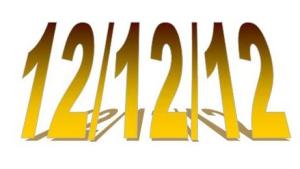
12/12/12 — A Wonderful and Wonderfully Mystic Day

1212/12/12 is a date that comes around every hundred years. Today should have been a mystical day, a momentous occasion with awesome happenings all over the world, though for the most part, it seemed to be a day like any other.

Twelve is a number steeped in our culture, in our heritage, in our very lives. To the ancients, it was a divine number. There were twelve major heavenly bodies in our solar system (the sun, the moon, the planets, which included Pluto and a far-flung planet as yet unknown to modern man, though currently hypothesized as Planet X). There were twelve gods. There are twelve signs of the zodiac, each representing 30 degrees of the heavenly arc. (Thirty is another divine number. If you are expecting the present era to end this month as the Mayans supposedly claimed, you will be disappointed. The Mayans used a mystical calendar with 360 days — 12 x 30 — rather than our 365.25 days. Hence, the so-called Mayan apocalypse won’t happen until 2087.)

There were twelve tribes of Israel, twelve apostles, twelve disciples of Mithras, twelve stations of life in Buddhism, twelve labors of Hercules, twelve sons of Odin in Norse mythology, twelve knights of the King Arthur’s round table.

Twelve is also a practical number, the lowest number with multiple divisors, making it a preferred method of organization, such as a dozen doughnuts or a dozen eggs; twelve colors on a color wheel; the twelve numbers on a clock face, the twelve inches to a foot, the twelve months in a year.

I’m sure there are dozens more instances showing the specialness of twelve, so why isn’t this day of twelves a momentous day of mystical happenings?

Well, for one, our calendar is arbitrary. The year could have started at a different time, perhaps in tune with the seasonal cycles where the first day of the year was the first day of spring. In certain cultures, the new year does begin on different dates, for example, the Chinese New Year was on January 23 this year, and the Jewish New Year was September 16th. The year itself is an entirely arbitrary number. Though this common era supposedly begins on the birth of Jesus, he was born no later than 4BC. (Though of course, back then, they would not have called it BC since the current calendar had not yet been invented.

And for another, this is a momentous day of mystical happenings. We are alive, aren’t we? That in itself is an awesome, momentous, and mystical experience.

Wishing you a wonderful and wonderfully mystic day.

***

Pat Bertram is the author of the suspense novels Light Bringer, More Deaths Than One, A Spark of Heavenly Fire, and Daughter Am I. Bertram is also the author of Grief: The Great Yearning, “an exquisite book, wrenching to read, and at the same time full of profound truths.” Connect with Pat on Google+