Doorways and Exploding Eggs

So often, it seems, we get up from our chairs in front of the computer to do something or get something in the next room that seems relevant at the time (yes, there is life away from the computer!!), but when we get where we are going, we have forgotten why it was so important to go there in the first place. Sometimes, if we go back to where we were when we got the inclination to do or get that something, we can remember, but other times the memory has completely disappeared.

Gabriel Radvansky, Sabine Krawietz. and Andrea Tamplin, a team of researchers at the University of Notre Dame, have shown that walking through a doorway makes us forget. They postulate that our brains are wired to keep the most relevant information handy until the need for it expires, and then oudoorr brains purge those details in preparation for new “need-to-know” information. (Please excuse this tangent, but I am laughing and had to share the joke. I just checked synonyms for “information” on MSWord, which I am using to write this post, and the only synonyms MS gives are: “in order,” “in sequence,” “in turn,” “in rank,” and “in a row.” Apparently, MS thinks “in formation” is a single word. Or maybe they think information is in such scant supply that we don’t need a synonym.)

According to the Notre Dame researchers, going through a doorway signifies that whatever information being held at the ready in our brains is no longer vitally important, and so our brains purge that information. In other words, we forget. Makes sense — we can’t keep every thought at the forefront of our brains, especially since a lot of what we learned in the past is no longer relevant. For example, we no longer have to remember how to crawl or how to let our mothers know our diapers need to be changed. Nor, in this digital age, do we need to remember where to put decimal points when multiplying percentages. For that matter, we don’t even need to remember how to add and subtract.

I have a hunch hallways are much like doors. Cross a threshold, walk down a hall and through a doorway into another room, and we are lucky to remember who we are, let alone what we were doing.

In the past couple of weeks, I have managed to blow up two pans of eggs I was hardboiling. Yep. Blew them up. Loud cracks of explosions. Bits of egg all over the kitchen. I do know how to make perfect hardboiled eggs, of course. The problem is that I do not have the patience to stand around waiting for the water to boil (I know for a fact watched pots do boil, it just seems like they don’t). I planned to set the timer, but the timer was next to my computer where I left it the last time I used it (because that’s where I was when the timer was set to go off, of course. What I said above about there being life away from the computer? Ignore that. I spend so much time online, I’m not sure it’s true.)

To set the timer, all I had to do was walk from one room, down a hall, and into another, and in those few seconds, I completely forgot about the eggs. Forgot to set the timer. It wasn’t until I heard the loud cracks of the explosion and went to investigate that I remembered. (I’m not sure why the eggs exploded. The water had long boiled off, so perhaps the heat conducted by the stainless steel pan was so great the moisture inside had turned to steam, and since the shell couldn’t expand with the steam, the egg exploded.)

The explosion wasn’t my fault, of course. It was the fault of a faulty memory system that doesn’t allow us to retain a thought from one room to the next. Yeah, that’s it. Not my fault at all.

***

Pat Bertram is the author of the suspense novels Light Bringer, More Deaths Than One, A Spark of Heavenly Fire, and Daughter Am I. Bertram is also the author of Grief: The Great Yearning, “an exquisite book, wrenching to read, and at the same time full of profound truths.” Follow Pat on Google+. Like Pat on Facebook.

On the Trail Again

A couple of weeks ago was the first time I hiked a bit of the Pacific Crest Trail (five miles round trip), and it was an incredible experience. The trail was well maintained, no huge climbs up or down, even footing, gorgeous views.

This past weekend I hiked another bit of the trail (just a little over four miles this time), and it was a completely different experience.

Instead of parking by a lake and heading immediately into the mountains, we parked by a heavily trafficked six-lane highway, then took a spooky trip through a long, damp water drainage tunnel under the highway.

We hiked past an abandoned house, through a culvert under the railroad tracks while a freight train went by overheard,

culvert

across a small wooden bridge,

and then we finally got to a part of the trail that was easy to traverse.

After that flat part of the trail, it climbed steeply into the rocks,

but it was all worth while because of the stunning views.

***

Pat Bertram is the author of the suspense novels Light Bringer, More Deaths Than One, A Spark of Heavenly Fire, and Daughter Am I. Bertram is also the author of Grief: The Great Yearning, “an exquisite book, wrenching to read, and at the same time full of profound truths.” Follow Pat on Google+. Like Pat on Facebook.

One More Post About Philip Seymour Hoffman (Or Rather, Philip Hoffman)

I hadn’t intended to write about Philip Hoffman — there have been more than enough blog posts written about him — but I’ve been thinking of the first time I saw him in a movie, so here is one more post about the deceased actor.

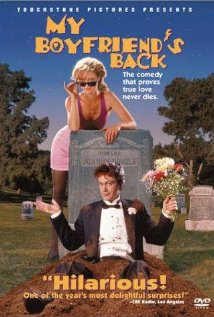
One of my favorite movies is the 1993 film My Boyfriend’s Back. The first time I ever saw Philip Seymour Hoffman was in that black comedy, though back then, he only called himself Philip Hoffman. Of course, that was long before he got his reputation for being such a great actor, so perhaps two names were all he needed. Still, his small role made MyBoyfriendsBack_a big impression on me. Made a big impression on his head, too. In the film, the hero, Andrew Lowry, comes back from the dead because the prettiest girl in school had agreed to go to the prom with him. (He’d saved her life, so what else could she do? Besides, he was dying . . .)

There is considerable prejudice in the high school against “dead kids,” and Philip Hoffman tried to kill Lowry — Chuck, Philip’s character, wasn’t exactly the brightest kid in school, so it never occurred to him he couldn’t kill someone who was already dead. Still, he took the axe from the emergency box on the wall (um . . . please tell me no one actually puts axes in schools anymore!). He swung the axe back to get momentum for a good swing, and because he was holding the axe backwards, he axed himself in the head. It doesn’t sound funny as I write this, but then, so often that is the nature of black comedy — the humor is in the moment.

The writer, Dean Lorey, penned some great lines.

For example, Dr. Bronson, who examines Chuck tells Big Chuck, Hoffman’s father, “I’m afraid I have some bad news. Your boy is very sick. He’s lost a massive amount of blood, and his pulse and retinal response are poor, and as you can see there’s an axe sticking out of his head.

Big Chuck: He’s not sick, you idiot, he’s dead!

Dr. Bronson: Oh, everybody’s a doctor. You think maybe I could make the diagnosis?”

Missy (the prettiest girl in school) tries to renege on her promise to go to the prom with the dead kid, and Lowry responds. “You may not know this, Missy, but I ate Chuck for YOU!” Missy’s friend tells her how lucky she is: “God, my boyfriend won’t even pump gas for me.”

I’m not sure why I’m telling you this, except that all the talk about Philip Seymour Hoffman reminded me of this movie, and it makes me smile. As great an actor as Hoffman is purported to be, he still had to start somewhere, and his “somewhere” was in a little known, badly acclaimed, poor money maker that is one of filmdom’s hidden gems.

It reminds me that no matter how serious we are about our writing, there is always room for a bit of humor, even black humor. It’s what makes our writing — and characters — memorable.

(An odd little mystery — Traci Lind, who played Missy, seems to have disappeared, at least disappeared from movies and the internet. Wherever she is, I hope she is happy. I always enjoyed seeing her.)

***

Pat Bertram is the author of the suspense novels Light Bringer, More Deaths Than One, A Spark of Heavenly Fire, and Daughter Am I. Bertram is also the author of Grief: The Great Yearning, “an exquisite book, wrenching to read, and at the same time full of profound truths.” Follow Pat on Google+. Like Pat on Facebook.

Being Nice

For many years, I was subject to depression and debilitating allergies that so enervated me, getting out of bed in the morning was about all I could handle. Then there were the years my life mate/soul mate was dying, where I hunkered down in my emotional foxhole, trying to protect myself from the pain with which life was bombarding us. During these times, whenever I’d go out among people, all I ever seemed to see were happy, healthy, and energetic folks, which made me feel as if I were alone in my misery.

It wasn’t until I signed up for Facebook and started making contact with all sorts of people that I discovered the truth rainbowin their status updates. Everyone is struggling with something — illness, disability, debility, depression, grief. Even if people aren’t struggling with such a difficulty themselves, they are taking care of someone with a problem. The strong, healthy people I saw were probably normally traumatized people on their good days.

I’m learning to be nice to everyone, even people with a bad attitude. Anger, rudeness, pettiness, are all signs of unhappiness and discontent, and chances are, the misery stems from actual problems, not just a desire to be mean. In a strange sort of way, how people treat me is not my problem. Their inconsideration is a reflection of them, not me. My only responsibility is in my own reaction, and — in an ideal world — I would always choose to be nice. Life of course, is not always ideal, and I sometimes I let my own problems dictate my behavior, especially when those problems entail a lack of sleep, such as the episodes with my afflicted brother.

One of my favorite scenes in a film is in the 1989 movie Roadhouse where Patrick Swayze is discussing his policy with the bouncers. “Be nice,” he says. He goes on to tell them that no matter what anyone does, be nice. And he ends, “I want you to be nice until it’s time to not be nice.” It’s a good policy for anyone, being nice.

Sure, we have problems, but everyone else does too. So let’s pretend this is an ideal world, and let us all be nice.

***

Pat Bertram is the author of the suspense novels Light Bringer, More Deaths Than One, A Spark of Heavenly Fire, and Daughter Am I. Bertram is also the author of Grief: The Great Yearning, “an exquisite book, wrenching to read, and at the same time full of profound truths.” Follow Pat on Google+. Like Pat on Facebook.

Wishing You Life and Love

Mahatma Ghandi said, “Where there is love, there is life.” On this day set aside for celebrating love, I wish you a life filled with love.

I love you

***

Pat Bertram is the author of the suspense novels Light Bringer, More Deaths Than One, A Spark of Heavenly Fire, and Daughter Am I. Bertram is also the author of Grief: The Great Yearning, “an exquisite book, wrenching to read, and at the same time full of profound truths.” Follow Pat on Google+. Like Pat on Facebook.
Lies, Damned Lies, and Statistics

“There are three kinds of lies: lies, damned lies, and statistics.”

This quote is usually attributed to Mark Twain, and in fact, he did use it in his biography, but he himself quoted it. Twain’s actual words were: ‘The remark attributed to Disraeli would often apply with justice and force: “There are three kinds of lies: lies, damned lies, and statistics”.’ But Disraeli’s biographer claims that the renowned statesman never used that particular phrase.

Some people postulate that Twain heard the phrase from Leonard Henry Courtney, a British economist and politician who said, in an August 1895 speech in New York, ‘After all, facts are facts, and although we may quote one to another with a chuckle the words of the Wise Statesman, “Lies – damn lies – and statistics,” still there are some easy figures the simplest must understand, and the astutest cannot wriggle out of.’ Courtney didn’t attribute the saying to Disraeli, and in fact, “wise statesman” might not even refer to a specific person, but a way of attributing the phrase to . . . whoever.

The earliest instance of the phrase found in print is from a letter that seems to indicate the saying was in common usage before Courtney’s speech, and was so old no one knew anymore who said it.  The letter dated June 8, 1891 and published June 13, 1891 states: “Sir,–It has been wittily remarked that there are three kinds of falsehood: the first is a ‘fib,’ the second is a downright lie, and the third and most aggravated is statistics. It is on statistics and on the absence of statistics that the advocate of national pensions relies…..”

I don’t suppose it matters who said “There are three kinds of lies: lies, damned lies, and statistics.” I don’t suppose it matters if there are, in fact, three kinds of lies, though I do know statistics can’t truly be a kind of lie. They are simply bits of data that have been compiled from a large sampling. People, of course, use these bits of data to bolster whatever truth or falsehood they happen to be peddling, and they are able to do this because of the very nature of statistics. For example, although everyone in the United States knows how abnormal this winter is, statistics show that on average, this is simply a normal winter — the warmth and dryness of the west balances the cold and snow of the east, giving us the lie of a normal winter.

Lucky for me, I happen to be on the warm, dry end of the “lie.” For all of you who are living on the opposite side of the land, be safe and try to stay warm.

***

Pat Bertram is the author of the suspense novels Light Bringer, More Deaths Than One, A Spark of Heavenly Fire, and Daughter Am I. Bertram is also the author of Grief: The Great Yearning, “an exquisite book, wrenching to read, and at the same time full of profound truths.” Follow Pat on Google+. Like Pat on Facebook.

Sundowners Syndrome and Other Night Time Horrors

For many people, night is a time of relaxation and rest, especially when it comes time to sleep, but for others, night is . . . well, it’s a nightmare.

For example, Sundowners Syndrome frequently affects people with Alzheimer’s and dementia, and sometimes elderly hospital patients. These people react to the sun going down with confusion, anxiety, aggressiveness, agitation, restlessness, anger, even disorientation and hallucinations. My father had such problems when he was hospitalized for an operation a few years ago, and the inordinate anxiety lasted for months afterwards. It’s one of the reasons I am here to look after him. Although at 97 years of age, he can still mostly take care of himself, he does need someone to do the things he can’t do for himself such as grocery shopping, some cookiSunrise/Sunsetng, cleaning, etc. More than that, though, he needs someone here at night because he is prone to panic attacks when he is alone after dark.

Those who suffer from bipolar disorder or narcissistic personality disorder seem to be afflicted with something similar to Sundowners syndrome, especially when it comes to night rages. These people can often control themselves during the light of day, but as the night progresses, their rage escalates, which makes even the generally well-balanced members of their families miserable, angry, and depressed.

Such night rages are often accompanied by insomnia and sleep deprivation, though I don’t know whether the lack of sleep is the result of the rage or a contributing factor. Although no one knows for sure what causes such night rages, there are various surmises. The rages could be a result of the build-up of stress during the day. They could be a result of fragmented circadian rhythms. Or they could have a biological basis, perhaps due to a disruption in the cholinergic system. (The cholinergic system is the network of nerve cells that uses acetylcholine in transmitting nerve impulses.)

I’m very aware of this nightmarish cycle since so often my dysfunctional brother inflicts his rage on me. He doesn’t physically inflict his rage on me, just verbally, though the fury he focuses on me sometimes feels like a physical assault — his anger is that powerful. Sometimes his anger isn’t directed at me specifically. He has a whole list of people who have “ruined his life” and he nourishes his anger against them as if his fury were a venomous hothouse plant. He seems to have such a stake in this anger that he cannot let it go, but what that stake is, I don’t know. Perhaps his rage makes him feel alive. Perhaps he is afraid of owning up to his own culpability in how he has ended up. Perhaps some sort of inner demon has him in thrall.

This conjecture, of course, is futile. He seems to have at least two cyclical patterns of disorder (bipolar swings and narcissistic rage, though he could have Sundowners Syndrome or something I have yet to identify — perhaps even alcohol-induced dementia), but since he has never been diagnosed, I have no idea that the truth is. All I know is that his night rages are impossible to predict, control, or deal with.

Because of him, my nights have become rather stressful, though occasionally, when his all his cycles wind down, so does he, and peace reigns. I have learned, however, never to take the quiet nights as a sign of things getting better, but simply to be grateful for them.

***

Pat Bertram is the author of the suspense novels Light Bringer, More Deaths Than One, A Spark of Heavenly Fire, and Daughter Am I. Bertram is also the author of Grief: The Great Yearning, “an exquisite book, wrenching to read, and at the same time full of profound truths.” Follow Pat on Google+. Like Pat on Facebook.

Look What I Caught!

Three days ago, I turned off the computer and went fishing for life. It was a lovely day, sunny and warm with just a hint of coolness in the air. I accompanied a group of hikers on a trek along the fabled Pacific Crest Trail. Since the PCT (as it is affectionately called) stretches from Mexico to Canada, it’s impossible to traverse the whole of the trail in just a few hours, but we hiked a three-mile portion of it. (Three miles out and three miles back for a total of six miles.) The trail is narrow, but well maintained, which makes hiking it easy. Well, the level areas are easy. I hear that parts of the trail rise steeply for miles. Whew! That would be a hike indeed.

We started at this lake (a dam, actually)

And headed up into the hills.

I’m glad I didn’t spent this gorgeous day inside and online.

***

Pat Bertram is the author of the suspense novels Light Bringer, More Deaths Than One, A Spark of Heavenly Fire, and Daughter Am I. Bertram is also the author of Grief: The Great Yearning, “an exquisite book, wrenching to read, and at the same time full of profound truths.” Follow Pat on Google+. Like Pat on Facebook.

Another Blessing For You

Concerned about my struggles with my rage-ful brother, yesterday a friend sent me a blessing by John O’Donohue, an Irish poet, author, priest, and philosopher.  Today she sent another one that really speaks to my longing for freedom. May you, too, find harmony between your soul and your life.

Blessing by John O’Donohue

May you listen to your longing to be free.
May the frames of your belonging be generous enough for your dreams.
May you arise each day with a voice of blessing whispering in your heart.
May you find harmony between your soul and your life.
May the sanctuary of your soul never become haunted.
May you know the eternal longing that lives at the heart of time.
May there be kindness in your gaze when you look within.
May you never place walls between the light and yourself.
May you allow the wild beauty of the invisible world to gather you, mind you and embrace you in belonging.

***

Pat Bertram is the author of the suspense novels Light Bringer, More Deaths Than One, A Spark of Heavenly Fire, and Daughter Am I. Bertram is also the author of Grief: The Great Yearning, “an exquisite book, wrenching to read, and at the same time full of profound truths.” Follow Pat on Google+. Like Pat on Facebook.

A Blessing for You

Concerned about my struggles with my rage-ful brother, a friend sent me the following blessing by John O’Donohue, an Irish poet, author, priest, and philosopher.  And now I am passing it on to you in the hopes that it will make your day a bit brighter.

moonOn the day when the weight deadens on your shoulders and you stumble, may the clay dance to balance you.
 
And when your eyes freeze behind the grey window and the ghost of loss gets into you, may a flock of colors, indigo, red, green, and azure blue come to awaken in you a meadow of delight.
 
When the canvas frays in the currach of thought and a stain of ocean blackens beneath you, may there come across the waters a path of yellow moonlight to bring you safely home.
 
May the nourishment of the earth be yours.
May the clarity of light be yours.
May the fluency of the ocean be yours.
May the protection of the ancestors be yours.
 
And so may a slow wind work these words of love around you, an invisible cloak to mind your life.
_

***

Pat Bertram is the author of the suspense novels Light Bringer, More Deaths Than One, A Spark of Heavenly Fire, and Daughter Am I. Bertram is also the author of Grief: The Great Yearning, “an exquisite book, wrenching to read, and at the same time full of profound truths.” Follow Pat on Google+. Like Pat on Facebook.