Yay! Great News!

I went to the doctor today for my pre-op appointment in preparation for surgery next Tuesday. Because there is a bit of irritation around one of the insertion points of the external fixator, he decided to reschedule the surgery for tomorrow. I planned to do a countdown this coming week, counting, down the days until the fixator is removed, so here is the countdown to surgery:

One.

I thought this would be an unsad day because of the doctor’s and lab appointments, and that busyness would have kept me from feeling the grief of this day — the seventh anniversary of Jeff’s death — but at the moment I am too excited to feel sad. I refuse to think about the coming weeks (and months!) and the pain that will be involved in trying to get my hand back into its proper position and getting some mobility in my wrist, but I won’t have to think about any of that for at least another week. After the fixator is removed, they will bandage the puncture wounds and put a soft cast around the wrist to give it a bit of support for the next week. And after that. . . well, I’ll go from there, dealing with whatever it is I need to deal with.

Although this should be a relatively uncomplicated surgery, any surgery under anesthesia is a risk, so please, spare a thought for me tomorrow, and wish me well.

***

(Pat Bertram is the author of the suspense novels Light Bringer, More Deaths Than One, A Spark of Heavenly Fire, and Daughter Am I. Bertram is also the author of Grief: The Great Yearning, “an exquisite book, wrenching to read, and at the same time full of profound truths.”) Connect with Pat on Google+. Like Pat on Facebook.

Eve of Seven Years of Grief

1:40 AM tonight marks the seventh anniversary of when my life mate/soul mate died. If it is true that our bodies are renewed every seven years, then this anniversary is another death — the death of whatever remains of him in me. When two people live together for an extended period of time, in our case thirty-four years, you not only exchange ideas and energy, you also exchange atoms and molecules, and DNA via benign viruses, so for all these years I carried a bit of him with me. And now he is truly gone. (I still have his cremains, haven’t decided yet what to do with them, but that is another story.)

A month ago, I entered a spate of grief so profound, I felt almost the same as I did at the beginning, as if parts of me were being amputated. Could that be when the last iota of him in me died? As romantic as the notion is, I have a hunch the upsurge of grief was simply that — an upsurge. Generally the month leading up to the anniversary is much worse than the anniversary itself, and I expected the past month to be a horror of pain. During that grief upsurge though, I wrote him a letter, and also printed out a photo of him to hang on my wall. (My photos are all packed away in a storage unit, and since I cannot drive because of my arm, they are not available to me.) Because of this renewed connection, as ephemeral though it might be, or maybe just because after all it’s been seven years since he died, the past month has not been a horror of grief, but rather a time of relative tranquility.

I still don’t understand life, death, grief. Don’t understand why some people are allowed to live out their lives with a special person, and others are fated to go into old age alone. It used to bother me, this unknowing, and sometimes it still does, but generally I try to live in the moment, to take from the day what I can and leave the immortal questions for another time.

I do know I will always be grateful he shared his life with me, even though memory of that life is fading behind newer memories of my life alone. And I know I will always miss him. We shared a special bond, not like a long married couple, not even like soul mates, though that is how I describe our relationship — more like cosmic twins. For most of our life together, I thought the bond was so strong it would pull me into death when he went, and I resented his having five years more of life than I would. As it turns out, something in me did die that day but other things were born, such as a determination to live, and I have now lived two years longer than he did. I resent the extra years on his behalf, though I hope he is beyond caring.

I don’t know where the next seven years will lead me — no one knows what the future will bring, of course. Will it end with me sitting at my computer telling you about the 14th anniversary of his death? By then, I will be elderly. No, I don’t want to even think about that. I’m still afraid of growing old alone, still afraid of being old alone. But today, living in the moment, there is no fear, just a sense that . . . I don’t know . . . maybe that my life is unrolling as it must.

There probably won’t be room for tears tomorrow. I have pre-op doctor and lab appointments that will take up much of the day. (As of now, the surgery to have the external fixator removed from my arm is scheduled for April 4th.) And I am packing one handed for a move to a nicer room and a nicer neighborhood.

Changes.

So much has changed in the past seven years. For a long time, I lamented that his death and my grief did not change me, but looking back, I no longer know who that woman was who clung so firmly to life when all she loved was swept away.

One thing has not changed — a great yearning to see him one more time. To see his smile that so often warmed me. To see the light in his eyes when something interested him.

And one other thing has not changed — disbelief. I can’t believe he’s been gone so many years. Can’t believe I survived.

And yet, changed,/ unchanged, here I am.
***

(Pat Bertram is the author of the suspense novels Light Bringer, More Deaths Than One, A Spark of Heavenly Fire, and Daughter Am I. Bertram is also the author of Grief: The Great Yearning, “an exquisite book, wrenching to read, and at the same time full of profound truths.”) Connect with Pat on Google+. Like Pat on Facebook.
Once Upon a Time Under the Sonoran Stars

A little more than a year ago, I stopped at Organ Pipe Cactus National Monument on my way across the country. It was a fantastic experience, like living in a southwestern botanical garden. It seemed such a magical spot that I stayed a day longer than I’d planned.

One of the special moments of my stay at the park was hiking with a couple of fellow campers. After we returned to our tents and rested a bit, one of the hikers, a guy who was exploring the south and west on his motorcycle, brought a bottle of Grand Marnier to my campsite. He and I sat under the bright stars with the glow of Mexico to the south and sipped our drinks.

I just got an email from the fellow. Once again he is camping at Organ Pipe Cactus National Monument, sipping Grand Marnier under the stars, and oh! How I wish I were there. I often think about that monumental park, especially now that I am homebound, and I dream of going back and spending more than just a couple of days.

My fixator will come off in exactly 13 days. (But who’s counting.) Planning new adventures and a replay of previous adventures will give me courage during the arduous months of physical therapy.

And maybe, one day, I will be back in my tent under the sonoran stars.

***

(Pat Bertram is the author of the suspense novels Light Bringer, More Deaths Than One, A Spark of Heavenly Fire, and Daughter Am I. Bertram is also the author of Grief: The Great Yearning, “an exquisite book, wrenching to read, and at the same time full of profound truths.”) Connect with Pat on Google+. Like Pat on Facebook.

If You Have a Queasy Stomach, Don’t Look

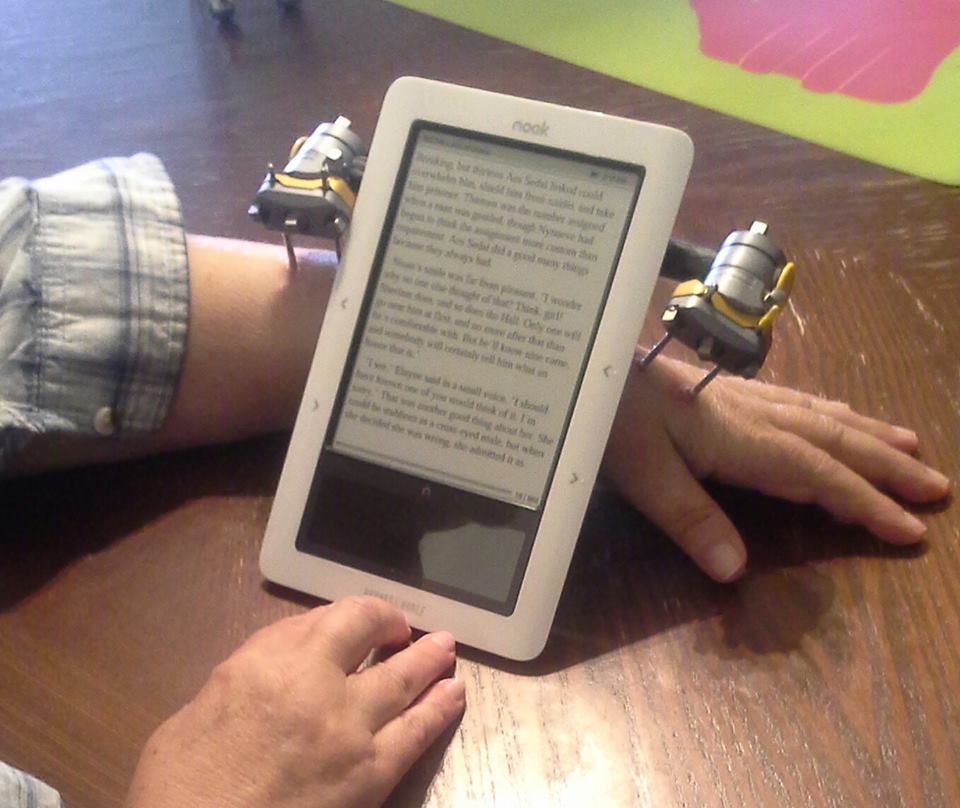
I haven’t wanted to make people sick by the sight of hardware screwed into my arm, but people have asked to see my fixator. As one fellow said, “we need some gruesome stuff to make us feel how fortunate we are.”

So, here is my arm with the fixator attached. Don’t you wish you had such a handy dandy ebook rest?

As you can see, a person really can get used to anything.

***

(Pat Bertram is the author of the suspense novels Light Bringer, More Deaths Than One, A Spark of Heavenly Fire, and Daughter Am I. Bertram is also the author of Grief: The Great Yearning, “an exquisite book, wrenching to read, and at the same time full of profound truths.”) Connect with Pat on Google+. Like Pat on Facebook.
What a Person Can Get Used To

It’s amazing what a person can get used to. Four months ago, after I broke my arm and elbow and wrist in more than a dozen places, I had surgery to have an external fixator screwed into my arm to keep the hand bones from migrating down to where my wrist was supposed to be. When I woke from the anesthetic with the hardware attached to my arm, I have no idea why I didn’t freak out. I don’t know if they told me what they were going to do; if I was so drugged, what they did to me just didn’t register; or if the whole thing was so preposterous that I just accepted the device for what it was.

At first, it was hard having something that looks like a small sewing machine attached my arm, a  sewing machine that weighed a couple of pounds, but at the beginning I had a bit of help — an occupational therapist that miraculously showed up at my door one day. I think one of the hospital doctors have prescribed a nursing service, which I did not need, and along with the service came this wonderful woman. For a couple hours a week, she helped me open bottles, cut up apples, wash my hair, help with whatever finger exercises I could do, massage scars and aching muscles. During most of that time, I was on heavy duty opioids that did little more than fog my brain, make me sleep, and slightly reduce the acuity of the pain. The loss of this therapist, who I had come to depend on, happened to coincide with my grief anniversary date (exactly one month before the seventh anniversary of his death, which for some reason is more painful than the anniversary itself).

I survived that unexpected and quite profound bout of grief, of course, because, odd though it might seem, I have gotten used to grief popping up whenever it feels like it.. After the grief episode, I entered a period of equanimity that hasn’t been especially good, but it certainly hasn’t been bad. I think it’s more that I’ve gotten used to the fixator, to not being able to drive, to spending most of my time a loan in a single room. The last week or so, I have done away with all pain medications, and surprisingly — or I suppose not surprisingly — I’ve begun to feel like writing again. Having forgotten most of the book I was writing, I had to reread the entire thing — twice — to get it back into my head. I also gave the rough draft to a couple of friends to read, and took their suggestions into consideration along with some of my own suggestions, such as moving a crucial scene closer towards the end.

Now that I have gotten used to this life, I have been given a surgery date to get the fixator removed. (First week in April.) People keep telling me, “I bet you’re going to be glad to have that thing off your arm,” and though I agree to keep from seeming contrary, the truth is, I’m not particularly glad. To be honest, I feel a bit of trepidation. As long as the fixator is on my arm, I am more or less forced into a life of idleness. Reading, writing, walking, painting, doing puzzles. When the fixator comes off, there will be a period of recuperation, drugs, and I’m sure quite a bit of backtracking in the use of fingers, elbow, etc. After that comes a year maybe two of relearning how to use the wrist and hand, and learning how to accommodate whatever deformity and disability I end up with. All necessary steps, but not necessarily pleasant ones.

So for now, these last couple of weeks before the fixator comes off, I intend to enjoy this idleness I have gotten used to.

I hope you are finding periods of creative idleness, too!

***

(Pat Bertram is the author of the suspense novels Light Bringer, More Deaths Than One, A Spark of Heavenly Fire, and Daughter Am I. Bertram is also the author of Grief: The Great Yearning, “an exquisite book, wrenching to read, and at the same time full of profound truths.”) Connect with Pat on Google+. Like Pat on Facebook.

The Power of Words

I am a writer, hence words are my life. So far, they are not my living, though I still have hopes of making money with my writing, but they are my life. I love to play with words. I think in words rather than images. I see hidden meanings in words. For example a friend on Facebook told me that grief is like tide pools — sometimes very shallow and sometimes unfathomably deep. She said she preferred the shallows because of the living things she could see in the pools, and all at once, in the midst of the word shallows, I saw the word hallow, meaning sacred and holy. This seemed very deep to me, but maybe I simply liked playing with the idea that “shallows” had depth.

Still, sometimes the power of words surprises me. In my previous post, Vulnerability and Upsurges of Grief,  I mentioned that I was going through a profound grief upsurge, one that was so strong I felt I needed to reach out to Jeff in the only way I knew how — by writing him a letter. The next day, I was puzzled by the absence of tears, by the peace that had settled over me. The only thing that changed from one day to the next was that letter. After I’d told him about my arm, my feelings of isolation, my financial woes, I wrote “Odd that your death brings so much grief, but it also brings me comfort, knowing you are out of this world. At least one of us doesn’t have to deal with this crap anymore.”

One of the hardest things about losing a lifemate/soul mate/spouse/partner is that there is no longer any “us.” There is only I. Me. By subconsciously identifying myself as being still part of an “us,” perhaps I felt a continuity of our shared life. Since his death, I’ve never really felt the continuity, never felt his presence — only his absence. (People sometimes suggest I should put Jeff out of my mind because he is in the past, and the truth is that I do forget him for weeks on end, but it’s also true that his absence is part of my present. His absence fuels my need to live, my need not to waste whatever life is left to me.) I’d packed his picture in my storage unit when I went on my trip, and since I have no way to go get it right now, I printed out another copy of the photo. I tacked his image above my computer, and seeing his radiant smile makes me smile.

I’d read once that those bereft who find a way to make their lost mate a part of their lives are happier and more contented than those who try to ignore the past. I suppose in my rush to live as fully as possible, I’d forgotten this, or maybe thoughts of him had just naturally drifted away. In the busyness of my life in the shallows, he’ll probably drift away again. But for now, it feels good to have this connection, even if it is all in my mind.

Because of anecdotes about near-death experiences, we all assume our dead are happily waiting for us, but I’m not sure that’s true. Even though they might not feel loss as we do, it’s possible that they too feel the separation. I also think it’s possible that sometimes inexplicable grief comes not from within us but from without, from our lost one thinking about us, missing us. (I used to think that calling a death a “loss” was a misnomer because we did not mislay the person, but now it does feel as if Jeff is lost to me, lost in the far reaches of time.)

March is shaping up to be an interesting month. Not only do I add another year to my age, I tick off another anniversary of his death. It’s also another long month of having the external fixator attached to my arm. (The surgery to remove the device will not take place until April.) Another month of isolation. Another month of surrendering to idleness. (That part, at least, sounds inviting.) I might again founder (and flounder) in the depths of grief, or I might find peace in the shallows. But whatever happens, right now, at this moment, I am at peace.

And all because of a few powerful words.

great-saguaro

***

(Pat Bertram is the author of the suspense novels Light Bringer, More Deaths Than One, A Spark of Heavenly Fire, and Daughter Am I. Bertram is also the author of Grief: The Great Yearning, “an exquisite book, wrenching to read, and at the same time full of profound truths.”) Connect with Pat on Google+. Like Pat on Facebook.