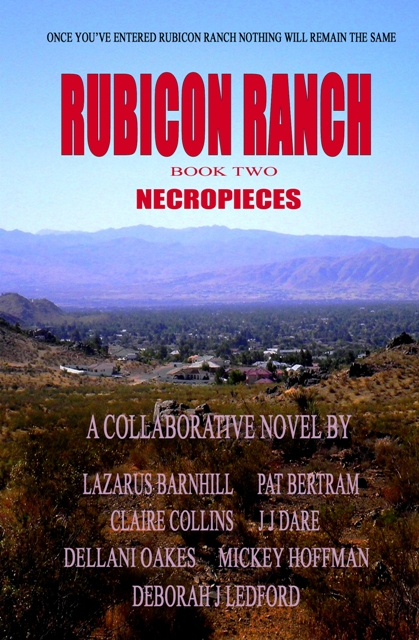
 Rubicon Ranch is a collaborative and innovative crime serial set in the desert community of Rubicon Ranch and is being written online by the authors of Second Wind Publishing. Seven authors, including me, are involved in the current story — Rubicon Ranch: Necropieces.
Residents of Rubicon Ranch are finding body parts scattered all over the desert. Who was the victim and why did someone want him so very dead? Everyone in this upscale housing development is hiding something. Everyone has an agenda. Everyone’s life will be different after they have encountered the Rubicon. Rubicon Ranch, that is.
Although some of the characters were introduced in Rubicon Ranch: Riley’s Story, a previous collaboration, Rubicon Ranch: Necropieces is a stand-alone novel. A new chapter is posted every Monday.
We hope you will enjoy seeing the story develop as we write it. Whodunit? No one knows, not even the writers, and we won’t know until the very end!
Chapter 25: Melanie Gray
by Pat Bertram
Melanie paced her rented house, wandering through the great room to the bedroom, then up the stairs to her loft office to stare out the window. The clouds that had skirted Rubicon Ranch all day yesterday had settled over the town in the early morning hours. The rainstorm had now weakened to a soft drizzle, but floodwaters were swirling out of the desert and down the middle of the street like dirty bath water in search of a drain.
Melanie half expected to see body parts floating by, but it had been forty-eight hours since she had found the ravens breakfasting on the disembodied foot, so perhaps by now all the necropieces had been discovered. Shivering, she turned from the window, trudged down the steps to the great room and then into the bedroom. She’d spent most of the fifteen weeks since Alexander’s death roaming the desert, and she found it almost impossible to relax during this enforced incarceration. If she were any kind of photographer instead of an amateur shutterbug, she’d be out in the desert despite the rain, chronicling the way the runoff was recreating the desert floor, but her tiny camera wouldn’t stand up to the moisture, and then where would she be?
She plodded back through the great room and up the stairs again. Her cell phone rang, and for just a second, her spirits rose. Alexander! He was finally calling to tell her he was coming back. Just as abruptly, the realization that he was dead hit her like a physical blow, and tears spilled down her cheeks. Why couldn’t she remember that he would never come home? His body had been cremated and the ashes stored in a square brass urn sitting atop the dresser until she could take them high up into the Rocky Mountains in Colorado and scatter them.
By the time she reached her bedroom where she’d left her cell phone on the nightstand, the phone had stopped ringing. The tiny screen showed the number for her agent, and when the phone rang again, she considered not answering. What could the woman say that hadn’t been said a dozen times before? Melanie already knew her deadline had passed. She already knew she owed the publisher either the book or the return of the advance. She already knew . . . Oh, crap. It would be better to talk to Dottie and get it over with.
“Yes?” she said, hating the hesitancy she heard in her voice.
“Dahling!” Dottie chirped. “I’ve been calling and calling. Have I got good news for you! I’ve been talking to Jack, and he says you can have all the time you need to finish the desert book. He’ll even hire a photographer for you. And he’ll send you five hundred thousand dollars, though I’m sure I can get him up to a million.”
“What does he want from me? A kidney?” Jack Nolan, her publisher, had a reputation for wringing every last bit of creative effort from his authors while paying the least possible advance. He got away with it because, despite his miserly ways, he was scrupulously honest, remitting every penny of the royalties his authors earned.
Dottie chuckled. “So cynical, dahling. It’s perfect, really. You’re there. You know the people and the place. And from what I understand, you live next door to the Sinclairs.”
“No,” Melanie said, without a hint of uncertainty in her tone.
“You don’t live next door to them? My sources—”
“I mean, no. I will not write whatever book Jack wants me to write. I’m going to finish the desert book and then . . .”
“And then what? Knowing Alexander, he probably left you not only broke but also in debt. Someone is going to write the book about Morris Sinclair. It might as well be you.”
“Wait a minute,” Melanie said. “How do you know what’s going on here?”
Dottie laughed. “The whole world knows. It’s everywhere. On television, Facebook, Twitter. It’s such a delicious story. The author of the infamous ‘Necropieces’ series has himself become a series of necropieces. His fans don’t believe he’s permanently dead. They are holding vigils, waiting for him to come back to life. And his head was found in the house where that little girl died. Riley? Is that her name? The girl that was kidnapped as an infant and then killed by her biological father? How can you not want to write the story of Rubicon Ranch? It’s going to be huge. Humongous.”
“Not interested.”
“Wait! There’s more!” Dottie said. “You gotta love this stuff. One of the suspects in Morris’s murder is Tara Windsor.”
“Who?” Melanie asked.
“You had to be living out in the boonies somewhere not to have heard of Tara. Oh, right—you’ve been out of the country for the past umpteen years. Tara is an actress. She was in that movie with that actor, you know, the one with the gorgeous abs? No, I guess you don’t know. Anyway, it turns out the suspect isn’t Tara at all. Tara is in Cabo with her pool boy. Don’t you just love it?”
Melanie sank down onto the bed, suddenly weary. “No.”
“And then there’s you,” Dottie said slyly.
Melanie sat up straight. “Me? What about me?”
“The cops say you’re a suspect. You knew that, right? Jack says if you killed Morris and tell all the gory details, he’ll up your advance to two million.”
A suspect. Melanie had presumed the Sheriff’s insinuation that he considered her a suspect was his way of manipulating her and keeping her off balance, but if he or someone in the Sheriff’s department had given out her name, then she really had a problem. She heard the echo of herself screaming at Morris, “You leave me alone, Sinclair, or I’ll be shooting your dead body parts.” Could she have been more foolish?
“Do you know a good lawyer?” She gave a small laugh, wanting Dottie to think the question a joke, but fear clutched at her belly with clammy fingers. Maybe she’d have to write Morris’s story in order to pay for a defense attorney.
“You might not be a celebrity on a par with Morris or Tara,” Dottie said, “but you and Alexander have quite a following. Since there’s been mention of your involvement in Alexander’s death—”
“Who told you I was involved in Alexander’s death?” Melanie demanded.
“Just a guess.” Dottie voice sounded smug, as if she’d caught Melanie out in a secret. But there was no secret when it came to Alexander’s death. Just shoddy police work. “So many important deaths in such a small place make for a good story,” Dottie added.
“All the deaths are unrelated,” Melanie pointed out.
“Perhaps, but it’s more likely they are connected somehow. After all, Morris had autopsy photos of that little girl, and Alexander took some photos of necropieces for Morris.”
“You knew about that?”
“Alexander accidentally included a couple of the pictures when he sent Jack a batch of desert photos.”
Melanie sighed. “Maybe you’re right. Maybe Alexander’s death had something to do with Morris and the evil that this place seems to bring out in people.”
“So can I tell Jack you’ll write the book if he gives you an advance of a million dollars?”
“No. But you can tell him I’ll consider it.”
“Good girl. I’ll see what I can do about finding you a lawyer.”
Melanie set the phone on the nightstand, and put her head in her hands. Oh, Alexander. Look what you’ve done to me. She took a few deep breaths, determined not to cry, but when the tears spilled over anyway, she jumped to her feet, ran up the stairs, and plopped in front of the computer. Immersing herself in research always helped take her mind off herself, and she needed to know more about Morris before she could give Dottie her decision.
Typing “Morris Sinclair” into her search engine resulted in over two hundred million hits. Morris’s website. Book and movie sites. Thousands of fan sites and cult groups. Blogs. Articles. She narrowed her search to “Morris Sinclair biography” and managed to piece together the story of a highly narcissistic and anti-social man in his late sixties who had started out as a normal kid, turned into a troubled and rebellious teenager, and grew into a sadistic beast during his tour of duty in Vietnam.
After Vietnam, Morris married a woman he’d only known for a few weeks. He worked as a roughneck on an oilrig and wrote tales of terror on the side. When the stories were published, they found an immediate readership. He quit work to write fulltime.
Morris and his wife had three children, two boys and a girl. His wife committed suicide while the children were very young. Or perhaps Morris had killed her? That made more sense to Melanie—what mother would kill herself and leave her children to be raised by the devil incarnate?
Although the thought of a million dollars and the freedom it could buy tempted her, Melanie did not want to spend the next few months of her life immersed in the evil that was Morris. She was all set to call her agent and turn down the deal, when the doorbell rang.
She opened the door to find Lieutenant Frio and Deputy Midget standing on her doorstep, their faces set as if in stone.
“Ms. Gray,” Lieutenant Frio said, “we’d like for you to come with us. Sheriff Bryan wants to talk to you.”
Melanie held out her hands, wrists together, but Deputy Midget shook his head. “Sheriff Bryan says not to cuff you unless you give us trouble.”
“Can I get my coat?”
Lieutenant Frio threw Melanie a stern look. “You’re not going to try anything?”
“No.” Melanie darted into the bedroom, grabbed a trench coat from the closet and tucked her phone in the pocket.
Sandwiched between the two law officers, Melanie marched out to the tan Navigator parked at the curb in front of her house. Deputy Midget opened the back door of the vehicle, put a hand on her head to guide her through the opening as if she were a common criminal, then lowered himself into the front passenger seat. The right side of the Navigator sank, and the tires seemed to scream out for relief.
Lieutenant Frio peeled away from the curb. The tires sent up huge plumes of floodwaters that broke over the vehicle, and made it seem as if they were driving through a car wash.
Melanie stared out the window, though she couldn’t see anything but the backwash of water. If she strained her ears, she felt sure she could hear Alexander’s ghostly laughter. During all their years of living in countries with no civil liberties, they had never had a single problem with the authorities, and yet now, not even four months after his death, she found herself at odds with the law.
Maybe this arrest was just another of the sheriff’s games? She had never known what he wanted from her, though when they met after she’d found Riley’s body, he had focused his attention on her, and made her feel . . . seen. No one but Alexander had ever looked at her that closely, and even Alexander had stopped paying attention to her years before. Or maybe what had seemed like manipulation—the sheriff concentrating his attention on her and then ignoring her—had all been in her head, a widow’s cry to be noticed.
Once they hit the dry road of the highway, the thirty miles to Rojo Duro seemed to slip past in an instant. Deputy Midget ushered Melanie to a small room with two chairs and a metal table bolted to the floor, and left her alone.
A mirror on one wall had to be a one-way window, but Melanie put a finger against the glass to be sure. Finger touching finger without any space told her the truth—anyone could be watching her from the other side, and she would never know. She resisted the urge to stick out her tongue in a childish show of temper. Instead, she sat tall in a chair, hands folded on the table, and tried not to think of where she was. Tried not to think of her pathetic life. Tried not to think of her uncertain future.
Nine minutes later, Sheriff Bryan entered the room and locked the door behind him. He perched one hip on the table, and stared at her, no friendliness in his eyes.
After a long moment, he heaved a sigh and said, “Why did you do it, Melanie?”
***
Pat Bertram is the author of the suspense novels Light Bringer, More Deaths Than One, A Spark of Heavenly Fire, and Daughter Am I. Bertram is also the author of Grief: The Great Yearning, “an exquisite book, wrenching to read, and at the same time full of profound truths.” Connect with Pat on Google+
 12/12/12 is a date that comes around every hundred years. Today should have been a mystical day, a momentous occasion with awesome happenings all over the world, though for the most part, it seemed to be a day like any other.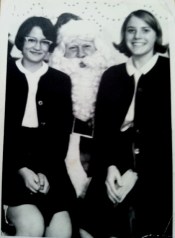
 My mother died five years ago today, almost exactly a year after my brother. (This is the last photo of the two of them together.) To understand the sly humor rather than the pathos behind that sentence, I’ll have to tell you a bit about my mother. She spoke with perfect diction, in unstilted, unaccented English, and she loved words and word games, especially the kind of game where you take a word or phrase and find as many smaller words as possible. For example: in “almost exactly,” you can find most, call, cell, yell, exact, alas, and so on (Me? I hate that game, perhaps because I could never win when I played with her.).
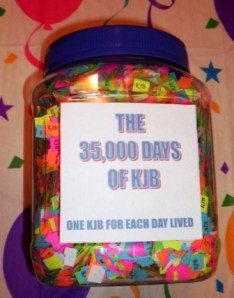
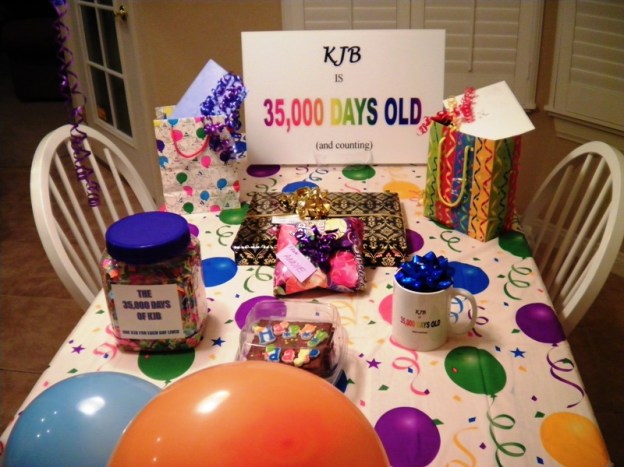
 Yesterday I wrote about
  I’m noticing a change in my attitude lately — more cynical perhaps, and at the same time more optimistic about the future. This change showed itself to me in my reaction to a news story that is going around about a couple who holds the record for the longest marriage — 86 years. The story purported to tell the secrets of how they stayed together for so long, and my first thought was, “Because one of them didn’t die.” No matter how much they love each other, no matter how well they get along, if one of them had died, that would have been the end of their being together.
 During the past thirty-two months since the death of my life mate/soul mate, I have shared my grief, and in turn others have shared their grief with me, telling me stories they never told anyone else. I have heard incredible tales of signs and dreams and feelings of connection to the one who has left earthly life behind, which makes me realize that something is going on beneath the surface of earthly life, though I don’t know what.









