More About Risks and Safety

I think a lot about safety, wondering how to be adventurous and bold while at the same time not embarking on a death march.

Human predators mostly look for the weakest member of the herd, someone who walks with their head down, someone that no one will notice if they disappear. To that end, I keep my head up, try to pay attention to what’s around me, and always wear a hat that makes me stand out. Wide brims with flowers, ribbons, feathers — any sort of decoration that makes people look and smile. Seems like a silly sort of thing to do for protection, but getting people to notice me in a good way makes it harder for a predator to cull me from the herd. Not that I started wearing hats for that reason. The hats came first, the reason later. I wear hats for protection from the sun, and when I would get gorgeous ribbons on presents, I started decorating my hats with them. It’s nice that the extra bit of color makes people smile and me noticeable.

When I was trying to decide whether to get a new car or get my Beetle restored, the deciding factor was safety. Admittedly, an old bug, even one with a new engine and transmission isn’t the safest car from a driving point of view, but from a predator point of view, it’s worth its weight in gold. Everyone notices my car. Not everyone talks to me, but everywhere I go, someone does, and that is protection. And if something were to happen to me, if I were disappeared from an interstate truck stop, someone would notice that my car was there way longer than it should be. Most cars don’t garner attention because most cars are common. But mine is an uncommon car of memories and dreams. And there is safety in that.

Although I blog about my adventures, giving frequent updates, I am particularly careful not to post itineraries online. After I’ve been somewhere, I will tell you about it, but I see no reason to leave a trail for predators to follow. For someone who lives her life online, I guard my privacy. (And you should too.)

I do other things of course. Carry an external battery good for four charges of my cell phone. I stash filled water bottles under my seat, carry extra food, keep my camping quilt and a pillow handy, have a flashlight near at hand, keep a few tools in the glove compartment, have an emergency kit in the car, and oh, so many other things.

When I’ve hiked by myself, I’ve carried a map, generally just a handout at a trail head or printed off the internet, but when/if I ever get into a real backpacking situation, I will make sure I have a topographical map and compass, and will know how to use them.

I’m researching other things at the moment, such as bear spray (which some people say is great, some people say no, some people say it’s illegal in areas) and a bear horn to scare the animal away if I were ever so lucky to see one. Knowing me, though, I’d probably do what I do when I see a snake — watch it in awe. But we’ll see what my research holds. (I’m more concerned with dogs, though. I’ve never even seen a bear when I hiked in the woods, but I have been bitten by someone’s unleashed dog because the stupid woman couldn’t control her three animals.)

I’m not foolish enough to say nothing will happen to me, because anything can happen, and often does. But that knowledge is a safety feature I carry with me at all times. Cockiness can get people killed. Caution can save lives. And I am almost always cautious. I listen to my surroundings, not music. I try to be present in the moment and not get lost in daydreams. I use two trekking poles to save my knees, to help me keep my balance on slopes, and hopefully to ward off anything that comes close.

All this is by way of saying that I do everything in my power to minimize whatever  risks I might face, so that I can face adventure with wonder and a touch of boldness.

I understand how difficult it is to see someone you care about take risks, so I hope this makes you feel better about the risks I take.

***

Pat Bertram is the author of the suspense novels UnfinishedMadame ZeeZee’s Nightmare, Light BringerMore Deaths Than OneA Spark of Heavenly Fireand Daughter Am IBertram is also the author of Grief: The Great Yearning, “an exquisite book, wrenching to read, and at the same time full of profound truths.” Connect with Pat on Google+. Like Pat on Facebook.

Risk Management

I have never been a risk taker. I do not like pain or discomfort of any kind — not taunts, not scoldings, not broken bones, not cuts, not illness. For most of my life, my adventures were the literary kind, and oh, I was intrepid. Actually, that’s not true. I never identified as the hero. I was always sort of a companion, analyzing the risks and trying to figure out how not to have gotten into the scrapes the character did, and thinking about how I would get myself out the situation.

The habit of analyzing risks followed me into real life. For example, although I had no aptitude for dancing when I was young and there was no way for me to take dance classes, I’d still decided at a young age that dancing wasn’t for me. I didn’t want the foot pain and bleeding toes, the horrendous hours of work, and all the rest that goes into being a dancer. I still don’t want any of that. As dedicated as I am about taking dance classes now, at the first sign of debilitating pain (other than the muscle aches from too many plies), that will be it.

Even before I fell and broke my arm, I’d fall-proofed wherever I lived — stayed away from area rugs, made sure the night time trek from bed to bathroom was completely open. Now I have bars in the bathtub, but I’d always been careful getting in and out of the shower, been especially careful picking up soap if I dropped it because I knew that’s how and where most home injuries occurred.

How did I know all this? I have always been a researcher. And I think things through and rethink things to the point of overthinking.

That being said, the truth is, there is no way to avoid risk. Many terrible things have happened to me over the years, from being held up at gunpoint, to having to deal with devastating grief when Jeff died, and most recently, the destruction of my arm. Everything bad that has ever happened to me has happened in the city, sometimes even when I was with someone else.

If I were still with Jeff, or if I hadn’t had to deal with the horrors of grief, my adventurous spirit might never have been kindled, but now the wild woman in me is struggling to get out. I have an inordinate desire to live. To experience. To be. To become.

I realize this call to adventure (whatever the adventure might be) involves more risks than reading in bed (though I have known people who broke hips when they fell out of bed), but all I can do is minimize the risks. As I have always done, I research ways to be safe, I imagine myself in precarious situations, learn what others have done and what I would do to get out of them. Even following a well established trail, it’s easy to get lost (as many people have discovered too late), but my years of venturing into the nearby desert have taught me to mark the way back to the trail if I have to leave it, to pay attention to my tracks (and the tracks of other creatures).

I make sure my cell phone is fully charged, and I am always wary, never acting as if I am in a safe place, though the truth is, I am safer wandering in the desert than I am in the city. (A lot safer than driving, that’s for sure!) The most dangerous thing I do is cross a street. I’m not joking here. To get to the dance studio, I have to cross one of the busiest and most dangerous intersections in town where six roads with multiple lanes meet, cars going all directions, and no cross walk. (Sometimes I jaywalk, which is safer, unless I’m caught, and then I face an $80 fine).

I have driven cross country alone, hiked in national parks and wild places alone. I have camped alone. It’s not as if I have no experience being alone in potentially dangerous places, but still, people worry about me.

Don’t get me wrong — I appreciate the concern. I really do. It’s pleasing — and comforting — to know that people care. Lately, though, so many people have cautioned my about putting myself at risk, that I’m getting scared. And I don’t want to be.

Of course I’m at risk, and I will be at even greater risk when I take my trip in May, but so what? I can’t live my life in fear of something bad happening to me. I take more than reasonable precautions, but I will not be bounded by fear, mine or anyone else’s. If something happens, will it be worse than Jeff dying? Will it be worse than being held up at gunpoint? Will it be worse than destroying my arm? Will it be worse than living in fear? Will it be worse than stagnating, worse than squandering this opportunity of freedom where I am still healthy enough to go where adventure calls, worse than squandering myself?

I understand that terrible things could be waiting for me out there, and if any of those things happen, I’ll deal with it then.

But think of this. What if I can handle whatever comes as I have always done? What if nothing bad happens? What if something wonderful is waiting for me if I only have the courage to grab hold of adventure and life?

So yes, please worry about me, but don’t forget to encourage me, too. I need both.

***

Pat Bertram is the author of the suspense novels UnfinishedMadame ZeeZee’s Nightmare, Light BringerMore Deaths Than OneA Spark of Heavenly Fireand Daughter Am IBertram is also the author of Grief: The Great Yearning, “an exquisite book, wrenching to read, and at the same time full of profound truths.” Connect with Pat on Google+. Like Pat on Facebook.
The Right Way

I’ve been haunting the various Facebook hiking and backpacking groups, trying to get more information about the right way to do things, and I’ve come across some interesting discussions. In one, a fellow asked if it were possible to hike the PCT without seeing anyone, and apparently, it’s all but impossible these days ever since THAT book and THAT movie. In fact, some people were downright rude in their responses, telling the poor fellow that one of the major benefits of hiking such a well-known trail was the camaraderie among hikers and that he’d be better off hiking somewhere far from them. Very few seemed to understand why he would want the trail to himself; most acted as if he were committing some sort of crime against the community by wanting to be alone on the trail.

One person who did understand suggested other hikes, such as The Desert Trail, which apparently runs parallel to the PCT, but goes through the desert portions of California, Nevada, Oregon and Washington. It sounds interesting, but there isn’t a lot of information about the trail, not like The Pacific Crest Trail or the Appalachian Trail. He also suggested the Ouachita Trail, which is one I actually considered hiking. In fact, before my road trip turned into more of a friend trip than a camping trip, I’d planned to hike the trail. I even printed out all the maps and instructions and rules for the trail. I’ve kept all that information because it still fascinates me, not just because it’s an east-west trail, but because it goes through states I would never have considered, and also because the best time to hike the trail is in the winter rather than the summer when so many people are out and about.

Other discussions center on cost. Apparently, a thru hike on the PCT costs about $1,000 a month. If you add home rent on top of that expense, plus all the extravagantly expensive gear, thru hiking becomes a pricey undertaking. (When I first considered it, I thought I’d be homeless and so the $1,000 a month seemed reasonable.

There seem to be two groups who thru hike, recent college graduates and recent retirees, probably because both groups have the money and the time and little responsibility. A lot of retirees do manage to complete the hike, though many have to bail out because of health issues or bad knees. At least one older woman who completed the trail had to have her knees replaced afterward. Eek.

Many discussions in the various groups are about basic pack weight — the weight of all gear except for perishables such as food, water, and fuel. It seems to be a matter of status to hike the lightest possible hike. In fact, one fellow’s base pack weight was five pounds. Yep — tent, backpack, sleep system, emergency gear, clothes, all less than five pounds.

Outside of the understandable need to carry as little weight as possible, the real reason for ultra light is for thru hikers to be able to go as fast as possible, which seems a bit ridiculous to me, but what do I know. I’m just a saunterer or a plodder or even a trudger, no matter how much or how little weight I carry. This ultra lightweight gear is horrendously expensive (coming near to truly costing their weight in gold), and seems a bit counterproductive. The lightest weight backpack has no hip belt, just shoulder straps, which means all the weight is on the shoulders. If it were just the five pounds of basics that needed to be carried, that’s one thing, but if you add food and water, especially water enough to get through the dry places (six liters minimum at two pounds a liter) that’s a whole heck of a lot of weight to be hanging from one’s shoulders. Some of the ultra light tents are enclosed spaces, but some are not, and if you’re going through a buggy or snaky area, I for one would prefer a totally enclosed tent.

There’s quite a bit of snobbishness when it comes to light weight backpacking. One person sneered at the folks who spent all that money on ultra lightweight gear, but carried many extra pounds of their own weight. So what? At least the huskier folks are trying. And they have as much right on the trail as the thinner ones.

I left one forum when the talk turned political, as if I care whether or not the various companies catering to backpackers aim for diversity or not. All I know is that they are not catering to me. There are clothes geared toward women backpackers now, but very little for hefty women, even though a lot of not-thin women are interested in hiking. For example, the hip belt of the lightest backpack with a hip belt would in no way fit me. And most sleeping pads, especially ultra light sleeping pads, are too narrow.

Which is why I have to go lightweight and not ultra light. My base weight is, at a guess, seventeen pounds, depending on what sort of emergency and electronic gear I would bring in addition to extra clothes. (Unheard of in the early backpacking days, my tent is three pounds, my backpack three pounds, and my sleep system four pounds.) Of course, the ultra lights don’t bring many optional items. As one person said, “If you have energy to read or write at the end of the day, you’re not doing it right.” As if there is a right way or a wrong way. Each person who hikes or backpacks has different goals, and although “hike your own hike” seems to be a mantra of the hiking bunch, they don’t all seem to live by it, at least not for other people. (To be fair, I should admit that most hikers seem helpful and supportive of one another.)

I don’t suppose any of this really matters since there is a good chance neither you nor I will ever meet these folks on the trail.

There’s a good chance you will never meet me, anyway. I’m not sure I enjoy carrying any weight on my back, regardless if it’s ultra lightweight or just lightweight. With what I can carry and for how long, I’ll still be able to do short backpacking trips, dispersed camping, and various other activities that will get me out in the wild and away from people who think they know the “right” way to do things.

***

Pat Bertram is the author of the suspense novels UnfinishedMadame ZeeZee’s Nightmare, Light BringerMore Deaths Than OneA Spark of Heavenly Fireand Daughter Am IBertram is also the author of Grief: The Great Yearning, “an exquisite book, wrenching to read, and at the same time full of profound truths.” Connect with Pat on Google+. Like Pat on Facebook.
Meeting the Challenges of the Day

I woke this morning feeling sore and achy after yesterday’s adventure, and I considered staying in bed. No one but me would know I was being lazy, but I got up anyway. First challenge of the day met!! Yay!

I also considered taking a zero day (hiker parlance for a day without accumulating miles), but after puttering around for a bit and getting my muscles working, and after adjusting the pack again (since I have a hard time adjusting the shoulder straps when it’s on), I decided what the heck, just go. Second challenge of the day met!

Except it wasn’t that easy. The cold wind hurt my ears, so I came back for my earwarmers. Headed out again, walked a ways, and then realized I’d never make it with the cold blowing down the back of my neck. So I came back for a scarf. Headed out again. Left shoe came untied. Bent down to tie it. A real challenge with twenty-plus pounds on my back. Then the right shoe came untied. Then the right shoe. Sheesh. But I met all those challenges.

20180107_113937.jpg

Finally, I got to the desert, made my loop and headed back. When I got to a crossroads where I could take my usual route down to a sidewalk and ending with an uphill trudge or I could take a slightly shorter route back without battling that final hill. I stood there for what seemed like minutes but I’m sure was only seconds, unable to decide. (My brother recently told me he worried about me because I seemed to have a hard time making decisions. Ya think?) I eventually took the usual, slightly harder route because this is supposed to be a challenge, right? Well, challenge met.

I had to stop a couple of times on that last uphill leg, but I made it. (Well, obviously, otherwise you wouldn’t be reading this.)

And these were just the challenges of this day.

I thought all these challenging faux backpacking trips on the weekends would have made a difference by now, but I don’t seem any stronger, have no more stamina or endurance, don’t weigh any less. I mean, I’ve been doing this for months now, haven’t I?

Uh, no. Although it does feel that way, it’s been merely four weeks. Still, I would have thought there would have been some sign that I’m getting more conditioned to backpacking, but so far, I don’t see a change, and did I expect some change. If nothing else, I thought I would feel lighter after taking off the pack, that hiking with the extra weight would make the rest of my life a bit easier, but it doesn’t seem to work that way. I still lumber more than bounce when I walk, still struggle to get things done.

But then, the challenge is in the doing, and I am doing these weekends of backpacking practice. In fact, these weekend backpacking challenges are beginning to seem an end in themselves. Who knows — maybe by the time I’m in condition for a real backpacking trip, I’ll feel as if I’ve already accomplished what I want to accomplish.

Whatever that is.

***

Pat Bertram is the author of the suspense novels UnfinishedMadame ZeeZee’s Nightmare, Light BringerMore Deaths Than OneA Spark of Heavenly Fireand Daughter Am IBertram is also the author of Grief: The Great Yearning, “an exquisite book, wrenching to read, and at the same time full of profound truths.” Connect with Pat on Google+. Like Pat on Facebook.
Backpacking Practice

If ever I get to thinking I can play with the big kids, all I need is a day like today to remind me that I am still a neophyte when it comes to hiking and such.

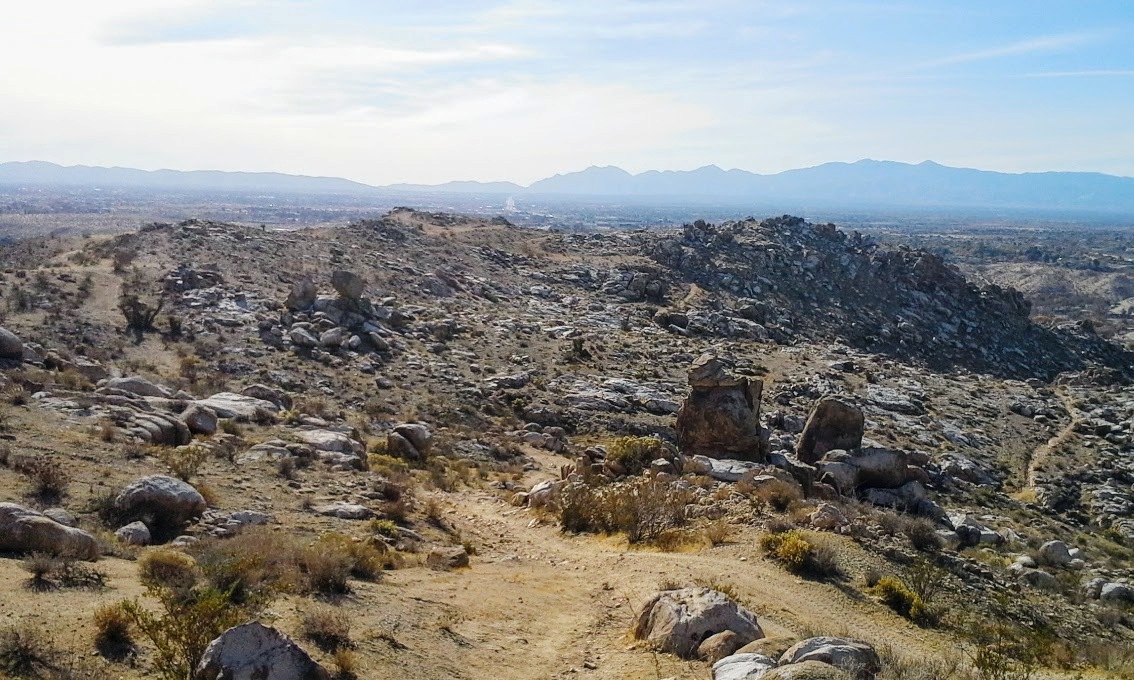
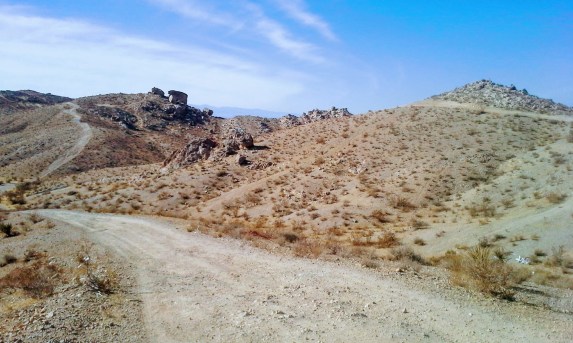
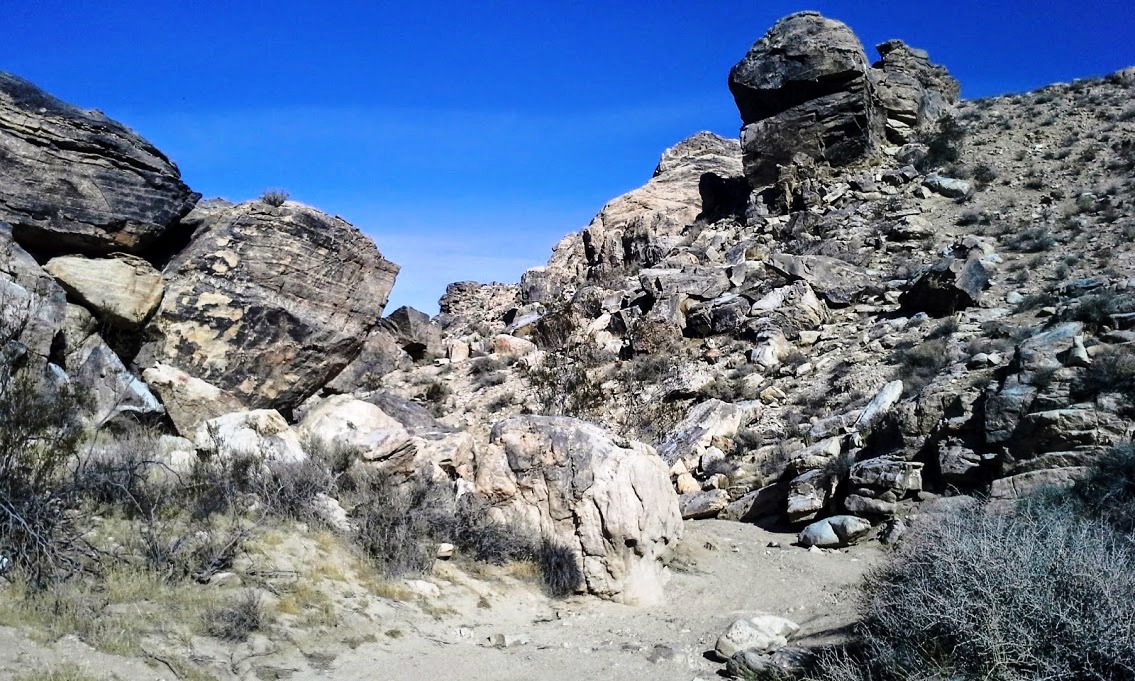
I’m having a hard time getting my backpack adjusted correctly, and today I tried to wear it lower on my hips to see if that helps. When I started out this morning for backpacking practice, I actually felt good, so good that when it came time to turn right to do my usual loop in the desert, I turned left. I thought this would be a good day to take a small risk and saunter through a canyon. The canyon wasn’t much of a canyon, perhaps more of gully, and the trail wasn’t much of a trail — it seemed more like a wash, with sand and rocks strewn about as if left from a flash flood. Still, I managed to pick my way through the canyon without too much trouble.

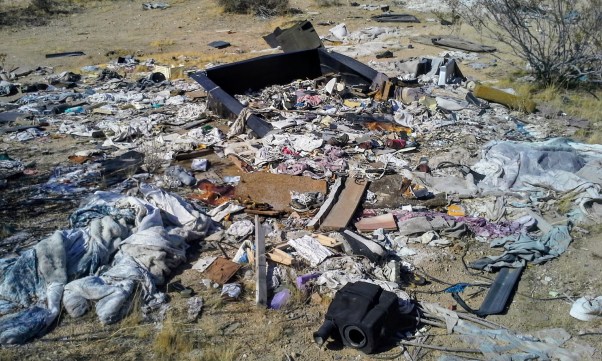
My mistake was thinking the path would turn right and the bottom of the gully and take me back to trails I was more familiar with. Instead, it turned left, and plunked me in the center of what looked like a dump. It wasn’t a legal dump, just a long section of trail that apparently was easily accessed from the highway. (Cripes — what is wrong with people? This is just one of the numerous piles of trash I saw. I can’t imagine the mindset that believes they have the right to jettison their trash wherever they wish.)

20180126_114718.jpg

I’d never been to that part of the desert before, and though I knew where I was, I had no idea how to get back to what was familiar. I kept trudging along for miles before I finally ended up where I had originally planned to go, so instead of an easy four miles, I did a difficult seven. Surprisingly, despite carrying twenty-three pounds, I didn’t do too badly. I think I have a blister forming on a toe, some pain in my deformed wrist from using the trekking poles, a bit of chafing on one shoulder (for some reason, I can’t fix the straps while the pack is on), and probably a couple of other minor irritations that will show up later. But nothing major. In fact, it’s similar to how I feel after such a long hike even without the pack.

20180126_113332.jpg

Still, there is no way I am ready for a long backpacking trip, especially something like a section of the Pacific Crest Trail where there could be huge distances (not huge for thru-hikers, just huge for me) between legal camping spots. (Parts of the trail are regulated, with rules about where you can and cannot camp.) Even more disheartening, are the sometimes long distances from the trail to resupply points. An oddity about long distance hiking is that you also do a lot of hitchhiking. Um. No. Not me. Hitchhiking is  something I am uncomfortable even mentioning.

So, what this means is that when I attempt a long backpacking trip, I need to go somewhere with no camping rules, somewhere like the backcountry of a national park or forest or wilderness area or BLM land, where once I have my backcountry permit, I can hike until I drop and then camp where I land.

Luckily, today I landed back in my room where I can “camp” in luxury for the night.

***

Pat Bertram is the author of the suspense novels UnfinishedMadame ZeeZee’s Nightmare, Light BringerMore Deaths Than OneA Spark of Heavenly Fireand Daughter Am IBertram is also the author of Grief: The Great Yearning, “an exquisite book, wrenching to read, and at the same time full of profound truths.” Connect with Pat on Google+. Like Pat on Facebook.
Researching the PCT

I had an interesting realization this morning — my dream of a long, long, long walk doesn’t necessarily mean a thru-hike. (Well, the realization was interesting to me, anyway.)

In hiking jargon, a thru hike is from end to end, from the beginning of the trail to the end of the trail, though it doesn’t have to be done that way. Because of the immense throng attempting thru-hikes on the iconic trails, the starting point can be insanely packed, so some people are splitting the trail in sections, maybe beginning in the middle, going to the end, and then getting a ride back to the start of the trail, and hiking to the middle where they began. Apparently, as long as you finish the trail in a year, it’s considered a thru-hike.

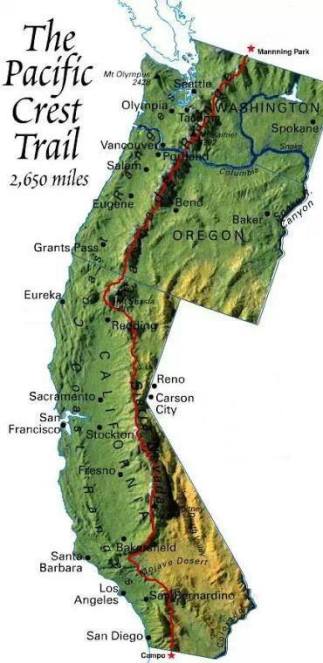
It sounds good — taking a year to hike the trail. But there isn’t really a full year for the hike when you consider the heat of the desert in summer, the late snow packs and early snows in the high country, streams swollen with melt-off, fires, and a thousand other weather related issues. The hiking season is usually six months, which means a lot of miles per day when you’re talking about a total distance of 2,650 miles.

It would be nice if I could do a thru hike, but I’m not an athlete, and I have no aspirations to be one. I am a saunterer, off to see what I can see, out to be what I can be. If I get strong enough to walk a lot of miles, that’s fine, but I’m satisfied with five to seven miles a day. Which means approximately 442 days for me to do the entire Pacific Crest Trail. I bet taking it slow and easy, and not having to push through heavy weather or harsh aches and pains would make the trail a lot more like a walk in the park than an endurance test.

One other realization that showed up this morning, and a big change from other times I thought of doing the trail, is that the logical place for me to start would be at the beginning. The southern part of the trail is desert. Hmmm. Desert? Aren’t I getting myself acclimated to hiking in the desert?

Whenever I’ve thought of doing a long distance hike on the PCT, I thought about starting after the desert — the desert section frightens me because of the need to carry extra water. But now that I have gotten to like the desert so much, hiking the desert section sounds wonderful. Well, except for the water situation. Perhaps it would work if I hiked the desert section in the fall, though by then, some of the seasonal water sources will have been turned off.

If the desert sections were simply desert, that would be a perfect long-distance hike for winter because although water would still be a problem, there wouldn’t be as great a need for hydration as in the heat of the summer. But those desert sections contain mountains, too, which means snow.

How do I know all this? Oh, the internet is a wondrous thing! I spend way too much time reading articles about the trail, about gear, about survival, about the various dangers and wonders.

It could be that because of all this research, I will have mentally spent so much on the trail that my mind will believe I have already hiked it. Then it will stop urging me to go adventuring, and I can stay inside with my feet up, reading about those people with blisters and swollen feet and worn-out shoes who actually are hiking the trail.

***

Pat Bertram is the author of the suspense novels UnfinishedMadame ZeeZee’s Nightmare, Light BringerMore Deaths Than OneA Spark of Heavenly Fireand Daughter Am IBertram is also the author of Grief: The Great Yearning, “an exquisite book, wrenching to read, and at the same time full of profound truths.” Connect with Pat on Google+. Like Pat on Facebook.
From “Impossible Dream” to “Why Not”?

I’ve never been much of a group person. I do things alone and sometimes with one other person. The most group-ish thing I do is dance class. I used to go out to lunch with a group, but those people don’t lunch together anymore. I used to walk with a group a couple of times a week, and I even hiked with different groups on the weekend, but the walking group is pretty much disbanded, and I found hiking in a group to be frustrating and dangerous. Groups HIKE. I s a u n t e r. They go fast and purposeful. I go slow and stop frequently to smell the air or take a photo or enjoy a particular vista. Then I have to hurry and catch up. Sometimes they take a break and wait for me, and then as soon as I catch up, they continue along the trail, leaving me with no break. Often, they bring their dogs, and sometimes the dogs harry me or try to push me over a cliff. (True.) One dog wore a bell that about drove me nuts. Why go out to the wilderness to listen to the quiet and be assaulted with the constant tinkle of that dang bell? Even worse, if I hesitated at a stream crossing, people would try to help and I would always get wet. Or they’d try to pull me up an incline even if I didn’t ask for help. Or yank my arm if I struggled to stand after sitting to rest instead of letting me find my own purchase.

Nope. Too dangerous.

I realize there are problems with hiking alone. But there are problems with living alone. Sometimes we simply have no choice. We do what we can.

Before I took my cross-country road trip, people told me I shouldn’t do it — my car was too old, I was a woman alone, it’s too dangerous, etc. etc. etc.

Well, I did the trip. More than twelve thousand miles in five months. And yes, the car broke down — one time the battery went dead, another time a piece of fuel line that was supposed to have been replaced hadn’t been and all the gas leaked out, and a third time, the VW mechanic who changed my oil in Wisconsin put in the wrong grade — it was way too thin, and my car kept vapor locking when I drove through hotter climes.

The most traumatic thing happened when I was with someone — I fell down the stairs backward and scalped myself — but it wouldn’t have happened if I had been alone.

Now that I’m talking about a solo backpacking trip, people are again telling me I shouldn’t do something. They remind me about my destroyed arm. Well, yes, that fall did happen when I was alone, but it was in the middle of the city, and I wouldn’t have been in that dangerous parking lot if it weren’t for other people. (Left to my own devices, I do not go out at night.)

Oddly, the arm thing makes me more determined on a solo backpacking trek, maybe because I have proof of how quickly one’s life can change. If I had someone to go with, I might not go alone, but if it’s a matter of going alone or not going at all, I’m going. What else am I going to do? Hide in my room lest I suffer another injury?

Besides, the point is to be out there alone. To connect with the world, to see if I can handle the immensity — a sort of spiritual journey or vision quest.

My eventual goal is to do one of the iconic hikes, probably the Pacific Crest Trail since I know someone in each state along the way who might possibly be able to help. From what I hear, though, there are so many people on the trail now that it is almost impossible to hike alone. And there are trail angels along the way, willing to help PCT hikers.

Meantime, a three-day solo journey, accompanied by a satellite phone connected to people who would come rescue me if necessary, is as safe as it’s going to get.

All this is still in the maybe, could be, possibly stage. And yet, I can feel the change in me, the change from “impossible dream” to “why not”?

Years ago, when I first thought about hiking one of the long distance trails, I thought it would be so uncommon that if I wrote a book about my experience, the story would propel me into bestsellerdom. Unfortunately, the trails have become so common and the stories so ubiquitous, that the only way to get noticed is if I were to screw up and embroil myself in a lot of drama, and I have no intention of doing either.

With enough research, preparation, and luck, my book would be just a ho-hum story of a woman who decided to hike the PCT and did it.

***

Pat Bertram is the author of the suspense novels UnfinishedMadame ZeeZee’s Nightmare, Light BringerMore Deaths Than OneA Spark of Heavenly Fireand Daughter Am IBertram is also the author of Grief: The Great Yearning, “an exquisite book, wrenching to read, and at the same time full of profound truths.” Connect with Pat on Google+. Like Pat on Facebook.

Solivagant

So many cool words to describe wanderers and travelers!

Wanderlust, of course, means a strong desire to travel, and though I never had any particular inclination for traveling before Jeff died, now I feel the need (or anyway, a periodic need) to keep on the go. Maybe I’m running away. Maybe I’m running to, but all I know is that wanderlust fills a bit of the void in my soul that his death created.

Wayfarer describes a person with wanderlust who generally travels by foot, which is my preferred method of wandering.

Resfeber is the mingled excitement and dread a traveler feels just before the journey begins. This is a Swedish word, and though I only heard of it recently, the feeling itself is very familiar! A couple of years ago, I stayed with a friend who would drop me off at the beginning of a trail and pick me up hours later on the other end. The moment before that first step, I always succumbed to that heart-racing feeling of anticipation and anxiety, but it never lasted more that that brief moment. As soon as I took the first step, I was fine.

Coddiwomple, meaning to travel purposefully to a vague destination is a great word I talked about yesterday.

Sauntering, with its connotation of a spiritual ramble, is also a word I’ve already discussed.

And today, I discovered another perfect word: solivagant, which means to wander alone. Not much to discuss here! Wandering alone. Yep. That’s me.

Who knew there were so many ways to describe my sojourn through life?

***

Pat Bertram is the author of the suspense novels UnfinishedMadame ZeeZee’s Nightmare, Light BringerMore Deaths Than OneA Spark of Heavenly Fireand Daughter Am IBertram is also the author of Grief: The Great Yearning, “an exquisite book, wrenching to read, and at the same time full of profound truths.” Connect with Pat on Google+. Like Pat on Facebook.
Coddiwompling

Sounds wonderful, doesn’t it? Coddiwompling. Even the definition sounds wonderful. Coddiwompling means to travel in a purposeful manner towards a vague destination.

Doesn’t that sound like me and my desire to walk the Pacific Crest Trail? (Or any long distance trail, actually. I just want to take a very, very, very long walk.) I don’t really have a need to walk one place or another, just to walk purposefully toward some vague destination. Though, if I ever get to the point of actually going on a backpacking trip, that destination will probably not be vague — I will, of course, need to know where the trail is going and have an approximate idea of how long it will take me to get there.

So maybe coddiwompling isn’t the right word for my aspirations, though my true destination is more spiritual, and that certainly is vague. How does one know what sort of spiritual destination one is heading toward, or what one will gain from a vision quest? That part, for sure, is about traveling purposefully toward a vague destination.

And this whole impetus to saunter the world, for all its purposeful preparation, is vague. I will be doing a solo backpacking trip while in Washington State this May, probably just for a few days, to dip my toes into the backpacking pool (figuratively speaking, of course — I truly do not like crossing water on foot, not even creeks or rivulets, and I truly do not like hiking in wet socks and shoes! So not fun). Then, a longer backpacking trail in the fall.

And then? Who knows. Either I will have had my fill of adventure, or I will be so addicted that I continue to coddiwomple.

I once read an article that claimed it is the pain we are willing to sustain, the pain we want in our life that determines our happiness. I don’t like pain of any kind, but so far, whatever pain has come from coddiwompling in the desert, is pain I am willing to embrace for my greater good. Luckily, many of the rewards of walking come from effort and dedication and concentration rather than sustained pain. (Though carrying a twenty-two-pound pack for five miles last weekend certainly brought its share of soreness!)

It seems weird to still be talking about aspirations, about things I am going to do rather than what I have already done, and yet, what I have already done is . . . done. It’s the traveling purposefully toward a vague and unknown destination that I find so compelling.

So, coddiwomple on!

***

Pat Bertram is the author of the suspense novels UnfinishedMadame ZeeZee’s Nightmare, Light BringerMore Deaths Than OneA Spark of Heavenly Fireand Daughter Am IBertram is also the author of Grief: The Great Yearning, “an exquisite book, wrenching to read, and at the same time full of profound truths.” Connect with Pat on Google+. Like Pat on Facebook.
The Gift is in the Preparation

I woke this morning to the sound of wind squeaking through my ill-fitted bedroom window.

(Hmm. Wind. Window. Is there a relationship here? Be right back; I need to check the etymology of window. Yep. They’re related. Window comes from Old Norse words vindr meaning wind and auga meaning eye. So a window is a wind eye, or a wind hole. The earliest mention of window came early in the 13th century, and it meant an unglazed hole in the roof. So originally a window let in the wind and now it keeps it out?)

But back to the matter at hand . . .

I snuggled under the covers, thinking that I’d take a zero day today. (A zero day in backpacking terms is a day when no miles are gained.) Then I remembered my weekends are supposed to mimic a backpacking trip, and if I were really out in the wilds, I’d have to keep on the move. (Or not. There is that zero day thing.)

I remembered also that I only have these three days each week to condition myself to carrying a pack, since I have dance class the other four days. (I still hope for grace and balance from dance. It could happen.) And I need all three backpacking days to get used to carrying extra weight.

So, I got dressed, shrugged on the pack and headed into the wind. Yikes. Cold! And gusty. Some of those gusts were so strong they almost blew me over. But I did it — trudged four miles, teetering in the wind, with twenty-two pounds on my back — and I realized that though the goal might be to backpack on the Pacific Crest Trail, the gift is in the doing. It was hard going today, but what a thrill to be on my feet, moving through the blustery air, racking up the miles. Admittedly, four miles isn’t exactly “racking up the miles,” but still, to be able to walk any distance is a true wonder.

It seems funny that I’ve been thinking, writing, talking about the Pacific Crest Trail for so many years — four-and-a-half years since my first mention of the PCT, four years since my first hike on the trail — but until this very year, I never actually strapped on a backpack to try to train myself for such an epic hike.

I still don’t know if I can do any long distance sauntering, but as I discovered today, the PCT is the goal. The gift is in the preparation. And that, for sure, I can do — even on a windy day.

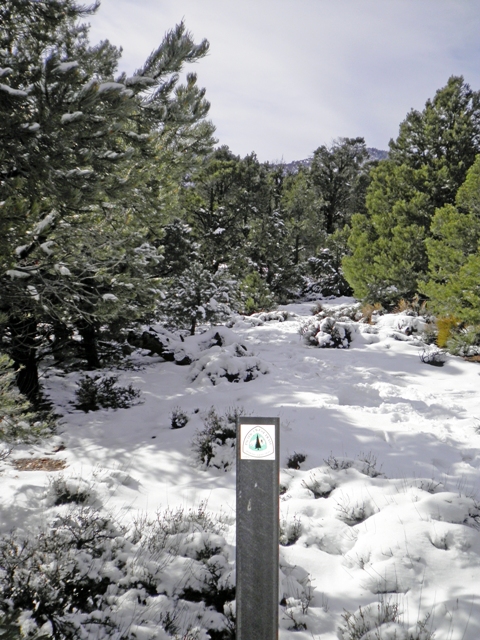
I still remember seeing this sign and taking the photo when I was on a different outing (to find the San Andreas Fault). I was so excited to see evidence of this mythical trail that I walked up the path a bit, but then I had to turn around because neither of my companions had any interest in the trail at all. I’ve done many day hikes since then, but still no overnights. That fearful joy is still to come.

***

Pat Bertram is the author of the suspense novels UnfinishedMadame ZeeZee’s Nightmare, Light BringerMore Deaths Than OneA Spark of Heavenly Fireand Daughter Am IBertram is also the author of Grief: The Great Yearning, “an exquisite book, wrenching to read, and at the same time full of profound truths.” Connect with Pat on Google+. Like Pat on Facebook.